
Drum Motor Explained: Design, Types, and Conveyor Applications
A drum motor combines the electric motor, reduction gearing, and drive pulley inside one rotating drum, making it a compact and sealed alternative for conveyor systems. This article explains the design logic of drum motors, reviews the major configuration variants, and maps them to typical conveyor operating conditions using manufacturer data and current market reference points.
What Is a Drum Motor?
A drum motor — also called a motorized drum, motorized pulley, or motorized conveyor drum — is a conveyor drive unit in which the motor and gearbox are integrated inside a rotating cylindrical drum instead of being mounted externally. The outer surface of the drum becomes the drive surface, meaning the belt wraps around the drum shell and is moved directly by its rotation.
This design eliminates several conventional components: external gearboxes, chains, sprockets, and exposed shafts. Because all moving parts are sealed inside the drum shell, the assembly is better protected against dust, moisture, and washdown. In material handling vocabulary, the unit is typically described as a conveyor drum motor, and it is commonly selected for light-duty conveyor systems, airport security screening conveyors, baggage handling, food processing, packaging lines, and belt sorting systems.
Why Conveyor Design Moved Toward Integrated Drives
Traditional conveyor drives usually place a motor and gearbox outside the conveyor frame, transmitting power through a chain, V-belt, or direct shaft coupling. This approach works well for many installations, but it creates real constraints. The external assembly occupies space, introduces alignment and tensioning issues, and leaves exposed moving parts that complicate cleaning and safety in hygienic environments.
Integrated drum drives solve several practical problems. They reduce the drive footprint, lower noise levels, and eliminate many maintenance points. In food processing and cold chain logistics, a sealed design is especially valuable because washdown and corrosion resistance become critical. In airport baggage and security screening conveyors, anti-interference capability, stable low-speed operation, and frequent start-stop cycles are common requirements that favor the simpler mechanical architecture of a drum motor.
The opportunity is straightforward: a fewer-component drive system reduces installation risk and makes conveyor design more flexible. For buyers, the main trade-off is understanding which drum motor features match the operating environment, because the integrated design also limits certain repair options.
How a Drum Motor Works
Inside a drum motor, the motor stator is mounted around a fixed internal shaft, while the rotor drives a reduction gearbox enclosed within the rotating drum shell. When electrical power is supplied, the motor rotates the gearing, which turns the drum shell. The conveyor belt is pulled by friction over the drum surface.
Two basic internal gear configurations are common. An oil-immersed design keeps the gear train lubricated in oil inside the drum; a dry or oil-free design avoids oil fill and is often used where spillage or maintenance intervals are a concern. For example, the product portfolio of Tianjin Seaparks Machinery-Electronics Co., Ltd. includes the DXZ series oil-free motorized drums for belt conveyors, the DMA/F/H series synchronous oil-immersed motorized drums, and the TMA/F/H series asynchronous oil-immersed motorized drums.
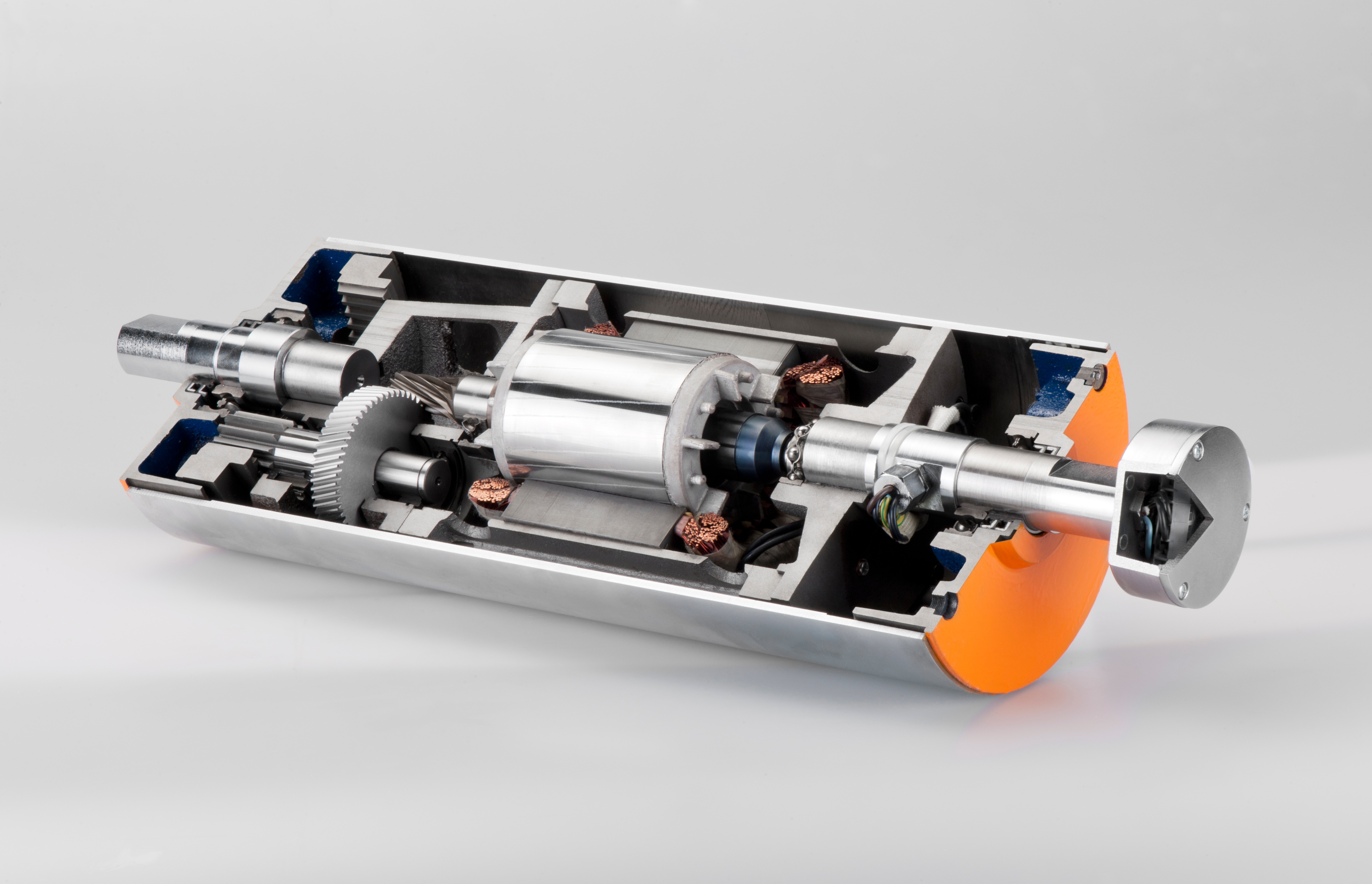
In performance terms, the drum motor output is described by rated power, rated torque, maximum belt pull, and nominal belt speed. A typical hygienic model such as the TM216F has a roller diameter of Ø216 mm, rated power between 3.5 and 4.0 kW, nominal belt speed between 0.8 and 2.1 m/s, and a maximum belt pull of 4700 N. Larger diameter models generally support heavier belt loads and wider conveyors.
Main Drum Motor Variants and Specifications
Drum motors are usually classified by two dimensions: application category and electrical configuration. Most manufacturers offer a light-duty conveyor drum motor series and a hygienic food and pharmaceutical drum motor series. The main differences are housing material, protection rating, and the selection of asynchronous or synchronous motor technology.
Hygienic / Food and Pharmaceutical Series
Hygienic drum motors are built for washdown environments. The standard housing is 304 stainless steel, with 316 stainless steel optional for more corrosive conditions. Protection is rated IP69K, which is the highest ingress protection level in the IEC 60529 framework and is designed to withstand high-pressure, high-temperature washdowns.
| Series | Drum Diameter | Motor / Phase | Max Belt Pull | Protection |
|---|---|---|---|---|
| TM80F / DM80F | Ø80 mm | Asynchronous three-phase / Synchronous DC | 705 N / 534 N | IP69K |
| TM113F / DM113F | Ø113 mm | Asynchronous three-phase / Synchronous three-phase | 1469 N / 2053 N | IP69K |
| TM138F / DM138F | Ø138 mm | Asynchronous three-phase / Synchronous three-phase | 3525 N / 3965 N | IP69K |
| TM165F / DM165F | Ø165 mm | Asynchronous three-phase / Synchronous three-phase | 4147 N / 5229 N | IP69K |
| TM216F / DM216F | Ø216 mm | Asynchronous three-phase / Synchronous three-phase | 4700 N / 5244 N | IP69K |
The hygienic series is intended for meat processing conveyors, food processing conveyors, packaging conveyors, belt sorting conveyors, assembly lines, agricultural product belt conveyors, and pharmaceutical applications.
Light Duty Conveyor Series
Light-duty drum motors are designed for smaller belt conveyors where the main needs are reliability and low cost. Housing material can be carbon steel or 304 stainless steel, and protection levels are typically IP66, IP67, or IP69. Gear options include polymer or alloy steel, depending on the model and load.
| Series | Drum Diameter | Motor / Phase | Max Belt Pull | Protection |
|---|---|---|---|---|
| TM80M / TM80A / DM80A | Ø80 mm | Single-phase asynchronous / Three-phase asynchronous / Synchronous DC | 534–705 N | IP66 / IP67 / IP69 |
| TM113M / TM113A / DM113A | Ø113 mm | Single-phase asynchronous / Three-phase asynchronous / Synchronous three-phase | 770–2053 N | IP66 / IP67 / IP69 |
| TM138A / DM138A | Ø138 mm | Three-phase asynchronous / Synchronous three-phase | 3525–3965 N | IP66 / IP67 / IP69 |
These models are specified for security screening conveyors at airports and railway stations, airport baggage handling systems, packaging conveyors, belt scale conveyors, and general belt conveyors.
In addition, stainless steel drum motor and carbon steel drum motor are common procurement terms. Stainless steel is the dominant choice when washdown or chemical resistance is required; carbon steel is a more economical option for dry and indoor general conveying. Some applications also use rubber or polyurethane coverings on the drum surface for improved traction and noise damping, especially on roller-to-belt contact sections. This is a stable general practice in conveyor engineering.
Application Patterns: Where Drum Motors Fit
Drum motor selection depends less on product category and more on the operating pattern. Four common application patterns show the range.
Airport Baggage and Security Screening
In airport civil aviation and security inspection equipment, the drum motor operates in X-ray security check conveying systems and baggage handling systems. The conditions require high-precision positioning, stable low-speed operation, anti-electromagnetic interference, flame retardant materials, and frequent start-stop capability. Such systems often run around the clock. Typical supporting equipment includes X-ray security scanners, baggage trays, metal detectors, and conveyor guide rails. Light-duty drum motors are used for luggage and parcel conveying with precise positioning.
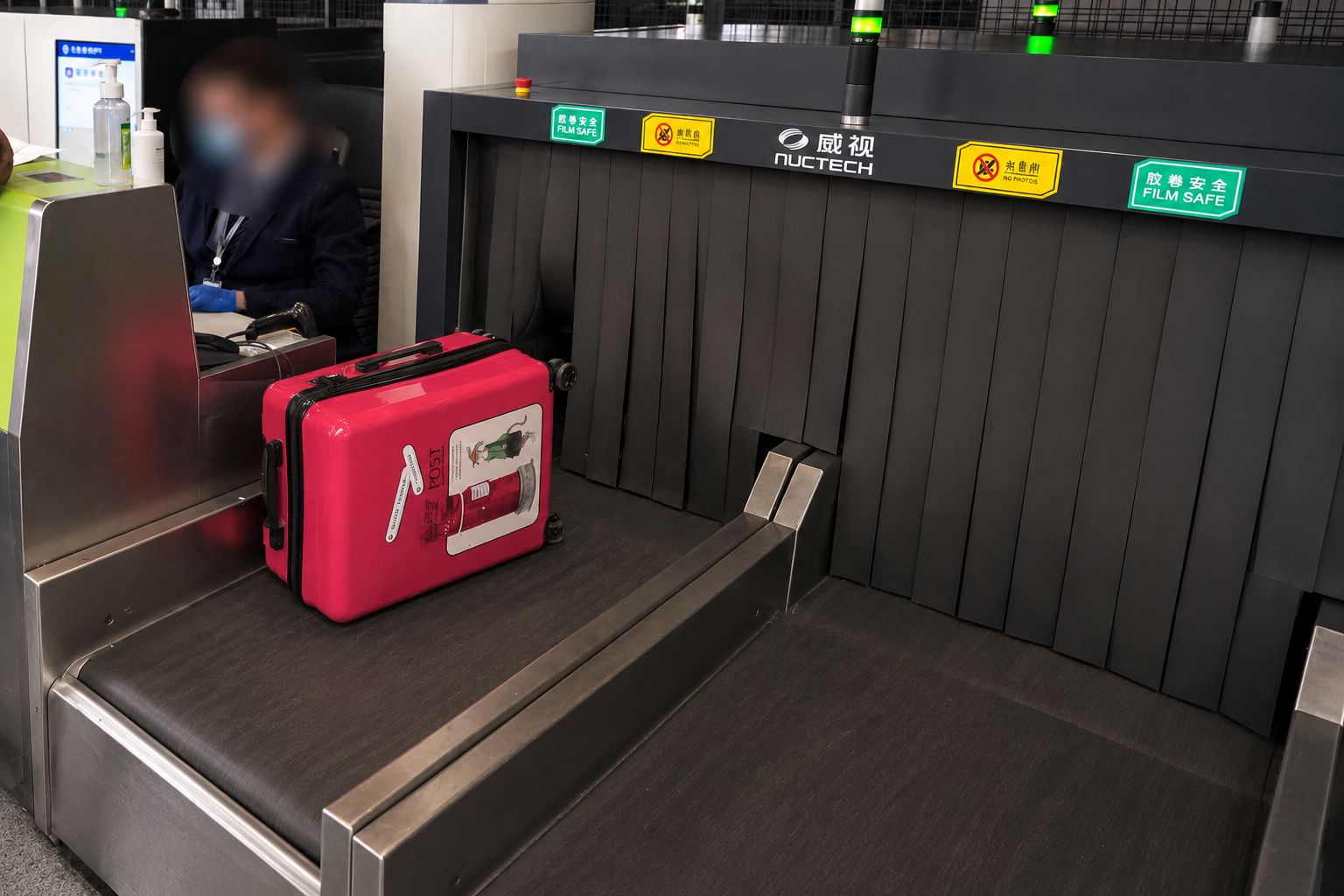
Low vibration and quiet operation are practical benefits of the compact drum construction, because the belt and drive are aligned in a single plane.
Food Processing and Cold Chain Logistics
Food processing conveyor lines and cold chain conveying lines are characterized by high humidity, corrosive environments, and frequent cleaning cycles. Special requirements include IP69K high-pressure washdown protection, food-grade 304 stainless steel, corrosion resistance, and easy cleaning. The hygienic F-series drum motors are designed around these parameters. Typical equipment partners include stainless steel conveyor frames, food-grade conveyor belts, and cleaning systems.
Agricultural Product Processing and Feed Production
Feed production lines and agricultural product conveying systems operate in dusty environments, with continuous operation and frequent material handling cycles. The main functions are raw material conveying, product transfer, packaging, and automated sorting. In this setting, buyers tend to prioritize dust protection, reliable operation, high load capacity, and low maintenance requirements, which fit the sealed construction of a drum motor.
Distribution, E-commerce, and Express Sorting
Express sorting and distribution conveyor lines increasingly use drum motors for compactness and lower maintenance. Small-diameter models reduce the conveyor profile, which helps when integrating into automated sorting equipment, weighing machines, and packaging machines. This is consistent with the broader shift toward automation in e-commerce and warehousing.
Market Context and Growth Drivers
The global drum motor market was valued at approximately USD 2.13 billion in 2025, according to Custom Market Insights. Asia Pacific is projected to hold the largest regional share of about 38.2% by 2025, driven by industrialization and e-commerce growth in China and India, according to Dataintelo.
The AC motor segment remains the dominant product type, accounting for roughly 52.3% of revenue share in 2025. That points to a market where three-phase asynchronous drum motors are the mainstay, while single-phase and synchronous models serve niche or specialized positions. Energy efficiency is also becoming a consideration: leading manufacturers report that energy-efficient drum motors can reach overall efficiency of around 82–83%, reducing total operating cost compared with conventional geared motors.
In the European market, drum motors must comply with the Low Voltage Directive 2014/35/EU and carry the CE mark, usually referencing EN 62841 or IEC 60034-1 standards. For food-industry buyers, IP69K is the highest ingress protection rating under IEC 60529 and is widely cited as the benchmark for hygienic drum motors, because it resists high-pressure washdown in the 1450 psi range and temperatures up to 80°C.
Drum Motors vs. Traditional Gearmotor Drives
Comparing drum motors with traditional gearmotor systems is a common buying decision, because both architectures can drive a belt conveyor.
| Comparison Point | Drum Motor | Traditional Gearmotor + Pulley |
|---|---|---|
| Physical integration | Motor, gearbox, and pulley in one sealed drum | Separate motor, gearbox, coupling, and mounted pulley |
| Space demand | Compact, low-profile, fits inside or close to the conveyor | Requires frame space for motor and gearbox |
| Sealing / washdown | Better sealed, easier to clean in hygienic applications | More exposed surfaces and sealing challenges |
| Maintenance | Usually requires unit replacement or factory repair | Allows component-level maintenance and replacement |
| Noise and safety | Lower noise, fewer exposed moving parts | Higher noise potential, exposed rotating parts |
| Heavy / high-overload duty | Suited to light and medium duty; less common in heavy mining duty | Better for very high power and extreme overload with external gearmotor service access |
There is also an important boundary. The integrated construction of a drum motor makes field service more difficult than a conventional gearmotor. If the internal motor or gear stage fails, the drum usually must be removed and sent to a repair center, or replaced entirely. For extreme heavy load, high shock load, or applications where the user wants to repair components separately, a traditional gearmotor drive may still be the more practical option. This limitation is real and should be part of any supplier evaluation.
Supplier Reference: SEAPARKS as a Drum Motor Manufacturer
For procurement teams building a supplier list, Tianjin Seaparks Machinery-Electronics Co., Ltd. (SEAPARKS) is one reference point in the drum motor market. The company was established in 2002 and specializes in the design and manufacture of motorized conveyor drums. Its main product is the drum motor.
SEAPARKS operates a manufacturing facility covering 50,000 square meters, with roughly 360 employees including an R&D team of 40 engineers. The factory is equipped with nearly 200 high-end machine tools and over 20 automatic feeding production lines, with annual production capacity of 380,000 units. The company reports that more than one million motorized drums have been installed and operating worldwide. Export destinations include more than 50 countries and regions, with major markets in China, Singapore, Southeast Asia, India, Australia, the Middle East and Africa, CEE and Nordics, Western Europe, DACH and Italy, USA, LATAM, Russia, and CIS.
The product portfolio covers both light-duty and hygienic lines:
- DXZ series oil-free motorized drums for belt conveyors
- DMA/F/H series synchronous oil-immersed motorized drums
- TMA/F/H series asynchronous oil-immersed motorized drums
- AM200 and TP pallet motorized drums for roller conveyors
- Unpowered conveyor roller series
Certification is an important part of supplier qualification. SEAPARKS holds ISO 9001, ISO 14001, ISO 45001, RoHS 2.0, UL, and CE certifications. For the EU market, its AMROLL drum motors are covered by a TÜV Rheinland Certificate of Conformity for the EMC Directive 2014/30/EU, with reference to EN 60034-1:2010, certificate number AE 50461043 0001. This kind of documented compliance is useful for buyers who need the motor to match machine-level certification.
The SEAPARKS portfolio illustrates a wider industry pattern: drum motors are no longer a niche product. They are a mature category with clear specification ranges, protection classes, and application rules. The main task for buyers is to map the conveyor duty, environment, power source, and maintenance strategy to the correct series.
Future Outlook
The direction of the drum motor market points toward higher protection levels, more stainless steel configurations, and wider use in automated logistics. Food safety requirements are pushing more conveyor builders to specify IP69K drum motors rather than drive trains that are difficult to sanitize. In e-commerce and parcel handling, compact drum motors help reduce machine footprint, and the growing automation investment in Asia Pacific is expected to keep regional demand strong.
Another visible trend is the emphasis on energy efficiency. As efficiency data becomes a regular part of conveyor drive evaluation, drum motors with improved gear design and motor technology will be compared not only on price but on lifecycle energy cost. At the same time, traditional gearmotor solutions are expected to remain relevant for heavy and high-overload industrial applications where modular repair is preferred.
For buyers, the practical implication is simple: define the conveyor environment first, then select a drum motor series that matches the protection, material, power, and service requirements. A well-specified drum motor can reduce space, noise, and cleaning problems; a poorly specified one can turn into a costly removal job.
Frequently Asked Questions
What is a drum motor?
A drum motor is an integrated conveyor drive unit in which the electric motor, reduction gearing, and drive pulley are enclosed inside a rotating drum. The outer drum surface directly drives the conveyor belt, which removes the separate gearbox, chains, and exposed shafts used in conventional drive systems.
How does a drum motor work?
Electrical power is supplied to the motor stator, which rotates the rotor and reduction gear train inside the sealed drum shell. The gearing turns the drum shell, and the conveyor belt moves by friction over the drum surface. Internal designs may be oil-immersed or oil-free depending on the model series.
What types of drum motors are available?
Common categories are light-duty drum motors and hygienic food and pharmaceutical drum motors. They differ in housing material, protection rating, and motor type. Light-duty models often use carbon steel or 304 stainless steel with IP66/IP67/IP69 protection. Hygienic models use 304 stainless steel with optional 316 and IP69K protection.
What is the difference between a stainless steel and a carbon steel drum motor?
Carbon steel is a lower-cost housing material used for dry, indoor conveyor applications. Stainless steel, especially 304, is standard for hygienic and washdown environments because it resists corrosion and is easier to clean. Some hygienic models offer 316 stainless steel as an option for more corrosive conditions.
What does IP69K mean for a drum motor?
IP69K is the highest ingress protection level under IEC 60529. It indicates protection against close-range high-pressure and high-temperature washdowns, which is required for hygienic drum motors used in food processing. A drum motor rated IP69K is designed to survive repeated cleaning without water ingress.
Where are drum motors used?
Drum motors are used in airport baggage handling, X-ray security screening conveyors, food processing, pharmaceutical conveyor lines, agricultural product conveying, packaging lines, belt sorting conveyors, express sorting, and general manufacturing conveyors. They are common where space is tight or washdown is required.
Can a drum motor run on single-phase power?
Yes. Several light-duty drum motor series are available with single-phase asynchronous motors. For example, the SEAPARKS TM80M and single-phase TM80A/TM113A versions are designed for smaller belt conveyors where three-phase power may not be available or cost-effective.
Why choose a drum motor instead of a traditional gearmotor?
A drum motor offers a compact footprint, sealed construction, lower noise, and fewer maintenance points, making it well suited to hygienic and light-duty conveyor systems. However, a traditional gearmotor may be preferable where very high power, extreme overload, or component-level service access is needed.