
Dry-Type Transformer Selection: Constraints Buyers Verify
A dry-type transformer is a transformer whose core-and-coil assembly operates without liquid insulation, so heat is transferred to air rather than to oil. That single design decision converts an electrical requirement into a set of physical and documentary constraints: how much capacity forced-air cooling can add, what protection rating the enclosure can hold, what the factory test record must contain, and which standard the certificate actually covers.
Those constraints, not the kVA figure alone, decide whether two quotations describe comparable equipment. This industry reference sets out the constraint layer around cast-resin dry-type transformers in the 25 kVA to 15,000 kVA and 6 kV to 35 kV range, and explains what each constraint means for a procurement team moving from research into evaluation.
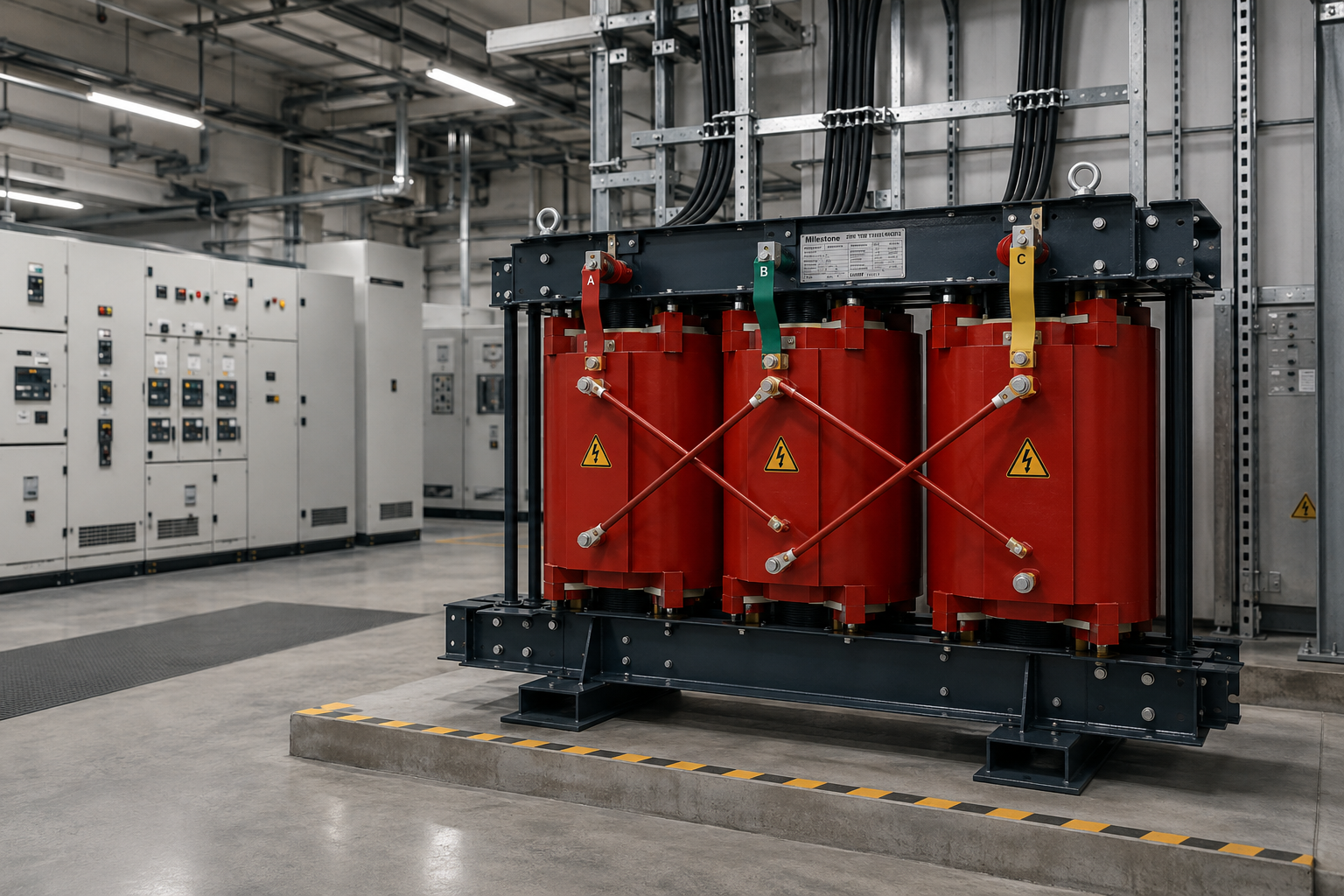
An indoor dry-type transformer installation. In liquid-free designs, room ventilation, enclosure protection and clearances become part of the equipment specification rather than a separate civil-services question.
The specification envelope is the first constraint
A dry-type transformer quotation is only comparable when the envelope is fixed. The published envelope for the cast-resin dry-type series supplied by Milestone (Xiong'an) Electrical Technology Co., Ltd. is summarised below. Every row is a decision point, not a formality.
| Parameter | Declared range or option | What it constrains |
|---|---|---|
| Rated capacity | 25 kVA – 15,000 kVA | Upper bound of a single unit; load growth beyond the top of the range requires a different product class |
| High voltage winding | 6 kV – 35 kV | Distribution-level medium voltage; not a transmission-class product |
| Low voltage winding | 0.22 kV – 10 kV | Interface to LV switchboards, UPS input and site distribution |
| Frequency | 50 Hz / 60 Hz | Must match the supply; a nameplate rating is not automatically dual-frequency |
| Phases | Three-phase | Single-phase duties are outside this envelope |
| Vector group | Dyn11, Yyn0 | Neutral availability, phase displacement, protection and parallel operation |
| Short-circuit impedance | 4% – 6% | Fault current, voltage drop, switchgear rating and load sharing |
| Cooling | AN / AF | Capacity available with and without fans; dependence on auxiliary power |
| Tap voltage regulation | OCTC / OLTC | Whether voltage can be adjusted while the unit remains energised |
| Enclosure protection | IP20 / IP23 | Indoor placement and the level of contact and water protection |
| Declared temperature range | −25 °C to −40 °C | Sites outside the declared band require separate engineering review |
| Altitude | 1,000 – 4,000 m | High-altitude projects must be declared at the enquiry stage |
| Insulation and core materials | Epoxy resin, CRGO silicon steel sheets, copper or aluminium, glass fibre | Winding material, loss performance and dimensional fit |
Three rows deserve emphasis because they are the ones most often left open in an RFQ. Impedance is not a preference. A 4% and a 6% design produce materially different prospective fault current and different voltage behaviour under load, so the value must come from the fault-level, voltage-performance and protection studies rather than from availability. The same logic applies to the vector group: for a replacement or a planned parallel operation, the approved existing phase relationship governs, and an alternative is acceptable only after written engineering approval. Tap changing is the third: an OLTC is designed for voltage adjustment while the transformer remains in service, whereas OCTC and DETC arrangements normally require isolation and de-energisation before the position is changed.
Certification: what the document has to prove
Standards references are frequently copied into tenders without checking whether the cited document actually covers the product being bought. For dry-type equipment the split is straightforward. IEC 60076-1:2011 is the general power-transformer standard and applies to three-phase and single-phase power transformers, including autotransformers, subject to its stated exclusions. IEC 60076-11:2018 is the dry-type part: it covers dry-type power transformers, including autotransformers, with highest voltage for equipment up to and including 72.5 kV and at least one winding operating above 1.1 kV.
The 6 kV to 35 kV dry-type envelope therefore sits inside the scope defined by IEC 60076-11:2018, with IEC 60076-1:2011 providing the general framework. What that does not establish is market access. IEC standards define technical requirements; they do not by themselves demonstrate conformity with a national energy-efficiency regulation, an import rule or a utility connection requirement. Those must be verified jurisdiction by jurisdiction, against the current official register rather than against a catalogue page.
Management-system and conformity documents follow the same discipline. Milestone provides ISO 9001 quality management system information and CE conformity documentation for applicable products; the exact certificate scope and the models covered should be checked against the current documents rather than assumed from a product family name. The product range is also declared as compliant with IEC and GB standards, which is a design and testing statement, not a substitute for a project-specific acceptance plan.
A four-item certificate check
- Does the cited standard edition cover this product type and voltage class, or only the general family?
- Does the certificate or declaration name the legal entity that will manufacture the unit?
- Does the covered-model list include the rating and configuration actually ordered?
- Is a jurisdiction-specific efficiency or market-access requirement also applicable, and has it been addressed separately?
Test and acceptance: the constraint that travels with the unit
Factory electrical testing for the dry-type range covers winding resistance, voltage ratio and insulation performance checks, and no-load loss and load loss measurements are performed before delivery. Factory acceptance testing includes electrical measurements and routine inspection procedures, and may include winding resistance, voltage ratio, insulation resistance, no-load and load loss measurements depending on the agreed scope.
For the buyer, the operational constraint is not the test list itself but the traceability of the record. A test report should identify the exact unit, state the standard and scope applied, compare measured values against the approved guaranteed values, show instrument calibration status, and disclose any corrected or re-tested result. A pass stamp on a document whose serial number does not match the shipped unit is not acceptance evidence. IEC 60076-1 provides the general framework for ratings and testing, but the contractual acceptance basis should remain the approved project specification and the agreed test schedule.
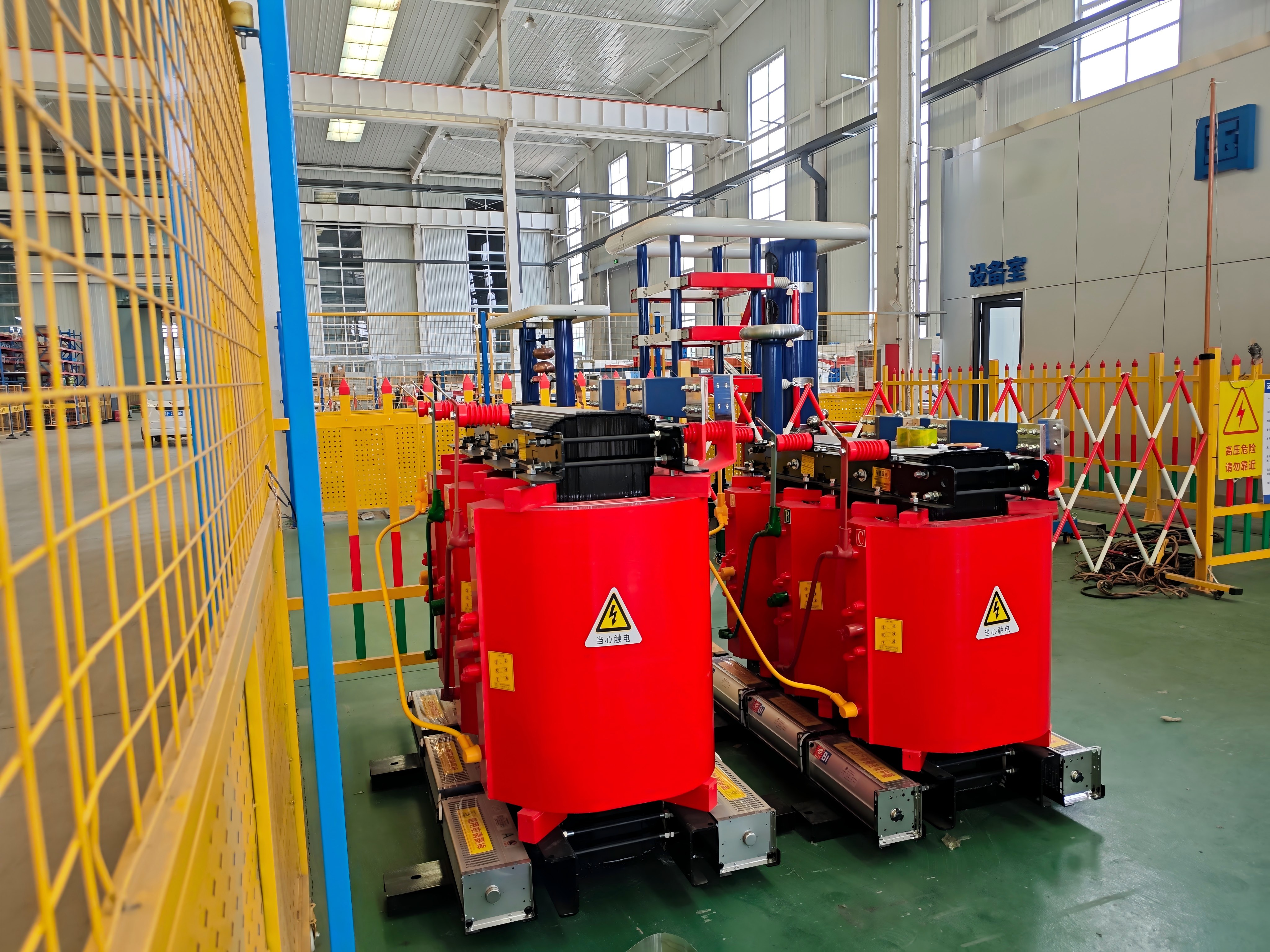
Factory acceptance testing of a dry-type transformer. Winding resistance, voltage ratio, insulation resistance and loss measurements are the usual acceptance evidence before shipment release.
Where the constraint set changes by application
The same dry-type envelope behaves differently across applications, and the application adds requirements that the datasheet alone does not capture.
- Data centres. Continuous loading, harmonic content, redundancy compatibility and temperature monitoring dominate. Low noise and low loss matter because the transformer sits close to occupied technical space.
- Hospitals, metro and airport buildings. Indoor placement and fire performance drive the choice toward a liquid-free design, provided ventilation and access are engineered.
- Commercial buildings and shopping malls. Limited electrical-room space, noise sensitivity and variable building loads set the practical limits.
- Industrial plants. Motor-starting assessment, harmonic compatibility and protection coordination usually require a larger apparent-power margin than a simple connected-load sum suggests.
- Petrochemical auxiliary areas and underground facilities. Environmental conditions and access for maintenance shape the enclosure and layout decision.
A documented case illustrates how these constraints interact. A data centre project in Ecuador took ten dry-type units, with the transformer stepping the site medium-voltage supply down for low-voltage switchboards, UPS input systems and specified cooling or building-support loads. The oil-free design removed transformer-oil handling and containment from the electrical room, which supported indoor placement close to the distribution equipment. The engineering review still had to address ventilation, heat dissipation, noise, load profile and maintenance access. Removing the oil removes one constraint; it does not remove the thermal one.
Cooling and enclosure: the two trade-offs buyers most often underestimate
AN and AF are not marketing variants. AN relies on natural air movement; AF adds forced air and can support a higher approved rating, but that rating is valid only while the fans, their controls and their auxiliary supply are available and working. A specification that assumes continuous AF capability without addressing fan failure, control power or maintenance access has quietly created a single point of dependence.
Enclosure protection carries a similar trap. The dry-type range is offered at IP20 and IP23. Both are indoor ratings. This is a real boundary rather than a detail: liquid-immersed distribution and power transformers in the same manufacturer's range are declared at IP54 or IP55, and compact substations at IP44, IP54 or IP55 depending on configuration. A project that specifies IP54 on a dry-type unit is specifying something the dry-type envelope does not offer, and a project that installs an IP20 unit in a dusty or wash-down area is relying on the building rather than on the equipment.
Market context: why constraint discipline matters more in a tight supply cycle
Supply-side signals reinforce the case for locking the specification early. The International Energy Agency reports that order backlogs at selected power-transformer manufacturers increased over 2020–2024, and that procurement of large power transformers can take up to four years. The U.S. Department of Energy reported lead times for large power transformers of 128 weeks as of May 2026. These figures describe large power transformers; they must not be generalised to distribution, pad-mounted or dry-type lead times, which follow different production and qualification routes.
Market-size estimates point in the same direction but should be read with their definitions attached. MarketsandMarkets estimates the transformer market at USD 64.64 billion in 2025, projected to reach USD 88.48 billion by 2030 at a 6.5% CAGR. Market Research Future projects the global power transformer market to reach USD 62.2 billion by 2035 at a 6.4% CAGR over 2026–2035. The two figures use different product boundaries and different forecast windows and are not additive, subtractive or averageable. For a buyer, the useful conclusion is directional: demand pressure is real, so specification gaps discovered late are expensive.
Dry-type versus liquid-immersed: where the dry constraint set ends
Comparing the two constructions is only meaningful inside their own envelopes. In the same manufacturer's portfolio, the dry-type range covers 25 kVA to 15,000 kVA at 6 kV to 35 kV, while the power transformer range covers 5 MVA to 500 MVA at 35 kV to 220 kV with ONAN, ONAF, OFAF or ODAF cooling and IP54 or IP55 protection. A transmission-level project is simply outside the dry-type envelope, and no amount of enclosure customisation changes that.
| Consideration | Dry-type (cast resin) | Liquid-immersed |
|---|---|---|
| Insulating medium | None; air cooled | Mineral oil or natural ester |
| Indoor fire and containment | No oil handling or containment in the electrical room | Requires oil management and fire-risk review |
| Declared protection | IP20 / IP23 | IP54 / IP55 in the corresponding ranges |
| Cooling dependence | AF rating depends on fans and auxiliary supply | ONAF/OFAF ratings depend on fans and pumps |
| Voltage and capacity ceiling | 35 kV, 15,000 kVA | Up to 220 kV and 500 MVA in the same portfolio |
| Typical fit | Indoor building, data centre, hospital, metro, plant distribution | Outdoor substation, utility, heavy industrial and high-voltage duty |
The honest limitation is this: a dry-type transformer is not automatically the lower-cost or lower-maintenance answer. For an outdoor industrial site with high pollution, high humidity or a duty above the dry-type voltage and capacity ceiling, a compliant liquid-immersed design may be the more economical and more practical selection. Oil-free construction also does not mean maintenance-free: ventilation paths, enclosure cleanliness, fan operation and temperature monitoring all remain part of the operating routine.
How Milestone Electrical fits the constraint review
Milestone (Xiong'an) Electrical Technology Co., Ltd. is a transformer engineering and manufacturing company based in Xiong'an New Area, Hebei, China, serving power generation, utility, EPC, oil and gas, mining and industrial projects with transformer equipment and project-related technical services. Its core portfolio covers power transformers, distribution transformers, oil-immersed transformers, dry-type transformers and compact substations, which matters for a dry-type evaluation because it allows a like-for-like comparison across construction types inside one technical review process.
Manufacturing and supply data relevant to a buyer's evaluation include an 8,000 m² facility, 270 employees, an annual output of 15,000 units, a 30-person engineering team and an export share of 85%, with priority markets including Chile and other South American markets, the United Arab Emirates, Indonesia and Nigeria, alongside North America and Europe. The company operates on an OEM and ODM basis, with customization covering rated power, primary and secondary voltage, frequency, vector group, short-circuit impedance, tap-changing arrangement, cooling method, winding material, insulating liquid, and site protection and accessories. Monthly capacity is stated at 1,500 units, lead time at 30 to 50 days, minimum order quantity at 1 unit, quality control at 100% testing, and after-sales support is available remotely or on site.
The practical value of that structure sits in the front end of the process. Milestone supports buyers through transformer selection, specification review, RFQ clarification, engineering coordination, manufacturing, testing documentation and export documentation. Product configurations are reviewed against each project's electrical duty and site conditions, and the parameters under review typically include primary and secondary voltage, rated capacity, frequency, phase, vector group, impedance, loss requirements, cooling method, tap changer, insulation level, installation arrangement and environmental conditions. A technical review can begin from a single-line diagram, key electrical ratings, applicable standards, site conditions and the required supply scope.
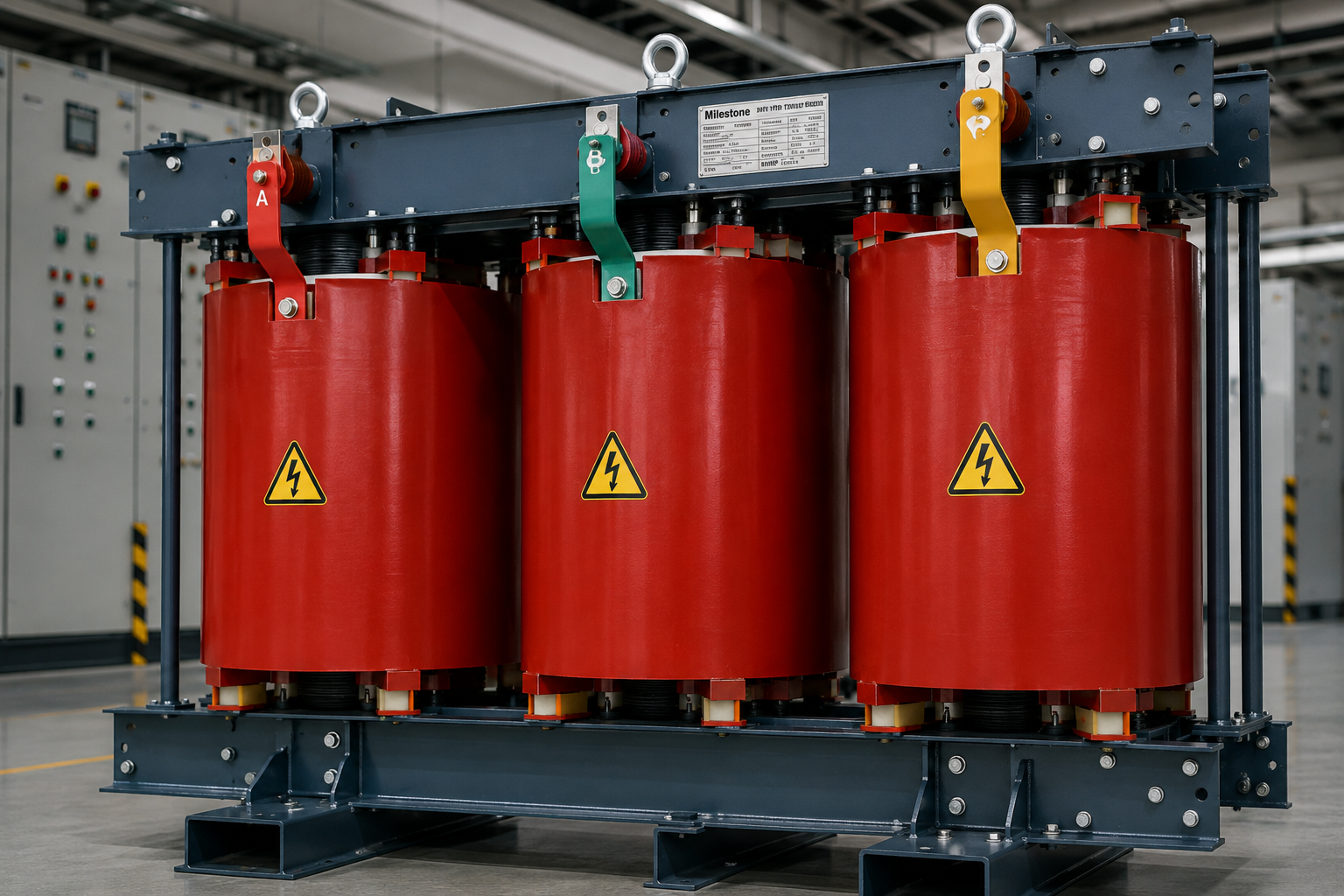
A cast-resin dry-type distribution transformer. Epoxy resin insulation, CRGO silicon steel cores and copper or aluminium windings are configured against the approved electrical duty and site conditions.
Future outlook
Two pressures are likely to shape dry-type procurement over the next planning cycle. The first is load growth in concentrated, indoor and occupied environments – data centres, transport buildings and dense commercial sites – where the liquid-free argument is structural rather than preferential. The second is documentary. As specification reviews tighten, the differentiator moves from the headline rating to the quality of the evidence pack: which standard edition applies, which tests were witnessed, which certificate covers which model, and whether the loss figures are guaranteed values or indicative claims.
Neither pressure changes the laws of the equipment. A 35 kV, 15,000 kVA ceiling is still a ceiling, and an IP23 enclosure is still an indoor rating. The buyers who benefit are the ones who lock those constraints before the quotation stage rather than after the factory acceptance test.
FAQ
Should we choose a dry-type or a liquid-immersed transformer for our project?
Construction selection follows the installation, not a general preference. Where the transformer sits indoors and avoiding insulating liquid is a primary requirement, a dry-type design is the first option to evaluate, with an approved less-flammable liquid-filled unit as an alternative and a mineral-oil unit only where the installation rules permit it. For an outdoor industrial project, a liquid-immersed design may be the first option once capacity, losses and site conditions are evaluated. The decision inputs are fire requirements, ventilation, maintenance access, installation cost and the applicable standard for the chosen construction.
Is IP20 sufficient, or should we specify IP23 for a dry-type unit?
The dry-type range is offered at IP20 and IP23, and both are indoor ratings. IP20 provides contact protection without a defined water-protection claim; IP23 adds a defined degree of protection against access and against water falling at an angle. Selection should follow the actual room condition, cleaning method and presence of dust or moisture rather than a default preference. Where the site requires IP54 or IP55, that requirement falls outside the dry-type enclosure options in this range and points to a different product configuration.
Should we specify AN cooling only, or AN with AF?
AN relies on natural air movement, while AF adds forced air and can support a higher approved rating while the fans and their controls are available. Where a project must carry its required load without depending on fans, an AN rating sized for that load is the simpler arrangement. Where higher planned loading exists and auxiliary power and fan maintenance can be supported, a validated AN/AF design may be appropriate. In either case, the permitted loading during a fan failure must be defined by the manufacturer and reflected in the operating plan.
Are copper windings always better than aluminium windings?
Copper has higher electrical conductivity than aluminium, and aluminium generally requires a larger conductor cross-section for comparable resistance. That does not make conductor material a standalone performance verdict. Compliance requirements, guaranteed losses, temperature rise, impedance, short-circuit withstand evidence, overall dimensions, weight and delivery should be compared, and where copper is mandatory in the specification, aluminium must not be substituted without written approval. A copper design does not automatically guarantee lower losses or a longer service life; the verified guaranteed values and the general arrangement drawing do.
What should the factory acceptance test cover before shipment?
Factory acceptance testing includes electrical measurements and routine inspection procedures, and may include winding resistance, voltage ratio, insulation resistance, no-load loss and load loss measurements. Factory electrical testing for the dry-type range covers winding resistance, voltage ratio and insulation performance checks, and loss measurements are performed before delivery. The test scope, the witness arrangement and the acceptance criteria should be agreed in the contract, because a third-party inspection is an acceptance arrangement rather than a universal test list, and a similar unit's report cannot substitute for the report of the unit being shipped.
Should we accept a 4% or a 6% short-circuit impedance for a dry-type unit?
Neither value is universally preferable. The dry-type range offers 4% to 6%, and the correct figure is the one approved by the fault-level, voltage-performance and protection studies. Lower impedance may improve voltage stiffness but increases prospective fault current; higher impedance can limit fault current but increases voltage depression under load. A supplier-proposed alternative should be accepted only after those studies are updated and approved, because impedance also affects switchgear ratings and load sharing between transformers operating in parallel.
For buyers who need the full parameter set, test scope and configuration options in one document, the manufacturer catalogue is available here: Milestone Transformer Catalogue (PDF).
Sources referenced in this article: IEC 60076-1:2011; IEC 60076-11:2018; IEA, Building the Future Transmission Grid (2025); IEA order-backlog chart for selected power-transformer manufacturers, 2020–2024; U.S. Department of Energy large power transformer resilience reporting; MarketsandMarkets transformer market estimates; Market Research Future power transformer market estimates. Market figures are reported with their own product definitions and forecast windows and are not directly comparable.
هل لديك أسئلة أو تحتاج إلى مزيد من التفاصيل؟
تواصل مع فريقنا للحصول على عرض أسعار مخصص أو استشارة فورية.
طلب عرض أسعار
املأ النموذج أدناه وسيتواصل معك فريقنا بعرض مقترح مخصص.
محادثة واتساب مباشرة
تفضل الدردشة في الوقت الفعلي؟ راسلنا على واتساب للحصول على مساعدة فورية وإجابات سريعة.
- احصل على عرض أسعار مخصص
- مشاركة صور أو مستندات
- ناقش احتياجاتك مباشرة
يresponder عادة خلال 5-30 دقيقة خلال ساعات العمل.