
Dry Wipes OEM Orders: Procurement Terms and Verification Q&A
Dry Wipes OEM Orders: Procurement Terms and Verification Q&A
Dry Wipes OEM Orders: Procurement Terms and Verification Q&A
Dry wipes orders rarely fail at the specification stage. They fail between an approved sample and the first container, when the purchase order, the acceptance criteria and the certificate file stop agreeing with each other — or with the line that will actually run the job.
This reference answers the questions brand owners and procurement teams raise at exactly that point: the shift from evaluation into execution. The answers use documented information from one OEM/ODM supplier, Zhejiang Uniquality Nursing Products Technology Co., Ltd. (Uniquality), whose dry wipes range includes model YQ002, a 15 × 20 cm nonwoven wipe. Where a question can only be settled by the buyer's own order documents, the answer states what to fix in those documents rather than assuming a commercial term nobody has agreed.
Why terms, acceptance and certificates form one chain
Three document sets decide whether a dry wipes order starts cleanly. Purchasing terms fix the frame: minimum quantity, delivery basis, payment mechanics and lead time. Acceptance criteria fix the standard against which the goods will be judged — and they can only be applied if they were written before production began. Certificate verification provides the assurance layer: which management systems, labour practices and energy controls have been independently assessed, for which products, and until when.
Treat them as a chain rather than three separate tasks. A container dispute almost always resolves to a link that was left vague: an MOQ quoted on one basis and invoiced on another, an inspection performed against a standard nobody wrote down, or a certificate whose scope line never actually named the product being bought. The questions below follow that chain in the order a buyer meets it.
Purchasing terms: what is fixed and what is quoted
What is the minimum order quantity for dry wipes?
Uniquality's documented MOQ is one 40-foot high-cube container for wet wipes and dry wipes, while baby diapers and pull-ups start at 150,000 pieces. A second, bag-based schedule also appears in the company's procurement material: 60,000 bags for packs of 10–30 pieces, 50,000 bags for packs of 40–70 pieces, and 36,000 bags for packs of 80–120 pieces.
Those are two different bases, not two versions of one number. The bag tiers describe pack-count-dependent volume; the container figure describes a shipment unit. Neither should be averaged or treated as interchangeable, and the quotation should state which basis governs the order — then print pack count, sheet count per pack and basis weight beside it, so that quantity and specification cannot drift apart between quote and purchase order.
Which delivery and payment terms apply?
Delivery is quoted FOB or CIF, and payment is 30% deposit with the balance against a copy of the bill of lading. Each element carries its own check. FOB should name the port of loading and clarify who handles export clearance. CIF should state whether cargo insurance is included and at what cover, since the gap between an FOB and a CIF price is largely freight plus that cover. Balance against a bill of lading copy means funds are released against an on-board transport document rather than a booking confirmation — a distinction worth writing into the payment clause instead of leaving it to custom.
How long does production take, and when does the clock start?
The stated lead time is 35–45 days after artwork and deposit are confirmed, with sampling under the one-stop private label service quoted at 3–5 days. Because the production clock begins at artwork confirmation rather than at inquiry, packaging artwork is a schedule item in its own right: a dieline approved two weeks late moves the shipment by the same two weeks. Customization covers material, size, logo, packaging, fragrance and formula, so each customized element is a potential approval gate sitting on the critical path before the 35–45 day window even opens.
| Item | Documented position | What the purchase order should add |
|---|---|---|
| MOQ, container basis | 1 × 40HQ container for wet wipes and dry wipes | Port of loading; loading and carton plan |
| MOQ, bag basis | 60,000 bags (10–30 pcs/bag); 50,000 bags (40–70 pcs); 36,000 bags (80–120 pcs) | Which basis governs; pack count per SKU |
| Delivery terms | FOB or CIF | Named port; insurance cover if CIF |
| Payment | 30% deposit, balance against BL copy | Exact document set released against the balance |
| Lead time | 35–45 days after artwork and deposit | Artwork approval date; committed production window |
| Sampling | 3–5 days, one-stop private label | Sample specification matched to PO specification |
| Quality control | COA, AQL sampling inspection | Inspection level, defect classes, acceptance numbers |
Acceptance criteria: agreed before the run
What acceptance criteria does the supplier document?
The documented position is a pre-shipment test at the factory, or acceptance criteria as customized by the buyer. That wording deserves a second reading. It gives the buyer the right to define the standard, but it also means an order that defines nothing is judged only by the factory's own test. The practical move is to convert every specification into a measurable acceptance item before the deposit is paid, so that inspection becomes a comparison rather than an opinion.
How should the YQ002 specification be pinned down in a purchase order?
YQ002 is listed as a 15 × 20 cm nonwoven wipe in 35–70 gsm, packed at 10 pieces or 80 pieces per bag in soft pack or disposable packaging, with size, material, pack count and packaging all customizable. The 35–70 gsm band is a customization envelope, not an order specification.
A purchase order should select one basis weight inside that band, one sheet dimension, one sheet count per pack and one packaging type, then attach a tolerance to each. A dimension written as 15 × 20 cm without a tolerance is a description; with a tolerance it becomes an acceptance criterion an inspector can pass or fail. The same logic applies to seal integrity, pack appearance and carton labelling: each needs a stated condition, not an adjective.
What does AQL sampling inspection actually cover?
The stated quality control combines a COA (certificate of analysis) with AQL sampling inspection. AQL inspection judges a defined sample against agreed accept and reject numbers; it does not inspect every unit, and by design it cannot. The order therefore needs to name the inspection level, the defect classification used — critical, major, minor — and the acceptance numbers, so that a passed inspection has an agreed meaning if a dispute arises later.
The COA is the companion document. It states what the batch was tested against, which is why the lot reference on it carries more weight than the signature at the bottom. An inspection result without a lot reference describes a sample; an inspection result tied to a lot describes a shipment.
What makes a facility acceptance-ready?
Two elements of the published record matter here. Production runs in a 100,000-class GMP cleanroom, and the quality-control model is COA plus AQL sampling inspection. For a buyer, the cleanroom class is a facility claim that must be matched to the specific line running the order, while the COA is a document that must be matched to the specific lot being shipped.
The single question that converts traceability from a phrase into an auditable link is whether the COA carries a lot or batch reference that also appears on the shipped cartons and the packing list. If those three records cannot be reconciled, the documentation exists but does not trace anything — and that is true of any supplier, not just this one.

Certification verification: from certificate number to completed check
Which certificates cover dry wipes, and what are their numbers?
Five entries in the company's certificate file are relevant to a dry wipes buyer. Four are management-system certificates issued by GAC; the fifth is a SEDEX registration administered through Bureau Veritas CPS - Asia. In each case the stated scope names dry wipes alongside the company's other product categories, which is the first thing a buyer should confirm rather than assume.
| Certificate | Number | Issuer | Stated scope | Validity |
|---|---|---|---|---|
| ISO 9001:2015 | 01326Q0078R102 | GAC | wet wipes; dry wipes; baby diaper; training pants | 11 Apr 2026 – 10 Apr 2029 |
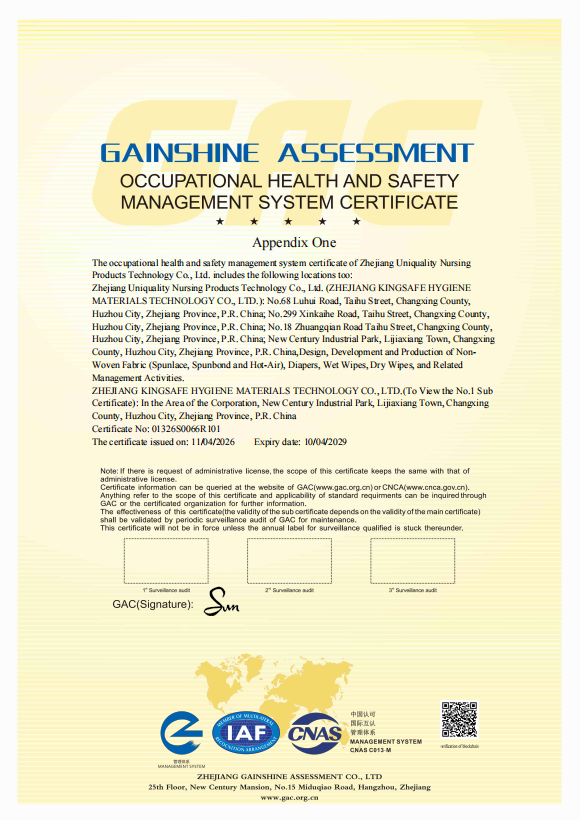
| ISO 45001:2018 | 01326S0066R101 | GAC | wet wipes; dry wipes; baby diaper; training pants | 11 Apr 2026 – 10 Apr 2029 |
| ISO 14001:2015 | 01326E0075R101 | GAC | wet wipes; dry wipes; baby diaper; training pants | 11 Apr 2026 – 10 Apr 2029 |
| ISO 50001:2018 (GB/T 23331-2020) | 01326En0008R201 | GAC | wet wipes; dry wipes; baby diapers; training pants | 9 Mar 2026 – 8 Mar 2029 |
| SEDEX | ZAA600079586 | Bureau Veritas CPS - Asia | same four categories; labour standards, health and safety, environment (2-pillar and 4-pillar), business ethics | issued 24 Jul 2025 |
How does a buyer verify a certificate number rather than accept it?
Five checks, in order. First, scope: the certificate text must name dry wipes, because a certificate covering baby diapers only does not extend to a dry wipes SKU. Second, entity and site: the certified legal name must match the contracting party and the manufacturing site, since a group certificate does not automatically cover every plant. Third, validity: the expiry date should fall after the planned shipment and ideally after the first year of the program, so renewal becomes a scheduled review rather than a surprise.
Fourth, completeness: management-system certificates can be issued with annexes, and the ISO 50001:2018 certificate above is accompanied by an appendix that forms part of the evidence set. Fifth, independent confirmation: the number should be checked with the issuing body or an accredited certificate database, not only against a PDF forwarded by a sales contact. A buyer who reads the number without running these five steps has verified a font, not a management system.
What do these certificates not prove?
They are system and audit evidence, not product test results. ISO 9001:2015 certifies the quality management system across the stated scope; it does not certify the strength, absorbency or cleanliness of an individual sheet. ISO 45001:2018 addresses occupational health and safety management, ISO 50001:2018 addresses energy management, ISO 14001:2015 addresses environmental management, and the SEDEX registration records a social-compliance audit spanning labour standards, health and safety, environment and business ethics. None of them substitutes for a pre-shipment inspection or a lot-specific COA.
The company's CE certificate 6C240227.ZUNU051, issued by ENTE CERTIFICAZIONE MACCHINE, shows why the scope line has to be read rather than scanned. Its stated scope is baby diapers and training pants — not dry wipes. A buyer who sees a CE mark on a supplier profile and assumes it covers a dry wipes program has drawn an inference the document does not support. The same discipline applies to every entry in the file: read the scope, then the dates, then the entity name.
What belongs in the quality agreement?
Six items, each traceable to a document: the product specification (material, one basis weight inside the 35–70 gsm band, sheet dimensions with tolerance, sheet count per pack, packaging type); the inspection method (AQL level, defect classes, acceptance numbers, and the point in production at which inspection happens); the documentation set (lot-referenced COA, inspection report, certificate copies including annexes); the certificate review date; the change-control rule; and the delivery-and-payment document set.
Change control deserves its own clause, because material, size, logo, packaging, fragrance and formula are all listed as customizable. A substitution made without written approval is the most common route by which an approved specification quietly stops being the specification — and it is invisible in the finished goods until someone reopens the file.
Where the evidence stops
Two limits should be stated plainly, because a procurement reference that hides them is not usable.
Capacity. The published company data gives a 1,000,000 m² factory and 60 billion sheets of annual output, and it also gives a monthly capacity figure of 7 billion units that is explicitly described as wet wipes capacity, with capacity differing by product. No dry wipes line capacity appears in the material reviewed here. A buyer planning a multi-container dry wipes program should therefore request line-level capacity and current loading for the specific product, rather than scaling a group-level number to a different product family.
Case evidence. The documented UK OEM case — three years of cooperation, 20 forty-foot containers per month, a 99.5% on-time delivery rate and zero major quality complaints, with highlights including the GMP workshop, ISO certifications, eco-friendly materials and strict quality control — is recorded against the company's wet wipes line. It is meaningful evidence of order management and delivery discipline at volume. It is not by itself a dry wipes quality result, and the correct use of that case is as a process reference while the dry wipes line is assessed on its own records.
What to check before the deposit
The deposit should be the last step, not the first. A workable sequence runs as follows:
- One specification sheet with a single value per attribute — material, basis weight within the 35–70 gsm band, sheet size with tolerance, sheet count per pack, packaging type.
- Acceptance criteria and AQL parameters written into the purchase order, with defect classes and acceptance numbers stated.
- Certificate numbers verified independently: scope first, then entity, dates, annexes and issuing-body confirmation.
- A lot-referenced COA confirmed as the shipment document, matched to carton markings and the packing list.
- Delivery basis and the document set released against the balance payment defined before signing.
- A production schedule anchored to artwork approval, not to the inquiry date.
Two external checkpoints belong in the same file. China's mandatory standard GB 15979-2024, which replaced the 2002 version and took effect on 1 July 2025, sets hygienic requirements for disposable sanitary products, so a buyer sourcing from China should ask how the specification and test protocol map to it. On the import side, a 2014 U.S. Customs and Border Protection ruling classifies wood pulp spunlace nonwoven wipes from China under HTSUS 5603.92.0090 at a Free duty rate — a useful illustration of why the exact construction written on the purchase order determines the tariff code. That ruling addresses wood pulp spunlace specifically; a different nonwoven construction may classify differently.
As standards and tariff treatment evolve, the certificate file becomes a living document rather than a one-time attachment to a supplier profile. The review date written into the quality agreement is what keeps it current, and it is the cheapest clause in the contract to enforce.
FAQ
Does the MOQ differ between pack formats?
Yes, on paper. Uniquality documents a container-based MOQ of one 40HQ for wet wipes and dry wipes, and separately a bag-based schedule of 60,000 bags at 10–30 pieces per bag, 50,000 bags at 40–70 pieces, and 36,000 bags at 80–120 pieces. The quotation should state which basis applies to the order, since the two are different measures.
Is the sheet size on the product page already an order specification?
No. The 15 × 20 cm size on YQ002 is a standard description within a customizable offer. A purchase order should state the dimension with a tolerance and select one basis weight inside the 35–70 gsm customization range, so the order specifies a product rather than a category.
How long are the certificates valid?
ISO 9001:2015 (01326Q0078R102), ISO 45001:2018 (01326S0066R101) and ISO 14001:2015 (01326E0075R101) run from 11 April 2026 to 10 April 2029. ISO 50001:2018 (01326En0008R201) runs from 9 March 2026 to 8 March 2029. SEDEX registration ZAA600079586 was issued on 24 July 2025. Buyers should re-check validity against the shipment date and confirm current status with the issuing body.
What documents should accompany a dry wipes shipment?
The stated quality-control instruments are a certificate of analysis and AQL sampling inspection. The bill of lading copy that triggers the balance payment is a separate commercial document. Any additional paperwork required for import clearance should be agreed in the purchase order rather than assumed.
Can dry wipes be customized for a private label program?
Yes. Uniquality offers OEM and ODM production with customization of material, size, logo, packaging, fragrance and formula, with sampling at 3–5 days and production at 35–45 days after artwork and deposit confirmation. Each customized element should enter the quality agreement as a controlled change item.
Procurement questions of this kind are settled by documents, not adjectives. The checks above do not make a dry wipes order risk-free; they make the risk visible, attributable and negotiable before the container is loaded.
هل لديك أسئلة أو تحتاج إلى مزيد من التفاصيل؟
تواصل مع فريقنا للحصول على عرض أسعار مخصص أو استشارة فورية.
طلب عرض أسعار
املأ النموذج أدناه وسيتواصل معك فريقنا بعرض مقترح مخصص.
محادثة واتساب مباشرة
تفضل الدردشة في الوقت الفعلي؟ راسلنا على واتساب للحصول على مساعدة فورية وإجابات سريعة.
- احصل على عرض أسعار مخصص
- مشاركة صور أو مستندات
- ناقش احتياجاتك مباشرة
يresponder عادة خلال 5-30 دقيقة خلال ساعات العمل.