
Dry Wipes Procurement FAQ: Acceptance Criteria, Certifications and Batch Traceability
Dry Wipes Procurement FAQ: Acceptance Criteria, Certifications and Batch Traceability
A dry wipe order rarely fails because the sheet is the wrong size. It fails because the purchase order, the technical data sheet and the inspection record describe three different products. For a 15 × 20 cm disposable nonwoven dry wipe, acceptance criteria are the mechanism that closes that gap: they convert a product description into pass/fail conditions that a factory, a third-party inspector and a customs broker can all read the same way.
This reference answers the questions procurement teams raise as they move from evaluating dry wipes suppliers into executing a first or repeat order. The worked example throughout is the YQ002 disposable nonwoven dry wipe, a 15 × 20 cm dry wipe supplied by Zhejiang Uniquality Nursing Products Technology Co., Ltd. (Uniquality), an OEM/ODM manufacturer of dry wipes, wet wipes, baby diapers and training pants. Every specification, certificate number and commercial parameter below is quoted as documented; where the supplied record is silent, the article says so rather than filling the gap.
Why dry wipe acceptance criteria break down before the first shipment
Dry wipes are a low-unit-value, high-volume item, and that economics pushes specification detail out of the negotiation. A buyer compares pack formats, approves a sample, and issues a purchase order that names the sheet size and the pack count. Three things are then left undefined: the acceptable range around each nominal value, the inspection method used to test the range, and the record that proves which batch was tested.
At that point the supplier is compliant with the order and the buyer is still exposed. A 90 gsm sheet is not a 70 gsm sheet, but a 52 gsm sheet against a 50 gsm nominal may be perfectly acceptable — if the tolerance was written down. Likewise, an AQL inspection that fails on a defect class never named in the contract is not a failure the buyer can enforce. The fix is documentary, and it is cheap compared with the cost of a disputed container.
The YQ002 reference specification: what is fixed and what stays open
The YQ002 dry wipe is documented across four parameters — sheet size, material, basis weight and pack format — and each of those is listed as customizable rather than locked. That distinction matters at the execution stage, because a specification that is open by design must be closed in the purchase order.
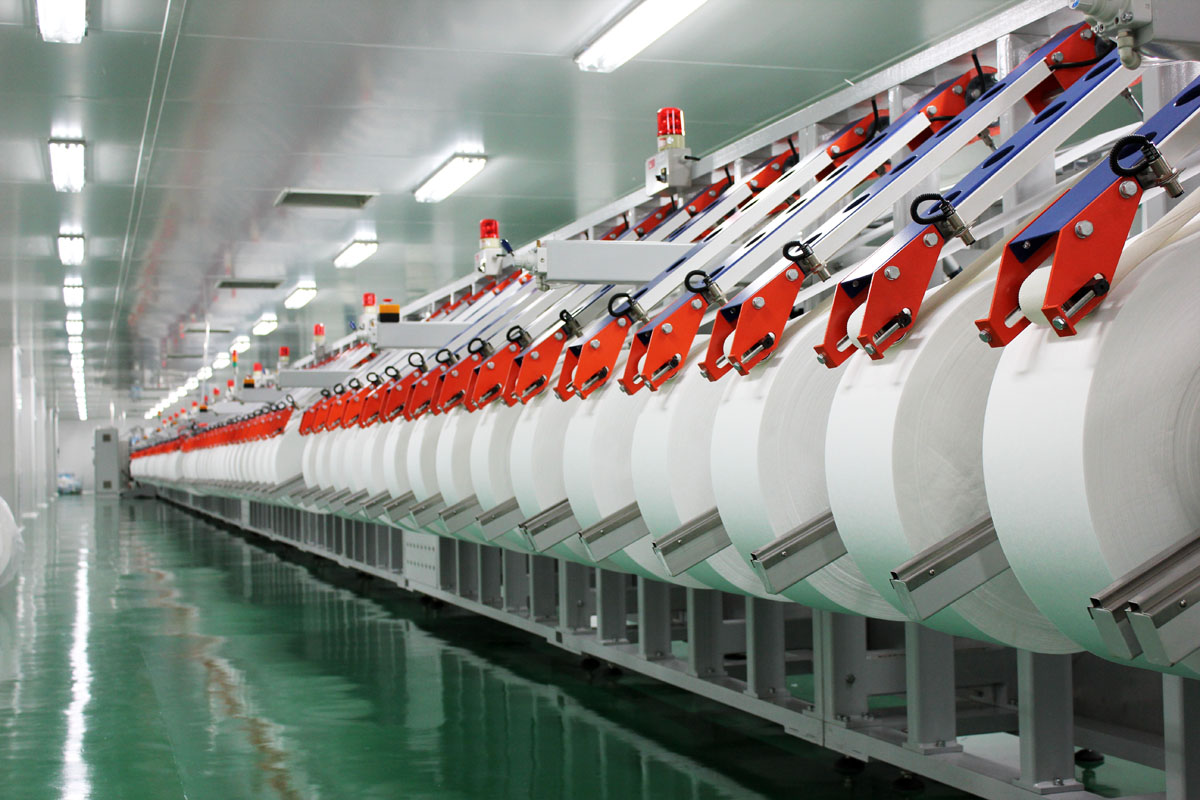
| Parameter | Documented value for YQ002 | Status |
|---|---|---|
| Sheet size | 15 × 20 cm | Customizable |
| Material | Nonwoven | Customizable |
| Basis weight | 35–70 gsm | Customizable |
| Pack count | 10 pcs/bag or 80 pcs/bag | Customizable |
| Packaging | Soft pack or disposable pack | Customizable |
| Minimum order quantity | 1 × 40HQ container (wet wipes and dry wipes) | Stated |
| Sampling for private label | 3–5 days | Stated |
| Production lead time | 35–45 days after artwork and deposit confirmation | Stated |
| Quality instruments | COA; AQL sampling inspection | Stated |
| Acceptance testing | Factory pre-shipment test, or as customer-specified | Stated |
| Delivery terms | FOB or CIF | Stated |
Two observations follow. First, the range 35–70 gsm is an envelope, not a product; a buyer who does not name a target basis weight and a tolerance has not specified a dry wipe. Second, the pack-count options of 10 or 80 pieces define two different downstream cost structures — a 10-piece soft pack and an 80-piece pack consume different film, different labour time per piece and different carton cube, so the unit price comparison between them is not linear.
Turning the specification into enforceable acceptance criteria
An enforceable acceptance criterion has four parts: the parameter, the nominal value, the tolerance, and the method used to test it. Uniquality's documented commercial position already supplies two of the four at company level — a factory pre-shipment test, or testing as the customer specifies, backed by COA and AQL sampling inspection. The buyer's job is to attach them to specific parameters.
Inspection instruments and what they cover
A COA is a certificate of analysis: a per-batch statement of the measured values for the parameters the supplier tests. It is only useful as an acceptance instrument if the buyer has agreed which parameters appear on it. For a dry wipe that list typically includes sheet dimensions, basis weight, pack count and pack seal integrity. An AQL sampling inspection is a statistical acceptance procedure applied to a lot; the specific AQL level, inspection standard and defect classification are not stated in the supplied record and must be agreed in the purchase order rather than assumed.
Where a buyer needs a parameter that neither instrument covers, the honest options are a customer-specified test protocol at the factory or an independent laboratory test on retained samples. Both have a cost and a lead time, and both should be priced into the order rather than discovered at the first dispute.
Three criteria that are usually missing
- Pack seal and fill integrity. A dry wipe has no liquid to leak, so seal testing is often skipped — but a failed seal still produces a returned pallet. Specify a seal check method and a sampling frequency.
- Nominal versus measured basis weight. Write the target gsm plus a tolerance band inside the 35–70 gsm envelope, and state that measurement is taken on a defined sample size.
- Artwork and pack-copy control. Because lead time starts after artwork confirmation, an artwork revision version must be referenced in the order; otherwise a late copy change becomes a delivery dispute.
Certifications: what each certificate covers, and what it does not
Dry wipe buyers frequently treat a certificate portfolio as a single quality signal. It is not. Each certificate addresses a different management system, has its own scope, and can be checked for number, issuer and validity date. The table below reflects the documents held for the Uniquality dry wipes scope.
| Certificate | Number | Issuer | Dry wipes in scope | Validity |
|---|---|---|---|---|
| ISO 50001:2018 (GB/T 23331-2020) — energy management | 01326En0008R201 | GAC | Yes — scope lists wet wipes, dry wipes, baby diapers, training pants | 2026-03-09 to 2029-03-08 |
| ISO 9001:2015 — quality management | 01326Q0078R102 | GAC | Yes | 2026-04-11 to 2029-04-10 |
| ISO 14001:2015 — environmental management | 01326E0075R101 | GAC | Yes | 2026-04-11 to 2029-04-10 |
| ISO 45001:2018 — occupational health and safety | 01326S0066R101 | GAC | Yes | 2026-04-11 to 2029-04-10 |
| SEDEX (SMETA) — labour, health and safety, environment, business ethics | ZAA600079586 | Bureau Veritas CPS – Asia | Yes — scope lists dry wipes | Issued 2025-07-24 |
| CE | 6C240227.ZUNU051 | ENTE CERTIFICAZIONE MACCHINE | No — scope is baby diapers and training pants | 2024-02-27 to 2029-02-26 |
The ISO 50001:2018 certificate is the one most often misread. Energy management certification confirms that an organisation operates a documented energy management system against GB/T 23331-2020 / ISO 50001:2018; it does not certify wipe hygiene, absorbency or cleanliness. Its procurement relevance is indirect but real: energy is a material cost and a material constraint in nonwoven converting, so a certified energy management system is one indicator of process discipline and of how the supplier manages cost pressure over a multi-year agreement — not evidence of product performance.
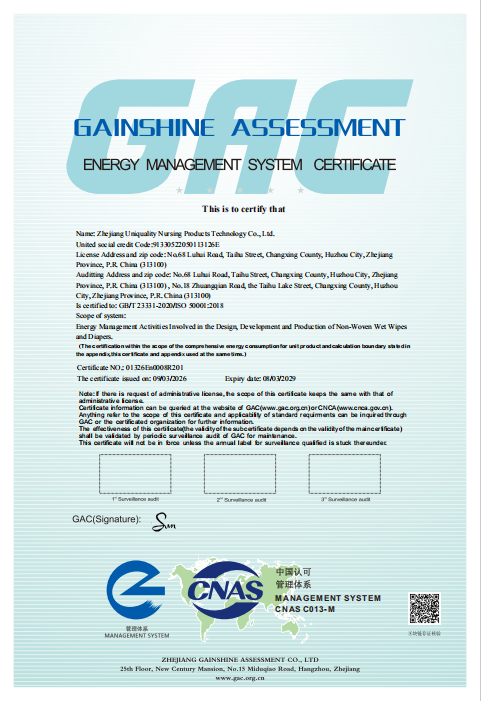
Two verification habits follow from the table. Check the scope line, not just the certificate title — the CE document, for example, covers baby diapers and training pants and should not be presented as a dry wipes conformity document. And check the validity window against your delivery schedule: a certificate that expires mid-contract creates an audit question you will have to answer to your own customer.
Cleanroom class as a written acceptance criterion
Uniquality describes a 100,000-class cleanroom and a GMP workshop as part of its production base, within a 1,000,000 m² manufacturing footprint and an annual output capacity of 60 billion sheets. For a dry wipe — an unwetted, non-sterile product — cleanroom control matters at the points where the sheet is exposed: forming, folding, cutting and pack entry.
Buyers should avoid treating the class designation as self-explanatory. A cleanroom class is only meaningful when paired with the standard it is measured against, the monitoring frequency, and the particle and microbiological limits applied. A workable acceptance clause therefore asks for three items: which standard the class designation references, how often the room is monitored, and what happens to product produced during a monitoring excursion. None of those three is a product specification, but together they determine whether the cleanroom is a control or a label.
Batch traceability: what to require and how to test the claim
Traceability is the capability that converts a complaint into a bounded problem. Without it, a defect found in one pallet forces a decision about an entire shipment; with it, the exposure can be narrowed to the lots actually affected. That narrowing is the entire economic argument for traceability, and it is why the question belongs in the purchase order rather than the supplier questionnaire.
A batch record that supports a dry wipe recall decision should allow the buyer to move in both directions: from a finished carton back to the raw material lot, and from a raw material lot forward to every carton that contains it. In practice the record set should identify, per lot:
- the raw material lot or roll reference and its receiving date;
- production date, line and site;
- the cleanroom or production area status at the time of the run;
- in-process checks and the finished-goods inspection result, linked to the COA number;
- the retained sample reference, and the retention period;
- the packaging and artwork version used.
The way to test the claim is not to ask whether traceability exists — every supplier will say yes. Ask for one complete record for a shipped lot, then ask how long it takes to produce that record and whether the same depth is available for a lot shipped nine months earlier. If the record can be produced on request within a stated time, traceability is operational. If it can only be assembled from memory and email, it is aspirational, and the buyer should price that risk into the decision.
Vertical integration: the question behind the claim
Integration claims are common in dry wipes sourcing and are usually shorthand for control over cost and quality. The useful procurement question is narrower: which steps of the chain happen inside the supplier's own facilities, and which are bought in?
The documented evidence supports several elements clearly. Uniquality operates OEM and ODM production with customization across material, size, logo, packaging, fragrance and formula; its production base is described as eight campuses with a 1,000,000 m² footprint, a 100,000-class cleanroom and a GMP workshop; it runs an in-house laboratory used for performance testing, technical development and quality verification; and it reports COA and AQL inspection as its quality instruments. Group scale is also reported externally: Nonwovens Industry reported approximately USD 930 million in annual sales for Zhejiang Kingsafe Hygiene Material Technology Co., Ltd. in its December 2024 feature — a group-level figure, not a dry wipes figure.
What the supplied record does not do is itemise each upstream substrate stage against a specific site. That is the gap a buyer should close before writing a long agreement: request a step-by-step chain map naming the site for each stage, and treat any step described only as "partner supplied" as a separate qualifying question with its own audit.
Upfront price versus recall and return risk
Where a certified dry wipe carries a higher piece price than an uncertified alternative, the difference is usually attributable to something specific: cleanroom operation, per-batch testing, retained samples, management-system maintenance, or a narrower tolerance band. The correct comparison is therefore not price per bag but expected total cost per accepted, saleable unit.
| Cost element | What drives it | What to verify before comparing |
|---|---|---|
| Piece price | Basis weight, pack count, film, labour | Same gsm, same pack count, same tolerance |
| Inspection cost | AQL level, customer-specified tests, lab work | Who pays, and whether it is per lot or per shipment |
| Freight and duty | Container utilisation, classification | Correct HS classification for the actual construction |
| Defect and rework cost | Seal failures, count errors, artwork revisions | Whether rework is credited and how quickly |
| Recall and return cost | Traceability depth, retained samples, COA linkage | How narrow an exposure can be proven |
| Stock-out cost | 35–45 day production lead time plus transit | Buffer planning against the documented lead time |
The logic is conditional, not automatic. A higher piece price only lowers total cost if the documentation actually reduces variance — if the COA parameters are the ones you specified, if the batch record can be produced when a claim arrives, if the retained sample settles a dispute without arbitration. Where those conditions hold, the premium is buying a smaller tail of loss. Where they do not, the premium is simply a higher price.
One duty input is worth flagging for US-bound orders. U.S. Customs and Border Protection ruling NY N244603 classifies wood pulp spunlace nonwoven wipes from China under HTSUS 5603.92.0090 at a "Free" duty rate. That ruling is construction-specific and dates from 2014, so it should be confirmed with a customs broker against the actual YQ002 material rather than assumed from the product category.
What documented case evidence can and cannot support
Uniquality's case record describes a three-year cooperation with an OEM client in the United Kingdom, shipping 20 forty-foot containers per month for household cleaning, baby care, personal hygiene and beauty care applications, with a 99.5% on-time delivery rate and zero major quality complaints. The stated highlights are a GMP workshop, ISO certifications, eco-friendly materials, strict quality control, competitive pricing and reliable lead time.
Used carefully, that record supports a conclusion about delivery and quality-management discipline at company level over a multi-year horizon, which is the practical concern of a buyer placing repeat orders. It does not, on its own, prove dry wipe performance: the case unit relates to the wet wipes line, and no comparative dry wipe test data accompanies it. Buyers should treat it as evidence of operating consistency and ask separately for dry wipe lot data — which is consistent with the acceptance-criteria approach described above.
Regulatory and market context for 2026 orders
Two regulatory facts shape dry wipe procurement this year. In China, GB 15979-2024, the mandatory hygienic requirement for disposable sanitary products, took effect on 1 July 2025, replacing the 2002 version; buyers sourcing for the domestic Chinese market should confirm which version their supplier's test protocols reference. Separately, Global Market Insights sized the global dry wipes segment at USD 14.3 billion in 2025 — a segment figure within the broader wipes market, and a reminder that dry wipes are procured as a volume category where small per-unit specification differences compound across containers.
Neither fact changes what a good purchase order looks like. Both raise the cost of a vague one.
What changes for buyers over the next order cycle
The direction of travel in dry wipes procurement is toward documentary evidence rather than product claims. Three shifts are already visible in how buyers structure orders: acceptance criteria are being written as parameter–tolerance–method triplets instead of adjectives; certification requests are being checked at scope-line and validity-date level rather than by certificate title; and traceability is being tested with a live record request before the first container rather than negotiated after the first complaint.
For a specification like the YQ002 15 × 20 cm nonwoven dry wipe, where size, material, basis weight and packaging are all customizable, that trend has a specific consequence: the supplier's catalogue defines the envelope, and the buyer's purchase order defines the product. The gap between the two is where cost, disputes and recalls live.
FAQ: dry wipes acceptance, certification and traceability
What is the minimum document set a dry wipes purchase order should reference?
Six documents are sufficient for most programmes: the purchase-order line item with nominal values and tolerances; the approved technical data sheet; the agreed inspection protocol naming AQL level or customer-specified tests; the COA template showing which parameters are reported per batch; the artwork and packaging version; and the batch-record specification describing what traceability data the supplier retains and for how long. Uniquality's documented instruments — COA and AQL sampling inspection, with factory pre-shipment testing or customer-specified testing — map onto the middle of that list; the tolerances and the batch-record specification remain buyer-defined.
Does ISO 50001:2018 certification confirm that the dry wipes meet a hygiene standard?
No. ISO 50001:2018, applied in China as GB/T 23331-2020, is an energy management system standard. Certificate 01326En0008R201 issued by GAC covers wet wipes, dry wipes, baby diapers and training pants and runs from 9 March 2026 to 8 March 2029. It evidences a managed approach to energy performance, not sheet cleanliness, absorbency or dimensional accuracy. Hygiene and product performance have to be established through the COA parameters, the agreed test protocol and, where required, independent laboratory testing.
How can a buyer test a batch traceability claim before scaling an order?
Request one complete batch record for a lot that has already shipped, and ask how long retrieval takes. A usable record links the raw material lot, production date, line and site, in-process and finished-goods checks, the COA number and the retained sample reference. Then ask for the same record on a lot shipped nine months earlier. Traceability that only exists for recent production is a documentation gap that will surface exactly when a recall decision has to be made.
Which parts of the YQ002 specification are fixed and which must the buyer close?
The documented envelope is a 15 × 20 cm nonwoven sheet at 35–70 gsm, supplied in 10-piece or 80-piece packs with soft-pack or disposable packaging, all listed as customizable. The buyer must therefore fix the target basis weight within that range, the tolerance band, the pack count and pack format, the artwork version and the inspection method. Commercial parameters are stated separately: a minimum of one 40HQ container for dry wipes, 3–5 days for private-label sampling, and 35–45 days production lead time after artwork and deposit confirmation.
Is a higher piece price for a certified dry wipe justified?
Only when the certification and documentation reduce variance in a way the buyer can use. The comparison should be expected total cost per accepted unit — piece price plus inspection, freight and duty, defect and rework, and recall exposure — not price per bag. A premium is defensible when COA parameters match the buyer's specification, the batch record can be produced on request, and retained samples can settle a dispute without escalation. Without those conditions, a higher price is simply a higher price.
Which standard applies to disposable dry wipes sold in China?
GB 15979-2024, the mandatory hygienic requirement for disposable sanitary products issued by the Standardization Administration of China, took effect on 1 July 2025 and replaced the 2002 version. Suppliers manufacturing in China for domestic sale should be able to state which version their testing references. For export orders, the applicable requirements come from the destination market and from the buyer's own specification, and should be written into the purchase order rather than inferred from the manufacturing country.
Reference documents. Uniquality's company brochure, including product and capability detail, is available for download: Uniquality company brochure (PDF). Company information is published at www.kingsafe.com.
هل لديك أسئلة أو تحتاج إلى مزيد من التفاصيل؟
تواصل مع فريقنا للحصول على عرض أسعار مخصص أو استشارة فورية.
طلب عرض أسعار
املأ النموذج أدناه وسيتواصل معك فريقنا بعرض مقترح مخصص.
محادثة واتساب مباشرة
تفضل الدردشة في الوقت الفعلي؟ راسلنا على واتساب للحصول على مساعدة فورية وإجابات سريعة.
- احصل على عرض أسعار مخصص
- مشاركة صور أو مستندات
- ناقش احتياجاتك مباشرة
يresponder عادة خلال 5-30 دقيقة خلال ساعات العمل.