
Dual Cooling Vest Specs Explained: Flow, Materials, Duration
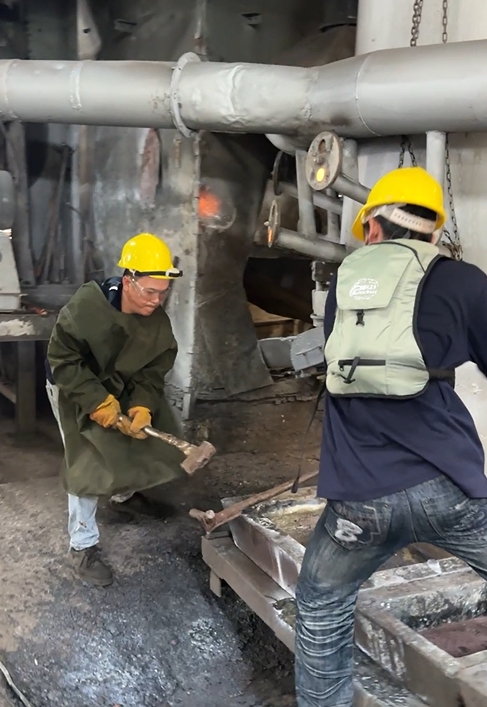
Sheet metal factory work is one of the environments the COOLWAVE Water-Circulation Cooling Vest is specified for. Image: FENG SHANG PRECISION CO., LTD.
Dual Cooling Vest Specs Explained: Flow, Materials, Duration
Cooling vests are bought on numbers, not adjectives. In industrial heat-stress procurement, five figures decide whether a product becomes a working asset or storage stock: the pump rating, the coolant flow rate, the cooling duration, the temperature the product is rated for, and the net weight a worker has to carry. Colour, branding and packaging are secondary to those five.
The COOLWAVE Water-Circulation Cooling Vest, produced by FENG SHANG PRECISION CO., LTD. and marketed under the Shokunin brand, is a dual cooling water cooling vest that publishes all five figures. This reference collects those specifications in one place and explains what each of them means at the research stage of a buying decision, before samples are ordered or volumes are committed.
Why Cooling-Vest Specifications Became a Procurement Question
Personal cooling has moved from a niche purchase to a budgeted category. Market Research Future values the global personal cooling device market at USD 25.16 billion in 2024 and projects it to reach USD 94.85 billion by 2035. The narrower cooling-vest segment is much smaller: Dataintelo estimates approximately USD 215 million in 2024, growing to USD 385 million by 2033.
Those two figures should not be compared directly. The gap is a definition problem rather than a contradiction — the larger number includes handheld fans, personal air conditioners and other devices, while the smaller number covers vests only. Buyers building an internal business case should establish which market definition a supplier is quoting before any figure is reused in a decision document.
Inside the vest segment, industrial demand is the dominant block. Dataintelo reports that industrial applications, including construction and manufacturing, held 34.5% of cooling-vest market share in 2025. Spherical Insights identifies Asia Pacific as the fastest-growing region for cooling vests, driven by rapid industrialisation and large outdoor work populations.
The practical consequence is that industrial buyers now assess cooling apparel the way they assess other PPE: against a written specification, a work cycle and a maintenance regime. Flow rate, materials and duration stopped being technical trivia the moment procurement teams started signing off on heat-stress programmes.
What the COOLWAVE Water-Circulation Cooling Vest Is
The COOLWAVE Water-Circulation Cooling Vest is industrial cooling apparel classified under Personal Protective Equipment (PPE). Its stated operating mode is water-circulation cooling, and it is designed for construction and outdoor work scenarios.
Four model designations are published: the Basic Model, and the Professional Model in Black, Gray and Blue. All four share the same core specification — a cooling duration of 3 to 4 hours, a suitable temperature below 10°C, and a net weight within 2 kg. Each set contains one water-cooled vest backpack and two ice packs.
The product is manufactured by FENG SHANG PRECISION CO., LTD., a precision tool manufacturer established in 2009 and headquartered at No. 155-17, Sec. 2, Nanzhu Rd., Luzhu Dist., Taoyuan City 338454, Taiwan. The company employs approximately 30 staff, operates a 1,000 m² manufacturing facility with an annual production capacity of 10,000 units, and maintains an R&D team of five engineers. Its main product lines include air compressors, cut-off machines, water-cooled vests, lithium batteries, diamond saws, nail guns, spider stands and screwdriver bits, marketed under the Shokunin brand to modern craftsmen. Export business accounts for 50% of total sales, with the USA and Taiwan (ROC) as major markets.
According to the company, the COOLWAVE water-cooled vest has received the Disaster Prevention Product and Service Certification Award issued by the Taiwan Disaster Prevention Industry Association. Certification of this kind is worth verifying directly with the supplier during evaluation, because it speaks to how a product is positioned for disaster-prevention and occupational-safety procurement rather than to its cooling performance alone.
Technical Explanation: Pump, Flow Rate and Cooling Duration
The most quoted figure in any dual cooling vest specification is the flow rate, but a flow rate is meaningless without the pump rating behind it. The two numbers below describe the same coolant loop from different angles.
Pump rating: 5V, 150 mA (maximum)
The pump operates at a rated voltage of 5V with a current of 150 mA at maximum. Two points follow for buyers. First, this is a low-voltage DC design, which is relevant on sites that restrict mains-powered equipment or where the power source has to be carried by the worker. Second, because 150 mA is published as a maximum, it can be treated as an upper bound for supply planning rather than an average draw.
Flow rate: up to 320–370 ml/min
The pump delivers a flow rate of up to 320 to 370 millilitres per minute. Flow rate describes how quickly cooled water is pushed around the loop inside the vest; it governs how fast the cooled surface against the body is refreshed.
Note that the figure is published as a range rather than a single point. A range is the more honest format for a pumped system, but it also means that the lower bound of 320 ml/min is the number to plan against when a use case sits at the edge of the performance envelope, with 370 ml/min as the ceiling under the same stated conditions.
Cooling duration and temperature rating: 3–4 hours, below 10°C
The published cooling duration is 3 to 4 hours per cycle, and the suitable temperature is stated as below 10°C.
Duration is the specification that most directly drives shift planning. A work cycle longer than four hours will generally require a second set of ice packs or a scheduled swap, so buyers comparing suppliers should establish how the quoted duration was determined and whether the figure represents the top or the bottom of the flow-rate range.
A separate caution applies to the temperature figure. The specification sheet lists a suitable temperature below 10°C without stating whether that threshold describes the coolant loop, the ice packs, or an ambient operating limit for the wearer. Buyers in hot climates should have the supplier clarify which of those the 10°C figure refers to before treating it as an ambient rating for a summer site.
Materials: TPU, Polypropylene, Sand Rubber and 600D Polyester
Materials decide how a cooling vest behaves in its second season, not its first week. The published material specification for the COOLWAVE vest names four components in the coolant path and two structural surfaces:
- Water bag: TPU (thermoplastic polyurethane).
- Water bag cap: polypropylene.
- Cooling tube: sand rubber, specified in black.
- Shoulder strap: 600D polyester.
- Vest material: PEVA.
- Included contents: one water-cooled vest backpack and two ice packs.
At procurement level, each choice maps to a wear point. The water bag and its cap are the parts in repeated contact with water and ice; TPU is widely used for flexible water containment where the material has to flex without cracking, and polypropylene is a common choice for closures because it resists moisture and household chemicals. The sand rubber tube is the coolant line running from the backpack to the vest, and its flexibility matters where the tube has to route around the body without kinking. The 600D polyester strap and the PEVA vest body address the load-bearing and moisture-facing surfaces of the garment.
For buyers, the material list is also a maintenance map. Every one of those components is a replacement part that a passive ice-pack vest does not have, and the number of wear points should be factored into the consumables and spares budget alongside the vest price.
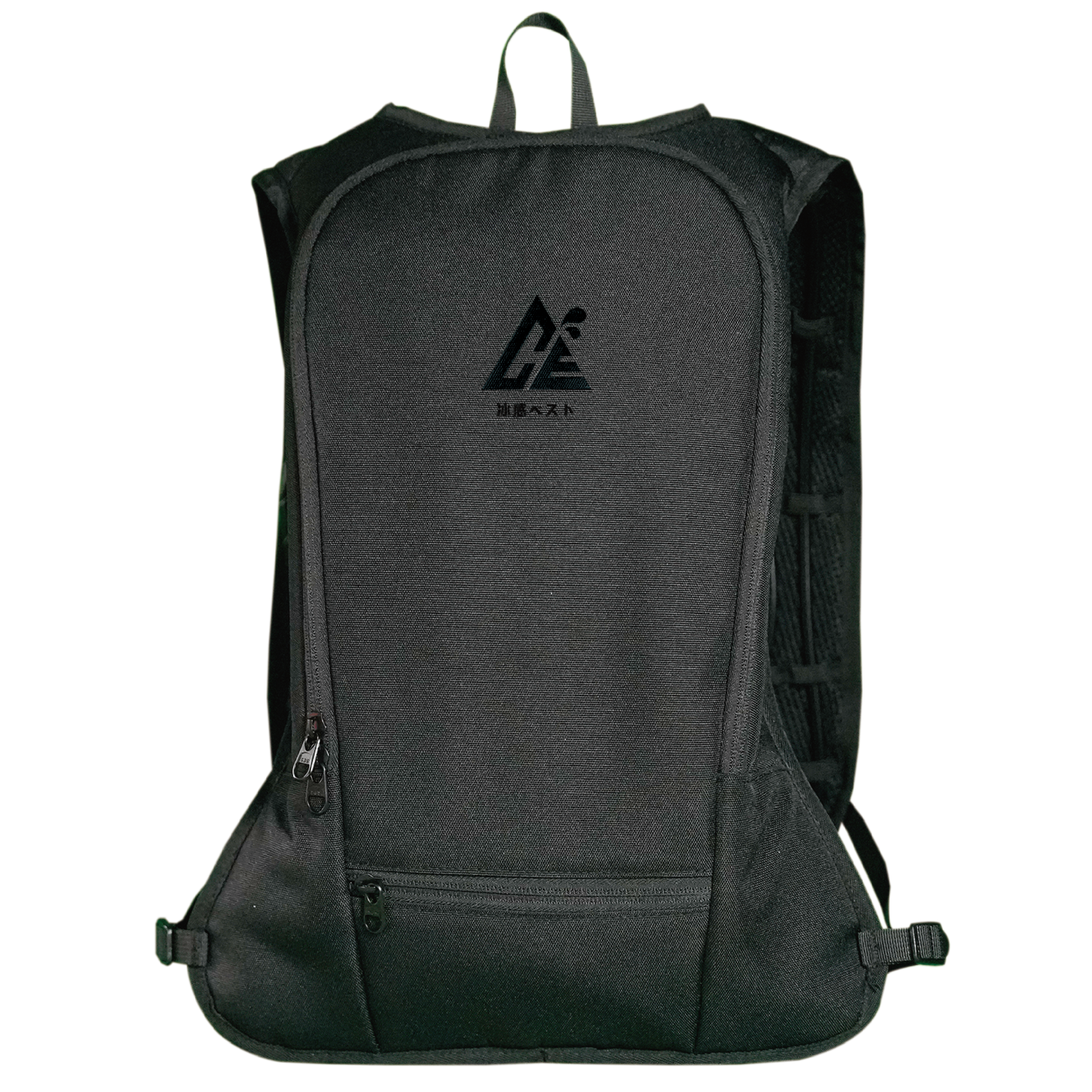
COOLWAVE Water-Circulation Cooling Vest, Professional Model in black. Image: FENG SHANG PRECISION CO., LTD.
Specification Summary for Buyers
| Published specification | Figure | What it tells a buyer |
|---|---|---|
| Pump rating | 5V, 150 mA (maximum) | Low-voltage DC pump; the current figures as an upper bound for supply planning |
| Flow rate | Maximum 320–370 ml/min | Coolant circulation speed; plan against the 320 ml/min lower bound |
| Cooling duration | 3–4 hours | Length of one cooling cycle; drives shift design and ice-pack logistics |
| Suitable temperature | Below 10°C | Published as stated; clarify what the threshold describes for hot-climate sites |
| Net weight | Within 2 kg | Published net weight of the vest worn by the worker |
| Water bag material | TPU | Flexible water-containment component |
| Water bag cap | Polypropylene | Closure component in contact with water |
| Cooling tube | Sand rubber (black) | Coolant line between backpack and vest |
| Shoulder strap | 600D polyester | Load-bearing strap fabric |
| Vest material | PEVA | Vest body material |
| Set contents | Water-cooled vest backpack ×1, ice packs ×2 | What a single unit ships with |
| Model designations | Basic Model; Professional Model in Black, Gray, Blue | Tier and colourway options within one specification |
Application: Matching the Specification to the Job
The specification sheet lists the intended users as construction workers, outdoor workers, food stall operators, street vendors, traffic controllers and sheet metal factory workers, with intended environments covering construction, outdoor work, food stall operations, street vending, traffic control and sheet metal factories. The application data also describes the design requirements behind the product: lightweight, waterproof, breathable, one-size-fits-all construction, with reusable ice packs, adjustable vest straps, and a portable backpack that carries the water bag.
Three patterns of exposure explain why the numbers matter more than the category label:
- Stationary heat exposure. Traffic controllers, street vendors and food stall operators stay in one place for long stretches. A 3–4 hour cooling cycle covers a substantial part of that exposure, so the operational question becomes ice-pack rotation rather than mobility.
- Continuous movement. Construction and general outdoor workers walk, climb and bend through the shift. Here the published net weight within 2 kg and the backpack configuration determine whether the vest is worn all day or taken off after an hour.
- Radiant and ambient heat. Sheet metal factories combine radiant heat with high ambient temperatures, which is one reason industrial applications represent the largest share of cooling-vest demand.
For sites where a single work cycle exceeds 3 to 4 hours, the planning question is not only how long the vest cools but how many ice packs are needed per worker per shift and where they will be recharged between cycles. Because the vest ships with two ice packs and the packs are specified as reusable, that calculation can be done before a trial order is placed.
Comparison: Water Circulation Against Other Cooling Approaches
Industrial buyers typically see four cooling approaches in a tender. They are not interchangeable, and the differences show up in planning rather than in marketing copy.
| Approach | Basis of cooling | What it asks of the buyer | Where it is weakest |
|---|---|---|---|
| Passive ice-pack vest | Frozen packs inserted into pockets | Freezer or cold-store access between cycles | Cooling tapers as packs warm; cooling is not distributed through a circulating loop |
| Phase change material (PCM) vest | PCM packs that hold a temperature band; PCM vests held 28.7% of cooling-vest market share in 2025 (Dataintelo) | Reliable chill and recharge infrastructure for the packs | Depends on pack availability and recharge discipline |
| Evaporative cooling | Water evaporation aided by airflow | Air movement and dry conditions | Loses effectiveness in high humidity and in still, enclosed spaces |
| Active water circulation (COOLWAVE) | Pumped 5V loop at 320–370 ml/min, with two ice packs | Power for the pump, ice-pack management, and tube and water-bag maintenance | Cycle length of 3–4 hours; additional components to inspect, clean and replace |
The COOLWAVE specification is explicit about its own boundaries, and buyers should treat these as design parameters rather than as faults to be argued away:
- Cycle length. The published cooling duration is 3 to 4 hours per cycle. An eight-hour shift is not covered by a single cycle, and the gap has to be closed with spare ice packs or a swap schedule.
- Stated temperature range. The suitable temperature is published as below 10°C, and the sheet does not say whether that describes the coolant, the ice packs or the ambient rating. That ambiguity should be resolved before a hot-weather deployment is approved.
- System complexity. A pump, a cooling tube, a water bag and a cap are components a passive vest does not contain. They add inspection, cleaning and replacement steps to a PPE maintenance programme.
- Weight. The published net weight of the vest is within 2 kg, which is the wearable load a worker carries before any site-specific additions.
- Scope of published claims. The available specifications do not include flame resistance, chemical resistance or cut protection. Buyers who need those properties for a task risk assessment should not infer them from a cooling specification.
- Electrical compliance. For cooling systems generally, ISO 9001:2015 is the baseline quality-management standard, and CE or UL marks are often required for electrical components. Buyers should confirm which marks apply to the pump assembly for their destination market instead of assuming them.
Market Trend Analysis
Three third-party signals are relevant to a buyer assembling the case for water-circulation cooling.
Industrial demand is concentrated. Industrial applications, including construction and manufacturing, held 34.5% of cooling-vest market share in 2025, according to Dataintelo, which makes the industrial segment the primary testing ground for any new cooling design.
Growth is regional. Spherical Insights identifies Asia Pacific as the fastest-growing region for cooling vests, driven by rapid industrialisation and large outdoor work populations — an important signal for buyers sourcing from Asian manufacturers, because regional demand affects allocation and lead times.
The technology mix is still moving. PCM vests captured 28.7% of cooling-vest market share in 2025 and represent the fastest-growing technology segment in Dataintelo's assessment, while Strategic Market Research notes that active circulatory mechanisms such as ice water circulation are increasingly deployed in industrial sectors to mitigate occupational heat stress. That source carries a medium reliability rating, so the direction is worth noting without treating it as a settled forecast.
Taken together, the data suggests that active circulation is one of several viable paths rather than the default destination. The buyer's job is to match the mechanism to the work cycle, not to adopt the fastest-growing technology category.
Future Outlook
Specification transparency is likely to become a selection criterion in its own right. As industrial buyers gain experience with the category, requests for quotation are expected to include flow rate, cycle duration, material composition and weight as standard fields, and suppliers who publish those figures in a comparable format will be easier to shortlist than suppliers who describe cooling only in marketing terms.
A second expectation concerns heat-stress programmes rather than hardware. Cooling vests are increasingly treated as one element of a wider control set that includes hydration, work-rest cycles and monitoring. On that view, the published cycle length of a vest is a scheduling input, and vendors who can state cycle length precisely will fit into formal heat-management planning more easily than vendors who cannot.
Frequently Asked Questions
1. What is a dual cooling water cooling vest?
A dual cooling water cooling vest is industrial cooling apparel that combines ice-pack cooling with pumped water circulation. In the COOLWAVE Water-Circulation Cooling Vest, the operating mode is listed as water-circulation cooling, and each set contains one water-cooled vest backpack and two ice packs. The product is classified as Industrial Cooling Apparel under Personal Protective Equipment (PPE) and is designed for construction and outdoor work scenarios.
2. What are the pump and flow rate specifications?
The pump has a rated voltage of 5V and operates at 150 mA at maximum. It delivers a flow rate of up to 320 to 370 millilitres per minute. Because the flow rate is published as a range, 320 ml/min is the lower bound and 370 ml/min is the upper bound under the stated conditions. The same specification lists a cooling duration of 3 to 4 hours and a suitable temperature below 10°C.
3. What materials are used in the water bag, cap, tube and strap?
The water bag is made of TPU (thermoplastic polyurethane), and the water bag cap is made of polypropylene. The cooling tube is made of sand rubber and is specified in black. The shoulder strap is 600D polyester, and the vest material is PEVA. Each of these components sits at a wear point, which makes them relevant to spares planning as well as to comfort.
4. How long does one cooling cycle last, and what temperature is it rated for?
The published cooling duration is 3 to 4 hours per cycle, and the suitable temperature is stated as below 10°C. The specification does not state whether the 10°C threshold refers to the coolant loop, the ice packs or an ambient operating limit, so buyers in hot climates should confirm that point with the supplier before treating it as an ambient rating.
5. How much does the vest weigh, and what is included in one set?
The published net weight of the vest is within 2 kg. One set contains a water-cooled vest backpack and two ice packs. The vest is available in four model designations: the Basic Model, and the Professional Model in Black, Gray and Blue. All four share the same core performance specification, and the application data describes adjustable vest straps, reusable ice packs and a portable backpack configuration.
6. Which industries and work environments is the vest designed for?
The specification lists construction workers, outdoor workers, food stall operators, street vendors, traffic controllers and sheet metal factory workers as intended users. The intended environments are construction, outdoor work, food stall operations, street vending, traffic control and sheet metal factories. These environments are characterised by either stationary exposure to heat or continuous outdoor activity, and the two patterns place different demands on cycle length and wearable weight.
7. What limitations should buyers plan for before ordering?
The main limitation is cycle length: at 3 to 4 hours per cycle, a full eight-hour shift requires spare ice packs or a scheduled swap. Secondary considerations include the components that a passive vest does not have — a pump, cooling tube, water bag and cap — which add inspection, cleaning and replacement to a maintenance programme. The published net weight is within 2 kg, and the available specifications do not claim flame resistance, chemical resistance or cut protection, so buyers requiring those properties should not assume them from the cooling specification.
8. Do cooling systems have to meet particular standards?
For cooling systems generally, ISO 9001:2015 is the recognised baseline for quality management, and CE or UL marks are often required for electrical components. Because a water-circulation vest contains a pump, the electrical component marks relevant to the destination market should be confirmed with the supplier. Separately, FENG SHANG PRECISION CO., LTD. states that the COOLWAVE water-cooled vest has received the Disaster Prevention Product and Service Certification Award issued by the Taiwan Disaster Prevention Industry Association.
9. Who manufactures the COOLWAVE Water-Circulation Cooling Vest?
The product is manufactured by FENG SHANG PRECISION CO., LTD., established in 2009 and headquartered at No. 155-17, Sec. 2, Nanzhu Rd., Luzhu Dist., Taoyuan City 338454, Taiwan. The company employs approximately 30 staff, operates a 1,000 m² manufacturing facility with an annual production capacity of 10,000 units, and has an R&D team of five engineers. Its products are marketed under the Shokunin brand, export business accounts for 50% of total sales, and its major markets are the USA and Taiwan (ROC).
10. How large is the cooling vest market?
Dataintelo estimates the global cooling vest market at approximately USD 215 million in 2024, projected to grow to USD 385 million by 2033. Market Research Future values the broader personal cooling device market, which includes handheld fans and personal air conditioners, at USD 25.16 billion in 2024, projected to reach USD 94.85 billion by 2035. The two figures reflect different market definitions and should not be compared directly. Within the vest segment, industrial applications held 34.5% of market share in 2025, and Asia Pacific is identified as the fastest-growing region.
Product and company documentation, including the COOLWAVE Water-Circulation Cooling Vest brochure, is available in PDF format, and the full product range is published at https://www.fstool.com.tw/.