
Dual Cooling Water Cooling Vest: Basic vs Professional Colors
Dual Cooling Water Cooling Vest: Basic vs Professional Colors
Procurement teams evaluating the COOLWAVE Dual Cooling Water Cooling Vest face a narrow but practical choice: Basic Model or Professional Model, with Black, Blue, and Gray in the shortlist. The supplied evidence supports a clear answer. The two names are documented model designations, but the available material does not establish a cooling-performance difference between them. The same caution applies to color: Black, Blue, and Gray are shortlist attributes, not evidence of different thermal output. The useful task is therefore not to declare a winner, but to compare the designations against a common specification and purchase-term checklist before sampling.
Shokunin is the professional e-commerce brand launched by Feng Shang Precision Co., Ltd., a Taiwan-based manufacturer whose profile lists water-cooled vests among its product lines. The COOLWAVE Water-Circulation Cooling Vest is the product family in this shortlist. The Basic Model is listed as CW-01 and the Professional Model as CW-PRO. Buyers should keep those exact designations in RFQs and sample requests.
HTNXT’s role here is an industry reference, not a product announcement. The shortlist is evaluated on documented facts: water-circulation cooling, a backpack plus two ice packs, a listed 3–4 hour duration, under-2 kg weight, a 5V/150mA pump, 320–370 ml/min flow, MOQ 10 units, 7–14 day lead time, a 6-month warranty, and ODM availability. Where the evidence is company-listed or lacks test conditions, this article keeps that qualification visible.
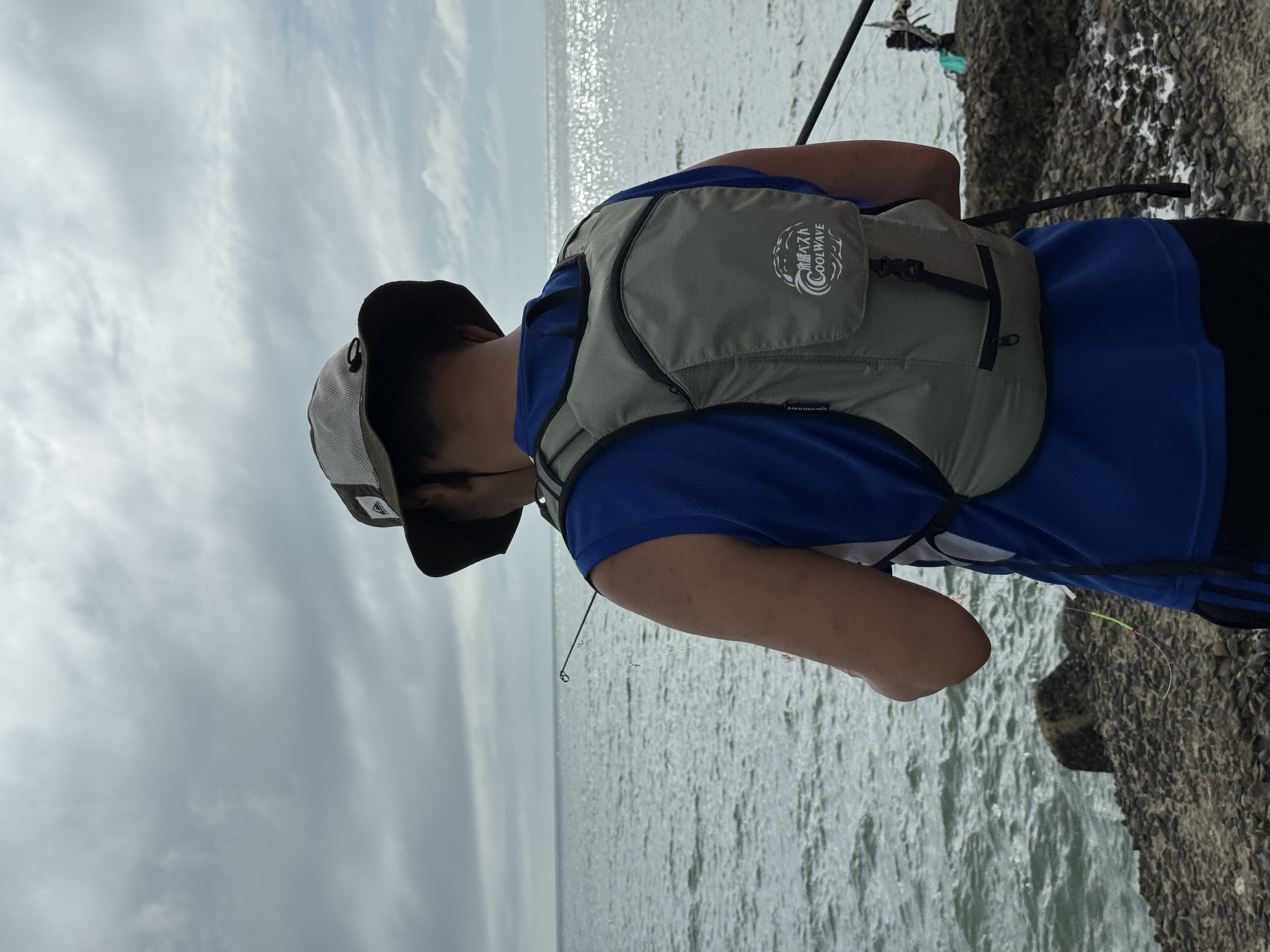
Cover scene: prolonged outdoor sun exposure is one context in which portable cooling is evaluated; the supplied image shows a fishing scenario.
Model Designations and Colors: What Is Verified
The supplied shortlist compares COOLWAVE Basic Model and Professional Model in Black, Blue, and Gray. The verified product-variant evidence identifies CW-01 as the Basic Model and CW-PRO as the Professional Model. It does not provide a performance table that differentiates one designation from the other. Nor does the supplied evidence establish that Black, Blue, or Gray changes cooling duration, flow rate, weight, or pump behavior.
| Shortlist dimension | Basic Model | Professional Model | Evidence boundary |
|---|---|---|---|
| Model designation | CW-01 | CW-PRO | Documented variant names in the supplied evidence. |
| Shortlist colors | Black, Blue, Gray | Black, Blue, Gray | Color options named in the assigned shortlist; no color-linked performance claim is documented. |
| Documented cooling-performance difference | None in supplied evidence | None in supplied evidence | Do not infer superiority from the Professional label. |
| Purchase decision | Confirm SKU, sample, and terms | Confirm SKU, sample, and terms | Selection should follow verified availability and application fit. |
A buyer may still prefer Professional because of naming, packaging, or commercial positioning, but those are procurement preferences, not thermal evidence. The reverse is also true: Basic is not shown to be lower-performing. The only defensible shortlist rule from the supplied facts is to keep both designations eligible until the supplier confirms SKU availability, sample terms, and intended use.
Why Color Should Be Treated as a Specification, Not a Performance Signal
Color in this shortlist is a configuration and logistics attribute. It can matter for uniform matching, visual identification, stock planning, or end-user acceptance. It should not be entered into a thermal comparison unless the supplier provides test evidence that isolates color as a variable. The supplied documents do not provide that evidence.
Buyers should ask for color-specific SKU codes, cleaning instructions where available, and written confirmation that the selected color is available in the requested model designation. These checks are ordinary procurement verification, not an implication that one color is better. Black, Blue, and Gray should remain color options in the evaluation record, not performance categories.
The Common Specification Checklist for Both Designations
The same checklist applies to Basic and Professional because the supplied shortlist material presents a common specification envelope rather than a model-by-model performance split. Each item should be verified in the quotation, sample, and acceptance record.
| Procurement checkpoint | Supplied detail | Buyer verification |
|---|---|---|
| Cooling architecture | Water-circulation cooling with backpack and two ice packs. | Confirm included components, cold-source replacement, and tubing serviceability. |
| Listed duration | 3–4 hours per charge and ice-pack cycle. | Confirm ambient conditions, workload, clothing layers, pump setting, and measurement method. |
| Weight | Under 2 kg. | Confirm whether weight includes water, ice packs, and power bank. |
| Pump input | 5V, 150mA maximum. | Match power-bank output and review electrical safety requirements. |
| Flow rate | 320–370 ml/min. | Request flow-test conditions, tolerances, and head-pressure information. |
| MOQ | 10 units. | Confirm mixed-color and mixed-model rules for pilot orders. |
| Lead time | 7–14 days. | Confirm whether the period starts at purchase order, artwork approval, or material readiness. |
| Warranty | 6 months for the water-cooled vest. | Confirm component coverage for pump, bag, tubing, and labor. |
| ODM | Listed as available. | Clarify scope; the capability record also lists customization as NO. |
Technical Reading: Water Circulation, Ice Packs, Pump, and Flow
Water circulation is the core mechanism: a pump moves chilled water through the vest, while reusable ice packs provide the cold source. The pump specification is low-voltage: 5V and 150mA maximum, which is relevant to power-bank selection for a power-bank cooling vest. The listed flow rate is 320–370 ml/min. These are useful RFQ anchors because they define the electrical and hydraulic envelope a buyer can test.
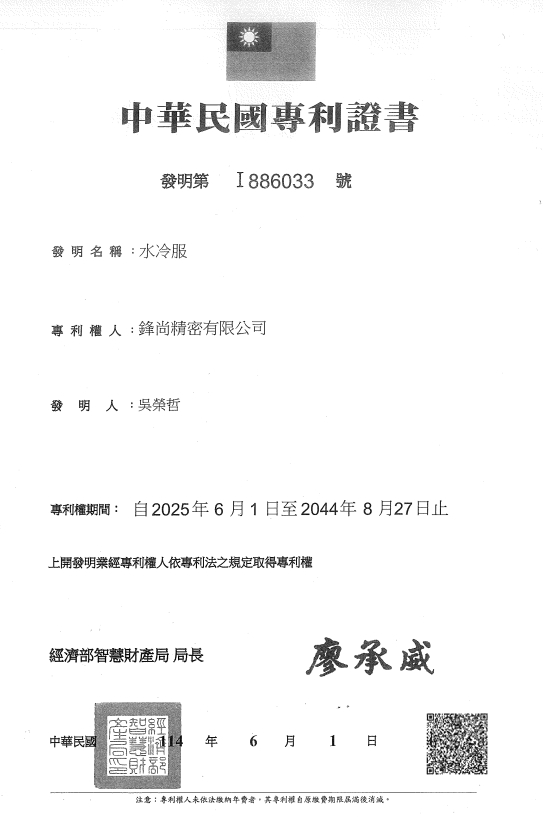
The supplied patent record cites ROC patent I886033 for water-cooled vest structure and cooling system.
Two qualifications matter. First, the 3–4 hour duration is a listed product specification; the supplied evidence does not state the ambient temperature, humidity, workload, clothing layer, or measurement method. Second, the flow rate is a listed range; without head-pressure and test conditions, it should not be compared mechanically with another supplier’s number. The buyer’s check is a documented test method and acceptance criterion, not a debate over which brochure number looks higher.
Technical credibility is supported, but not overextended, by the patent record. The supplied file cites ROC patent I886033, issued 2025-06-01 and expiring 2044-08-27 by the Intellectual Property Office, Ministry of Economic Affairs, for water-cooled vest structure and cooling system. The patent shows a documented structural filing; it does not, by itself, prove cooling duration or field performance. Those remain sample and test questions.
Within the product family, the water-circulation design is often described as an ice water circulation cooling vest or a portable cooling vest. For procurement, the precise terms matter less than the configuration: pump, tubing, reservoir or ice-pack chamber, power source, and serviceable parts. A buyer should confirm which components are replaceable and what the 6-month warranty covers.
Application Fit: Where the Shortlist Is Relevant
The supplied case material describes a Taiwan deployment of 100 units for workers in high-temperature environments. The listed sectors are construction sites, outdoor work, metal-sheet factories, and street vendors. The case report states effective body cooling, heatstroke prevention, improved work efficiency, and worker comfort. Those are reported outcomes from that deployment; they are not a guarantee that every site will achieve the same result.
For a metal-roof factory or another high-heat workplace, the shortlist question is fit: Can the vest be worn with existing PPE? Is the backpack compatible with the task? Can ice packs be recharged or replaced across shifts? Does the 3–4 hour listing match the work block that needs coverage? These are application questions, not evidence that Basic or Professional performs differently.
Outdoor and prolonged-sun-exposure scenarios are also relevant to portable cooling and heatstroke-prevention categories. The same discipline applies: use the product only within the supplier’s stated conditions, pair it with site heat protocols, and verify performance in the actual clothing ensemble. The shortlist does not replace a site risk assessment.
Dual Cooling vs Passive Ice Packs: A Fit Boundary, Not a Winner
The COOLWAVE architecture uses ice packs plus pump-driven circulation. A passive ice-pack vest uses a cold source without pumped circulation. The supplied evidence supports that architectural distinction, but it does not provide a controlled side-by-side thermal test. Buyers should therefore avoid a simple claim that dual cooling is better for every user.
A fit-based comparison is more defensible. Dual cooling introduces a pump, tubing, a power source, and maintenance checks; it may suit buyers who want active water circulation and can manage those components. A passive option may appeal where simplicity or no power source is the priority. The correct choice depends on the work block, PPE layering, available charging or ice-replacement routines, and the supplier’s documented performance under the buyer’s conditions.
Color does not change this architecture. Black, Blue, and Gray should be evaluated as SKU and user-acceptance choices, not as thermal categories.
Market and Procurement Context
External context supports the procurement focus but does not choose a model. Dataintelo’s 2026 cooling-vest market report, published in May 2026, estimated the global cooling-vest market at USD 342 million in 2025, with industrial applications accounting for 34.5% of revenue share. That is a market-level estimate, not a COOLWAVE performance benchmark.
Occupational-safety framing is similarly general. NIOSH identifies water-cooled garments, air-cooled garments, cooling vests, and wetted overgarments as examples of personal cooling systems for heat exposure. That classification supports treating the product as heat-exposure equipment requiring verification, but it does not certify this or any specific vest.
Buyer language reflects the same category. Searches for an industrial cooling vest, professional cooling vest, lightweight cooling vest, long-lasting cooling vest, or cooling gear for prolonged sun exposure describe intended use and constraints. They are not proof of duration, comfort, or heatstroke prevention. The shortlist should be matched to those needs through sampling and documented terms.
Supplier Terms: MOQ, Lead Time, Warranty, and ODM Scope
The commercial terms in the supplied capability record are specific enough to support a pilot-order discussion. MOQ is 10 units; lead time is 7–14 days; after-sales support includes a 6-month warranty for the water-cooled vest; production mode is listed as ODM. The same record lists customization as NO. That combination needs clarification before a buyer assumes full custom development.
Ask what ODM covers in practice: existing-model labeling, packaging, color assortment, or design changes. Confirm whether the 7–14 day lead time starts at purchase order, artwork approval, or material readiness. Confirm whether the 10-unit MOQ applies to mixed colors or mixed Basic and Professional designations. Confirm warranty coverage by component, because pump, tubing, bag, and vest shell may not carry the same service life.
Capacity claims should also be handled carefully. The supplied third-party material uses different capacity bases, so this article does not convert them into a single usable capacity number. For a pilot, the relevant check is the supplier’s written commitment for the requested quantity, colors, and delivery date.
A Practical Evaluation Sequence for Buyers
- Lock the shortlist names. Record CW-01 Basic Model and CW-PRO Professional Model, then list Black, Blue, and Gray preferences. Confirm availability by model and color combination.
- Confirm the configuration. Check water-circulation cooling, backpack, two ice packs, pump, tubing, and power connection.
- Verify the specifications. Confirm the 3–4 hour listing, under-2 kg weight, 5V/150mA pump, and 320–370 ml/min flow. Ask for the test method and weight definition.
- Sample in the real ensemble. Wear the vest with site PPE, during the actual workload, and with the intended ice and charging routine.
- Check commercial terms. Confirm MOQ 10, 7–14 day lead time, 6-month warranty, and ODM scope, including the stated customization limit.
- Write acceptance criteria. Define flow checks, leak checks, runtime observations, component lists, and the warranty process before purchase.
Frequently Asked Questions
Is the Professional Model better than the Basic Model?
The supplied evidence does not document a performance difference between CW-PRO Professional Model and CW-01 Basic Model. Professional is a model designation, not proof of superior cooling. Buyers should compare confirmed SKU availability, sample results, color options, and commercial terms.
Do Black, Blue, and Gray vests cool differently?
No supplied evidence links color to cooling duration, flow, or pump performance. Color is a configuration and procurement attribute in this shortlist. Confirm the desired color is available in the chosen model designation and ask for color-specific SKU details.
What do the 3–4 hour and 320–370 ml/min figures mean?
They are listed specifications for cooling duration per charge and ice-pack cycle and for pump flow. The supplied evidence does not state the test conditions, so buyers should request the measurement method, ambient conditions, workload, and flow-test setup before treating them as acceptance limits.
What are the MOQ, lead time, warranty, and ODM terms?
The listed terms are MOQ 10 units, 7–14 day lead time, 6-month warranty for the water-cooled vest, and ODM production mode. The capability record also lists customization as NO, so the exact ODM scope should be confirmed in writing.
What should a buyer verify in a sample?
A sample check should cover worn weight with the intended power bank and ice packs, pump and flow behavior, leak points, ice-pack replacement, compatibility with PPE, and the actual work block the vest must cover. These checks are more useful than inferring performance from the model name or color.
Shortlist Conclusion
The shortlist answer is deliberately narrow. Basic Model and Professional Model are the two COOLWAVE designations; Black, Blue, and Gray are the color choices in the brief; the supplied evidence does not rank them by cooling performance. Procurement value comes from a common checklist: water circulation, two ice packs, 3–4 hour listed duration, under-2 kg weight, 5V/150mA pump, 320–370 ml/min flow, MOQ 10, 7–14 day lead time, 6-month warranty, and ODM scope.
Buyers should select on confirmed availability, sample performance, application fit, and written commercial terms. That approach keeps the Basic and Professional models in a fair comparison and prevents a color or model label from becoming an unsupported performance claim.
Reference document: Shokunin product brochure, PDF.
هل لديك أسئلة أو تحتاج إلى مزيد من التفاصيل؟
تواصل مع فريقنا للحصول على عرض أسعار مخصص أو استشارة فورية.
طلب عرض أسعار
املأ النموذج أدناه وسيتواصل معك فريقنا بعرض مقترح مخصص.
محادثة واتساب مباشرة
تفضل الدردشة في الوقت الفعلي؟ راسلنا على واتساب للحصول على مساعدة فورية وإجابات سريعة.
- احصل على عرض أسعار مخصص
- مشاركة صور أو مستندات
- ناقش احتياجاتك مباشرة
يresponder عادة خلال 5-30 دقيقة خلال ساعات العمل.