
Dual Cooling Water Cooling Vest FAQ: Pump, Materials, Runtime, and Acceptance
Dual Cooling Water Cooling Vest FAQ: Pump, Materials, Runtime, and Acceptance
For a buyer moving from evaluation to execution, the important question is not only what the Dual Cooling Water Cooling Vest is, but what the sample must prove before a purchase order is released. This FAQ answers the technical and procurement questions around the included kit, the 5V/150mA pump, the 320–370 ml/min flow specification, the listed 3–4 hour runtime, the under-2 kg weight claim, the specified materials, and the acceptance terms tied to a 10-unit minimum order, a 7–14 day lead time, and a 6-month warranty.
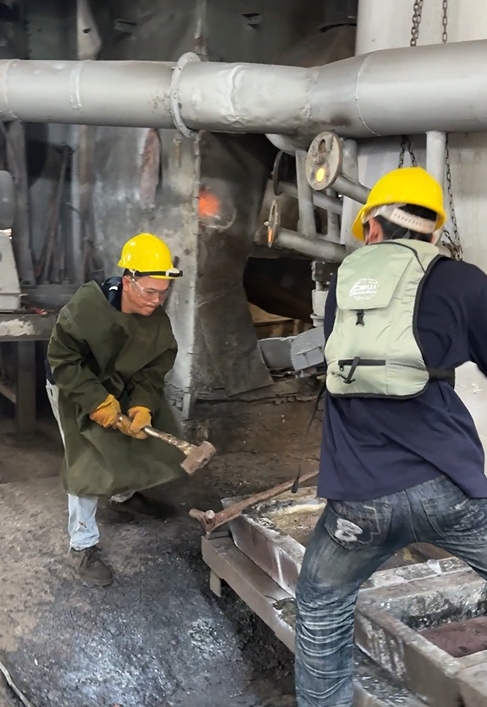
Metal sheet factories are among the high-temperature environments listed for the cooling vest. Image source: supplied Shokunin material.
What is included in the Dual Cooling Water Cooling Vest package?
The package described for this FAQ includes the water-cooled vest, its backpack-style water reservoir assembly, and two ice packs. That contents list matters at the acceptance stage because the buyer is not only approving a garment; the buyer is approving a wearable cooling system whose water bag, tubing, pump, ice packs, cap, and strap must work together as one configuration.
Shokunin is the cooling-vest brand of Feng Shang Precision Co., Ltd., a Taiwan-based manufacturer whose public profile lists water-cooled vests among its product lines. For procurement purposes, the included-items check should be written into the purchase order: vest, reservoir assembly, two ice packs, pump, tubing, cap, shoulder strap, and the agreed documentation. If the sample arrives without one of those items, or with a different configuration, the acceptance record should show the difference before mass production begins.
How do the 5V/150mA pump and 320–370 ml/min flow relate to the listed 3–4 hour runtime?
The pump is listed at 5V and 150mA maximum, with a stated flow rate of 320–370 ml/min. Those are circulation and electrical specifications. The 3–4 hour figure is a separate cooling-duration listing, described as the duration per charge or ice-pack cycle. In practical evaluation, the two should be read together but not treated as interchangeable: the pump moves chilled water through the vest, while the usable duration depends on the ice packs, water volume, ambient conditions, workload, clothing layers, power-bank behavior, and the pump’s operating conditions.
A 5V input is in the voltage class used by many portable power banks, so the specification is relevant to power-source selection. It does not prove compatibility with every power bank. The connector type, cable, power-bank output behavior, and low-current shutoff settings can all affect whether the pump runs as expected. The 150mA maximum current rating is also a component-level figure; it should not be converted into a guaranteed runtime without a measured test using the actual sample and the intended power source.
The 320–370 ml/min range describes the water-circulation rate. Flow is affected by tubing length, bends, lift, reservoir level, cap sealing, and any restriction in the cooling path. A buyer should therefore measure flow on the assembled sample, with the supplied tubing and a representative power bank, rather than accepting a bench figure that was not tied to the delivered configuration. The same test should record whether the pump primes reliably after the reservoir is filled and the tubing is connected.
Runtime interpretation: the published 3–4 hour cooling duration should be verified under recorded conditions. The supplied materials do not state the ambient temperature, humidity, workload, water fill level, ice-pack starting temperature, or clothing configuration used for that figure. A buyer’s acceptance test should define those conditions so that a passed or failed result is meaningful.
Why is the vest listed under 2 kg?
The product listing states a weight within 2 kg. That is a total-product claim, not a component-by-component weight breakdown. The architecture uses a small pump, a wearable water bag, tubing, two ice packs, textile construction, and a shoulder strap rather than a compressor-based cooling unit. That architecture is consistent with a portable vest, but the exact contribution of the water bag, ice packs, pump, tubing, and textile is not disclosed in the supplied materials.
For sample acceptance, the weight should be measured in a defined condition. Buyers should ask whether the under-2 kg figure refers to the dry vest, the vest with the water bag filled to a stated level, the assembly with two ice packs installed, or the complete setup including a power bank. Those are different configurations and can produce different results. The weight check should therefore be tied to the purchase configuration, not treated as a single unqualified number.
Weight matters because the vest is worn during work. A lighter assembly can reduce carrying burden, but it is not proof of cooling performance, durability, or comfort over a full shift. The useful procurement question is whether the delivered assembly stays within the agreed limit while still holding the required water volume, ice packs, pump, and tubing in place.
Which materials should buyers verify in the sample?
The specified configuration lists a TPU water bag, a polypropylene cap, a sand rubber cooling tube, and a 600D polyester shoulder strap. These material calls are useful starting points for sample verification, but they should be confirmed against the actual delivered sample and the supplier’s material declaration. A material name alone does not establish wall thickness, seam quality, connector fit, abrasion resistance, or long-term leak behavior.
| Part or assembly item | Stated specification | What to verify in the sample |
|---|---|---|
| Water bag | TPU | Confirm the TPU grade and wall thickness on the material record; inspect seams, fill-port area, and bag shape under a representative water load; check for leakage and deformation after filling. |
| Cap | Polypropylene | Check thread engagement, seal fit, opening and closing feel, and whether the cap remains secure when the reservoir is tilted or carried. |
| Cooling tube | Sand rubber | Confirm the exact compound designation; check flexibility, kinking at bends, abrasion points, connector fit, and whether the tube remains properly seated under pump pressure. |
| Shoulder strap | 600D polyester | Inspect weave, stitching, edge finishing, buckle attachment, and adjustment range; confirm the strap can carry the filled assembly without obvious strain at the attachment points. |
| Pump | 5V, 150mA maximum; 320–370 ml/min listed flow | Confirm the label and connector; run the pump with the supplied tubing and a representative power bank; check priming, stable circulation, noise, and whether flow remains within the agreed range. |
| Ice packs | Two packs included | Confirm dimensions and fit in the reservoir or designated pockets; check that two packs can be installed as described; inspect for damage before and after a freeze-thaw cycle. |
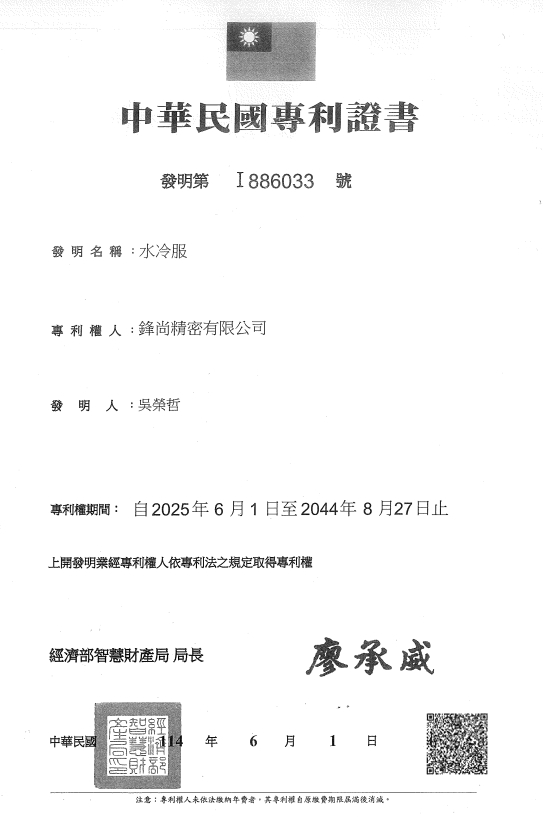
ROC patent I886033 covers water-cooled vest structure and cooling system. A patent supports design provenance, not flow rate, runtime, or sample acceptance. Image source: supplied Shokunin material.
The supplier’s patent record lists ROC patent I886033, issued on 1 June 2025 and expiring on 27 August 2044, with the Intellectual Property Office, Ministry of Economic Affairs, as the authority. The stated scope is water-cooled vest structure and cooling system. That is relevant to design provenance, but it is not a performance certificate. A patent does not replace a measured flow test, a leak check, a runtime observation, or a market-specific compliance review.
What should a buyer check in a pre-shipment sample?
The purchasing terms list pre-shipment test as the acceptance criterion. That phrase needs to become a defined checklist before the order moves forward. The checklist below is not a substitute for the buyer’s own quality plan, but it covers the technical points raised by this product configuration.
- Configuration match. Confirm the vest, reservoir assembly, two ice packs, pump, tubing, cap, and shoulder strap match the approved sample and purchase-order description.
- Leak check. Fill the water bag to the agreed level, close the cap, connect the tubing, and observe the assembly in the positions it will be used. Record any seepage at the cap, seams, tube connectors, or pump inlet.
- Flow check. Run the pump with the supplied tubing and a representative power bank. Record the start-up behavior, whether the pump primes, and the observed flow range. Do not compare a bare-pump bench figure with an assembled vest unless the test conditions are the same.
- Runtime observation. Define the ambient condition, water fill, ice-pack preparation, clothing layer, and work simulation. Record the start and end of the cooling period and any change in flow or pump behavior. This is how the 3–4 hour listing becomes a verifiable sample result rather than a catalog claim.
- Weight check. Weigh the assembly in the agreed configuration and record whether it is dry, filled, with ice packs, or with a power bank. State the condition in the acceptance record.
- Strap and wear-point inspection. Check stitching, buckle attachment, adjustment range, and the points where the filled bag or tubing loads the garment.
- Tube routing and durability check. Confirm the cooling tube does not kink at normal body movement, that connectors stay seated, and that the tube material does not show obvious cracking or abrasion after handling.
- Cap and refill routine. Check that the cap can be opened and closed with the vest in use, that the seal is replaceable if applicable, and that the refill procedure is clear to the operator.
- Documentation. Request the pump specification, material declaration, warranty terms, and the pre-shipment test record. The record should identify the sample, test date, configuration, and result.
These checks are practical acceptance steps, not claims that the product has passed every possible test. The purpose is to align the delivered sample with the specification and to give both parties a common record before shipment.
What purchasing terms apply to a 10-unit order?
The stated commercial terms are a 10-unit minimum order quantity, a typical production lead time of 7–14 days, shipment after payment, freight paid by the buyer, pre-shipment test as the acceptance criterion, full payment, and a 6-month warranty for the water-cooled vest. The manufacturer also lists ODM production services. Buyers should confirm how any requested ODM scope affects the sample, tooling, documentation, and lead time, because the supplied terms do not define a separate customization schedule.
| Term | Stated position | Buyer action before order release |
|---|---|---|
| Minimum order quantity | 10 units | Confirm the SKU, color, packaging, and included accessories for the 10-unit lot. |
| Lead time | 7–14 days typical production lead time | Agree the start trigger and the delivery date in the purchase order; clarify whether the period begins after payment, sample approval, or another event. |
| Payment and delivery | Full payment; shipment after payment; freight paid by buyer | Confirm the Incoterm or delivery arrangement separately if it is not stated in the quotation, and reconcile payment timing with the pre-shipment acceptance record. |
| Acceptance | Pre-shipment test | Write the test items, sample identification, pass/fail record, and photo or video evidence into the order documents. |
| Warranty | 6-month warranty for the water-cooled vest | Define the warranty start date, covered components, claim process, and whether consumable or wear items are included. |
Full payment before shipment makes the pre-shipment acceptance record especially important. The buyer should not rely on a general statement that a test will be performed; the purchase order should identify what is tested, on which sample, under which configuration, and what evidence is provided before shipment. The 6-month warranty should also be tied to a clear start date and a claim route. If the warranty start date is not defined, the buyer and supplier may interpret it differently after delivery.
Where does the specification fit, and what are its limits?
The product is described for cooling in high-temperature environments. Supplied case material lists construction sites, outdoor work, metal sheet factories, and street vendors as users, and one case record describes 100 units deployed in Taiwan for high-temperature environments. The same case record reports effective body cooling, heatstroke prevention, improved work efficiency, and worker comfort as user-reported outcomes. Those are application and case statements, not a controlled thermal-performance result.
The U.S. National Institute for Occupational Safety and Health identifies water-cooled garments, air-cooled garments, cooling vests, and wetted overgarments as examples of personal cooling systems for heat exposure. That classification supports the product’s category relevance, but it does not establish that this particular vest meets a given workplace heat plan. A cooling vest is an auxiliary measure. It should be considered alongside hydration, work-rest scheduling, acclimatization, and site-specific heat-risk controls, not as a replacement for them.
Shokunin states that the vest has received the Disaster Prevention Product and Service Certification Award from the Taiwan Disaster Prevention Industry Association. That award is a relevant credential, but it should not be read as a product-specific PPE certification for every market. Buyers should check the credential that applies to their destination market and intended use, and should keep that review separate from the pump, flow, runtime, and material acceptance checks.
FAQ
What is included with the Dual Cooling Water Cooling Vest?
The described package includes the water-cooled vest, its backpack-style water reservoir assembly, and two ice packs. The purchase configuration should also identify the pump, tubing, cap, and shoulder strap so that the sample and the order match. Buyers should list every included item in the acceptance record rather than relying on a general product description.
What do the 5V/150mA pump and 320–370 ml/min flow mean for the buyer?
The 5V/150mA maximum rating describes the pump’s electrical input, and the 320–370 ml/min figure describes the listed water-flow range. These are component and circulation specifications, not a guarantee of cooling duration. Buyers should test the pump with the supplied tubing and a representative power bank, then record whether the assembled system primes and circulates as expected.
How should the 3–4 hour runtime be verified?
The 3–4 hour figure is a listed cooling duration per charge or ice-pack cycle. The supplied materials do not state the ambient temperature, humidity, workload, water volume, ice-pack preparation, or clothing conditions used for that figure. A buyer should define those conditions in the sample test and record the start and end of the cooling period, along with any change in flow or pump behavior.
Why is the vest listed under 2 kg, and how should that be checked?
Within 2 kg is the listed total weight. The supplied materials do not break that figure down by water bag, ice packs, pump, tubing, or textile. Buyers should weigh the assembly in the configuration they intend to buy, such as dry, filled, with ice packs, or with a power bank, and record the condition with the result.
Which materials and purchasing terms require sample confirmation?
The specified materials are a TPU water bag, a polypropylene cap, a sand rubber cooling tube, and a 600D polyester shoulder strap. The stated purchasing terms are a 10-unit minimum order, a 7–14 day typical lead time, shipment after payment, freight paid by the buyer, pre-shipment test as acceptance, full payment, and a 6-month warranty for the water-cooled vest. Each item should be confirmed against the sample and the purchase-order documents.
What is the practical next step?
The practical sequence is to approve a sample against a written checklist, record the pump and flow result with the delivered tubing and power source, define the runtime conditions, weigh the assembly in the purchase configuration, and confirm the 10-unit order terms, 7–14 day lead time, pre-shipment test evidence, and 6-month warranty start date. If those points are documented, the buyer can move from evaluation to execution with a clearer basis for acceptance.
The public product brochure is available for download: Shokunin product brochure.
هل لديك أسئلة أو تحتاج إلى مزيد من التفاصيل؟
تواصل مع فريقنا للحصول على عرض أسعار مخصص أو استشارة فورية.
طلب عرض أسعار
املأ النموذج أدناه وسيتواصل معك فريقنا بعرض مقترح مخصص.
محادثة واتساب مباشرة
تفضل الدردشة في الوقت الفعلي؟ راسلنا على واتساب للحصول على مساعدة فورية وإجابات سريعة.
- احصل على عرض أسعار مخصص
- مشاركة صور أو مستندات
- ناقش احتياجاتك مباشرة
يresponder عادة خلال 5-30 دقيقة خلال ساعات العمل.