
Dual Knob Car Stereo Production: Inside the Supplier's Evidence
Dual Knob Car Stereo Production: Inside the Supplier's Evidence
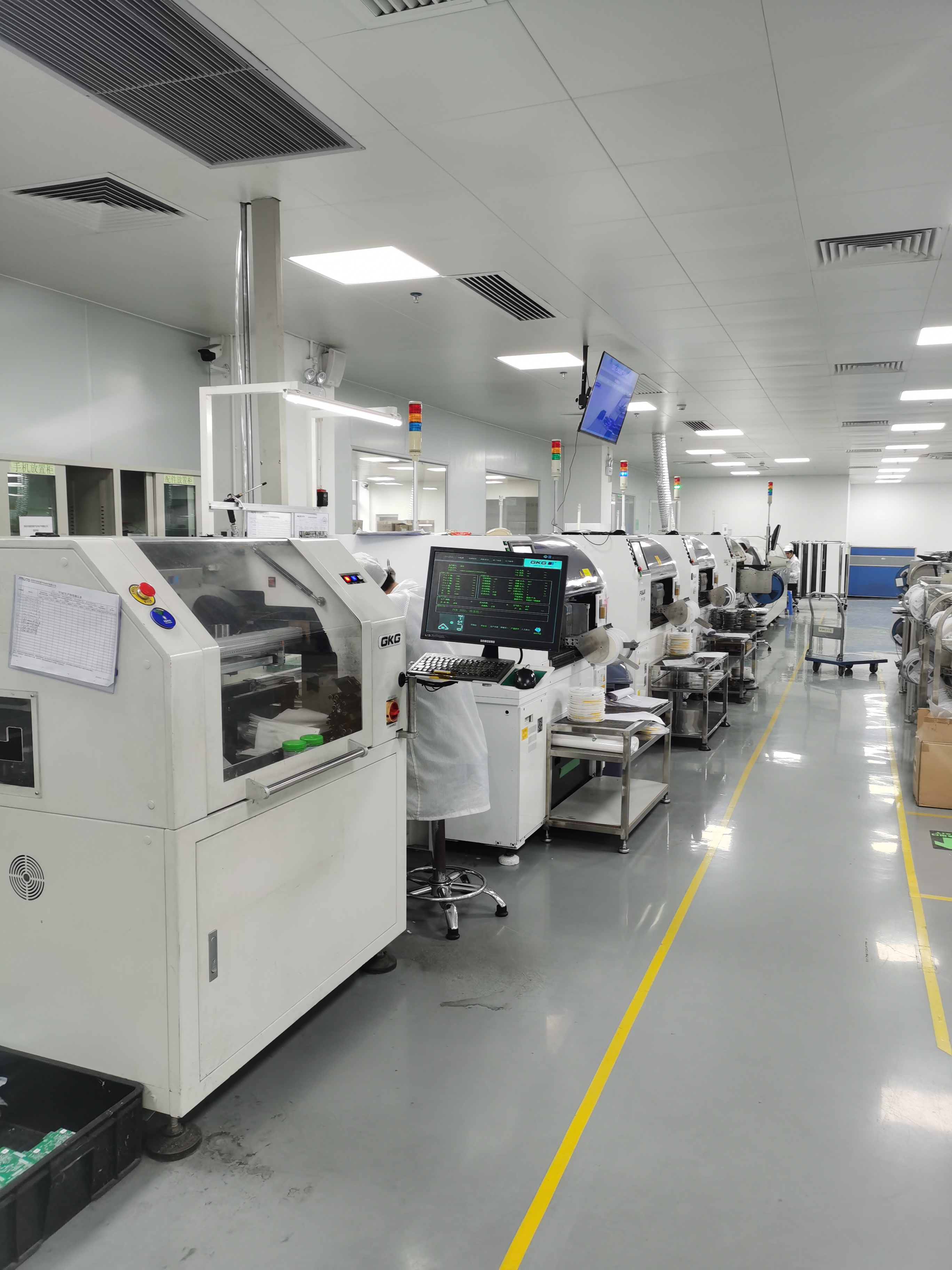
Surface-mount assembly is where a dual knob head unit programme is either supported or constrained: display drivers, radio front-ends and amplifier stages all pass through the same line.
A dual knob car stereo is one of the most useful test cases in supplier evaluation. The form factor forces a manufacturer to combine display bonding, metal chassis fabrication, mechanical encoder assembly, radio-frequency design and thermal management inside one dashboard-sized enclosure — and none of those capabilities appear on a quotation sheet.
The Knob Came Back, and It Brought Manufacturing Requirements With It
The return of physical controls to aftermarket head units is a packaging decision rather than a stylistic one. Two rotary encoders must survive repeated use without play developing in the shaft; the front panel has to hold those controls rigidly while a large display sits behind tempered glass; the radio front-end has to stay isolated from a switching power supply; and heat from an eight-core processor and a 4×50W amplifier class must be moved out of a metal chassis that is often installed behind a closed dashboard fascia.
The commercial context is large enough to justify that engineering. The global in-car infotainment market was valued at USD 22.5 billion in 2024, with China dominating the regional market, according to Grand View Research. Within it, Market Research Future estimated the car audio head unit market at USD 15.44 billion in 2024, with Double DIN remaining the largest single segment. Fortune Business Insights reported that Asia Pacific accounted for 54.21% of car audio revenue in 2025, reaching USD 6.01 billion in that region.
For distributors, importers and installers, the practical argument for knob-based units is control retention. In pickup trucks, SUVs, commercial vans and used-vehicle retrofit programmes, physical volume and tuning controls remain easier to operate by touch and do not depend on screen responsiveness in sunlight or with gloves. That demand reaches suppliers as a specification: double knob layout, 2 DIN universal fitment, and a display large enough to compete with all-touch alternatives.
That combination is difficult to fake. A model number and a screen size can be advertised in a day; encoder tooling, chassis casting or stamping, display bonding and a thermal design that holds up in a hot vehicle cannot.
The Sourcing Problem: Spec Sheets Hide the Factory
Buyers in the evaluation and execution stages rarely struggle to find a dual knob car stereo. The difficulty is determining whether the supplier behind the model number can manufacture it consistently across repeat orders. A quotation typically lists screen size, processor, memory and supported features. It rarely shows the material stack, the soldering process, the test regime, or the exact scope of the certificate that covers the model being quoted.
Five categories of evidence can be requested instead, all of which are verifiable before a purchase order is issued:
- Certificate identity and scope. A certificate number, issuing authority, issue date and the wording that defines which models are covered — including whether covered models share the same PCB layout and key components.
- Declared material stack. Housing polymer, chassis metal, screen glass and sealing materials, stated per model rather than per brand.
- Operating and storage temperature ranges. These separate a catalogue product from a product designed for a specific climate.
- Test equipment actually installed in the factory. SMT, reflow and wave soldering, thermal chambers, drop testing, salt spray and signal shielding rooms are specific, checkable assets.
- Acceptance procedure. Whether testing is sampled or 100%, whether customer on-site inspection is accepted, whether third-party inspection is supported, and whether a sample is confirmed before bulk production.
Each of these points converts a supplier claim into a procurement criterion. The rest of this article works through one supplier's published evidence pack to show what that looks like in practice.
Supplier Evidence: Shenzhen Topnavi Electronic Tech Co., Limited
Shenzhen Topnavi Electronic Tech Co., Limited (brand: TOPNAVI) is a Shenzhen-based manufacturer of car multimedia players, Android car radios, head units, motorcycle CarPlay navigation units and related accessories. The company was founded in 2014, operates a 20,000 m² factory with more than 100 production staff, and reports an annual output of 360,000 units and an export ratio of 95%.
Its engineering base is a 50-engineer R&D team, and its product portfolio spans Android car radio, car head units, car stereo, motorcycle CarPlay navigation, CarPlay AI Box, headrest monitor, car backup camera and DVR categories. Stated markets cover Europe, the United States, South and Central America, and Southeast Asia, with clients reported in more than 70 countries.
Manufacturing capability is published in operational terms rather than as adjectives: OEM and ODM production modes, a monthly capacity of 30,000 units, a typical lead time of 7–15 days, 100% testing, and remote and online after-sales support. Standard items are listed with a minimum order quantity of 1 unit, while documented purchasing terms for volume orders state an MOQ of 10 units with FOB delivery terms — a distinction worth clarifying with any supplier before quoting a client.
Customisation scope as a capability statement
For buyers assessing OEM and ODM depth, the customisation list is more informative than the product list. The manufacturer's declared scope covers Logo, UI theme, boot animation, APP pre-install, language (PT/ES/EN/FR), DSP tuning, button light colour, panel colour, screen size and resolution, RAM/ROM, wired or wireless CarPlay, 4G module, GPS/BeiDou, AHD camera, steering wheel control (SWC), CAN protocol, vehicle adaptation, packaging, firmware OTA and after-sales service.
Read as a capability map, that list implies four separate engineering functions inside the supplier: industrial design and tooling for panel and colour variants, embedded software for UI and firmware, audio tuning for DSP profiles, and vehicle-interface engineering for CAN protocol and SWC adaptation. A supplier that cannot sustain all four will normally limit customisation to logo printing and packaging.
Technical Explanation: What a Dual Knob Platform Actually Contains
Three models in this portfolio carry the dual knob form factor directly, and their specifications show how the packaging decision propagates through the bill of materials.
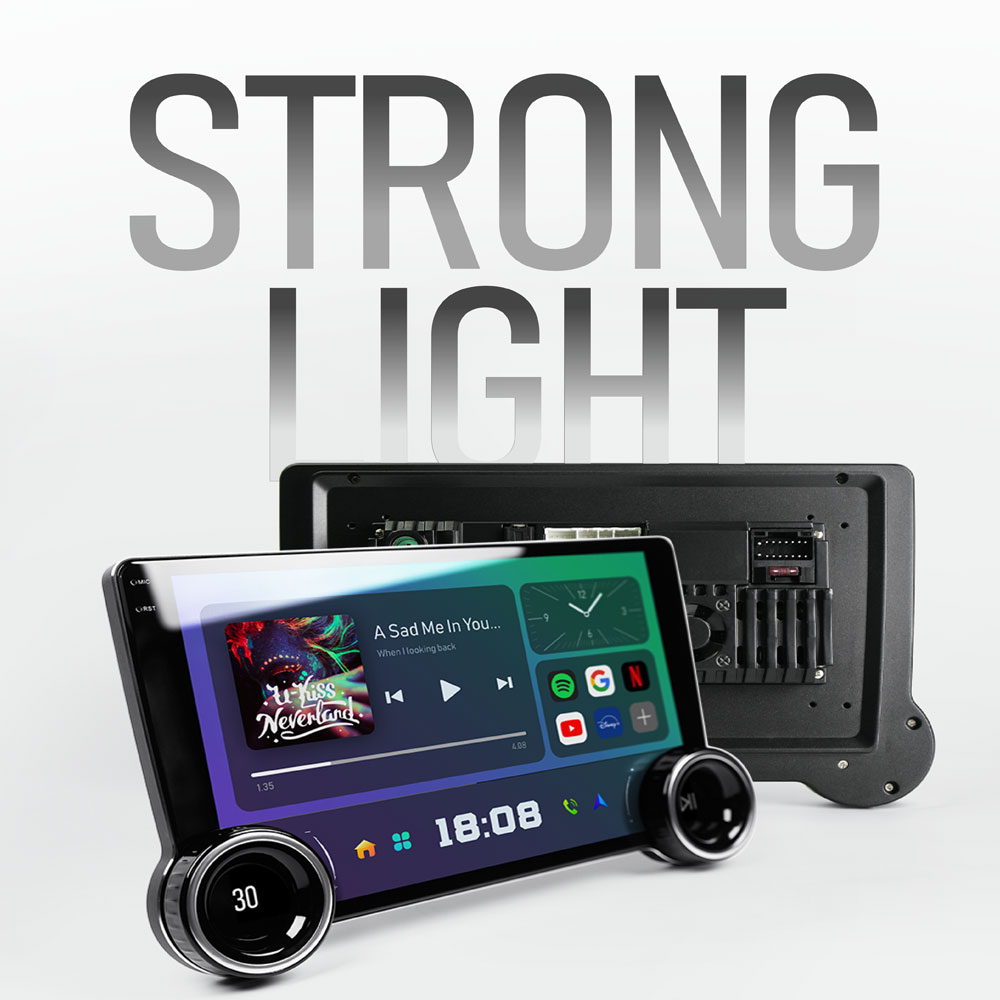
Physical rotary controls and a high-resolution panel share the same fascia, which is why dual knob units depend on rigid front-panel construction and a bonded display stack.
The TN-X23 dual knob car stereo radio pairs a 12.3-inch diamond QLED capacitive touch screen with a double knob design, Android 13, an eight-core UIS8581A processor at 1.6GHz, 4GB RAM and 64GB ROM, and radio IC 4755. It supports wireless Apple CarPlay and wired Android Auto, built-in GPS and a 4G SIM card, and it ships with installation cable and retail box. Its full metal body includes a built-in cooling fan — a detail that only exists because the enclosure also carries a 4×50W high-power amplifier, DC 12V input and a 2 DIN universal fitment.
The TN-X80 dual knob car radio takes a different balance: a 10.1-inch OLED panel at 2000×1200 with Android 13 on the same UIS8581A eight-core platform, DSP, Hi-Res Audio, mirror link, built-in microphone and steering wheel control. Its material declaration — ABS plastic, aluminium alloy and tempered glass — describes a mixed-material fascia rather than a single-moulding design, which is typical of units that must hold two mechanical controls and a bonded glass panel in alignment.
The TN-X15 broadens the family with an 11.5-inch HD touch screen at 1280×720, a dual knob layout, wireless Apple CarPlay, wired Android Auto, Bluetooth 5.0, FM radio, USB/TF playback, mirror link, steering wheel control and rear-view camera input in a 2 DIN universal installation with a metal chassis.
| Model | Form factor | Display | Platform | Control and construction |
|---|---|---|---|---|
| TN-X23 | Dual knob car stereo radio | 12.3 in diamond QLED capacitive touch, double knob design | Android 13, 8-core UIS8581A 1.6GHz, 4GB + 64GB | Double knob layout, full metal body with built-in cooling fan, 4×50W amplifier, 2 DIN universal fit |
| TN-X80 | Dual knob car radio | 10.1 in OLED, 2000×1200 | Android 13, UIS8581A 8-core 1.6GHz | Knob control, dashboard mount, ABS plastic / aluminium alloy / tempered glass |
| TN-X15 | 11.5 in dual knob car multimedia player | 11.5 in HD touch screen, 1280×720 | Android | 2 DIN universal, ABS plastic + metal chassis + capacitive touch screen |
| TN-UK1105 | Single knob car multimedia player | 11.5 in 2K OLED, 2000×1200 | Android 13, TS18L 8-core Cortex-A55 1.6GHz | Universal 1 DIN dashboard mount, metal chassis, 2K capacitive touch screen |
The same factory, a wider platform range
A single dual knob model proves tooling. A portfolio that spans Android and Linux, cars and motorcycles, does more: it shows the supplier maintains more than one software stack, more than one display supply route, and more than one sealing and enclosure technology at the same time.
On the Android side, the TS105 nine-inch head unit runs Android 14 on a UIS7865 octa-core processor with IPS capacitive touch, USB, built-in WiFi, Bluetooth and 3G/4G SIM support, and carries E-mark, CE and FCC certification. The TN-3036 Toyota Prado multimedia player pushes the display envelope to 16.8 inches at 2560×1440 with Android 13, Bluetooth 5.0, built-in GPS, FM/AM RDS, wireless and wired CarPlay and Android Auto, a 4×50W audio output and an operating temperature range of −30°C to 75°C. The TS10 universal head unit uses Unisoc UIS7862S eight-core silicon with 4GB/6GB/8GB LPDDR4X, a ROHM BU32107EFV DSP with 48-band EQ, a TDA7851 amplifier rated 4×48W maximum, and a TDA7703 radio front-end covering FM 87.5–108.0MHz and AM 522–1710KHz with RDS. The TN-AI47 CarPlay box, running Android 11 with HDMI output, extends the same electronics into vehicles that already have a factory screen.
On the Linux side, the TN-9359 two-DIN universal player runs a Linux OS with a 7-inch 1024×600 or 1280×720 display, GPS, Bluetooth, WiFi, FM, USB/TF playback, steering wheel control and AUX input. The TN-RD1001 portable navigation unit combines a 10.26-inch HD IPS touch screen with a 4K UHD rotatable front camera and a 1080P AHD rear camera on 12–24V. Two motorcycle units complete the picture: the TN-M9 with a 5-inch display, V853 ARM Cortex-A7 1.0GHz processor, H.264 decoding and IP67 waterproofing, and the TN-M11 with a 6.25-inch IPS panel at 1560×720, 300 cd/m² brightness, V853/V533 processing, 12–30V input and an operating range of −10°C to +60°C.
| Platform | Representative models | Typical computing base | Operating temperature | Primary application |
|---|---|---|---|---|
| Android, dual knob | TN-X23, TN-X80, TN-X15 | UIS8581A 8-core 1.6GHz, Android 13 | Not stated per SKU | Aftermarket replacement with physical controls |
| Android, universal | TS10, TS105, TN-UK1105, TN-3036 | UIS7862S / UIS7865 / TS18L, Android 12–14 | −30°C to +75°C (TS10, TN-3036) | Retail, fleet, OEM pre-installation |
| Linux, car | TN-9359, TN-RD1001 | Linux OS, 2 DIN or portable chassis | −20°C to +70°C (TN-RD1001) | Cost-controlled retrofit, projection-focused use |
| Linux, motorcycle | TN-M9, TN-M11 | V853 / V533, IP67 | −10°C to +60°C (TN-M11) | Two-wheeler navigation and CarPlay projection |
Materials and accessory integration as engineering evidence
The material declarations across the range are consistent rather than incidental: ABS engineering plastic for housings, aluminium alloy for structural and thermal parts, tempered glass over the display, and silicone sealant where water ingress protection is required — the motorcycle units use all four. Where heat load is highest, the design adds mass rather than removing it: the TN-X23 uses a full metal chassis with a built-in cooling fan, and the TS10 combines an ABS+PC housing with an FR-4 main board and an optional 2.5D tempered glass screen.
Accessory integration is the second signal. The TN-M9 supports a 2K DVR camera, tire pressure detection on the 433 protocol, blind spot detection and AP driving trajectory query. The TN-M11 lists DVR and TPMS functions alongside GPS tracking and dual Bluetooth 4.2/5.0. The TS10 supports DVR and reverse camera input. Supporting DVR and TPMS is not a marketing feature — it requires available processing headroom, an additional wireless protocol stack and a harness design that tolerates extra loads.
Evidence You Can Verify: Certification Scope and Test Regime
Certification is the part of a supplier's evidence pack that is genuinely checkable against a register. Four documents define the compliance position of this product range:
| Certificate | Number | Authority / market | Standard and scope | Issued |
|---|---|---|---|---|
| ISO 9001 Quality Management System | SW25Q20244R1S | Shanghai Sailway Certification Co., Ltd; China and ISO 9001 / IAF recognised regions | GB/T19001-2016 / ISO 9001:2015; covers R&D, production and sales of car audio-visual systems, car multimedia players and GPS navigation systems | 2025-03-11, valid to 2028-03-10 |
| FCC Part 15B | WST23N080171E | Shenzhen WST Testing Co., Ltd; United States | FCC Part 15 Subpart B; certificate covers the full series of Vehicle Navigation Instruments listed, with covered models sharing the same PCB layout and key components | 2023-08-21 |
| CE-EMC Certificate of Conformity | WST23N080170E | Shenzhen WST Testing Co., Ltd; European Union | EN 55032:2015+A1:2020 and EN 55035:2017+A11:2020; covers the listed TN-901 to TN-144 series | 2023-08-21 |
| ECE E24 Type-Approval (E-mark) | E2410R06/024547*00 | NSAI; European Union | UN/ECE Regulation No. 10 (06 series of amendments) on electromagnetic compatibility | 2023-03-30 |
Two details in that table matter more than the certificates themselves. The first is the scope wording: certificates that cover a series of models sharing the same PCB layout and key components are more commercially useful than single-model approvals, because they indicate platform-level design control rather than a one-off test. The second is the separation between quality management (ISO 9001) and product compliance (FCC, CE-EMC, E-mark) — buyers need both, and a supplier that presents only one is telling you something about its process maturity.
As an industry reference point, automotive electronic devices are frequently assessed against ISO 16750 for environmental testing covering temperature, vibration and humidity resilience. Buyers comparing suppliers should ask which environmental standards were applied, not only which market-access marks were obtained.
The production test regime is stated as 100% full function testing before shipment, with customer on-site inspection accepted, third-party inspection such as SGS or TUV supported, and sample confirmation required before bulk production. Factory equipment documented in the evidence pack includes SMT lines, reflow and wave soldering, temperature cycling chambers, drop testing, salt spray equipment and signal shielding rooms for RF testing. Payment terms for volume orders are 30% T/T in advance with 70% T/T against a copy of the bill of lading, and full payment for sample orders.
Application Evidence: Where These Units Actually Ship
Delivery records reveal the mix of channels a manufacturer can serve. Across nine documented projects, the same product families were delivered to online retailers, modification chains, modification shops and automotive OEMs, at volumes ranging from 500 to 10,000 units and durations from two to four years.
| Market | Client type | Volume | Duration | Application |
|---|---|---|---|---|
| United States | Online auto parts retailer | 1,500 units | 3 years | Retail sales to pickup truck and SUV modification enthusiasts |
| Germany | Automotive OEM | 2,000 units | 4 years | Factory pre-installation for new energy vehicle models |
| Brazil | Automotive OEM | 10,000 units | 2 years | Used car upgrade and retrofit, plug-and-play non-destructive installation |
| Russia | Aftermarket car modification shop | 5,000 units | 2 years | Car audio and navigation retrofit for passenger vehicles |
| Pakistan | Automotive OEM | 3,000 units | 2 years | Factory infotainment upgrade for new car models |
| Australia | Automotive OEM channel | 3,000 units | 2 years | Aftermarket modification shop and car audio retail supply |
| South Korea | Car modification shop | 2,500 units | 3 years | Car infotainment system upgrade |
| Mexico | Car modification chain store | 1,000 units | 2.5 years | After-sales upgrade for used car dealerships and private owners |
| Switzerland | Automotive OEM | 500 units | 3 years | Car infotainment system upgrade for local modification shops |
Two patterns are worth noting for procurement planning. First, OEM and aftermarket channels are served from the same production base, which means a distributor is not relying on a supplier that only knows retail packaging. Second, order sizes span two orders of magnitude, from 500 units to 10,000 units — relevant when assessing whether a supplier's capacity claim of 30,000 units per month can accommodate both a pilot batch and a volume programme.
Market Trend Analysis: Where Dual Knob Demand Is Heading
Three verifiable market signals frame the category. First, head unit volume remains concentrated in the Double DIN segment, which Market Research Future identified as the largest part of a USD 15.44 billion head unit market in 2024. Dual knob units are a Double DIN variant, so they inherit that install base rather than creating a separate one.
Second, integration cost is a real part of the buyer's calculation. Grand View Research valued the automotive wiring harness market at USD 50.1 billion in 2023, and harness compatibility is precisely where universal-fit head units either succeed or generate returns. Suppliers that publish installation cable content and vehicle adaptation support are addressing the costliest part of a retrofit, not the cheapest.
Third, regulation continues to shape which suppliers can serve which markets. CE marking is mandatory for car radios entering the EU, covering RED, EMC and LVD requirements, while FCC certification is required for the US market. Suppliers holding both, plus E-mark approval under UN/ECE Regulation No. 10, can support a distributor selling into multiple regions from one purchasing relationship.
Competitively, the car audio and head unit space includes long-established global brands such as Alpine Electronics, Harman International, Sony, Pioneer and JVCKenwood. Manufacturer-tier suppliers compete in a different layer: the private-label, OEM and ODM programmes where the buyer owns the brand, the packaging and the market position. That layer is won on tooling flexibility, certification readiness and repeat-order consistency rather than on consumer brand recognition.
Comparison With Traditional and Alternative Solutions — and the Limits
Dual knob platforms are not automatically the right answer, and a supplier's evidence pack should be read with the trade-offs in view.
Screen area versus control. Two rotary encoders occupy fascia space that an all-touch design would give to the panel. A 10.1-inch or 12.3-inch dual knob unit therefore presents less usable display area than an all-touch unit of the same nominal size. Buyers who prioritise maximum screen area should weigh that against the tactile control benefit.
Universal fitment is not vehicle-specific function. A 2 DIN universal fitment describes the mounting aperture, not the vehicle's data bus. Steering wheel control, factory amplifier retention and CAN protocol behaviour typically require vehicle adaptation and CAN protocol customisation through the OEM/ODM process. Where a specific vehicle model is critical, that adaptation must be confirmed at sample stage rather than assumed from the word universal.
Linux and Android serve different buyer needs. Linux-based units such as the TN-9359, TN-RD1001, TN-M9 and TN-M11 focus on projection, navigation and stability with a narrower local app ecosystem. Android units from Android 12 to Android 14 offer expandable storage, app installation and 4G connectivity, but they also require ongoing firmware maintenance to keep third-party apps stable over the product's service life.
Certification boundaries. The FCC and CE-EMC certificates cover the model series listed on them, where covered models share PCB layout and key components. A derivative design with a materially different board would require its own approval path — a planning point for buyers considering deep hardware customisation.
Customisation lead time. Panel colour, UI theme, boot animation and CAN protocol work are engineering tasks measured in samples and revisions, sitting outside the stated 7–15 day lead time that applies to standard configurations.
Against a traditional single-DIN all-touch unit, a dual knob model costs more in parts and tooling because of the encoder assemblies, reinforced fascia and, in the TN-X23, an active cooling solution. Against a factory-fitted OEM head unit, an aftermarket dual knob unit offers installation flexibility and multi-region certification but not the deep vehicle integration that a platform-specific OEM development programme provides. The honest position is that dual knob units sit between those two alternatives, and buyers should select them for control retention and install-base coverage rather than as a universal upgrade for every vehicle.
Future Outlook
Three directions are visible from the evidence pack itself. Display resolution in the portfolio has already moved from 1024×600 on earlier head units to 2000×1200 OLED on the TN-X80 and TN-UK1105, and to 2560×1440 on the TN-3036 — a pattern that will continue to raise the panel share of head unit cost and make display bonding quality a more important selection criterion than screen size alone.
Second, two-wheeler platforms are converging with car platforms. The TN-M9 and TN-M11 already deliver CarPlay and Android Auto projection at IP67, with tire pressure detection and DVR support. As that segment matures, buyers sourcing for motorcycle accessory channels will increasingly evaluate the same suppliers they use for car audio.
Third, firmware OTA and vehicle adaptation are becoming recurring service obligations rather than one-time engineering tasks. Suppliers that treat CAN protocol support, OTA capability and after-sales remote support as part of the product — rather than as exceptions — will be better positioned as distributors extend product life cycles across multiple model years.
FAQ
What does OEM/ODM capability actually include for a dual knob car stereo programme?
Documented OEM and ODM scope covers Logo, UI theme, boot animation, APP pre-install, language (PT/ES/EN/FR), DSP tuning, button light colour, panel colour, screen size and resolution, RAM/ROM, wired or wireless CarPlay, 4G module, GPS/BeiDou, AHD camera, steering wheel control, CAN protocol, vehicle adaptation, packaging, firmware OTA and after-sales service. Standard configurations are quoted with a 7–15 day lead time and, for standard items, a minimum order quantity of 1 unit; volume purchasing terms state an MOQ of 10 units with FOB delivery.
How can a buyer verify a supplier's production claims before placing an order?
Four checks are practical. Request certificate numbers with issuing authority and scope wording — for this supplier, ISO 9001 certificate SW25Q20244R1S, FCC Part 15B certificate WST23N080171E, CE-EMC certificate WST23N080170E and ECE E24 type approval E2410R06/024547*00. Confirm the documented test regime, which states 100% full function testing before shipment. Ask for third-party inspection, which is supported through SGS or TUV alongside customer on-site inspection. And require sample confirmation before bulk production, since that step verifies both the product and the supplier's documentation accuracy.
Which platform is a better fit for a dual knob head unit: Android or Linux?
Both exist in the same production range, and the choice depends on the market. Android models such as the TN-X23, TN-X80, TS105 and TN-3036 provide app installation, higher memory configurations up to 8GB and 4G connectivity on Android 12, 13 or 14 platforms. Linux models such as the TN-9359, TN-RD1001, TN-M9 and TN-M11 focus on CarPlay and Android Auto projection, navigation and accessory functions with a narrower local app ecosystem and, typically, a simpler software maintenance burden. Buyers whose customers expect installable apps generally specify Android; buyers optimising for stability and cost in retrofit channels frequently specify Linux.
Can a dual knob head unit support DVR and TPMS accessories?
Accessory support is model-specific and should be confirmed per SKU. Documented support includes the TN-M9 motorcycle navigation, which supports a 2K DVR camera, tire pressure detection on the 433 protocol, blind spot detection and AP driving trajectory query. The TN-M11 lists DVR and TPMS functions with GPS tracking and dual Bluetooth 4.2/5.0. The TS10 head unit lists DVR and reverse camera support with steering wheel control. For dual knob car models, camera and steering wheel control inputs are documented, but DVR and TPMS capability should be verified against the specific model's configuration before specifying it in a quotation.
What are the practical limits of a universal 2 DIN dual knob platform across vehicle models?
A universal 2 DIN fitment defines the mounting aperture and does not guarantee vehicle-specific functions. Steering wheel control, factory amplifier retention and CAN protocol behaviour generally require vehicle adaptation, which is handled as a customisation service rather than as a default. Physically, dual knob designs consume fascia area that would otherwise be display. On compliance, FCC and CE-EMC certificates apply to the model series listed on them, where covered models share the same PCB layout and key components, so a redesigned board starts a new approval path. These limits are manageable, but they need to be identified at sample stage rather than after a volume order.
What capacity and lead time should a buyer plan around?
The published manufacturing figures are a monthly capacity of 30,000 units from a 20,000 m² facility with more than 100 production staff, an annual output of 360,000 units, and a typical lead time of 7–15 days for standard configurations. Documented delivery records show completed programmes from 500 units over three years to 10,000 units over two years, so pilot batches and volume programmes are both represented in the reference base. Buyers should treat the stated lead time as applying to standard configurations and plan separately for customised panel, software or CAN protocol work.
Reading the Evidence Pack
A dual knob car stereo production capability is not demonstrated by the existence of a model number. It is demonstrated by a material stack that can be named, a thermal solution that exists for a stated reason, a platform range that spans more than one operating system, certification that names its scope rather than its logo, a testing regime that can be inspected, and a delivery record that covers both OEM pre-installation and aftermarket retrofit at very different order volumes. Buyers who evaluate suppliers on those six points will find that the difference between quotations becomes much easier to explain to their own customers.
For the full technical documentation, model specifications and customisation options referenced in this article, the supplier's product brochure is available for download: Topnavi product brochure (PDF).