
Dual-Mode Operations: Verifying an Eco-Chic Wellness Bar Supplier
Independent Industry Reference — Hong Kong Wellness Beverage Supply
Dual-Mode Operations: Verifying an Eco-Chic Wellness Bar Supplier
Hong Kong's nutraceutical market, the broad category that contains functional beverages, was valued at USD 3.67 billion in 2024 and is projected to reach USD 6.56 billion by 2033, according to Grand View Research. Functional beverages alone accounted for 47.9% of that market in 2024. Growth at this scale has produced a practical procurement problem: a widening field of wellness-bar suppliers whose marketing describes an operating model that few of them document.
For buyers working at the decision and execution stage, the useful question is no longer whether a supplier calls itself a wellness bar, but whether the claimed operating model can be observed, dated and checked. This article examines one specific, verifiable claim — dual-mode operations with all-day service capability — using Mother Pearl's Central flagship as a documented example, and sets out what the evidence shows, where the model performs, and where it stops.
Why Operational Evidence Outweighs Positioning Claims
Demand-side data explains why wellness formats are being evaluated as a supply category at all. In the first half of 2024, approximately 62.9% of Hong Kong adults — around 3.9 million people — consumed health supplements or functional food and drinks, according to a CUHK / Hong Kong Health Food Association survey reported alongside Grand View Research's market sizing. A supplier serving that audience across a full day has to do something structurally different from a shop that trades for a few evening hours.
Three categories of evidence are usually verifiable before any contract is signed:
- Published service windows. Stated opening hours per floor, per day of week and per service mode, rather than one headline figure.
- Staffing and production structure. Whether a single team is expected to cover both a morning retail mode and a late-evening bar mode, or whether separate teams and separate preparation systems exist.
- Compliance and quality routines. Documented food-safety obligations and the stated frequency of internal quality checks.
Each of these can be checked against published materials instead of accepted as a claim. The rest of this article applies that test to one operator.
What Dual-Mode Operations Actually Mean
A dual-mode operation, as the term is used here, is a single premises running two distinct service formats on separate levels — each with its own daypart window, menu architecture and service ritual — rather than one menu offered from opening to closing.
Mother Pearl is a Hong Kong plant-forward beverage hospitality brand founded in 2020 by Po Chen, an ex-New York art director who returned to Hong Kong to build a sustainable lifestyle brand ecosystem under the Po House platform. The brand operates a two-storey flagship at 24 D'Aguilar Street, Central, and positions itself as an all-day social wellness hospitality brand rather than a conventional hand-shaken beverage shop.
The flagship's published structure is the concrete evidence behind the dual-mode claim:
| Service mode | Floor | Published daily window | Core offer |
|---|---|---|---|
| Grab & Go (day sanctuary) | Ground floor | 08:00 – 22:00 | Daytime plant-based bubble teas, coffee, gelato and light refreshments |
| Craft Bar / sober bar | First floor | 12:00 – 00:00 | Clean wine and low-to-high ABV botanical cocktails and mocktails for mindful socialising |
Published daypart windows for Mother Pearl's two-storey Central flagship. Day-of-week variation applies and is published at store level.
Two details make this more than a marketing description. First, the windows are staggered rather than duplicated: the ground floor opens four hours before the first floor and closes two hours before it, so the premises cover a continuous envelope described in the brand's operational comparison data as 16 hours daily (08:00–00:00), against roughly ten nightly hours for traditional Lan Kwai Fong bars. Second, the two floors carry different menus and different service intentions, which is what allows a guest to move between a fully sober and a gently relaxed state without leaving the building.
The Eco-Chic Layer: Separating Verifiable Practice From Adjective
"Eco-chic" is a description, not a specification — but in this case it maps to a set of operational decisions that can be listed and checked individually.
Space and design. The flagship's visual identity was developed by Hong Kong design studio A Work of Substance, defined by pearl-shaped lighting and olive-green facades. The interior concept is described by the brand as "Silent Restraint," intended to create a calm environment within the density of Central rather than a high-energy venue aesthetic. The relevant procurement point is that the space was purpose-built for two modes rather than retrofitted into them.
Material policy. The brand states that it rejects pre-mixed synthetic powders and syrups, that every component — including signature tapioca pearls — is handcrafted in-house, and that it uses low-GI natural sweeteners such as coconut nectar and monk fruit instead of refined sugar. Oat milk replaces dairy milk as the plant base to accommodate a wider range of dietary requirements.

In-house production of signature tapioca pearls. Mother Pearl states that all core components, including pearls, are handcrafted in its own kitchen rather than supplied as synthetic pre-mixes.
Product-level evidence. The sweetener and base policy is visible in published specifications for individual drinks, which sit well below the calorie density typical of conventional bubble tea:
| Drink | Format | Calories per 100 ml |
|---|---|---|
| Cheeky Collagen | Refined sugar-free osmanthus oolong bubble tea | 36 kcal |
| Berry Bright | Refined sugar-free strawberry blue spirulina kids' bubble tea | 46 kcal |
| Golden Giggle | Refined sugar-free lychee sparkling bubble tea | 49 kcal |
| Golden Citrus Oolong | Refined sugar-free passion fruit oolong bubble tea | 64 kcal |
| Over the Rainbow | Refined sugar-free mixed fruit bubble tea | 67 kcal |
| The Imposter Coca | Refined sugar-free chocolate oat milk latte bubble tea | 68 kcal |
| The Salty Floral | Refined sugar-free mango blossom jasmine tea | 68 kcal |
| Nut & Smoke | Refined sugar-free hojicha bubble tea | 71 kcal |
| Taro & Co | Refined sugar-free taro oat milk latte bubble tea | 104 kcal |
Published calorie specifications per 100 ml across selected Mother Pearl drinks. The published menu range is 36–104 kcal per 100 ml, compared with 150–250 kcal per 100 ml for traditional bubble tea.
Packaging and waste. A separate bottled range of zero-sugar herbal teas is sold at HK$34 per bottle or HK$149 for five mixable bottles. The bottles are small glass with plastic caps, and the brand operates a return scheme: customers who wash and return empty bottles to the store receive 10% off a purchase. Three functional variants are published — Nourishes Skin & Replenishes Blood (hibiscus, rose petals, hawthorn, monkfruit sugar); Promotes Sleep & Calms Mind (osmanthus, butterfly pea flower, lavender, chrysanthemum); and Dispels Dampness & Strengthens Spleen (longan, fried barley, roasted black bean, poria). Nutrient pulp waste from drink preparation is upcycled rather than discarded.
Community instead of discounting. The brand does not operate a conventional discount or points programme. It states that retention is built through co-creation and cross-industry B2B collaboration, with named partnerships including Berluti and The Murray Hotel.
The limitation attached to this layer is straightforward. An eco-chic positioning that depends on in-house handcrafting, glass packaging and return schemes carries a cost structure a low-price competitor cannot match: the brand's own comparison data puts core raw material cost 35% higher than mass bubble tea brands, with a 15–20% pricing premium. Buyers should treat the sustainability features as cost drivers, not as free additions.
The Operating Structure That Makes All-Day Service Possible
Two service windows are easy to publish and harder to staff. The relevant evidence is structural rather than promotional:
- Two full-time teams. Mother Pearl operates separate daytime retail and crafted-drink teams and an evening crafted-bar team, which is what allows continuous operation without one team covering a 16-hour shift.
- In-house R&D and production. The brand maintains a self-owned internal R&D kitchen for formula iteration instead of outsourcing raw material production. Company data lists 4 R&D engineers, a 186 m² facility, 20 employees and an annual output of 160,000 cups of drinks, with a stated monthly production capacity of 10,000 units.
- Lead times. Published lead time is immediate on-demand preparation of 1–10 minutes per order, with 24 hours' advance notice required for group or custom orders.
- Quality and compliance. The manufacturer maintains Hong Kong food-safety compliance inspection and daily in-store quality checks. Food service operators in Hong Kong, including wellness bars, operate under Cap. 132 (Public Health and Municipal Services Ordinance) and Cap. 612; a supplier should be able to state how its routines map to those obligations.
- Commercial terms. Minimum order quantity is stated as any number; delivery is available through in-store pick-up, Keeta, Foodpanda and in-person delivery; payment is accepted by credit card, Alipay, Octopus and bank transfer, with no cash accepted in store.
For an execution-stage buyer, these are the facts that turn an appealing concept into a schedulable supply relationship. They also define the ceiling: 160,000 cups a year and a 186 m² production footprint describe a single-site, quality-led operation rather than a high-volume contract manufacturer.
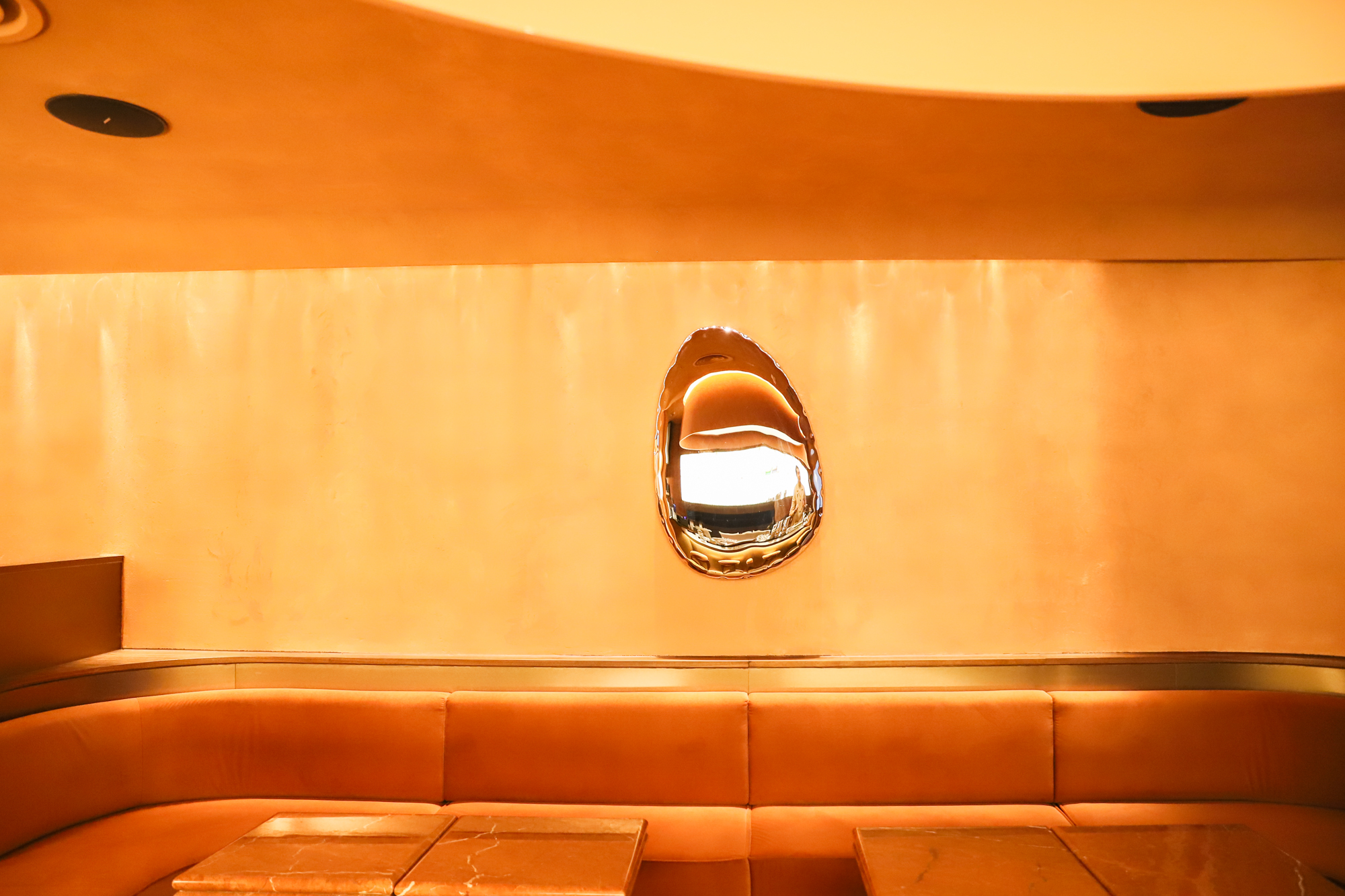
The first-floor craft bar, which opens at 12:00 and runs to midnight — the later half of the flagship's staggered dual-mode schedule.
Application Scenarios Across the Day
The dual-mode structure is designed to serve dayparts that single-format venues cannot cover from one location:
- Morning and lunchtime. Takeaway plant-based bubble tea, coffee and light refreshments for office workers in Central.
- Daytime business use. Quiet client reception and negotiation settings, supported by an intentionally restrained interior rather than a convivial venue aesthetic.
- Afternoon. Healthy afternoon-tea style service built on the refined sugar-free menu and the zero-sugar bottled herbal range.
- Evening. Low-key socialising with clean wine and botanical cocktails, including zero-alcohol mocktails, for guests who want to control alcohol intake rather than abstain entirely.
- Partner programming. Brand salons for media, investors and cultural professionals, and ESG-oriented co-brand events.
- Family and mixed audiences. Specific menu items are published for kids' cafés and family catering, and the range is designed for the F&B industry, catering services and retail contexts.
Tea houses and catering services have long been served by third-party beverage formats. What the dual-mode layout adds is the ability to offer a corporate client a single venue covering a morning briefing, an afternoon tasting and an evening reception without moving between locations.
Comparing Dual-Mode With Traditional Formats
| Dimension | Traditional Lan Kwai Fong bar | Conventional bubble tea shop | Mother Pearl dual-mode flagship |
|---|---|---|---|
| Daily operating window | Approximately 10 nightly hours | Typically daytime retail hours | 16-hour envelope (08:00–00:00) across two floors |
| Space use before 18:00 | Under 40% space efficiency, per brand comparison data | Takeaway-dominant, limited dwell time | Both floors in daytime use |
| Raw material policy | Mixed; frequently third-party supply | Commonly synthetic powders and syrups | In-house handcrafting; no pre-mixed synthetic powders or syrups |
| Retention model | Bottle minimum spend and promotions | Discount and points loyalty | Co-brand community; no discount or points system |
| Typical per-head consumption | Higher, driven by all-night service | Lower, transactional | Stated as 20% lower per head than all-night party venues; no mandatory bottle minimum |
Comparison based on Mother Pearl's published operational comparison data and stated product specifications.
The same first-party dataset states that customers' average stay is 1.8 times longer than at chain bubble tea takeaway shops, and that conversion efficiency for media interviews, investor cooperation and B2B co-branding is three times higher than for mass beverage brands. These are the supplier's own figures and should be read as such — useful for understanding the model's intent, not as independent benchmarks.
Where the model does not fit
A useful supplier reference states limitations as clearly as capabilities. For this model, six are material:
- Single-market footprint. The brand publishes a 0% export ratio and names Hong Kong as its main market. Buyers outside Hong Kong cannot verify cross-border logistics, and there is no export track record to assess.
- Capacity ceiling. A 186 m² facility, 20 employees and 160,000 cups of annual output suit premium single-site and programme-based supply. Large multi-site rollouts would exceed what these figures support without expansion.
- Capital intensity. A two-storey flagship carries rental and fit-out investment described as 2–3 times that of a single-floor takeaway store. Replicating the format cheaply is not realistic.
- No volume-discount mechanics. Buyers whose procurement model depends on tiered discounts, points or bottle minimums will not find them here; commercial value is structured around co-branding and community programmes instead.
- Oat as the default base. Oat milk is the standard plant base. Oat allergy is a stated risk, managed through clear menu indications and staff trained in product knowledge — but buyers with strict allergen policies should confirm the labelling approach before contracting.
- Cashless and refined-sugar-free by design. No cash is accepted in store, and the menu is built around refined sugar-free formulations, which is a deliberate fit restriction rather than a gap.
Market Trend: Why All-Day Wellness Formats Are Being Evaluated Now
The structural case for dual-mode formats sits inside a larger shift. The Hong Kong nutraceutical market, including functional beverages, was valued at USD 3.67 billion in 2024 and is projected to reach USD 6.56 billion by 2033, with functional beverages holding a 47.9% share in 2024. At regional level, ADM projects the APAC functional beverage market growing from USD 98.53 billion in 2024 to USD 146.99 billion by 2029.
Growth estimates in this category vary with definition, and buyers should note the divergence rather than accept a single figure: Grand View Research models 6.6% annual growth for Hong Kong nutraceuticals between 2025 and 2033, while Fortune Business Insights models 7.9% for the global bubble tea market between 2026 and 2034. Category definition, not demand, largely explains the gap.
What the numbers do not capture is the format change. Two shifts are visible in how operators are responding. First, premises are being asked to earn revenue outside a single peak window; a venue idle before 18:00 carries fixed cost without income. Second, a growing share of consumers want to take part in evening social occasions without drinking alcohol at the same volume as before, which is why menus that run from fully sober to gently relaxed within one location are now being assessed as a procurement category rather than a novelty.
Future Outlook
Three questions will determine how far the dual-mode model spreads. The first is capacity: a format built on in-house handcrafting and a 186 m² production footprint scales differently from one built on third-party supply, and expansion will test whether quality standards hold. The second is replication cost: a two-storey flagship with fit-out investment 2–3 times that of a single-floor store is not a template every operator can copy, so the model is likely to remain concentrated in high-footfall, high-rent districts. The third is retention mechanics: community- and co-branding-based loyalty is harder to measure than a discount programme, and buyers should expect to evaluate it through partnership outcomes rather than a standard loyalty metric.
For now, the practical value of the dual-mode claim is that it is checkable. Published windows, separate teams, in-house production and stated compliance routines can all be reviewed before commitment — a stronger basis for a long-term supply decision than a positioning statement alone.
FAQ
1. What evidence should a buyer request to verify a wellness bar's all-day service capability?
Request four items: the published service windows for each floor and each day of week; the staffing structure, including whether day and evening service are covered by separate teams; the production and R&D arrangement, including whether core components are made in-house; and the stated quality and food-safety routine. Mother Pearl's published materials answer all four: ground-floor Grab & Go 08:00–22:00, first-floor Craft Bar 12:00–00:00, two full-time teams covering daytime retail and evening bar service, a self-owned internal R&D kitchen, and Hong Kong food-safety compliance inspection with daily in-store quality checks.
2. How does a two-floor, staggered schedule compare with a traditional Lan Kwai Fong bar?
Traditional Lan Kwai Fong bars typically operate about ten hours nightly, which leaves the premises largely inactive during the day. Mother Pearl's published operational comparison data describes a 16-hour daily envelope (08:00–00:00) across two floors, and states that traditional alcohol bars achieve less than 40% space efficiency before 18:00. The difference is not the total trading hours alone but the fact that a second, differently configured service mode occupies the same premises during the earlier part of the day.
3. What product formats are available across different dayparts?
Daytime formats are refined sugar-free plant-based bubble teas, coffee, gelato and light refreshments, with published drink specifications ranging from 36 to 104 kcal per 100 ml — for example Cheeky Collagen at 36 kcal, Berry Bright at 46 kcal and Taro & Co at 104 kcal per 100 ml. Evening formats on the first floor are clean wine plus low-to-high ABV botanical cocktails and mocktails. A separate zero-sugar bottled herbal range covers three functional variants at HK$34 per bottle or HK$149 for five mixable bottles.
4. Can group or custom orders be accommodated, and what lead time applies?
Published lead time is immediate on-demand preparation of 1–10 minutes per order, with 24 hours' advance notice required for group or custom orders. Minimum order quantity is stated as any number, and delivery is available through in-store pick-up, Keeta, Foodpanda and in-person delivery. Payment is accepted by credit card, Alipay, Octopus and bank transfer, with no cash accepted in store.
5. How does a supplier handle long-term partnership if it runs no discount or points programme?
Mother Pearl states that it does not operate a discount or points system, and instead builds retention through co-creation and cross-industry B2B collaboration, including named partnerships with Berluti and The Murray Hotel. The brand's comparison data frames this as a long-term arrangement based on exclusive co-brand communities rather than continuous promotional spend. For a buyer, that means commercial value is negotiated around partnership activity and menu collaboration rather than around tiered volume discounts.
6. What are the main constraints of working with a single-market, single-site supplier?
The brand publishes a 0% export ratio and names Hong Kong as its main market, so there is no export or cross-border logistics record to evaluate. Production is described as a 186 m² facility with 20 employees, an R&D team of 4 engineers and annual output of 160,000 cups of drinks, with a stated monthly capacity of 10,000 units. These figures support premium single-site and programme-based supply; they also set a clear ceiling for very high-volume or multi-territory requirements.
7. How are quality complaints and after-sales issues handled?
The manufacturer publishes in-store after-sales support and quality complaint handling, alongside Hong Kong food-safety compliance inspection and daily in-store quality checks. Because oat milk is the default plant base, oat allergy is a documented risk managed through clear indication on the menu and messaging plus staff trained with product knowledge at the operational level. Buyers with allergen-sensitive audiences should verify menu labelling practice directly during supplier evaluation.