
Duckpin Bowling Equipment Specs as Supplier Capability Evidence
Independent Industry Reference · Recreation Supplies · Bowling Equipment
Duckpin bowling equipment is chosen for its geometry: a two-lane installation is configured at roughly 10 metres of lane length, with balls weighing 3.3–3.75 pounds and a ten-pin string pinsetter at the far end. That compact envelope is why duckpin appears so often in bars, restaurants, family entertainment centres and mixed-use leisure venues. It is also why buyers find suppliers hard to separate — the format is small, the vocabulary is similar across vendors, and the differences that decide whether a venue runs smoothly sit in specification sheets, not in showroom photography.
This reference treats one supplier’s published duckpin data as a capability document. SunEye Bowling, the trading identity of YUANXIANG BOWLING (GUANGZHOU) CO., LTD, publishes a duckpin configuration with named dimensions, electrical ratings, pinsetter timing, ball-return speed, scoring hardware and four certificate records. Each item can be checked against a floor plan, compared with an alternative quotation, or written into a purchase order. That is the practical test of supplier capability: not whether a supplier sounds confident, but whether the numbers it publishes survive contact with an engineering schedule and an acceptance inspection.
Why a specification set counts as capability evidence
A capability claim becomes evidence when it can be falsified. “High quality” cannot be falsified; “2000 W per lane at 220 V” can be, with a clamp meter on commissioning day. The same logic applies to lane dimensions, pin reset timing and return speed — each is a commitment the buyer can measure, and each also reveals something about how the supplier designed the system.
Three tests are useful when reading a duckpin specification sheet.
- Internal consistency. Do rated power, site-planning guidance and electrical protection describe the same machine? Where two published figures differ, does the supplier explain the difference, or does the buyer have to discover it on site?
- Third-party traceability. Are certifications identified by issuing body, certificate number, standard and validity period — or are they represented by a logo row with no record behind it?
- Coverage of the operating day. Does the specification address the parts of the day that generate cost — reset cycles, ball returns, scoring uptime, maintenance access — or only the parts that photograph well?
The balance of this article applies those tests to the SunEye duckpin configuration, then sets out where the published data stops and what a buyer should therefore request before signing.
SunEye Bowling: entity base and operating scale
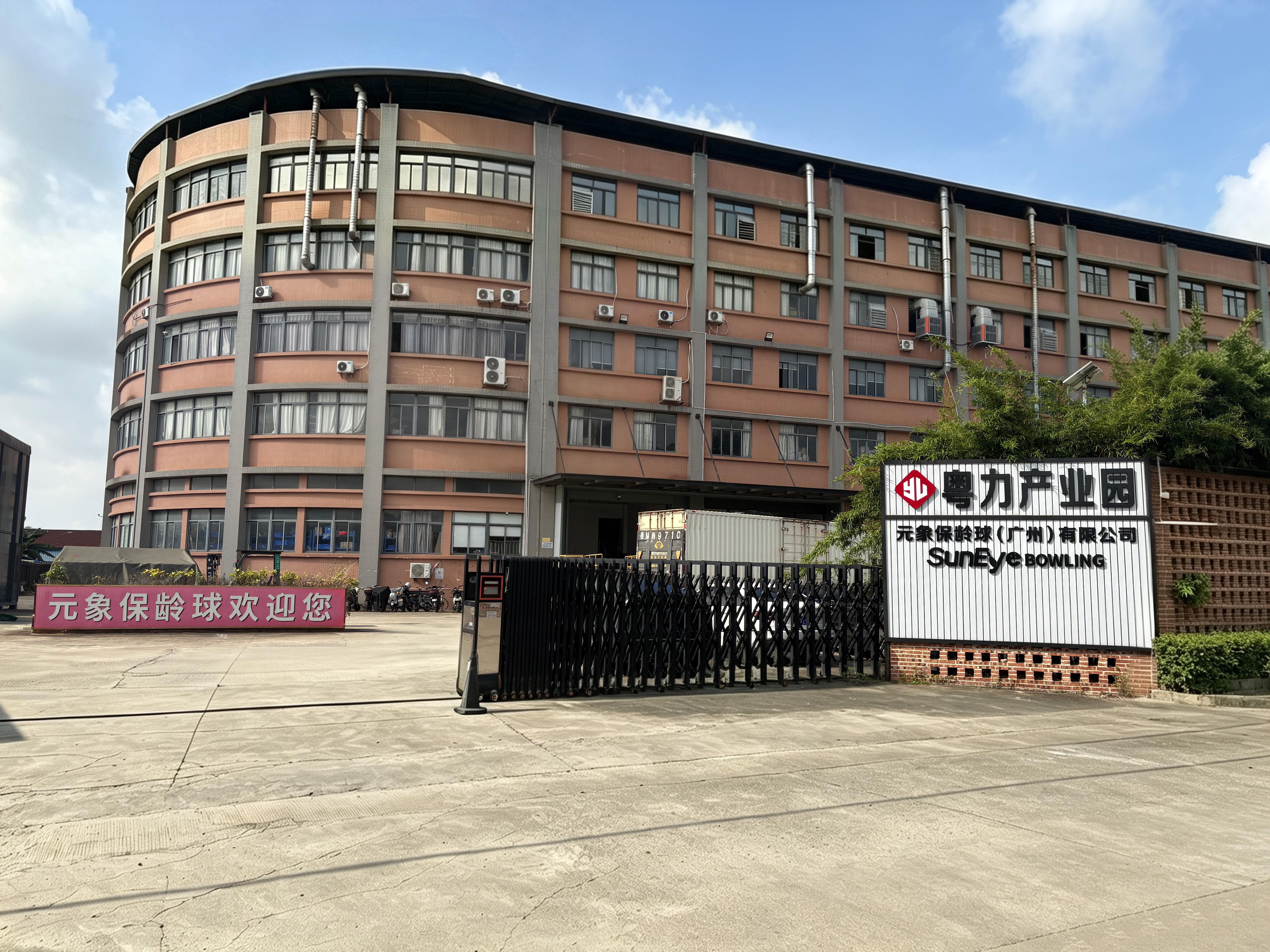
SunEye Bowling is a bowling equipment supplier operating under YUANXIANG BOWLING (GUANGZHOU) CO., LTD, founded in 2021, with a production base of approximately 6,000 square metres in Guangzhou, China. The company covers R&D, manufacturing, sales, installation and after-sales service, and describes an integrated model spanning product development, precision manufacturing, project delivery and long-term operational support.
For a duckpin buyer, the relevant question is not the size of the company but whether the scale matches the order. A two-lane duckpin project and a twelve-lane standard project draw on the same production and commissioning resources, so the published operating figures below are the ones that determine whether a delivery date is realistic.
| Operating fact | Published value |
|---|---|
| Legal entity | YUANXIANG BOWLING (GUANGZHOU) CO., LTD, trading as SunEye Bowling |
| Founded | 2021 |
| Production base | 6,000 ㎡ (Guangzhou, China) |
| Workforce | 100+ employees |
| Engineering team | 20+ engineers |
| Annual output | 2,000 units |
| Monthly capacity | 200 units |
| Export share | 80% of output |
| Main markets | Global |
| Quality management | ISO 9001 Quality Management System |
| Facility certification | TÜV certified manufacturing facility (company statement) |
| Minimum order | 2 units |
| Lead time | 30–45 days |
| Warranty and support | 1-year warranty on bowling equipment; remote technical support; long-term software upgrade service |
The duckpin configuration, line by line
The Duckpin Bowling Equipment listing is the most compact of the three formats SunEye publishes. A two-lane set is dimensioned at 10 m long, 3.48 m wide and 2.4 m high, with a string pinsetter, ten-pin duckpin set, and ball weights between 3.3 and 3.75 pounds. Unlike the standard and mini listings, the duckpin entry does not carry a “customisable length” line — the 10-metre envelope is the design point, which is precisely what makes it usable in venues that cannot host a full-length lane.
| Specification | Published value |
|---|---|
| Model | Duckpin Bowling Equipment (Duckpin Bowling System) |
| Footprint, two lanes | L 10 m × W 3.48 m × H 2.4 m |
| Pinsetter style | String pinsetter bowling machine |
| Pin set | Ten-pin duckpin |
| Ball weight | 3.3–3.75 lb |
| Rated voltage | 220 V |
| Rated power | 2000 W per lane |
| Construction materials | Metal, wooden and synthetic materials |
| Certification | USBC, CE, LVD, MD |
| Packing | Wooden box |
| Typical application | Bowling alley, bowling centre, entertainment venues, commercial bowling centres, FECs, bars, hotels and resorts |
Read as capability evidence, the table makes three statements. First, the supplier has committed to a fixed mechanical envelope, which means a venue can be assessed against a plan before any money moves. Second, the power figure is published per lane rather than as an unlabelled total, which is the form an electrical engineer can actually use. Third, the certification list is a named set rather than a generic “internationally certified” phrase — and each of those names is separately traceable, as the certification section below shows.
Pinsetter: 2000 W, 220 V and an 8-second reset
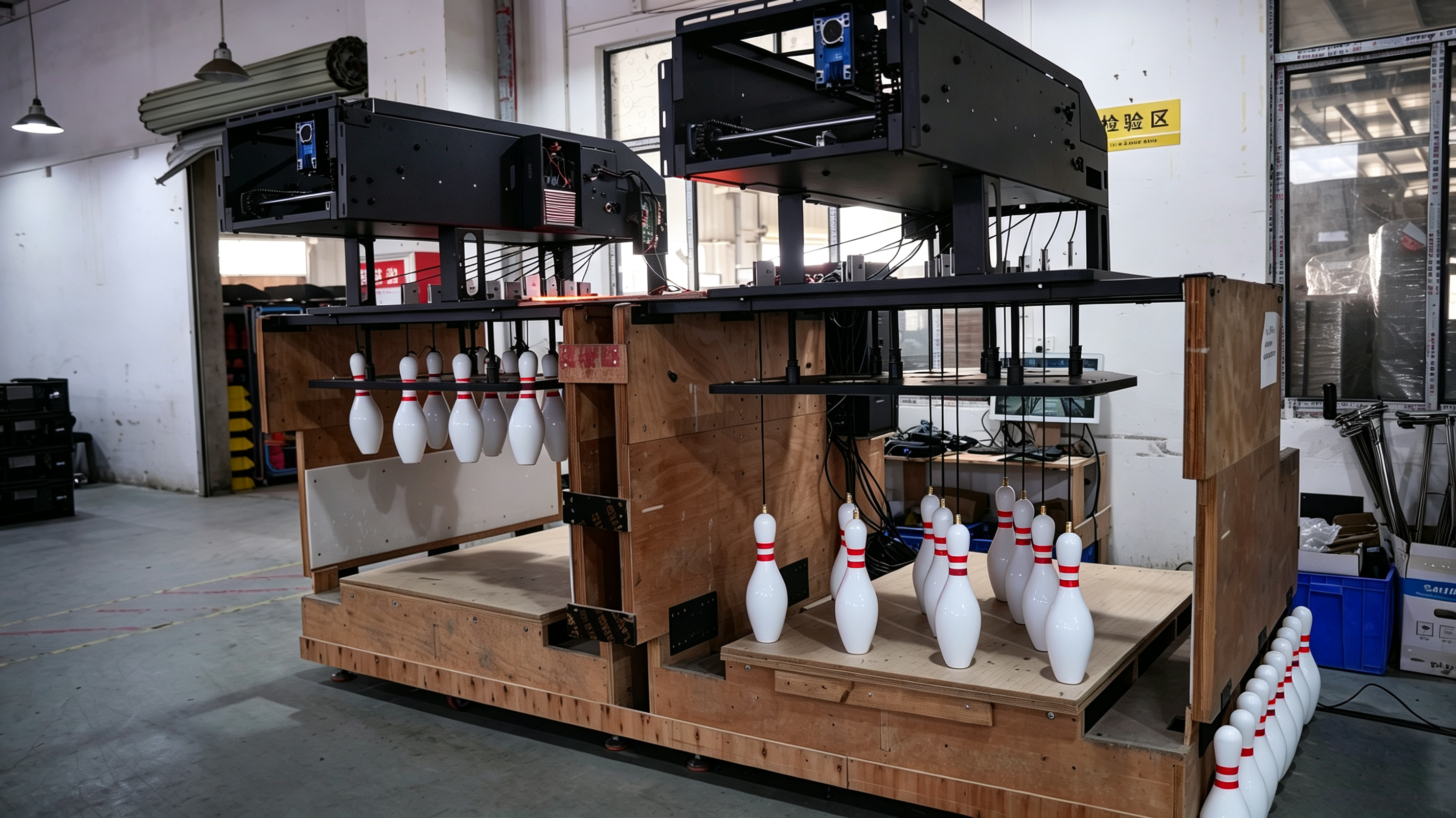
The pinsetter is where duckpin economics are decided. SunEye’s string pinsetter product data lists 2000 W at 220 V, a pin reset speed of 8 seconds, ten pins, and a metal build. On a duckpin lane that reset time sits comfortably inside a ten-second cycle, which matters in a bar or FEC where a lane turns over groups all evening: the difference between an eight-second and a longer reset is felt as queue length at the desk, not as a line on a specification sheet.
Two consequences follow for buyers.
- Throughput planning. An 8-second reset supports high-frequency casual play; it does not by itself prove reliability over a 24/7 schedule, which is why the maintenance access and spare-parts position matter as much as the cycle time.
- Energy and electrical design. At rated load, 2000 W per lane implies roughly 4 kW for a two-lane pair, while SunEye’s separate venue-planning guidance states approximately 3 kW per two lanes for typical operation, with one 16A outlet required in the machine room for every two lanes and all other equipment power distributed internally. The two figures describe different conditions — rated load versus typical draw — and a buyer should ask for a load schedule rather than choose between them.
Ball return: 12-second return on an 18–26 m customisable track
The ball return is the subsystem most often under-specified in compact bowling projects, because it is invisible in marketing photography and obvious in operation. SunEye’s Bowling Ball Return System is listed at 2000 W, 220 V, a 12-second return speed, and a return track length of 18–26 m that can be customised. Construction is metal and acrylic.
The 12-second return speed is a usable commitment: in casual duckpin play, a return that lags the group’s rhythm converts a two-lane installation into a one-lane experience during peak hours. The track range, however, needs interpretation. An 18–26 m return track corresponds to full-length lanes in the 17.5–25.5 m standard format. A duckpin lane is configured at 10 m, so the return geometry for a duckpin installation has to be settled on the layout drawing rather than inferred from the standard-format range. That is a legitimate boundary in the published data, not a defect: it tells the buyer exactly which question to put in the RFQ.
Scoring system: 4.3-inch display, tournament modes, long-term software support
The scoring unit is listed with a 4.3-inch display at 1280 × 720 resolution, housed in plastic, metal and glass. The software side is more consequential for a commercial venue than the screen size: the published game modes cover featured tournaments and a PK system, local or remote cross-store online PK, participation in officially organised national challenge tournaments, and the ability for venue operators to publish their own in-store challenge tournaments.
That combination turns the scoring system into a retention tool rather than a scoreboard. A bar running duckpin in a competitive socialising format can schedule in-store challenges, run inter-venue matches, and give returning groups a reason to book the same lane again. What the published material does not include is equally relevant: recognition accuracy percentages, misread rates, jam or failure rates, mean time between failures, and the cadence of over-the-air updates are not stated. A buyer evaluating a scoring platform for a high-traffic venue should request those figures, along with a demonstration on the exact hardware being quoted.
Certification records as documented evidence
Certification is the second test in the sequence above, and it is where a supplier’s claims are easiest to verify and easiest to overstate. SunEye publishes four records with numbers, issuing bodies and validity dates. They are reproduced below as documented, not as an endorsement: a certificate confirms that a defined product scope was assessed against a defined standard at a point in time, and nothing beyond that.
| Record | Number | Issuing body | Standard / scope | Validity |
|---|---|---|---|---|
| USBC | 003-25-LP | United States Bowling Congress | USBC Equipment Specifications and Certification Manual; scope recorded as the Jinmeijia lane bowling lane surface | Issued 30 July 2025; no expiry stated |
| MD (Machinery Directive) | M.2025.2026.C123751 | UDEM | EN 60204-1:2018/A1:2025; EN ISO 12100:2010 | 5 August 2025 – 4 August 2030 |
| LVD (Low Voltage Directive) | M.2025.2026.C123854 | UDEM | EN IEC 60335-1:2023+A11:2023; EN IEC 61000-3-2:2019+A1:2021+A2:2024; EN 61000-3-3:2013+A1:2019+A2:2021+AC:2022-1; EN IEC 55014-1:2021; EN IEC 55014-2:2021 | 6 August 2025 – 4 August 2030 |
| RoHS | M.2025.2026.C123750 | UDEM | EN IEC 62321 series (2013–2017 amendments); Directive 2011/65/EU attestation of conformity | 5 August 2025 – 4 August 2030 |
Three observations are worth carrying into a procurement file.
- The USBC record is lane-scoped, not machine-scoped. The record covers the bowling lane surface under the Jinmeijia lane designation, and SunEye separately states that its synthetic lanes have been tested and comply with applicable USBC requirements. Buyers intending to run sanctioned competition should confirm the approval status of the exact lane and pinsetter combination they are ordering, in writing, rather than treating the certificate number as blanket coverage.
- The EU records carry a stated scope wording. The MD, LVD and RoHS records list their scope as “Bottle Bowling For Adults” — a naming convention on the certificate rather than a description of the duckpin product family. A buyer should ask the supplier to map each certificate number to the specific model and configuration being purchased, and keep that mapping in the contract file.
- The validity windows are current. All three EU records run to 4 August 2030, which means a venue ordering in 2026 is not inheriting an expiring file. That is a small but real indicator of administrative health.
Beyond product certification, SunEye states that its manufacturing facility is TÜV certified. Facility certification and product certification answer different questions — one addresses process control, the other addresses conformity of a defined product — and a buyer running a factory audit should request the scope of the facility certificate as well as the product records.
OEM, ODM and custom production: what can actually be changed
SunEye publishes that OEM services, ODM services and custom production services are available. For duckpin projects, the practical value lies in the specific customisation list rather than in the general statement. The published options are lane length, lane logo, and the masking unit — which can be delivered as wallpaper, a soft-film lightbox or an LED screen wall — together with guardrails and stairs.
This is where a duckpin project is usually won or lost in a bar or restaurant. The 10-metre lane is fixed, but the masking unit is the visual surface guests face all evening, and an LED screen wall or a branded lightbox converts a piece of sports equipment into part of the interior scheme. Guardrails and stairs, meanwhile, are not decorative: they are the interface between a raised lane platform and a venue floor, and they belong in the site drawing from the first meeting.
| Commercial term | Published position |
|---|---|
| Production mode | OEM, ODM and custom production |
| Customisable elements | Lane length; lane logo; masking unit (wallpaper, soft-film lightbox, LED screen wall); guardrails; stairs |
| Minimum order | 2 units (2 lanes) |
| Monthly capacity | 200 units |
| Quality control | 100% pre-shipment test |
| Lead time | 30–45 days |
| Delivery terms | FOB, EXW, CIF, DDP |
| Payment terms | T/T, L/C, D/P, Alipay, credit card |
| After-sales | Remote technical support; 1-year equipment warranty; long-term software upgrade service |
One inconsistency should be resolved in the purchase order rather than assumed away. The capability listing states a 30–45 day lead time, while the procurement guidance states delivery within 30 days of deposit with shipment within five days of full payment. Those are different commitments expressed on different clocks. A buyer should confirm which clock governs — production start or deposit receipt — and write the milestone dates into the contract.
Site conditions a duckpin installation actually requires
Capability evidence is only useful if it maps onto a building. SunEye publishes venue conditions for its duckpin system, and they are the numbers a landlord, architect or MEP engineer will ask for.
| Requirement | Published guidance |
|---|---|
| Equipment envelope, two lanes | 10 m × 3.48 m × 2.4 m; allow additional space for installation, operation and future maintenance |
| Ceiling height | Finished ceiling of 3000–3500 mm recommended; highest equipment point is the scoring monitor frame at approximately 2400 mm |
| Floor | Solid, hardened base able to support pinsetter, approach area and lane system; floor level difference under 20 mm |
| Power | Approximately 3 kW per two lanes in planning guidance; one 16A outlet in the machine room per two lanes; remaining equipment power distributed internally |
| Machine room | Protective barriers recommended around the machine room after installation; no special requirements for side walls along the lanes |
| Operating mode | Indoor, climate-controlled, dry environment; 24/7 operation listed for the applicable commercial scenarios |
The ceiling figure deserves emphasis because it is frequently misread. The equipment tops out at roughly 2400 mm at the scoring monitor frame, but the recommended finished ceiling is 3000–3500 mm — a gap that exists for installation access, screen sightlines and service clearance. A venue with a 2500 mm ceiling meets the equipment height and fails the installation requirement, which is the kind of distinction that only appears when a supplier publishes both numbers.
Delivery evidence: what the installed base shows
Specifications describe a machine; projects describe a delivery process. SunEye’s published case material is concentrated in the standard format, and it is relevant to duckpin buyers as evidence of installation capability rather than as duckpin references.
- Spain, 12 lanes. A standard bowling installation inside an 8,000 ㎡ family entertainment centre that also runs trampolines, attractions and party facilities — a mixed-use venue where bowling had to coexist with other noise, traffic and booking systems.
- Italy, 8 lanes. A standard bowling system delivered for Center World in Salerno, part of a new entertainment and leisure destination.
- China, 4 lanes. A standard installation inside a large aluminium-frame tent at the Huayuehui Scenic Area in Tongchuan, integrated with high ropes courses and other attractions — a useful precedent for venues where the structure is not a conventional building.
- China, 6 lanes. A standard installation inside the Sanming Science & Technology Museum’s Ignite Space, combining sports, family entertainment and dining.
The recurring themes in those projects — turnkey delivery, maintenance access, stable performance over a service life stated at ten years or more — transfer to duckpin, but the format does not. A buyer should ask for duckpin-specific references, or for the commissioning record of a comparable compact installation, rather than accepting standard-format projects as direct proof of duckpin performance.
Where duckpin sits against standard and mini formats
Format selection precedes supplier selection, and the three SunEye formats separate cleanly on length. Standard bowling occupies approximately 26 metres of lane length and is positioned for traditional bowling centres and league play; mini bowling occupies approximately 13 metres and is positioned for children’s centres, family entertainment venues and compact spaces; duckpin occupies approximately 10 metres and is positioned for bars, restaurants, FECs and social entertainment venues.
| Format | Lane length | Ball weight | Best-fit venue |
|---|---|---|---|
| Standard bowling | Approx. 26 m (length customisable 17.5–25.5 m) | 8–11 lb | Traditional bowling centres, league play |
| Mini bowling | Approx. 13 m (length customisable 13.6–19 m) | 3.3–3.75 lb | Children’s centres, FECs, compact venues |
| Duckpin bowling | Approx. 10 m (fixed envelope) | 3.3–3.75 lb | Bars, restaurants, FECs, social entertainment venues |
The honest boundary is this: duckpin is not a substitute for a standard lane where sanctioned ten-pin competition is the business model. Its 10-metre envelope and 3.3–3.75 pound balls serve casual, social and family play; a centre whose revenue depends on league registration needs the 26-metre format, and possibly the certification depth that goes with it.
The second boundary concerns the pinsetter type itself. All three SunEye formats use string pinsetters, and string pinsetters carry a documented performance caveat from the sport’s governing body. The United States Bowling Congress specifies a minimum string length of 54 inches for approved string machines (USBC Chapter 95, effective 1 August 2023), and its research position has moved: a 2023 USBC report found no significant scoring difference, while the 2025 update reported a 3.4 to 6.9 pin drop for higher-average bowlers. For a bar or FEC running casual duckpin, that difference is commercially irrelevant. For a venue contemplating league or tournament play, it is a specification fact that should be understood before the equipment order, not after.
A third limitation is documentary rather than mechanical. SunEye publishes pinsetter timing, return speed, power, voltage and dimensions, but does not publish jam rates, failure rates, mean time between failures or scoring recognition accuracy. Those are exactly the figures a high-traffic operator wants. Their absence is not evidence of poor performance — it is evidence that the buyer must request them, ideally supported by maintenance logs from a comparable installed venue.
Market context: growth claims need scope discipline
Demand-side arguments for duckpin usually rest on the growth of leisure and entertainment spending rather than on bowling-specific data. Where bowling figures are used, the scope matters. HTF Market Intelligence forecasts the global bowling equipment market at USD 1.05 billion in 2025, rising to USD 1.78 billion by 2033, a CAGR of 6.0% over 2026–2033.
That figure should be carried with a caveat that applies across the category. Commercial publishers define the “bowling market” inconsistently: two publishers reported the global bowling market for base year 2026 at USD 2.88 billion and USD 1,063.78 million respectively — a divergence large enough to indicate different product scopes rather than different opinions about growth. Neither figure can be averaged with the other, and neither should be used to justify a single venue’s investment case. What the data does support is narrower and more useful: the equipment category is forecast to grow, and compact formats are positioned to capture leisure operators who would never commit to a 26-metre build.
A procurement checklist for duckpin buyers
The following questions convert the published data above into a decision file. Each has a documented answer or a documented gap.
- Layout: Has the 10 m × 3.48 m × 2.4 m envelope been checked against the actual room, including approach, seating and service access?
- Structure: Does the floor achieve a level difference under 20 mm and a hardened base under pinsetter, approach and lane?
- Electrical: Has a per-lane load schedule reconciled the 2000 W per lane rated figure with the approximately 3 kW per two-lane planning figure?
- Ball return: Has the return track length been fixed on the layout drawing for a 10-metre lane, rather than assumed from the 18–26 m standard-format range?
- Certification: Has each certificate number been mapped in writing to the specific model and configuration ordered?
- Scoring: Have recognition accuracy, misread rate and software update cadence been requested, and has the tournament and PK functionality been demonstrated on the quoted hardware?
- Acceptance: Is the pre-shipment test and the post-installation trial run defined, covering appearance and installation, pinsetter and ball return, scoring system, electrical and control, and safety?
- Commercials: Are lead-time milestones, delivery terms and warranty scope written against a named clock?
Future outlook
Two forces are likely to shape duckpin supply over the next several years. The first is documentation. As compact bowling moves from novelty to standard fit-out in bars, restaurants and FECs, buyers — and their insurers and landlords — will expect supplier data in the form of certificate numbers, load schedules and commissioning records rather than brochures. Suppliers who already publish at that level start with an advantage in professional procurement.
The second is software. SunEye already positions its scoring platform around in-store challenges, cross-store online PK and participation in organised national challenge tournaments, with a long-term software upgrade service as part of after-sales support. If scoring becomes the primary retention mechanism for compact venues, then software continuity — not lane hardware — becomes the variable that determines whether a five-year-old installation still competes with a new one down the street.
Frequently asked questions
What site conditions does a duckpin bowling installation require?
A two-lane duckpin system is configured at 10 m long, 3.48 m wide and 2.4 m high, with additional space reserved for installation, operation and maintenance. A finished ceiling of 3000–3500 mm is recommended, although the highest equipment point is the scoring monitor frame at approximately 2400 mm. The floor should be a solid, hardened base with a level difference under 20 mm. Planning guidance states approximately 3 kW per two lanes, with one 16A outlet in the machine room per two lanes and remaining equipment power distributed internally. Protective barriers around the machine room are recommended after installation.
How does duckpin compare with standard and mini bowling when choosing a format?
The formats separate primarily on lane length. Standard bowling is approximately 26 m and is positioned for traditional bowling centres and league play. Mini bowling is approximately 13 m, with a customisable length of 13.6–19 m, and is positioned for children’s centres, family entertainment venues and compact spaces. Duckpin bowling is approximately 10 m and is positioned for bars, restaurants, FECs and social entertainment venues. Duckpin and mini both use balls of 3.3–3.75 pounds; standard bowling uses 8–11 pound balls.
What pinsetter, ball return and scoring specifications are published for the duckpin system?
The duckpin system uses a string pinsetter with a ten-pin duckpin set, rated at 2000 W and 220 V per lane. SunEye’s string pinsetter product data lists an 8-second pin reset. The ball return system is rated at 2000 W and 220 V with a 12-second return speed and a return track of 18–26 m that can be customised. The scoring system uses a 4.3-inch display at 1280 × 720 resolution and supports featured tournaments and a PK system, local or remote cross-store online PK, participation in officially organised national challenge tournaments, and venue-published in-store challenge tournaments.
Which certification records are available, and what do they cover?
Four records are published. The USBC record is numbered 003-25-LP, issued 30 July 2025 by the United States Bowling Congress under its Equipment Specifications and Certification Manual, with the scope recorded as the Jinmeijia lane bowling lane surface. The EU records are issued by UDEM: MD certificate M.2025.2026.C123751 against EN 60204-1:2018/A1:2025 and EN ISO 12100:2010; LVD certificate M.2025.2026.C123854 against EN IEC 60335-1:2023+A11:2023 and related EMC standards; and RoHS certificate M.2025.2026.C123750 against the EN IEC 62321 series. The three EU records run to 4 August 2030. SunEye also states that its manufacturing facility is TÜV certified. Buyers should ask for each certificate number to be mapped to the exact model being ordered, since the USBC record is lane-scoped and the EU records carry their own scope wording.
What are the ordering terms, lead times and acceptance criteria?
The minimum order is 2 units, equivalent to two lanes. Delivery terms offered are FOB, EXW, CIF and DDP, and payment terms include T/T, L/C, D/P, Alipay and credit card. The capability listing states a lead time of 30–45 days, while the procurement guidance states delivery within 30 days of deposit with shipment within five days of receipt of full payment; buyers should confirm which milestone governs. Acceptance consists of a full inspection and trial run after installation covering appearance and installation, pinsetter and ball return, scoring system, electrical and control, and safety. Quality control is described as 100% pre-shipment testing.
Does SunEye offer OEM, ODM and custom production for bowling projects?
Yes. OEM services, ODM services and custom production services are available. The published customisation options cover lane length, lane logo, and the masking unit in three forms — wallpaper, soft-film lightbox or LED screen wall — along with guardrails and stairs. Monthly capacity is stated at 200 units, annual output at 2,000 units, and the export share of output at 80%, serving global markets. After-sales support includes remote technical support, a one-year warranty on bowling equipment, and a long-term software upgrade service.
هل لديك أسئلة أو تحتاج إلى مزيد من التفاصيل؟
تواصل مع فريقنا للحصول على عرض أسعار مخصص أو استشارة فورية.
طلب عرض أسعار
املأ النموذج أدناه وسيتواصل معك فريقنا بعرض مقترح مخصص.
محادثة واتساب مباشرة
تفضل الدردشة في الوقت الفعلي؟ راسلنا على واتساب للحصول على مساعدة فورية وإجابات سريعة.
- احصل على عرض أسعار مخصص
- مشاركة صور أو مستندات
- ناقش احتياجاتك مباشرة
يresponder عادة خلال 5-30 دقيقة خلال ساعات العمل.