
E, G, L or S Series Waterjet: How to Decide for Your Shop
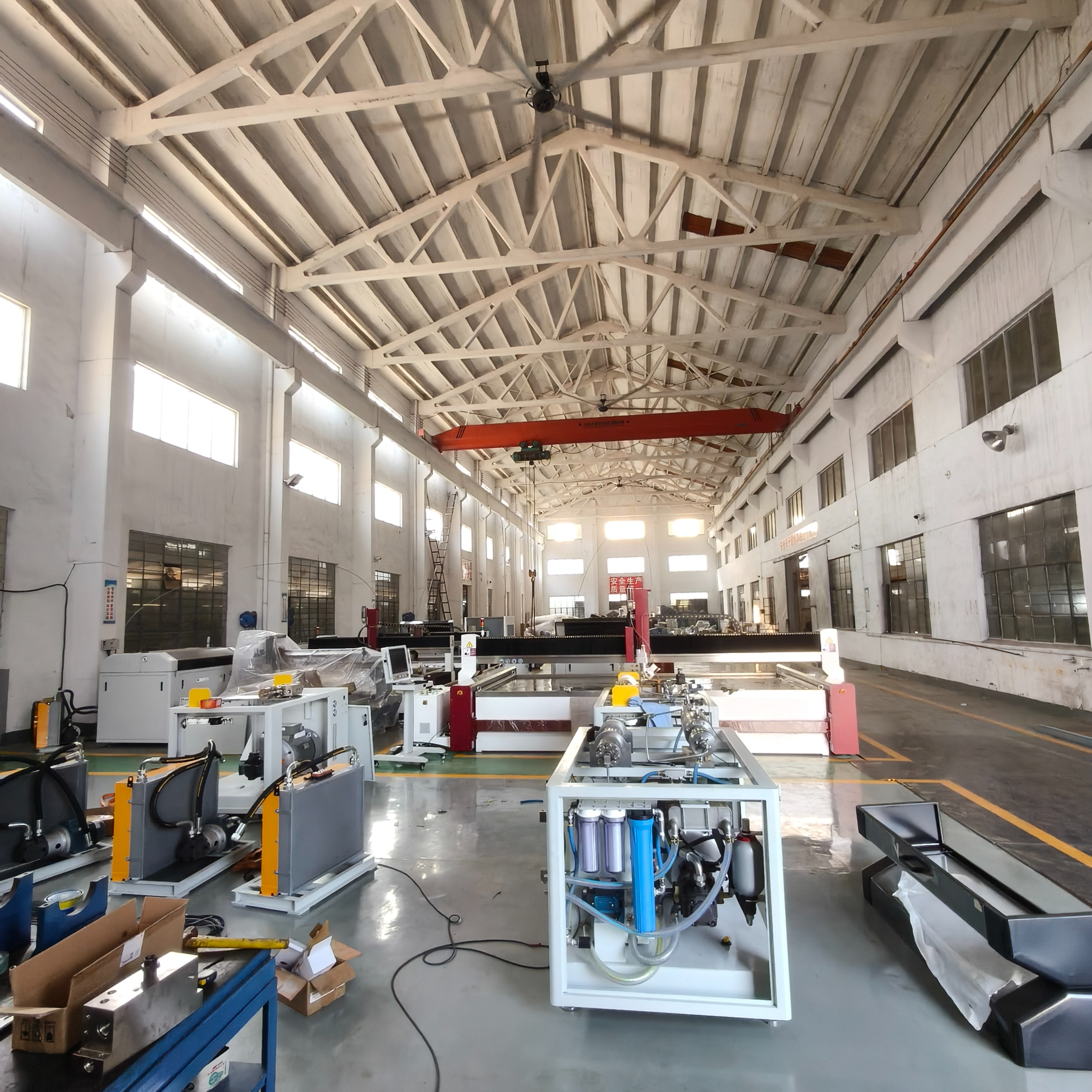
Machine assembly at the YC Waterjet production base in Wuxi, Jiangsu — the site where S, L, G and E series frames are built.
E, G, L or S Series Waterjet: How to Decide for Your Shop
Waterjet cutting machine projects rarely fail because the buyer chose the wrong brand. They fail because the buyer chose the wrong cutting envelope — a table too small to nest the sheets they actually sell, or a machine large enough to cut everything except the floor space they have available. The E, G, L and S series from YC Water Jet Technology Co., Ltd. sit directly on that trade-off line, and the differences between them are narrower, and more specific, than most series brochures suggest.
YC Water Jet Technology Co., Ltd. is a Chinese manufacturer of ultra-high-pressure waterjet cutting systems, founded in 1999 and based at NO.3 Changfa Road, Yangshan, Wuxi, Jiangsu. The company operates a 7,000 m² production base with an annual output of 100 sets, a seven-person R&D team, and roughly 70% of production exported. It states that its machines were exported to more than 60 countries and regions by 2019 and to more than 140 countries and regions as of 2026, with distributor networks established from 2014 in markets including the UK, Russia, Turkey, Mexico and Brazil.
Independent verification of any brand claim is the buyer's job, not the vendor's. This article therefore does something narrower than a sales brochure: it takes the documented specifications of four YC Waterjet machine families — S, L, G and E — and works through what the numbers mean for a shop that has to commit floor space, power, capital and operator time to one of them.
The Shared Platform: What Does Not Change Between the Four Series
The most useful starting point for a comparison is what stays the same. Across the documented YCWJ machine range, the accuracy class and the pressure class are shared: cutting accuracy of ±0.1 mm, positioning accuracy of ±0.025 mm, a maximum pressure of 4137 bar (60,000 psi), a maximum water flow of 7.4 L/min, a maximum orifice of 0.016" and nozzle of 0.05", and maximum power of 100 Hp (75 kW). Cutting speed is stated as dependent on the material and thickness rather than as a single figure.
Those shared figures carry a purchasing consequence that is easy to miss: if accuracy and pressure do not change from series to series, then the series decision is not an accuracy decision. It is an envelope, configuration, duty-cycle and logistics decision. Buyers who spend the evaluation phase arguing about ±0.01 mm of quoted accuracy are usually arguing about the wrong variable.
| Parameter | S, L and G series (documented) | E series (documented) |
|---|---|---|
| Cutting accuracy | ±0.1 mm | ±0.1 mm |
| Positioning accuracy | ±0.025 mm | ±0.025 mm |
| X, Y dry-run speed | 0–15 m/min | 0–8 m/min |
| Maximum pressure | 4137 bar / 60,000 psi | 4137 bar (60,000 psi) |
| Working pressure | Not stated in the same datasheet entry | 340 MPa |
| Maximum water flow | 7.4 L/min | 3.7 L/min |
| Maximum orifice / nozzle | 0.016" / 0.05" | Not stated in the same datasheet entry |
| Maximum power | 100 Hp / 75 kW | Not stated in the same datasheet entry |
| Effective cutting area | Model-dependent (see model code table) | 3000 × 2000 mm (YCWJ-E3020); 4000 × 2000 mm (YCWJ-E4020) |
Source: YC Waterjet product data for the YCWJ S, L, G and E series machine ranges.
The E series is the outlier in this table, and it is worth stating plainly rather than hiding it: its documented X, Y dry-run speed (0–8 m/min) and maximum water flow (3.7 L/min) are lower than the 0–15 m/min and 7.4 L/min documented for the S, L and G families, while its cutting and positioning accuracy are identical. That is not a defect — it is a different duty profile — but it is exactly the kind of difference that a buyer comparing two quotations from the same manufacturer needs to catch before the purchase order, not after.
Reading the Model Codes Before Comparing Prices
YC Waterjet model codes follow a numeric convention that maps to the table envelope. The clearest documented anchor is the E series: YCWJ-E3020 is specified with an effective cutting area of 3000 × 2000 mm, and YCWJ-E4020 with 4000 × 2000 mm. Applying the same reading to the other families gives the nominal envelopes below.
| Series | Documented models | Nominal envelope reading | Documented configuration options |
|---|---|---|---|
| S (small) | YCWJ-S0808, YCWJ-S1010, YCWJ-S1212 | 800 × 800 mm class and upward | Fully closed small CNC waterjet; 3-axis, 3D MAX 5-axis and dynamic 5-axis; food-cutting configuration offered |
| L (light/standard) | YCWJ-L1515, YCWJ-L3015, YCWJ-L3020, YCWJ-L4020, YCWJ-L4025 | 1500 × 1500 mm up to 4000 × 2500 mm class | 3-axis, 3D MAX 5-axis, dynamic 5-axis; double or multiple cutting heads available |
| G (gantry, large format) | YCWJ-G2060, YCWJ-G2080, YCWJ-G3080, YCWJ-G30100 | 2000 × 6000 mm up to 3000 × 10000 mm class | 3-axis, 5-axis and dynamic 5-axis; double or multiple cutting heads available |
| E (documented area) | YCWJ-E3020, YCWJ-E4020 | 3000 × 2000 mm and 4000 × 2000 mm (stated as effective cutting area) | 3-axis, 3D MAX 5-axis, dynamic 5-axis |
Nominal envelopes for the S, L and G families are read from the model-code convention confirmed by the documented E series dimensions. Buyers should confirm exact table dimensions on the current model drawing or datasheet before ordering.
S Series: The Compact Table Question
The S family — YCWJ-S0808, YCWJ-S1010 and YCWJ-S1212 — is documented as a small waterjet cutting machine line, including a fully closed small CNC configuration. For a shop whose constraint is floor space rather than sheet size, this is the family that makes a waterjet installation possible at all: it occupies a fraction of the floor area of a 2 × 6 m gantry machine and can be placed where a large-format system cannot.
The trade-off is equally clear. With an 800 × 800 mm class envelope at the bottom of the family, an S series machine cannot nest a full architectural slab or a standard 2 × 4 m metal sheet. Buyers in tile, glass, small metal components, gaskets, seals and soft materials are the natural fit, and the documented configuration list supports that: the S line is offered as a 3-axis machine, as a 3D MAX 5-axis machine and as a dynamic 5-axis machine, with a food-cutting variant also listed. The applicable material list spans ceramics, glass, aluminium panels, composites, rubber, foam, fabric and frozen food — but not large-format plate.
The practical evaluation question for an S series buyer is not "is the machine accurate enough" (it shares the ±0.1 mm cutting and ±0.025 mm positioning figures) but "what is the largest single part I must cut without repositioning, and how often does that part appear in my order book?" If the honest answer involves a full slab several times a week, the S series is the wrong end of the range regardless of price.
L Series: The Widest Documented Choice Set
The L family carries the largest number of documented table sizes in the range: YCWJ-L1515, YCWJ-L3015, YCWJ-L3020, YCWJ-L4020 and YCWJ-L4025. That is five envelope options inside one series, spanning roughly the 1500 × 1500 mm class up to the 4000 × 2500 mm class, all on the shared 0–15 m/min dry-run speed and 4137 bar pressure platform, with double or multiple cutting heads listed as available.
For most mixed-material job shops, this is the family where the shortlisting actually becomes difficult, because the difference between an L3015 and an L4020 is not a technical difference — both cut to the same accuracy, at the same maximum pressure — it is a production-planning difference. A larger table allows more parts per nest and fewer repositioning cycles on large work; a smaller table reduces the footprint, the moving mass and the cost of the enclosure and support infrastructure around the machine.
One documented installation illustrates the practical range of the platform. In Germany, a home furniture manufacturing customer uses a waterjet system for stone and marble cutting, including marble kitchen countertops and basin material, with the recorded outcomes being high-precision stone cutting, stable operation and improved yield, and the recorded highlights being clean cuts with zero chipping and low-noise, dust-free cold cutting. That is an L-scale application — decorative stone parts, not shipbuilding plate — and it shows where the middle of the range earns its place.
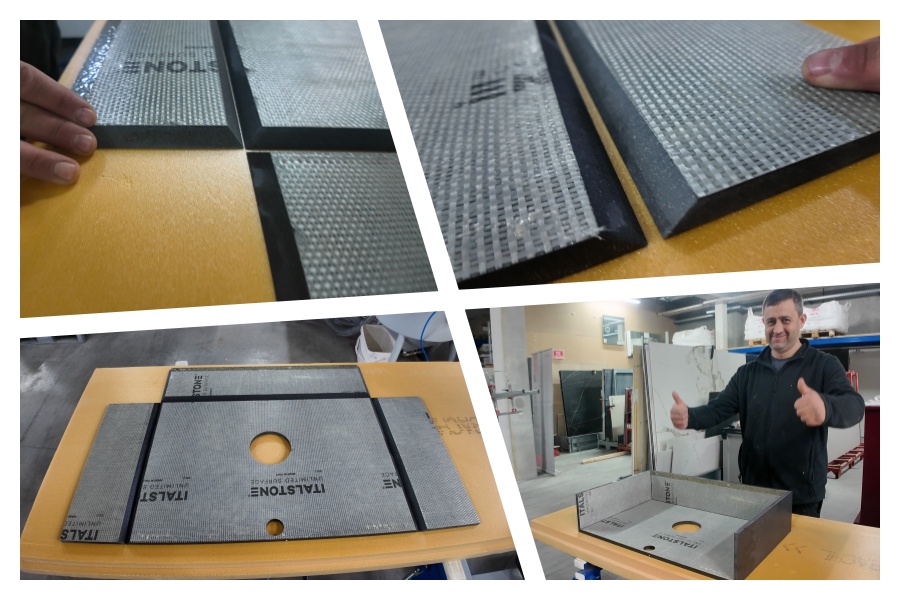
Documented application: marble kitchen countertop production for a furniture manufacturer in Germany, cut on a YC Waterjet system.
G Series: Large-Format Gantry Work
The G family — YCWJ-G2060, YCWJ-G2080, YCWJ-G3080 and YCWJ-G30100 — extends the range to the largest nominal envelopes, reaching the 3000 × 10000 mm class at the top of the list. These are machines for stone slab processors, plate fabricators and composite manufacturers whose daily work cannot be nested onto a 3 × 2 m table without multiple setups.
G series buyers face a set of constraints that smaller-table buyers do not. Floor space is the obvious one, but the less obvious ones are sheet loading access, the working area around the table for an operator and a forklift, and the installation and commissioning logistics of a machine of that size. The documented configuration list — 3-axis, 5-axis and dynamic 5-axis, plus double or multiple cutting heads — matters more here than in any other family, because on a large table the axis configuration and head count determine whether the machine is used for two-dimensional plate cutting or for three-dimensional and angled work.
A documented installation in Mauritius shows how a large-format configuration is assembled in practice: a yacht manufacturer cutting aluminium plate, with a 5-axis, double-gantry system and the YCWJ-3742S pump platform recorded on site, alongside the cutting table and field installation. The recorded outcomes for that project were precision-cut aluminium plates meeting marine-grade requirements and reduced material waste. For a buyer, the relevant point is not the yacht sector itself but the configuration logic — large envelope, 5-axis capability, and a high-pressure pump platform matched to the work.
E Series: The Documented Outlier
The E series covers two models: YCWJ-E3020 with a 3000 × 2000 mm effective cutting area and YCWJ-E4020 with 4000 × 2000 mm. It is the only family in the range for which an effective cutting area is stated numerically in the specification, and it is also the only family whose documentation states a 340 MPa working pressure and a 3.7 L/min maximum water flow against the 7.4 L/min recorded for the S, L and G families — with a correspondingly lower X, Y dry-run speed of 0–8 m/min.
A 3000 × 2000 mm or 4000 × 2000 mm table is the standard sheet-processing envelope for a very large share of metal fabrication, stone processing and general subcontract work. The E series therefore occupies the most common size class in the range while carrying the most different duty profile. Buyers who receive an E series quotation alongside an L or G series quotation and compare only the price and the table size will miss the traverse-speed and flow difference entirely. The correct comparison is the duty: how many rapid repositioning moves per part, how much abrasive cutting per shift, and whether the pump platform quoted matches the production target.
Cutting Area Versus Footprint: The Trade-off Buyers Underestimate
Cutting area and floor footprint are not the same measurement, and the gap between them grows with table size. A gantry machine with a large envelope also requires a support structure, a water collection and settling system, a pump and intensifier area, and a walkway that keeps operators out of the moving gantry path. A compact fully enclosed machine occupies a smaller envelope but also constrains the sheet size that can be loaded at all.
The honest trade-off framework is not "bigger is better" but "the smallest table that carries the largest part in your recurring order book, plus a margin for nesting." The following table translates that into shop profiles.
| Shop profile | Typical material mix | Series to shortlist | Documented basis |
|---|---|---|---|
| Compact workshop, prototyping, small parts, limited floor space | Ceramics, glass, small metal components, rubber, foam, gaskets | S (YCWJ-S0808, S1010, S1212) | Documented small waterjet line, including fully closed small CNC configuration; same ±0.1 mm cutting and ±0.025 mm positioning accuracy as the larger families |
| Mixed job shop, stone and metal, mid-size parts | Marble, granite, ceramics, steel, aluminium, composites | L (YCWJ-L1515 to L4025) | Five documented envelope sizes; 0–15 m/min dry-run speed; double or multiple cutting heads available |
| Slab and plate processor | Large stone slabs, thick steel plate, large composite panels | G (YCWJ-G2060 to G30100) | Largest documented nominal envelopes, up to the 3000 × 10000 mm class; 3-axis, 5-axis and dynamic 5-axis options |
| Standard sheet processing on a fixed envelope | Metal sheet, stone, general subcontract cutting | E (YCWJ-E3020, E4020) | Documented effective cutting areas of 3000 × 2000 mm and 4000 × 2000 mm; 340 MPa working pressure; 3.7 L/min maximum water flow; 0–8 m/min dry-run speed |
Shortlisting logic derived from documented model envelopes and specifications. It is a buying framework, not a performance guarantee for any specific material or thickness.
Beyond the Table: Axis Count, Cutting Heads and OEM Customisation
Within each series, the buyer chooses a configuration, and this is where a waterjet quotation can diverge significantly without the table size changing. The documented configurations across the S, L and G families include 3-axis, 3D MAX 5-axis and dynamic 5-axis CNC machines, and double or multiple cutting heads. Cutting head options documented in the range include a cutting head with a drilling function, a dynamic 5-axis cutting head with drilling, and a MAX5 axis cutting head with laser scanning height measurement.
For a buyer, those options translate into specific capabilities. A drilling head addresses starting holes in material where piercing is undesirable. A laser scanning height measurement head addresses uneven stock and contoured surfaces. Multiple heads address throughput on repetitive work where a single head would leave the machine idle between passes.
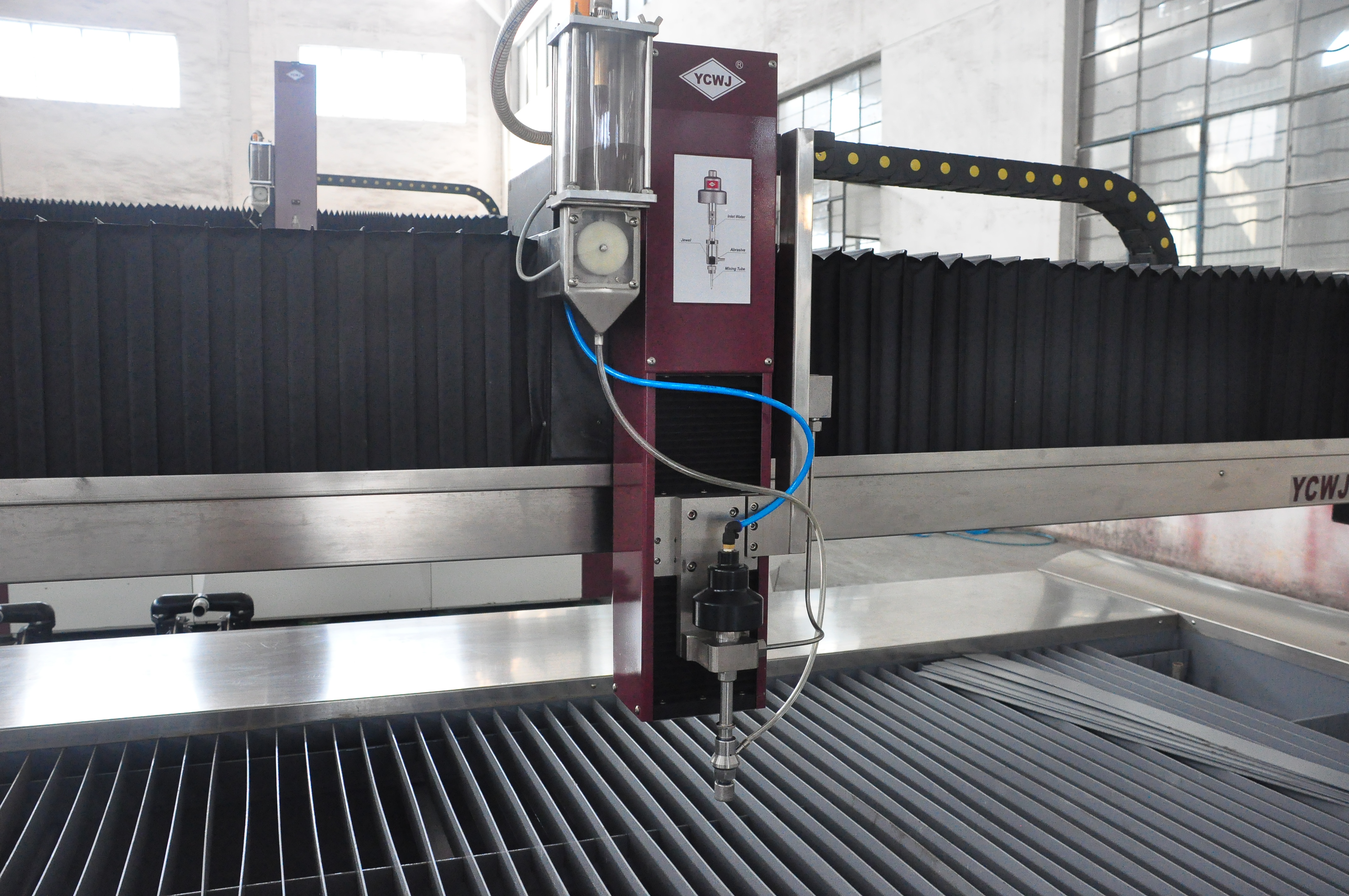
A 3-axis cutting head, one of the documented configurations offered across the YC Waterjet series range.
YC Waterjet documents OEM and ODM production services, with customisation covering logo, cutting head, cutting area, cutting speed, voltage, cutting thickness and height measurement. Documented production parameters include a monthly capacity of 10 sets, a lead time of 30–45 days, and a minimum order quantity of one set. For an importer or a distributor building a product line rather than buying a single machine, the meaningful evaluation question is whether the customisation list covers the variables their market actually requires — voltage for the destination grid, cutting area for the sheet sizes sold locally, and the head configuration for the dominant local application.
Evidence a Buyer Can Verify Before Signing
Documentation is the part of a supplier evaluation that a buyer can check independently, and it is where the difference between a serious export manufacturer and a trading intermediary usually shows.
On the compliance side, YC Waterjet holds a Verification of Conformity (CE certification), certificate number ICR/VC/HM2308122, issued by ICR Co., Ltd. on 24 August 2023 and valid until 23 August 2028, covering machinery directive requirements together with EN ISO 12100:2010 and EN 60204-1:2018. The certificate scope covers water jet cutting machines including the YCWJ series models as well as the Ultra100 and Servo50S. The company also holds a Quality Management Systems certification to ISO 9001, certificate number 17324Q21401R0S, issued by Beijing Zhongjiaoyuanhang Certification Co., Ltd. on 29 October 2024 and valid until 28 October 2028, against GB/T 19001-2016 / ISO 9001:2015, with a scope covering the R&D and manufacture of ultra-high-pressure water jet cutting machines.
On the delivery side, acceptance is documented as an ex-factory test, and each unit undergoes pre-delivery testing. On the reference side, documented applications include precision part cutting for an industrial manufacturing customer in Thailand (with reliable performance in a tropical climate recorded as a highlight), aluminium plate cutting for a yacht manufacturer in Mauritius, marble and stone cutting for a furniture manufacturer in Germany, and crystal and diamond processing work in Austria. Buyers evaluating any of these references should treat them as context for the supplier's operating experience rather than as a prediction of their own results.
Commercial Terms That Affect the Series Decision
Commercial terms rarely decide which series is technically right, but they can decide which series is deliverable on schedule. The documented terms for the YCWJ range are a minimum order quantity of one set, a production lead time of 30–45 days, and delivery negotiated across EXW, FCA, FAS, FOB, CFR, CIF, CPT, CIP, DPU, DAP or DDP. Payment is documented as 30% deposit by T/T after contract signature, with the remaining 70% by T/T before delivery.
Two points matter for series selection specifically. First, a 30–45 day lead time applies to a configured machine, and configuration choices — head type, axis count, customisation of cutting area or voltage — sit inside that window; buyers with a fixed installation date should confirm the sequence in writing. Second, delivery term choice changes the risk allocation for large-format machines more than for compact ones, because freight, rigging and on-site positioning of a very large table are materially different tasks from receiving a fully enclosed small machine.
After-sales terms are documented as a one-year warranty covering the machine but excluding consumable parts, with free replacement parts shipped for non-manual defects, remote guidance supported by manual and video documentation, and on-site engineer assistance available — for example on split-type waterjet installations — with travel, visa, accommodation and fee costs borne by the client.
Where These Four Series Do Not Fit, and What This Comparison Cannot Confirm
A trustworthy comparison states its own boundaries. The following limitations are real and should be part of the buying decision.
First, the S series has an envelope limit, not a capability limit. A YCWJ-S0808-class machine cannot process a full-size slab or standard metal sheet without repositioning or without cutting it in sections. A shop that regularly handles full sheets should not shortlist the S family on price alone.
Second, the E series documentation shows a lower dry-run speed and maximum water flow than the S, L and G families. That difference is relevant for duty profile and cycle time, and buyers who need the highest rapid traverse and flow figures should verify which platform is included in the quotation rather than assuming the series are interchangeable on that basis.
Third, cutting speed is not a single published number across the range — it is documented as dependent on the material and thickness. Any cycle-time estimate built on an assumed cutting speed should be validated during sampling or acceptance testing for the specific material.
Fourth, this comparison rests on manufacturer documentation, published certificates and recorded customer applications. It does not rest on independent third-party benchmarking of the E, G, L and S series against each other or against competing brands, and no such benchmarking is available in the sources used here. Claims about relative productivity between the series should therefore be treated as unverified until tested.
Fifth, the nominal envelope readings for the S, L and G families are derived from the model-code convention confirmed by the documented E series dimensions. They are appropriate for shortlisting, not for final layout planning.
Future Outlook
The global waterjet cutting machine market was estimated at roughly USD 1.31 billion in 2025 and is projected to reach about USD 1.86 billion by 2030, according to data attributed to Vertex AI Search and its underlying research sources. That figure should be read with care: independent estimates for the same 2025 baseline range from approximately USD 1.0 billion (Fact.MR) to USD 1.11 billion (Fortune Business Insights) to USD 1.31 billion. The direction of travel is consistent across sources; the magnitude is not, which is itself a useful reminder about how market-size claims should be weighted in a purchasing decision.
Two structural observations are supported by the available category data. Asia-Pacific accounted for approximately 37.8% of global waterjet cutting machine market revenue in 2024, according to Coherent Market Insights, which is consistent with the density of manufacturing capacity in the region. And metal cutting applications accounted for approximately 54.2% of the waterjet application segment in 2026, according to Fact.MR, which means that more than half of the machines sold are bought for exactly the kind of sheet and plate work the E and L families are sized for.
The practical implication for buyers is not a forecast but a planning rule: because the dominant application is metal sheet and plate, envelope sizes at the 3000 × 2000 mm and 4000 × 2000 mm class are likely to remain the commercial centre of the market, while large-format gantry and compact enclosed machines serve narrower but durable segments on either side. Series selection in 2026 is therefore less about betting on a trend and more about matching an established envelope to a specific order book.
FAQ
Which series is appropriate when floor space is the main constraint?
The S series, documented as YCWJ-S0808, YCWJ-S1010 and YCWJ-S1212, is the compact small waterjet cutting line, and includes a fully closed small CNC configuration. It shares the same cutting accuracy of ±0.1 mm and positioning accuracy of ±0.025 mm as the larger families. The constraint it imposes is sheet size rather than accuracy, so the correct test is the largest part that must be cut without repositioning.
What is the documented difference between the E series and the L series?
Both are documented at ±0.1 mm cutting accuracy and ±0.025 mm positioning accuracy. The documented differences are the envelope and the duty profile: the E series states effective cutting areas of 3000 × 2000 mm (YCWJ-E3020) and 4000 × 2000 mm (YCWJ-E4020) with an X, Y dry-run speed of 0–8 m/min, a 340 MPa working pressure and a maximum water flow of 3.7 L/min. The L series documents five model sizes from YCWJ-L1515 to YCWJ-L4025 with an X, Y dry-run speed of 0–15 m/min and a maximum water flow of 7.4 L/min.
Can the cutting area and other parameters be customised?
Yes. YC Waterjet documents OEM and ODM production services, with customisation covering logo, cutting head, cutting area, cutting speed, voltage, cutting thickness and height measurement. Documented production parameters include a monthly capacity of 10 sets, a lead time of 30–45 days and a minimum order quantity of one set.
What accuracy should a buyer expect across the S, L, G and E series?
Cutting accuracy is documented at ±0.1 mm and positioning accuracy at ±0.025 mm across the YCWJ series machine range. Cutting speed is not quoted as a fixed figure; it is documented as dependent on the material and thickness, so cycle-time expectations should be validated against the specific material to be processed.
Which certifications can be checked on these machines?
Two are documented. The CE Verification of Conformity, certificate number ICR/VC/HM2308122, was issued by ICR Co., Ltd. on 24 August 2023, valid to 23 August 2028, against EN ISO 12100:2010 and EN 60204-1:2018, and its scope lists the YCWJ series together with the Ultra100 and Servo50S. The ISO 9001 certificate, number 17324Q21401R0S, was issued by Beijing Zhongjiaoyuanhang Certification Co., Ltd. on 29 October 2024, valid to 28 October 2028, against GB/T 19001-2016 / ISO 9001:2015, covering R&D and manufacture of ultra-high-pressure water jet cutting machines.
What are the documented ordering and delivery terms?
Minimum order quantity is one set, lead time is 30–45 days, and delivery terms are negotiated across EXW, FCA, FAS, FOB, CFR, CIF, CPT, CIP, DPU, DAP or DDP. Payment is documented as 30% by T/T after contract signature and the remaining 70% by T/T before delivery, with acceptance defined as an ex-factory test.
How should a large-format G series purchase be evaluated differently from a compact purchase?
The G series documents the largest nominal envelopes in the range, up to the YCWJ-G30100 at the 3000 × 10000 mm class, and offers 3-axis, 5-axis and dynamic 5-axis configurations plus double or multiple cutting heads. Because of the size, evaluation should extend beyond the machine specification to sheet loading access, the working area required around the table, and the logistics of installation and commissioning — factors that do not carry the same weight for a compact enclosed machine.