
E-Coating in 2026: How Buyers Should Evaluate Providers
Electrophoretic coating (E-coating) is a surface treatment process for metal parts that require uniform corrosion protection, and the global market for it is projected to expand from approximately USD 3.5 billion in 2023 to USD 6.1 billion by 2032. Dongguan Yongxin Industrial Co., Ltd. (Yongxin) is a high-tech enterprise in Qiaotou Town, Dongguan City, China, specializing in electrophoretic processing for metal surface treatment. This article reviews the market conditions, provider categories, and technical criteria that procurement and engineering teams should weigh when evaluating electrophoretic coating suppliers in 2026.
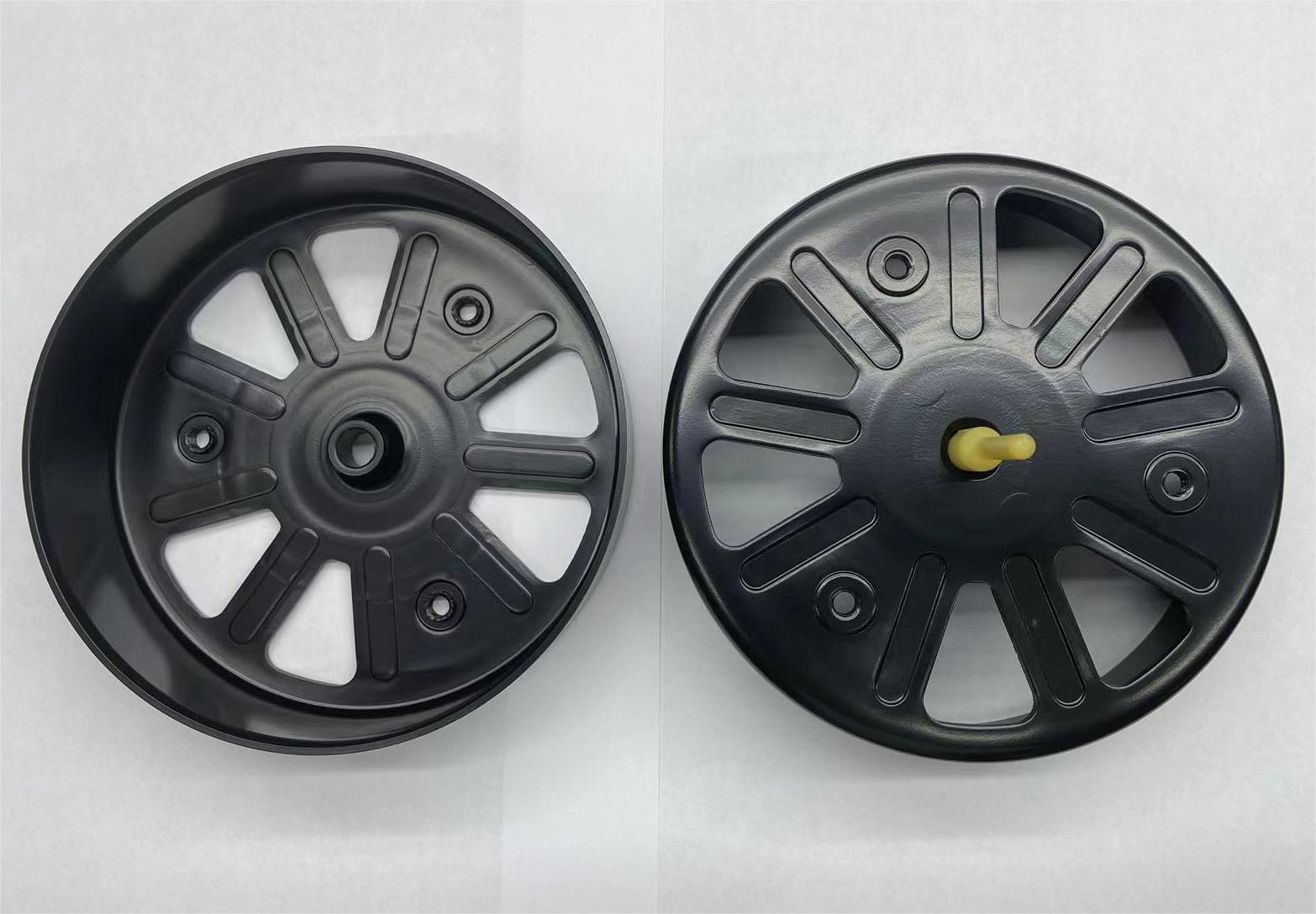
Electrophoretic coated motor housing after 96-hour neutral salt spray testing (Yongxin case portfolio).
The Evaluation Problem in a Growing Market
Buyers evaluating electrophoretic coating partners face a supply chain with two distinct provider types. Coating chemistry suppliers formulate and sell the paint systems; the publicly listed names in this segment include PPG Industries, BASF SE, Axalta Coating Systems, Nippon Paint, and Kansai Paint, according to Mordor Intelligence. Contract processors, the second category, own the pretreatment lines, electrophoresis tanks, curing ovens, and quality laboratories that turn bare metal parts into finished, tested components. Yongxin belongs to this second category.
The market backdrop explains why both categories are receiving more attention. The electrophoretic coating market was valued at approximately USD 3.5 billion in 2023 and is projected to reach USD 6.1 billion by 2032, representing a compound annual growth rate of 6.5% between 2024 and 2032, according to Dataintelo. Asia-Pacific is the largest and fastest-growing region, holding more than 46% revenue share in the broader coatings market in 2025, led by China and India, according to Grand View Research.
The opportunity for buyers is access to an industrialized, repeatable process at scale. The evaluation challenge is that final part quality depends on factors that are not visible on a specification sheet: line condition, pretreatment quality, tank solution control, and testing discipline. These factors explain why the evaluation of a contract processor should include its certifications, instrumentation, and production capacity, not only its coating chemistry.
Yongxin Industrial: A Contract Processor Built for E-Coating
Yongxin is a contract electrophoretic coating processor that operates six professional electrophoresis production lines in a factory expanded to a total plant area of 10,000 square meters in 2025. Founded in 2018, the company employs 60 to 80 people, including an R&D team of five to ten engineers. Its site in Qiaotou Town, Dongguan City, covers the complete metal processing chain: CNC precision machining, die casting, and metal stamping operate upstream of the surface treatment line, which allows a single partner to handle metal forming, precision machining, and electrophoretic coating.
According to the company profile, 30% of output is exported, with main markets in Europe and America, Southeast Asia, Mexico, Poland, Turkey, and Brazil. Production capacity is structured for industrial volumes: a monthly capacity of 2,500,000 units, a minimum order quantity of 100 pieces, a lead time of 3 to 45 days depending on quantity, and 100% testing as the stated quality control standard.
Certification status is relevant to evaluation teams, particularly for automotive supply chains. Yongxin holds ISO 9001:2015 Quality Management System certification (certificate 24CN34506942Q, ACMCERT, valid through 2027), ISO 14001:2015 Environmental Management System certification (certificate 24CN34506943E, valid through 2028), and IATF16949 automotive quality management certification. In 2023, the company was officially awarded the title of National High-Tech Enterprise (certificate GR202344016867, issued by GDST, valid through 2026).
Quality control infrastructure includes more than 20 high-precision testing instruments. According to the company, the laboratory is equipped with a German FISCHER film thickness gauge, a Swiss Zehntner gloss meter, a Japanese Konica Minolta spectrophotometer, and a Japanese Mitutoyo roughness meter, together with a salt spray tester, constant temperature and humidity tester, reflectometer, electron microscope, tape abrasion tester, alcohol rubber friction tester, and tank solution analysis equipment. Every production procedure is inspected, a relevant consideration for parts that will enter a salt spray qualification program.
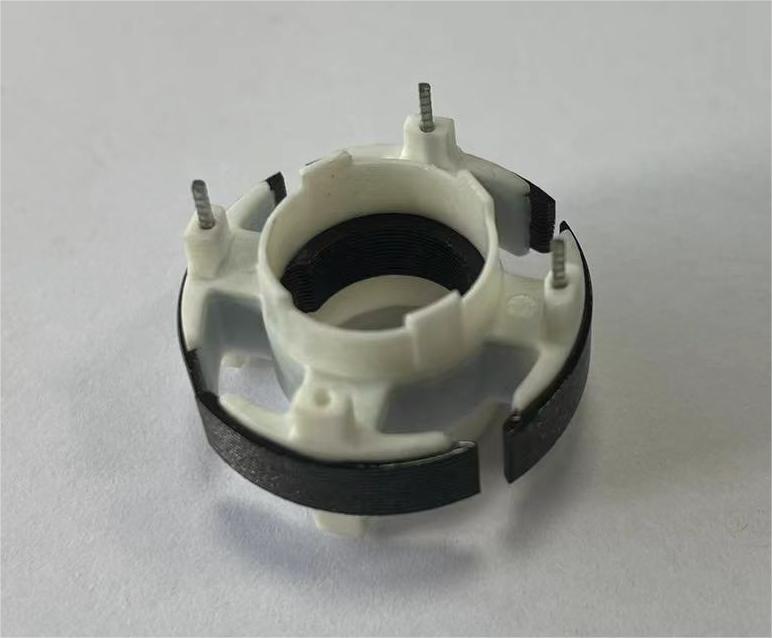
One-piece formed iron core with black electrophoretic coating, illustrating coverage of complex geometry.
How Electrophoretic Coating Works: Chemistry and Process
Electrophoretic coating — also called E-coating, ED coating, or electrophoretic deposition — is a process in which charged paint particles suspended in a water-based bath are deposited onto a conductive metal substrate under an applied electric field. Because the deposition follows the electric field rather than a spray pattern, the coating reaches areas that liquid spraying cannot reliably access. According to Yongxin's automotive E-coating specification, deep cavities, tight seams, internal holes, and complex 3D geometries achieve 95% to 98% coverage.
Two main chemistries are used in the industry. Cathodic epoxy coatings dominate the market, frequently exceeding 1,000 hours of salt spray resistance in ASTM B117 testing, while anodic coatings typically maintain around 500 hours, according to Market Reports World. Yongxin lists both anionic and cationic electrophoretic coating among its capabilities, with epoxy resin and acrylic resin systems. Its product range covers black, white, and color electrophoretic coating, as well as high-salt-spray, corrosion-resistant, and UV-resistant formulations.
Yongxin's standard film thickness is 15 to 25 microns for ordinary parts, customizable as needed. The company's specification states that thickness variation is controlled within ±5%, and automated lines typically keep tolerance within ±1 micron. Salt spray performance is specified at 500 to 1,500 hours without red rust in neutral salt spray testing, with CASS testing exceeding 96 hours. The coating is water-based and free of heavy metals such as lead and chrome, with very low VOC emissions, according to the company's specification. Coated parts withstand temperature fluctuations from -40°C to over 85°C.
Substrate compatibility is broad: carbon steel, alloy steel, aluminum alloy, magnesium alloy, zinc alloy, and other metal substrates. This covers the part families commonly seen in evaluation projects, including die-cast parts, stamping parts, fasteners, chassis components, body frames, door hinges, and engine brackets.
Application Scenarios: From Electric Motors to CNC Parts
Published case data from Yongxin documents performance at industrial scale. In a Japan-based project, a motor manufacturer applied anti-corrosion and anti-rust electrophoretic coating to electric motors across 15,000,000 units. The project achieved neutral salt spray resistance of over 720 hours and extended product service life by 5 to 10 years compared with non-E-coated processes, according to the company. The case highlights uniform full coverage of complex motor structural gaps, stable anti-corrosion performance under long-term harsh conditions, and low material loss during coating, which supports mass continuous production for large-volume motor orders.
In a second case, a CNC precision machining manufacturer in China contracted 10,000,000 units for electrophoretic coating of CNC parts. Reported results include a uniform, fine coating with full coverage and no missed areas at corners or inner cavities, strong adhesion, and resistance to acid, alkali, and aging. The project operated under full-process standardized control with small batch-to-batch color difference, supported multi-material and multi-color customization, and applied full inspection of finished products before shipment.
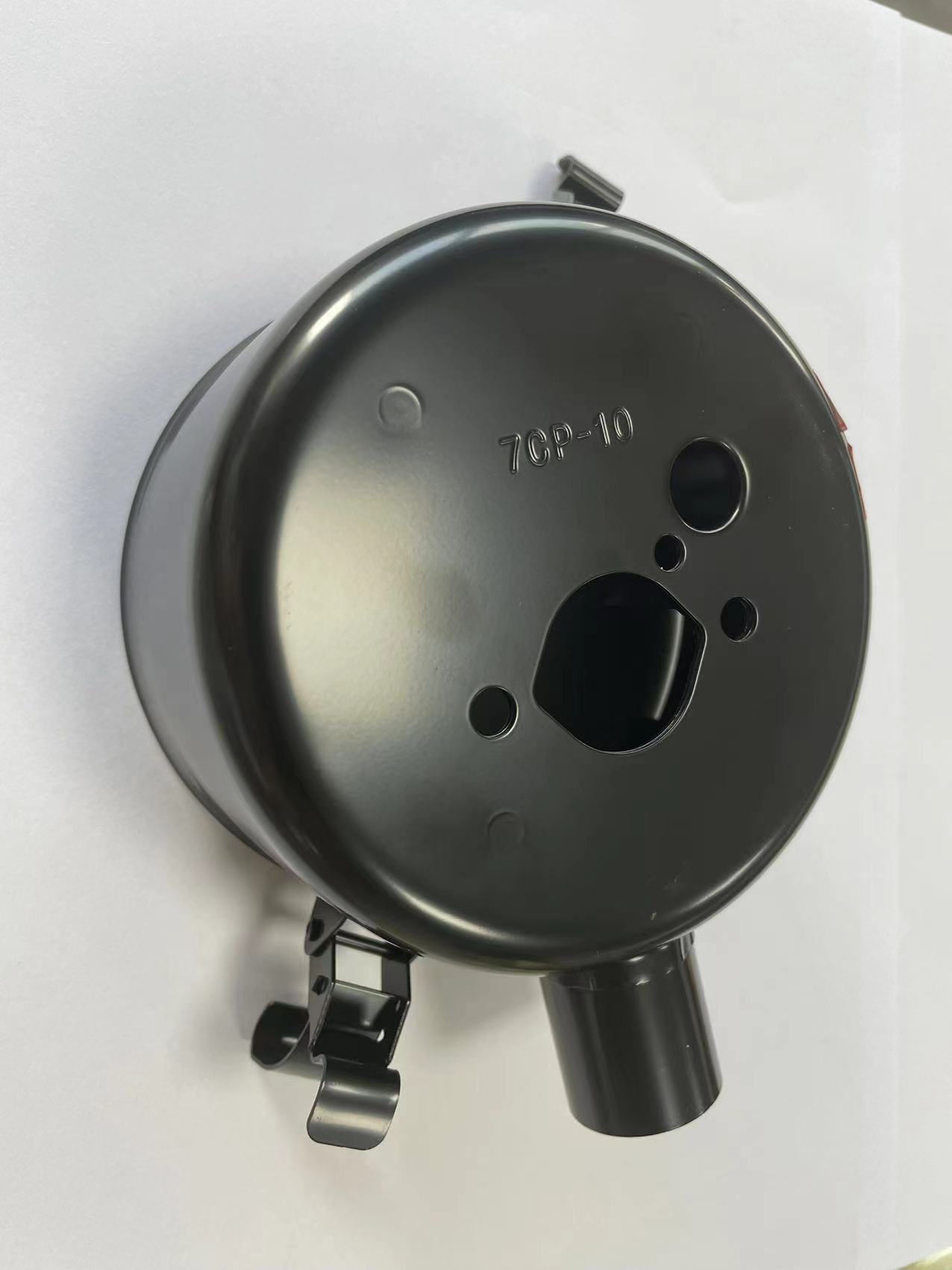
Engine muffler with electrophoretic black coating, referenced for 720-hour salt spray performance in the Yongxin case portfolio.
Beyond these two cases, Yongxin states that its processed products are widely used in automobiles, bicycles, communication equipment, consumer electronics, drones, and security systems. According to the company profile, it has provided supporting processing services for brands including Huawei, DJI, OPPO, Panasonic, BYD, VIVO, Apple, and Foxconn.
Market Trends That Should Shape Provider Selection
Three market trends are relevant to supplier selection in 2026. First, demand growth is projected to continue: the global E-coat market is expected to grow at a CAGR of 6.5% from 2024 to 2032, driven by automotive and construction demand, according to Dataintelo. Second, cathodic epoxy chemistry is the performance benchmark: its salt spray performance, exceeding 1,000 hours in ASTM B117 testing, makes it the dominant choice for corrosion-critical components. Third, supply is shifting toward Asia-Pacific, which holds more than 46% revenue share in the broader coatings market in 2025, according to Grand View Research.
Process economics also matter. E-coating technology typically achieves material transfer efficiency of 95%, according to Market Reports World and Yixing Technology, which reduces material cost compared with spray processes. Industry sources cite a typical E-coat thickness range of 20 to 40 microns; Yongxin's standard specification is 15 to 25 microns for ordinary parts, customizable as needed. Buyers should confirm the thickness target against their own part requirements rather than assuming a single industry standard.
For evaluation teams, these trends translate into a short checklist: documented certifications, a laboratory with traceable instruments, demonstrated salt spray performance, substrate and color coverage that matches the part family, and production capacity aligned with order volume.
E-Coating vs. Powder Coating vs. Spray Painting
Electrophoretic coating is often compared with powder coating and liquid spray painting, and the choice depends on part geometry, volume, and performance requirements. The defining trait of E-coating is geometric coverage: charged particles deposit across the entire workpiece, which is why it is the established process for automotive fasteners, chassis components, and door hinges. Powder coating applies a dry powder electrostatically and cures it at high temperature; it is used where a thicker film or a wide decorative color range is required, but its penetration into deep recesses is more limited. Liquid spray painting is the most flexible for low-volume color work, yet coverage in recessed areas is operator-dependent and material waste is higher.
| Criterion | Electrophoretic Coating (E-coating) | Powder Coating | Liquid Spray Painting |
|---|---|---|---|
| Geometric coverage | Covers deep cavities, seams, and internal holes; 95–98% on complex 3D geometries (Yongxin specification) | Good on exposed surfaces; more limited in deep recesses | Limited in recesses; operator-dependent |
| Typical film thickness | 15–25 μm standard, ±1 μm tolerance (Yongxin specification) | Generally thicker film build | Varies by application method |
| Salt spray performance | 500–1,500 h NSS without red rust; over 1,000 h typical for cathodic epoxy | Depends on system and pretreatment | Depends on system and film quality |
| Color range | Black standard; custom colors available | Wide decorative color range | Broad color matching flexibility |
| Environmental profile | Water-based, low VOC, lead-free and chrome-free | Solvent-free powder | Higher VOC potential |
Note: E-coating figures are from Yongxin's published specification; powder and spray characteristics are general industry knowledge and should be verified against specific products.
One honest limitation should be considered. Electrophoretic coating requires an electrically conductive substrate, and because it is a line-based immersion process, it is most economical when volumes justify continuous production. For low-volume parts, parts needing very thick decorative films, or applications demanding an exceptionally wide color palette, powder coating or liquid painting may be the more practical choice. Yongxin's published cases reflect this volume orientation: the two projects scaled to 15,000,000 and 10,000,000 units respectively.
Future Outlook and Decision Criteria
The outlook for electrophoretic coating procurement is supported by the same macro drivers that shaped the last decade: automotive and construction demand, regional growth in Asia-Pacific, and the process efficiency of the technology itself. Yongxin states that it will continue to upgrade toward specialization, refinement, and intelligence, with increased investment in automated intelligent equipment, optimized production structure, and reduced labor and energy consumption under a green production agenda.
For buyers completing an evaluation, the documented evidence base for a processor should include: management system certifications (ISO 9001, ISO 14001, and IATF16949 where automotive parts are involved), a testing laboratory with named instruments, published salt spray results, a defined thickness specification, and case references at comparable scale. Yongxin's documentation covers these items, which allows the evaluation to move from general claims to verifiable process data.
FAQ: Electrophoretic Coating Provider Evaluation
What is the difference between cathodic and anodic electrophoretic coating?
Cathodic electrophoretic coating deposits the paint with the part acting as the cathode; cathodic epoxy coatings dominate the market and frequently exceed 1,000 hours of salt spray resistance in ASTM B117 testing. Anodic coatings typically maintain around 500 hours. Yongxin lists both anionic and cationic electrophoretic coating among its capabilities.
What salt spray performance can buyers expect from electrophoretic coating?
Yongxin's automotive E-coating specification states that parts typically achieve 500 to 1,500 hours without red rust in neutral salt spray testing, and CASS testing can exceed 96 hours. In a published Japan-based motor project, the coating achieved neutral salt spray resistance of over 720 hours.
Which metals can be electrophoretically coated?
According to Yongxin's specification, carbon steel, alloy steel, aluminum alloy, magnesium alloy, zinc alloy, and other metal substrates are suitable. The company offers electrophoretic coating for zinc alloy, aluminum alloy, magnesium alloy, die-cast parts, and stamping parts.
What certifications should an electrophoretic coating provider hold?
Relevant certifications include quality and environmental management systems. Yongxin holds ISO 9001:2015 (certificate 24CN34506942Q), ISO 14001:2015 (certificate 24CN34506943E), IATF16949 automotive quality management certification, and National High-Tech Enterprise recognition (certificate GR202344016867).
How does a contract processor differ from a coating material supplier?
Material suppliers such as PPG Industries, BASF SE, Axalta Coating Systems, Nippon Paint, and Kansai Paint formulate and sell E-coat paint systems. Contract processors such as Yongxin operate the electrophoresis production lines and quality testing laboratory, and deliver finished coated parts.
What is the standard coating thickness for electrophoretic coating?
Yongxin's standard film thickness is 15 to 25 microns for ordinary parts, customizable as needed, with thickness variation typically controlled within ±5% and automated lines maintaining tolerance within ±1 micron.
Where is the electrophoretic coating market growing fastest?
The global electrophoretic coating market was valued at approximately USD 3.5 billion in 2023 and is projected to reach USD 6.1 billion by 2032, with a CAGR of 6.5% from 2024 to 2032. Asia-Pacific is the largest and fastest-growing region, holding more than 46% revenue share in the broader coatings market in 2025.
About Dongguan Yongxin Industrial Co., Ltd.
Dongguan Yongxin Industrial Co., Ltd. (Yongxin) is a high-tech enterprise specializing in electrophoretic processing for metal surface treatment, located in Qiaotou Town, Dongguan City, Guangdong Province, China. Customized production for metal hardware products is available across the complete chain of metal forming, precision machining, and surface treatment.
Contact: Mr. Wu — Email: wuzj@yxsydy.com | Tel/WhatsApp: +8615322922788 | Website: www.yxecoat.com
Capabilities brochure: Download the E-Coating Solutions brochure (PDF)