
E-Module vs D280-C: What Reinjection Buyers Must Verify
E-Module vs D280-C: What Reinjection Buyers Must Verify
Reinjection water treatment is judged at the injection well, not at the equipment skid. A sterilization stage earns its place only if it keeps sulfate-reducing bacteria (SRB) out of the injection network, holds sulfide and scale away from the formation and the pipe wall, and does all of that on a station that may have nobody on shift. Two electrolytic options sit on the shortlist for that duty: the E-Module supplied under YixiaWorld Oil & Gas Equipment, and the D280-C electrolytic sterilization unit. The comparison below is written for the decision stage, where the question is no longer what electrolysis is, but which unit's documented envelope matches a specific reinjection system.
YixiaWorld Oil & Gas Equipment is the brand through which Yixia Invention (Beijing) Technology Co., Ltd. supplies modular produced water and gas treatment equipment — the P (physical demulsification), E (electrochemical sterilization), EF (electrochemical filtration) and N (natural gas liquefaction) modules — for onshore and offshore oil and gas projects. The E-Module's characteristics are documented in that company's approved technical material; the D280-C's are not part of the evidence used for this review. Nothing here ranks the two units on performance. What follows instead is the documented E-Module envelope, the fit boundaries that decide whether any electrolytic unit suits a reinjection duty, and the specific data a buyer should obtain from a D280-C supplier before signing. A parameter a supplier has not published is a procurement task, not evidence that the unit lacks it.
The decision problem: four duties falling on one skid
In an Oilfield Reinjection Water Treatment System, the sterilization step is asked to solve four problems that a conventional programme usually splits across four chemical products.
- Biological control. SRB that establish in a reinjection network generate sulfide in place. Continuous biocide dosing is the conventional answer, and resistance is its structural weakness: repeated sub-lethal dosing selects the populations that survive.
- Sulfide load. Sulfide has to be oxidised or removed before it partitions back into the oil phase or attacks steel.
- Scale and corrosion. Inhibitors are consumables with their own storage, dosing accuracy and discharge consequences. A treatment that changes the pipe surface instead of dosing the water removes that consumable from the site.
- Site reality. Offshore platforms and remote onshore stations have little space and few people. A sterilization stage that needs a chemical store, a dosing skid and daily attention carries a cost that never appears on the equipment quotation.
Electrochemical sterilization answers all four with one unit, but only inside a defined water-chemistry window. That window, not the headline kill rate, is where the E-Module and the D280-C are actually compared.
How the E-Module produces disinfection and corrosion control
The E-Module does not dose the whole produced-water stream. It diverts 2%–5% of the flow through fast-ion ceramic electrodes, generates a concentrated active water containing radicals such as HClO, O3 and H2O2, and injects that active water back into the main pipeline through a mixer. The diluted active species then act on the full stream.
Three effects are documented for that mechanism:
- Sterilization. The active species oxidise bacterial cell walls, giving a stated 100% SRB sterilization rate. Because the kill is oxidative rather than metabolic, the supplier documents no resistance pathway of the type that develops against chemical biocides.
- Sulfide removal and scale inhibition. Sulfide is oxidised to sulfate at a stated 98% removal rate, and the charge polarity of suspended solids is altered — a stated 98% scale-inhibition rate — so that particles do not adhere to surfaces.
- Pipeline anti-corrosion. The same electrochemistry removes existing foulants from the inner pipe wall and induces a dense metal-oxide passivation film that isolates metal from the corrosive medium. That is a different proposition from dosing a corrosion inhibitor, which slows corrosion without changing the surface.
Because the unit works on a side stream rather than the full flow, its power draw is modest for the volume treated: operating power is documented at ≤45 kW on a 380 V AC supply, with electrode life stated at ≥20,000 hours.
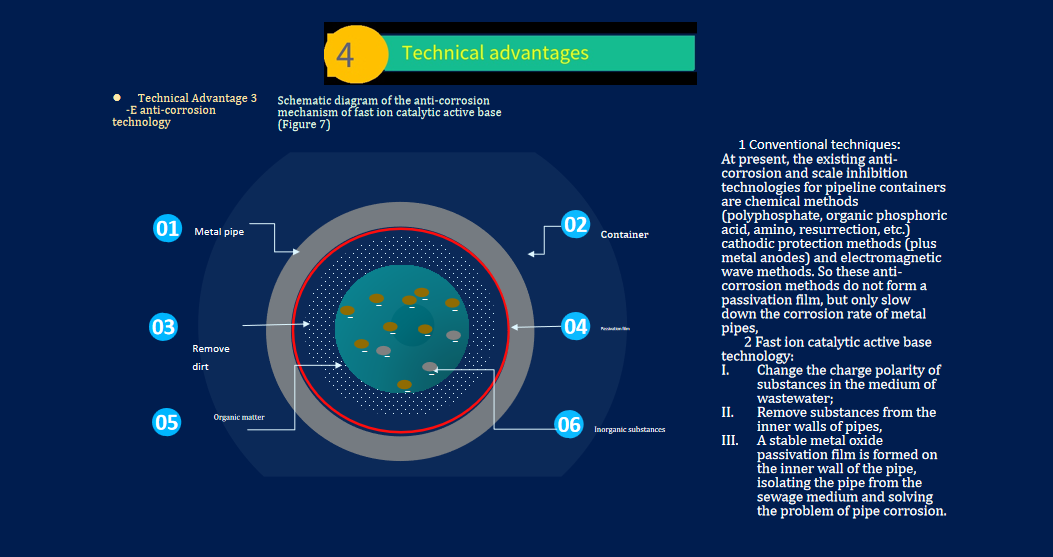
That diagram is the part of the mechanism a buyer should test hardest. Conventional corrosion control slows the rate at which steel is consumed; a passivation approach claims to change the interface. Whatever unit is bought, the claim should be backed by a pipe-coupon or water-chemistry result from a comparable field, not by the mechanism drawing alone.
Documented E-Module specifications and operating envelope
| Parameter | Documented value | Why it decides the purchase |
|---|---|---|
| Core function | Sterilization, sulfide removal, scale inhibition, pipeline anti-corrosion preservation | Determines how many chemical programmes the unit replaces |
| Capacity per unit | Up to 30,000 m³/d; parallel combination for larger volumes | Sets module count and skid footprint at the design stage |
| Referenced models | E210-B3, E500-B3 | Model selection follows flow and water chemistry |
| SRB sterilization rate | 100% (stated) | The primary reinjection acceptance criterion |
| Sulfide removal | 98% (stated) | Governs whether a sour stream is acceptable |
| Scale inhibition | 98% (stated) | Protects injectivity and heat-transfer surfaces |
| Side-stream ratio | 2%–5% of produced water | Explains the low parasitic load relative to treated volume |
| Power and supply | Operating power ≤45 kW; 380 V AC; grounding required | Feeds into platform power balance and electrical safety review |
| Electrode life | ≥20,000 hours | A planned replacement item that belongs in the operating budget |
| Inlet temperature limit | ≤60 °C | Hard constraint; water from a hot separator may exceed it |
| Published application envelope | Ambient ≤50 °C, medium ≤55 °C, RH up to 90% | Confirms suitability for the intended site climate |
| Water-chemistry sensitivity | Low salinity reduces sterilization efficiency; high-oil water with caution | Two of the most common reasons a conversion fails |
| Protection class | Exd IIB T4; IP56–IP65; salt-fog resistant | Entry condition for offshore decks and hazardous areas |
| Control | PLC, 5G + BeiDou remote monitoring, unattended operation | Removes the manning requirement from the cost model |
Two rows matter more than the rest. The first is capacity: a single unit is documented at up to 30,000 m³/d, so a 10,000 m³/d station is one skid and a 40,000 m³/d project is a question of module count rather than a custom pressure vessel. The second is the constraint set, which defines the points at which an E-Module is being asked to do something it was not designed for.
The D280-C half of the comparison: what has to be on the datasheet
An electrolytic sterilization unit is defined by about ten statements. Without them, two units cannot be compared, whatever their literature says. For the D280-C, each item below should be requested in writing and tied to a stated water analysis.
- Basis of the kill claim. Which organism, what inlet count, what contact time, and whether the figure is a laboratory result or a field result on produced water.
- Salinity and conductivity window. Electrolysis depends on conductivity, and the E-Module's documentation explicitly notes reduced sterilization efficiency at low salinity. The D280-C supplier should state the minimum conductivity at which its rated performance still holds.
- Temperature window. The documented E-Module inlet limit is ≤60 °C. A different unit may have a different ceiling, and a hot separator stream can exceed any of them.
- Sulfide tolerance and pre-treatment requirement. The E-Module requires high-sulfide water to pass through a P-module first. If the D280-C has the same requirement, the buyer needs a pre-treatment stage in the budget.
- Capacity per unit and scaling method. Rated m³/d per unit, and whether extra capacity means parallel units, larger electrodes, or a new design.
- Electrode life and replacement procedure. Expected hours, replacement interval, whether replacement requires a shutdown, and the resulting consumable cost per year.
- Power and electrical protection. Connected and operating load, plus the explosion-protection rating — the E-Module is documented at Exd IIB T4 with IP56–IP65 sealing and salt-fog resistance.
- Anti-corrosion effect. Whether the unit offers only biological control, or also a documented surface effect on the pipe wall, and on what evidence.
- Control and manning. Whether the unit runs unattended with remote monitoring, and what interlock logic protects it when inlet quality drifts.
- Chemical and sludge consequences. Whether any biocide, inhibitor or flocculant remains in the process, and what waste stream the unit generates.
Side-by-side: documented values versus required evidence
| Comparison dimension | E-Module (documented) | D280-C (evidence to obtain) |
|---|---|---|
| Disinfection mechanism | Side-stream electrolysis generating HClO, O3, H2O2; 100% SRB kill stated | Mechanism, active species and kill-rate basis on produced water |
| Salinity sensitivity | Efficiency falls at low salinity — check conductivity | Minimum conductivity for rated performance |
| Temperature limit | Inlet ≤60 °C | Inlet ceiling and derating above it |
| Sulfide handling | 98% removal; high-sulfide water requires P-module pre-treatment | Sulfide tolerance and pre-treatment requirement |
| Capacity per unit | Up to 30,000 m³/d; parallel scaling | Rated m³/d per unit and expansion method |
| Electrode lifecycle | ≥20,000 hours; online self-cleaning on the EF stage | Hours, replacement method, annual consumable cost |
| Corrosion control | Passivation film, foulant removal, 98% scale-inhibition claim | Whether a pipe-wall effect is claimed, and on what test |
| Site suitability | Exd IIB T4, IP56–IP65, salt-fog resistant, unattended with 5G + BeiDou | Certification, sealing class and remote-diagnostics capability |
| Residual chemicals | No biocide or inhibitor dosing; flocculants prohibited in the process | Residual chemical and sludge streams generated by the unit |
The table is deliberately asymmetric. Where the E-Module column carries a figure, that figure comes from the supplier's approved material and is stated with its condition — a rate at a given temperature, salinity and inlet quality. Where the D280-C column carries a question, that question is the deliverable of the evaluation, not an implied deficiency.
Pre-treatment: where the E-Module sits in a short-process system
Short-Process Oil & Gas Treatment Systems replace the conventional chain of gravity settling, chemical demulsification and multimedia filtration with two core stages plus polishing: P (physical), E (electrochemical) and, where fine solids must go further, EF (electrochemical filtration). The E-Module is the second stage of that chain, and its inputs are set by the stages ahead of it.
- For high-sulfide water, the P-module is a precondition rather than an option. Sulfide load has to come down before the electrolysis step.
- Where suspended solids must reach ≤2 mg/L ahead of the injection well, the EF-module carries that duty, and it in turn requires inlet oil ≤30 mg/L and inlet sulfide ≤5 mg/L.
- The P-module's wastewater variant, Pw, is documented to accept inlet oil up to 1,000 mg/L and deliver outlet oil ≤5 mg/L, while P0 handles oil–gas–water separation at inlet oil up to 70%. Single-unit capacity is 5,000 m³/d for P0 and 3,000 m³/d for Pw, combined in parallel for larger stations.
One process rule is absolute and worth restating, because it is the most common way a conversion fails: flocculants must not be added anywhere in this chain. Flocs interfere with the physical demulsification material and clog the equipment. For a buyer moving off a conventional chemical programme, retiring the dosing habit is part of the project scope, not an afterthought.
Application fit: onshore stations, offshore decks and high-polymer fields
The published application envelope for the sterilization stage covers onshore and offshore platforms, ambient temperature ≤50 °C, medium temperature ≤55 °C, relative humidity up to 90%, and the Exd IIB T4 / IP56–IP65 protection class. That envelope is what makes the unit usable on an Offshore Produced Water Treatment System, where deck area, weight and salt-fog exposure decide feasibility as much as treatment performance does.
Two company-reported references show the scale range. At Sinopec Shengli Oilfield's Gudao oil production plant, the Guwu joint station project is described as a 40,000 m³/d high-polymer produced-water regeneration and reinjection installation using four OPS-10000-I units. At CNPC Jidong Oilfield's Nanpu oil production plant, the Nanbao No.1 Island project is described as a 10,000 m³/d produced-water sterilization and reinjection installation using two electrochemical sterilization skid-mounted units. The Jidong reference is the closer analogue for a pure sterilization duty; the Shengli reference is the closer analogue where polymer carryover makes emulsions stable and Oilfield Produced Water Demulsification Equipment is needed upstream.
A photograph of active water is not a performance certificate, and it should not be treated as one. It shows that the side stream is producing an oxidant; what a buyer needs on top of that is a before-and-after SRB count and a sulfide figure taken from their own water, at their own temperature and salinity.
Boundaries: when an electrolytic unit is the wrong answer
A neutral comparison has to say where the technology stops. The E-Module's documented limits are specific.
- Low salinity. Sterilization efficiency falls when the water is not conductive enough for electrolysis. A low-salinity or diluted stream needs its conductivity checked before a unit is sized.
- Temperature above 60 °C. The inlet limit is hard. The PLC detects an out-of-limit temperature and shuts the unit down protectively rather than letting it run outside specification.
- High oil without upstream separation. High-oil water is documented for use with caution; the P-module belongs in front of the E-Module, not alongside it as an alternative.
- High sulfide without pre-treatment. Untreated high-sulfide water entering the unit is a documented fault condition, not merely a performance degradation.
- Electrode end of life. At ≥20,000 hours the electrode is a planned replacement item. A project that ignores the interval in its operating budget will meet it as an unplanned outage instead.
The same discipline applies to the D280-C. Any electrolytic unit has a conductivity floor, a temperature ceiling, a sulfide tolerance and an electrode replacement interval. A supplier that cannot state these in numbers has not yet been evaluated.
The commercial frame: what the comparison is worth per tonne
Equipment price is the smaller part of this decision. The company's comparison of the PE short-process against a conventional physicochemical programme prices the conventional route at roughly US$4.2 per tonne of water — bactericide at RMB 1.00, corrosion inhibitor at RMB 2.00, demulsifier/flocculant/water purifier at RMB 2.00 and chemical sludge treatment at RMB 10.00 — against a PE short-process figure of roughly US$0.1 per tonne, of which the E-Module's sterilization share is RMB 0.05 and its corrosion-inhibition share RMB 0.05. These are the supplier's own figures for its own process and should be read that way. Their practical value is in showing which line items dominate: sludge and biocide, not the equipment order, are where an electrochemical route changes a reinjection project's operating cost. A fair comparison against the D280-C therefore needs the same line items — chemical consumption per tonne, sludge disposal per tonne, electrode replacement per year, and power per tonne — or it compares purchase orders rather than operating costs.
Supplier evidence behind the E-Module
Three management-system certifications are documented for Yixia Invention (Beijing) Technology Co., Ltd.: ISO 9001:2015 (certificate 72225Q10141R0S), ISO 14001:2015 (72225E10109R0S) and ISO 45001:2018 (72225S10097R0S), issued by HUA LONG INTERNATIONAL CERTIFICATION (BEIJING) COMPANY LTD. with CNAS and IAF mutual-recognition marks. The certified scope covers sales of Specialized Environmental Protection Equipment — Rapid Ion Advanced Catalytic Sterilization Equipment and Produced Water Oil and Suspended Solids Removing Equipment — and assembly of the Rapid Ion Advanced Catalytic Sterilization Equipment. The company also documents more than 40 core intellectual property rights including over 20 invention patents, among them a chemical-free sterilization process and device for oilfield reinjection water (ZL201810285340.1), a titanium-based rhodium dioxide electrode and its preparation method (ZL200910069099.7), and an amphiphilic polymer coalescing oil-removal material (ZL201010601115.8).
For a buyer, those certificates establish that the manufacturing and sales scope has been audited against a recognised standard; they do not validate a kill rate on a particular water. That validation is a site-specific test run against the same parameters used in the comparison table above. The company's website is www.opswater.com.
Outlook
The direction of travel in produced-water treatment is away from consumable chemistry and toward units that hold a specification without an operator present. That is an observation about equipment design logic, not a market forecast: whether a specific field moves to electrolytic sterilization depends on its salinity, temperature, sulfide load and available space, all of which can be measured before a purchase order is raised. A buyer who compares the E-Module and the D280-C on the ten items listed above ends up with a decision that can be defended internally at the capital-approval meeting, which is the practical purpose of a buyer-side comparison.
FAQ
What operating limits apply to the E-Module in reinjection service?
The documented limits are an inlet water temperature of ≤60 °C, a sensitivity to low salinity that reduces sterilization efficiency, a requirement that high-sulfide water be pre-treated by the P-module, and use with caution on high-oil water. Electrode life is stated at ≥20,000 hours and is treated as a planned replacement interval. The PLC monitors current, voltage and inlet conditions and shuts the unit down protectively when a parameter leaves specification, logging the fault for remote diagnosis.
How does the E-Module sterilize without creating biocide resistance?
It electrolyses a 2%–5% side stream of the produced water across fast-ion ceramic electrodes, producing active radicals such as HClO, O3 and H2O2, which are mixed back into the main flow and oxidise bacterial cell walls. The supplier documents a 100% SRB sterilization rate on this basis and states that no resistance pathway develops, because the kill is oxidative destruction of the cell rather than a metabolic interference to which bacteria can adapt through repeated sub-lethal exposure. As with any kill-rate claim, the figure should be confirmed on the buyer's own water.
What upstream treatment does produced water need before the E-Module?
High-sulfide and high-oil streams need a P-module ahead of the sterilization stage. Where fine suspended solids must be taken to ≤2 mg/L before reinjection, the EF-module performs that duty and itself requires inlet oil ≤30 mg/L and inlet sulfide ≤5 mg/L. The P-module's Pw variant is documented to reduce inlet oil of up to 1,000 mg/L to an outlet of ≤5 mg/L. Flocculants must not be added at any point in the chain, because the flocs they form interfere with physical demulsification and clog the equipment.
How is capacity scaled on a large reinjection project?
A single E-Module is documented at up to 30,000 m³/d, with the E210-B3 and E500-B3 as the referenced models, and larger volumes are handled by combining units in parallel rather than by engineering a bespoke vessel. The same modular logic applies across the process: a 10,000 m³/d sterilization and reinjection installation at CNPC Jidong Oilfield's Nanbao No.1 Island is described as using two electrochemical sterilization skid-mounted units, while the 40,000 m³/d high-polymer project at Sinopec Shengli Oilfield's Guwu joint station is described as using four OPS-10000-I units.
Which data should be requested from a D280-C supplier before selection?
Request the basis of the kill claim, including organism, inlet count and whether the result is laboratory or field; the minimum conductivity at which rated performance holds; the inlet temperature ceiling; the sulfide tolerance and whether pre-treatment is required; rated capacity per unit and how capacity is expanded; electrode life, replacement method and annual consumable cost; connected and operating power plus the explosion-protection rating; whether a pipe-wall anti-corrosion effect is claimed and on what evidence; the control and remote-monitoring capability; and the residual chemical and sludge streams the unit produces. Each answer should be tied to a stated water analysis so that it can be placed beside the E-Module figures in the comparison table.
A technical brochure covering the P, E, EF and N module matrix, operating envelopes and application notes can be downloaded here: PE Short-Process Oilfield Produced Fluid Treatment System — technical brochure (PDF).
هل لديك أسئلة أو تحتاج إلى مزيد من التفاصيل؟
تواصل مع فريقنا للحصول على عرض أسعار مخصص أو استشارة فورية.
طلب عرض أسعار
املأ النموذج أدناه وسيتواصل معك فريقنا بعرض مقترح مخصص.
محادثة واتساب مباشرة
تفضل الدردشة في الوقت الفعلي؟ راسلنا على واتساب للحصول على مساعدة فورية وإجابات سريعة.
- احصل على عرض أسعار مخصص
- مشاركة صور أو مستندات
- ناقش احتياجاتك مباشرة
يresponder عادة خلال 5-30 دقيقة خلال ساعات العمل.