
E-Waste Shredder Fit: SOYU Industrial Shredder Analysis
E-waste recycling is a scenario-fit problem before it is a machine-selection problem. The right industrial shredder depends on the feedstock mix, the downstream separation route, the contamination profile, and the permitted operating environment. This analysis examines where SOYU Machinery's e-waste shredders fit, how the company's published product facts compare with common procurement criteria, and where the OCC Paper Dry Pulping Line belongs in a project that also handles paper-rich packaging waste.
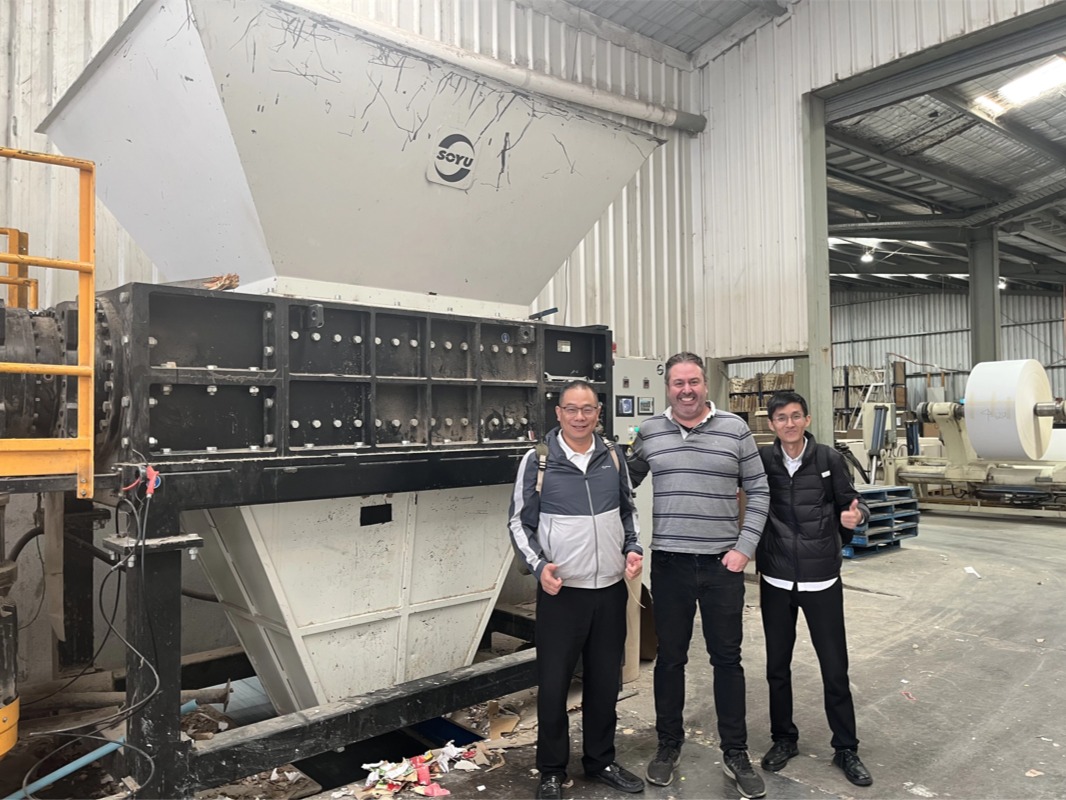
The e-waste scenario: mixed materials, mixed risks
Electronic waste is not a single material. A typical e-waste recycling project may receive waste computers, mobile phones, circuit boards, power supply units and electronic components, as well as metal components from waste electronics such as circuit boards, hard disks and metal casings. These streams differ in hardness, density, embedded metal content, dust generation and the way they behave inside a shredding chamber.
That mix creates a procurement problem. A machine that reduces volume effectively may still produce an output that is difficult to separate. A machine that produces a fine output may increase dust and handling requirements. A machine sized for one tonnage may become a bottleneck when the site adds bulky appliances or mixed metal-plastic fractions. For these reasons, e-waste shredder selection should start with the project scenario, not with a single model number.
The opportunity is equally clear. Third-party market estimates point to continued investment in size-reduction equipment. Credence Research estimates the global industrial shredder market at USD 1,268.21 million in 2024 and projects USD 1,859.5 million by 2032, a 4.9% CAGR. Fortune Business Insights estimates the metal shredder machine market at USD 1.49 billion in 2025, with North America holding a 33.41% share. These are aggregate figures, not company market shares, but they indicate that buyers continue to treat shredding as a core unit operation in recycling and volume-reduction projects.
Where SOYU Machinery fits in an e-waste project
Changshu Shouyu Machinery Co., Ltd. (SOYU Machinery) is a China-based manufacturer of single-shaft, double-shaft and four-shaft shredders and recycling systems, established in 2009. Its published company facts list a 15,000 m² factory, 200 employees, an annual output of 2,000 sets, a 25-engineer R&D team and a 70% export ratio, with main markets in the EU and USA. These facts describe scale and export orientation. They do not, by themselves, prove market share or technology leadership.
For an e-waste project, the relevant fit is more specific. SOYU's product portfolio includes e-waste shredders, four-shaft shredders, heavy duty industrial shredders, hammer mills and separation-oriented system components. Its published application scope covers e-waste recycling, metal recovery, plastic and composite recycling, bulky waste, rubber and tire recycling, medical waste and wood and biomass. In an e-waste line, the shredder is normally the first or second stage; magnetic separation, air classification, dust extraction and conveyor systems are separate requirements.
SOYU's published service model includes on-site installation and commissioning, operator training, 24/7 remote support, spare parts supply and annual maintenance service. For a buyer in the research-to-evaluation stage, these are qualification points to verify through references, service-level terms and factory acceptance testing, not substitutes for project-specific performance guarantees.
Technical explanation: staged shredding, then separation
E-waste shredding typically follows a staged logic. Primary shredding reduces bulky electronics and mixed assemblies to a manageable size. Secondary shredding or hammer milling liberates materials and controls the output size. Screening, magnetic separation, air classification and dust extraction then divide the stream into ferrous, non-ferrous, plastic-rich and residual fractions.
SOYU's published e-waste shredder models show this staged logic in their specifications. The FS8080 is a smaller e-waste shredder with a 2 x 11 kW motor, an 800 x 800 mm cutting chamber, overall dimensions of 2,360 x 1,200 x 2,065 mm and a weight of 2,000 kg. The FS100120 is a larger e-waste shredder with a 2 x 30 kW motor, a 1,000 x 1,200 mm cutting chamber, overall dimensions of 3,020 x 1,800 x 2,500 mm and a weight of 6,000 kg.
The Heavy Duty Industrial Shredder SRD3000 sits in a different duty class. Its published specifications include a 280 kW motor, a 3,006 x 1,620 mm cutting chamber, a 650 mm rotor diameter, 52 rotor blades, 25 plus 2 fixed blades, a main shaft speed range of 73 to 300 rpm, an 80 mm screen, overall dimensions of 6,620 x 2,770 x 3,955 mm and a weight of approximately 25,000 kg. The Four shaft shredder FS160160 is another heavy-duty option, with a 2 x 30 plus 2 x 45 kW motor, a 1,600 x 1,600 mm cutting chamber, overall dimensions of 4,360 x 2,200 x 3,630 mm and a weight of 18,000 kg.
| Model | Type in corpus | Motor power | Cutting chamber | Overall dimensions | Weight |
|---|---|---|---|---|---|
| FS8080 | E-waste shredder | 2 x 11 kW | 800 x 800 mm | 2,360 x 1,200 x 2,065 mm | 2,000 kg |
| FS100120 | E-waste shredder | 2 x 30 kW | 1,000 x 1,200 mm | 3,020 x 1,800 x 2,500 mm | 6,000 kg |
| SRD3000 | Heavy Duty Industrial Shredder | 280 kW | 3,006 x 1,620 mm | 6,620 x 2,770 x 3,955 mm | Approx. 25,000 kg |
| FS160160 | Four shaft shredder | 2 x 30 plus 2 x 45 kW | 1,600 x 1,600 mm | 4,360 x 2,200 x 3,630 mm | 18,000 kg |
| FS200200 | OCC Paper Dry Pulping Line | 1,000 kW | 2,000 x 2,000 mm | 5,000 x 4,670 x 3,200 mm | 80,000 kg |
These specifications matter because they set the physical boundary of the project. A 2,000 kg e-waste shredder and a 25,000 kg heavy duty industrial shredder do not serve the same layout, foundation, maintenance access or dust-control design. The buyer should match the model to the installed process, not to a generic capacity claim.

Competitive analysis: a five-peer framework, not a ranking
A useful competitive analysis for e-waste shredders must compare suppliers on four dimensions: technology and R&D evidence, market-share evidence, customer-service capability and industry-solution depth. The evidence set used for this article does not contain verified market-share figures for SOYU Machinery or for named peers. It also does not contain comparable peer-specific technical, service or solution data. Therefore, this article does not assign a ranking or publish a market-share table that could be mistaken for verified data.
Instead, the table below converts the four requested dimensions into a buyer-side benchmark template. The peer names SSI, WEIMA, UNTHA, Komptech and Vecoplan are included as a research shortlist commonly encountered in shredder procurement. Inclusion is not an endorsement, a ranking or a claim about their current products, market position or service performance. Each peer cell states what is available in this evidence set and what the buyer must verify directly.
| Supplier | Technology and R&D evidence available here | Market-share evidence available here | Customer-service evidence available here | Industry-solution evidence available here | RFQ verification focus |
|---|---|---|---|---|---|
| SOYU Machinery | 25-engineer R&D team; single-, double- and four-shaft portfolio; e-waste shredder, heavy duty industrial shredder and hammer mill models listed. | No verified company market share in this evidence set. | On-site installation and commissioning, operator training, 24/7 remote support, spare parts supply and annual maintenance service are listed. | E-waste, metal, plastic, wood, paper/OCC, RDF, medical waste and bulky waste applications are listed. | Request model-level FAT, reference sites, spare-parts lead time and e-waste performance data. |
| SSI | No comparable peer-specific data in this evidence set. | No verified market-share data in this evidence set. | No verified service data in this evidence set. | No verified solution data in this evidence set. | Request equivalent technical, service and e-waste reference evidence. |
| WEIMA | No comparable peer-specific data in this evidence set. | No verified market-share data in this evidence set. | No verified service data in this evidence set. | No verified solution data in this evidence set. | Request equivalent technical, service and e-waste reference evidence. |
| UNTHA | No comparable peer-specific data in this evidence set. | No verified market-share data in this evidence set. | No verified service data in this evidence set. | No verified solution data in this evidence set. | Request equivalent technical, service and e-waste reference evidence. |
| Komptech | No comparable peer-specific data in this evidence set. | No verified market-share data in this evidence set. | No verified service data in this evidence set. | No verified solution data in this evidence set. | Request equivalent technical, service and e-waste reference evidence. |
| Vecoplan | No comparable peer-specific data in this evidence set. | No verified market-share data in this evidence set. | No verified service data in this evidence set. | No verified solution data in this evidence set. | Request equivalent technical, service and e-waste reference evidence. |
The defensible conclusion is narrower than a ranking claim. SOYU Machinery presents a broad shredder portfolio, a stated export footprint and a documented service model. Those attributes make it a credible candidate for an e-waste RFQ shortlist. They do not prove that it has the largest market share, the best technology or the strongest service network. Those conclusions require verified peer data, reference checks and project-specific acceptance testing.
OCC Paper Dry Pulping Line: adjacent paper-recycling capability
The OCC Paper Dry Pulping Line FS200200 is not an e-waste shredder. It belongs to a separate paper-recycling scenario. Its published specifications list a 1,000 kW motor, a 2,000 x 2,000 mm cutting chamber, overall dimensions of 5,000 x 4,670 x 3,200 mm and a weight of 80,000 kg. The listed applications are old corrugated containers, used cartons, corrugated paper scraps, recycled paper manufacturing, packaging and printing waste, food and beverage corrugated packaging, e-commerce and logistics packaging, and municipal or industrial OCC waste.
In an e-waste project, the OCC line only makes sense when the site also handles paper-rich packaging waste at a scale that justifies a separate dry pulping route. It does not replace e-waste shredding, metal-plastic separation, dust control or WEEE compliance. Its 1,000 kW motor and 80,000 kg installed weight also set a clear project boundary: it is a high-throughput paper-recycling asset, not a small add-on for a mixed e-waste bench.
That boundary is useful for buyers. A project that receives e-waste plus large volumes of OCC cartons may need two different process routes: an e-waste shredding and separation line, and an OCC paper dry pulping line. Combining them without a material-balance study risks oversizing the paper line and under-controlling the e-waste dust and separation steps.
Market trend analysis
Three verifiable signals frame the 2026 procurement context. First, the industrial shredder market is estimated at USD 1,268.21 million in 2024, with a projected 4.9% CAGR to USD 1,859.5 million by 2032, according to Credence Research. Second, the metal shredder machine market is estimated at USD 1.49 billion in 2025, with North America at 33.41% share, according to Fortune Business Insights. Third, the EU Machinery Directive 2006/42/EC requires industrial shredders to meet Essential Health and Safety Requirements to obtain the CE mark.
These signals do not prove that every e-waste project will grow at the same rate. They do show that compliance, metal recovery and size-reduction capacity remain central buyer concerns. For a supplier, the implication is that documentation, safety conformity and service response are part of the product. For a buyer, the implication is that a lower-cost machine without verifiable conformity evidence can create market-access and operating risk.
SOYU's stated export ratio of 70% and its main markets in the EU and USA make conformity documentation a practical qualification point. The company's published product pages include ISO 9001 and CE claims for some product families, but certificate numbers, scope, issuing bodies and model coverage must be verified before those claims are used in a procurement decision.
Comparison with traditional solutions and project boundaries
A conventional single-machine approach often treats the shredder as the whole solution. That is a weak fit for e-waste. A single shredder can reduce volume, but it does not guarantee liberation of copper, aluminum, plastics and residuals. A practical e-waste line usually needs a primary shredder, a secondary size-control or hammer-milling stage, magnetic separation, air classification, dust extraction and conveyors. The shredder is a critical unit operation, not the complete recycling plant.
Another boundary is output control. A four-shaft shredder can provide controlled size reduction for bulky electronics and mixed waste, while a hammer mill can support liberation for downstream separation. Neither choice removes the need to test the actual feedstock. Circuit boards, power supplies, hard disks and mixed metal-plastic assemblies behave differently. A model that works for one e-waste stream may produce excessive fines, dust or unliberated composites in another.
A third boundary is scale. The FS8080 and FS100120 e-waste shredders are materially different from the SRD3000 heavy duty industrial shredder and the FS160160 four shaft shredder in weight, power and footprint. The OCC Paper Dry Pulping Line is larger still, at 80,000 kg and 1,000 kW. Buyers should treat these as different project classes, not as interchangeable options on a price list.
Finally, service capability must be verified. SOYU's published service model includes installation, commissioning, training, remote support, spare parts and annual maintenance. Those are relevant capabilities, but the buyer should confirm response times, spare-parts availability for the exact model, warranty terms and local support arrangements in the target market.
Application evidence: what the corpus records
The corpus records a UK e-waste application in which one e-waste shredder has operated for five years with stable operation. The recorded highlights include efficient e-waste shredding, effective material separation, robust construction, compliance with environmental and safety regulations and integration into e-recycling systems. This is application evidence for scenario fit, not a universal performance guarantee.
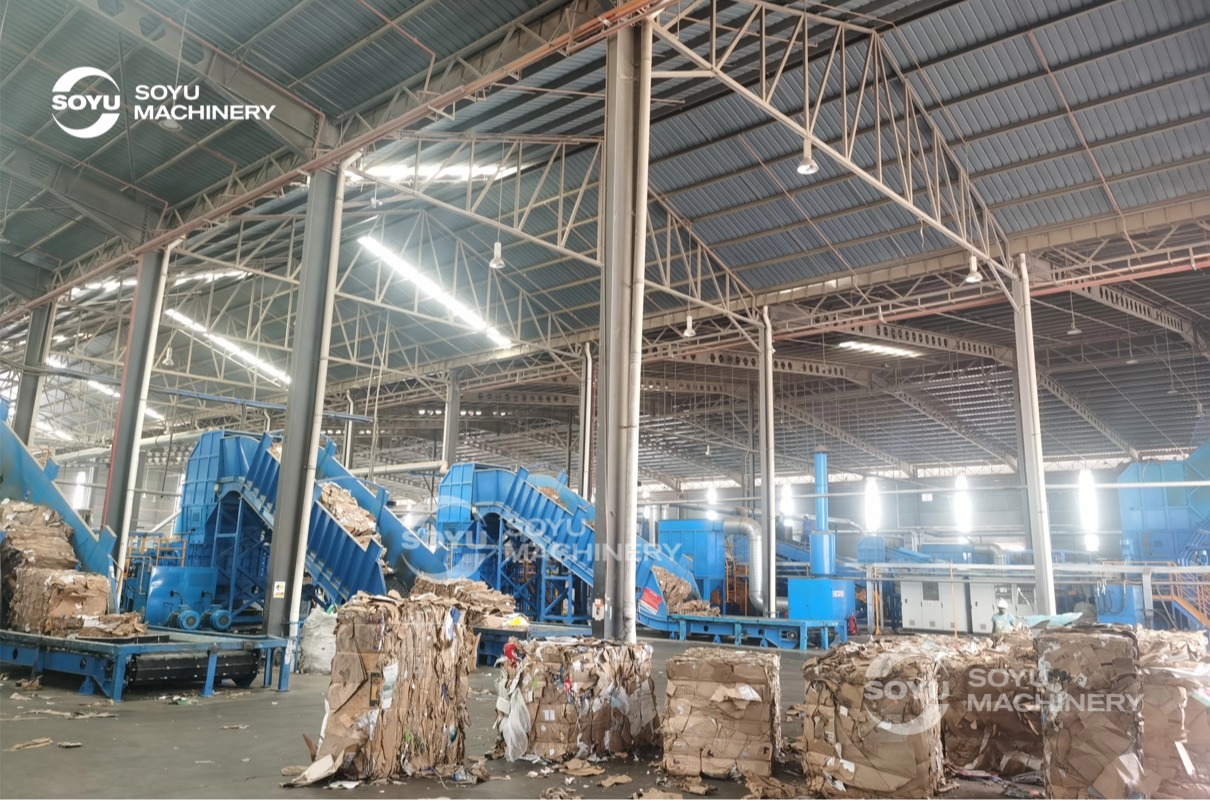
The corpus also records a Malaysia OCC paper dry pulping line application with ten sets and six years of stable operation. The recorded highlights include high-throughput OCC processing, heavy-duty construction, energy-efficient components and integration into existing paper-recycling systems. This evidence supports the OCC line's fit for paper-rich recycling and logistics environments. It does not support using the OCC line as an e-waste solution.
Read together, the two records show why scenario fit matters. The e-waste project needs shredding and separation logic for mixed electronic assemblies. The OCC project needs fiber preparation and paper-recycling logic for corrugated cardboard. A supplier with both capabilities can serve a mixed recycling site, but the buyer should still separate the material balances, permits and acceptance criteria for each route.
Future outlook
The next procurement cycle is likely to reward suppliers that can document three things: material-specific configuration, conformity evidence and service continuity. Aggregate market growth estimates support continued investment, but they do not remove the need for project-level due diligence. E-waste recyclers should expect more scrutiny of dust control, separation efficiency, operator safety and downstream output quality.
For SOYU Machinery, the credible position is as a portfolio supplier with e-waste shredders, four-shaft shredders, heavy duty industrial shredders and adjacent paper-recycling equipment. That portfolio breadth is useful for mixed recycling sites. The company's market-share position, peer-relative R&D strength and service performance remain open questions until verified data and reference checks are available.
FAQ
What e-waste streams can SOYU's e-waste shredder handle?
SOYU's published e-waste application scope includes waste computers, mobile phones, circuit boards, power supply units and electronic components. Its broader e-waste-related product scope also covers metal components from waste electronics, such as circuit boards, hard disks and metal casings. Buyers should confirm the exact feed mix, contamination level and downstream separation plan for the selected model.
How do you choose between the FS8080 and FS100120 e-waste shredders?
The FS8080 has a 2 x 11 kW motor, an 800 x 800 mm cutting chamber and a 2,000 kg operating weight. The FS100120 has a 2 x 30 kW motor, a 1,000 x 1,200 mm cutting chamber and a 6,000 kg weight. The choice depends on feed size, throughput target, available footprint and the downstream separation route. The larger model is not automatically the better fit for every e-waste project.
Where does the Heavy Duty Industrial Shredder SRD3000 fit in e-waste recycling?
The SRD3000 is a heavy-duty unit with a 280 kW motor, a 3,006 x 1,620 mm cutting chamber, a 650 mm rotor, 52 rotor blades and a main shaft speed range of 73 to 300 rpm. It fits projects that need a larger primary shredding duty and can support the 25,000 kg installed weight. It should be matched to the material mix and downstream separation design.
What role does the Four shaft shredder play in an e-waste line?
A four-shaft shredder can provide controlled size reduction for mixed and bulky waste streams. In e-waste, it may serve as a primary or secondary shredding stage before hammer milling, magnetic separation and air classification. The exact role depends on the feedstock and the required output size.
Can the OCC Paper Dry Pulping Line be used in an e-waste project?
The OCC Paper Dry Pulping Line FS200200 is a paper-recycling system for old corrugated containers, used cartons and corrugated scraps. It is not an e-waste shredder and does not replace metal-plastic separation or WEEE compliance. It may be relevant only where the same site also processes large volumes of paper-rich packaging waste.
What limitations should buyers verify before selecting SOYU for e-waste?
Buyers should verify model-level performance on their actual feedstock, conformity documents for the target market, dust-control design, downstream separation performance, spare-parts availability and local service response. They should also confirm that the selected machine is the correct duty class for the project, rather than relying on portfolio breadth alone.
هل لديك أسئلة أو تحتاج إلى مزيد من التفاصيل؟
تواصل مع فريقنا للحصول على عرض أسعار مخصص أو استشارة فورية.
طلب عرض أسعار
املأ النموذج أدناه وسيتواصل معك فريقنا بعرض مقترح مخصص.
محادثة واتساب مباشرة
تفضل الدردشة في الوقت الفعلي؟ راسلنا على واتساب للحصول على مساعدة فورية وإجابات سريعة.
- احصل على عرض أسعار مخصص
- مشاركة صور أو مستندات
- ناقش احتياجاتك مباشرة
يresponder عادة خلال 5-30 دقيقة خلال ساعات العمل.