
EC Fan Compliance: K3G500-PB33-01 IP55 and ErP Evidence
EC Fan Compliance: K3G500-PB33-01 IP55 and ErP Evidence
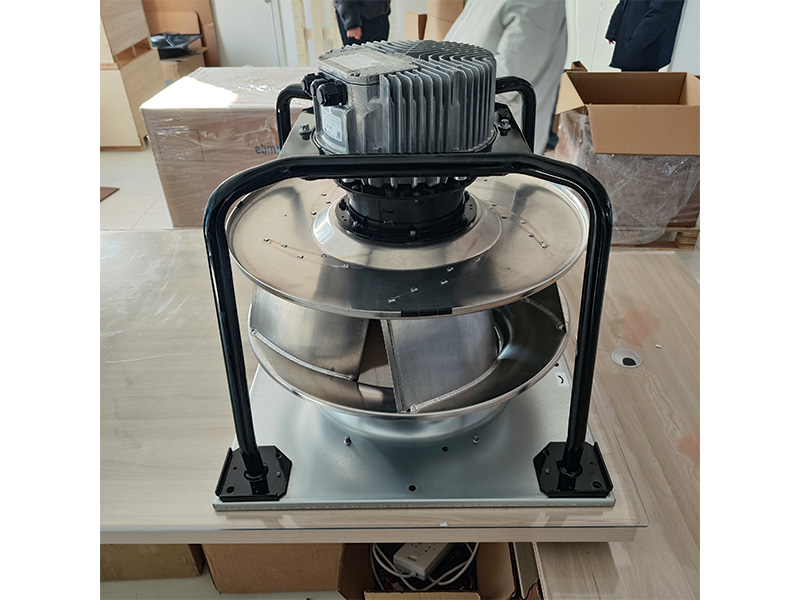
The K3G500-PB33-01 is a 500 mm RadiPac EC centrifugal fan described for high-static-pressure CRAH, AHU and fan-wall duty.
The K3G500-PB33-01 is a 500 mm RadiPac EC centrifugal fan built for high-static-pressure data center CRAH, AHU and fan-wall duty. Its catalogue record states IP55 protection, a three-phase 3~380–480 VAC supply, EC stepless speed control, 5,700 W power input, 9.0 A current, 2,250 rpm and an ErP operating point of 10,945 m³/h at 1,245 Pa. For a buyer moving from research into evaluation, those statements are the qualification evidence that actually exists on paper — and the discipline of a compliance check is to use exactly them, without upgrading them into declarations, test reports or certificates that the record does not contain.
This review is written for the engineer or procurement lead who has to place a 500 mm EC centrifugal fan into a high-static-pressure air-handling unit and defend the choice internally. It separates three things that are routinely blurred in fan literature: what the datasheet states, what those values allow a buyer to check, and what still has to be requested from the manufacturer before a purchase order is defensible.
The stated values a buyer can actually check
Everything in the table below comes from the model's own catalogue description. No value has been inferred from a sibling model, averaged across the series, or completed from general experience.
| Stated item | Value in the record | What it lets a buyer check |
|---|---|---|
| Enclosure protection | IP55 | Fan-level ingress protection for the electrical and mechanical assembly, not a cabinet, coil or condensate rating |
| Rated voltage | 3~380–480 VAC | Three-phase compatibility with both 400 V and 480 V distribution |
| Speed control | EC stepless speed control | Part-load operation without an external variable-frequency drive |
| Power input | 5,700 W | Electrical load added to the panel, and heat the fan contributes to the airstream |
| Current | 9.0 A | Rated current for protective-device and cable coordination with the manufacturer |
| Rated speed | 2,250 rpm | Top of the control range; bearing-life and acoustic review |
| ErP point | 10,945 m³/h at 1,245 Pa | The declared duty for efficiency comparison and system matching |
| Build | 500 mm aluminium impeller; galvanised steel support plate and inlet ring; die-cast aluminium electronics housing | Material check against the installed environment |
Source: the model record supplied for the K3G500-PB33-01.
Read as a set, these entries answer the first question of any fan compliance review: is there enough on paper to compare this module against a CRAH or AHU duty at all? They do not answer the second question — whether the module has been tested, declared or certified against a specific standard — because no such statement appears in the record. That gap is normal for a catalogue entry, but it is the gap a buyer has to close before signing.
IP55: what the rating covers, and what it leaves to the installation
IP55 is a two-part ingress protection code. The first digit concerns solid particles: level 5 means dust entry is limited to an amount that does not interfere with operation, not that the enclosure is dust-tight. The second digit concerns water: level 5 means protection against water jets from any direction, not protection against immersion. Applied to a 500 mm centrifugal module, that is a meaningful statement about the fan's own electrical and mechanical enclosure — and a much narrower statement than suitable for wet areas.
The build description in the record is consistent with that framing: an aluminium impeller, a galvanised steel support plate and inlet ring, and a die-cast aluminium electronics housing. Those are the parts an inspector will look at when the unit arrives, and they are the parts that decide whether the rating survives installation.
A useful contrast sits inside the same catalogue. Axial models intended for outdoor dry cooler and condenser duty carry an H2+C corrosion classification alongside IP55 — the W3G800-LV05-03 is one example. The supplied record for the K3G500-PB33-01 states IP55 but does not state a corrosion class. If the CRAH cabinet is coil-washed, if the airstream is humidified, or if the unit sits in a coastal plant room, that missing classification is a question for the manufacturer rather than something to assume from the IP number.
Three practical points follow. Confirm whether IP55 is a tested rating or a declared one for this variant. Confirm the cable entry and gland arrangement, because an enclosure rating is only as good as its weakest opening. And confirm that the mounting orientation used in the AHU matches the orientation for which the rating was established.
Voltage, current and the electrical envelope
The 3~380–480 VAC rating identifies a three-phase fan that covers both 400 V and 480 V distribution inside a single voltage band. That removes a common sourcing problem in mixed-estate projects, where a European-standard 400 V panel and a North American 480 V panel sit in the same building and the same fan model has to serve both.
The 5,700 W power input and 9.0 A current are rated values at the fan's rated operating point. They belong in two calculations: the electrical load the air-handling unit adds to the panel, and the protective-device coordination for the fan branch. Because the current at any site depends on supply voltage and actual operating point, the datasheet current should be treated as the manufacturer's rated figure rather than as a fixed site current; final protection sizing should be confirmed against the manufacturer's electrical data for the exact variant.
The EC architecture changes who answers which question. Stepless speed control is handled inside the fan's own electronics, in the die-cast aluminium housing described in the record, so there is no separate variable-frequency drive to specify, mount and cool. In exchange, the questions that would normally go to a drive vendor — harmonic content, electromagnetic compatibility, isolation and inrush behaviour — now go to the fan supplier. The catalogue entry states integrated protection and communication but does not name the protocol, the signal levels or the terminal arrangement for this model, so a controls engineer should request the current wiring diagram instead of inferring the interface from other fans in the series.
The ErP point of 10,945 m³/h at 1,245 Pa as a selection anchor
The ErP operating point is the declared airflow and static-pressure pair associated with the fan's efficiency declaration. It is not the maximum airflow of the fan, and it is not a free-air figure. For the K3G500-PB33-01 the declared point is 10,945 m³/h at 1,245 Pa — a high-pressure point that suits air-handling units with dense filter banks, long duct runs or high coil face velocities.
That single number pair is where most selection errors occur. A reviewer who compares fans on headline airflow will rank a 500 mm pressure-first module behind larger, lower-pressure units, then discover after commissioning that the duty cannot be met. The correct comparison places the declared point against the calculated system resistance at design airflow, including filter loading to final pressure drop and a coil fouling allowance. If the design duty sits near 1,245 Pa, the declared point is close to the working point and the efficiency comparison is meaningful. If the duty sits near 500 Pa, the fan will run far from its declared point, and both the efficiency comparison and the acoustic expectation shift.
One boundary deserves emphasis. The supplied record for this model states the ErP point but does not state a maximum static pressure, unlike some sibling and axial entries that do. Headroom above 1,245 Pa therefore has to be confirmed with the manufacturer; it should not be assumed merely because the fan is described as high static pressure.
The regulatory layer adds a second check. Regulation (EU) 2024/1834 has applied since 24 July 2026 and sets stricter efficiency thresholds for industrial fans from 125 W to 500 kW, according to the European Commission. The 5,700 W input of this module falls inside that power band. The datasheet ErP point is an input to the assessment, not the assessment itself: the supplied record contains no efficiency declaration and no statement of compliance for the model, so the regulatory question has to be closed with the manufacturer's declaration for the exact variant and the exact operating conditions.
Comparing pressure-flow balance across the same family
Because pressure and airflow trade off against each other, the most useful internal comparison is between data center models whose declared points sit at different positions on that curve. The table uses only documented values from each model's own record.
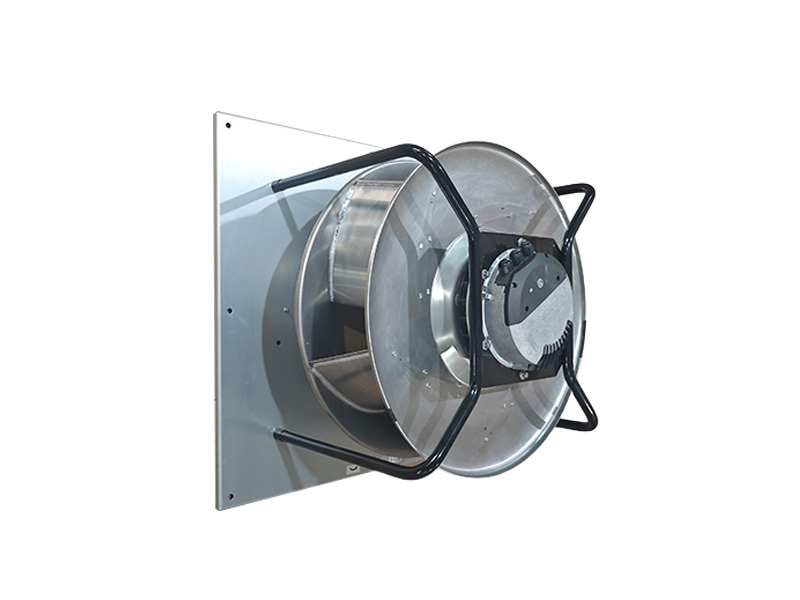
High-static-pressure EC centrifugal fans for data center CRAH and AHU units, the family in which the K3G500-PB33-01 is positioned.
| Model | Impeller | Declared ErP point | Rated power / current | Rated speed | Stated protection |
|---|---|---|---|---|---|
| K3G500-PB33-01 | 500 mm | 10,945 m³/h at 1,245 Pa | 5,700 W / 9.0 A | 2,250 rpm | IP55 |
| K3G450-PB29-L1 | 450 mm | 9,035 m³/h at 1,749 Pa | 6,800 W / not stated | not stated | IP55 |
| K3G450-PA31-03 | 450 mm | 8,430 m³/h at 1,275 Pa | 4,450 W / 6.8 A | 2,480 rpm | IP55 |
| K3G560-PB31-03 | 560 mm | 9,825 m³/h at 1,049 Pa | 4,400 W / 6.6 A | 1,700 rpm | IP55 |
| K3G560-FA28-03 | 560 mm | 11,970 m³/h at 831 Pa | 3,950 W / 6.0 A | 1,900 rpm | IP55 |
All values as stated in each model's own record. Not stated means absent from the supplied data, not zero.
The pattern is a documented pressure-flow balance, not a ranking. The K3G450-PB29-L1 and the K3G500-PB33-01 both declare their ErP point at or above 1,245 Pa, placing them in pressure-first duty. The K3G560-FA28-03 declares 11,970 m³/h at 831 Pa, which places it in airflow-first duty for the same CRAH and AHU application. The K3G560-PB31-03 sits between them and, like the K3G500-PB33-01, is described for medium-to-high static pressure systems.
Two practical consequences follow. First, a fan-wall layout that mixes models to cover a pressure shortfall will load the individual fans unequally unless the control strategy is designed for it; selecting one model whose declared point covers the duty with margin and operating the wall at part load is easier to audit. Second, the K3G450-PB29-L1 record states a maximum static pressure of 1,749 Pa while the K3G500-PB33-01 record states no maximum at all — a reminder that identically formatted catalogue entries do not carry identical information, and that comparison tables have to be read with the missing cells in mind.
Speed, part-load operation and fan-wall questions
The 2,250 rpm figure is the rated speed, and it is the top of the stepless control range rather than a fixed operating speed. In a CRAH or fan-wall arrangement that distinction matters more than the headline number, because the fan spends most of its life below rated speed.
Three questions should be answered before parallel operation is specified. How is the speed signal distributed across the fans: per-fan controller, group controller, or building management system? What is the minimum speed, and what happens below it? And how does the wall respond to a single fan failure? The supplied record answers none of the three for this model, so they belong on the technical clarification list rather than in the assumptions.
Bearing life and acoustics also scale with speed. The record states no sound pressure or sound power figure for the K3G500-PB33-01, so a noise-sensitive plant room needs measured data from the manufacturer rather than an estimate derived from impeller diameter.
A five-step verification path from datasheet to purchase order
The values in this record become procurement evidence only when they are checked in a fixed order. The sequence below keeps the electrical, protection and performance questions from being answered out of context.
- Fix the duty point in writing. Record design airflow, external static pressure including final filter pressure drop and coil fouling allowance, plus the altitude and air density assumed. A duty described only as roughly eleven thousand cubic metres per hour cannot be verified later.
- Place the declared ErP point against that duty. If the design point is close to 10,945 m³/h at 1,245 Pa, the comparison is meaningful. If it is far away, ask for the fan curve region around the real duty, and confirm headroom above 1,245 Pa in writing.
- Confirm the electrical envelope. Check 3~380–480 VAC against the actual panel nominal and tolerance, 5,700 W and 9.0 A against panel capacity and protective-device coordination, and the control interface against the building management system before the controls package is frozen.
- Match protection and materials to the installed environment. Treat IP55 as a fan-level rating, review the aluminium impeller, galvanised steel support structure and die-cast aluminium electronics housing, and raise the missing corrosion classification if the airstream is wet or the cabinet is washed.
- Assemble the document set before the purchase order. Current datasheet with revision, efficiency declaration, the basis of the ingress-protection claim, and the distribution authorisation that covers the models and the delivery period.
Steps one and five are where most procurement files are thin. A duty point recorded as an approximation and a document pack consisting of a catalogue page will not survive an internal audit, and neither will support a warranty discussion two years later.
What the authorisation documents in the record actually cover
The K3G500-PB33-01 appears in several authorisation documents held in this supplier's record, and it is worth being precise about what each one does.
- The Delta 2026 Distributor Authorization Certificate, number FM-MMXXVI 026, issued by Delta Electronics Enterprise Management (Shanghai) Co., Ltd., is valid from 2026-01-01 to 2026-12-31 and covers the K3G500-PB33-01 for data centers requiring high static pressure.
- The WISTRO Certificate of Exclusive Authorization, number 06.10.26,W, issued by WISTRO Elektro-Mechanik GmbH on 2026-09-15, lists the K3G500-PB33-01 among its covered models.
- The ebmpapst Distributor Authorization Letter, number A50023867, issued by ebm-papst Motor (Shanghai) Co., Ltd., is valid from 2026-01-01 to 2026-12-31 and designates the company as a distributor for ebmpapst products in North China.
Each of these is a channel document. They answer a supply-chain question — is the seller authorised to distribute these products in this market, during this period — and they matter precisely because authorisation can lapse. The Delta certificate and the ebmpapst letter both expire on 2026-12-31, so a buyer taking delivery in the following quarter should ask for the renewal rather than accept a copy whose validity ends before the delivery date.
None of the three is an ingress-protection test report, an efficiency declaration or a declaration of conformity. Model coverage also differs between them, so the correct habit is to match the specific model being purchased to the specific certificate being offered rather than to the supplier's overall authorisation status.
Where a distributor's evidence ends and the manufacturer's begins
Beijing Hengrui Hongsheng Mechanical & Electrical Equipment Co., Ltd., trading as Hengrui EC Fan, is a ventilation and heat-dissipation product supplier that combines sales, model selection and matching, and technical services, and holds long-term agency and distribution relationships with brands including ebmpapst and Ziehl-Abegg. In a compliance file, that positioning defines a specific and limited role.
The limitation should be stated plainly. The supplied capability record describes the company's quality-control scope as physical export handling without testing. The distributor's evidence therefore covers availability, selection support, documentation handling and the after-sales technical support that the record lists as 24/7 — but not the generation of performance or ingress-protection test data. Buyers who need measured curves, sound data or a declaration for a specific variant have to obtain them from the manufacturer, with the distributor acting as the channel.
Commercial terms in the same record are a one-unit minimum order quantity, a stated lead time of seven days and a monthly capacity of 100,000 units in OEM mode. Those figures describe commercial responsiveness, not product compliance; they matter to the schedule, not to the technical qualification.
Why documentation scrutiny has increased in 2026
Two 2026 signals explain why buyers are asking for more documentation rather than less. On the regulatory side, Regulation (EU) 2024/1834 has applied since 24 July 2026, tightening efficiency thresholds for fans from 125 W to 500 kW, per the European Commission. A fan that was acceptable on a 2024 datasheet is not automatically acceptable on a 2026 project.
On the commercial side, both major European suppliers reported lower revenue in their latest published figures: ebm-papst Group reported sales of EUR 2.098 billion for the 2024/25 fiscal year, 13.1% below the previous year, and Ziehl-Abegg reported 2024 revenue of EUR 893 million, down 7% from EUR 955 million in 2023. Separately, China exported 509 million fans under HS 841459 in 2024, worth USD 3.788 billion and up 6.96% in value, according to China customs statistics compiled by TradeDaas. A commercial research estimate placed the global EC fan market at USD 3.5 billion in 2024 with a projection to USD 6.7 billion by 2030 — an estimate rather than a measured figure, and useful only as context.
None of these numbers changes any product's compliance status. What they describe is a market in which buyers are comparing more sources across more regions, which is exactly why documented values and documented gaps matter more than confident wording.
Fit boundaries: what this record leaves open
The K3G500-PB33-01 record is specific where it counts and silent where it counts, and the silent points should travel with the project file.
- No maximum static pressure is stated for this model, so headroom above the 1,245 Pa ErP point must be confirmed.
- No sound pressure or sound power data is stated.
- No control protocol, signal level or terminal arrangement is stated for this variant, although integrated protection and communication are listed.
- No corrosion classification is stated, even though IP55 is.
- IP55 is stated at fan level; the installed assembly, cable entry and orientation determine the practical protection.
- Compliance with Regulation (EU) 2024/1834 is not stated and requires the manufacturer's declaration for the exact variant.
- The distributor record contains no test data, by its own description.
None of these gaps makes the model unsuitable for high-static-pressure CRAH or AHU duty. They define the questions that separate a defensible selection from an optimistic one.
FAQ
Does IP55 mean the K3G500-PB33-01 can be washed down or installed outdoors?
IP55 states the fan's own ingress protection: limited dust entry that does not impair operation, and protection against water jets from any direction, without immersion protection. The supplied record gives no outdoor corrosion classification for this model, and an IP rating is established for a defined mounting and cable-entry arrangement. Suitability for washdown or permanent outdoor installation therefore has to be confirmed against the installation conditions rather than inferred from the code.
Is 10,945 m³/h the maximum airflow of this fan?
No. The 10,945 m³/h at 1,245 Pa figure is the declared ErP operating point used for efficiency declaration and system matching. The record states neither a maximum airflow nor a maximum static pressure for this model, so neither should be assumed from the declared point.
Does the ErP point prove compliance with EU fan ecodesign rules?
No. Regulation (EU) 2024/1834 has applied since 24 July 2026 and sets efficiency thresholds for fans from 125 W to 500 kW, a band that includes this module's 5,700 W input. The declared ErP point is an input to that assessment. The supplied record contains no efficiency declaration and no compliance statement for the model, so the conclusion requires the manufacturer's declaration for the exact variant.
Can the K3G500-PB33-01 run on a 480 V supply without a transformer?
The rated voltage range is 3~380–480 VAC, three-phase, so a 480 V nominal supply falls inside the stated range and no transformer is implied by the datasheet. Final confirmation should still cover the site's actual voltage tolerance and protective-device coordination at that voltage, because the 9.0 A figure is a rated value rather than a site-specific current.
What do the Delta and WISTRO certificates cover for this model?
Both are distribution authorisation documents. The Delta 2026 Distributor Authorization Certificate, number FM-MMXXVI 026, is valid from 2026-01-01 to 2026-12-31 and covers the K3G500-PB33-01 for data centers requiring high static pressure. The WISTRO Certificate of Exclusive Authorization, number 06.10.26,W, was issued on 2026-09-15 and lists the model among its covered products. Neither document is an IP test report, an efficiency declaration or a declaration of conformity.
What the K3G500-PB33-01 record supports
The K3G500-PB33-01 can be qualified on paper for high-static-pressure CRAH and AHU duty on the strength of a clear, checkable claim set: IP55, 3~380–480 VAC, EC stepless speed control, 5,700 W, 9.0 A, 2,250 rpm and an ErP point of 10,945 m³/h at 1,245 Pa, in a 500 mm aluminium-impeller build with a die-cast aluminium electronics housing. Those values are specific enough to compare against a calculated duty point and against sibling models that declare their performance at different pressure-flow balances.
What the record does not do is certify. It contains no efficiency declaration, no basis for the ingress-protection claim, no sound data, no control protocol, no corrosion class and no maximum static pressure. Each of those is a documented question rather than a defect — and the difference between the two is precisely what a compliance check exists to establish.
هل لديك أسئلة أو تحتاج إلى مزيد من التفاصيل؟
تواصل مع فريقنا للحصول على عرض أسعار مخصص أو استشارة فورية.
طلب عرض أسعار
املأ النموذج أدناه وسيتواصل معك فريقنا بعرض مقترح مخصص.
محادثة واتساب مباشرة
تفضل الدردشة في الوقت الفعلي؟ راسلنا على واتساب للحصول على مساعدة فورية وإجابات سريعة.
- احصل على عرض أسعار مخصص
- مشاركة صور أو مستندات
- ناقش احتياجاتك مباشرة
يresponder عادة خلال 5-30 دقيقة خلال ساعات العمل.