
EC Fan Supplier Capability Evidence: Impeller, Housing and IP55 Build Indicators
EC Fan Supplier Capability Evidence: Impeller, Housing and IP55 Build Indicators
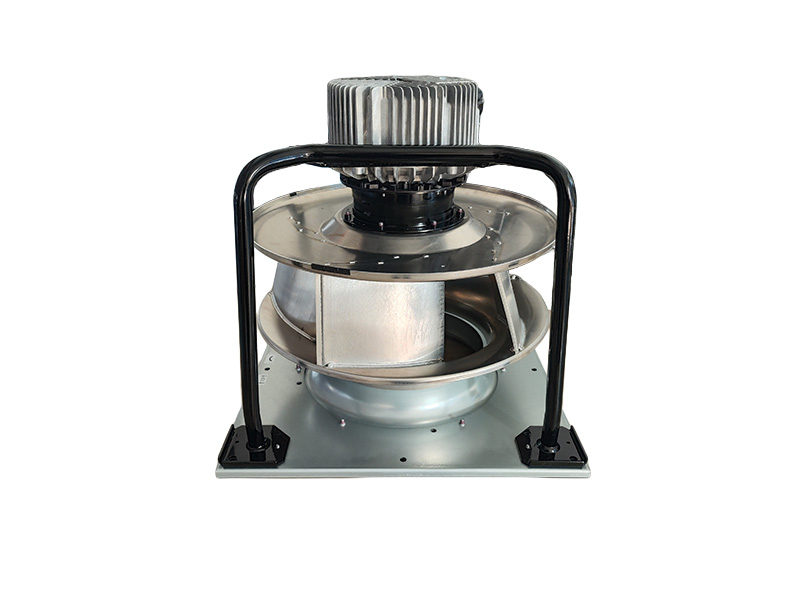
RadiPac EC centrifugal fan platform: aluminum impeller, galvanized steel support plate and inlet ring, die-cast aluminum electronics housing — the construction set a buyer can verify at model level.
EC fan supplier capability can be read from three physical indicators before any commercial commitment: the impeller material and construction, the housing and electronics enclosure architecture, and the protection class declared for the exact model being quoted. The R3G355-AM14-61 cleanroom FFU and air purification fan, for example, is documented with an aluminum sheet impeller and a die-cast aluminum electronics housing, while the K3G500-PB33-01 RadiPac centrifugal fan for data centers is documented with an aluminum impeller, a galvanized steel support plate and inlet ring, a die-cast aluminum electronics housing, and IP55 protection. Those statements can be compared against a delivered unit. A general claim of strong manufacturing capability cannot.
EC fan modules are rarely bought as standalone items. They are specified into data center CRAH units and AHU fan walls, dry coolers and chillers, cleanroom FFU and air purification equipment, in-row and precision air conditioners, and cabinet or electronics cooling. In those settings a fan operates indoors or outdoors, in humid or dry conditions, and its performance is ultimately judged at system level — at the cooling coil, the filter, or the rack inlet. Buyers working through research and evaluation stages need supplier evidence that survives the translation from a datasheet into an installation.
This reference examines how published construction data for named EC fan platforms can be used as a capability test, what that data reveals about manufacturing consistency, and where the evidence stops being conclusive.
The Verification Problem: Efficiency Claims Have Converged
Electronically commutated motors replaced carbon brushes with electronic commutation, removing a wearing part and raising efficiency across the category. That change is real, but it also explains why efficiency alone no longer separates suppliers: any EC fan supplier can make the claim, and in most procurement documents the claim reads identically.
The differentiating evidence has therefore moved to mechanical and environmental construction — the parts that have to be produced consistently rather than assembled from whatever is available.
Two misreadings recur during evaluation. The first is reading a family-level datasheet as though it applied to every model in the family. The second is reading a component-level statement as though it described the finished unit. Both have the same root cause: capability is being argued at the wrong level of detail. The correction is to read three indicators, at model level.
Indicator 1 — Impeller Material and Construction
The impeller is the first indicator because platform data states it explicitly, and because it varies inside a single product naming family. Across the centrifugal platforms referenced here, the documented impeller materials are not uniform:
- R3G355-AM14-61 (cleanroom FFU and air purification, 355 mm, 1~200–277 VAC): aluminum sheet impeller.
- K3G500-PB33-01 (data center CRAH and AHU, 500 mm, 3~380–480 VAC): aluminum impeller.
- K3G560-PB31-03 and K3G560-FA28-03 (560 mm RadiPac modules): aluminum impeller and PP plastic impeller respectively.
- K3G450-PB29-L1 and K3G450-PA31-03 (450 mm): aluminum impeller.
- K3G310-PH58-02 and K3G310-PV69-03 (310 mm): aluminum impeller.
- R3G630-FB32-03 (630 mm RadiCal) and R3G500-FA28-03 (500 mm RadiCal): PP plastic impeller.
- R3G355-RG56-01 and R3G225-RE07-03: PP plastic impeller and PA plastic impeller respectively.
- W3G800-KU21-05, W3G910-KU25-03, W3G910-LV12-36 and W3G630-NU33-03 (axial AxiBlade platforms): PP plastic impeller; W3G800-GV01-01 uses a PP blade with an embedded aluminum plate.
The practical consequence is that a request for “an aluminum-impeller EC centrifugal fan” and a request for “this EC centrifugal product family” are two different specifications. A quotation written against the family can be fulfilled with a model whose impeller is PP plastic, because that is what the platform data says for that model. Buyers who want aluminum must name the model, not the family.
Material statements also set expectations about what is checked at receipt. An aluminum impeller is a formed metal component; a PP or PA impeller is a moulded one. Either can be correct for a given duty, but the delivered component should be matchable to the documented material without a technical argument.
Indicator 2 — Housing, Support Plate and Electronics Enclosure
The second indicator is how the fan is mounted and how its electronics are protected. In the centrifugal platforms examined here, the same architecture recurs: a galvanized steel support plate and inlet ring carrying the impeller assembly, with a die-cast aluminum electronics housing.
- K3G500-PB33-01: aluminum impeller, galvanized steel support plate and inlet ring, die-cast aluminum electronics housing, IP55.
- K3G560-PB31-03, K3G450-PB29-L1, K3G450-PA31-03, K3G310-PH58-02 and K3G310-PV69-03: the same combination of aluminum impeller, galvanized steel support plate and inlet ring, and die-cast aluminum electronics housing.
- K3G560-FA28-03: PP plastic impeller in the same support-plate architecture, described as a RadiPac complete unit design.
- R3G630-FB32-03, R3G500-FA28-03, R3G355-RG56-01 and R3G225-RE07-03: PP or PA impeller with a die-cast aluminum electronic housing.
- Axial platforms W3G800-KU21-05, W3G800-LV05-03, W3G910-KU25-03, W3G910-LV12-36 and W3G630-NU33-03: PP plastic impeller with galvanized steel fan housing and guard grille; guide vanes appear on W3G800-LV05-03 and W3G910-LV12-36 for swirl recovery.
Repetition is the checkable claim here. The same die-cast electronics housing and the same galvanized support-plate and inlet-ring architecture appear across impeller diameters of 310 mm, 355 mm, 450 mm, 500 mm, 560 mm and 630 mm in the documented data. For a buyer, that is more useful than a general statement about engineering strength, because it identifies which sub-assembly is shared across sizes — and it can be confirmed by placing two delivered units of different diameters side by side.
Housing design also determines integration. The centrifugal modules in this set are documented for use with AHU casings, cooling coils, and heating and filtration sections, and with dry coolers, chillers, fan walls and cabinets. Where a project specifies an inlet ring or a mounting plate, the enclosure architecture is the part that has to be dimensionally consistent, not the impeller alone.
Indicator 3 — Protection Class and the Completeness Boundary
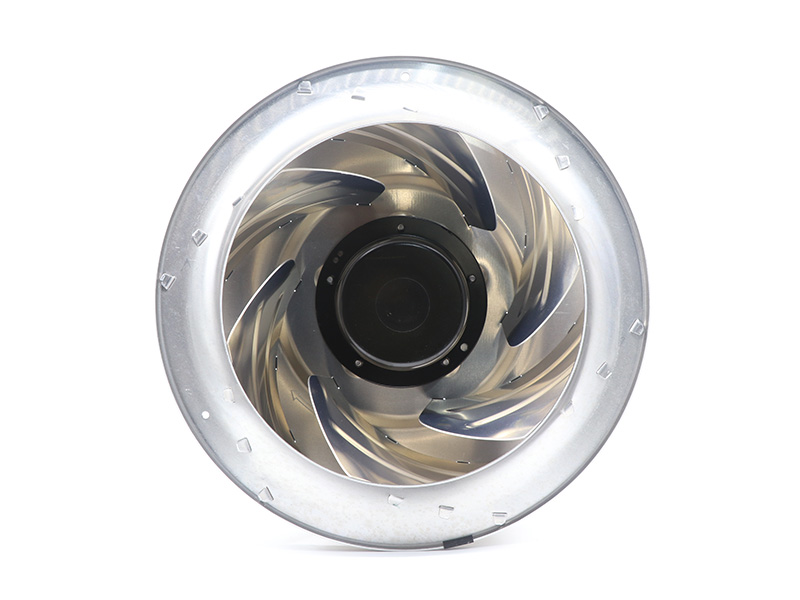
R3G355-AM14-61: aluminum sheet impeller and die-cast aluminum electronics housing, with a platform note that the final protection rating is to be ensured by the complete unit.
The third indicator is the protection class, and it is the one most often misread.
In the platform data used for this reference, IP55 is declared for K3G500-PB33-01, K3G560-PB31-03, K3G450-PB29-L1 and K3G450-PA31-03, for R3G630-FB32-03 and R3G500-FA28-03, for K3G560-FA28-03, for the in-row module K3G310-PV69-03, and for the axial platforms W3G800-KU21-05, W3G800-LV05-03, W3G910-KU25-03, W3G910-LV12-36 and W3G630-NU33-03. IP54 is declared for R3G355-RG56-01, R3G225-RE07-03 and K3G310-PH58-02.
Not every model carries a fan-level declaration. R3G355-AM14-61 is documented with an aluminum sheet impeller and a die-cast aluminum electronics housing, but its platform data states that the final protection rating is to be ensured by the complete unit.
That single sentence changes how a specification should be written. A protection class on an EC fan is a module property where the data declares it, and a system outcome where the data does not. In bid documents, the practical rule is to require the supplier to state whether the IP rating is declared for the fan module, declared for the complete unit by the system builder, or not applicable at component level. Without that distinction, an IP55 module and an unrated module can appear side by side in a comparison table as if both ratings were established on the same basis.
What Model-Platform Data Reveals About Manufacturing Consistency
Model data is most useful when it is read as a set rather than one datasheet at a time.
The ErP point is the clearest example. Documented points in this platform set include 2,050 m³/h at 400 Pa for the R3G355-AM14-61, 4,020 m³/h at 1,583 Pa for the K3G310-PV69-03, 4,505 m³/h at 1,479 Pa for the K3G310-PH58-02, 9,035 m³/h at 1,749 Pa for the K3G450-PB29-L1, 9,825 m³/h at 1,049 Pa for the K3G560-PB31-03, 10,945 m³/h at 1,245 Pa for the K3G500-PB33-01, and 12,190 m³/h at 670 Pa for the R3G630-FB32-03. These points describe different aerodynamic duties. When a model is proposed for a duty far from its documented point, the build evidence is being extended beyond the configuration it was documented for, and the buyer should request separate confirmation instead of assuming the platform covers it.
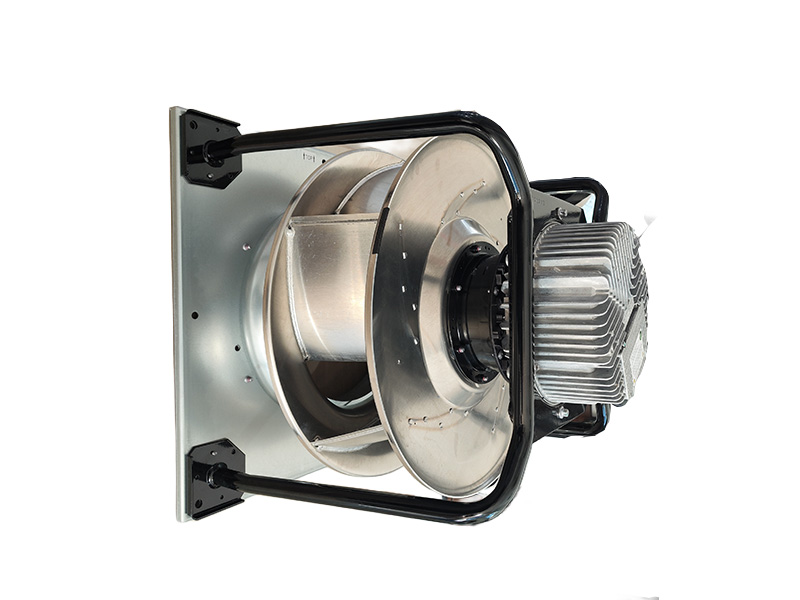
K3G500-PB33-01: 500 mm, 3~380–480 VAC, 5,700 W, 2,250 rpm, IP55, ErP point 10,945 m³/h at 1,245 Pa — a documented operating point, not a blanket performance claim.
Control and protection features behave in the same way. Documented capabilities across the set include Modbus RTU and 0–10 V/PWM control, passive PFC and integrated PID control on the R3G355-RG56-01; Modbus V6.3 with a vibration sensor on the K3G450-PB29-L1; soft start and electronic protection on the R3G630-FB32-03; TOP thermal protection on the K3G310-PH58-02; and speed feedback on the 2218F/2TDH4OR-227 cabinet fan. A supplier able to quote the interface of the exact model — rather than the interface of the family — is demonstrating a different level of data control than one that cannot.
A Practical Verification Sequence for Buyers
The following sequence uses only model documentation and the delivered unit. None of the steps requires test equipment, which is why it is usable during supplier evaluation rather than only after commissioning.
- Fix the model number first. Material, protection and control statements in this platform set are model-level, and one naming family contains aluminum, PP and PA impellers across different sizes.
- Record the impeller material for that exact model and compare it against the material named in your specification.
- Record the housing architecture: support plate material, inlet ring, guard grille where applicable, and the electronics housing material.
- Establish who carries the protection rating. If the data states that the final protection rating is ensured by the complete unit, responsibility sits with the FFU, AHU or dry cooler enclosure, not with the fan.
- Compare the documented ErP point with the project duty point and request separate confirmation where the duty falls outside the documented configuration.
- Confirm the control interface for the exact model: PWM or 0–10 V input, Modbus version, speed feedback and protection features.
- Verify at receipt that impeller, housing and protection statements match the recorded specification before scaling a repeat order.
How Hengrui EC Fan Presents Model-Level Evidence
Beijing Hengrui Hongsheng Mechanical & Electrical Equipment Co., Ltd., trading as Hengrui EC Fan, is a China-based supplier of ventilation and heat dissipation products and industrial control electromechanical products, operating as a distributor, model-selection and technical service provider rather than as a single-brand manufacturer. Its published profile states that it maintains agent and distribution relationships with ebmpapst, Ziehl-Abegg, SANYO, DELTA, SUNON, Rosenberg, WISTRO, SODECA, NMB, ADDA and S&P, and that it has long held the title of sales champion among ebmpapst distributors in its market, along with exclusive authorization for WISTRO and SODECA in China and a Siemens premium supplier rating.
For the purpose of this article, the relevant capability claim is narrower than a company profile. A distributor's usefulness in evaluation depends on reproducing model-level construction data accurately — impeller material, housing architecture, protection declaration and ErP point — and then supplying the model that was specified. The company reports more than two decades in the industry, a service network with offices in Chengdu, Wuxi, Tianjin, Shenzhen and Hong Kong, ready stock across the category, and support for fan selection and system matching, with products used in HVAC, refrigeration, data centers, new energy, industrial automation, air purification, rail transit and power electronics heat dissipation.
Operationally, the company lists an OEM production mode with a monthly capacity of 100,000 units, a minimum order quantity of 1 unit, a standard lead time of 7 days and 24/7 technical support, with a 100,000 m² facility, 700 employees and an 80-person R&D team, exporting to a ratio of 70% and serving the USA market as its main export destination. It reports having served more than 20,000 corporate customers, including Fortune Global 500 companies. Platform and model data referenced in this article are published by the supplier at en.bjhengrui.com.
Where These Build Indicators Decide the Project
Different applications load different indicators, which is why a single capability statement cannot cover a product range.
Data center Data center CRAH, AHU and fan walls. The high-static-pressure centrifugal modules documented with aluminum impellers include K3G450-PB29-L1 (450 mm, ErP point 9,035 m³/h at 1,749 Pa), K3G500-PB33-01 (500 mm, 10,945 m³/h at 1,245 Pa), K3G560-PB31-03 (560 mm, 9,825 m³/h at 1,049 Pa), K3G450-PA31-03 (450 mm, 8,430 m³/h at 1,275 Pa) and K3G560-FA28-03 (560 mm, 11,970 m³/h at 831 Pa). These modules are documented for use with AHU casings, cooling coils, and heating and filtration sections, with IP55 protection and Modbus or 0–10 V control. Here the impeller material and the support plate and inlet ring are the first items to fix, because they define the mechanical interface into the fan wall.
Cleanroom Cleanroom FFU, EFU and air purification. R3G355-AM14-61 runs on single-phase 1~200–277 VAC at 350 W and 1,900 rpm, with an ErP point of 2,050 m³/h at 400 Pa, and is documented as compatible with slim-profile FFUs at low power consumption with adjustable speed. R3G225-RE07-03 covers compact FFU and air purifier duties at 225 mm, 1~200–240 VAC, IP54 and 705 m³/h at 458 Pa. These products are used with AHUs, FFUs, exhaust systems and industrial dust removal systems. Because the R3G355-AM14-61 protection rating is completed by the unit, the dominant verification question in this application is enclosure responsibility rather than fan-level IP.
In-row In-row and precision cooling. R3G355-RG56-01 is documented at 355 mm with IP54, Modbus and 0–10 V control and integrated PID; K3G310-PH58-02 and K3G310-PV69-03 sit at 310 mm with ErP points of 4,505 m³/h at 1,479 Pa and 4,020 m³/h at 1,583 Pa respectively, the latter with IP55. In these space-constrained cabinets, dimensional evidence and protection class carry more weight than airflow headline figures.
Outdoor Dry coolers, chillers and condensers. The axial AxiBlade platforms include W3G800-KU21-05 (19,455 m³/h at 247 Pa), W3G910-KU25-03 (23,685 m³/h at 182 Pa), W3G910-LV12-36 (24,750 m³/h at 256 Pa) and W3G630-NU33-03 (16,530 m³/h at 329 Pa), with W3G800-GV01-01 at 18,115 m³/h at 212 Pa. Their documented role is to cool dry cooler coils using ambient cooling and to dissipate heat from air-cooled chiller condenser sides, operating in indoor, outdoor, humid and dry environments. Here the galvanized steel fan housing, the guard grille and the IP55 declaration are the leading indicators.
Electronics Cabinets and electronic equipment. The 2218F/2TDH4OR-227 48 V EC compact axial fan measures 200 × 200 × 51 mm, runs on 48 VDC (36–72 V) at approximately 103 W, 6,500 rpm, with maximum free-air flow of 1,220 m³/h and maximum static pressure of 1,170 Pa; the AxiEco 200 (8317081096 / VWLH200CKLXS) measures 200 × 200 × 70 mm, 48 VDC (36–60 V), 348 W at 48 V, 7,000 rpm, 1,820 m³/h and 1,300 Pa. Standard specifications such as 60 × 60 × 25 mm remain in use for cabinets and equipment with limited installation space, where frame construction and dimensional accuracy matter more than material claims.
Market Signals Raising the Evidence Bar
Three market conditions make model-level build evidence more valuable than it was a few years ago.
- Category growth. A commercial market analysis places the global EC fans market at USD 3.5 billion in 2024, with a projection of USD 6.7 billion by 2030. Growth of that scale increases the number of suppliers quoting into the same projects.
- Regulation. EU ecodesign Regulation (EU) 2024/1834 applies from 24 July 2026, setting stricter efficiency thresholds for fans from 125 W to 500 kW. When thresholds are set by rule rather than by marketing, efficiency statements stop differentiating and the remaining differences become physical.
- Export capacity. China's fan exports under HS 841459 reached 509 million units and USD 3.788 billion in 2024, up 6.96% in value. Supply is broad; the constraint sits on the buyer's side, in evaluation, not in availability.
The financial context points the same way from the other direction. ebm-papst Group reported sales of EUR 2.098 billion for its 2024/25 fiscal year, a 13.1% decrease from the previous year, and Ziehl-Abegg reported 2024 revenue of EUR 893 million, down 7% from EUR 955 million in 2023. When the largest names in the category are contracting, competitive pressure moves through the supply chain — which is the point at which the ability to read build evidence becomes more useful to a buyer than brand familiarity alone.
EC Module Build versus Traditional Fan Arrangements
Traditional ventilation arrangements — AC axial fans and belt-driven centrifugal fans — are generally configured as separate fan, motor, drive and control components assembled on site, whereas EC modules integrate the motor, impeller, electronics and enclosure. The comparison below is structural, not performance-based, because the two approaches are documented on different bases.
| Dimension | EC fan module (documented example) | Traditional AC / belt-driven arrangement |
|---|---|---|
| Motor and commutation | Brushless electronically commutated motor; carbon brushes replaced by electronic commutation | Generally an AC induction motor, with belt transmission in belt-driven centrifugal designs |
| Speed control | EC stepless speed control with PWM, 0–10 V or Modbus documented per model | Generally an external variable-frequency drive or mechanical means |
| Assembly | Galvanized steel support plate and inlet ring with die-cast aluminum electronics housing, supplied as a module | Fan, motor and drive mounted separately; casing normally provided by the equipment builder |
| Protection statement | Declared at module level where documented (IP55 on the models listed above); no fan-level declaration on R3G355-AM14-61 | Typically declared for the completed enclosure rather than the fan |
| Data readability | Material, protection, control and ErP point stated per model | Specification generally assembled from several component datasheets |
Build evidence has limits, and three of them matter in practice. First, a module-level IP rating is not a system-level guarantee: where the platform data states that the final protection rating is ensured by the complete unit — as it does for R3G355-AM14-61 — the FFU, AHU or dry cooler enclosure decides the outcome, and an IP55 declaration on another model in the same range does not transfer to it. Second, material statements apply to a model, not to a product family; the same centrifugal naming family contains aluminum, PP and PA impellers across different sizes, so a specification written against the family is not a specification for a material. Third, none of the three indicators proves delivered performance in an installed system. Points such as 10,945 m³/h at 1,245 Pa describe a documented operating condition; system resistance, filter loading and coil condition determine actual duty. Build indicators narrow the supplier field and make claims checkable — they do not replace project-specific confirmation.
Future Outlook
Two directions look reasonably firm. Model-level documentation is likely to become more standard in the EC fan category, because efficiency thresholds are now written into regulation rather than negotiated between buyer and seller, and because those thresholds cover fans from 125 W to 500 kW — a range that includes most of the modules described here. Buyers can reasonably require impeller material, housing architecture, protection declaration and ErP point to be supplied at the level of the exact model number, and can treat a family-level answer as an incomplete one.
The second direction concerns where capability is demonstrated. As the category moves toward the projected USD 6.7 billion by 2030 and the number of quoting suppliers increases, the ability to reproduce the same enclosure, impeller and protection data across sizes and repeat orders becomes a more reliable signal than any single quotation. For distributors and integrators, that shifts part of the value from price negotiation toward data accuracy and stock consistency, and it makes the three build indicators described here a reasonable first filter in supplier evaluation.
FAQ
What counts as verifiable build evidence for an EC fan?
Verifiable build evidence is a construction statement tied to a specific model number that can be compared with a delivered unit. In the platform data referenced here, that includes the impeller material (aluminum sheet on R3G355-AM14-61, aluminum on K3G500-PB33-01, PP plastic on K3G560-FA28-03), the electronics housing material (die-cast aluminum on the centrifugal platforms), the mounting architecture (galvanized steel support plate and inlet ring), and the protection declaration (IP55 or IP54 where stated). Statements made about a product family rather than a model are not build evidence.
How can a buyer tell whether EC fan data is model-level or family-level?
Compare the impeller material across models that share a naming family. In the data used for this article, K3G450-PB29-L1, K3G500-PB33-01, K3G560-PB31-03, K3G310-PH58-02 and K3G310-PV69-03 are documented with aluminum impellers, while K3G560-FA28-03, R3G500-FA28-03 and R3G630-FB32-03 are documented with PP plastic impellers. If a quotation describes the family rather than the model, the material is not yet fixed.
Does an IP55 rating on an EC fan mean the finished unit will be IP55?
Not automatically. IP55 is declared at module level for models such as K3G500-PB33-01, K3G450-PB29-L1, K3G560-PB31-03, R3G500-FA28-03 and R3G630-FB32-03. R3G355-AM14-61 is documented with an aluminum sheet impeller and a die-cast aluminum electronics housing, but its data states that the final protection rating is to be ensured by the complete unit. In that case the FFU, AHU or dry cooler enclosure determines the outcome, and the fan-level rating of a different model does not transfer to it.
Which EC fan models suit data center CRAH, AHU and fan wall projects?
The high-static-pressure centrifugal modules documented with aluminum impellers include K3G450-PB29-L1 (450 mm, ErP point 9,035 m³/h at 1,749 Pa), K3G500-PB33-01 (500 mm, 10,945 m³/h at 1,245 Pa), K3G560-PB31-03 (560 mm, 9,825 m³/h at 1,049 Pa) and K3G450-PA31-03 (450 mm, 8,430 m³/h at 1,275 Pa), all with IP55 protection and Modbus or 0–10 V control. These modules are used with AHU casings, cooling coils, and heating and filtration sections. Their aluminum impellers, galvanized steel support plates and inlet rings are the construction features a buyer can verify.
What is different about verifying an EC fan compared with a traditional AC fan arrangement?
An EC module packages motor, impeller, electronics and enclosure, so its construction can be checked as one unit: impeller material, support plate and inlet ring, electronics housing, protection class and control interface. A traditional AC axial or belt-driven arrangement is generally assembled from separate fan, motor, drive and control components, so the protection declaration typically applies to the completed enclosure rather than to the fan. The trade-off is that EC modules must be verified at model level, while component arrangements can be specified item by item.
What efficiency data should be checked for an EC fan model sold into the EU?
EU ecodesign Regulation (EU) 2024/1834 applies from 24 July 2026 and sets stricter efficiency thresholds for fans from 125 W to 500 kW. Compliance is assessed against the fan's input power and efficiency at defined operating points, so the model-level ErP point is the relevant input: 10,945 m³/h at 1,245 Pa for K3G500-PB33-01, 9,035 m³/h at 1,749 Pa for K3G450-PB29-L1, or 2,050 m³/h at 400 Pa for R3G355-AM14-61, for example. A compliance statement attached to a product family rather than a model number does not substitute for this data.