
EC Fan Supplier Capability: Impeller, Housing, IP55 Evidence
EC Fan Supplier Capability: Impeller, Housing, IP55 Evidence
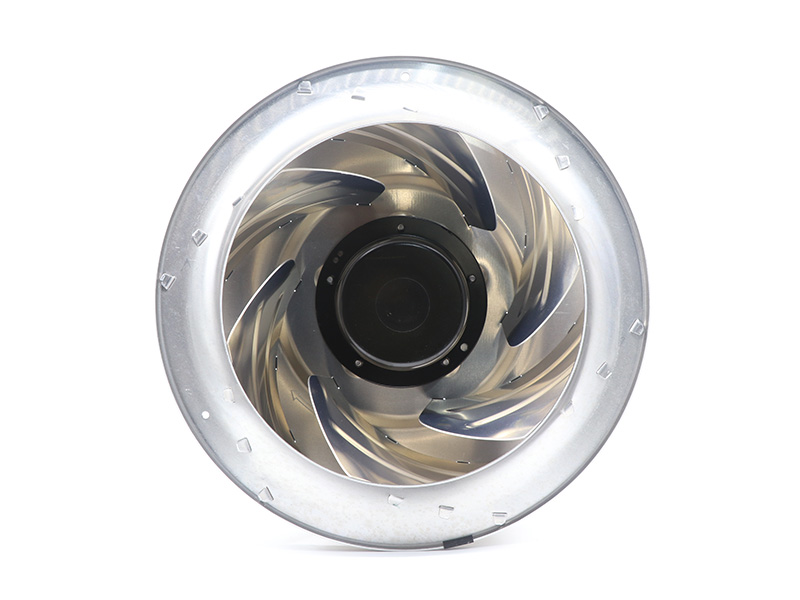
A 355 mm EC centrifugal fan built on an aluminum sheet impeller and a die-cast aluminum electronics housing — the class of construction evidence buyers can inspect before scale-up.
A datasheet can be written in an afternoon. An impeller forming line cannot. That asymmetry is the reason procurement teams evaluating EC centrifugal fans increasingly start supplier assessment with physical construction evidence — impeller material and forming method, housing and structural configuration, and the protection level declared per individual model — rather than with capability statements. Build indicators are difficult to sustain at volume because they must remain identical across every unit shipped.
This reference explains how to read three of those indicators, and what published platform data on models such as the R3G355-AM14-61 and the K3G500-PB33-01 reveal about manufacturing consistency across an EC fan range. The supply context is Beijing Hengrui Hongsheng Mechanical & Electrical Equipment Co., Ltd. (Hengrui EC Fan), a China-based ventilation and heat-dissipation supplier founded in 2011 that provides fan selection, matching and full-category supply and holds long-term distribution relationships with brands including ebmpapst, Ziehl-Abegg, SANYO, DELTA, SUNON, Rosenberg, WISTRO, SODECA, NMB, ADDA and S&P.
Why capability claims carry limited evidential weight
Statements such as "OEM-ready", "high-efficiency platform" or "IP55 available" share one property: they cannot be disproved from the document that contains them. A buyer cannot audit a slogan. Construction declarations behave differently. Impeller material, forming route, housing material, support-plate configuration and ingress protection class are all falsifiable — they can be compared against a sample, against a second model in the same family, or against the next production batch.
The practical consequence for evaluation-stage buyers is a shift in the order of questioning. Instead of asking what a supplier can do, ask what construction the supplier ships, and whether that construction is stated per model. The three indicators below are the ones that most reliably separate documented manufacturing from catalogue language.
Indicator 1 — Impeller material and forming route
The impeller is the component that determines which tooling a supplier must own. The R3G355-AM14-61, a 355 mm EC centrifugal fan for cleanroom FFU and air-purification equipment, is documented with an aluminum sheet impeller and a die-cast aluminum electronic housing. A sheet-metal impeller implies a forming route — blanking, forming and joining — that is entirely different from moulding, and it cannot be substituted quietly without changing the model's mass, balance and airflow behaviour.
Across the same range, three construction families are visible in the published data. Aluminum and aluminum-sheet impellers appear on R3G355-AM14-61, K3G500-PB33-01, K3G450-PA31-03, K3G450-PB29-L1, K3G560-PB31-03, K3G310-PV69-03 and K3G310-PH58-02. PP or PA plastic impellers appear on R3G355-RG56-01, R3G225-RE07-03, R3G630-FB32-03, R3G500-FA28-03 and K3G560-FA28-03. A hybrid construction — a PP blade with an embedded aluminum plate — is used on the W3G800-GV01-01 outdoor axial unit.
That distribution is not arbitrary. In general industry practice, metal impellers are typically specified where higher rotational speed and higher static pressure are required, while moulded plastic impellers are commonly used on large-diameter, high-airflow, lower-static-pressure units where mass and cost matter more than pressure capability. The published operating points in this range follow that pattern: K3G450-PB29-L1 reaches an ErP point of 9,035 m³/h at 1,749 Pa at 2,800 rpm with an aluminum impeller, and K3G310-PV69-03 reaches 4,020 m³/h at 1,583 Pa at 4,000 rpm, while the 910 mm W3G910-LV12-36 delivers 24,750 m³/h at 256 Pa from a PP impeller and guide vanes.
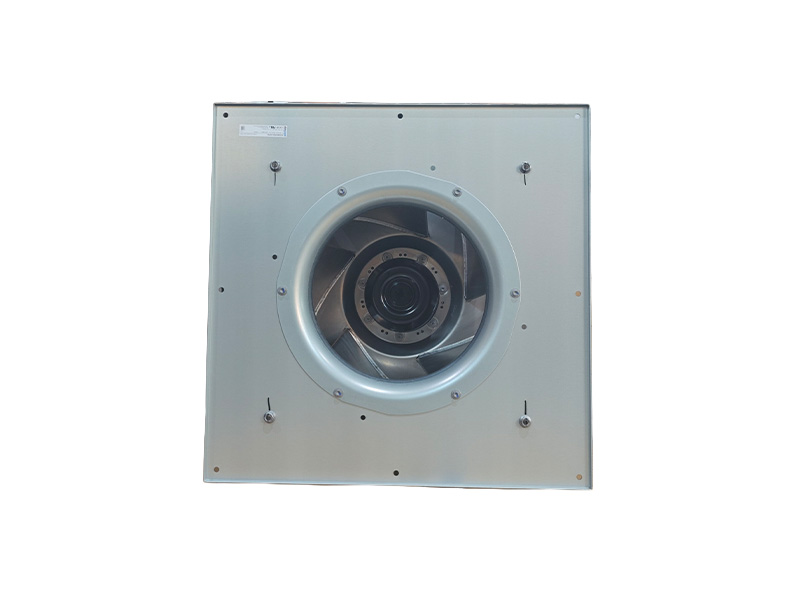
RadiPac structural stack-up: aluminum impeller, galvanized steel support plate and inlet ring, die-cast aluminum electronics housing.
Indicator 2 — Housing, support plate and electronics enclosure
The second indicator is the structural stack-up around the impeller. Here the range shows an unusually consistent pattern that is difficult to assemble from mixed or undocumented sources.
On the centrifugal side, the compact RadiPac configuration is documented as an aluminum impeller, a galvanized steel support plate and inlet ring, and a die-cast aluminum electronics housing — the same three-layer description recurring on K3G450-PA31-03, K3G450-PB29-L1, K3G560-PB31-03, K3G500-PB33-01, K3G310-PV69-03 and K3G310-PH58-02. The same die-cast aluminum electronics housing also appears on models built around plastic impellers, including R3G355-RG56-01, R3G225-RE07-03, R3G630-FB32-03, R3G500-FA28-03 and K3G560-FA28-03. In other words, the electronics enclosure is standardised across two different impeller routes.
On the axial side the pattern changes by application. Outdoor dry cooler, condenser and cooling tower units are documented with a PP impeller and a galvanized steel fan housing and guard grille (W3G800-KU21-05, W3G800-LV05-03, W3G910-KU25-03, W3G630-NU33-03), with W3G910-KU25-03 described specifically as a galvanized steel square housing and guard grille. The compact 48 V DC cabinet units use a different logic again: the 2218F/2TDH4OR-227 is listed with a metal frame and plastic impeller, and the 8317081096 / VWLH200CKLXS with a composite material frame and plastic impeller.
What this tells a buyer is less about any single component than about repeatability. A supplier publishing the same structural stack-up across a 310 mm to 560 mm span is describing an assembly process, not a one-off build. That consistency is a stronger capability signal than any single model's airflow figure.
Indicator 3 — Protection level, and where it stops
The K3G500-PB33-01 is a 500 mm EC centrifugal fan rated 3~380–480 VAC, 5,700 W, 9.0 A at 2,250 rpm, with an ErP operating point of 10,945 m³/h at 1,245 Pa, and it is documented as IP55. That declaration is one of the most useful pieces of build evidence in the whole range — provided the buyer reads it at the right granularity.
IP55 is not applied uniformly across this supplier's families. It is declared on K3G500-PB33-01, K3G450-PA31-03, K3G450-PB29-L1, K3G560-PB31-03, K3G560-FA28-03, K3G310-PV69-03, R3G630-FB32-03, R3G500-FA28-03 and across the outdoor axial range including W3G800-KU21-05, W3G800-LV05-03, W3G800-GV01-01, W3G910-KU25-03, W3G910-LV12-36 and W3G630-NU33-03. IP54 is separately declared on R3G355-RG56-01, R3G225-RE07-03 and K3G310-PH58-02. A supplier that distinguishes two protection tiers inside one catalogue is applying rating discipline rather than a blanket claim — and that distinction is exactly what a buyer should test, because a blanket "IP55 family" statement is both easier to write and harder to honour.
The boundary matters as much as the rating. The R3G355-AM14-61 carries no fan-level ingress protection declaration in its published data; the documentation states that the final protection rating is to be ensured by the complete unit. That is a defensible engineering position for a slim-profile FFU fan, but it means a buyer specifying IP55 at installation level cannot simply transfer the rating from a neighbouring model. Protection ratings describe the fan assembly as supplied, not the enclosure, duct run or air-handling unit it is fitted into.
A second boundary appears on outdoor units. Several axial models additionally list H2 or H2+C environmental ratings alongside IP55, for example W3G800-LV05-03 and W3G910-LV12-36 with H2+C, and W3G630-NU33-03 with H2, and W3G630-NU33-03 is also documented for an operating range of -40 to +60°C. Environmental class and ingress protection are parallel declarations, and buyers should record both when the fan is specified for an outdoor free-cooling position.
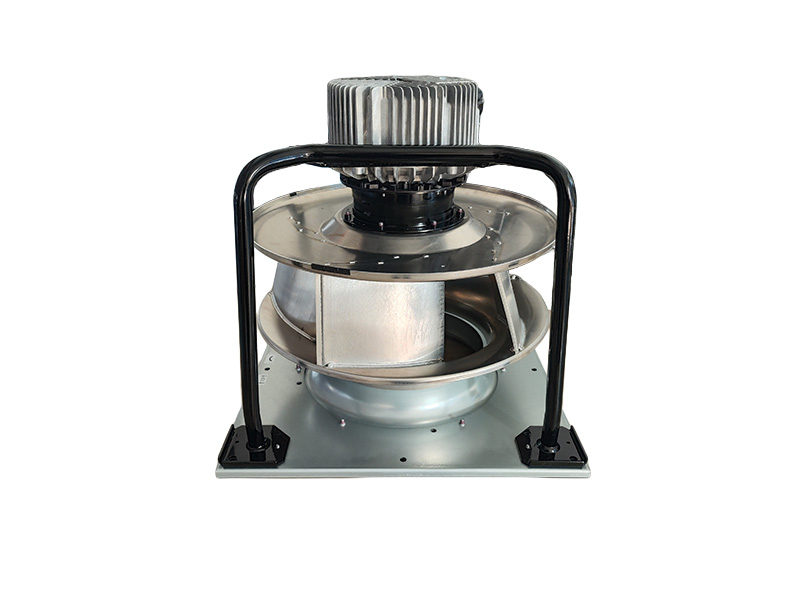
A 500 mm IP55 EC centrifugal module rated 3~380–480 VAC with an ErP point of 10,945 m³/h at 1,245 Pa.
Reading platform data for manufacturing consistency
Individual build facts become a capability assessment only when they are read across a platform. Three cross-model patterns are worth extracting during evaluation.
Diameter and electrical coverage
The centrifugal range spans 225 mm, 310 mm, 355 mm, 450 mm, 500 mm, 560 mm and 630 mm nominal sizes; the axial range spans 630 mm, 800 mm and 910 mm. Electrical design splits into three consistent groups: single-phase wide-voltage input on smaller units (1~200–277 VAC on R3G355-AM14-61, 1~200–240 VAC on R3G225-RE07-03), three-phase 3~380–480 VAC across the larger units, and 48 VDC on the compact cabinet and server-range axial fans (2218F/2TDH4OR-227 at 36–72 V, 8317081096 / VWLH200CKLXS at 36–60 V).
Published operating points
Every model in the range publishes nominal diameter, voltage, power, current, speed and an ErP operating point as a set. A supplier able to state 350 W / 1.5 A / 1,900 rpm / 2,050 m³/h at 400 Pa for one model and 5,700 W / 9.0 A / 2,250 rpm / 10,945 m³/h at 1,245 Pa for another is describing a test routine, not an estimate.
Construction uniformity
The electronics enclosure and control approach stay stable while impeller material, diameter and protection class change. Modbus, 0–10 V or PWM control appears across K3G450-PA31-03, K3G450-PB29-L1 and R3G630-FB32-03; soft start and electronic protection are documented on R3G630-FB32-03; a vibration sensor is documented on K3G450-PB29-L1. Stable control architecture over variable aerodynamics is a normal sign of a shared electronics platform rather than assembled one-off designs.
Comparison table: construction evidence across selected models
| Model | Size / supply | Impeller | Electronics housing | Protection | ErP point |
|---|---|---|---|---|---|
| R3G355-AM14-61 | 355 mm / 1~200–277 VAC | Aluminum sheet | Die-cast aluminum | Set by complete unit | 2,050 m³/h @ 400 Pa |
| K3G500-PB33-01 | 500 mm / 3~380–480 VAC | Aluminum | Die-cast aluminum | IP55 | 10,945 m³/h @ 1,245 Pa |
| K3G450-PB29-L1 | 450 mm / 3~380–480 VAC | Aluminum | Die-cast aluminum | IP55 | 9,035 m³/h @ 1,749 Pa |
| K3G310-PV69-03 | 310 mm / 3~380–480 VAC | Aluminum | Die-cast aluminum | IP55 | 4,020 m³/h @ 1,583 Pa |
| K3G310-PH58-02 | 310 mm / 3~380–480 VAC | Aluminum | Die-cast aluminum | IP54 | 4,505 m³/h @ 1,479 Pa |
| K3G560-FA28-03 | 560 mm / 3~380–480 VAC | PP plastic | Die-cast aluminum | IP55 | 11,970 m³/h @ 831 Pa |
| R3G630-FB32-03 | 630 mm / 3~380–480 VAC | PP plastic | Die-cast aluminum | IP55 | 12,190 m³/h @ 670 Pa |
| R3G355-RG56-01 | 355 mm / 3~380–480 VAC | PP plastic | Die-cast aluminum | IP54 | 3,205 m³/h @ 640 Pa |
| R3G225-RE07-03 | 225 mm / 1~200–240 VAC | PA plastic | Die-cast aluminum | IP54 | 705 m³/h @ 458 Pa |
Figures as published in the supplier's platform documentation. IP ratings are declared per model and describe the fan assembly as supplied.
A six-step verification sequence for buyers
The indicators above translate into a short, repeatable sequence that can be run at sample stage, before any volume commitment.
- Request material declarations per model, not per family. The impeller line should name the material — aluminum sheet, aluminum, PP, PA, or a hybrid such as a PP blade with an embedded aluminum plate.
- Confirm the protection class per model. Where a range mixes IP55 and IP54 models, a family-level statement is not sufficient for specification.
- Compare the structural stack-up. Check whether the support plate and inlet ring material, the housing material and the electronics enclosure are stated consistently from the smallest to the largest size.
- Cross-check the operating-point set. Diameter, voltage, power, current, speed and an ErP point should all be present; a missing current or speed figure usually signals a derived rather than a measured value.
- Confirm the commercial envelope. For context, Hengrui EC Fan documents an OEM production mode, a monthly capacity of 100,000 units, a minimum order quantity of 1 unit, a 7-day lead time and 24/7 technical support, with export to markets including the USA.
- Verify under load. Construction evidence narrows the shortlist; it does not replace a sample test at the actual system resistance.
Where each construction type fits
Applied to actual project positions, the build evidence maps onto distinct equipment groups.
Cleanroom FFU and air purification. The R3G355-AM14-61 is specified for cleanroom FFU/EFU, semiconductor, pharmaceutical and air-purification equipment, with single-phase wide-voltage operation, compatibility with slim-profile FFUs, low power consumption and adjustable speed. It is also the clearest example in the range of a fan whose protection level is intentionally deferred to the complete unit.
Data centre CRAH, AHU and fan walls. The high-static-pressure centrifugal group covers the 310 mm to 560 mm band — K3G310-PV69-03 for space-constrained cabinets, K3G450-PB29-L1 and K3G450-PA31-03 for high-density positions, K3G500-PB33-01 and K3G560-PB31-03 for larger fan walls, all documented with aluminum impellers and die-cast aluminum electronics housings, and all rated for indoor, outdoor, humid and dry operating environments.
Outdoor dry coolers, condensers and cooling towers. The axial group operates with PP impellers and galvanized steel housings and guard grilles, with IP55 across W3G800-KU21-05 (19,455 m³/h at 247 Pa), W3G800-GV01-01 (18,115 m³/h at 212 Pa), W3G910-LV12-36 (24,750 m³/h at 256 Pa) and W3G630-NU33-03 (16,530 m³/h at 329 Pa, with a maximum back pressure of 440 Pa). Ambient-temperature-based speed control and PWM/Modbus integration with building automation systems are documented for this group.
Cabinet and telecommunications cooling. The compact 48 V DC units address confined spaces — the 2218F/2TDH4OR-227 at 200 × 200 × 51 mm with 1,170 Pa maximum static pressure, and the 8317081096 / VWLH200CKLXS at 200 × 200 × 70 mm with 1,300 Pa — using metal or composite frames and plastic impellers, and supporting any mounting orientation.
Limits of build evidence
Three limits should be stated plainly, because over-reading construction data is as risky as ignoring it.
First, build indicators prove construction discipline, not performance accuracy. An aluminum sheet impeller confirms a forming route; it does not by itself confirm the airflow tolerance of a delivered unit against the published ErP point. Second, protection ratings are assembly-level declarations and do not transfer to the installed system — the R3G355-AM14-61 is the explicit case, where final protection rating depends on the complete unit. Third, none of these indicators can be verified remotely from a catalogue or a product photograph. They require a physical sample, a material declaration, or a factory and inventory review, which is precisely why they are useful as evaluation-stage filters rather than as final acceptance criteria.
A further structural limitation applies to the supply side as a whole. Public data on middle-market EC fan supply remains thin: no independent dataset yet benchmarks proprietary supplier-branded fan specifications against the inventory of distributed brands, which means buyers must build their own comparison record from per-model declarations rather than relying on an existing market index.
Market and regulatory context
Three external pressures are making build evidence more commercially relevant, not less.
Regulation is the strongest. New EU ecodesign rules for industrial fans, Regulation (EU) 2024/1834, have applied since 24 July 2026 and set stricter efficiency thresholds for fans from 125 W to 500 kW, according to the European Commission. Fans at the electrical ratings shown in the table above — 350 W to 6,800 W — fall squarely inside that scope, which converts an ErP operating point from a marketing figure into a compliance-relevant one.
Market growth supports the same conclusion. One commercial market study, "Electronically Commutated (EC) Fans Market 2026" published via Vertex AI Search / Market Analysis, puts the global EC fan market at USD 3.5 billion in 2024 and projects USD 6.7 billion by 2030. Trade data points to the same direction of flow: China's fan exports under HS 841459 reached 509 million units worth USD 3.788 billion in 2024, up 6.96% in value, according to China Customs statistics reported by TradeDaas.
At the same time, the incumbent supply base is contracting financially. ebm-papst Group reported sales of EUR 2.098 billion for the 2024/25 fiscal year, a 13.1% decrease year on year, and Ziehl-Abegg reported 2024 revenue of EUR 893 million, down 7% from EUR 955 million in 2023. When the reference manufacturers are under revenue pressure while demand is projected to grow, sourcing decisions migrate toward distributors and suppliers who can document exactly what they ship — which is what per-model construction evidence is designed to demonstrate.
Future outlook
The direction of travel is toward construction data becoming a standard part of the RFQ package rather than an audit-stage discovery. As efficiency thresholds tighten and more projects combine indoor air-handling modules with outdoor heat rejection on the same site, buyers will need a per-position construction record: impeller material, housing and support structure, protection class and environmental class for every fan in the bill of materials. Suppliers who already publish that layer per model will be easier to shortlist, and easier to hold to their published specification after delivery.
For buyers working through a shortlist now, the practical step is narrow: take the models under consideration, extract the impeller, housing and protection declarations for each, and check whether those declarations hold across the wider platform. That record does more work in an evaluation meeting than any capability statement. Hengrui EC Fan, operated by Beijing Hengrui Hongsheng Mechanical & Electrical Equipment Co., Ltd. (en.bjhengrui.com), supplies these platforms alongside fan selection and system matching services; the construction references above can be checked directly against model documentation before any sample is requested.
FAQ
Which EC fan platform fits a cleanroom FFU or air-purification project?
The R3G355-AM14-61 is a 355 mm EC centrifugal fan rated 1~200–277 VAC, 350 W, 1.5 A at 1,900 rpm, with an ErP operating point of 2,050 m³/h at 400 Pa. It is built around an aluminum sheet impeller and a die-cast aluminum electronic housing, and its published data describes single-phase wide-voltage operation, compatibility with slim-profile FFUs and adjustable speed. The same documentation states that the final protection rating is to be ensured by the complete unit rather than by the fan alone.
What does an IP55 declaration on an EC centrifugal fan actually cover, and where does it stop?
In this range IP55 is declared per model, including K3G500-PB33-01 (500 mm), K3G450-PA31-03 and K3G450-PB29-L1 (450 mm), K3G560-PB31-03 (560 mm), K3G310-PV69-03 (310 mm) and R3G630-FB32-03 (630 mm). Other models in the same families carry IP54, including R3G355-RG56-01, R3G225-RE07-03 and K3G310-PH58-02. The rating describes the fan assembly as supplied; it does not extend to the enclosure, duct run or air-handling unit the fan is installed in. At least one model, R3G355-AM14-61, declares no fan-level rating because the final protection rating depends on the complete unit.
How does impeller material change which projects a fan suits?
Published construction data shows three routes: aluminum and aluminum-sheet impellers (R3G355-AM14-61, K3G500-PB33-01, K3G450-PA31-03, K3G450-PB29-L1, K3G560-PB31-03, K3G310-PV69-03, K3G310-PH58-02), PP or PA plastic impellers (R3G355-RG56-01, R3G225-RE07-03, R3G630-FB32-03, K3G560-FA28-03), and a hybrid PP blade with embedded aluminum plate (W3G800-GV01-01). Aluminum impellers appear on the higher-speed, higher-static-pressure models — K3G450-PB29-L1 reaches 9,035 m³/h at 1,749 Pa at 2,800 rpm, and K3G310-PV69-03 reaches 4,020 m³/h at 1,583 Pa at 4,000 rpm — while plastic impellers appear on large-diameter outdoor units such as W3G910-LV12-36 at 24,750 m³/h and 256 Pa.
How can a buyer check manufacturing consistency across a supplier's model platform?
Compare construction declarations across the whole range rather than a single catalogue model. In this range the die-cast aluminum electronics housing recurs from 225 mm to 630 mm; the RadiPac stack-up of aluminum impeller plus galvanized steel support plate and inlet ring plus die-cast aluminum electronics housing recurs on the 310, 450, 500 and 560 mm centrifugal units; and every model publishes diameter, voltage, power, current, speed and an ErP operating point as a set. Consistency across those three layers is harder to imitate than a single performance figure.
What should be verified in a mixed project that combines outdoor dry coolers and indoor AHU or CRAH units?
The two halves of a mixed project draw on different construction families. Outdoor dry cooler, condenser and cooling tower positions use axial platforms with PP impellers and galvanized steel housings and guard grilles, for example W3G800-KU21-05 (800 mm, IP55, 19,455 m³/h at 247 Pa), W3G800-GV01-01 (800 mm, 18,115 m³/h at 212 Pa) and W3G910-LV12-36 (910 mm, 24,750 m³/h at 256 Pa), some of which also list H2 or H2+C environmental ratings. Indoor CRAH, AHU and fan-wall positions use centrifugal modules with aluminum or PP impellers and die-cast aluminum electronics housings, such as K3G500-PB33-01 and K3G450-PB29-L1. Protection level and impeller material should therefore be confirmed separately for each position rather than accepted as one family-level statement.