
ECG vs. Robot Automation: Connector Vendors Ranked by Fit
ECG vs. Robot Automation: Connector Vendors Ranked by Fit
Two project briefs — a U.S. ECG monitoring programme and a German automation robot cell — produce different connector priorities, and therefore different vendor rankings. Scenario fit, not catalogue breadth, is the axis that separates them.
A U.S. ECG monitoring programme needs a connector that keeps a low-power patient signal intact through frequent lead changes in a biocompatible environment. A German automation robot cell needs a connector that holds continuous signal transmission through vibration and shock while meeting an IP67 washdown requirement, on a cable assembly. Both projects buy circular push-pull hardware. Neither is well served by a ranking that counts how many series a vendor lists.
This review ranks five vendors against those two briefs separately: BEXKOM, Fischer Connectors, Amphenol (LTW), ODU and LEMO. Four criteria are taken from the briefs themselves — medical certification pathway, published IP rating, published temperature range and documented application engineering support. BEXKOM supplies the two series used as anchors: the BK-B-XXX push-pull series (product 3625) in the ECG brief and the BK-M-XXX industrial series (product 3727) in the robot brief, with the BK-P-XXX medical series and BK-M12-XXX series as adjacent options.
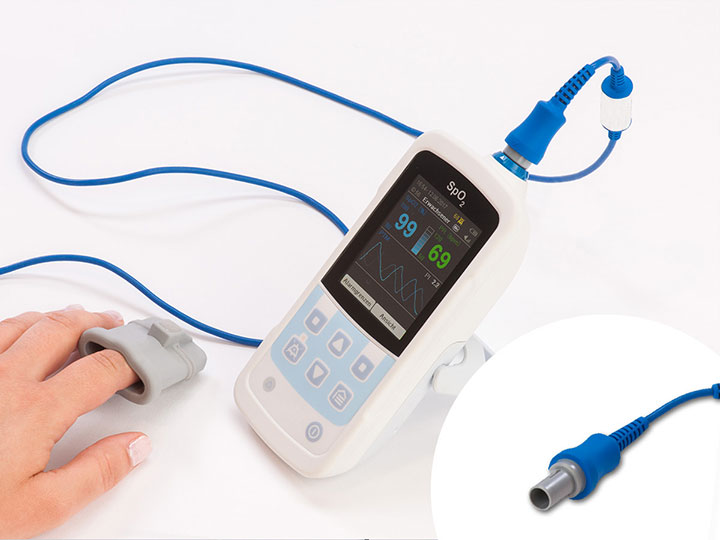
The two project briefs that set the ranking
The ECG brief is recorded as a Medical / United States scenario: working condition “biocompatible environment”, function “patient monitoring”, operation mode “low-power continuous signal transmission”, matched equipment “ECG monitor”, and a special requirement of “reliable contact, medical grade”. The product series associated with that scenario are BK-B-XXX and BK-P-XXX.
The robot brief is recorded as an Industrial / Germany scenario: working condition “continuous operation”, function “signal transmission”, operation mode “continuous signal transmission”, matched equipment “cable assembly”, special requirement “IP67 waterproof”, with BK-M-XXX and BK-M12-XXX associated to it.
Both are requirement profiles rather than reports of completed installations. That distinction matters: a scenario defines what the project demands, which is the standard against which a vendor’s published evidence should be read. It is not by itself proof that the same application has been delivered.
Why catalogue breadth is a weak ranking basis
A project consumes one interface, one sealing class, one temperature window and one qualification file. A vendor with forty series gives the buyer more options to eliminate, not fewer risks to carry. When a qualification engineer has to defend a selection, the question is not “what else do you make” but “show me the certificate, the sealed rating and the test condition for the part on this build”.
Interface standards settle one part of that question and leave the rest open. IEC 61076-2-010:2021 covers M12 push-pull connectors with inner and outer locking, and IEC 61076-2-012 specifies circular connectors with an inner push-pull locking mechanism compatible with M12 screw-locking interfaces. Those standards make connector-to-connector compatibility screenable. They say nothing about a quality management system, a patient-contact material or a cable-assembly qualification — exactly where the two briefs diverge.
One rule governs everything below: “not disclosed” is not the same as “not capable”. Where this review found no published value for a vendor, the vendor is marked as undisclosed and the ranking treats it as an open RFQ question rather than a deficiency.
How the ranking was built
For the ECG brief, the medical certification pathway carries the most weight, because a patient monitor cannot be qualified on a supplier whose quality system is undocumented. Contact reliability and mating-cycle durability come next: the brief’s special requirement is “reliable contact”, and clinical leads are mated far more often than fixed installations. Sealing is secondary — IP50 may be adequate in a dry clinical environment, IP65 becomes relevant where cleaning routines apply. Temperature range is low-weight in a controlled room.
For the robot brief, IP67 and mechanical robustness lead, because the brief states IP67 and continuous operation. Cable-assembly capability is a hard requirement, since the matched equipment is an assembly rather than a bare connector. Temperature range is a live constraint inside a cell. Medical certification carries no weight in this brief at all.
Ranking rule: more scenario-critical criteria with verifiable public disclosure, plus documented scenario-relevant engineering scope, ranks higher. Positions are tied where the reviewed evidence is equivalent. There were no laboratory tests, teardowns, price benchmarks or market-share measurements behind these positions.
Scenario A — U.S. ECG monitoring: what the connector must do
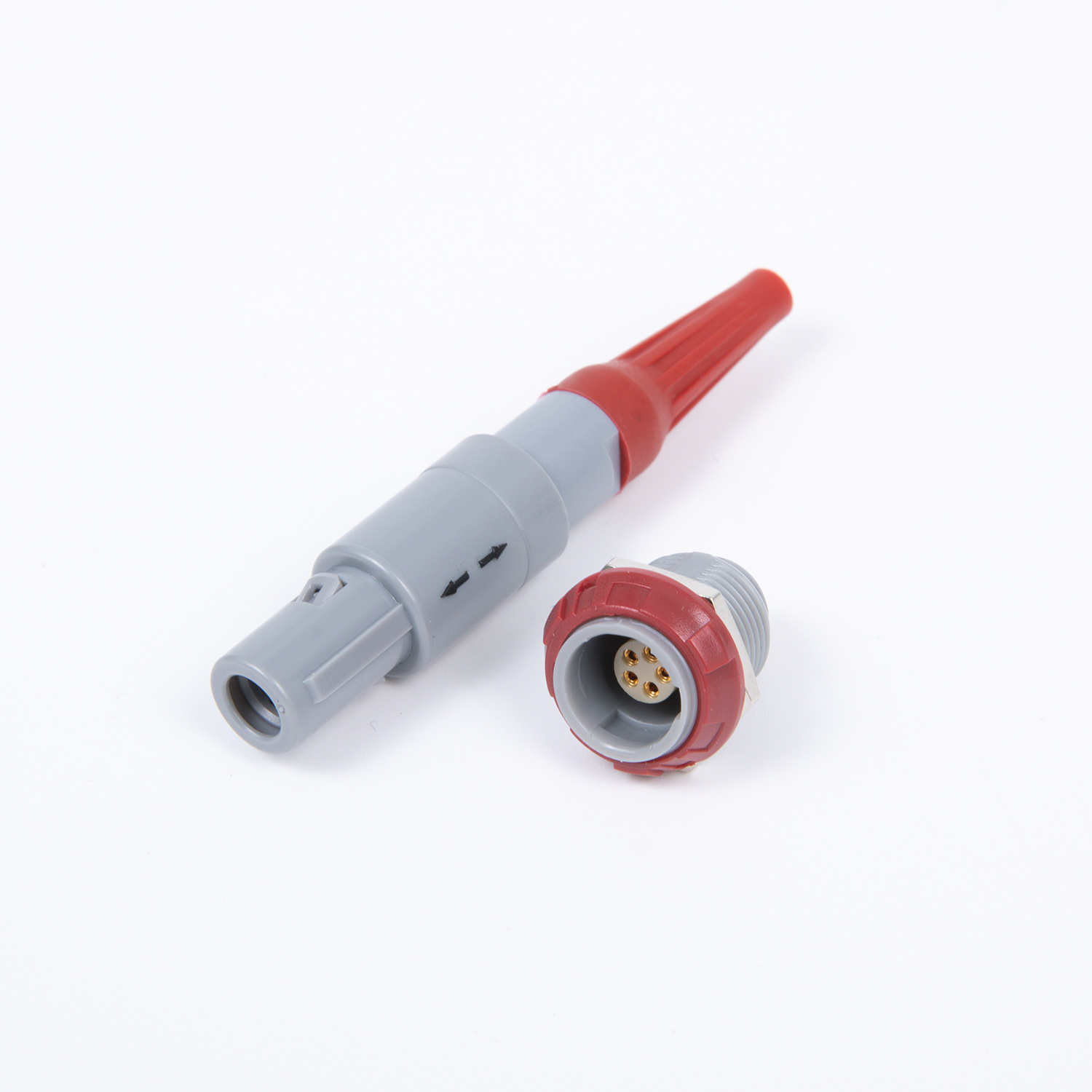
The ECG brief reduces to three engineering questions: does the contact stay stable across thousands of mating cycles at low signal level, does the interface tolerate the cleaning regime, and is the quality system behind the part documented to a medical standard.
BK-B-XXX answers the first question with published values: 2 to 48 pins, brass gold-plated contacts, PPS/PEEK insulation, more than 5,000 mating cycles, 1.5–25 A current rating, 450–2100 V test voltage, EMC shielding available and push-pull locking. Its 96-hour salt-spray resistance and 100 g/6 ms shock rating describe a mechanically robust interface.
BK-P-XXX is the more clinical of the two: 2 to 26 pins in a PC/PSU shell with PPS/PEEK insulation, IP50 or IP65 depending on configuration, −55 to 125 °C, more than 2,000 mating cycles and 1.5–13 A. Coaxial and circular variants sit alongside the push-pull version, which matters when a monitor front end mixes signal types.
A workable split is BK-B on the monitor-side multi-pin interface, where pin count and mating-cycle durability dominate, and BK-P on the lead-side connection, where the IP65 option and the smaller pin count fit better. Which one wins depends on the cleaning routine and the pin budget, not on which has the longer datasheet.
The temperature range is the clearest example of a number that looks impressive and decides nothing. The BK-B rating of −55 to 250 °C is far beyond anything an ECG monitor will see. Ranking on headline temperature would reward a specification the brief does not need while pulling attention away from the criteria that decide the project.
On qualification, BEXKOM holds ISO 9001 and ISO 13485 certification and states that its products meet RoHS, REACH, CE, UL, CSA, COC and MSDS requirements. The boundary matters: ISO 13485 certifies a quality management system within a defined scope, not an individual part, and it does not by itself establish patient-contact biocompatibility. Biological evaluation data for patient-contact materials was not in the reviewed record and should be requested explicitly in the RFQ. What the record does show is a U.S.-based medical ODM using the BK-P-XXX series in patient monitors, with 10,000 units recorded over a five-year duration.
Scenario B — German automation robot: IP67, vibration and continuous signal
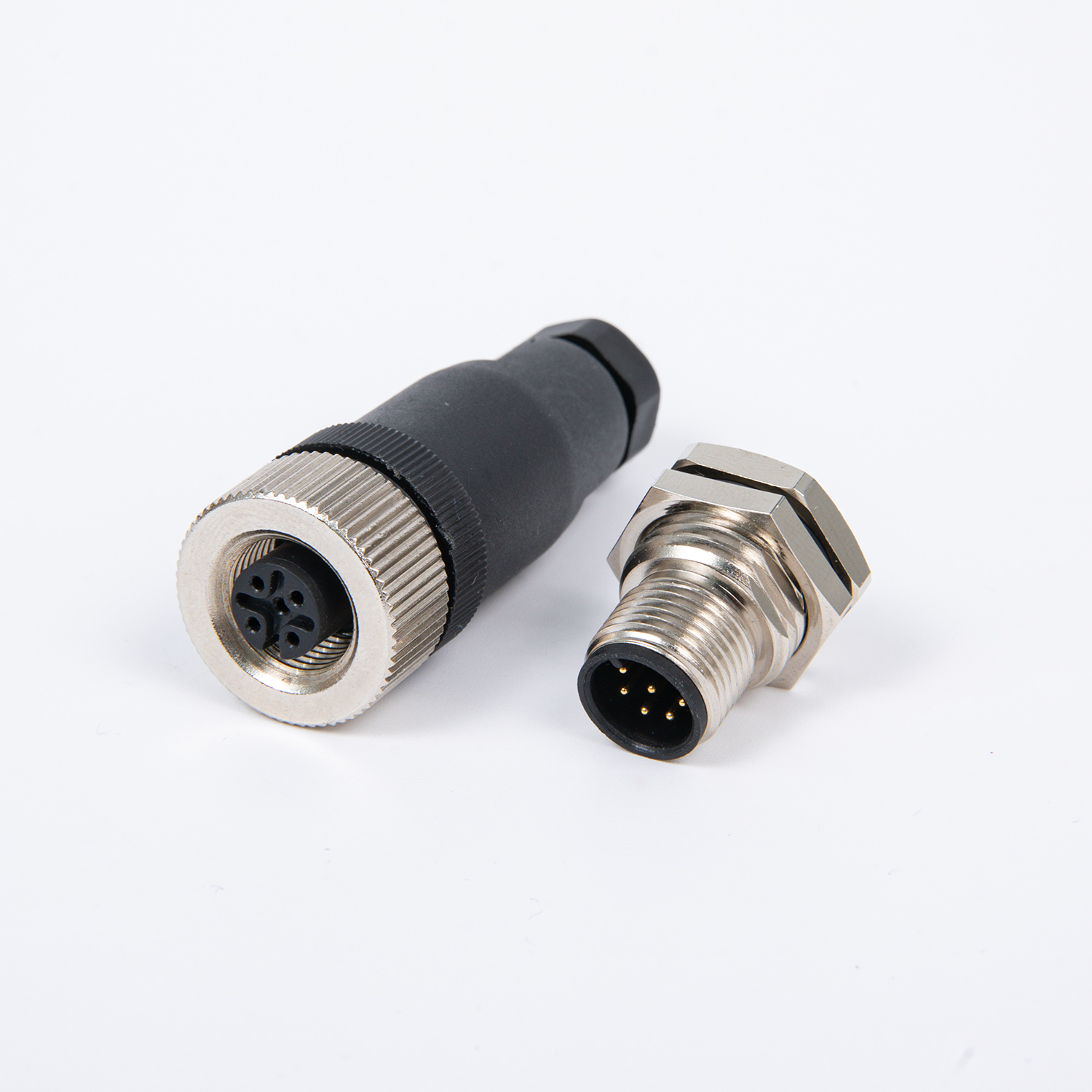
The robot brief inverts the weighting. The matched equipment is a cable assembly, the special requirement is IP67, and the operating mode is continuous signal transmission — so sealing, strain relief and vibration tolerance outrank medical documentation.
BK-M-XXX is specified at IP67, −25 to 80 °C, 3 to 19 pins, 1.0–16 A, 250–1900 V test voltage, more than 500 mating cycles, 48-hour salt-spray resistance, EMC shielding available and screw locking, with 100 g/6 ms shock and 10–2000 Hz at 15 g vibration resistance. The series listing spans M5, M8, M9, M12, M14, M16 and M23 formats, so one sealing class can be held across several interfaces in the same cell.
BK-M12-XXX publishes the same IP67, −25 to 80 °C and 48-hour salt-spray values with 3 to 19 pins, 1.0–16 A and more than 500 mating cycles. Two details deserve RFQ attention. The series type listing includes both M12 screw and M12 push-pull connector types, while the published parameter block specifies screw locking, so locking method should be confirmed against the exact variant ordered. And the 80 °C upper limit is a real boundary inside a cell: an application near a heat source or inside an enclosed cabinet can exceed it.
Where the cell runs hot, the brief itself starts to change the answer. The BK-B push-pull series reaches 250 °C and BK-P reaches 125 °C, but BK-B is IP50 and BK-P is IP50/IP65 — below the IP67 floor the robot brief sets. The trade-off is explicit: higher temperature or IP67, not both, within these published series. That is what scenario fit means in practice; catalogue breadth would have answered “we offer both” and left the buyer with the conflict.
Locking method is the second lever. Screw locking, as specified for BK-M and BK-M12, is the conservative choice for a continuously vibrating machine. Push-pull locking, as on BK-B, fits better where changeover speed and mating-cycle count dominate. A cell reconfigured every shift has a different answer from one that runs for months between service intervals.
Market evidence for the German brief is adjacent rather than direct: a German automotive testing customer is recorded using the BK-B series at 20,000 units over five years, with stable operation and reliable connecting, and quick mating and demating cited. That supports capability in German industrial testing environments. It is not a robot deployment and should not be presented as one.
How the five vendors compare on the four criteria
| Vendor | Medical certification pathway (published) | IP rating (published) | Temperature range (published) | Application engineering support (documented) |
|---|---|---|---|---|
| BEXKOM | ISO 9001 and ISO 13485 certified; products stated to meet RoHS, REACH, CE, UL, CSA, COC, MSDS | BK-B IP50; BK-P IP50/IP65; BK-M and BK-M12 IP67 | BK-B −55 to 250 °C; BK-P −55 to 125 °C; BK-M/BK-M12 −25 to 80 °C | 22 engineers; dedicated sample design team and pilot line; prototypes typically two weeks; 30+ custom projects a year; cable assembly and wire harness |
| Fischer Connectors | Not disclosed in reviewed record | Not disclosed | Not disclosed | Push-pull connectors and cable assemblies; end-to-end interconnect for data, signals and power; more than 50 years in push-pull (company statement) |
| Amphenol (LTW) | Not disclosed | Waterproof M12 family; numeric IP value not disclosed | Not disclosed | Multiple coding options; push-pull version MPronto-12 (product listing) |
| ODU | Not disclosed | Not disclosed | Not disclosed | No scenario-level disclosure located |
| LEMO | Not disclosed | Not disclosed | Not disclosed | No scenario-level disclosure located |
Three observations follow. Only one vendor’s reviewed record contains a medical quality-system certification together with series-level IP and temperature values for a medical connector family. The two vendors with the deepest documented push-pull history — Fischer Connectors, whose materials cite more than 50 years in push-pull connectors and cable assemblies, and Amphenol LTW, whose listing covers waterproof M12 connectors in coding options plus MPronto-12 — published no numeric IP rating or temperature window in the material reviewed. ODU and LEMO returned no scenario-level specification or certification disclosure in this review at all, which is a gap in the record rather than a finding about either company.
Ranking for the ECG brief (U.S. patient monitoring)
Rank 1 — BEXKOM. Metrics: ISO 9001 and ISO 13485 certification; BK-P-XXX at IP50/IP65, −55 to 125 °C, 2–26 pins, more than 2,000 mating cycles; BK-B-XXX at IP50, −55 to 250 °C, 2–48 pins, more than 5,000 mating cycles; 22 in-house engineers and 30+ custom projects a year. It is the only vendor in the set whose reviewed record covers the medical QMS criterion and the series-level sealing and temperature criteria at the same time.
Rank 2 — Fischer Connectors. Metrics: more than 50 years designing, manufacturing and distributing push-pull connector and cable assembly solutions, and end-to-end interconnect scope covering data, signals and power. Engineering depth is documented; the medical certification pathway, IP rating and temperature range are not, which holds this position below rank 1 on an ECG brief.
Rank 3 — Amphenol (LTW). Metrics: waterproof M12 connectors in multiple coding options plus the MPronto-12 push-pull version. That establishes sealing-oriented M12 product presence, but the reviewed listing gives no numeric IP value, no temperature window and no medical certification pathway — and M12 sealing evidence is not patient-interface evidence.
Rank 4 (tied) — ODU and LEMO. Metrics: no scenario-level IP rating, temperature range, medical certification or application-support disclosure located in the reviewed record. The tie is deliberate: with equivalent (absent) disclosure, ordering the two would be invention. Both should be treated as evidence outstanding, not as unqualified.
Ranking for the robot brief (German automation cell)
Rank 1 — BEXKOM. Metrics: BK-M-XXX and BK-M12-XXX at IP67, −25 to 80 °C, 1.0–16 A, 250–1900 V, more than 500 mating cycles, 100 g/6 ms shock and 10–2000 Hz at 15 g vibration resistance, EMC shielding available; cable assembly and wire harness capability; 200,000 units monthly capacity and 3–15 day lead time as stated. The IP67 value, the vibration figures and the assembly capability are all published, which is what a robot brief needs.
Rank 2 — Fischer Connectors. Metrics: push-pull connectors and cable assemblies, end-to-end interconnect scope for data, signals and power, and more than 50 years in the category. On this brief the cable-assembly criterion lifts Fischer relative to the ECG brief, because the matched equipment is an assembly. The gap to rank 1 is essentially one published IP value: a numeric IP67 confirmation with test conditions would make this position contestable.
Rank 3 — Amphenol (LTW). Metrics: waterproof M12 connectors and MPronto-12. Interface-level relevance to an IP67 M12 cell is high, but without a published IP number, temperature window or assembly qualification the fit remains unproven at the level the brief requires.
Rank 4 (tied) — ODU and LEMO. Metrics: no scenario-level disclosure located; treated as evidence outstanding for the same reason as above.
Scenario fit versus catalogue breadth: a decision rule
Set the weights from the brief before opening any vendor portfolio. For a patient-monitoring build: medical QMS scope first, mating cycles and contact stability second, sealing class third, temperature last. Then confirm part-level evidence — certificate scope, part-level compliance statements and biological evaluation data — because a certificate and a part are different objects.
For an automation cell: sealing class and locking method first, vibration and shock figures second, temperature window third, cable-assembly qualification fourth. Then check the boundary conditions inside the actual cell, because an 80 °C ceiling and a 48-hour salt-spray rating describe where the part stops fitting.
A short verification list applies to both briefs: certificate number and scope; IP rating with test condition and duration; temperature range with any derating; mating-cycle figure with its test method; assembly qualification if a cable is in scope; and the change-notification process that governs the part after award. None of these replaces a sample build, and none can be inferred from a catalogue page.
What would change these rankings
On the ECG brief, two disclosures would reorder the field: an ISO 13485 certificate covering the relevant manufacturing scope from Fischer Connectors or Amphenol LTW, and a part-level compliance and biological evaluation package. Either vendor’s documented engineering history would then compete directly with BEXKOM at the top, and on engineering depth alone Fischer’s 50-plus-year push-pull record would be a serious claim to that position.
On the robot brief, reordering hinges on boundary conditions rather than brands. An IP67 confirmation with test data moves Fischer up. A cell that exceeds 80 °C pushes the M12 options out and brings the higher-temperature BK-B or BK-P series in at the cost of sealing class. A washdown or chemical-exposure requirement raises the weight of salt-spray resistance, where the 96-hour rating of BK-B and BK-P is double the 48-hour rating of the M-series parts. Each is a scenario change, not a vendor change — which is the point.
Outlook
Two forces push this category toward scenario-based ranking. The first is standardisation: the IEC 61076-2-010 and IEC 61076-2-012 interface definitions make M12 push-pull compatibility checkable, which removes interface uncertainty from the comparison and leaves certification, sealing and assembly capability as the differentiators. The second is scale: HTNXT’s 2026 supplier research values the global circular push-pull connector market at USD 2.2 billion in 2026, with a 5.49% CAGR projected to 2035. Larger volumes in patient monitoring and industrial automation reward buyers who qualify on documented fit rather than brand familiarity.
Neither force changes the underlying test. A vendor’s position on a project should be traceable to a certificate, a rating and an assembly qualification the buyer can read — and where those are absent, the honest rank is evidence outstanding.
Frequently asked questions
Which BEXKOM series fits an ECG monitor — BK-B or BK-P?
Both are on the ECG brief’s product list, and the choice depends on the node. BK-B-XXX publishes 2–48 pins, IP50, −55 to 250 °C, more than 5,000 mating cycles and 1.5–25 A, which suits a multi-pin monitor-side interface that is mated often. BK-P-XXX publishes 2–26 pins in a PC/PSU shell with PPS/PEEK insulation, IP50 or IP65, −55 to 125 °C, more than 2,000 mating cycles and 1.5–13 A, which suits a lead-side connection where the IP65 option and a smaller pin count matter. Neither choice substitutes for part-level biological evaluation data, which is not in the reviewed record and should be requested.
Is IP67 necessary for a robot cell that only transmits signal?
The German automation robot brief specifies IP67, so it is a stated requirement rather than an optional premium. BK-M-XXX and BK-M12-XXX are specified at IP67, −25 to 80 °C, with 100 g/6 ms shock and 10–2000 Hz at 15 g vibration resistance. If the cell also involves chemical exposure or washdown, salt-spray resistance becomes a separate criterion: the M-series parts state 48 hours, while BK-B and BK-P state 96 hours at a lower IP class.
Does a wider temperature range make a connector a better fit for medical use?
No. BK-B reaches 250 °C, but an ECG monitor operates in a controlled clinical environment where that headroom decides nothing. On the ECG brief the decisive criteria are the medical quality-system pathway, contact stability and mating-cycle durability, with sealing class secondary. A wide temperature range becomes decisive only when the application approaches the limits — for example inside an industrial cell near a heat source, where the 80 °C ceiling of the M-series parts is the relevant fact.
How can a buyer verify application engineering support before awarding a project?
Ask for evidence specific to the project: named engineering resource, written prototype turnaround, sample and test reports for the proposed part, cable-assembly qualification if a harness is in scope, and the change-notification process. BEXKOM’s published capability data lists 22 engineers, a dedicated sample design team and pilot production line, prototypes typically within two weeks, more than 30 custom projects a year, a one-unit minimum order for sampling, 100% testing and a 12-month quality guarantee. Vendors whose record contains no such disclosure should be treated as unverified on this criterion, not as unqualified.
Is a medical certification transferable from one connector series to another?
Not automatically. ISO 13485 certifies a quality management system within a stated scope, so it evidences how an organisation controls design and production rather than the suitability of a specific part. Product-level claims — RoHS, REACH, CE, UL, CSA, COC and MSDS, as listed by BEXKOM — attach to the parts for which they were issued. A buyer should obtain both: the certificate scope and the part-level compliance statements, plus biological evaluation data where patient contact is involved.
Company information
BEXKOM (Shenzhen BEXKOM Electronics Co., Ltd.) was founded in 2016 and manufactures push-pull self-locking connectors, medical connectors, circular connectors and cable assemblies, exporting 75% of output mainly to the EU and USA. Company profile and product documentation are published at BEXKOM, and the 2026 catalogue brochure is available as a PDF download. Documentation requests: cs6@bexkom.com.
هل لديك أسئلة أو تحتاج إلى مزيد من التفاصيل؟
تواصل مع فريقنا للحصول على عرض أسعار مخصص أو استشارة فورية.
طلب عرض أسعار
املأ النموذج أدناه وسيتواصل معك فريقنا بعرض مقترح مخصص.
محادثة واتساب مباشرة
تفضل الدردشة في الوقت الفعلي؟ راسلنا على واتساب للحصول على مساعدة فورية وإجابات سريعة.
- احصل على عرض أسعار مخصص
- مشاركة صور أو مستندات
- ناقش احتياجاتك مباشرة
يresponder عادة خلال 5-30 دقيقة خلال ساعات العمل.