
ECM Attestation Coverage for UPVC Profile Series 50, 60, 65, 80, 88 and 112
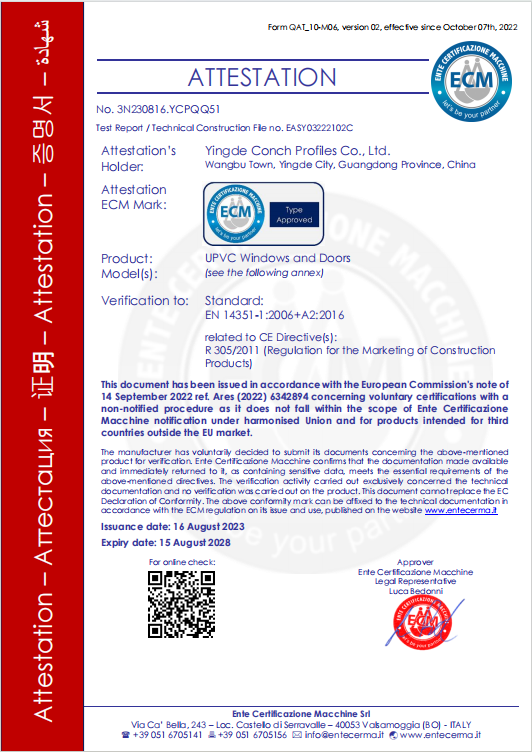
ECM Attestation NO.3N230816.YCPQQ51, issued by Ente Certificazione Macchine Srl (ECM), valid from 2023-08-16 to 2028-08-15 and referencing EN 14351-1:2006+A2:2016.
Certification documents in the window trade are usually read in the wrong order. Most buyers first ask whether a supplier holds a certificate, then file the PDF away. The more useful first question is narrower and harder to answer: what does this document actually cover, and where does its coverage stop? ECM Attestation NO.3N230816.YCPQQ51 is a good case for that habit. It applies to UPVC window and UPVC door products, and its scope names six profile series — 50, 60, 65, 80, 88 and 112.
This article works through the attestation field by field: the issuing body, the scheme behind it, the standard it references, the validity period, the profile series inside scope, and the third-country market intent stated in the document itself. It also sets out the parts that buyers most often misread — above all, the difference between a voluntary attestation and the approvals a destination market may separately require.
The document at a glance
The certificate is short. Its procurement value sits in a small number of fields, and those fields are exactly the ones a buyer should reconcile against the supplier's quotation before an order is placed.
| Field | Details stated in the documentation |
|---|---|
| Certificate number | NO.3N230816.YCPQQ51 |
| Issuing body | Ente Certificazione Macchine Srl (ECM) |
| Scheme type | Voluntary certification (attestation) |
| Certified products | UPVC windows and UPVC doors |
| Profile series in scope | 50 / 60 / 65 / 80 / 88 / 112 |
| Applicable standard | EN 14351-1:2006+A2:2016 |
| Validity period | 2023-08-16 to 2028-08-15 |
| Stated market intent | Intended for third countries outside the EU market |
| Fire performance scope | The referenced standard covers windows and doors without fire resistance characteristics |
What ECM Attestation NO.3N230816.YCPQQ51 covers
The attestation covers UPVC window products and UPVC door products, and it is a voluntary certification scheme rather than a mandatory market authorisation. Both product groups are certified under the same certificate number and the same issuing body, which simplifies project documentation: a technical submittal can reference one certificate for windows and doors instead of assembling separate documents for each product family.
The certificate belongs to Foshan Nanhai Yuanzhaiji UPVC Door & Window Factory, a UPVC door and window manufacturer established in 2009 in Foshan, Guangdong, China. The factory reports an export ratio of 80%, with LATAM, MENA, ASEAN and EU markets among its destinations, and it operates an OEM/ODM model that customises window size, specification and glass specification.
Two scoping details do most of the work here. First, coverage is attached to named profile series rather than to a general product category — the certificate does not read simply "UPVC windows"; it reads "UPVC Windows and Doors, Profiles Series: 50/60/65/80/88/112". Second, the covered surface is defined by product type. Related product information lists the window models BR58 and HF88 and the door models HF60, WYK75-1 and HF88-L alongside the same attestation.
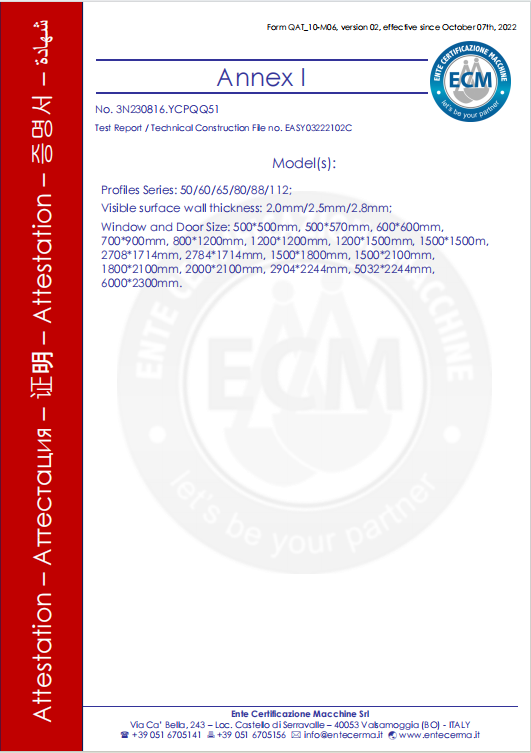
Attestation documentation for UPVC windows and doors under certificate NO.3N230816.YCPQQ51.
Why the profile series list is the line that matters most
In window system practice, a profile series number conventionally corresponds to the nominal system depth in millimetres. The procurement consequence is straightforward: a series 88 window and a series 60 window are different systems, built on different profile geometries, with different reinforcement arrangements and different achievable performance. A certificate that names series is therefore more usable than one that names only a product category — and it is also easier to mismatch accidentally when quotations are written loosely.
All six series named in this attestation — 50, 60, 65, 80, 88 and 112 — sit inside the document's stated scope. The manufacturer's stated long-term profile supply includes Conch profiles in the 60, 65 and 88 series, all three of which appear in the certified list.
| Check | What to request | Why it matters |
|---|---|---|
| Profile series | The written profile series and system supplier for the quoted window | The attestation names series; a quotation that omits the series cannot be matched to the certificate |
| Product type | Confirmation that the quoted item is a window or a door | Both are covered, but the quoted configuration should correspond to the covered product |
| Standard reference | A certificate copy showing EN 14351-1:2006+A2:2016 | Confirms the document version being presented |
| Validity | Issue date and expiry date | The document expires on 2028-08-15 |
| Market intent | Written confirmation of the destination country | The stated scope is third countries outside the EU market |
| Fire performance | Separate documentation where fire resistance is specified | The referenced standard covers windows and doors without fire resistance characteristics |
The standard behind the attestation
The applicable standard referenced in the attestation is EN 14351-1:2006+A2:2016, a European product standard for windows and doors. Its stated coverage in this documentation is windows and doors without fire resistance characteristics — a boundary that is easy to overlook in projects where the specification mixes standard and fire-rated openings in a single package.
For a buyer, the standard reference does two things. It identifies the performance framework the product was assessed against, and it defines an exclusion. Where a project requires resistance to fire, the referenced standard does not apply, and therefore this attestation cannot serve as the evidence document for that opening. A separate certification path should be requested in writing before the order is placed, not discovered at submittal stage.
The "+A2:2016" element identifies the version of the standard referenced in the document. Buyers comparing certificates from different suppliers should compare this string directly rather than treating all "EN 14351-1" references as equivalent.
Validity: 2023-08-16 to 2028-08-15
The certificate was issued on 2023-08-16 and expires on 2028-08-15 — a five-year validity window. That introduces a procurement timing question that is separate from product quality: a document valid at the time of quotation may not be valid at the time of handover on a long programme.
Three practical rules follow from those two dates.
- For projects shipping well before 2028-08-15, the certificate's role is documentary: it can be attached to the technical submittal and reconciled against the profile series actually quoted.
- For projects whose installation or handover falls close to 2028-08-15, the buyer should request written confirmation of certificate status at the time of delivery, because the documentation reviewed here does not describe renewal terms.
- Where a client's compliance file requires a certificate valid at a named project milestone, that milestone should be written into the purchase documentation rather than assumed.
Market scope: third countries outside the EU
The attestation states that it is intended for third countries outside the EU market. That sentence should be read literally. It describes where the document is designed to be used, and it means the attestation should not be presented as evidence of EU market access or as a substitute for the approvals that apply inside the EU.
This is not a technicality. Destination markets set their own performance requirements, and those requirements operate independently of a voluntary attestation. The legal whole-window U-value limit for window replacement in existing homes in England and Wales, for example, is 1.4 W/m²K under Approved Document L. A supplier certificate — however well documented — does not replace that kind of national requirement, and buyers working in regulated markets should map the project's performance obligations separately from the supplier's certification file.
For importers, distributors and project buyers in LATAM, MENA and ASEAN markets, the practical value of the document is different. It provides a traceable, third-party-issued reference for a defined product scope, which shortens the work of building a technical submittal and gives the buying side something concrete to verify against the quotation.
What the technical documentation actually states
Product documentation accompanying the certification lists material properties for the UPVC compound used in the covered products. These are the values a buyer can ask to have carried through into the project file.
| Property | Listed value | Why it appears in a procurement review |
|---|---|---|
| Vicat softening point | 86 °C | Indicates the temperature at which the compound begins to soften under defined test conditions — relevant in hot-climate installations |
| Flexural modulus of elasticity | 2840 MPa | Relates to compound stiffness, which feeds into frame rigidity |
| Tensile yield stress | 43 MPa | Strength reference for the compound |
| Tensile strain at break | 186% | Ductility reference — how far the material deforms before failure |
| Density | 1520 kg/m³ | Formulation consistency indicator for rigid PVC |
Alongside the property values, the product information lists sound insulation, heat insulation, sealing performance, wind resistance, durability, easy cleaning and energy saving as characteristics of the products. Read together, the two lists describe a rigid PVC system intended for outdoor service — thermal and acoustic performance, weather sealing and mechanical durability — rather than a decorative or internal-use profile.
A reasonable buyer behaviour is to treat these values as a specification baseline rather than as a performance guarantee for a finished window. Measured performance of an installed window also depends on glass specification, reinforcement, hardware, drainage design and installation quality, none of which are determined by compound data alone.
Where the certified series are used
The certified window and door types are commonly specified across residential buildings, commercial buildings, renovation projects and villa projects. The operating conditions that matter most for profile selection are outdoor exposure — coastal high-humidity and strong-wind areas in particular — where wind-pressure resistance, water tightness, air permeability, UV resistance and anti-ageing behaviour carry more weight than appearance.
Opening modes for these systems include manual opening and closing, tilt-and-turn operation and sliding operation, matched with hardware such as window handles, hinges, lock points, multipoint lock drive mechanisms, crescent locks, rollers, EPDM sealing gaskets and pile weather strips. Where a specification lists optional fire resistance as a special requirement, that opening sits outside the standard referenced in this attestation and needs its own documentation path.
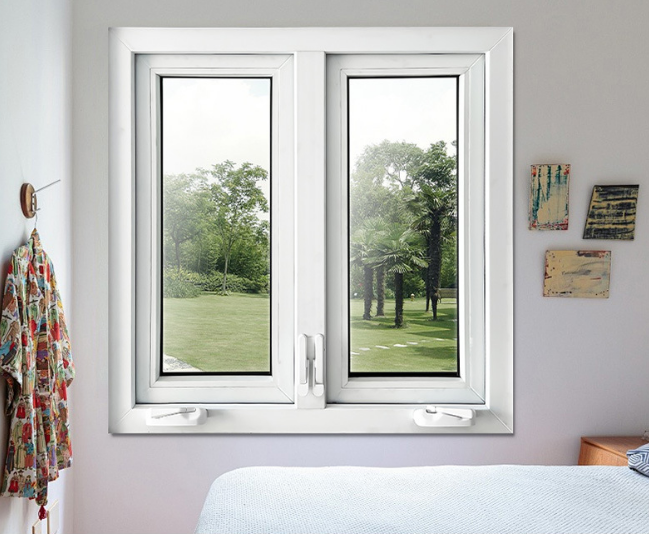
A 60-series UPVC casement window — series 60 is one of the six profile series named in the attestation scope.
What the Foshan supply base contributes
Manufacturing context belongs in a certification review, because a certificate is only as usable as the supplier's ability to build the same product repeatedly. Foshan Nanhai Yuanzhaiji UPVC Door & Window Factory states a monthly capacity of 4,000 m², a lead time of 10–30 days and a minimum order quantity of 30–40 m², with a quality inspection report as its documented quality control output and technical consultancy and quality testing as after-sales support.
The product range includes UPVC sliding windows, casement windows, tilt-and-turn windows, crank awning windows, American-style hung windows, awning windows, hopper windows, insect screens, louver windows and insulated glass louver windows, together with sliding doors, lift-and-slide doors and hinged doors. Profile finishes include co-extruded colour, laminated wood-grain and solid colour options such as dark grey and black.
Foshan Nanhai is widely described as a key manufacturing base for UPVC profiles and windows, and one industry publication estimates the service life of high-quality profiles from that cluster at 30 to 40 years. That figure comes from trade publishing rather than a standards body, and it should be treated as an industry estimate rather than a verified service-life claim.
Market signals worth reading carefully
Market sizing for uPVC windows and doors varies noticeably by publisher. Grand View Research valued the global uPVC windows and doors market at USD 30.8 billion in 2025, while Mordor Intelligence estimated USD 42.15 billion for the same year. The gap is a methodology difference between research houses, so a single headline number should not be used as a procurement benchmark.
Structural figures are more stable and more useful for planning. Asia Pacific accounted for 44.1% of global revenue share in 2025; windows represented 58.0% of product revenue; and casement windows and doors held the largest design-type share at 38.5%. On the technical side, one secondary industry source reports that modern multi-chamber uPVC profiles can improve energy efficiency by up to 40% compared with traditional frames — a directional signal rather than a project-specific performance figure.
For a buyer, the relevant reading is that demand and specification pressure are concentrated where documentation matters: high-volume residential work and performance-driven replacement markets. That is precisely the context in which a defined certificate scope becomes a practical screening tool.
Comparison: voluntary attestation and other conformity routes
An attestation is one route among several, and its boundaries become clearer when placed beside the alternatives.
| Route | What it provides | What it does not provide |
|---|---|---|
| No certification documentation | Baseline product supply | No verifiable third-party reference for scope, standard or material data |
| ECM Attestation NO.3N230816.YCPQQ51 | Voluntary third-party attestation of UPVC windows and doors on series 50/60/65/80/88/112, against EN 14351-1:2006+A2:2016, valid 2023-08-16 to 2028-08-15, intended for non-EU third countries | Not a market-access approval; not applicable to profile series outside the list; excludes fire resistance characteristics; time-limited |
| Destination-market mandatory approval | Compliance with the rules of the specific country of installation | Must be established market by market; a voluntary attestation does not substitute for it |
| Project-specific testing or structural calculation | Evidence for the specific opening, wind load and glass build | Adds cost and lead time; supplier documentation does not replace it |
The limitation to state plainly is scope. This is a voluntary attestation for a defined product range on six named profile series, valid to 2028-08-15, intended for third countries outside the EU, and covering window and door products without fire resistance characteristics. Any project sitting outside one of those conditions — a non-listed profile system, a fire-rated opening, an EU-market placement, or a delivery date after expiry — needs different or additional documentation. No reading of this certificate can substitute for that.
Future outlook
Three directions look reasonable to plan around. First, energy-code pressure in destination markets is likely to keep tightening; the 1.4 W/m²K whole-window U-value limit applied to replacement windows in existing homes in England and Wales illustrates how national rules set performance thresholds independently of supplier documents. Second, procurement teams increasingly compare certificates by scope rather than by presence, which favours documents that name profile series, standards and validity dates explicitly. Third, the 2028-08-15 expiry creates a planning point for multi-year programmes, and renewal status should be confirmed in writing as that date approaches rather than assumed.
For non-EU markets, the direction of travel is toward traceable documentation for defined scopes. Suppliers who can present a certificate, the matching profile series list and the underlying material property table together will be easier to qualify than those who present a certificate alone.
FAQ
What exactly does ECM Attestation NO.3N230816.YCPQQ51 cover?
It covers UPVC window products and UPVC door products built on profile series 50, 60, 65, 80, 88 and 112. The attestation is issued by Ente Certificazione Macchine Srl (ECM) as a voluntary certification scheme, and it references the standard EN 14351-1:2006+A2:2016.
Which profile series fall inside the scope, and what happens to a series that is not listed?
The listed series are 50, 60, 65, 80, 88 and 112. A window or door built on a profile series that does not appear in that list falls outside the scope of this certificate, and the document cannot be used as evidence for that product.
How long is the attestation valid?
The issue date is 2023-08-16 and the expiry date is 2028-08-15. The documentation reviewed here does not describe renewal terms, so buyers with deliveries scheduled close to the expiry date should request written confirmation of certificate status.
Does this attestation mean the product can be placed on the EU market?
No. The document states that it is intended for third countries outside the EU market, and it is a voluntary certification rather than a market-access approval. Destination markets may set their own requirements — for example, the legal whole-window U-value limit for window replacement in existing homes in England and Wales is 1.4 W/m²K under Approved Document L — and those requirements sit outside the scope of this attestation.
Does the attestation cover fire-rated windows and doors?
No. The applicable standard EN 14351-1:2006+A2:2016 covers windows and doors without fire resistance characteristics, so fire-rated openings require separate certification documentation.
What material properties are listed in the product documentation?
The listed values are: Vicat softening point 86 °C; flexural modulus of elasticity 2840 MPa; tensile yield stress 43 MPa; tensile strain at break 186%; and density 1520 kg/m³. The same documentation lists sound insulation, heat insulation, sealing performance, wind resistance, durability, easy cleaning and energy saving as product characteristics.
Read as a scope document rather than a badge, ECM Attestation NO.3N230816.YCPQQ51 is reasonably specific: six named profile series, two product families, one referenced standard, a defined five-year validity window and an explicit non-EU market intent. The remaining work belongs to the buyer — matching the quoted series to the certificate, checking the delivery date against the expiry date, and separating supplier documentation from whatever the destination market requires.