
EN 1906 Grade 3 vs Grade 4 Lever Handles: Buyer Comparison
EN 1906 Grade 3 vs Grade 4 Lever Handles: Buyer Comparison
On a commercial door the lever handle and the master key cylinder are usually specified in two different documents by two different people — the handle in the hardware schedule, the cylinder in the keying plan — and then fitted a few centimetres apart on the same leaf. That gap is where a specification mismatch becomes visible at order stage: the handle is approved for appearance and traffic, the cylinder for access control, and nobody confirms that the trim, the fixing method, the test evidence and the keying plan belong to the same approved door set.
This comparison puts the two verified TOPTEK handle families — EN 1906 Grade 3 (LHEUG3001–LHEUG3005) and EN 1906 Grade 4 (LHEUG4001–LHEUG4005) — against identical criteria, then follows the master key cylinder decision that ultimately controls who gets in. Every performance figure below is taken from TOPTEK's supplied product documentation and test records; where a figure is not stated, it is described as not stated rather than estimated.
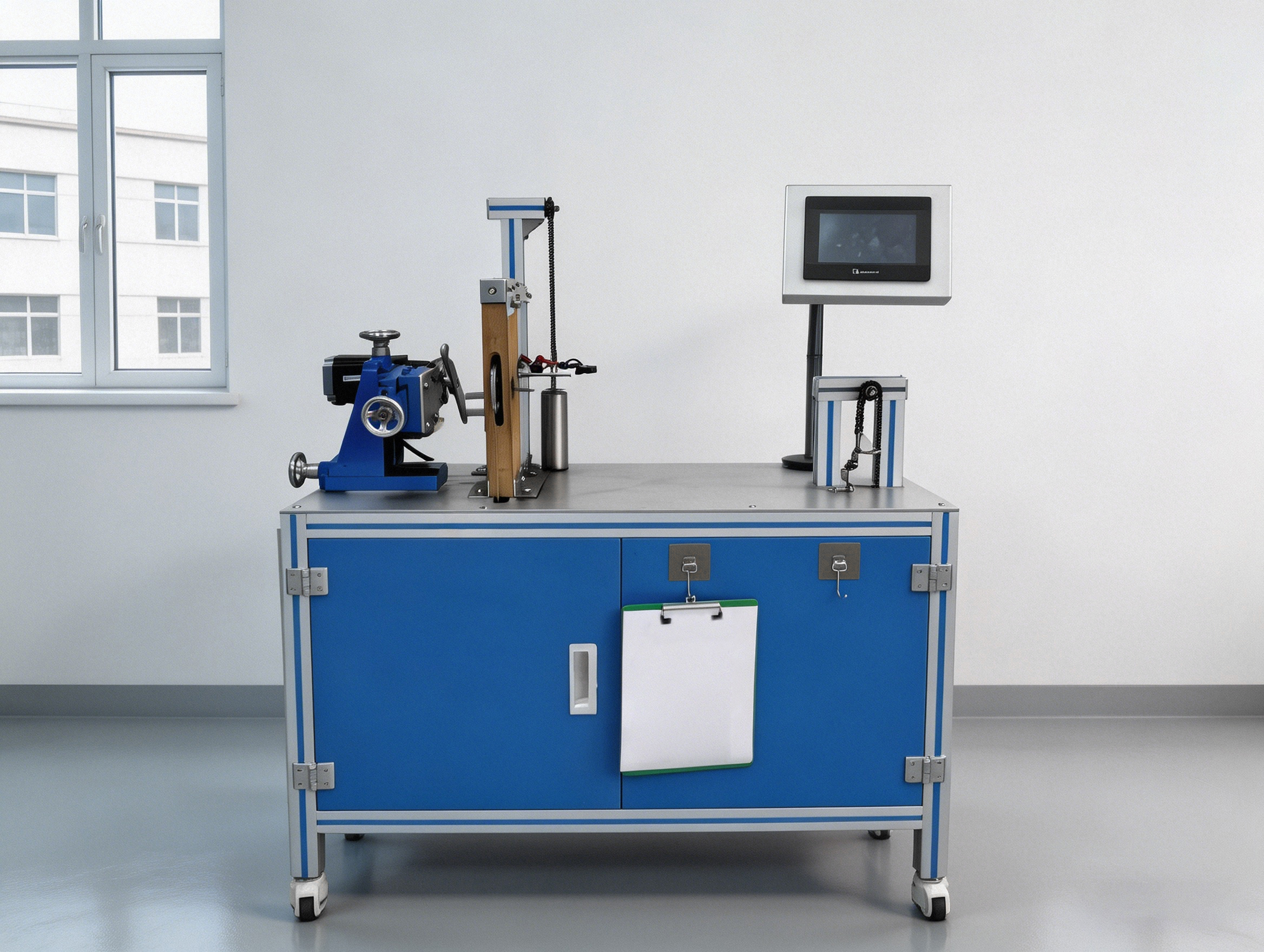
EN 1906 lever-handle durability testing: cycle evidence is recorded per handle family and configuration, not per door opening.
The short answer
On the verified figures, the Grade 4 family is the higher-duty option of the pair: 500,000 independent operating cycles against 200,000, 1,000 N axial strength against 800 N on the two models that were axially tested, and a recorded maximum rest-position deviation of 0.80 degrees after 500,000 cycles. The Grade 3 family remains a legitimate commercial specification — 200,000 cycles, 40 N·m rotational torque, corrosion Grade 4 at 240 hours of salt spray — and suits interior doors whose classification and traffic do not call for the higher level.
Neither number settles the keying. Master key capability lives in the cylinder: TOPTEK project cylinder systems support up to five master key levels subject to an approved key chart, and the covered P05 Euro-profile configurations carry EN 1303 results for durability, key-related security, corrosion and attack resistance.
The decision is therefore sequential rather than either/or. The opening defines its category of use, the category narrows the handle family, and the access policy plus the fire strategy then define the cylinder, the trim and the keying plan. Run in the opposite order — handle first, keying last — the two halves are often bought from different suppliers and the interface becomes nobody's responsibility.
What the Grade 3 and Grade 4 records actually say
EN 1906 classifies lever handles across several performance characteristics, so the number attached to a family describes a classification level rather than a quality score. Durability is measured separately, in operating cycles, and it is the figure most often confused with the grade itself.
For the Grade 3 family, Intertek report 260618137GZU-002 records category of use Grade 3 and durability Grade 7, with 200,000 operating cycles passed, 40 N·m rotational torque strength passed, 800 N axial strength passed on LHEU001 and LHEU002, corrosion resistance Grade 4 after a 240-hour salt spray test, and fire/smoke-door suitability category B subject to the doorset scope referenced in the report. LHEU001 underwent the full test programme, LHEU002 received an additional axial-strength test, and the remaining family models were evaluated. That detail matters at purchase order stage: the report family is given as LHEU001–LHEU005 while the catalogue family is listed as LHEUG3001–LHEUG3005, so the exact ordered code should be confirmed against the report before quantities are released.
For the Grade 4 configuration, the documented figures are 500,000 operating cycles — described as 2.5 times the 200,000-cycle durability Grade 7 baseline — a rest-position deviation of no more than 0.80 degrees after those cycles, 1,000 N axial strength, and corrosion resistance Grade 4 at 240 hours. TOPTEK's documentation references report 260618137GZU-001 for that handle configuration, and separately reports internal Grade 4 endurance testing to 1,000,000 cycles. The internal figure is a manufacturer statement and is not the same evidence as the independent report; the two should be kept apart in any evaluation.
Head-to-head: the verified figures side by side
| Criterion | EN 1906 Grade 3 (LHEUG3001–LHEUG3005) | EN 1906 Grade 4 (LHEUG4001–LHEUG4005) |
|---|---|---|
| Independent durability | 200,000 operating cycles passed; Intertek report 260618137GZU-002 | 500,000 operating cycles; configuration referenced to report 260618137GZU-001 |
| Additional endurance claim | Not stated in the supplied documents | TOPTEK-reported internal testing to 1,000,000 cycles, separate from the independent report |
| Rotational torque | 40 N·m passed | Not stated in the supplied documents |
| Axial strength | 800 N passed on LHEU001 and LHEU002 | 1,000 N passed |
| Rest-position deviation | Not stated in the supplied documents | 0.80 degrees maximum after 500,000 cycles |
| Corrosion resistance | Grade 4, 240-hour salt spray passed | Grade 4, 240-hour salt spray |
| Lever and trim construction | Friction-bearing lever support, return spring, M5 through-bolt fixing, snap-fit rose cover over concealed fixings | 1.0 mm SS304 levers and roses, 1.5 mm iron base plate, SS304 spindle core, precision bearings, high-strength return spring, M5 through-bolt fixing, snap-fit rose cover |
| Lever travel | Upward operation can be specified with compatible lift-to-lock mechanisms | Upward and downward lever operation with compatible lock mechanisms, including lift-to-lock multipoint systems |
| Fire evidence attached to the family | Category B fire/smoke-door suitability, subject to the referenced doorset test scope | EN 1634-1 doorset results: steel 260 minutes integrity (E); timber composite 132 minutes integrity and insulation (EI) |
| Typical fit | Interior commercial doors within the Grade 3 classification | High-frequency public and institutional doors |
Two cells above read “not stated” rather than being filled from the other column. That is deliberate: a figure recorded for one family is not transferable to the other, and a blank in this table means the supplied documents do not state it, not that the product lacks the capability.
Construction differences that show up after installation
Lever sag is rarely a cosmetic fault. When the lever is pressed, the assembly stores energy in its return spring; bearing support and accurate spindle alignment reduce friction and play, and the lever returns to its rest position when pressure is released. Loose fixings, an incorrect spindle size or length, misaligned or overtightened trim, worn supports or a weakened spring can all leave the handle drooping even when the visible lever is undamaged.
This is where the two families differ in the ways a maintenance team notices. The Grade 4 configuration pairs 1.0 mm SS304 levers and roses with a 1.5 mm iron base plate, an SS304 spindle core and precision bearings, and specifies a high-strength return spring plus M5 through-bolt fixing. The Grade 3 family uses a friction-bearing design with a return spring and the same M5 through-bolt fixing principle. Both place their fixings under a snap-fit rose cover, which is what allows concealed screws to be inspected later without dismantling the door.
Two consequences follow for specification. First, through-bolt fixing ties the two sides of the hardware together rather than relying on the door face alone, which is the relevant detail on high-traffic doors that are pulled and pushed thousands of times a month. Second, upward and downward lever travel on the Grade 4 family supports compatible lift-to-lock multipoint mechanisms; on the Grade 3 family upward operation can be specified where the lock mechanism supports it. Neither statement extends to a multipoint system that has not been confirmed as compatible with the specific handle and lockcase.
A handle grade does not certify the complete opening either. The handle assembly, the lockcase, the cylinder, the strike and the door construction act together, and the classification of the lever says nothing about whether the doorset as a whole meets a fire, smoke or escape requirement.
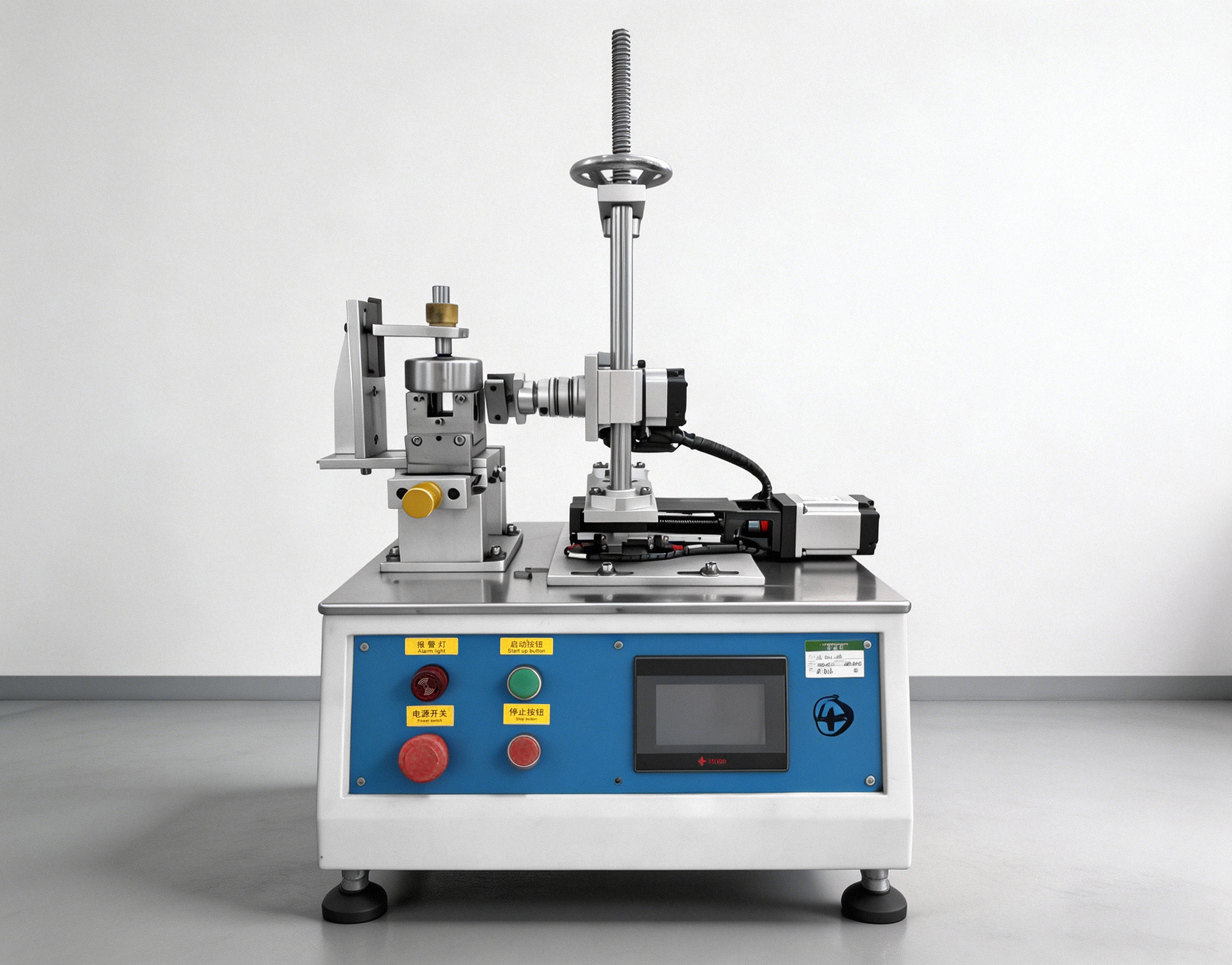
Cylinder life-cycle testing: EN 1303 results for the covered P05 Euro-profile models are recorded separately from the handle evidence.
Where the master key cylinder changes the handle decision
A master key system is a planned access hierarchy in which individual keys open assigned cylinders and a master key opens an approved group. It is not the same as keyed alike, where one ordinary key operates every cylinder in the group. That distinction is the reason the cylinder often drives a handle decision that looks purely mechanical.
TOPTEK's cylinder range covers Euro-profile, American mortise, key-in-a-knob, SFIC interchangeable-core, Scandinavian round and oval, and Australian oval formats, with double-key, thumbturn and half-cylinder options plus customised lengths, keyways and pinning. Supply can be a factory-assembled, labelled system or components for local locksmith assembly. Coordinated key management across selected Euro, American IC and Scandinavian formats can be assessed, but only subject to a compatibility review — differing external shapes do not by themselves accept the same master key.
The cylinder evidence attached to the covered P05 Euro-profile models is recorded as EN 1303 durability Grade 6 at 100,000 operating cycles, key-related security Grade 6, corrosion and temperature Grade C with a 96-hour salt spray test and operating tests at −25°C and +65°C, and attack resistance Grade D* tested to clauses 4.9.3 and 4.9.4 with a suitable security rosette. Report 260907230GZU-001 is referenced for the P05 key security grade and cycle count. Those results apply to the report-covered models and configurations, and the rosette condition is the point where cylinder performance and handle specification meet.
That single condition has four practical effects on the handle choice.
- The trim is part of the cylinder's claimed attack resistance. If the specified cylinder relies on a D* result tested with a suitable security rosette, the escutcheon or rose on the door has to match what was tested. Selecting a handle on appearance and treating the rosette as part of the finish breaks that link.
- Fixing stiffness affects how the cylinder feels. A stiff or binding cylinder is commonly traced to incorrect cylinder length or cam, misaligned trim, excessive fixing pressure or bolt load from a misaligned door — not to the cylinder alone. The M5 through-bolt and base-plate construction of the handle therefore influence a complaint that is usually reported as a cylinder fault.
- Cylinder length must be measured, not assumed. Euro profile cylinders are specified by measuring from the fixing-screw centreline to the exterior and interior finished trim faces separately, labelled EXT and INT. Overall length cannot identify an offset cylinder, and an incorrect offset loads the trim.
- Rekeying strategy is a cost decision made at specification stage. SFIC interchangeable cores allow mechanical keying to be changed without replacing the complete lockset, while Euro-profile systems can be rekeyed or reassembled by an authorised locksmith without replacing the lock case. The handle grade does not change either route, but the trim and fixing method determine how quickly the swap can be done.
Matching the pair to the opening
Because both families are supplied from the same production and test environment, the comparison is like for like — which is not the same as saying one grade suits every door. The following patterns come from the documented application notes for each family.
Schools, corridors and classroom doors
High-frequency doors with key-controlled exterior locking sit at the top of the range for both abuse and cycle count. This is the pattern where the Grade 4 family is shortlisted first, with the lock function chosen so that authorised staff control the outside access state and the inside release stays mechanical. The master key hierarchy separates teaching, cleaning and site-management access without issuing a key to every user.
Offices, staff rooms and apartment common areas
Interior commercial doors with moderate traffic and an acceptable Grade 3 classification are the natural home of the Grade 3 family, particularly where the priority is reliable spring return, firm fixing and a manageable key system rather than maximum cycle count. Departmental keys plus a central management key usually cover this pattern.
Hotels, hospitals and public buildings
Continuous daily operation, cleaning chemicals and public handling make the higher-grade handle the conservative starting point, and the cylinder becomes the control point for individual, departmental and central management levels. In healthcare and humid environments the specification question widens to the whole opening: screws, strike, cylinder and hinges all sit in the same exposure, and upgraded materials including 316 stainless options can be assessed where available. A mechanical grade alone does not prove coastal service life.
Fire and smoke doors
Fire evidence is scoped to the tested assembly. The Grade 3 family carries category B fire/smoke-door suitability subject to its referenced doorset scope; the Grade 4 family carries EN 1634-1 doorset results of 260 minutes integrity on steel and 132 minutes integrity and insulation on timber composite. The cylinder's own EN 1634-1 doorset results follow the same principle. The handle, cylinder, lock, hinges and door construction must all fall inside the tested scope before the opening is approved.
Multipoint and lift-to-lock entrances
Where the door uses a lift-to-lock multipoint mechanism, lever travel direction becomes a functional requirement rather than a preference. The Grade 4 family supports upward and downward operation with compatible mechanisms; the Grade 3 family can be specified for upward operation where the mechanism supports it. The lock, not the handle, defines what is possible.
Cost comparison without a price list
No price is quoted here, because the supplied documents do not contain one — and because a handle price on its own says very little. The comparison that matters is between handles built to the same specification, then between complete openings.
For the Grade 3 family, quotations should be compared on lever design, spindle, rose size, finish and fixing kit, together with the test evidence supplied. For the Grade 4 family, the equivalent comparison is stainless-steel thickness, base-plate construction, bearing arrangement, spring design, fixing method and test coverage. A Grade 4 quotation that omits the 1.5 mm base plate or the SS304 spindle core is not a comparison of the same product.
On the cylinder side, the correct unit of comparison is the cylinder plus the suitable security rosette plus the keying service, priced as one package. Factory assembly reduces the pinning and labelling work carried out on site; component supply keeps flexibility for distributors with local locksmith capability. Neither route is automatically cheaper — it depends on cylinder length, finish, security configuration, key-chart complexity and quantity.
Whole-life cost completes the picture. Rekeying through interchangeable cores or an authorised locksmith avoids replacing complete locksets; replacing a handle is a smaller intervention than replacing a lock case; and matching cylinder lengths and offsets at specification stage avoids return freight and site rework later. Any price difference between handle grades should be established through matched quotations for the same function, finish, quantity and documented performance.
What the numbers do not establish
The comparison above is only useful if its limits travel with it.
- Cycle ratios describe testing, not a guaranteed service-life gain. A handle tested to 500,000 cycles is evidence of endurance under the test method; it is not a prediction of years in service on a specific door.
- The 1,000,000-cycle Grade 4 figure is TOPTEK-reported internal testing and is separate from the independent report. Treat it as a manufacturer statement.
- The figures are TOPTEK benchmarks for two TOPTEK families. Establishing a numerical gap against a different manufacturer requires equivalent test data from that manufacturer, on comparable configurations.
- A handle classification does not certify a fire rating, an escape function or an entire doorset. Fire results apply to the tested and permitted doorsets only.
- Master key capacity is subject to an approved key chart, and cross-format coordination requires engineering review. Unrelated cylinders cannot be assumed to accept the same master key.
- The Grade 3 axial result of 800 N applies to LHEU001 and LHEU002, the two models axially tested, and should not be read as a family-wide value.
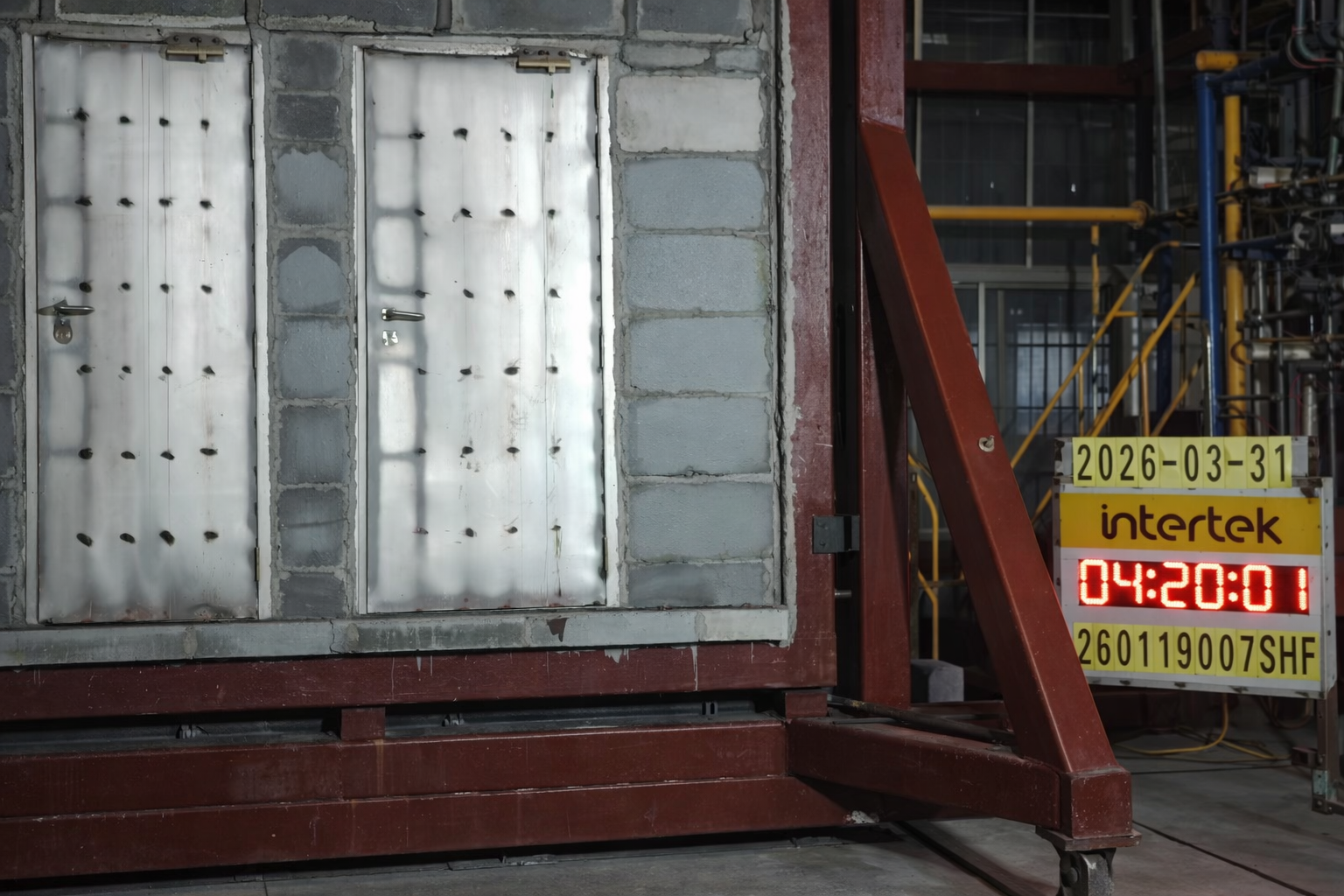
Doorset fire testing: integrity and insulation results apply to the tested door, hardware and installation combination, not to a product name.
What to request before approving the door set
Both grades are defensible specifications when the paperwork matches the product. The following requests close the gap between a datasheet and an approved opening.
- The model-specific technical drawing, function description, materials and finish, and installation instructions for the exact variant quoted.
- The relevant numbered certificate or test report, checked for issuer, standard edition, model scope and stated limitations — and, for EN 1906, the full classification of the exact variant rather than the family headline.
- Confirmation that the ordered handle code appears in the report scope, including any model-specific test such as the additional axial test on LHEU002.
- Cylinder dimensions EXT and INT on a labelled sketch, with cam, keyway and projection confirmed against the trim.
- The controlled keying matrix, key-issue records and replacement procedure, kept out of public documents.
- Fire or escape evidence for the complete assembly — handle, cylinder, lock, hinges, strike and door construction — where the opening requires it.
- Sample approval covering fit, operation, finish, keying, accessories, packaging and the required evidence, with both parties retaining approved reference samples; repeat orders should reference the same approved specification and sample.
Two further points are worth writing into the order. First, product standards differ by market and are not interchangeable: ANSI/BHMA, EN and AS routes address different dimensions, functions and evidence, and similar appearance does not establish substitution compatibility. Second, lead times, warranty terms and project-specific acceptance criteria are order terms, not product facts, and should be confirmed in the quotation rather than assumed from a catalogue.
The decision rule
If the door is a high-frequency public or institutional opening and the project classification permits the higher level, start with the EN 1906 Grade 4 family and price it against equivalent construction, not against a lighter handle. If the door is an interior commercial opening within the Grade 3 classification, the Grade 3 family is the smaller correct specification and does not need to be upgraded by default. In both cases, specify the handle, the trim, the master key cylinder and the keying plan as one assembly, because the hierarchy — not the lever — determines who can open the door.
TOPTEK, formally Zhongshan Toptek Security Technology Co., Ltd., has manufactured commercial door locks and architectural hardware since 1991 at a 13,000 m² facility in Xiaolan, Zhongshan, Guangdong, exporting around 70% of output to North America, Europe, Eastern Europe, the Middle East, Australia and New Zealand, and supporting door manufacturers, hardware brands, distributors, contractors and integrators through OEM and ODM services. Both handle families, the P05 Euro-profile and SFIC cylinder options, and the associated commercial mortise locks are produced and tested within the same operation, which is what makes the figures in this comparison directly comparable. Project teams can send the door schedule, target market and required functions for a configuration recommendation, and the TOPTEK company profile (PDF) is available for download.
FAQ
Which TOPTEK lever handle should I shortlist for a busy commercial door?
For demanding public use, shortlist the EN 1906 Grade 4 family (LHEUG4001–LHEUG4005) first where the project's documented category and assembly fit the specification, and compare Grade 3 options where the classification and usage allow them. Final selection also depends on spindle size, fixing method, corrosion exposure and lockcase compatibility. A handle category does not establish a fire rating or approval of an entire escape-door assembly.
What is a master key system for commercial cylinders?
A master key system is a planned access hierarchy in which individual keys open assigned cylinders and a master key opens an approved group. It differs from keyed alike, where the same ordinary key operates every cylinder in that group. TOPTEK project cylinder solutions can be specified with a controlled keying matrix and compatible formats; capacity, keyway, future expansion and sample operation all require confirmation.
How is a master key cylinder schedule prepared?
List the doors, user groups and access permissions; define individual, group and master-key levels; record cylinder format, EXT and INT dimensions, cam and finish for every opening; ask the supplier to review keyways, capacity and future expansion; approve a controlled keying matrix and test samples; then agree key numbering, issue records and replacement procedures. Live key codes and permission matrices should never appear in public documents.
How do I measure a Euro profile cylinder for a TOPTEK lock?
Measure from the fixing-screw centreline to the exterior end and to the interior end separately, using the finished trim faces as references, and label the values EXT and INT. Overall length alone cannot identify an offset cylinder. Confirm projection, cam, key or thumbturn arrangement and clearance against the drawing, then send both dimensions with a labelled sketch. Keep the door open when removing a cylinder.
What causes a commercial lever handle to sag, and how should it be checked?
A lever returns because the spring in its assembly stores energy during operation, while bearing support and accurate spindle alignment reduce friction and play. Loose fixings, an incorrect spindle size or length, misaligned or overtightened trim, worn supports or a weakened return spring can leave the lever below its rest position. Check fixings, spindle engagement and trim alignment with the door open, identify whether the handle or the lock return mechanism is damaged, replace approved parts, and retest lever return, full latch travel and inside exit. Do not stretch or improvise springs.
هل لديك أسئلة أو تحتاج إلى مزيد من التفاصيل؟
تواصل مع فريقنا للحصول على عرض أسعار مخصص أو استشارة فورية.
طلب عرض أسعار
املأ النموذج أدناه وسيتواصل معك فريقنا بعرض مقترح مخصص.
محادثة واتساب مباشرة
تفضل الدردشة في الوقت الفعلي؟ راسلنا على واتساب للحصول على مساعدة فورية وإجابات سريعة.
- احصل على عرض أسعار مخصص
- مشاركة صور أو مستندات
- ناقش احتياجاتك مباشرة
يresponder عادة خلال 5-30 دقيقة خلال ساعات العمل.