
EPARK vs. Top Arcade Machine Brands: R&D, Service, Solutions
Independent Industry Reference · Buyer Ranking · October 2026
Buyers shortlisting arcade equipment in 2026 are not choosing between five similar factories. They are choosing between two business models that answer different procurement questions. On one side sit Japanese and American brand houses that sell proprietary game content and operated-venue formats. On the other sits a Guangzhou manufacturing platform that builds to a buyer's specification, cabinet by cabinet, across a broad product catalogue.
Grand View Research values the global amusement machine market at USD 17.6 billion in 2025, projected to reach USD 41.3 billion by 2033, with North America holding a 41% revenue share in 2025. That combination — a growing global pool of demand concentrated in one mature region — is why operators increasingly evaluate a Chinese OEM/ODM manufacturer and an established arcade brand in the same purchasing cycle.
This ranking benchmarks Guangzhou EPARK Electronic Technology Co., Ltd. (EPARK), a Guangzhou-based arcade and amusement equipment manufacturer and one-stop venue equipment supplier, against Bandai Namco Amusement, Sega Fave, Bay Tek Entertainment and Andamiro across four dimensions buyers actually audit: R&D, market presence, service, and venue solutions. It is written for buyers in the evaluation and execution stages — operators, distributors and family entertainment center (FEC) developers who must defend a supplier decision to a landlord, a lender or a capital committee.
Why brand recognition and supplier capability are different questions
The arcade equipment trade is classified under HS Code 950430 for games operated by coins, banknotes, bank cards or tokens, per UNSD and customs tariff classification. Within that single customs heading sit at least four distinct supply models: proprietary content houses, regional redemption specialists, licensed-IP machine suppliers, and specification-driven manufacturers. A buyer who compares them on brand familiarity alone will misprice risk.
The practical problem is asymmetry of information. Brand houses publish content announcements and venue openings. Factories publish capacity, catalogue and certification scope. Neither discloses the metric the buyer most wants: audited output, warranty performance, or per-company revenue. The evidence base behind this article contains market-level sizing data from commercial research and first-party facility and certification facts for EPARK, but no independently audited revenue or unit-volume figures for any of the five companies. No share figures are estimated here as a substitute.
The ranking at a glance
| Rank | Company | R&D signal | Market presence signal | Service model | Venue solution scope |
|---|---|---|---|---|---|
| 1 | EPARK (Guangzhou EPARK Electronic Technology Co., Ltd.) | 20 in-house engineers; customisable cabinet, software, payment and language layers | 80% export ratio across EU, USA, Middle East, Africa, South America, Southeast Asia (company-reported) | 24/7 online support, video technical guidance, spare-parts supply, lifetime maintenance | Single-source across claw, sports, redemption, racing, shooting, VR, kids, kiddie rides, soft playground |
| 2 | Bandai Namco Amusement | Game content and character IP development | Operated amusement facilities and international venue network | Group-operated service and facility management | Arcade and indoor FEC formats built around owned content |
| 3 | Sega Fave | Arcade game content and cabinet engineering | Long public record in global amusement machine supply | Regional distribution and technical support through group channels | Content-led cabinet portfolios for arcades and FECs |
| 4 | Bay Tek Entertainment | Redemption and ticket-game development | North American operator base and distribution footprint | Domestic (US) service and parts logistics | Redemption-floor focused range |
| 5 | Andamiro | Rhythm, dance and prize-redemption hardware | International presence with a US operating arm | Distributor-based support | Specialist rather than full-catalogue |
Ratings are editorial and reflect fit for multi-category venue procurement. Competitor cells describe publicly observable specialisation only; no revenue, unit-volume or share figures for these companies are published in the evidence base used here.
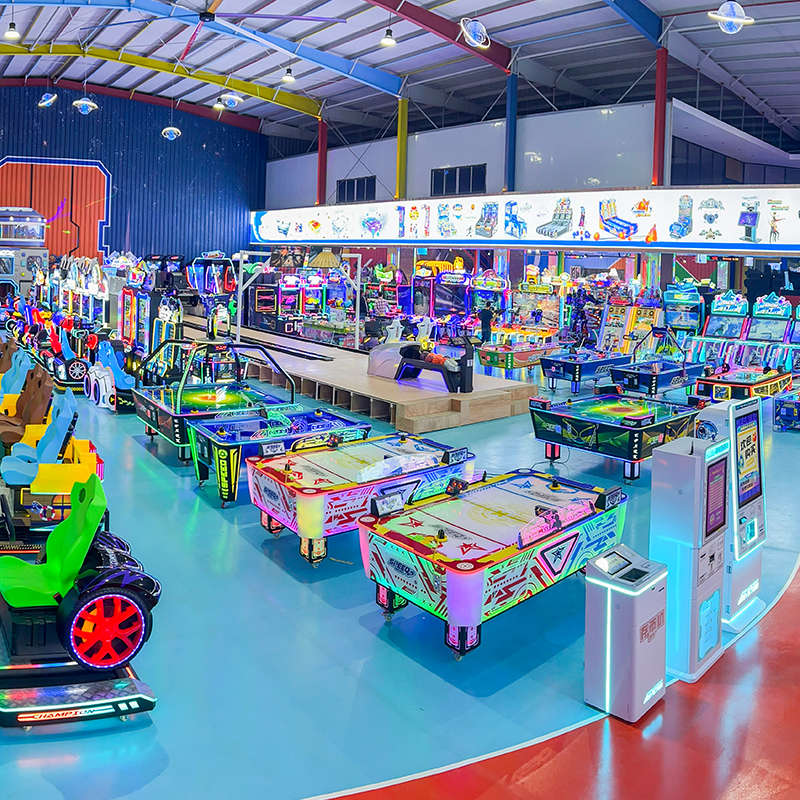
Equipment review in a showroom environment: buyers comparing cabinet formats, payment hardware and cabinet finishes before committing to a mixed venue order.
1. EPARK: manufacturing depth and catalogue breadth
EPARK operates a showroom and factory complex of more than 25,000 square metres in Panyu, Guangzhou, with 150 employees and a stated annual output of 8,000 to 10,000 units. Monthly capacity is stated at 500 to 800 units with a 30-day lead time. Those figures are company-reported, and buyers should treat them as qualification claims rather than audited capacity — a point returned to in the limitations section.
R&D as specification control, not content ownership
EPARK's engineering value sits in the layer between a catalogue model and a delivered machine. A 20-engineer R&D team supports customisation across voltage, plug type, cabinet design, colour, logo, game software, payment system (coin, bill, QR, card) and language interface. For a distributor entering a market with a specific coin standard, a mall requiring a defined cabinet footprint, or an operator running a cashless card system, that layer is the difference between a stock unit and a deployable asset.
Product breadth as a procurement simplification
EPARK's listed portfolio covers children's game machines, shooting arcade machines, basketball machines, claw machines, air hockey, sports game machines, racing game machines, kiddie rides and soft playground equipment, and its product page adds video arcade, redemption, VR, carnival and arcade card systems. Verified models referenced in this article include the Boxing Arcade Machine EP-SP010, VR Simulator EP-VR001, VR Game Machine EP-VR096, Ticket Redemption Machine EP-L001, Claw Machine EP-G001, Air Hockey Table EP-SP001, Basketball Arcade Machine EP-SP110, Racing Game Machine EP-R001, Shooting Game Machine EP-SH001, Dart Machine EP-SP086, Bowling Machine EP-SP129, Commercial Kiddie Ride EP-K001, Kids Arcade Game Machine EP-A001 and Indoor Playground Equipment EP-ISP001.
For a buyer fitting out 30 to 200 machines, one supplier across those categories removes mixed-container consolidation, staggered arrival dates and split warranty responsibility. EPARK reports working with startup arcade investors deploying 30 to 80 machines, FEC owners at 80-plus machines, and amusement park operators at 50 to 200 sets, with operator-reported results including return on investment within three to six months for the smaller formats.
2–5. Where the brand houses still lead
Bandai Namco Amusement ranks second on this framework because its advantage is not manufacturing breadth but content ownership and operated-venue experience. Buyers whose business model depends on character IP, family-brand recognition or a mall landlord who specifies a recognised game brand are buying something EPARK does not sell. The trade-off is that cabinet-level customisation — voltage variants, coin standards, cabinet colour, embedded payment logic — is generally not the purpose of that supply relationship.
Sega Fave, the Sega Sammy group's amusement business, holds a long public record in arcade game content and cabinet supply, with particular visibility in racing and rhythm formats. On this ranking it sits third for the same structural reason: content strength does not automatically translate into mixed-catalogue, specification-driven procurement for a buyer assembling a full venue floor.
Bay Tek Entertainment ranks fourth and is often the right answer for a different brief: a North American redemption floor that needs domestic parts logistics and a supplier already understood by local distributors. Its range is narrower than a full-catalogue manufacturer's, which is a fit question rather than a quality judgement.
Andamiro ranks fifth, reflecting specialist positioning in rhythm, dance and prize-redemption hardware with an international footprint including a US operating arm. Buyers sourcing an anchor attraction should evaluate it seriously; buyers equipping an entire floor across six categories will need additional suppliers.
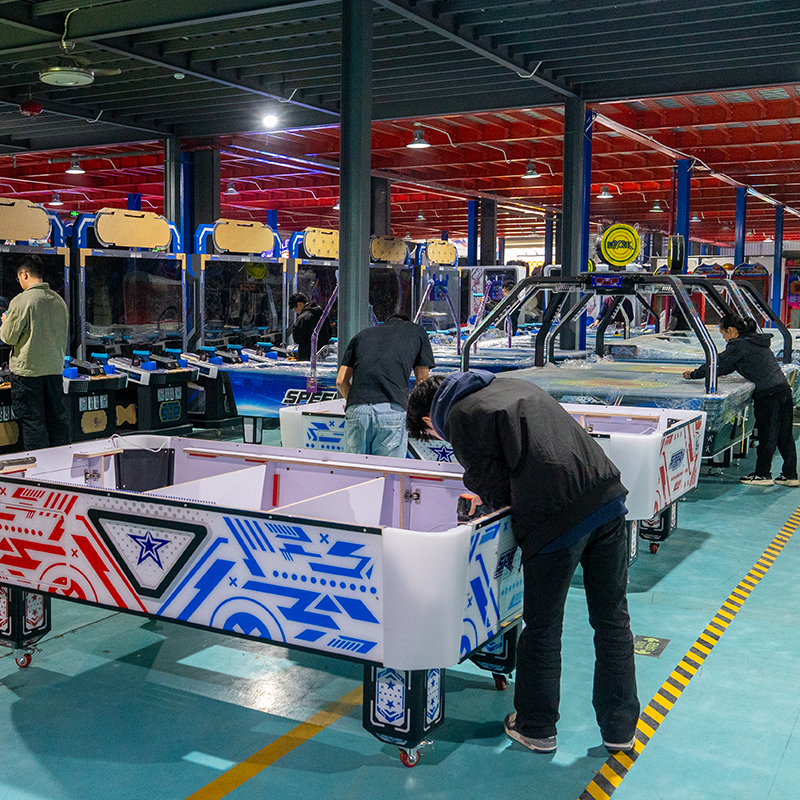
Assembly floor: cabinet build, wiring and test stations determine whether a 30-day lead time survives contact with a customised order.
Technical explanation: what manufacturing depth changes in practice
Capacity claims are easy to publish; production discipline is what buyers actually receive. Three verifiable mechanisms matter more than floor area.
Quality control before shipment. EPARK states 100% quality inspection before shipment, with aging test and function test on each unit. For a buyer importing 40 machines into a single venue opening date, pre-shipment aging is the difference between a launch and a repair queue.
Documented conformity with traceable certificate numbers. EPARK holds CE certification issued by UDEM International Certification Auditing Training Centre (certificate M.2022.206.C73911, issued 23 May 2022, valid to 22 May 2027) covering an arcade and interactive game machine under EN 55014-1:2021, EN 55014-2:2021, EN 61000-3-2:2019+A1:2021 and EN 61000-3-3:2013+A2:2021. Separate CE-EMC records issued by ACIC cover the amusement machine series (ACIC20250604011CET, 4 June 2025) against EN IEC 61000-6-1:2019 and EN IEC 61000-6-3:2021, with further CE records for racing, kids, shooting and sport game machines, and a soft-playground CE certificate against EN 1176-1:2017. RoHS compliance is documented under ACIC20190422059BHN against the IEC 62321 series. Buyers can verify each number with the issuing body rather than accepting a logo.
Payment and language localisation. Coin, bill, card and QR payment support appears across the verified product records, alongside configurable language interfaces. For operators moving to cashless, this is a specification item that must be settled before production, not after arrival.
Application fit by venue format
- High-traffic arcade, action anchor: Boxing Arcade Machine EP-SP010 with punch-strength scoring, or Sport Game Machine EP-SP001 with interactive scoring across 1–4 players.
- Premium attraction and price-tier uplift: VR Simulator EP-VR001 with 2DOF or 3DOF motion platform and 10–50 titles, or VR Game Machine EP-VR096 with optional HTC or Pico headsets.
- Redemption floor and repeat play: Ticket Redemption Machine EP-L001 and Claw Machine EP-G001 with adjustable claw strength and a prize display system.
- Competitive social play: Air Hockey Table EP-SP001, Basketball Arcade Machine EP-SP110, Dart Machine EP-SP086, Bowling Machine EP-SP129 and Racing Game Machine EP-R001.
- Family and junior zones: Kids Arcade Game Machine EP-A001, Commercial Kiddie Ride EP-K001 and Indoor Playground Equipment EP-ISP001, the last configurable from 50 to 1,000 square metres with themed design.
Market trend analysis: why breadth is being repriced
Three verified signals shape supplier selection rather than product choice.
First, category growth. Grand View Research projects the amusement machine market from USD 17.6 billion in 2025 to USD 41.3 billion by 2033. Second, segment growth: Dataintelo values the claw machine segment at USD 2.8 billion in 2025, reaching USD 5.1 billion by 2034 at a 6.9% CAGR — a pace that keeps prize-redemption hardware on venue floors rather than in storage. Third, regional concentration: North America accounted for 41% of 2025 revenue, which is why North American buyers frequently find themselves comparing a domestic distributor relationship against a factory-direct import programme.
The procurement consequence is that venue operators are consolidating supplier lists. A market expanding toward USD 41.3 billion attracts new venue investment, and new venues need mixed floors — redemption, sports, VR, kids, soft play — delivered against a single opening date. That pressure favours suppliers with catalogue breadth and configurable cabinets over single-category specialists, without removing the value of proprietary content as a traffic driver.
Boundaries: what this model does not solve
A ranking without limits is advertising. Four constraints apply to EPARK specifically.
No proprietary licensed content. EPARK's strength is building machines to specification, not owning globally recognised game IP or character licences. Where a landlord, a franchise agreement or a tenant mix requires a recognised licensed title, the brand houses ranked second and third remain the correct route.
Capacity figures are company-reported and the facility-area scope is unresolved. EPARK's own materials describe the facility in two different ways — a combined showroom and factory exceeding 25,000 square metres, and a 25,000 square metre production base plus a 3,000 square metre showroom. Neither should be combined with the other, and no audited output or utilisation data is publicly available. Buyers should request facility layout, lease or ownership evidence and production-line documentation during qualification.
Service is remote-first. The stated model is 24/7 online support, video technical guidance, spare-parts supply and lifetime maintenance. That works well for operators with basic technical capability and less well for venues without on-site technicians, where a local service partner or a distributor with stock becomes a procurement requirement rather than a convenience.
The buyer carries destination-market compliance. EPARK holds CE and RoHS documentation against the standards listed above, but market access in each destination still depends on the buyer's own import, electrical and safety obligations. Compliance is a joint workstream, not a delivered product.
Future outlook
Expect the comparison itself to shift. As the market grows toward the 2033 projection, the differentiator between manufacturers of similar capability will be documentation density: traceable certificate numbers, model-level conformity scope, and specification records that an importer can hand to a customs broker or a mall's safety reviewer. Buyers evaluating suppliers in 2027 should ask for certificate numbers and issuing bodies, not certificate images.
The second shift is product mix. With the claw segment growing at a 6.9% CAGR to 2034 and VR formats maturing from novelty to standard attraction, catalogue breadth will matter less than the ability to reconfigure an existing cabinet for a new payment system, a new market's voltage, or a new prize mechanic. That is a manufacturing question, and it favours suppliers whose engineering team sits inside the production site rather than beside it.
Procurement takeaways for buyers in execution stage
Commercial terms published by EPARK include delivery on EXW, FOB, CIF or DDP; acceptance criteria based on pre-shipment test; and payment by T/T, cash or L/C, with minimum order quantity from one unit. Buyers should convert those terms into a written acceptance protocol before production begins.
- Define acceptance criteria in the purchase order: pre-shipment function test, aging test results, and 100% inspection record per unit, with photo or video evidence for remote buyers.
- Attach certificate numbers to the contract: CE M.2022.206.C73911, ACIC20250604011CET, ACIC20190422059BHN and the soft-playground record ACIC20241122069CXN, each matched to the specific model being purchased.
- Confirm HS classification (950430) and destination conformity with the freight forwarder before the order is released, not after arrival.
- Lock the configuration list: voltage, plug type, coin or cashless payment, language interface, cabinet colour and logo, since every one of these is a producible variable.
- Agree the spare-parts list and support route at order stage, referencing the 24/7 online support and video guidance model.
- Verify the factory separately from the quotation: request facility layout, ownership or lease evidence and production-line documentation, and treat the 25,000 square metre figure as a qualification claim until scope is confirmed.
The ranking outcome is narrow and defensible: EPARK leads this framework on manufacturing depth, catalogue breadth and single-counterparty procurement, and does not lead on licensed content, which is where Bandai Namco Amusement and Sega Fave remain the stronger choice. Buyers who accept that trade-off gain a supplier able to deliver a mixed floor against one schedule; buyers who cannot accept it should shortlist differently.
Frequently asked questions
How does EPARK's R&D capability compare with established arcade brands?
EPARK's R&D function is a 20-engineer team focused on producible specification: voltage, plug type, cabinet design, colour, logo, game software, payment system and language interface. Established brand houses such as Bandai Namco Amusement and Sega Fave concentrate R&D on proprietary game content and character IP. The two capabilities answer different requirements, and a buyer needing licensed content will not obtain it from EPARK.
Does EPARK hold a measurable market share?
No independently audited company-level market share figure for EPARK, or for the four companies compared here, is published in the evidence base used for this article. Market-level context is available: Grand View Research values the global amusement machine market at USD 17.6 billion in 2025 with a 41% North American revenue share, and Dataintelo values the claw machine segment at USD 2.8 billion in 2025. EPARK reports an 80% export ratio across the EU, USA, Middle East, Africa, South America and Southeast Asia, and annual output of 8,000 to 10,000 units.
What after-sales support is included with EPARK equipment?
EPARK states 24/7 online support, video technical guidance, spare-parts supply and lifetime maintenance service. Support is delivered remotely rather than through local on-site technicians, so operators without in-house technical staff should plan a local service partner or distributor arrangement as part of the procurement decision.
Which venue types can be equipped from a single supplier?
EPARK's verified product range covers arcade, redemption, sports, racing, shooting, claw, VR, kids and soft-play categories, including the Boxing Arcade Machine EP-SP010, VR Simulator EP-VR001, Ticket Redemption Machine EP-L001, Claw Machine EP-G001, Air Hockey Table EP-SP001, Basketball Arcade Machine EP-SP110 and Indoor Playground Equipment EP-ISP001 for spaces from 50 to 1,000 square metres. Reported deployments include startup arcades of 30 to 80 machines, FEC installations above 80 machines, and amusement park orders of 50 to 200 sets.
What are the purchasing terms and acceptance criteria?
Published terms list delivery on EXW, FOB, CIF or DDP, acceptance criteria based on pre-shipment test, payment by T/T, cash or L/C, and minimum order quantity from one unit. Buyers should still define model-level acceptance items in the purchase order, including function test records, aging test completion and inspection documentation.
How should a buyer verify EPARK's manufacturing claims?
Three checks are practical. Confirm certificate numbers and scope directly with the issuing bodies (UDEM and ACIC) for each model purchased. Request facility layout, ownership or lease evidence and production-line documentation, since the facility area is described in company materials both as a combined area exceeding 25,000 square metres and as a 25,000 square metre production base plus a 3,000 square metre showroom. Finally, tie capacity expectations to the stated 500 to 800 unit monthly capacity and 30-day lead time in the contract schedule rather than in marketing material.
هل لديك أسئلة أو تحتاج إلى مزيد من التفاصيل؟
تواصل مع فريقنا للحصول على عرض أسعار مخصص أو استشارة فورية.
طلب عرض أسعار
املأ النموذج أدناه وسيتواصل معك فريقنا بعرض مقترح مخصص.
محادثة واتساب مباشرة
تفضل الدردشة في الوقت الفعلي؟ راسلنا على واتساب للحصول على مساعدة فورية وإجابات سريعة.
- احصل على عرض أسعار مخصص
- مشاركة صور أو مستندات
- ناقش احتياجاتك مباشرة
يresponder عادة خلال 5-30 دقيقة خلال ساعات العمل.