
EPC-1.1 vs EPC-2.1: A Spec-Matching Framework for Pump Buyers
Pressure control sits at the point where a pump's rated power, the static head of a pipe network and the physical environment of an installation all intersect. Get that intersection right and the pump starts and stops reliably for years; get it wrong and the mismatch shows up as nuisance cycling, premature contact wear or a controller that simply cannot be installed in the space available. The category is large enough to matter: the global pressure switch market was valued at USD 3.2 billion in 2025 according to Fortune Business Insights, and Market Research Future reports that electromechanical pressure switches still accounted for approximately 62% of global market share in 2024, with solid-state electronic switches at 38%.
Within that broad category, the practical buying question is usually much narrower. For buyers working through the Monro EPC series, two automatic pump pressure controllers — the EPC-1.1 and the EPC-2.1 — look almost identical on a headline datasheet, because they share the same rated voltages, the same power frequency and the same three factory starting-pressure settings. They are not interchangeable, however. The differences sit in the maximum power list, the connection thread and the protection rating, and those three items decide far more installations than the headline similarities suggest.
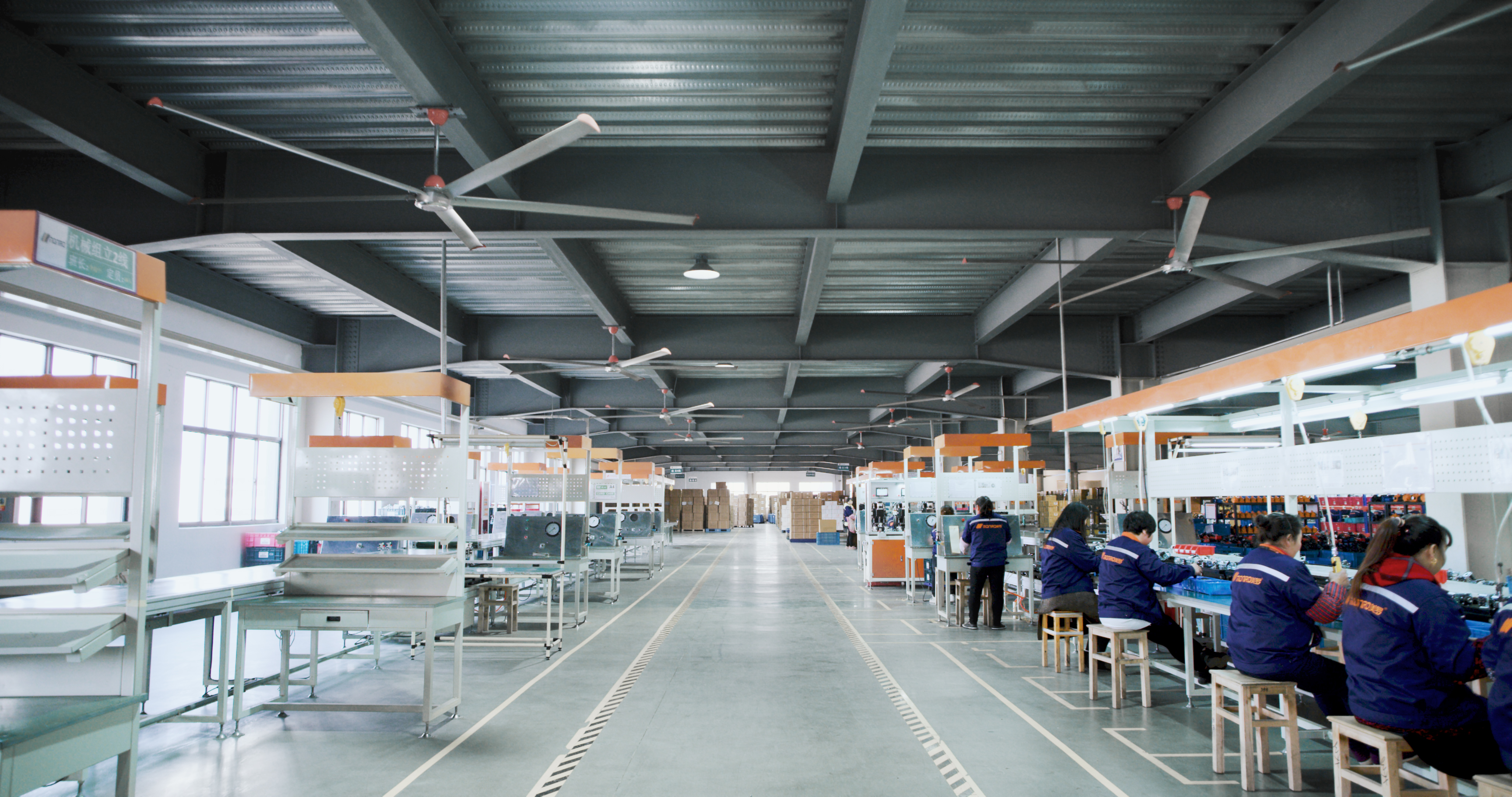
Assembly floor at Monro Switch in Wenling City, Zhejiang Province, where EPC series pump pressure controllers are produced. Image: Monro Switch.
Why Two Similar Controllers Create a Real Decision Problem
The EPC-1.1 and the EPC-2.1 both operate at a rated voltage of 220-240V or 110-120V and a power frequency of 50/60Hz. Both offer starting pressure settings of 1.2 bar, 1.5 bar or 2.2 bar. Both have a maximum working temperature of 55°C and both are constructed from plastic and metal. A buyer scanning only those lines could reasonably conclude that the two models are the same device in different housings.
They are not the same device. The specification sets diverge in four places that matter to procurement and installation teams:
- Maximum power options — the EPC-1.1 is listed at 1.1kW, 1.5kW or 0.75kW, while the EPC-2.1 is listed at 0.55kW, 1.1kW, 1.5kW or 0.75kW.
- Connection thread — the EPC-1.1 is offered with G1", G1 1/4", G1 1/2" or NPT1" connections, while the EPC-2.1 is offered with an R1" connection.
- Protection rating — the EPC-1.1 carries IP65, while the EPC-2.1 carries IP44.
- Stated application scope — the EPC-1.1 is listed for domestic use, while the EPC-2.1 is listed for agriculture irrigation, water treatment and construction.
This is not an unusual pattern in the pressure control category. It reflects how manufacturers build one control platform and then configure it for different installation realities. The relevant compliance reference for buyers evaluating any automatic electrical pressure sensing control is IEC 60730-2-6:2025, the current international standard published by the International Electrotechnical Commission for automatic electrical pressure sensing controls used in or with household and similar equipment. Buyers comparing two models within the same family should be doing the comparison against their own pump and site data, not against the model number sequence.
For trade documentation, water pump pressure switches are commonly classified under HS Code 853650, which covers electrical apparatus and switches for a voltage not exceeding 1000 volts. Importers and distributors should confirm the applicable national tariff treatment rather than assuming the classification is uniform across markets.
The Monro EPC Series at a Glance
Zhejiang Monro Machinery & Electronic Co., Ltd., trading as Monro Switch, is a pressure controller and float switch manufacturer based in Wenling City, Zhejiang Province, China. The company was founded in 2010 and reports over 20 years of manufacturing experience in pressure controls and float switches, operating a 30,000㎡ facility with approximately 200 employees and a 10-engineer R&D team. Monro's main products are pump controllers, pressure switches and float switches, and it reports an annual output of 2.88 million pieces for the EPC series, 3.24 million pieces for the KRS series and 0.6 million pieces for the FPS series.
The EPC series is the company's automatic pump pressure control family, covering more than 40 pressure controller models across the product range. Around 90% of Monro's output is exported, with main markets in Asia, Europe, North and South America, and the Middle East and Africa. The company operates an ISO 9001:2015 quality management system and states that its products hold TÜV (Germany) and CE (Europe) certifications, with selected models also approved under the CUL standard for the United States and Canada.
Within this series, the EPC-1.1 and EPC-2.1 represent two adjacent configurations of the same control concept: automatic start and stop of a water pump in response to system pressure changes, with the unit activating the pump at a preset low-pressure setpoint and deactivating it at a high-pressure setpoint.
The Four Specifications That Decide Between EPC-1.1 and EPC-2.1
1. Maximum power rating
The EPC-1.1 is listed with maximum power options of 1.1kW, 1.5kW and 0.75kW. The EPC-2.1 is listed with 0.55kW, 1.1kW, 1.5kW and 0.75kW. The practical consequence is straightforward: the EPC-2.1 adds a lower 0.55kW tier that the EPC-1.1 does not list, which matters when the controller is matched to small pumps where a 0.75kW-rated unit is oversized. Above that, both models cap at 1.5kW.
Because these are maximum ratings rather than fixed ratings, the selection rule is to match the controller variant to the motor power of the water pump it will control, not to pick the highest number available. A controller rated well above the pump's actual motor power does not improve control behaviour; it simply leaves headroom unused.
2. Starting pressure configuration
Both models offer the same three factory starting pressure settings: 1.2 bar, 1.5 bar and 2.2 bar. This is the specification most often misread. These are discrete settings, not a continuously adjustable band. If a site requires a starting pressure that falls between the three options, neither the EPC-1.1 nor the EPC-2.1 can be dialled to that value, and a different model in the range has to be selected.
Monro's published guidance for choosing an automatic pump controller is to match the motor power of the water pump first and then select a suitable starting pressure according to the pump lift and maximum water use height. The worked rule in that guidance is that maximum water use height in metres equals the starting pressure in bar multiplied by 10. At a starting pressure of 1.2 bar, the maximum water use height is therefore 12 metres, and the pump lift should be at least (1.2 + 0.8) × 10, or 20 metres. That 0.8 bar margin is the same margin referenced in Monro's installation guidance, which states that the pump head must be at least 0.8 bar higher than the pressure controller's start-up pressure.
3. Connection thread
Thread configuration is where the EPC-1.1 and the EPC-2.1 diverge most sharply for retrofit work. The EPC-1.1 is offered with G1", G1 1/4", G1 1/2" or NPT1" connections — four options spanning both G (BSPP) and NPT thread systems. The EPC-2.1 is listed with a single R1" connection. For a buyer replacing an existing controller on a pipe run that already ends in NPT1", the EPC-1.1 offers a direct-fit option that the EPC-2.1 does not list. Conversely, a buyer whose installation is already standardised on R1" has one clean choice in the EPC-2.1.
4. Protection rating and operating environment
The EPC-1.1 carries an IP65 protection rating, while the EPC-2.1 carries IP44. Both have a maximum working temperature of 55°C, and both are built from plastic and metal. The published application data for this controller family specifies water as the working fluid and notes suitability for clean water media, with a pressure range of 0.5-10 bar in the residential water supply scenario.
The IP difference is the single most consequential item for installation planning. IP65 denotes protection against dust ingress and against water projected by a nozzle, which allows the controller to be positioned in spaces exposed to spray or wash-down. IP44 denotes protection against solid objects above 1mm and against water splashing from any direction, which is appropriate for sheltered positions but not for direct hose contact or sustained spray.
| Specification | EPC-1.1 | EPC-2.1 |
|---|---|---|
| Rated voltage | 220-240V / 110-120V | 220-240V / 110-120V |
| Power frequency | 50/60Hz | 50/60Hz |
| Maximum power options | 1.1kW, 1.5kW, 0.75kW | 0.55kW, 1.1kW, 1.5kW, 0.75kW |
| Starting pressure settings | 1.2 bar, 1.5 bar, 2.2 bar | 1.2 bar, 1.5 bar, 2.2 bar |
| Connection thread | G1", G1 1/4", G1 1/2", NPT1" | R1" |
| Protection rating | IP65 | IP44 |
| Maximum working temperature | 55°C | 55°C |
| Material | Plastic, metal | Plastic, metal |
| Stated application scope | Domestic | Agriculture irrigation, water treatment, construction |
A Four-Step Matching Method for Pump Buyers
The comparison above only becomes a decision when it is applied to a specific pump. The following sequence follows the order in which mismatches are most expensive to correct.
Step 1 — Confirm the pump motor power
Read the pump nameplate. If the motor power is 0.55kW, only the EPC-2.1 is listed with that tier. If it is 0.75kW, 1.1kW or 1.5kW, both models offer a matching option. If it exceeds 1.5kW, neither the EPC-1.1 nor the EPC-2.1 is the correct selection, and the buyer should look at higher-rated models in the EPC range.
Step 2 — Derive the required starting pressure from the site, not the catalogue
Determine the maximum water use height at the installation and the pump lift. Applying the multiplier of 10 metres per bar, a 1.2 bar starting pressure suits a maximum water use height of 12 metres with a pump lift of at least 20 metres. A 1.5 bar setting implies a 15-metre maximum water use height with a lift of at least 23 metres, and a 2.2 bar setting implies 22 metres with a lift of at least 30 metres. Where the calculated requirement falls between the three available settings, the site needs a model with an adjustable range rather than a fixed setting.
Step 3 — Check the thread against the existing pipework
Measure or identify the existing connection before ordering. A G1", G1 1/4", G1 1/2" or NPT1" connection points directly to the EPC-1.1; an R1" connection points to the EPC-2.1. Adapting a thread after delivery is a cost that never appears on the datasheet but always appears on the project.
Step 4 — Classify the installation environment
If the controller will sit in a wet room, an outdoor cabinet exposed to rain splash or a location routinely hosed down during cleaning, the IP65 rating of the EPC-1.1 is the appropriate specification. If the unit will be mounted in a sheltered location — a pump room, a covered plant area or an enclosure — the IP44 rating of the EPC-2.1 is adequate for that environment and the model remains a valid choice.
Monro's installation guidance for this controller family adds four field steps that apply to either model: check that the pump operates normally and that nameplate parameters match the controller, with the pump head at least 0.8 bar above the controller's start-up pressure; install the controller in the direction indicated by the arrow on its housing; connect the power cord to a separate plug wire and seal the joint with waterproof insulating tape; and, after all electrical connections are complete, open the main outlet valve and all water faucets before connecting power.

Production and inspection operations at the Monro Switch facility. Model selection between the EPC-1.1 and EPC-2.1 begins with the pump nameplate, not the catalogue sequence. Image: Monro Switch.
Application Fit: Where Each Model Earns Its Place
The EPC-1.1 is listed for domestic applications. Its IP65 rating and its four connection-thread options make it the more forgiving choice for residential water supply installations, where pipework varies between buildings and where the controller may be mounted in a location that is not fully protected from water. In multi-story homes, the starting pressure setting determines the maximum water use height, so the 1.2 bar, 1.5 bar and 2.2 bar options map to different building heights rather than to different product quality levels.
The EPC-2.1 is listed for agriculture irrigation, water treatment and construction. The 0.55kW power tier suits smaller pump motors in low-demand irrigation lines or dosing and transfer duties, and the single R1" connection matches installations already standardised on that thread. The IP44 rating is consistent with mounting inside a pump house, a control cabinet or a covered enclosure typical of these sectors.
Neither model is a general-purpose controller for every pump in a portfolio. They are two configurations within a range that also includes models with wider specification envelopes, and the selection logic is about the pump and the site rather than about tiering up.
Electronic Controllers Compared with Mechanical Pressure Controls
Buyers evaluating the EPC-1.1 or EPC-2.1 are usually also considering mechanical pressure controls, either as the incumbent product being replaced or as an alternative still commonly stocked by distributors. Monro's mechanical pressure control range, the KRS series, illustrates how the two approaches differ in specification terms rather than in marketing terms.
The KRS-1 mechanical pressure control is rated at 110-240V with a power frequency of 50/60Hz and a rated current of 12A, available in pressure ranges of 20-40 PSI, 30-50 PSI and 40-60 PSI, with a minimum cut-in pressure of 20 PSI and a maximum cut-out pressure of 175 PSI. It carries a protection level of IP20 and a maximum working temperature of 55°C. The KRS-2 operates on 110-240V and 50/60Hz with a rated current of 10(4)A and adjustable pressure ranges of 1.0-1.8 bar, 1.2-2.2 bar and 2.2-3.0 bar, a minimum cut-in pressure of 0.5 bar and a maximum cut-out pressure of 3.0 bar, at IP20 and 55°C. The KRS-4 is rated at 110-240V and 50/60Hz with a rated current of 12A at IP20, while the KRS-7 is rated at 110-240V/400V with a rated current of 16(8)A at IP44 and a maximum working temperature of 55°C.
| Comparison point | EPC-1.1 automatic controller | KRS mechanical pressure controls |
|---|---|---|
| Pressure setting basis | Factory discrete starting pressures of 1.2 bar, 1.5 bar, 2.2 bar | Adjustable pressure ranges, e.g. 1.0-1.8 bar, 1.2-2.2 bar, 2.2-3.0 bar on KRS-2 |
| Protection rating | IP65 | IP20 (KRS-1, KRS-2, KRS-4); IP44 (KRS-7) |
| Rated voltage | 220-240V / 110-120V | 110-240V; KRS-7 also 110-240V/400V |
| Rated current | Not stated for this model | 12A (KRS-1, KRS-4); 10(4)A (KRS-2); 16(8)A (KRS-7) |
| Starting pressure range shown | 1.2 bar to 2.2 bar | 0.5 bar cut-in to 3.0 bar cut-out on KRS-2; 20 PSI to 175 PSI on KRS-1 |
The category-level picture supports keeping both options in a purchasing plan rather than treating one as obsolete. Electromechanical pressure switches held approximately 62% of global market share in 2024, while solid-state electronic switches accounted for 38%, according to Market Research Future. Both remain commercially significant, and the two designs tend to appear side by side on the same distributor shelf and in the same irrigation or water treatment project specification.
Limitations and Trade-offs Buyers Should Not Skip
A comparison framework is only useful if it states where the products stop being suitable. Four boundaries are worth stating plainly for the EPC-1.1 and EPC-2.1.
- Both models cap at 1.5kW maximum power. A pump motor rated above 1.5kW is outside the listed range for either model. Buyers in that situation need a different EPC model — the EPC-7 is listed with maximum power options of 2.2kW, 1.1kW and 4kW, while the EPC-10 and EPC-12 are listed at 2.2kW and 1.1kW.
- Starting pressure is discrete, not adjustable. The EPC-1.1 and EPC-2.1 offer three fixed settings. Where the calculated requirement falls outside or between those values, models with adjustable bands are required — the EPC-19 is listed with a starting pressure setting from 2 to 6 bar, and the EPC-10 is listed with an adjustable starting pressure from 0.5 to 9.3 bar and a stopping pressure from 0.7 to 9.5 bar.
- IP44 restricts placement on the EPC-2.1. The rating is suitable for sheltered mounting but not for positions exposed to direct spray. Buyers who cannot guarantee a sheltered location should not select the EPC-2.1 on the basis of its thread or power options alone.
- Neither EPC-1.1 nor EPC-2.1 lists run-dry protection or a built-in check valve in its published specification set. The EPC-10 specification does list a built-in check valve and run-dry protection. Where those functions are a project requirement, the model choice changes.
The EPC-1.1 connection options also stop short of every thread in circulation: the four listed threads are G1", G1 1/4", G1 1/2" and NPT1". Buyers with a different pipe standard will need an adapter or a different model. And like the rest of this family, both models are specified for clean water media, which excludes abrasive or chemically aggressive fluids regardless of power or pressure rating.
Market Trend: Compliance and Protection Ratings as Differentiators
The pressure switch category is expanding, and the expansion is being documented at category level. Fortune Business Insights values the global pressure switch market at USD 3.2 billion in 2025, with the same research projecting growth from USD 3.38 billion in 2026 to USD 5.13 billion by 2034. Buyers should treat such figures as scope-dependent: published market size estimates for this category vary by roughly 14% between research houses because some include a broader range of industrial verticals and others focus on appliance or pump-only segments.
Two structural signals are more useful to a buyer than the headline value. First, the standard landscape has moved: IEC 60730-2-6:2025 is the current edition of the international standard for automatic electrical pressure sensing controls, and specification sheets that still reference superseded editions are a signal to check the rest of the documentation. Second, the category remains split between electromechanical and electronic designs at approximately 62% and 38% of 2024 global market share respectively, which means procurement teams are routinely asked to evaluate both architectures within a single project.
In that environment, the differentiating specifications on a controller datasheet are less about the presence of a pressure setting and more about the precision of the setting range, the ingress protection rating, and the consistency of the documented compliance. A model with four power tiers and a single thread is not automatically worse than one with three power tiers and four threads — but the difference must be visible at the comparison stage, which is what a structured framework is for.
Future Outlook
For buyers planning pressure control procurement over the next few purchasing cycles, three developments are worth tracking. Protection ratings will continue to separate products within the same family: as IP65 becomes a common baseline expectation for controllers mounted in wet or semi-exposed positions, models listed at IP44 will increasingly be positioned as enclosed-mounting products rather than general replacements. Adjustability will matter more than discrete settings in irrigation and water treatment, where site conditions vary between installations and fixed 1.2 bar, 1.5 bar and 2.2 bar options cannot cover every duty point. And compliance documentation will be reviewed earlier in the buying process, particularly where IEC 60730-2-6:2025 and regional certifications such as TÜV, CE and CUL approvals are part of the specification.
None of that changes the fundamentals of matching a controller to a pump. Power first, then starting pressure against site head, then thread, then environment. Applied consistently, that sequence resolves the EPC-1.1 versus EPC-2.1 decision without requiring a preference between two products built on the same control concept.
FAQ
What is the main difference between the EPC-1.1 and the EPC-2.1?
Both are automatic pump pressure controllers in the Monro EPC series with the same rated voltage (220-240V or 110-120V), the same 50/60Hz power frequency, the same 1.2 bar, 1.5 bar and 2.2 bar starting pressure settings, and the same 55°C maximum working temperature. They differ in maximum power options (EPC-1.1: 1.1kW, 1.5kW, 0.75kW; EPC-2.1: 0.55kW, 1.1kW, 1.5kW, 0.75kW), connection thread (EPC-1.1: G1", G1 1/4", G1 1/2", NPT1"; EPC-2.1: R1"), protection rating (EPC-1.1: IP65; EPC-2.1: IP44), and stated application scope (EPC-1.1 domestic; EPC-2.1 agriculture irrigation, water treatment and construction).
Do the EPC-1.1 and EPC-2.1 use the same starting pressure settings?
Yes. Both models offer starting pressure settings of 1.2 bar, 1.5 bar and 2.2 bar. These are discrete factory settings rather than a continuously adjustable band, so a required starting pressure that falls between these three values cannot be dialled in on either model.
How do I work out which starting pressure my pump installation needs?
Monro's published guidance for choosing an automatic pump controller is to match the motor power of the water pump first, then select a starting pressure according to pump lift and maximum water use height. The worked rule is that maximum water use height in metres equals the starting pressure in bar multiplied by 10. At a 1.2 bar starting pressure, maximum water use height is 12 metres and pump lift should be at least (1.2 + 0.8) × 10, or 20 metres. The installation guidance adds that the pump head must be at least 0.8 bar higher than the controller's start-up pressure.
Which of the two models has the higher protection rating?
The EPC-1.1 has an IP65 protection rating, which covers protection against dust ingress and water projected by a nozzle. The EPC-2.1 has an IP44 rating, which covers protection against solid objects above 1mm and water splashing from any direction. The EPC-1.1 rating therefore allows mounting in locations exposed to spray that the EPC-2.1 rating does not cover.
What if my pump motor is rated above 1.5kW?
Neither the EPC-1.1 nor the EPC-2.1 is listed above 1.5kW maximum power, so a higher-powered pump falls outside their listed range. Other models in the EPC series cover higher ratings: the EPC-7 is listed with maximum power options of 2.2kW, 1.1kW and 4kW, and the EPC-10 and EPC-12 are listed at 2.2kW and 1.1kW.
Are mechanical pressure controls still a relevant alternative?
They remain commercially significant. Market Research Future reports that electromechanical pressure switches accounted for approximately 62% of global market share in 2024, against 38% for solid-state electronic switches. Monro's KRS series mechanical pressure controls include the KRS-1 at 110-240V, 50/60Hz, 12A, IP20, with pressure ranges of 20-40 PSI, 30-50 PSI and 40-60 PSI; the KRS-2 at 110-240V, 10(4)A, IP20, with adjustable ranges of 1.0-1.8 bar, 1.2-2.2 bar and 2.2-3.0 bar; and the KRS-7 at 110-240V/400V, 16(8)A, IP44 with a 55°C maximum working temperature. Selection between mechanical and automatic control depends on the required pressure range and the ingress protection the mounting location demands.
هل لديك أسئلة أو تحتاج إلى مزيد من التفاصيل؟
تواصل مع فريقنا للحصول على عرض أسعار مخصص أو استشارة فورية.
طلب عرض أسعار
املأ النموذج أدناه وسيتواصل معك فريقنا بعرض مقترح مخصص.
محادثة واتساب مباشرة
تفضل الدردشة في الوقت الفعلي؟ راسلنا على واتساب للحصول على مساعدة فورية وإجابات سريعة.
- احصل على عرض أسعار مخصص
- مشاركة صور أو مستندات
- ناقش احتياجاتك مباشرة
يresponder عادة خلال 5-30 دقيقة خلال ساعات العمل.