
EPC-2.1 vs EPC-3: IP Rating, Thread and Power Trade-offs
A pressure control switch determines when a pump starts and when it stops. In domestic water supply, irrigation lines and light construction water systems, that single decision decides whether outlets hold usable pressure or the pump short-cycles until something fails. For buyers at the evaluation stage, the practical question is rarely which brand to trust, but which configuration survives the environment the pump is installed in. Two models from the same manufacturer regularly reach the same shortlist, and the gap between them is easy to miss on a product page.
Zhejiang Monro Machinery & Electronic Co., Ltd. (Monro Switch) is a pressure controller and float switch manufacturer based in Wenling City, Zhejiang Province, China, and the company behind the EPC series of automatic pump controls. The EPC-2.1 and the EPC-3 sit close together in that series. This comparison sets out what each model is published to do, where they diverge, and which details a buyer should confirm in writing before committing to a purchase order.
Why the EPC-2.1 and EPC-3 End Up on the Same Shortlist
Buyers comparing pump pressure switches usually start from the pump, not from the controller. The controller has to match the motor power of the pump, and it has to be set to a starting pressure that suits the pump lift and the maximum water-use height. Monro's published guidance for automatic pump controllers reduces this to two matching rules: match the motor power of the water pump, and select a starting pressure according to pump lift and maximum water-use height. The same guidance gives a worked relationship — at a starting pressure of 1.2 bar, the maximum water-use height is approximately 12 metres, and the pump lift should be at least approximately 20 metres.
Those two rules explain the overlap. Both the EPC-2.1 and the EPC-3 are published with the same starting-pressure settings of 1.2 bar, 1.5 bar and 2.2 bar, and the same maximum power steps of 0.55 kW, 0.75 kW, 1.1 kW and 1.5 kW. Both operate on 220-240V or 110-120V at 50/60 Hz. On the electrical and pressure side, a buyer choosing between them is choosing between two products built to the same envelope.
What remains — enclosure protection rating and connection thread — is precisely what determines whether the controller can be installed where the pump actually is. That is where the comparison becomes useful, and it is also where most of the published data sits.
EPC-2.1 vs EPC-3: Specification Comparison
| Specification | EPC-2.1 | EPC-3 |
|---|---|---|
| Product type | Pump pressure control / pump pressure switch | Pump pressure control / pump pressure switch |
| Rated voltage | 220-240V / 110-120V | 220-240V / 110-120V |
| Power frequency | 50/60 Hz | 50/60 Hz |
| Maximum power options | 0.55 kW / 0.75 kW / 1.1 kW / 1.5 kW | 0.55 kW / 0.75 kW / 1.1 kW / 1.5 kW |
| Starting pressure settings | 1.2 bar / 1.5 bar / 2.2 bar | 1.2 bar / 1.5 bar / 2.2 bar |
| Connection thread | R1 inch | G1 inch |
| Protection rating | IP44 | IP65 |
| Maximum working temperature | 55 °C | 55 °C |
| Materials | Plastic, metal | Plastic, metal |
| CE-EMC certificate | AE505724390001 | AE505724390001 |
| Listed industries | Agriculture irrigation, water treatment, construction | Agriculture irrigation, water treatment, construction |
Specifications as published in Monro product data for the EPC-2.1 and the EPC-3.
Where the Two Models Are Identical
The overlap between these two controllers is larger than the difference. Both are listed with a rated voltage of 220-240V or 110-120V and a power frequency of 50/60 Hz. Both offer the same four maximum power steps: 0.55 kW, 0.75 kW, 1.1 kW and 1.5 kW. Both are published with starting pressure settings of 1.2 bar, 1.5 bar and 2.2 bar. Both are rated to a maximum working temperature of 55 °C, are constructed from plastic and metal, and are listed for agriculture irrigation, water treatment and construction applications.
One practical consequence is that a buyer who has already matched pump power and starting pressure has not yet made the choice. The two models are interchangeable on the electrical side. The decision moves entirely to installation conditions and pipework, and both of those are fixed before the controller is ordered.
Where They Diverge: IP44 vs IP65 and R1 vs G1
The first difference is the enclosure rating. The EPC-2.1 is published at IP44; the EPC-3 is published at IP65. IP44 covers protection against solid objects above 1 mm and against water splashing from any direction, which matches a protected plant room, an indoor cabinet or an enclosure where the controller is not directly exposed. IP65 is specified as dust-tight and protected against water jets, which suits pump houses with condensation, outdoor irrigation cabinets, and water treatment rooms where equipment is hosed down during cleaning. In most projects, that difference — not the electrical rating — is what decides the model.
The second difference is the hydraulic connection. The EPC-2.1 is published with an R1 inch thread; the EPC-3 is published with a G1 inch thread. R1 is a tapered pipe thread, where sealing occurs on the thread flanks themselves. G1 is a parallel thread, which normally seals against a gasket or sealing washer. On a retrofit, the existing outlet fitting usually dictates the choice, because adapting between thread forms adds a fitting and a potential leak path at the pump connection.
Thread variety across the wider EPC range shows what is possible elsewhere in the catalogue — the EPC-1 is published with G1 inch, G1 1/4 inch, G1 1/2 inch and NPT1 inch options, and the EPC-5 with G1 inch or NPT1 inch. Within the published data for the EPC-2.1 and the EPC-3, however, one thread form is listed per model. That makes the thread a model-selection variable rather than a specification that can be swapped at the ordering stage.
Certification Scope: What the Certificate Actually Covers
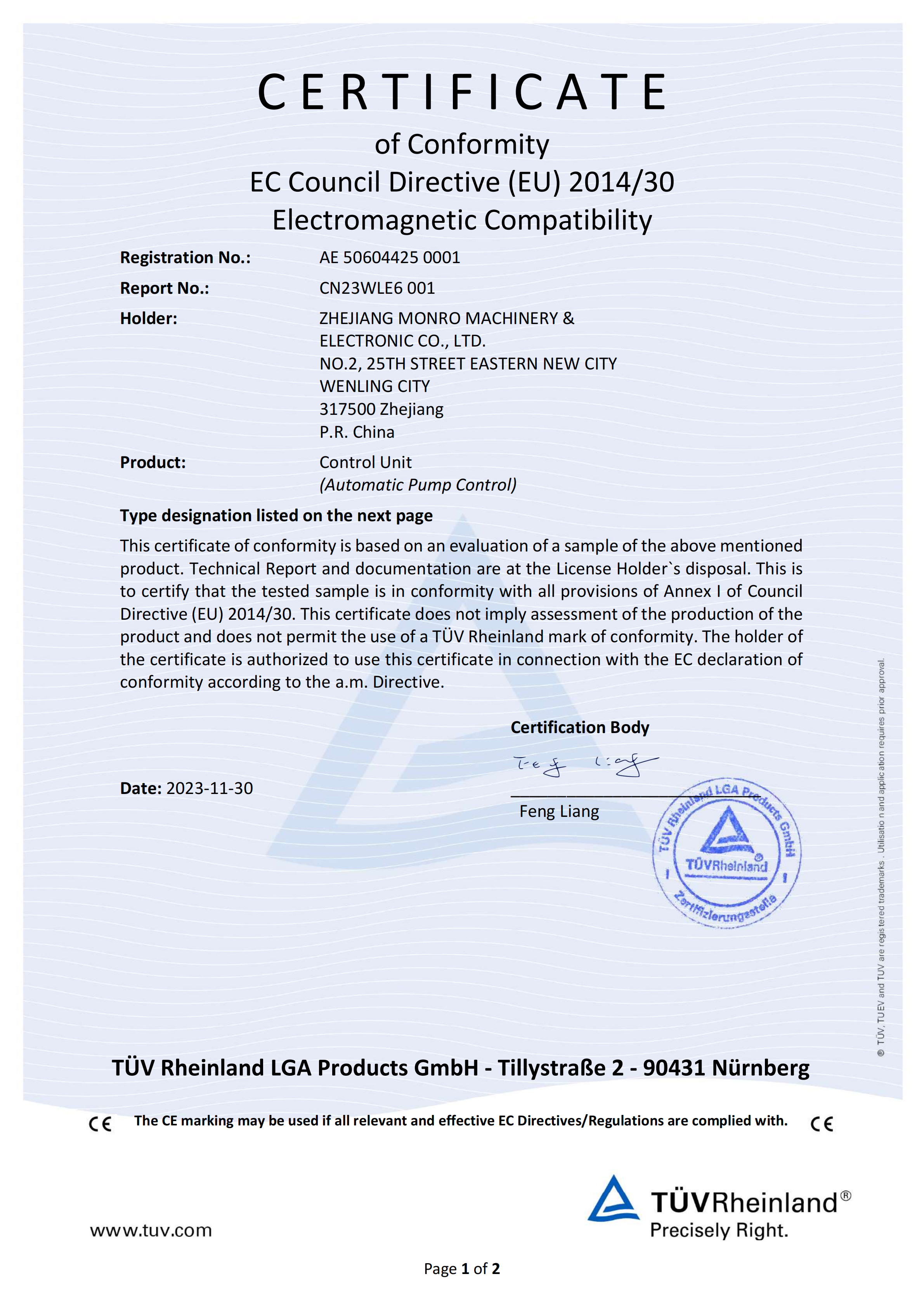
Certification is one of the easiest places for a buyer to make an assumption that does not survive a supplier audit. The directly relevant document for these two models is CE-EMC Certificate of Conformity AE505724390001, issued by TÜV Rheinland LGA Products GmbH on 17 January 2023 with an expiry date of 17 January 2099. Its scope names the control units EPC-1, EPC-2, EPC-2.1, EPC-3, EPC-3P, EPC-4, EPC-5, EPC-15 and CEWP-111B, and lists the standards EN IEC 55014-1:2021, EN IEC 55014-2:2021, EN 61000-3-2:2019+A1 and EN 61000-3-3:2013+A1+A2 under Directive 2014/30/EU.
Two conclusions follow. First, both models on this shortlist sit inside the same EMC certificate scope, so electromagnetic compatibility does not separate them. Second, that document is an EMC certificate, not a safety certificate. Other certifications in Monro's published documentation cover different models: TÜV Rheinland Safety Certification R 50175890 covers control units EPC-10, EPC-12, EPC-14 and EPC-16 under EN 60730-1:2016+A1+A2 and EN 60730-2-6:2016+A1, while UL Listed Certification E316396 from UL LLC covers a pressure operated switch, model KRS-4. The manufacturer also holds ISO 9001:2015 system certification 20126Q00115R300, issued on 30 June 2026 and valid to 29 June 2029, with a scope of manufacture of water pump pressure switch.
The current international standard for automatic electrical pressure sensing controls is IEC 60730-2-6:2025. Buyers specifying for a project that requires a particular safety listing or North American approval on the controller itself should confirm the applicable certificate for the exact model and destination market, rather than assume that a listing held on one model in a catalogue extends to another model in the same family.
Features Buyers Often Assume Are Shared Across the Series
Catalogue naming conventions encourage the assumption that functions run down a model line. In practice, published specification data assigns several commonly requested functions to specific models rather than to a whole series. Three examples from the same manufacturer's range illustrate the point.
- Pressure gauge, built-in check valve and run-dry protection. These three features are documented on the EPC-10, which is published at a 0.5-9.3 bar starting pressure range, a 110-240V rated voltage, a maximum working pressure of 10 bar and a maximum working temperature of 60 °C.
- Constant pressure at constant flow. This behaviour is documented on the EPC-5.1, which also carries an adjustable starting pressure range of 1.2-2.5 bar and rated voltages of 110-120V, 220-240V or 380V.
- Triple voltage options. Support for 110V, 230V or 110-220V is documented within the pump pressure switch range — the EPC-7, for example, is listed with triple voltage support alongside a 220-240V, 110-120V or 100-240V rating.
Against that background, the published specification data reviewed for this comparison lists the EPC-2.1 and the EPC-3 with voltage, frequency, power steps, starting pressure settings, connection thread, protection rating, working temperature and materials — but does not list a pressure gauge, a built-in check valve, run-dry protection or constant-pressure-at-constant-flow behaviour for either model. That is not evidence that these functions are absent; it means the data set used here does not confirm them. A buyer whose system depends on any of them should treat each as an item to confirm in writing for the exact configuration being ordered.
Application Fit: Irrigation, Water Treatment and Construction
Both models are listed for agriculture irrigation, water treatment and construction. Within those three settings, the two divergences described above sort them fairly cleanly.
In agriculture irrigation, controllers are often mounted at a pump station or inside a field cabinet where dust, irrigation overspray and occasional rain exposure are part of normal operation. The IP65 rating of the EPC-3 is the closer match for that environment, provided its G1 inch thread fits the existing manifold. The EPC-2.1 fits where the controller sits inside a protected cabinet or enclosure and the pipework is already R1 inch.
In water treatment, plant rooms are routinely washed down and standing moisture is common. IP65 is the specification written for that condition. Where the controller is housed in a sealed control panel, the IP44 rating of the EPC-2.1 is sufficient for the panel environment, but not for wet-room exposure.
On construction and site water supply, dust is the dominant risk. The first digit of the IP65 rating addresses dust ingress directly, which is the practical reason the EPC-3 tends to be the default choice on exposed site installations rather than the model with the wider thread availability.
For reference, Monro's case records include a retail customer in China that has run automatic pressure control in a water supply system for two years across 50 units, with automatic pump start/stop control as the highlighted function. The models associated with that record come from the wider EPC range rather than from the EPC-2.1 and EPC-3 pair, so it is best read as evidence of automatic control behaviour in service rather than as a model-specific reference.
Market Context: Mechanical Volume, Electronic Growth
Two market data points frame how these controllers are positioned. The global pressure switch market was valued at USD 3.2 billion in 2025 and is projected to grow from USD 3.38 billion in 2026 to USD 5.13 billion by 2034, according to Fortune Business Insights. Within that market, Market Research Future reports that electromechanical pressure switches accounted for approximately 62% of global market share in 2024, with solid-state electronic pressure switches accounting for approximately 38%.
Electronic automatic pump controls such as the EPC-2.1 and the EPC-3 therefore sit in the smaller of the two segments by share. For buyers, that has a practical consequence: the specification detail that differentiates one electronic controller from another — enclosure rating, integrated protection functions, certificate scope — is model-level rather than category-level. On the trade side, water pump pressure switches are commonly classified under HS Code 853650, which matters when comparing landed cost across suppliers in different regions.
How These Compare with Traditional Mechanical Pressure Controls
The established alternative to a controller such as the EPC-3 is a mechanical pressure control. Monro's KRS-2 is published with a rated voltage of 110-240V at 50/60 Hz, a rated current of 10(4)A, adjustable pressure ranges of 1.0-1.8 bar, 1.2-2.2 bar and 2.2-3.0 bar, a minimum cut-in of 0.5 bar, a maximum cut-out of 3.0 bar, an IP20 protection level and a maximum working temperature of 55 °C. The KRS-1 is published at 12A with pressure ranges expressed in PSI — 20-40 PSI, 30-50 PSI and 40-60 PSI — and the same IP20 rating.
The trade-off is straightforward and worth stating plainly. Mechanical controls are simple, and some of their pressure ranges are expressed in the units installers already work with. But IP20 offers no meaningful protection against water, so they belong inside enclosures. Electronic automatic pump controls add start/stop logic and can integrate functions that a mechanical switch would need separate hardware for — depending on the model, a built-in check valve, run-dry protection and a pressure gauge, as published for the EPC-10. What electronic control does not remove is the matching requirement: the controller still has to match pump power and starting pressure, and it still has to sit inside the temperature and ingress limits printed on its data sheet.
Limitations and Trade-offs to Weigh Before Ordering
- Maximum working temperature. Both models are published at 55 °C. Neither is specified for hot-water transfer or for pump rooms with sustained high ambient temperatures.
- Maximum working pressure. The published specification data reviewed here does not state a maximum working pressure for either the EPC-2.1 or the EPC-3. Designers should not infer a value from neighbouring models in the range.
- Protection functions. Run-dry protection and a built-in check valve are documented on other models in the Monro range, not on the EPC-2.1 or EPC-3 in the data reviewed for this comparison. A system that depends on dry-run protection needs that requirement resolved before the order — either through a different model or through a separate protective device.
- Power ceiling. Both models top out at 1.5 kW in their published power steps. Larger pumps require a different model; the EPC-7 is published up to 4 kW, and the EPC-10 and EPC-12 up to 2.2 kW.
- Thread flexibility. Each model shows a single thread form in the published data. Adapting between R1 inch and G1 inch adds a fitting and a joint to maintain.
Supply, Customization and After-Sales Considerations
Manufacturing scale becomes relevant once a controller is part of a repeating product line rather than a one-off installation. Monro reports annual output of 2.88 million pieces for the EPC series and monthly capacity of 180,000 pieces for automatic pump controls, within a 30,000 m² facility and a workforce of approximately 200, supported by a 10-engineer R&D team. The company exports approximately 90% of production, serves markets across Asia, Europe, North and South America, the Middle East and Africa, and lists more than 40 pressure controller models across its ranges.
The published commercial terms are a minimum order quantity of 204 pieces, a lead time of 45 days and 100% testing on products. Customization options listed are cable length, cable material, brand customization, colour box customization and colour customization. That list does not extend to enclosure rating or thread form, which reinforces the earlier point: for the EPC-2.1 and the EPC-3, those two variables are addressed by model selection rather than by configuration on a single model. After-sales terms are published as remote support with a one-year warranty.
Future Outlook
The direction of travel is visible in the market data. Electronic pressure switches represent roughly 38% of the category against approximately 62% for electromechanical designs, and the overall pressure switch market is projected to move from USD 3.38 billion in 2026 toward USD 5.13 billion by 2034. IEC 60730-2-6:2025 now governs automatic electrical pressure sensing controls internationally, which steadily pushes documentation quality and certificate specificity higher on the buyer's checklist.
For buyers evaluating models such as the EPC-2.1 and the EPC-3, the practical effect is that differentiators are migrating away from basic electrical ratings — which are already largely standardised across a series — and toward enclosure rating, integrated protection functions and the exact scope of the certificate attached to the model being ordered. Comparisons that stop at voltage and power will increasingly miss the specifications that actually decide whether an installation holds up.
FAQ
What is the main difference between the EPC-2.1 and the EPC-3?
The two models share their electrical and pressure envelope: 220-240V or 110-120V at 50/60 Hz, maximum power steps of 0.55 kW, 0.75 kW, 1.1 kW and 1.5 kW, and starting pressure settings of 1.2 bar, 1.5 bar and 2.2 bar. They differ on two published specifications. The EPC-2.1 carries an IP44 protection rating and an R1 inch connection thread, while the EPC-3 carries an IP65 protection rating and a G1 inch connection thread. Both are rated to a maximum working temperature of 55 °C and are made of plastic and metal.
Do the EPC-2.1 and the EPC-3 carry the same certification?
Both models are named in CE-EMC Certificate of Conformity AE505724390001, issued by TÜV Rheinland LGA Products GmbH on 17 January 2023 under Directive 2014/30/EU, covering EN IEC 55014-1:2021, EN IEC 55014-2:2021, EN 61000-3-2:2019+A1 and EN 61000-3-3:2013+A1+A2. That certificate also covers control units EPC-1, EPC-2, EPC-3P, EPC-4, EPC-5, EPC-15 and CEWP-111B. Other certifications in the same documentation cover different models: TÜV Rheinland Safety Certification R 50175890 covers EPC-10, EPC-12, EPC-14 and EPC-16, and UL Listed Certification E316396 covers the KRS-4 mechanical pressure control.
Which model suits a damp or outdoor installation?
The EPC-3 is published with an IP65 protection rating, meaning the enclosure is specified as dust-tight and protected against water jets. That suits pump houses with condensation, outdoor irrigation cabinets and water treatment rooms where equipment is washed down. The EPC-2.1 is published with an IP44 rating, which covers solid objects above 1 mm and water splashing, and is better matched to protected plant rooms, cabinets and indoor enclosures. Neither model is specified above a maximum working temperature of 55 °C.
Can the starting pressure be adjusted on either model?
The published starting pressure settings for both the EPC-2.1 and the EPC-3 are 1.2 bar, 1.5 bar and 2.2 bar. Monro's guidance for automatic pump controllers relates starting pressure to installation geometry: at a starting pressure of 1.2 bar, the maximum water-use height is approximately 12 metres, and the pump lift should be at least approximately 20 metres. Wider adjustable starting-pressure ranges are documented on other models in the range — the EPC-5.1, for example, is listed with an adjustable starting pressure of 1.2-2.5 bar.
What should a buyer verify before ordering an EPC-2.1 or an EPC-3?
Five points are worth resolving in writing. First, confirm the existing thread form on the pump outlet, since the EPC-2.1 is published with R1 inch and the EPC-3 with G1 inch. Second, confirm the installation environment against the IP44 and IP65 ratings respectively. Third, confirm the maximum working pressure required by the system, because the published data reviewed here does not state one for either model. Fourth, confirm whether any protection function such as run-dry protection or a built-in check valve is required, since those are documented on other models in the range. Fifth, confirm the certificate scope applicable to the exact model and destination market.
The full Monro pressure control, float switch and automatic pump control range is documented in the Monro catalogue 2025 (PDF): https://cdn.socialarks.com/sbsp/25242/common/2026/0821/Monro%20catalogue%202025.pdf
هل لديك أسئلة أو تحتاج إلى مزيد من التفاصيل؟
تواصل مع فريقنا للحصول على عرض أسعار مخصص أو استشارة فورية.
طلب عرض أسعار
املأ النموذج أدناه وسيتواصل معك فريقنا بعرض مقترح مخصص.
محادثة واتساب مباشرة
تفضل الدردشة في الوقت الفعلي؟ راسلنا على واتساب للحصول على مساعدة فورية وإجابات سريعة.
- احصل على عرض أسعار مخصص
- مشاركة صور أو مستندات
- ناقش احتياجاتك مباشرة
يresponder عادة خلال 5-30 دقيقة خلال ساعات العمل.