
EPD-Certified WPC Decking and Cladding: GH001, D053, GH010, GH024
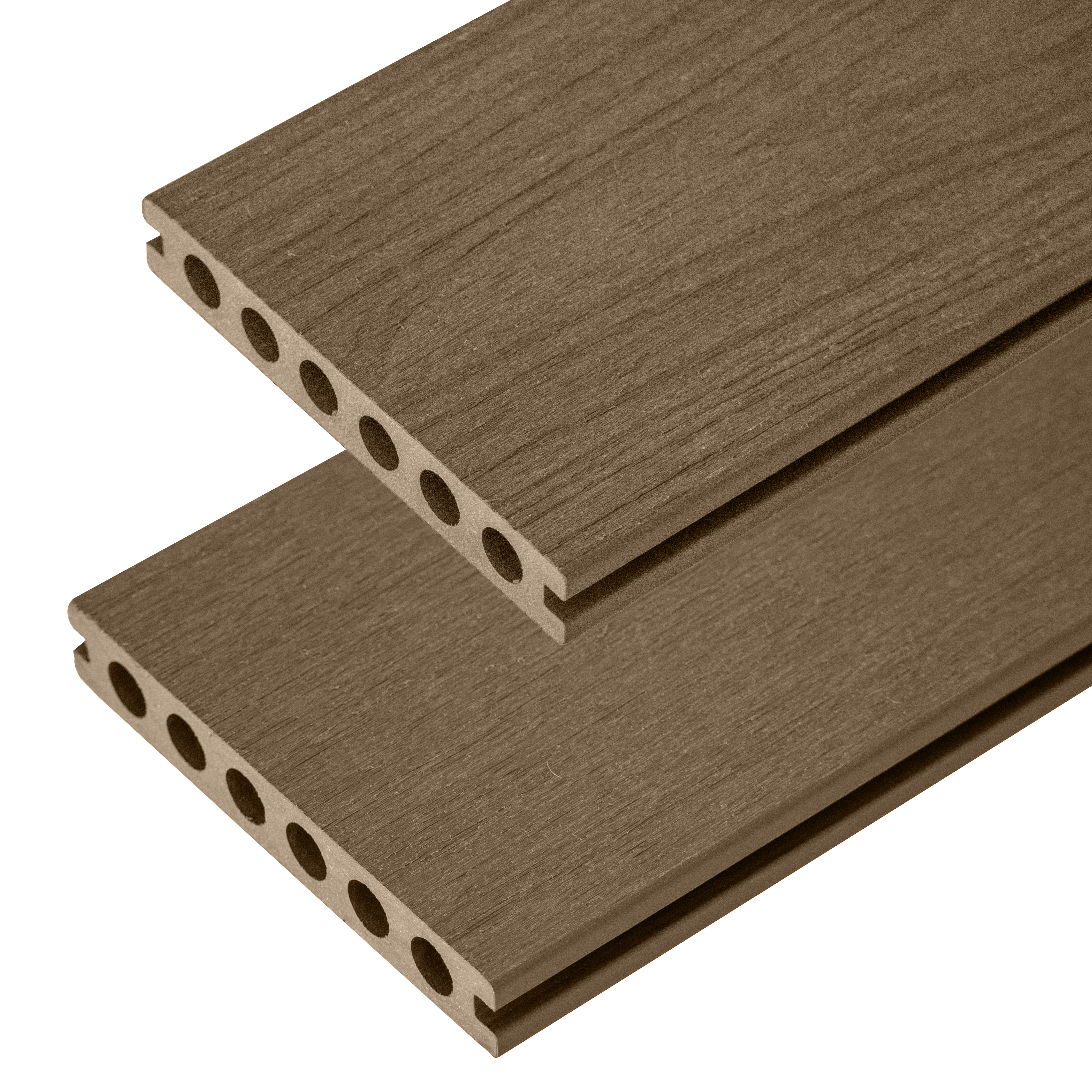
Cover: GH001 co-extruded outdoor decking — one of four WPC models listed in EPD S-P-12197.
Four wood-plastic composite (WPC) products from Terratsa New Material (Liaoning) Co., Ltd. — GH001 co-extruded outdoor decking, D053 outdoor hollow WPC decking, GH010 exterior wall cladding and GH024 outdoor WPC cladding — sit under one Environmental Product Declaration (EPD) issued by EPD International AB under registration number S-P-12197. The declaration is valid until 2029-03-15, conforms to EN15804+A2 and ISO 14025 / ISO 21930, and is recognised in the China and Netherlands markets. For a buyer at research and evaluation stage, that resolves the environmental documentation question before the technical comparison starts.
Terratsa New Material (Liaoning) Co., Ltd. is a WPC manufacturer founded in 2007 that relocated its production base from Jilin to the Yingkou Area of the China (Liaoning) Pilot Free Trade Zone in 2024. It operates a 74,000 m² facility with more than 70 fully automatic production lines and a 25-engineer R&D team, exports to more than 40 countries, and holds an independent overseas warehouse in the Netherlands — a detail that matters when a declaration is recognised in the Dutch market.
Why certification paperwork now sets the WPC shortlist
Specifiers receive two different questions at the same time. The first is documentary: does this product carry third-party verified environmental data, and against which standard? The second is technical: does the published performance data support the intended application? An EPD answers only the first. Performance questions — flexural behaviour, water absorption, UV colour stability, slip resistance — are answered by product data and test reports. Treating the two as interchangeable produces shortlists that cannot survive a tender review.
The environmental side has moved quickly in the construction sector. EN 15804+A2 is the core product category framework used for construction product declarations, and declarations published through programme operators such as EPD International AB are held in searchable public libraries, which means a buyer can verify a registration number without contacting the supplier. On the performance side, ASTM D7032 is the specification used to establish performance ratings for wood-plastic composite deck boards, stair treads, guards and handrails. A supplier able to provide both document types shortens the qualification period for any commercial or public project.
What EPD S-P-12197 actually covers
| Declaration attribute | Published detail |
|---|---|
| Programme operator | EPD International AB |
| Registration number | S-P-12197 |
| Issue date | 2024-03-15 |
| Valid until | 2029-03-15 |
| Framework standards | EN15804+A2 & ISO 14025 / ISO 21930 |
| Stated product scope | Co-extrusion WPC products |
| Models listed | GH001 co-extruded outdoor decking, D053 outdoor hollow WPC decking, GH010 exterior wall cladding, GH024 outdoor WPC cladding |
| Market recognition stated | China and the Netherlands |
An EPD is an environmental declaration based on lifecycle assessment methodology. It is not a strength rating, a warranty, or a substitute for a load table. Buyers who need span and load data should request it separately from the technical file.
The four EPD-listed products at a glance
| Model | Type | Generation | Documented parameters | Typical fit |
|---|---|---|---|---|
| GH001 | Co-extruded outdoor decking | Second generation, capped co-extrusion | Flexural properties ≥ 3300 N; moisture resistance under cyclic test conditions mean ≤ 10%; water absorption (boiling test) ≤ 7%; IP55 protection level; service range −40 °C to +75 °C; outer shell with UV-resistant components such as ASA | Wet and high-traffic zones, swimming pool surrounds, garden terraces, waterfront boardwalks |
| D053 | Outdoor hollow WPC decking | First generation, hollow profile | 23 mm × 146 mm × 2900 mm; bending failure 3900 N; density 1.3 g/cm³; water absorption (5-hour boil) ≤ 2%; linear thermal expansion coefficient ≤ 37·10⁻⁶ K⁻¹ | Large-area public realm: parks, plazas, boardwalks, community pathways |
| GH010 | Exterior wall cladding | Extruded cladding profile | 22 mm × 136 mm × 2900 mm; flexural properties ≤ 0.79 mm; swelling and water absorption (28-day immersion) ≤ 2%; linear thermal expansion coefficient ≤ 37·10⁻⁶ K⁻¹ | Exterior facades, balcony privacy screens, garden feature walls |
| GH024 | Outdoor WPC cladding | Extruded fluted cladding profile | Flexural properties ≤ 0.9 mm; moisture resistance under cyclic test ≤ 0.9 mm; swelling and water absorption (28-day immersion) ≤ 4%; boiling test ≤ 3%; linear thermal expansion coefficient ≤ 37·10⁻⁶ K⁻¹ | Fluted 3D cladding for exterior walls and feature surfaces |
Figures are reproduced as published in the supplied product data. Where a test method, specimen condition or unit is not stated next to a value, request the underlying test report before writing that number into a specification.
GH001 — co-extruded outdoor decking
GH001 is built around a second-generation co-extruded polymer cap layer that fully encapsulates the core, so the protective shell covers all exposed faces rather than the wearing surface alone. The shell is formulated with UV-resistant components such as ASA, and the board is documented to withstand service temperatures from −40 °C to +75 °C without cracking, warping or splitting, with an IP55 protection level and flexural properties of ≥ 3300 N. It is designed to be cut, sawed and fastened with standard woodworking tools and installed with hidden clip systems, and it is available in standard colours and custom finishes.
D053 — outdoor hollow WPC decking
D053 is a first-generation hollow-profile decking board made from wood powder and plastic, measuring 23 mm × 146 mm × 2900 mm, with a published density of 1.3 g/cm³ and a bending failure value of 3900 N. Water absorption after a five-hour boil is documented at ≤ 2%. The board carries a grooved or textured anti-slip surface, retains the visual texture of natural timber, and is positioned for high-volume installations where material cost and basic durability drive the decision — public parks, scenic areas, plazas, boardwalks and community pathways.
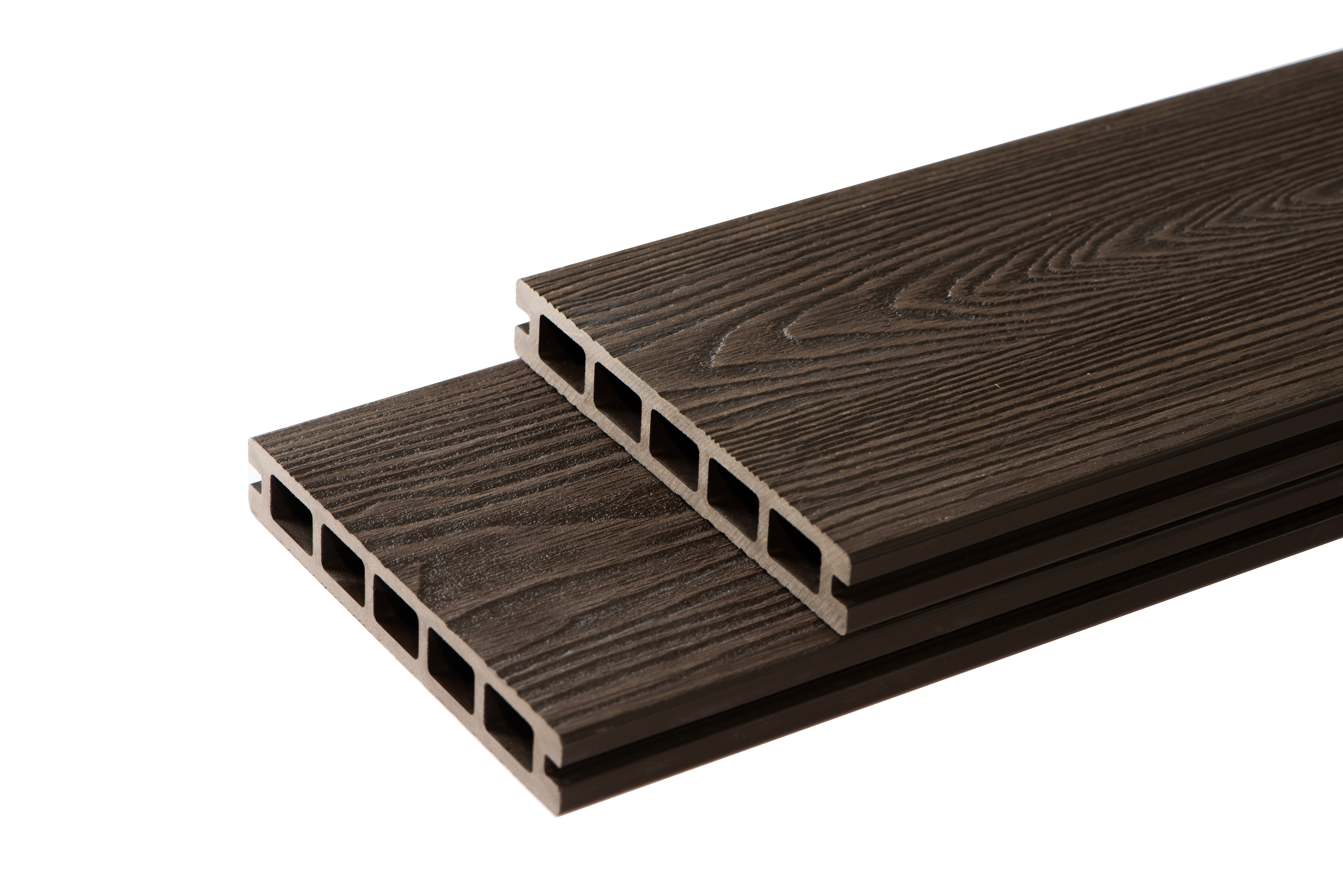
D053 outdoor hollow WPC decking (146 × 23 mm), the cost-oriented first-generation option in the EPD-listed shortlist.
GH010 and GH024 — exterior cladding
GH010 is a 22 mm × 136 mm × 2900 mm exterior wall cladding profile with published flexural properties of ≤ 0.79 mm and swelling and water absorption of ≤ 2% after 28 days' immersion. It has a solid, non-porous structure that prevents water absorption, 3D wood grain embossing, and is documented as resistant to termites, wood-boring insects, mould and mildew. GH024 is an outdoor WPC cladding with a fluted 3D profile, documented at ≤ 4% swelling and water absorption after 28 days' immersion and ≤ 3% in boiling test conditions; it is designed for exterior walls, feature surfaces, garden feature walls and outdoor kitchen surrounds. Both cladding models share a documented linear thermal expansion coefficient of ≤ 37·10⁻⁶ K⁻¹, which is the number to use when sizing expansion joints and rail clearances.
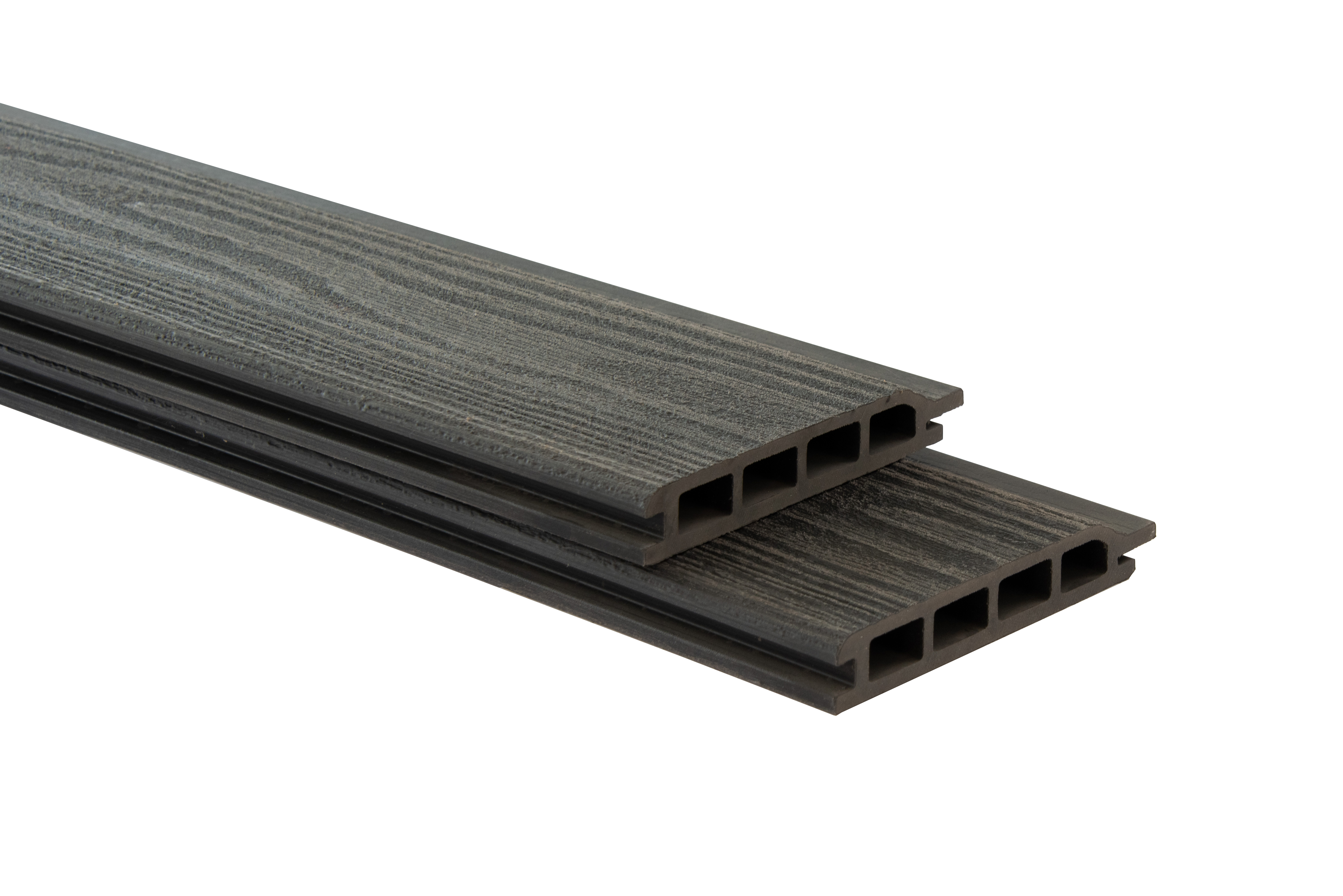
GH010 exterior wall cladding (136 × 22 mm), one of two EPD-listed cladding profiles alongside GH024.
Supporting credentials: management systems and chain of custody
| Certificate | Number | Issuer | Standard | Validity | Stated scope |
|---|---|---|---|---|---|
| ISO 9001 Quality Management System | 03825Q01470R0M | World Standards For Certification Center Inc. | GB/T 19001-2016 / ISO 9001:2015 | Issued 2025-03-03, valid to 2028-03-02 | Production of WPC flooring |
| ISO 14001 Environmental Management System | 03825E01471R0M | World Standards For Certification Center Inc. | GB/T 24001-2016 / ISO 14001:2015 | Issued 2025-03-03, valid to 2028-03-02 | Environmental management activities in WPC flooring production |
| ISO 45001 Occupational Health and Safety Management System | 03825S01472R0M | World Standards For Certification Center Inc. | GB/T 45001-2020 / ISO 45001:2018 | Issued 2025-03-03, valid to 2028-03-02 | Occupational health and safety activities in WPC flooring production |
| FSC Chain of Custody Certification | 0218718 | SAI Global Certification Services Pty. Ltd. | FSC-STD-40-004 V3-1; FSC-STD-50-001 V2-1 | Issued 2025-07-10, valid to 2030-07-07 | Tracking of wood-based material; wood-plastic composites W9.11; claims FSC 100% and FSC Mix; global |
These certificates serve different purposes and should be read literally. The ISO 9001 and FSC scopes refer to WPC flooring production and to wood-based material tracking respectively, so the practical check is whether the specific model code a buyer intends to order appears in the certificate annex for the project. The FSC claim type also matters: FSC 100% and FSC Mix are separate claims covering separate material flows. Separate from the certification file, the manufacturer's wider product portfolio is documented with CE, FSC, ASTM, SGS and EPD approvals, and the company states participation in the drafting of nearly 10 national and industrial standards, alongside more than 30 national independent intellectual property patents.
First-generation or second-generation decking: a workable decision rule
The meaningful difference between the two decking models in this shortlist is the surface system. A first-generation board such as D053 is a homogeneous extruded profile with a hollow core and colour running through the material. A second-generation board such as GH001 adds a co-extruded polymer cap that seals the core on all faces, which changes what the board does well: the capped board performs differently in permanent wet zones, in strong UV exposure, and under abrasion from foot traffic.
- Choose first generation (D053) when the project is large-area, cost-sensitive and moderately trafficked — parks, plazas, community pathways, boardwalks — and when a grooved anti-slip surface plus waterproof, rot-proof behaviour covers the requirement.
- Choose second generation (GH001) when the installation is permanently wet, high-traffic or highly exposed: swimming pool surrounds, spa areas, garden terraces, waterfront walkways or any location where colour stability and surface hardness under UV are specification items.
- Mix rather than default. Nothing prevents a project from specifying D053 for primary circulation areas and GH001 for wet-zone or feature areas, provided the same fixing system and expansion detailing logic is applied consistently.
A caution on comparing published numbers: GH001 is documented at ≤ 7% water absorption under boiling test and mean ≤ 10% under cyclic moisture testing, while D053 is documented at ≤ 2% after a five-hour boil. Different test durations and specimen conditions sit behind those figures, so request both test reports and compare method to method rather than headline to headline.
Application fit: parks, northern terraces, pools and facades
Two documented use scenarios illustrate how the models are applied. In a high-humidity park decking scenario in China, D053 and GH001 are installed as outdoor paving and decoration with joist clips and screws, against requirements for weather resistance, anti-slip behaviour, UV resistance and scratch resistance. In a European decking scenario in Poland, where low winter temperatures combine with high humidity, GH001 is specified against requirements for weather resistance, UV resistance, no maintenance, low water absorption, anti-slip and anti-scratch performance.
Cladding follows a different logic. GH010 and GH024 are exterior wall products rather than decking boards, so the governing criteria are wind-driven rain exposure, facade ventilation, substructure compatibility and colour stability on a vertical surface, which is typically less abrasion-exposed than a floor but far more exposed to UV-driven fading. Both profiles are documented as compatible with matching trims and hidden fastener systems, and both can be installed horizontally or vertically according to the manufacturer's guidance.
On installed evidence, a park decking project in China supplied 500 tonnes to a project contractor, with a reported service record of 15 years and a highlight of no fading and no bending. That kind of reference is more useful than a general durability claim, because it ties a product model to a project type, a quantity and an application.
Where WPC stops short: boundaries to plan around
- Market recognition of the EPD is stated for China and the Netherlands. A project in another region should confirm with its green-building assessor or client whether this declaration is accepted, or whether additional national documentation is required.
- An EPD is not a performance certificate. Load, span, fixing and slip performance must be validated from product data and test reports for the specific model and profile.
- Thermal movement must be designed for. The documented linear thermal expansion coefficient of ≤ 37·10⁻⁶ K⁻¹ on D053, GH010 and GH024 is the basis for expansion gaps, end clearances and rail detailing; omitting them is a site-level failure, not a product failure.
- Substructure discipline is mandatory. Joist spacing, clip type, drainage slope and ventilation behind cladding are installation-critical, and the same board performs differently on a compliant versus a non-compliant frame.
- Cost positioning differs by generation. First-generation hollow boards are positioned for lower upfront material cost on large areas; capped co-extruded boards carry a higher initial cost that is justified by wet-zone performance, colour stability and reduced surface maintenance.
WPC versus traditional timber, stone and metal cladding
| Criterion | Documented WPC behaviour | Conventional alternative | What it means for the specification |
|---|---|---|---|
| Routine maintenance | No painting, staining, sealing or varnishing; cleaning with soap and water | Timber facades and decks typically need periodic re-finishing | Lower recurring labour cost; fewer access requirements over the service life |
| Water behaviour | Solid, non-porous structure that prevents water absorption (GH010); waterproof and rot-proof (D053) | Untreated timber swells, checks and rots in wet service | Suitable for humid and intermittently submerged-edge conditions with correct detailing |
| Biological attack | Resistant to termites, wood-boring insects, mould and mildew | Timber may require preservative treatment | Removes chemical treatment cycles from the maintenance plan |
| Material origin | Blends of recycled plastics and reclaimed wood fibres; fully recyclable; FSC chain-of-custody tracked material on covered models | Solid timber, quarried stone, coated metal | Supports recycled-content and responsible-sourcing criteria in tenders |
| Documentation depth | Model-level EPD plus ISO 9001, ISO 14001, ISO 45001 and FSC chain of custody | Varies widely by supplier and product | Verifiable file available at tender stage rather than after award |
The honest boundary is this: WPC is a finishing and surfacing material, not a structural one. It replaces timber cladding and decking boards well where waterproofing, low maintenance and dimensional stability matter; it does not replace structural framing, and it will not compensate for poor drainage, missing expansion joints or a substructure that was never built to the board's fixing specification.
Purchasing terms and acceptance criteria to confirm before ordering
| Commercial term | Documented position |
|---|---|
| Minimum order quantity | 1 container |
| Lead time | 30–45 days |
| Production mode | OEM / ODM, including logo customisation |
| Quality control | 100% testing |
| Monthly capacity | 10,000 tons |
| After-sales | Remote support |
Acceptance criteria are where shortlist decisions either hold or unravel. The checks below can be run against the same shipment without specialist equipment:
- Confirm that the delivered model code, profile dimensions and colour match the purchase order and the approved sample, and that packing labels reference the correct batch.
- Request moisture and water-absorption test records for the production batch, and reconcile them with the published values for that model.
- Verify certificate numbers directly against the issuing body or public library — S-P-12197 for the EPD, 03825Q01470R0M, 03825E01471R0M and 03825S01472R0M for the ISO certificates, and 0218718 for the FSC chain of custody — rather than accepting scanned copies.
- Check the certificate annexes to confirm the specific model being supplied is listed, and that the FSC claim type stated on the delivery documents matches the claim actually granted.
- Confirm that clips, joists, screws and trims supplied or specified are the same system referenced in the installation instructions, and that expansion gaps are calculated from the documented thermal expansion coefficient.
- Agree handling and storage expectations on site before delivery, and confirm the remote after-sales support route for installation queries.
Market signals behind the shift to documented composite products
The global wood plastic composite market was valued at USD 8.05 billion in 2025 and is projected to reach USD 11.26 billion by 2034, according to Straits Research. The same source places North America at 36.4% of global WPC market share in 2025, which is consistent with the region's role in shaping decking performance specifications such as ASTM D7032. Trade monitoring data published by Zauba for HS Code 39189090 recorded China as the largest exporter of WPC decking, accounting for 97.81% of imports in that monitored dataset — a figure that reflects one trade dataset and is best treated as directional evidence of supply concentration rather than a definitive share.
What ties these signals together for a buyer is documentation. As declarations become searchable and comparable, the practical advantage shifts from "who can supply the volume" to "who can evidence the product". A manufacturer with a model-level EPD, three management-system certificates, a chain-of-custody certificate and a distribution presence in one of the EPD-recognised markets is easier to qualify than one that answers these questions with marketing material.
What to expect next
Three developments are worth tracking. First, declarations are moving from company level to model level, which means buyers will increasingly shortlist individual profile codes rather than supplier names. Second, verification is moving into public registries, so the certificate numbers on a submittal can be checked in minutes — expect tender documents to name them. Third, the first-generation and second-generation split will remain commercially relevant for several years: cost-driven public realm projects will keep specifying hollow first-generation boards, while wet-zone, pool and premium facade work will keep moving toward capped co-extruded profiles.
For the four models covered here, the practical next step is unchanged: match the profile to the exposure, confirm the certificate annex lists the model, and price the project on lifecycle maintenance rather than the material line alone.
FAQ: EPD-certified WPC decking and cladding
What does EPD registration number S-P-12197 cover?
S-P-12197 is an Environmental Product Declaration issued by EPD International AB for co-extrusion WPC products from Terratsa New Material (Liaoning) Co., Ltd. It conforms to EN15804+A2 and ISO 14025 / ISO 21930, was issued on 2024-03-15 and is valid until 2029-03-15. The listed models are GH001 co-extruded outdoor decking, D053 outdoor hollow WPC decking, GH010 exterior wall cladding and GH024 outdoor WPC cladding.
Does an EPD prove product strength, slip resistance or durability?
No. An EPD is an environmental declaration based on lifecycle assessment methodology; it does not certify mechanical performance. Structural and surface performance must be read from product data and test reports — for example, GH001 is documented with flexural properties of ≥ 3300 N, and D053 with a bending failure value of 3900 N and a density of 1.3 g/cm³.
Which markets recognise this EPD?
The declaration states recognition in the China and Netherlands markets. Buyers specifying in other regions should confirm with their project's certification or green-building assessor whether this declaration is accepted, or whether additional national documentation is required. The manufacturer maintains an independent overseas warehouse in the Netherlands, which is relevant to projects in that market.
How do the first-generation and second-generation decking options differ?
D053 is a first-generation outdoor hollow WPC decking board measuring 23 mm × 146 mm × 2900 mm, with a documented density of 1.3 g/cm³, bending failure of 3900 N and water absorption after a five-hour boil of ≤ 2%; it is positioned for cost-efficient, large-area installations. GH001 is a second-generation co-extruded board whose polymer cap layer fully encapsulates the core; it is documented for service temperatures from −40 °C to +75 °C with an IP55 protection level, and is positioned for wet, high-traffic and high-UV areas such as swimming pool surrounds.
What commercial terms apply to these products?
Documented terms are a minimum order quantity of one container, lead times of 30 to 45 days, OEM/ODM support including logo customisation, 100% testing in quality control, a monthly capacity of 10,000 tons, and remote after-sales support.
Which supporting certificates accompany the four EPD-listed models?
ISO 9001 (certificate 03825Q01470R0M), ISO 14001 (03825E01471R0M) and ISO 45001 (03825S01472R0M), all issued by World Standards For Certification Center Inc. on 2025-03-03 and valid to 2028-03-02; and FSC Chain of Custody certificate 0218718, issued by SAI Global Certification Services Pty. Ltd. on 2025-07-10 and valid to 2030-07-07, covering wood-based material tracking for wood-plastic composites W9.11 with FSC 100% and FSC Mix claims under FSC-STD-40-004 V3-1 and FSC-STD-50-001 V2-1.
What should a buyer check when the shipment arrives?
Check that the delivered model codes, profile dimensions, colour and batch labels match the purchase order and approved sample; request the batch test records for moisture and water absorption; verify certificate numbers directly with the issuing body or public registry rather than relying on scanned copies; confirm the certificate annex lists the specific model supplied; and confirm that clips, joists, trims and expansion gaps follow the documented installation guidance. The published linear thermal expansion coefficient of ≤ 37·10⁻⁶ K⁻¹ on D053, GH010 and GH024 is the figure used to size those gaps.
Product ranges, profile drawings and published specifications are collected in the Terratsa decking brochure, available for download: https://cdn.socialarks.com/sbsp/25170/common/2026/0819/Terratsa%20Brochure-decking.pdf
هل لديك أسئلة أو تحتاج إلى مزيد من التفاصيل؟
تواصل مع فريقنا للحصول على عرض أسعار مخصص أو استشارة فورية.
طلب عرض أسعار
املأ النموذج أدناه وسيتواصل معك فريقنا بعرض مقترح مخصص.
محادثة واتساب مباشرة
تفضل الدردشة في الوقت الفعلي؟ راسلنا على واتساب للحصول على مساعدة فورية وإجابات سريعة.
- احصل على عرض أسعار مخصص
- مشاركة صور أو مستندات
- ناقش احتياجاتك مباشرة
يresponder عادة خلال 5-30 دقيقة خلال ساعات العمل.