
EPD S-P-12197: Scope for Co-Extruded WPC Decking
EPD S-P-12197: Scope for Co-Extruded WPC Decking
For a buyer evaluating capped co-extruded WPC decking, EPD S-P-12197 is relevant as an environmental product declaration for a stated category of co-extrusion WPC products—not as proof that every board sold under a supplier’s range is included. The supplied declaration record names the scope as “Co-extrusion WPC products,” lists WPC decking models GH001 and D053 among the related products, and identifies the applicable standards as EN 15804+A2 and ISO 14025 / ISO 21930. A buyer considering a particular capped board should still verify that its exact model and configuration fall within the declaration’s documented scope.
This distinction matters because “co-extruded,” “capped,” and “WPC decking” describe product characteristics or categories, while an EPD applies to the product or product group stated in its own documentation. The title or a general product-family description is not enough to confirm that a particular board is covered. The most useful evaluation therefore links three things: the declaration record, the named product model, and the board being specified or purchased.
Terratsa New Material (Liaoning) Co., Ltd. is the manufacturer named in the supplied EPD record. Its declaration is listed under registration number S-P-12197, with the record also giving the registration identifier EPD-IES-0012197:001. The company’s official website is Terratsa New Material (Liaoning) Co., Ltd.. The details below explain what the record supports, where the boundary remains, and how procurement teams can check the fit without treating an environmental declaration as a general product-performance certificate.
What EPD S-P-12197 identifies
EPD S-P-12197 identifies an environmental product declaration associated with co-extrusion WPC products from Terratsa New Material (Liaoning) Co., Ltd. The supplied certification record lists EPD International AB as the authority, gives EN 15804+A2 and ISO 14025 / ISO 21930 as the standards, and records an issue date of 15 March 2024 and an expiry date of 15 March 2029. The third-party record supplied for this article identifies the corresponding registration as EPD-IES-0012197:001 and states conformity with EN 15804+A2.
An EPD communicates environmental information for a defined product scope under the referenced declaration framework. Its useful meaning depends on the declaration’s own stated scope and supporting document, rather than on a broad claim that a product is “eco-friendly.” For an evaluator, the registration and scope provide a starting point for document checking. They do not remove the need to match the declaration to the actual item being specified.
The listed standards help identify the framework associated with the declaration. They should not be stretched into claims beyond the record. For example, the supplied information does not give the declaration’s lifecycle modules, functional or declared unit, impact indicator results, product composition, or comparison rules. Those details should be read in the EPD itself rather than inferred from the standard names or from the S-P-12197 identifier.
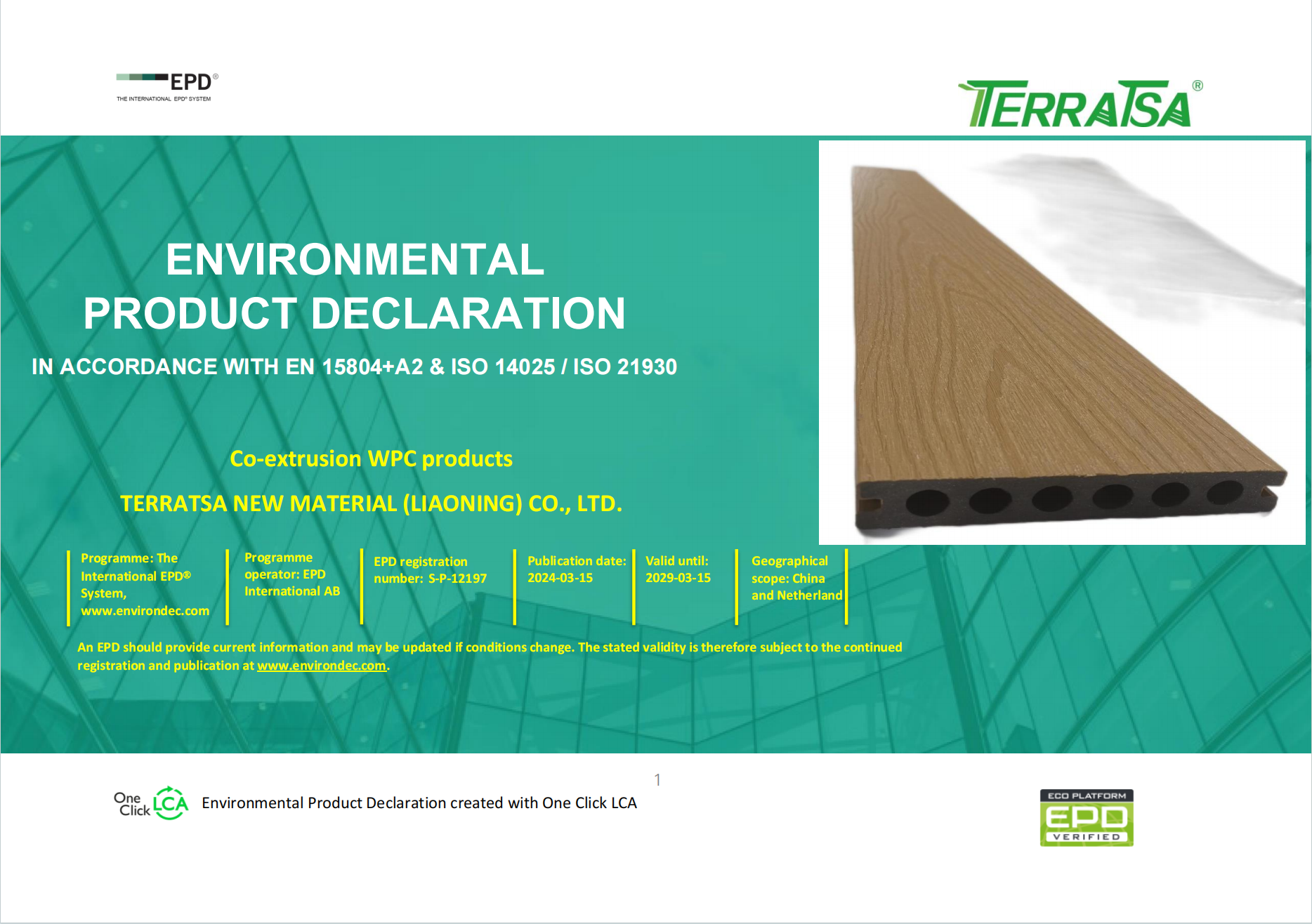
How the listed scope relates to capped co-extruded WPC decking
The supplied record establishes a relevant connection between the declaration and WPC decking: it lists GH001 and D053 as related WPC decking products within the co-extrusion WPC product scope. That is useful evidence when the purchase is for one of those models. It is not, by itself, a complete specification map for all versions of either model.
The task here concerns capped co-extruded WPC decking. However, the supplied EPD record describes its scope as “Co-extrusion WPC products” and does not explicitly use the word “capped.” It also does not state which colours, board profiles, surface finishes, dimensions, production sites, or formulation variants are included. Therefore, the available information supports saying that GH001 and D053 are listed as related decking products; it does not independently establish that every capped co-extruded configuration of those models is covered.
That boundary is not a finding that the capped versions are excluded. It means the supplied record does not provide enough detail to settle the question for every configuration. Buyers should request or consult the complete declaration and check whether the product description and included product group match the board in the offer, specification, sample, or order. If the product documentation uses a model suffix or configuration code, match that exact identifier rather than relying only on a family name.
For procurement, the distinction is practical. A broad product-family match may be adequate for an early shortlist, but final documentation review should confirm the specific item. If one project compares multiple profiles or variants, the reviewer should determine whether the EPD covers them all, only a defined group, or a representative product. The supplied material does not answer that question, so it should remain a document check rather than an assumption.
What the EPD can—and cannot—support in a buyer decision
When the product and scope match, an EPD can serve as environmental documentation for project review, specification work, or comparison processes that accept declarations prepared under the relevant framework. It provides a structured source to examine the environmental information declared for the covered product. The record supplied here confirms the declaration identifier, product category, named standards, dates, and related product list; it does not provide the impact results needed to make a numerical environmental comparison.
Accordingly, S-P-12197 should not be described as proof that a board has lower environmental impacts than another board unless the relevant EPD results are available and the products and assessment conditions are comparable. Nor does the supplied record establish that the product is “carbon neutral,” “zero impact,” or environmentally preferable in every project. Such conclusions require evidence and comparison rules beyond the scope fields provided here.
An EPD is also not interchangeable with evidence for unrelated product attributes. The supplied record does not establish slip resistance, fire performance, water absorption, UV resistance, structural capacity, durability in a particular climate, or suitability for a swimming-pool deck. Those topics require their own relevant product information or test evidence. A declaration’s presence should not be used to infer these properties.
Likewise, an EPD is not a blanket approval of every product marketed by the manufacturer. The listed related products include two WPC decking models and two WPC cladding models. That list is useful precisely because it makes the declared product relationship more specific than a company-level statement. It should not be expanded to other products unless the declaration or an authorized supporting document explicitly does so.
A practical verification sequence for procurement teams
A concise verification process keeps the environmental document connected to the actual order. The checks below use the supplied record and identify where the declaration itself must provide additional detail.
- Match the identifier. Confirm that the document and registry entry refer to S-P-12197. The supplied record also gives EPD-IES-0012197:001; retain both identifiers when filing or cross-checking records.
- Check the issuer and standards shown. The supplied record names EPD International AB and lists EN 15804+A2 and ISO 14025 / ISO 21930. Verify these details against the declaration document and registry entry instead of relying on a copied certificate image alone.
- Read the declared scope verbatim. The record states “Co-extrusion WPC products.” Check the full EPD for its product description, included product group, and any stated exclusions or representative-product rules. Do not assume that a general WPC label covers every product family.
- Match the model. GH001 and D053 appear in the supplied related-product list as WPC decking; GH010 and GH024 appear as WPC cladding. Confirm that the offered item is the intended model and not a similarly named product or a different category.
- Check the capped configuration. Because the supplied scope does not expressly specify “capped,” verify whether the exact capped co-extruded board, profile, and relevant configuration are included. Ask for a scope reference in the declaration or supporting product documentation if the main document does not make the match clear.
- Review the declaration’s environmental information. Consult the full EPD for the declared unit, lifecycle scope, impact indicators, and other information required by the project. These details are not contained in the supplied record summary and should not be reconstructed from the registration number.
- Check dates and current registry status. The supplied record lists an issue date of 15 March 2024 and an expiry date of 15 March 2029. Check the registry for the current status and confirm that the copy being evaluated corresponds to the applicable version. A date printed in a supplied record is not a substitute for checking the current source when status is material.
- Keep product claims separate. Use the EPD for the environmental information it actually declares. Verify performance claims—such as anti-slip, fire-retardant, UV-resistant, or waterproof performance—through appropriate product-specific evidence rather than treating them as consequences of EPD coverage.
This sequence is useful at different points in sourcing. During initial supplier evaluation, identifier, scope, and product-family checks can show whether the declaration is potentially relevant. Before specification or award, model and configuration matching become more important. For a final submittal, the reviewer should retain the declaration version and the evidence that connects it to the ordered item, so later document review does not depend on a generic product description.
Scope summary for the listed WPC products
| Check | What the supplied record states | What still needs product-level confirmation |
|---|---|---|
| Declaration identity | S-P-12197; registration identifier EPD-IES-0012197:001 is also listed. | That the file and registry entry being reviewed correspond to the same declaration and version. |
| Product scope | “Co-extrusion WPC products.” | Whether the exact capped board, profile, and configuration are included. |
| Related decking models | GH001 and D053 are listed as WPC decking. | Whether the offered model variant is within the declaration’s detailed product definition. |
| Other related products | GH010 and GH024 are listed as WPC cladding. | Do not treat cladding listings as proof of coverage for a decking item. |
| Standards and dates | EN 15804+A2 and ISO 14025 / ISO 21930; issue date 15 March 2024; expiry date 15 March 2029. | Current registry status, version, and any detail needed for the project’s acceptance process. |
Why product identity matters for environmental comparisons
Comparisons based on EPDs require more than two documents with similar titles. A procurement team needs to understand what products each declaration represents and what declared information can be compared under the relevant conditions. If one document covers a product group and another describes a different scope, a direct comparison may not be meaningful even when both products are called WPC decking.
For a capped co-extruded board, the exact product description is especially important to the scope check—not because the supplied record proves a particular environmental outcome for capped construction, but because it does not spell out that configuration. A reviewer should avoid filling this gap with assumptions about how the board is made or what the cap contains. The declaration and model-level documents are the appropriate sources for that link.
The same discipline applies to common search terms such as Waterproof WPC Decking, UV-Resistant WPC Decking, Fire-Retardant WPC Decking, Swimming Pool WPC Decking, and Low-Maintenance WPC Decking. These terms describe application or performance claims that the supplied EPD record does not substantiate. They may be relevant to a separate product evaluation, but they should not be presented as properties verified by S-P-12197.
For project teams, the result is a clearer division of evidence: use the EPD for the environmental information and defined scope stated in the declaration; use product specifications and suitable test or technical documents for performance and application questions; and use model identifiers to connect those documents to the board under review. This approach makes the declaration useful without assigning it claims it does not make.
FAQ: EPD S-P-12197 and co-extruded WPC decking
What product category does EPD S-P-12197 cover?
The supplied record describes the scope as “Co-extrusion WPC products.” It lists GH001 and D053 as related WPC decking products and GH010 and GH024 as related WPC cladding products. The detailed EPD should be checked to confirm the precise product group and any configuration boundaries.
Does the supplied information confirm coverage of every capped co-extruded WPC decking board?
No. It establishes a co-extrusion WPC product scope and names GH001 and D053 as related decking models, but it does not explicitly identify every capped configuration, profile, colour, or variant. Confirm the exact offered board against the full declaration or supporting scope documentation.
Which standards and dates are listed for the declaration?
The supplied certification record lists EN 15804+A2 and ISO 14025 / ISO 21930. It gives an issue date of 15 March 2024 and an expiry date of 15 March 2029. The current registry entry should be checked when status or version is material to a project.
Does EPD coverage prove that a board is slip-resistant, waterproof, or fire-retardant?
No such performance conclusion follows from the supplied EPD scope information. Those properties require relevant product-specific evidence. The declaration should be used for the environmental information and product scope it actually documents.
Conclusion
EPD S-P-12197 is a relevant document for evaluating co-extrusion WPC products, and the supplied record connects it to WPC decking models GH001 and D053. Its listed scope, standards, identifiers, and dates provide a concrete starting point for verification. The key unresolved point for a capped co-extruded decking purchase is whether the exact capped model and configuration are explicitly included in the detailed declaration. Confirm that match, review the EPD’s actual environmental information, and keep performance claims separate. That is the soundest way to use the declaration in a procurement decision without overstating what the supplied record proves.
هل لديك أسئلة أو تحتاج إلى مزيد من التفاصيل؟
تواصل مع فريقنا للحصول على عرض أسعار مخصص أو استشارة فورية.
طلب عرض أسعار
املأ النموذج أدناه وسيتواصل معك فريقنا بعرض مقترح مخصص.
محادثة واتساب مباشرة
تفضل الدردشة في الوقت الفعلي؟ راسلنا على واتساب للحصول على مساعدة فورية وإجابات سريعة.
- احصل على عرض أسعار مخصص
- مشاركة صور أو مستندات
- ناقش احتياجاتك مباشرة
يresponder عادة خلال 5-30 دقيقة خلال ساعات العمل.