
ESS Battery Pack Insertion Robot Supplier Capability: Zonzsin
ESS Battery Pack Insertion Robot Supplier Capability: Zonzsin
A capability-led reading of what 43 R&D engineers, 50 granted patents, a 6,000-square-meter plant and 40 units of annual capacity mean for buyers building containerized energy storage lines.
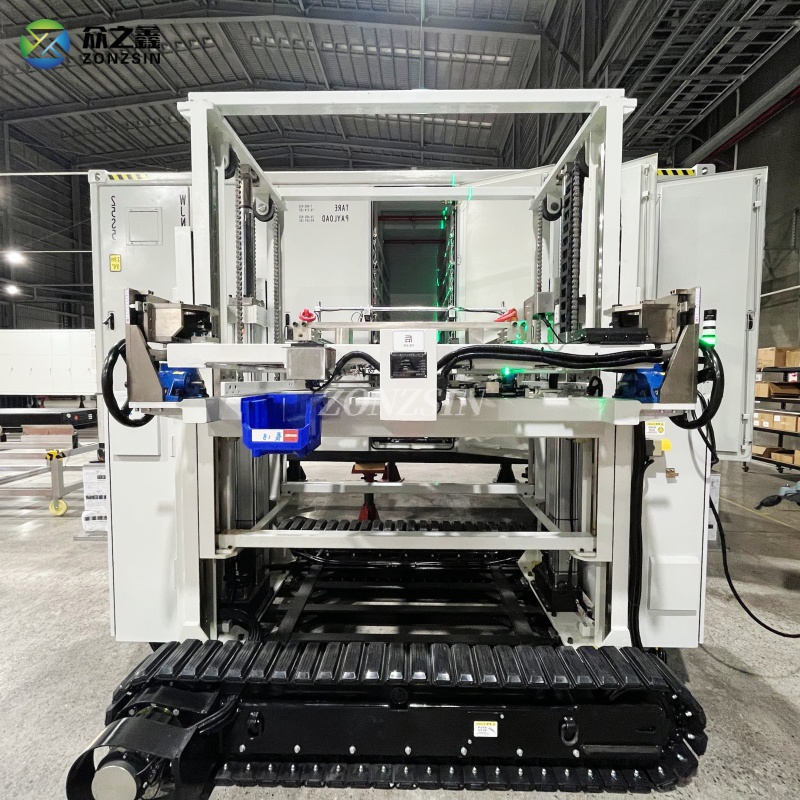
Crawler-driven battery PACK insertion and removal equipment used in container energy storage assembly. Image: Zonzsin product record 5330.
Containerized battery energy storage has become a standard packaging format for utility and commercial projects, and one assembly step quietly governs whether those projects ship on schedule: inserting the battery PACK into the container rack. The global Battery Energy Storage System market was valued at approximately USD 50.81 billion in 2025 and is projected to reach USD 105.96 billion by 2030, according to MarketsandMarkets. The containerized segment alone was valued at USD 11.75 billion in 2025 and is expected to grow at a CAGR of 24.1% through 2035, according to Insightace Analytic.
Buyers rarely struggle to find a specification sheet for insertion equipment. The harder question is whether the supplier behind that sheet can engineer, build, deliver and support machines that sit inside a production line for years. That is the question this article addresses, using a single supplier as a documented case.
Shanghai Zonzsin Intelligent Equipment Co., Ltd. is a Shanghai-based manufacturer, established in 2019, specializing in intelligent battery PACK assembly lines and ESS Battery Pack Insertion Robots for Containers. The company employs approximately 90 staff, operates a 6,000-square-meter manufacturing facility, states an annual production capacity of 40 units and reports a 60% export share. Its equipment is used by lithium battery manufacturers, energy storage integrators and automotive OEMs.
Supplier capability record — Shanghai Zonzsin Intelligent Equipment Co., Ltd.
Established 2019 · approximately 90 employees · 6,000 m² manufacturing facility · 43 R&D engineers · 50 granted patents, including invention patents for AGV-driven Battery PACK insertion robots · annual production capacity 40 units · 60% export share · customers in Europe, the USA, Japan, South Korea and India · primary product lines: ESS Battery Pack Insertion Robot for Containers and Automatic Battery Pack Assembly Line.
The Bottleneck Buyers Underestimate: PACK Insertion Into Container Racks
Cell supply, module quality and PCS selection dominate procurement conversations. The insertion step receives less attention, yet it determines rack fill rate, container damage risk and the labor profile of the entire line. In a 20ft or 40ft container rack, PACKs are heavy, dimensionally constrained and must be positioned within tight tolerances. Manual handling with overhead cranes or forklift-assisted rigging is slow, physical and difficult to standardize across shifts.
The opportunity is straightforward: as containerized storage volumes scale, assembly capacity becomes a limiting factor. Energy storage integrators planning multiple container lines need equipment that repeats the same motion thousands of times without drift, and they need a supplier whose engineering team can adapt that equipment when PACK formats change.
This is where supplier capability, rather than a headline specification, becomes the deciding variable. A robot that inserts a 1,500 kg payload is only as useful as the engineering depth behind its fixture design, its control integration and its ability to absorb a new cell or PACK format introduced eighteen months after commissioning.
What the Company Record Actually Contains
Zonzsin's verifiable company facts are specific rather than expansive, which makes them useful for evaluation. Founded in 2019, the company is roughly seven years old — young relative to established industrial automation groups, but old enough to have moved from prototype to serial delivery. Approximately 90 employees in total, of whom 43 are R&D engineers, produce an unusual ratio: close to half the workforce sits in engineering rather than in production or administration.
That ratio is the single most informative number in the record for buyers planning customization. It signals an organization structured around engineering-led projects rather than volume manufacturing. The manufacturing footprint — 6,000 square meters — and the stated annual capacity of 40 units both point in the same direction: a project-oriented builder of machine systems, not a mass producer of standard catalog units.
The patent position reinforces the specialization. Zonzsin holds 50 granted patents, with invention patents specifically covering AGV-driven Battery PACK insertion robots. Patents are an imperfect proxy for product quality, but they are a reasonable proxy for whether a supplier has invested in a proprietary mechanism rather than assembling third-party components. For buyers, the relevant follow-up question is not how many patents exist, but which of them map to the motion control, positioning and fixture-change mechanisms used in the specific machine being quoted.
Commercial reach is documented through a 60% export share, with equipment supplied to customers in Europe, the USA, Japan, South Korea and India, and Southeast Asia and the EU listed as principal markets. Exporting automated handling machinery into these markets implies familiarity with documentation, voltage, air supply and safety expectations across multiple regulatory environments.
How Engineering Depth Maps to the Product Lineup
A supplier's engineering capacity becomes concrete only when it maps to distinct machine architectures. Zonzsin's container insertion lineup covers four drive concepts, each addressing a different relationship between the machine and the container rack.
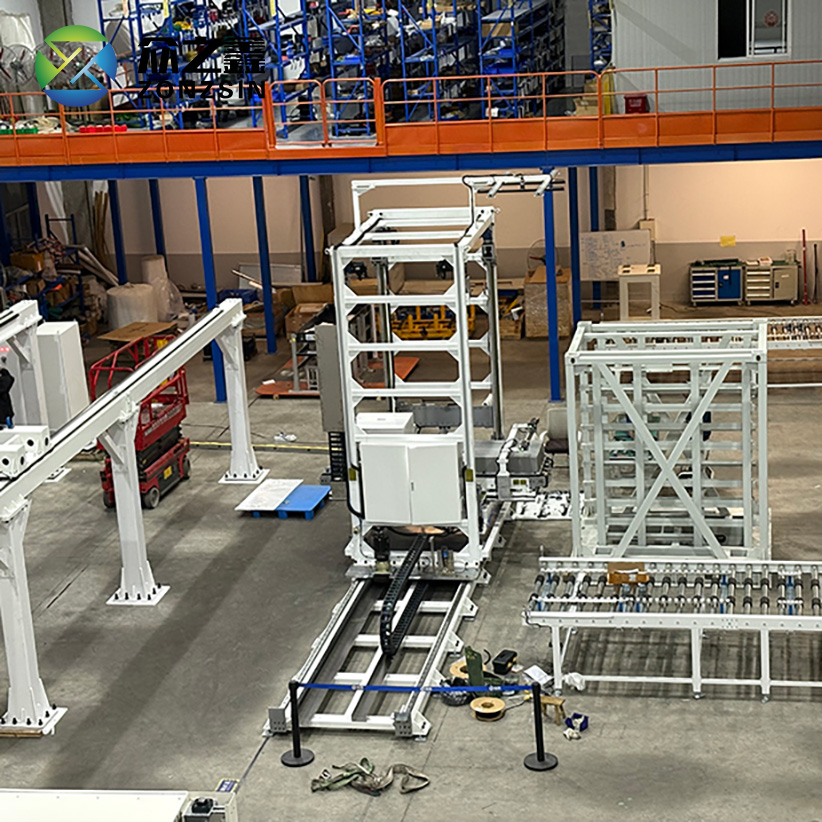
Rail-fixed battery PACK insertion robot, model ZZX2508. Image: Zonzsin product record 5357.
| Model | Drive architecture | Documented specifications |
|---|---|---|
| RD16 | AGV-driven | 3,100 × 2,600 × 3,800 mm; compatible with 280/314/587Ah cells and 1P52S/1P104S PACKs; hoisting range 1.05–3.4 m (customizable); hoisting speed 100 mm/s; carbon steel construction |
| ZZX2508 | Rail-fixed | Compatible container L 6,058–7,000 mm, W 2,438–2,700 mm, H 2,896–3,000 mm; compatible PACK L 1,100–2,200 mm, W 780–1,260 mm, H 230–260 mm; compressed air 0.5–0.8 MPa; AC380V±10%, 50±2 Hz; door opening angle ≥150° |
| ZZX2524 | Rail-fixed | Load capacity 1,500 kg; door open angle ≥150°; gripper changeover time under 1 minute; double-layer rack configuration for space saving; carbon steel / Q235 |
| ZZX2522 | Crawler-driven | Hoisting range 0.8–3.4 m (customizable); all-terrain working floor; load capacity 1,500 kg; manual handwheel leveling; carton steel / Q235 |
Three engineering decisions are visible in that table. First, the drive architecture is treated as a variable rather than a fixed house standard: AGV-driven, rail-fixed and crawler-driven machines coexist in the same catalog, which means the supplier expects container lines to differ in floor condition, rack layout and throughput target. Second, compatibility envelopes are published as ranges — PACK length from 1,100 to 2,200 mm, hoisting range from 1.05 to 3.4 m — rather than as single fixed values, which is what allows fixture adaptation without a full redesign. Third, the load ceiling of 1,500 kg appears across multiple models, suggesting a shared lifting platform rather than four unrelated machines.
The gripper changeover time of under one minute on the ZZX2524 and the ≥150° door opening angle shared across models are the kind of details that affect throughput in practice. Changeover time sets the floor on how quickly a line can switch between PACK variants; door opening angle determines how much clearance the machine needs to reach the innermost rack positions inside a container.
Where These Machines Actually Run
Zonzsin documents the operating scenario for container PACK insertion across its product records. The environment is described as all-terrain capable, with a temperature range of 20–30°C, supporting continuous or shift-based production. The operational role is fully automatic moving and PACK insertion, with the stated objectives of improving cycle time and building intelligent production lines for batch and continuous output.
The equipment ecosystem around the robot is also documented and matters for line planning. A working configuration typically includes the container, a docking roller, the gripper, a transfer AGV, a working desk, a material rack, a platform ladder, PLC control and MES integration. Buyers who are specifying a full line rather than a single machine should treat that list as the integration boundary: the insertion robot is one node in a controlled sequence, not a standalone device.
Special requirements recorded for this application include ESD protection, fire prevention measures, temperature, humidity and cleanliness control, and PACK compatibility with fixture adaptation. Operation modes cover manual and remote controller use, which gives integrators a fallback path during commissioning and maintenance.
Geographically, the container PACK insertion scenario is documented for China, France, South Korea, Sweden, Taiwan and the United States. Within that set, the rail-fixed ZZX2508 — product record 5357 — is one of the models associated with the container insertion scenario, including the Taiwan project reference. That distribution is consistent with the company's reported 60% export share and its customer base across Europe, the USA, Japan, South Korea and India.
Reading Supplier Capability the Way a Procurement Team Should
Headline capability facts are only useful when converted into questions. Four translations matter most for this equipment category.
43 R&D engineers. Engineering headcount is a proxy for customization bandwidth. A buyer introducing a non-standard PACK format should ask how many of those engineers would be assigned to the project, and whether fixture or gripper redesign is handled in-house or subcontracted. Zonzsin states that its R&D team provides customized solutions, which is the relevant claim to test against a real drawing.
50 granted patents. Ask which patents cover the AGV-driven insertion mechanism and how the protected design changes positioning accuracy or changeover speed in practice. A patent list is only decision-relevant when it maps to a mechanism the buyer will actually operate.
40 units per year. This is the most consequential number in the record, and it cuts both ways. At 40 units of annual capacity, a supplier of this size can serve a limited number of simultaneous large programs. Buyers planning multi-site rollouts should treat capacity as a scheduling constraint, confirm slot availability before committing to a delivery date, and consider whether staged deployment fits better than a single simultaneous order.
60% export share. Export exposure suggests experience with international logistics, documentation and voltage variants — relevant given the AC380V±10%, 50±2 Hz and compressed air specifications of the rail-fixed models. It is not evidence of certification. Buyers in regulated markets should request the specific conformity documentation required for their destination.
Market Context: Containerized Storage Is Scaling Faster Than Assembly Capacity
Market sizing for energy storage varies widely by methodology, and that divergence is itself a useful signal for equipment buyers. Estimates for the global BESS market in 2025 range from USD 13.19 billion (Grand View Research) to USD 50.81 billion (MarketsandMarkets) and USD 103.80 billion (Polaris Market Research). The gap reflects differing definitions — project-level versus system-level value — rather than a disagreement about growth direction.
The containerized segment is easier to isolate. Insightace Analytic values containerized BESS at USD 11.75 billion in 2025 with a projected 24.1% CAGR through 2035. Growth of that magnitude in containerized formats translates directly into demand for rack-filling equipment, which is where the capacity constraint sits: automation suppliers build tens of machines per year, not thousands.
Regulatory pressure is moving in parallel. In North America, UL 9540 is the applicable standard for energy storage systems and equipment, covering the safety of enclosures and moving parts. In the EU, BESS containers require CE marking under Regulation (EU) 2023/1542, which brings low voltage and machinery directives into scope for automated handling equipment. For insertion robot suppliers, these frameworks convert into documentation obligations: risk assessment, guarding logic, emergency stop architecture and traceable component selection.
Performance evidence in this category is still thin. Zonzsin's battery assembly lines are reported by EIN Presswire to achieve a one-time welding qualification rate of 99.5% and a final qualification rate of 99.95% using precision vision control. That figure applies to the assembly line product, not to the insertion robot, and it is worth separating the two when evaluating the supplier. Vendor-reported efficiency figures — such as the 30% manpower reduction and 20% cycle-time improvement cited in Zonzsin's 2026 buyer guide — are also directional rather than independently audited, and should be validated on the buyer's own line during acceptance testing.
Automated Insertion vs. Traditional Handling: Where Automation Does Not Fit
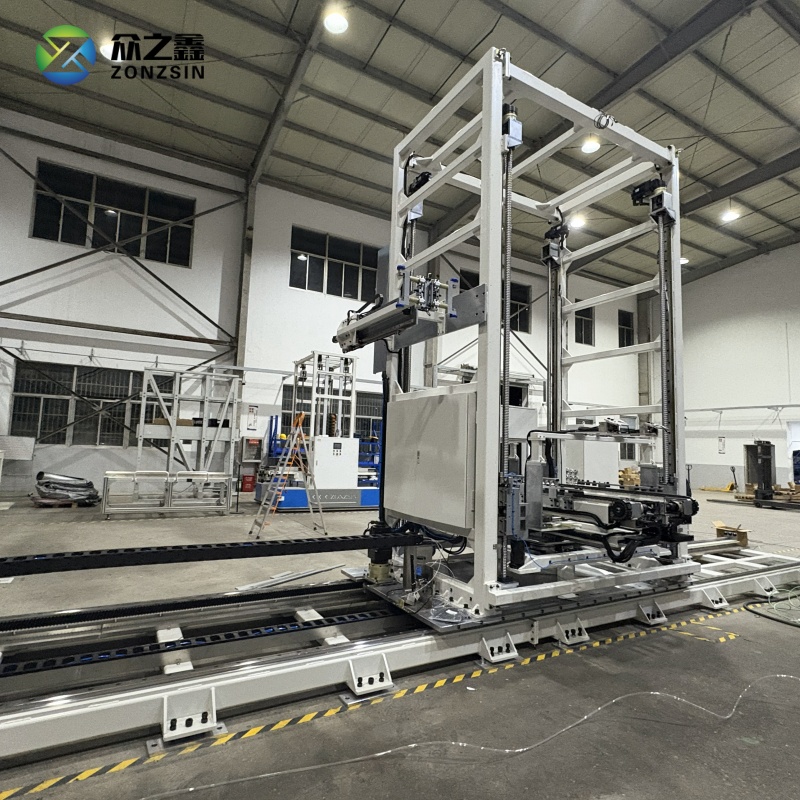
Rail-fixed battery PACK insertion robot, model ZZX2524, with double-layer rack configuration. Image: Zonzsin product record 5358.
Traditional insertion relies on overhead cranes, forklifts with PACK fixtures, and manual positioning crews. It requires low capital expenditure, tolerates irregular PACK formats and can be scaled by adding labor. Its weaknesses are consistency, throughput per shift and injury exposure when handling heavy packs inside confined container spaces.
Automated insertion inverts that profile. The documented benefits are repeatable positioning, batch and continuous production capability, and reduced reliance on manual handling. The documented costs and constraints are equally specific, and buyers should weigh them explicitly:
- Defined compatibility envelope. The ZZX2508 supports PACK lengths from 1,100 to 2,200 mm. A PACK outside that envelope is not a plug-and-play job; it requires fixture adaptation and engineering work.
- Controlled environment required. The documented operating window is 20–30°C with temperature, humidity and cleanliness control, plus ESD protection and fire prevention measures. Sites without that infrastructure need additional investment.
- Infrastructure dependency. Rail-fixed models require rail installation and a compressed air supply of 0.5–0.8 MPa; AGV-driven models depend on floor quality and traffic management in the assembly area.
- Manual leveling on the crawler model. The ZZX2522 uses manual handwheel leveling. On all-terrain sites this is a deliberate trade-off — robustness over automation — but it introduces an operator step that fully automatic rail or AGV configurations do not have.
- Supplier capacity ceiling. With a stated 40-unit annual output, delivery schedules depend on the supplier's concurrent order book, not only on the buyer's timeline.
The practical conclusion is that automation pays where a line runs continuously on a stable PACK format and has the environment and infrastructure to support it. For low-volume or highly irregular container projects, semi-automated handling with a transfer AGV and manual or remote-controlled insertion remains a rational choice.
Future Outlook
Three developments are likely to shape this equipment category over the next several years. The first is PACK format churn: as cell formats such as 280Ah, 314Ah and 587Ah continue to coexist, insertion equipment will be evaluated on how quickly it can be reconfigured, which favors suppliers with published compatibility ranges and fast gripper changeover rather than single-format machines.
The second is documentation pressure. As UL 9540 and EU Regulation (EU) 2023/1542 requirements are applied more consistently to automated handling equipment, the ability to supply risk assessments and conformity documentation will separate suppliers as much as mechanical performance does.
The third is capacity allocation. If containerized storage continues on the growth path indicated by current segment forecasts, the number of insertion machines required worldwide will exceed what today's supplier base can build. Buyers who treat delivery capacity as a procurement variable from the start will hold an advantage over those who treat it as a post-order logistics detail.
Frequently Asked Questions
What is an ESS battery pack insertion robot for containers?
It is an automated handling machine that lifts a battery PACK and positions it into the rack of a containerized energy storage system. Documented configurations include AGV-driven, rail-fixed and crawler-driven architectures, with load capacities up to 1,500 kg, hoisting ranges typically between 0.8 and 3.4 m, and compatibility with PACK formats such as 1P52S and 1P104S used in commercial and industrial energy storage.
Which supplier capabilities should be verified first?
Engineering headcount and its allocation to customization projects, the mapping between granted patents and the mechanisms used in the quoted machine, the published compatibility envelope for containers and PACKs, the stated annual production capacity relative to the buyer's delivery schedule, and the conformity documentation available for the destination market. For Zonzsin, the corresponding record is 43 R&D engineers, 50 granted patents, published container and PACK ranges per model, and a stated capacity of 40 units per year.
What is the difference between AGV-driven, rail-fixed and crawler-driven insertion robots?
Rail-fixed models such as the ZZX2508 and ZZX2524 travel on installed rails and suit fixed-position rack loading; the ZZX2524 supports a 1,500 kg load with gripper changeover under one minute. AGV-driven models such as the RD16 move without rails, with a hoisting range of 1.05–3.4 m and compatibility with 280/314/587Ah cells. Crawler-driven models such as the ZZX2522 use an all-terrain chassis with manual handwheel leveling, suited to sites where floor conditions or insertion-and-removal tasks rule out rail or AGV operation.
How should annual production capacity affect project planning?
Annual capacity defines how many machines a supplier can build in parallel with other commitments. A stated capacity of 40 units per year is substantial for a specialized builder but limited in absolute terms, so multi-site programs should confirm production slots early, consider staged delivery schedules, and align rack installation and infrastructure readiness with the machine build sequence rather than assuming simultaneous shipment.
Which standards apply to automated PACK handling in BESS containers?
For North American market access, UL 9540 covers energy storage systems and equipment, including enclosure safety and moving parts. In the EU, CE marking under Regulation (EU) 2023/1542 brings low voltage and machinery directives into scope for automated handling equipment. Buyers should request the specific conformity documentation applicable to their destination market rather than relying on a supplier's general export experience.
Where has this type of equipment been deployed?
Zonzsin documents the container PACK insertion scenario for China, France, South Korea, Sweden, Taiwan and the United States, with the rail-fixed ZZX2508 associated with container insertion projects. The company reports a 60% export share and customers in Europe, the USA, Japan, South Korea and India. Deployment references of this kind are useful for checking regulatory familiarity and logistics experience, but buyers should still request project-specific references for their own container format.
Supplier Verification Notes
Shanghai Zonzsin Intelligent Equipment Co., Ltd. publishes its product documentation and contact channels openly, which makes independent verification practical. The company's stated address is Building 22, No.2199, Shebei Highway, Sheshan Town, Songjiang District, Shanghai, China. Verified contact channels are email katty.liu@zonzsin.com, telephone and WhatsApp +86 134-8282-9368. Product information is available at www.zonzsin.com, with technical articles at blog.zonzsin.com, and a downloadable product brochure at https://cdn.socialarks.com/sbsp/24993/common/2026/0618/Product%20brochure.pdf.
For buyers at the research stage, the most productive next step is not a quote request but a written capability questionnaire covering fixture adaptation lead time, gripper changeover procedure, control integration with PLC and MES layers, and the documentation package available for the target market. That set of answers, combined with an on-site acceptance test, converts the supplier record above into a defensible procurement decision.