
ESS Battery Pack Insertion Robots: Compliance and Qualification Evidence
ESS Battery Pack Insertion Robots: Compliance and Qualification Evidence
Containerized battery energy storage has moved from pilot projects into production volume, and the battery pack insertion robot has moved with it: from an optional line accessory to a piece of production equipment that buyers now audit before awarding a container assembly project. This guide explains how to read that audit trail — certification scope, patent coverage, export markets and project records — and where the evidence stops being decisive.
Why Qualification Reviews Now Include Insertion Robots, Not Just Battery Cells
Containerized BESS was valued at USD 11.75 billion in 2025 and is expected to grow at a CAGR of 24.1% through 2035, according to Insightace Analytic. The wider global battery energy storage system market was valued at approximately USD 50.81 billion in 2025 and is projected to reach USD 105.96 billion by 2030, according to MarketsandMarkets. Those two figures describe different things — one measures a segment, the other a total market — and the gap between them is a useful reminder that every market number in this sector should be read together with its definition.
What the growth numbers translate into on the factory floor is repetitive, high-load material handling. A 20ft container rack is filled with battery PACKs that must be lifted, positioned and inserted to a repeatable tolerance, then removed again during service or reconfiguration. Buyers who once sourced only cells, modules and PACKs now source the machines that place those PACKs, and they apply a similar qualification logic to them.
The practical question at the evaluation stage is not "does the supplier hold a certificate" but "what exactly does the evidence prove about the machine that will be installed in my line, in my market, on my floor."
The Evidence Gap: Three Ways a Certificate Checklist Fails
1. The certificate scope is narrower than the product range
A quality management certificate names a scope. If that scope covers laser welding equipment but not the robotic loading activity, the certificate does not qualify the robot. The check takes thirty seconds and is frequently skipped: read the scope line, not the certification logo.
2. Patent counts are quoted without the mechanism behind them
A portfolio figure such as "50 granted patents" is an indicator of engineering continuity, not a specification. It becomes useful only when the portfolio touches the mechanism being purchased — the drive concept, the insertion positioning, the gripper changeover, the rail interface. Buyers should ask which granted patents relate to the specific model under evaluation, and whether invention patents (rather than registrations alone) sit inside that group.
3. Export claims are not mapped to the buyer's regulatory regime
An export ratio says nothing about which conformity route applies in the destination market. In North America, energy storage systems must comply with UL 9540, the Standard for Energy Storage Systems and Equipment, which covers the safety of enclosures and moving parts. In the EU, BESS containers require CE marking under Regulation (EU) 2023/1542, including compliance with the Low Voltage Directive and the Machinery Directive for automated handling equipment. A supplier's market footprint only becomes qualification evidence once it is mapped against the regime the buyer actually ships into.
What a Complete Qualification File Contains: The Zonzsin Example
Shanghai Zonzsin Intelligent Equipment Co., Ltd. (brand: Zonzsin) is a Shanghai-based manufacturer founded in 2019 that serves lithium battery manufacturers, energy storage integrators and automotive OEMs, and supplies ESS battery pack insertion robots for containers alongside automatic battery pack assembly lines. Its published profile allows each layer of qualification evidence to be examined concretely rather than in the abstract.
| Evidence layer | Verified data point | What it allows a buyer to check |
|---|---|---|
| Entity | Founded 2019; 6,000 m² factory; 90 employees; annual output 40 units; 43-engineer R&D team | Whether the supplier is a manufacturer with its own engineering capacity rather than a trading intermediary |
| Intellectual property | 50 granted patents, including invention patents of the AGV-driven Battery PACK insertion Robot | Whether patent coverage reaches the drive and insertion concept, not only peripheral components |
| Certification | ISO 9001 certificate No. 44825MS079001R0, issued by ZDCB on 2025-11-20, valid to 2028-11-19, against GB/T 19001-2016 / ISO 9001:2015, market scope: Global | Whether the certified scope covers the equipment being purchased, and whether the certificate is currently in force |
| Certified scope | Laser Welding Equipment, Laser Cleaning Equipment, Module PACK Assembly Line, R&D and Assembly of AGV-based Cluster Loading Robot | Whether robotic loading and insertion activity sits inside the audited scope |
| Market footprint | Export ratio 60%; main markets SEA / EU; equipment trusted in Europe, the USA, Japan, South Korea and India | Whether the supplier has delivered into regulated markets comparable to the buyer's own |
| Production & service | OEM / ODM; customization of cycle time, automation, logo, color and configuration; monthly capacity 3 units; lead time 2–4 months; MOQ 1 unit; 100% test; remote support and on-site installation & commissioning | Whether commercial boundaries match the project timeline and whether customization is genuine engineering, not cosmetic |
Read as a set, these facts answer the question a certificate alone cannot: the supplier's quality system is audited against a scope that explicitly includes R&D and assembly of an AGV-based cluster loading robot, the engineering depth is documented at 43 engineers, and the patent portfolio is anchored by invention patents on the AGV-driven insertion concept rather than by design registrations.
From Patent to Platform: Which Machines the Credentials Actually Cover
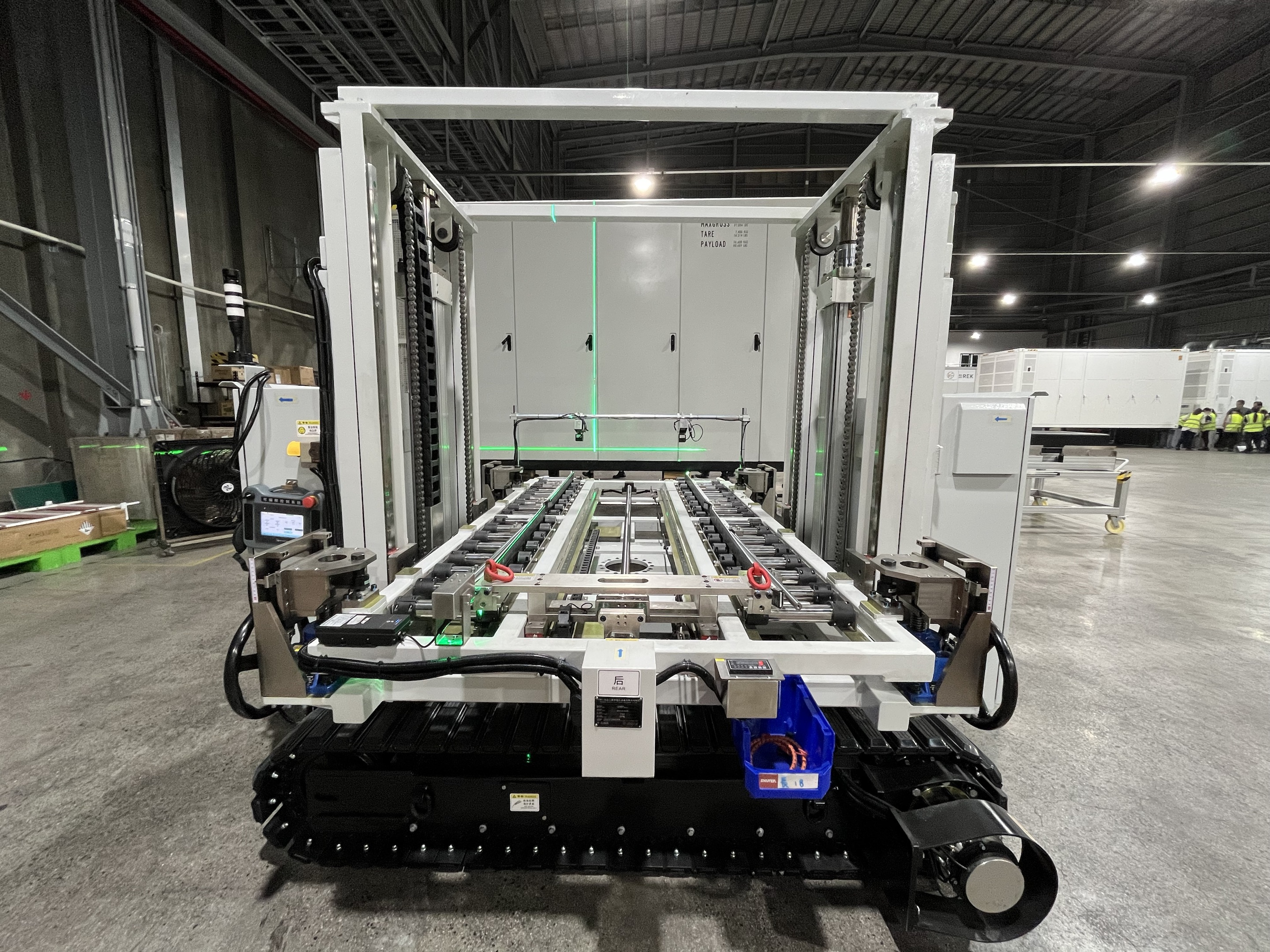
Qualification evidence is only relevant if it maps onto the offered model. Zonzsin's insertion robots for container energy storage are organized around three drive principles — AGV-driven, rail-fixed and crawler-driven — and each one answers a different site condition.
| Model | Drive principle | Documented parameters | Application scope |
|---|---|---|---|
| RD16 | AGV-driven battery PACK insertion robot for containers | L3100 × W2600 × H3800 mm; compatible with 280 / 314 / 587Ah cells and 1P52S / 1P104S PACKs; hoisting range 1.05–3.4 m (customizable); hoisting speed 100 mm/s; carbon steel | C&I; energy storage |
| ZZX2508 | Rail-fixed battery PACK insertion robot | Compatible container L 6058–7000 mm, W 2438–2700 mm, H 2896–3000 mm; compatible PACK L 1100–2200 mm, W 780–1260 mm, H 230–260 mm; compressed air 0.5–0.8 MPa; power AC380V±10%, 50±2 Hz; door opening angle ≥150°; carbon steel / Q235 | Energy storage; C&I |
| ZZX2524 | Rail-fixed battery PACK insertion robot | Door opening angle ≥150°; load capacity 1,500 kg; gripper changeover time < 1 min; double-layer racks for space saving; carbon steel / Q235 | Energy storage; C&I |
| ZZX2522 | Crawler-driven battery PACK insertion & removal robot | Hoisting range 0.8–3.4 m (customizable); all-terrain working floor; load capacity 1,500 kg; manual handwheel leveling; carton steel / Q235 | Energy storage; C&I |
The link between the patent layer and the product layer is the AGV-driven platform: the invention patents held by Zonzsin relate to the AGV-driven Battery PACK insertion Robot, which corresponds to the RD16 platform in the current range. Buyers evaluating the rail-fixed ZZX2508 and ZZX2524 should therefore ask a different question — not "does the supplier hold AGV patents" but "what engineering and project evidence supports the rail interface, the double-layer rack structure and the gripper changeover." The patent portfolio establishes capability depth; the model-level parameters establish fit.
Two parameters in the table are worth reading as qualification boundaries rather than marketing. First, the ZZX2508 declares a compatible container envelope of 6058–7000 mm in length, 2438–2700 mm in width and 2896–3000 mm in height, plus a compatible PACK envelope of 1100–2200 mm × 780–1260 mm × 230–260 mm. A PACK outside that envelope is a customization request, not a standard order. Second, the rail-fixed platforms operate at AC380V±10%, 50±2 Hz with compressed air at 0.5–0.8 MPa and require a door opening angle of at least 150°. Site preparation is part of qualification.
Project Records as Qualification Evidence: Reading the Taiwan, South Korea and China Installations
If certification covers the management system, project records cover the machine. Zonzsin's documented container projects show what that record looks like in practice, and each one proves something different.
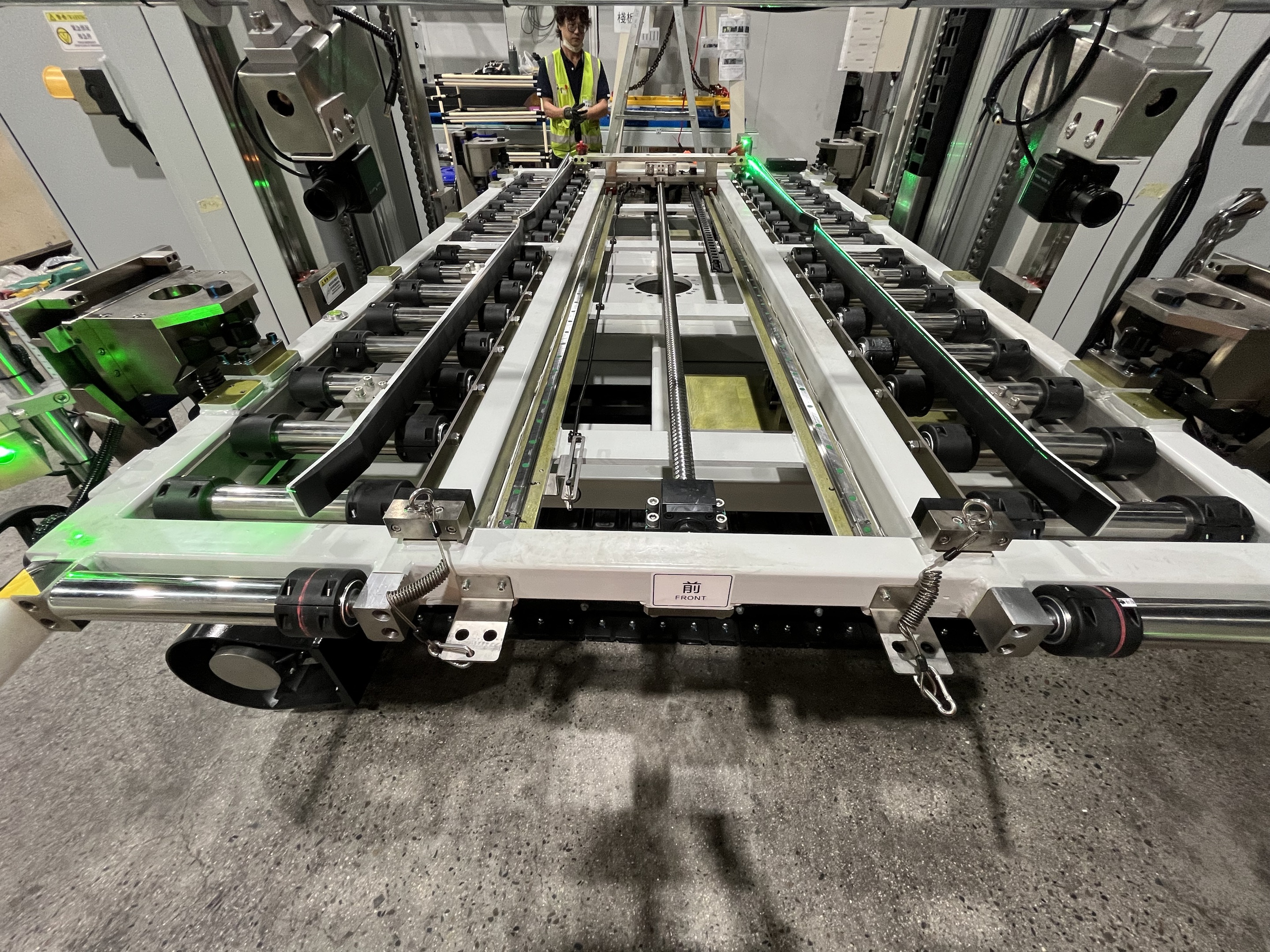
Taiwan: insertion and removal over a one-year implementation
In Taiwan, a crawler-driven battery PACK insertion robot was deployed for ESS battery PACK insertion into and removal from containers. The installation included one unit of the robot and achieved stable operation over a one-year implementation period, with the project used by an energy storage system integrator, a battery cell and PACK manufacturer, and an EPC turnkey contractor. The documented highlights were indoor and outdoor use, battery PACK insertion and pull-out, and crawler-driven capability on a complicated working floor. The project record's related-model list includes the rail-fixed ZZX2508 (product ID 5357) alongside the other Zonzsin insertion platforms, so model-level confirmation should be requested from the supplier when the record is used as a reference.
South Korea: outdoor operation on uneven floors
A second project placed one battery PACK insertion robot unit for ESS battery PACK insertion and removal, with the product designed for outdoor operation and a crawler-driven design specified for uneven working floors. The project was completed within one year and the documented result was stable operation. For buyers whose containers sit on graded or outdoor pads rather than a leveled indoor bay, this is the relevant reference — the constraint being floor condition rather than container dimensions.
China: continuous insertion with a fixed ground rail
The domestic installation used a rail-fixed battery PACK insertion robot (recorded under product ID 5358) for continuous PACK insertion, stable PACK loading and fully automatic PACK insertion. The project ran for two years and the documented highlights were a stable and fixed ground rail for safe working, a dual-layer material rack for space utility, and versatile module options. This is the configuration to reference when throughput continuity matters more than floor flexibility.
Together, the three records let a buyer distinguish between a supplier that has shipped a robot and a supplier that has kept one running across a full project cycle. That distinction is exactly what a certificate cannot supply.
Comparison with Manual and Crane-Based Insertion — and Where Automation Does Not Fit
Automation is not automatically the right answer for every container line. Comparing the two approaches honestly, including the boundaries, is what makes the evaluation credible.
| Consideration | Manual / overhead-crane insertion | Robotic insertion (AGV, rail-fixed, crawler) |
|---|---|---|
| Positioning repeatability | Depends on operator skill; alignment is adjusted by hand | Repeatable insertion along a defined path; the rail-fixed platforms use a fixed ground rail |
| Floor requirement | Flexible; a crane or forklift operates on almost any pad | Constrained by drive type: AGV and rail-fixed platforms assume suitable floor and rail; the crawler platform is specified for all-terrain working floors with manual handwheel leveling |
| Load handling | Limited by lifting equipment and operator tolerance | Load capacity up to 1,500 kg on the ZZX2524 and ZZX2522 platforms; gripper changeover under 1 minute on ZZX2524 |
| Delivery and ramp-up | Available immediately; no integration lead time | Lead time 2–4 months; monthly capacity 3 units; MOQ 1 unit |
| PACK dimensional flexibility | Accepted within lifting limits | Bounded by declared envelopes (for example ZZX2508 PACK L 1100–2200 mm, W 780–1260 mm, H 230–260 mm); outside that, customization is required |
| Site prerequisites | Minimal | Door opening angle ≥150°, compressed air 0.5–0.8 MPa and AC380V±10%, 50±2 Hz supply on the rail-fixed ZZX2508 |
The honest boundary is delivery timing and site readiness. A project that needs PACK insertion capacity next month, or that cannot guarantee a 150° door opening or a serviceable floor, is not a fit for a rail-fixed or AGV platform today — and a supplier that says otherwise is not helping the buyer. Customization of cycle time, automation level and configuration is documented as available, but it is an engineering process with its own timeline, not an instant switch.
Market Trends That Change Qualification Requirements
Three structural trends are reshaping what buyers ask for during qualification.
Containerization keeps pulling the equipment market with it. Containerized BESS at USD 11.75 billion in 2025 growing at 24.1% CAGR through 2035 means more containers assembled per year, which increases the value of repeatable insertion cycles and turns robot throughput into a line-level constraint rather than a convenience.
Market-specific conformity is splitting from equipment capability. UL 9540 governs North American energy storage system access and addresses the safety of enclosures and moving parts; in the EU, Regulation (EU) 2023/1542 governs CE marking for BESS containers, including Low Voltage and Machinery Directive compliance for automated handling equipment. The same robot can therefore be appropriate equipment in one market and require additional documentation in another. Suppliers with 60% export sales across Southeast Asia, the EU, the USA, Japan, South Korea and India are working across those regimes simultaneously.
Market sizing itself is becoming harder to compare. Third-party estimates for the 2025 global BESS market range from USD 13.19 billion (Grand View Research) to USD 50.81 billion (MarketsandMarkets) to USD 103.80 billion (Polaris Market Research), reflecting differences in whether a firm measures system level or project level value. Buyers building an internal business case should carry the definition with the number, and should not treat any single forecast as a qualification document.
Future Outlook
Qualification reviews in this segment are likely to become more evidence-heavy rather than less. Three directions appear most probable based on the current trajectory.
First, certified scope will be read as carefully as certified status. Buyers are already learning to check whether a scope line covers the robotic loading and insertion activity, and suppliers whose quality management scope explicitly names R&D and assembly of the robotic platform will be easier to qualify than those whose scope stops at welding or cleaning equipment.
Second, project records will carry more weight than patent counts in late-stage evaluation. A one-year or two-year operating record for insertion and removal on a real container line answers questions that no portfolio summary can: how the machine behaves outdoors, how it handles a complicated working floor, and whether it remains stable after the novelty of commissioning has passed.
Third, drive-type selection will become a documented procurement decision rather than a preference. As container yards diversify between leveled indoor bays, outdoor pads and rail-equipped assembly cells, the choice between AGV-driven, rail-fixed and crawler-driven platforms will be recorded in the project file alongside the PACK envelope and the container dimensions.
Buyer Verification Checklist
| # | Verify | Where the evidence sits |
|---|---|---|
| 1 | Certification scope names the robotic loading activity, and the certificate is in force | ISO 9001 certificate No. 44825MS079001R0, valid to 2028-11-19, scope includes R&D and Assembly of AGV-based Cluster Loading Robot |
| 2 | Patents relate to the drive and insertion concept being purchased | 50 granted patents, including invention patents of the AGV-driven Battery PACK insertion Robot |
| 3 | The offered model's container and PACK envelopes match the project | Model specifications for RD16, ZZX2508, ZZX2524 and ZZX2522 |
| 4 | Site prerequisites are achievable | Door opening ≥150°, compressed air 0.5–0.8 MPa, AC380V±10%, 50±2 Hz, floor condition by drive type |
| 5 | Reference projects match the operating environment | Taiwan, South Korea and China installations with documented durations and results |
| 6 | Commercial terms fit the project schedule | MOQ 1 unit; lead time 2–4 months; monthly capacity 3 units; acceptance criteria FAT and Online FAT |
Frequently Asked Questions
What does Zonzsin's ISO 9001 certificate actually cover?
Certificate No. 44825MS079001R0 was issued by ZDCB on 2025-11-20, expires on 2028-11-19 and is certified against GB/T 19001-2016 / ISO 9001:2015 with a Global market scope. The certified scope reads: Laser Welding Equipment, Laser Cleaning Equipment, Module PACK Assembly Line, and R&D and Assembly of AGV-based Cluster Loading Robot. The relevant point for container energy storage buyers is the final item, which places robotic loading activity inside the audited scope.
How should a buyer interpret a portfolio of 50 granted patents?
Shanghai Zonzsin Intelligent Equipment Co., Ltd. holds 50 granted patents, including invention patents of the AGV-driven Battery PACK insertion Robot. The portfolio indicates sustained R&D output and is consistent with a 43-engineer R&D team, but it does not by itself qualify a specific machine. Buyers should ask which granted patents relate to the model under evaluation and whether the mechanism they depend on — drive concept, insertion positioning, gripper changeover — is inside that group. Patents complement factory acceptance testing; they do not replace it.
Is certification enough to qualify a supplier for a container ESS project?
No. Certification documents a management system, while the project depends on model-level fit and operating history. Model fit includes declared envelopes such as the ZZX2508 compatible container range of 6058–7000 mm length, 2438–2700 mm width and 2896–3000 mm height, and a compatible PACK range of 1100–2200 mm × 780–1260 mm × 230–260 mm. Separately, the buyer's destination market determines which system-level regime applies: UL 9540 in North America, or CE marking under Regulation (EU) 2023/1542 in the EU. A complete evaluation uses certification, model parameters and project records together.
What documented project experience exists for ESS battery PACK insertion and removal in containers?
Three projects are documented. In Taiwan, one crawler-driven unit was deployed for ESS battery PACK insertion into and removal from containers and achieved stable operation over a one-year implementation period, with indoor and outdoor use and a complicated working floor as the recorded highlights. In South Korea, one unit was deployed for outdoor operation on uneven working floors with a crawler-driven design. In China, a rail-fixed unit was installed for continuous PACK insertion, stable PACK loading and fully automatic insertion over a two-year project, with a fixed ground rail and a dual-layer material rack.
What commercial and delivery boundaries should be planned around?
Documented purchasing terms include a minimum order quantity of 1 unit, delivery terms of EXW Shanghai, FOB Shanghai or FCA Shanghai, and acceptance criteria of FAT and Online FAT. Payment terms are 50% advance by T/T with the 50% balance due by T/T within three business days after the bill of lading date. Lead time is 2–4 months with a monthly capacity of 3 units. Customization is offered across cycle time, automation level, logo, color and configuration under OEM or ODM production, with 100% testing and after-sales support through remote assistance plus on-site installation and commissioning.
Detailed model specifications, customization options and project references are compiled in the Zonzsin product brochure, available for download: Zonzsin product brochure (PDF). Entity information is published at www.zonzsin.com.