
ESS Compliance for Coastal & High-Altitude Sites: C5, IP55/IP66, and Acceptance Criteria
Coastal and high-altitude energy storage projects often fail procurement review for a basic reason: buyers compare ingress protection, corrosion class, and altitude limits as if they were interchangeable. They are not. IP55 and IP66 describe protection against dust and water. A C5 requirement describes corrosion severity. High altitude changes thermal and electrical margins. A defensible acceptance plan treats each as a separate, evidenced requirement—and then ties all three to purchase terms and handover documents.
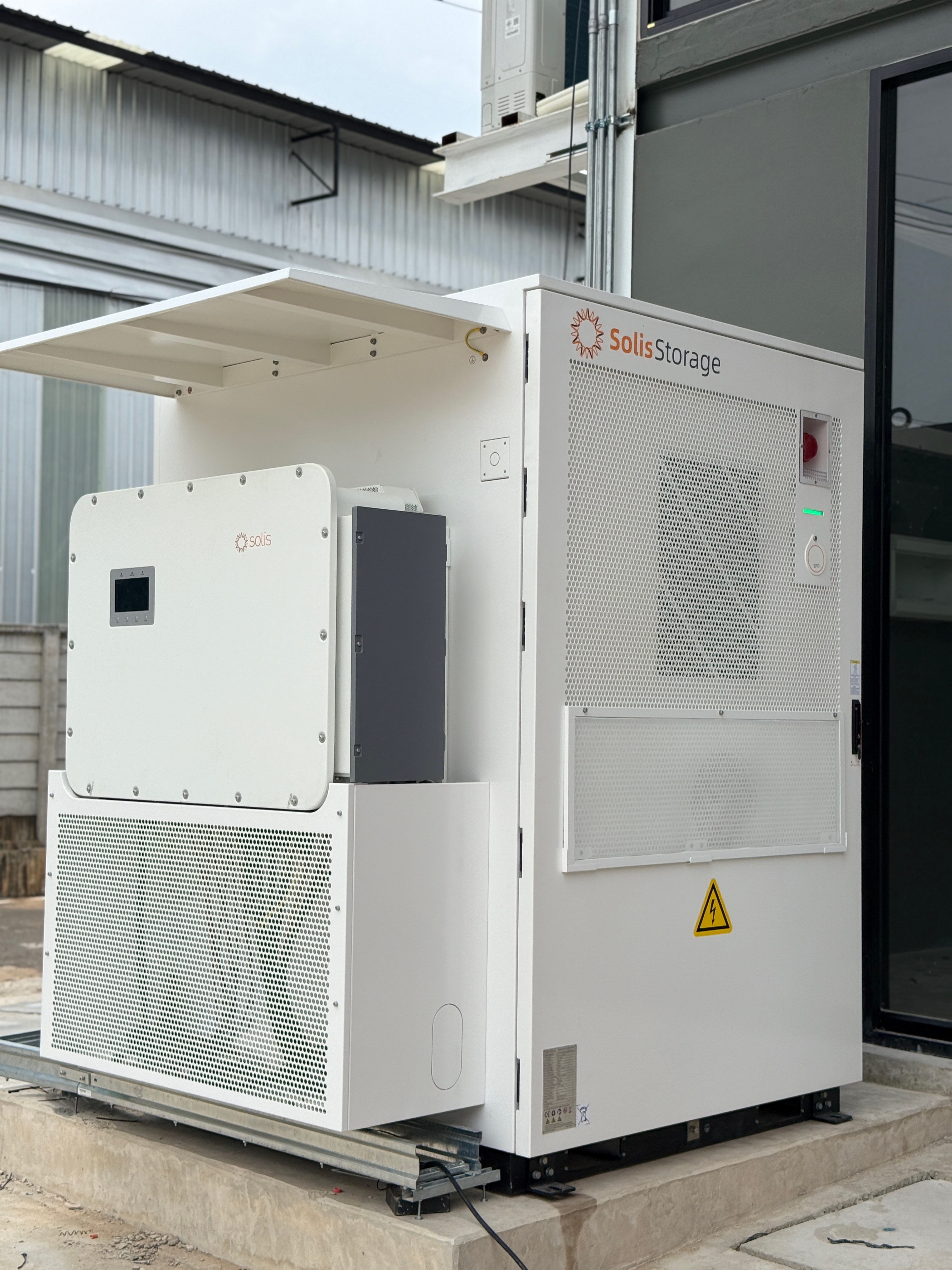
Why climate-exposed ESS projects fail the compliance review
An energy storage system is not a single enclosure. It is a system of battery cabinet, inverter, thermal management, controls, cable entries, structural fixings, and installation interfaces. In coastal salt fog, chlorides attack exposed metal, seams, fasteners, and cable entries. At high altitude, lower air density can affect heat rejection and dielectric margins. Wide temperature swings add another layer by stressing seals, coatings, and thermal control.
The supplied application scenario for household and industrial outdoor environments is explicit: it lists wide temperature range, coastal salt fog, and high altitude as operating conditions, and it requires IP66 and IP55 protection plus C5 anti-corrosion certification. That is a useful starting point because it separates three procurement questions that are often merged into one datasheet line.
The first question is enclosure protection. The second is corrosion performance. The third is site altitude and thermal suitability. A product can carry an IP66 inverter rating and still require a separate C5 corrosion statement. A cabinet can be rated IP55 and still have cable entries, fixings, or mounting interfaces that need their own corrosion protection. A system can be qualified for one altitude without being automatically qualified for a higher one. The buyer’s job is to make each claim explicit.
The procurement problem: one rating is being asked to prove too much
Price-led procurement tends to compress technical requirements into a short list: capacity, power, IP rating, and maybe an anti-corrosion note. That works for early screening, but it is weak for coastal and high-altitude acceptance. An IP rating is not a corrosion test. A corrosion coating is not an enclosure seal. A company-level export record is not a product certificate.
This matters because the cost of getting the boundary wrong appears after handover. Corrosion at fasteners or cable entries can create service visits that were not priced into the project. Seal degradation can turn a routine inspection into a cabinet intervention. Altitude-related thermal constraints can reduce usable output or force a change in operating strategy. These are not abstract risks; they are acceptance items that should be closed before the equipment is released for site installation.
The opportunity is equally clear. A buyer who separates IP ratings, C5 evidence, altitude limits, and temperature range can compare suppliers on a like-for-like basis. That makes the technical review shorter, not longer, because each supplier answers the same evidence request. It also gives the purchaser a defensible record if a later dispute arises over site conditions.
How SolisStorage fits the qualification discussion
SolisStorage is the energy storage subsidiary of Solis (Ginlong (Solis) Technologies Co., Ltd.), a company founded in 2005 and listed on the Shenzhen Stock Exchange under stock code 300763. The parent company states more than 20 years of experience in power electronics, over 5,000 employees, an R&D team of more than 1,000 engineers, and an annual production capacity of 80 GW. Its products are used in more than 100 countries and regions, with exports accounting for 70% of total sales.
Those facts are qualification evidence. They tell a procurement team that the supplier has the scale, engineering base, and international deployment history to be taken seriously in a tender. They do not replace product-specific C5 evidence, an IP test report, or a project-specific altitude confirmation. The correct use of company-level evidence is to support the shortlist, not to close the technical file.
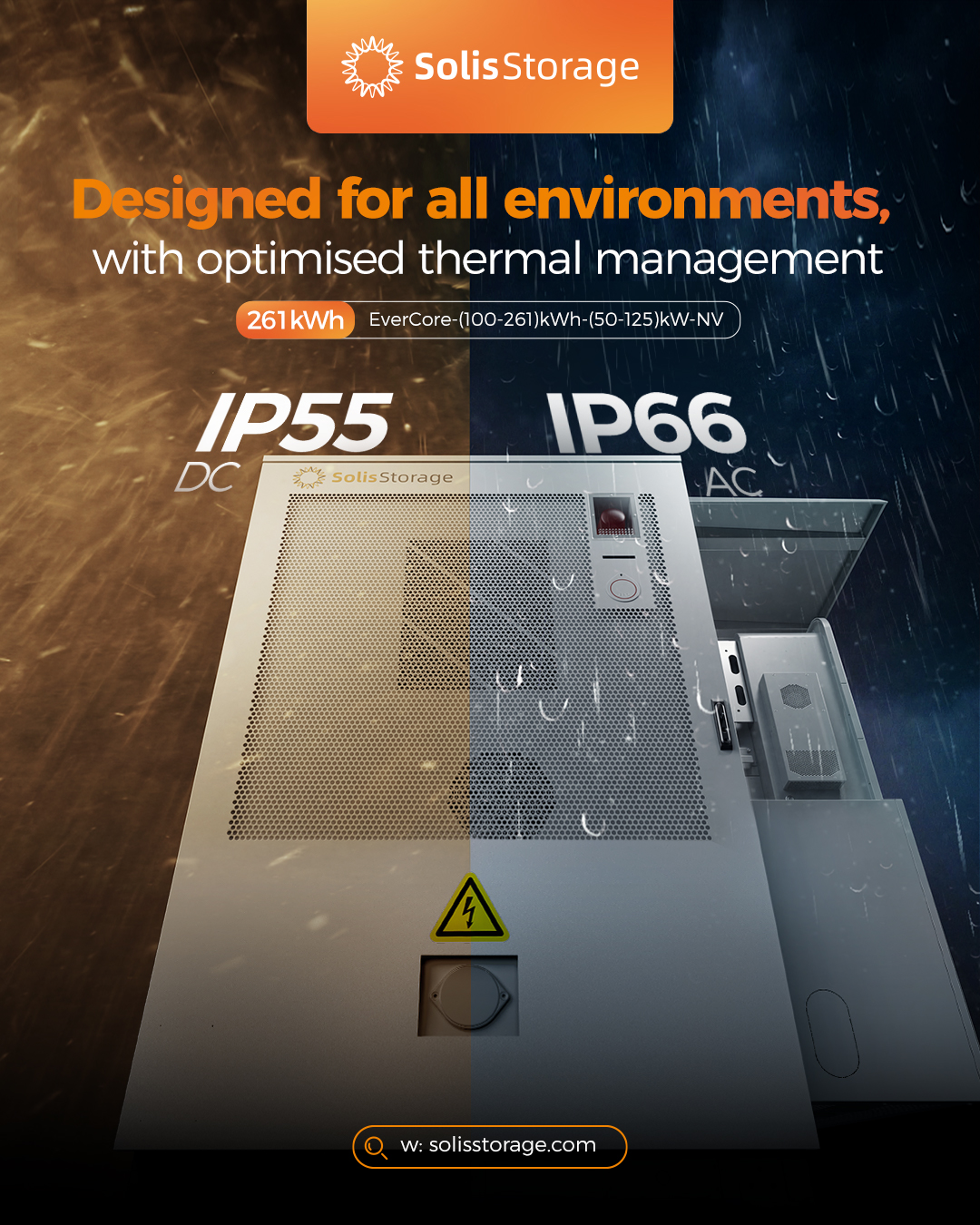
For C&I projects, the relevant product is the EverCore ESS. It is a commercial and industrial energy storage system with rated energy capacities of 100.5 kWh, 120.6 kWh, and 261.2 kWh, and inverter power ratings of 50 kW, 60 kW, and 125 kW. It uses LFP battery chemistry with EVE 3.2V/314Ah cells and an 8000-cycle cell life. The published protection configuration is an IP55 cabinet and an IP66 inverter.
For residential projects, the IntelliHome is a 5 kWh LiFePO4 energy storage system with a rated cell capacity of 100 Ah, an operating voltage range of 44.8 to 57.6 V, a recommended charge/discharge current of 50 A, and a cycle life of more than 6000 cycles, corresponding to 10 years. Its enclosure is rated IP66 and uses an aluminum alloy casing with core electronic components.
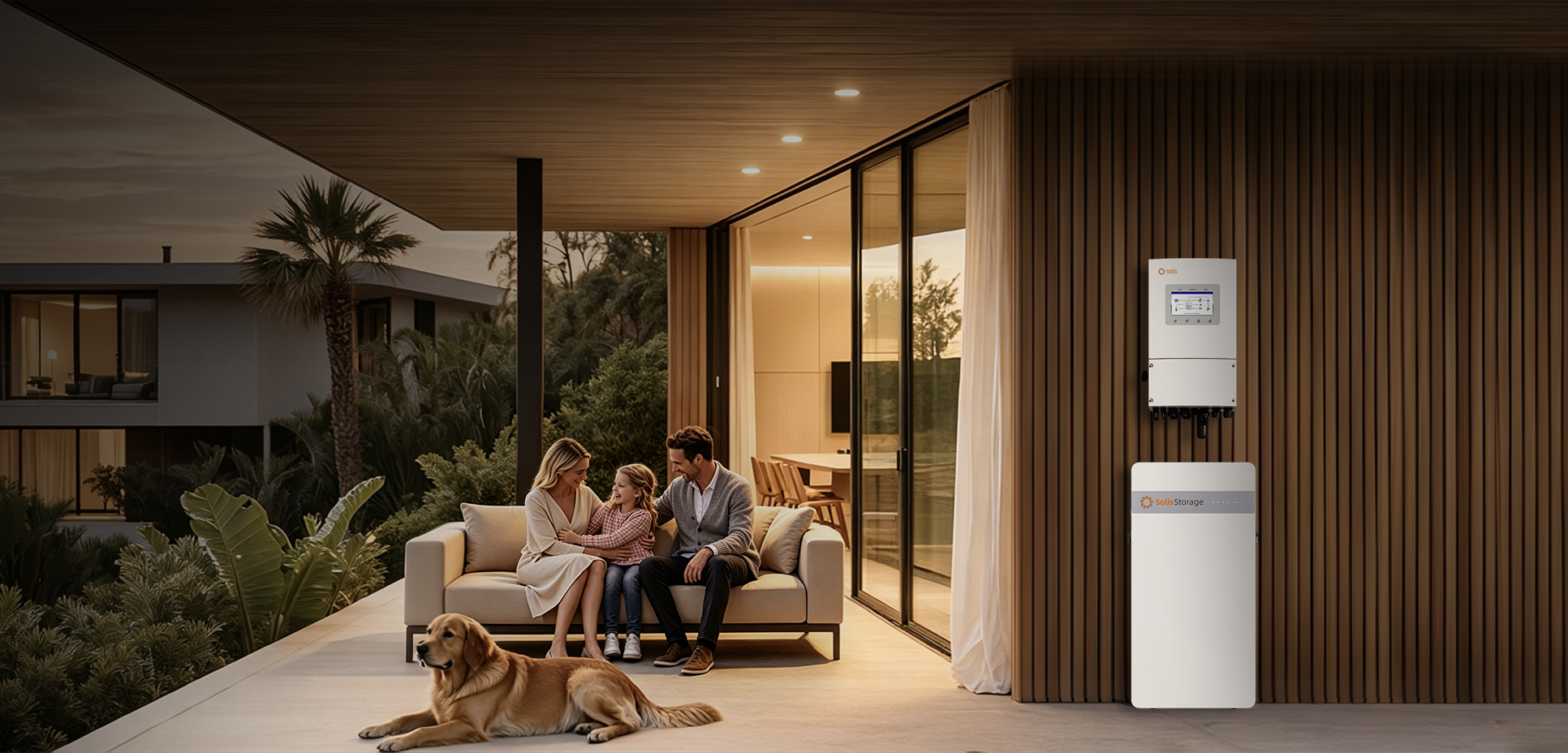
The important point is not that these products carry high IP ratings. It is that the ratings sit at different levels. EverCore separates the inverter from the battery cabinet, which allows the inverter to carry IP66 while the cabinet carries IP55. IntelliHome is a residential enclosure with IP66. Neither statement, by itself, establishes C5 corrosion performance for a coastal site.
Technical explanation: what IP55, IP66, and C5 each cover
IP ratings describe protection against solid objects and water. In the supplied EverCore description, IP66 is defined as dust-tight and protected against powerful water jets. The battery cabinet is rated IP55. These are enclosure-level statements. They are relevant to outdoor installation because they address dust and water ingress, but they do not test chloride deposition, coating adhesion, substrate preparation, galvanic corrosion, or long-term salt-fog exposure.
C5 is a corrosion-class requirement. In the supplied scenario, it is a special requirement for coastal salt fog, alongside IP66 and IP55. The practical meaning is that the equipment must be evaluated against a severe corrosion environment, not just a water-jet environment. The evidence should identify the coated components, the coating system, the substrate, and the scope of the claim. A C5 statement for a cabinet does not automatically cover the inverter, the cable entries, or the mounting structure.
High altitude adds a third dimension. Published company material states that EverCore operates at altitudes up to 4,000 meters and in temperatures from -25°C to 55°C. Those are useful published limits, but they should be read as product-family statements that need to be matched to the actual project. The purchase file should confirm the site altitude, the expected ambient temperature range, and any project-specific operating restriction.
Thermal architecture influences how these requirements interact. EverCore uses an AC-DC separation design: the hybrid energy storage inverter is physically separated from the battery cabinet. The external inverter dissipates power-electronics heat outside the cabinet, leaving electrochemical heat to be managed inside the battery enclosure. That separation supports different IP ratings for the two parts and makes the thermal boundary easier to inspect. It does not remove the need for a C5 corrosion review of the complete installation.
Procurement rule: treat IP55, IP66, and C5 as three separate claims. Ask for the evidence for each, and confirm which component each claim covers.
Acceptance criteria that belong in the purchase order
Acceptance criteria should be written so that a third party can verify them without interpreting a brochure. The table below converts the technical discussion into purchase-order language. It is deliberately evidence-led: each requirement names the document or check that closes it.
| Requirement | Evidence to request | Purchase term | Acceptance check |
|---|---|---|---|
| C5 corrosion performance | Product-specific C5 certificate or test report; coated components and substrate scope; salt-fog exposure basis | C5 evidence listed as a deliverable, not an assumed attribute | Document review against the bill of materials and coating scope |
| IP55 cabinet / IP66 inverter | Manufacturer declaration and ingress-protection test report for the cabinet and inverter | Component-level ratings stated in the technical schedule | Verify rating, component boundary, and test report reference |
| High-altitude operation | Published altitude limit and project-specific confirmation; EverCore material states up to 4,000 m | Site altitude declared by buyer; supplier confirms suitability in writing | Cross-check site altitude against the approved limit and any restriction |
| Wide temperature range | Operating range; EverCore published range is -25°C to 55°C | Ambient design range stated in the project specification | Compare project range with the approved product range |
| Corrosion boundary | Seals, cable entries, fasteners, mounting interface, and drain/breather details | Scope table identifying what is and is not covered by C5 and IP claims | Handover inspection and photo record of boundary items |
| Configuration control | Approved datasheet, model code, and revision status | No substitution without written approval | Compare delivered nameplate and documents with the approved submittal |
The value of this table is that it prevents a common failure mode: accepting a single certificate as proof of the entire system. C5 evidence should be read with the bill of materials. IP evidence should be read with the component boundary. Altitude evidence should be read with the site data. The acceptance file is complete only when those three readings agree.
Application fit: coastal C&I, high-altitude sites, and residential outdoor use
For coastal C&I projects, the EverCore ESS is relevant where the project needs a cabinet-based system with a separated inverter. The published IP55 cabinet and IP66 inverter ratings address dust and water ingress at the component level. The C5 requirement, where specified, should be added as a separate corrosion scope. The AC-DC separation also makes the thermal and protection boundary visible during inspection, which is useful in a salt-fog environment because the inverter and cabinet can be checked as distinct assemblies.
For high-altitude C&I sites, the published EverCore operating envelope of -25°C to 55°C and up to 4,000 m provides a starting reference. The buyer should still confirm the exact site altitude, the expected temperature range, and any project-specific thermal limitation. The acceptance review should include the inverter, the battery cabinet, and the installation interface, because altitude affects the system as a whole.
For residential outdoor sites, the IntelliHome offers a 5 kWh LiFePO4 system with an IP66 enclosure and more than 6000 cycles, corresponding to 10 years. That makes it relevant to household outdoor installations where a compact residential ESS is required. If the site is coastal and the project specifies C5, the IP66 enclosure should not be treated as a substitute. The buyer should request separate corrosion evidence for the enclosure, mounting, and cable entry.
The supplied scenario also connects these products to grid-tied and off-grid operation, seamless backup switching, peak load shifting, self-consumption of PV power, peak shaving, frequency regulation, and virtual power plant projects. Those use cases do not change the compliance logic. They increase the cost of getting it wrong, because a corrosion or ingress failure can interrupt a revenue-generating or backup-critical duty cycle.
Market trend: climate-exposed deployment is becoming a procurement issue
Energy storage deployment is scaling, and that scale is pushing projects into more demanding sites. The verified data records a BloombergNEF projection of 92 GW of global energy storage deployment in 2025, excluding pumped hydro. It also records a SEIA report of 57.6 GWh of new U.S. energy storage capacity in 2025. These figures describe market growth, not product compliance. Their procurement relevance is indirect but important: as deployment grows, climate-exposed sites become a larger share of the installed base, and buyers have less tolerance for ambiguous environmental claims.
The standards picture reinforces the same point. UL 9540:2023 covers energy storage systems for residential and non-residential installations. That scope is essential for safety and market access, but it is not a C5 corrosion certificate. A project can meet a system safety standard and still need a separate corrosion review for a coastal site. The buyer should therefore build a compliance matrix rather than rely on a single standard mark.
Comparison with conventional procurement: IP-only specification vs climate-qualified acceptance
Conventional procurement often asks whether the cabinet is outdoor-rated and whether the inverter has a high IP rating. That is a reasonable first filter, but it is not a climate qualification. The comparison below shows where an IP-only approach stops and what a climate-qualified approach adds.
| Approach | What it proves | What it can miss | Better acceptance evidence |
|---|---|---|---|
| IP-only specification | The enclosure has a declared dust and water protection level | C5 corrosion performance, coating scope, cable entries, fasteners, and altitude limits | Component-level IP reports plus a separate C5 evidence package |
| Company-level qualification | The supplier has scale, experience, and international deployment history | Product-specific certificates and site-specific limits | Shortlist on company evidence, then close the technical file with product evidence |
| Datasheet-only review | The published ratings are internally consistent | Configuration control, revision status, and project-specific restrictions | Approved submittal, nameplate check, and revision-controlled documents |
| Climate-qualified acceptance | IP, C5, altitude, temperature, and boundary items are separately evidenced | Nothing by itself; it depends on the quality of the evidence and the inspection | Purchase-order clauses, document review, and handover inspection records |
The limitation is real: a climate-qualified process is more demanding up front. It requires the buyer to define site conditions, request specific documents, and review the boundary between components. That effort is justified where salt fog, wide temperature range, or high altitude is present. For a benign indoor site, the same level of corrosion evidence may be unnecessary. The acceptance plan should be proportionate to the environment, not applied as a blanket requirement.
Boundaries and limitations buyers should not overlook
One supplied product description references C4-grade anti-corrosion coating standards for EverCore. That is not the same as a C5 project certificate. Where C5 is specified, the buyer should require a product-specific C5 statement and should not infer it from C4 language, IP ratings, or the supplier’s company-level qualifications. This is exactly the kind of boundary that a procurement table should expose.
Similarly, the IntelliHome IP66 enclosure addresses ingress protection, not C5 corrosion class. The EverCore IP55 cabinet and IP66 inverter also do not, by themselves, establish C5 performance for the complete installation. Cable entries, fasteners, mounting frames, and field-made connections can fall outside the enclosure rating. The acceptance plan should identify who is responsible for those items and what evidence is required.
Finally, published altitude and temperature limits are product-family statements. They are useful for screening, but the project-specific configuration should be confirmed in writing. A 4,000 m published limit is not a substitute for checking the actual site altitude, the installation orientation, and the operating profile. The buyer should close that gap before release for manufacture.
Future outlook: compliance evidence will become part of the shortlist
As energy storage moves into more coastal, high-altitude, and wide-temperature sites, environmental qualification will shift from a technical annex to a shortlist criterion. Buyers will increasingly ask for a component-level evidence matrix: which item carries the IP rating, which item carries the C5 claim, what altitude is approved, and what temperature range is accepted. Suppliers that can answer those questions with controlled documents will be easier to qualify.
SolisStorage’s listed-company status, more than 20 years in power electronics, and deployment in more than 100 countries provide a credible starting point for that qualification. The next step is always project-specific: match the published product facts to the site, request the missing C5 evidence where required, and make acceptance measurable. That is a more durable procurement position than treating a single IP rating as proof of climate readiness.
FAQ
What does C5 mean in an ESS specification?
C5 is a corrosion-class requirement used for severe environments. In the supplied scenario, it is a special requirement for coastal salt fog, alongside IP66 and IP55 protection. It should be evidenced separately from the enclosure IP rating.
Does IP66 mean an ESS is C5 corrosion resistant?
No. IP66 describes protection against dust and powerful water jets. It does not establish resistance to chloride deposition, coating breakdown, or galvanic corrosion. A coastal project that specifies C5 should request a separate C5 certificate or test report.
What should be in the purchase order for a coastal or high-altitude ESS?
The purchase order should state the site altitude, ambient temperature range, required IP ratings by component, and the C5 scope. It should also require the evidence documents, define the corrosion boundary, and require written approval before any configuration substitution.
Can the EverCore ESS operate at high altitude?
Published company material states that EverCore operates at altitudes up to 4,000 meters and in temperatures from -25°C to 55°C. The project should still confirm the exact configuration and any project-specific restriction in writing.
Is the IntelliHome suitable for coastal residential sites?
IntelliHome is a 5 kWh LiFePO4 residential ESS with an IP66 enclosure and more than 6000 cycles, corresponding to 10 years. IP66 does not establish C5 corrosion performance. A coastal project that requires C5 should request separate corrosion evidence for the enclosure, mounting, and cable entry.
Reference
Product and corporate reference: Solis Global Brochure V3.9.
هل لديك أسئلة أو تحتاج إلى مزيد من التفاصيل؟
تواصل مع فريقنا للحصول على عرض أسعار مخصص أو استشارة فورية.
طلب عرض أسعار
املأ النموذج أدناه وسيتواصل معك فريقنا بعرض مقترح مخصص.
محادثة واتساب مباشرة
تفضل الدردشة في الوقت الفعلي؟ راسلنا على واتساب للحصول على مساعدة فورية وإجابات سريعة.
- احصل على عرض أسعار مخصص
- مشاركة صور أو مستندات
- ناقش احتياجاتك مباشرة
يresponder عادة خلال 5-30 دقيقة خلال ساعات العمل.