
EU 6–15 kW Hybrid Inverters for Farm, Site and Field Use
EU 6–15 kW Hybrid Inverters for Farm, Site and Field Use
Agriculture, construction and military power users rarely buy a hybrid inverter for its own sake. They buy it because a 6–15 kW unit is the smallest platform that can hold a mixed load, absorb a solar array, and keep supplying the site when the grid does not. What separates the three sectors is not the inverter's core function but the constraints layered on top of it: ingress protection, phase configuration, duty cycle, and the compliance package a buyer has to defend at audit.

Specification view of an EU-standard three-phase hybrid inverter platform with multiple MPPT inputs — the configuration most often specified for 6–15 kW agricultural, construction and field installations.
The direct answer to the scenario-fit question is that a 6–15 kW hybrid inverter fits all three sectors, but for different reasons and under different boundary conditions. In agriculture it replaces an unreliable rural feeder and shaves daytime irrigation and cold-chain load. On construction sites it buffers generator-dependent work areas and site offices. In military and remote field use it provides a sized, transportable power node where the grid is either absent or deliberately avoided.
Three parameters decide whether a given unit actually fits: the electrical interface (EU 220–230 V, 50 Hz), the enclosure rating (IP21 through IP67 across the series), and the storage duty cycle the site will impose. Buyers who screen on watts alone usually discover the mismatch later, at commissioning or at first audit.
Why Agricultural, Construction and Military Loads Converge on 6–15 kW
The 6–15 kW band sits at a specific point in the inverter market. Below it, systems are usually single-appliance or panel-level; above it, they are commercial three-phase plant. The band is where a site starts to have a genuine mixed load — pumps, lighting, refrigeration, tools, communications — but still lacks the engineering staff of an industrial facility.
This is also where the market has been shifting. Three-phase hybrid inverters held a 61.3% share of hybrid inverter market revenue in 2024, according to Grand View Research. That concentration is consistent with demand moving toward commercial and higher-capacity residential configurations rather than small single-phase retrofits. For agricultural and construction buyers, the practical reading is that three-phase designs are no longer a premium option — they are the mainstream specification in this power band.
Military and remote field procurement applies a different filter. There, the requirement is not market trend but repeatability: the same unit, the same spare parts, the same commissioning sequence, deployed across sites that may not have a technician on hand. A stable 6–15 kW platform with documented IP options and a defined accessory set is easier to sustain in that model than a mixed fleet of one-off designs.
What the "EU" Part of the Brief Actually Constrains
"EU standard" is frequently used loosely in procurement documents. In the hybrid inverter series referenced here, it describes a defined electrical interface rather than a certificate. The listed output is EU standard 220 V–230 V with a rated grid frequency of 50 Hz or 60 Hz, and the series is documented across 6 kW, 10 kW, 12 kW and 15 kW ratings.
The supplied product imagery identifies a 6 kW IP66 EU-standard single-phase hybrid inverter and a 10 kW / 12 kW / 15 kW IP66 EU-standard three-phase hybrid inverter. That split matters more than most datasheets admit. A 6 kW single-phase unit suits farmhouses, site offices and smaller field shelters on a single-phase supply. Once a site adds three-phase borehole pumps, workshop machinery or multiple air-handling loads, the three-phase 10–15 kW models become the realistic entry point.
Other series parameters listed for these units include input voltage options of 12 V, 24 V and 48 V, output options of EU standard 220 V–230 V or US standard 110 V–120 V, protection degrees spanning IP21, IP55, IP65, IP66 and IP67, and an aluminium alloy construction. The protection degree is not a single fixed value across the range — it is a selectable configuration, and that selection is where many agricultural and construction projects either succeed or fail.
Sector-by-Sector Scenario Fit
Agriculture, Animal Husbandry and Fishery
Agricultural sites typically combine a daytime load peak with a night-time baseline. Irrigation pumps, milking and cooling equipment, ventilation, cold storage and lighting all compete for the same supply, and the rural feeder that serves them is often the least stable part of the operation. A 6–15 kW hybrid inverter with battery storage addresses the two problems separately: solar charging and battery discharge cover the daytime peak, while stored energy and grid complement cover the night baseline.
Corpus documentation for the storage side of these systems explicitly lists agriculture among the intended industries for wall-mounted and floor-standing battery energy storage, alongside photovoltaic, power grid, telecommunication and industrial manufacturing. That placement is consistent with how the loads behave: long low-current periods interrupted by short high-current events.
The environment is the harder constraint. Farm installations face wide seasonal temperature swings, high humidity, dust from feed and field work, and in coastal operations salt fog. An IP21 enclosure is an indoor product; a pump house or an open-sided implement shed exposed to driven rain and dust requires a materially higher rating. This is the single most common specification error in agricultural hybrid projects.
Construction, Real Estate, Hospitals and Schools
Construction power is temporary by definition, but the loads are not light. Site offices, welfare units, lighting towers, small hoists, compressors and power tools create a load profile that is spiky, unpredictable and often generator-led. A 6–15 kW hybrid inverter with storage changes the economics of that profile by absorbing the peaks that would otherwise size the generator.
Sites also move. A unit installed in a temporary compound may be relocated two or three times across a project, which makes enclosure rating, mounting configuration and wiring accessibility more important than lab-grade efficiency figures. Construction procurement tends to favour the IP65 or IP66 variants for this reason — not because the site is permanently wet, but because the enclosure has to survive transport and temporary siting between installations.
The same rationale carries into permanent buildings. Hospitals, schools and real estate projects in this band use hybrid inverters for partial backup rather than whole-building resilience, and the specification conversation shifts from "can it run the site" to "which circuits must stay live and for how long." That is a load-profile question, not an inverter question, and it should be answered before the model is chosen.
Military and Remote Off-Grid Scenarios
Military and remote off-grid deployments place the highest documentation burden on the same hardware. The scenario is not simply "no grid" — it is "no grid, no local service technician, and a defined power budget." The relevant international guidance here is IEC TS 62257-301:2025, which addresses the design and implementation of hybrid off-grid solar systems, with or without an energy storage system. That scope is directly relevant to how a 6–15 kW hybrid inverter is specified into a field power node.
For sizing, IEC TS 62257-9-7:2019 provides criteria for selecting and sizing inverters suitable for different off-grid applications integrating solar as an energy source. Buyers should note a currency caveat: the source page for that publication indicates it has been replaced, and the replacement status requires verification against official IEC records before it is cited in a live tender. Using a superseded reference in a military or government specification is a avoidable compliance risk.
Practically, field deployments value three things above peak efficiency: a defined IP rating, a stable battery chemistry, and a service model that does not require returning the unit to the factory. Current documentation for the storage units in this ecosystem specifies LiFePO4 chemistry in an aluminium alloy enclosure, with warranty coverage of 5 years.
Where the Yeyanghong Energy 6–15 kW Hybrid Inverter Line Sits
Guangdong Yeyanghong Energy Technology Co.,Ltd. is a Chinese manufacturer of inverters and energy storage systems whose portfolio covers on-grid inverters, off-grid inverters, micro inverters, all-in-one energy storage systems, BESS, stacked home energy storage, wall-mounted and floor-standing batteries, and PCBA. The company reports a 400+ workforce, a 15-engineer R&D team, and an export share of approximately 90%, with stated markets across the USA, EU, Southeast Asia, the Middle East, Australia, Africa, South America and Central America.
Within that portfolio, the Hybrid Inverter series covers 6 kW, 10 kW, 12 kW and 15 kW models, with EU standard 220 V–230 V or US standard 110 V–120 V output, rated grid frequency of 50 Hz or 60 Hz, input voltage options of 12 V, 24 V and 48 V, protection degrees from IP21 to IP67, and aluminium alloy construction. The listed applicable industries explicitly include agriculture, animal husbandry and fishery; construction, real estate, hospitals and schools; and military and remote off-grid scenarios — which is precisely the three-sector overlap this article addresses.
Manufacturing and supply terms reported by the company include OEM, ODM and SKD production modes, customization across Wi-Fi, battery, 4G/5G, IP rating and power, a monthly capacity of 100,000 sets, lead times of 30–45 days, a minimum order quantity of 2 pcs, 100% testing, and after-sales support covering accessory replacement, extended warranty and remote installation services.

EU-standard 230 V specification detail for the hybrid inverter series — the parameter set a buyer should reconcile against the destination grid code before ordering.
Two caveats belong here. First, the manufacturing figures above are manufacturer-reported; a buyer running a formal supplier audit should verify facility scale and production capacity independently rather than relying on a profile page. Second, the 6–15 kW hybrid series does not replace the company's high-power on-grid range, which extends from 2 kW through 320 kW. Projects requiring more than 15 kW per unit should be designed around parallel units or a different product line, not around an over-driven single inverter.
Storage Pairing: The Cycle-Life Constraint Buyers Underestimate
In agricultural and field applications, the battery usually determines the real service life of the system, not the inverter. The published figures for this ecosystem are specific and conditional, and reading them correctly matters.
| Storage unit | Chemistry & enclosure | Rated cycle life | IP options | Warranty |
|---|---|---|---|---|
| Wall Mounted & Floor Standing Battery Energy Storage 16 kWh | LiFePO4, aluminium alloy | 8000 cycles @ 90% DOD / 25 °C / 0.5C–1C | IP21, IP55, IP65, IP66, IP67 | 5 years |
| Wall Mounted & Floor Standing Battery Energy Storage 5 kWh | LiFePO4, aluminium alloy | 6000 cycles @ 90% DOD / 25 °C / 0.5C–1C | IP21, IP55, IP65, IP66, IP67 | 5 years |
The condition string is the part buyers skip. A cycle-life figure quoted at 90% depth of discharge, 25 °C ambient and a 0.5C–1C rate describes a laboratory reference point, not a farm shed in a 40 °C summer. Running a unit at deeper discharge, higher ambient temperature or a more aggressive charge rate will shorten service life relative to the quoted number. This is not a defect in the product — it is how lithium iron phosphate behaves across the industry — but it does mean that an agricultural buyer sizing storage for a daily full cycle should treat the headline figure as an upper bound.
The 5 kWh and 16 kWh units differ in rated cycle life as well as capacity, which is a real procurement consideration. A project that only needs a modest night-time buffer may be better served by multiple smaller units than by one large unit run hard, particularly where enclosure ratings and physical siting differ across a site.
Micro Inverter or String Hybrid: A Sizing Decision, Not a Preference
The same portfolio includes micro inverters rated at 800 W, 1,000 W and 2,000 W, with EU standard 220 V–230 V output, 50 Hz rated grid frequency and IP67 protection. Micro inverters and 6–15 kW hybrid inverters are frequently compared as if they were alternatives; in agricultural, construction and field work they are usually complements sitting at different points in the architecture.
A micro inverter is a panel-level device. Its natural role is a small, distributed or partially shaded array where per-module conversion and a high IP rating solve a siting problem. At 800 W to 2,000 W per unit, a 6–15 kW site would require multiple micro inverters, and any backup requirement would have to be architected separately.
A 6–15 kW hybrid inverter is a site-level device. It centralizes the solar input, the battery interface and the load distribution in one enclosure with one commissioning point — which is what most farms, site compounds and field shelters actually need. Choosing micro inverters for a site that requires stored backup typically adds components, not simplicity.
The decision rule is therefore straightforward. If the problem is shading, module-level granularity or a physically fragmented array, micro inverters fit. If the problem is a mixed site load that must keep running through grid loss, a 6–15 kW hybrid inverter with storage fits. Both answers can be correct on the same property, on different circuits.
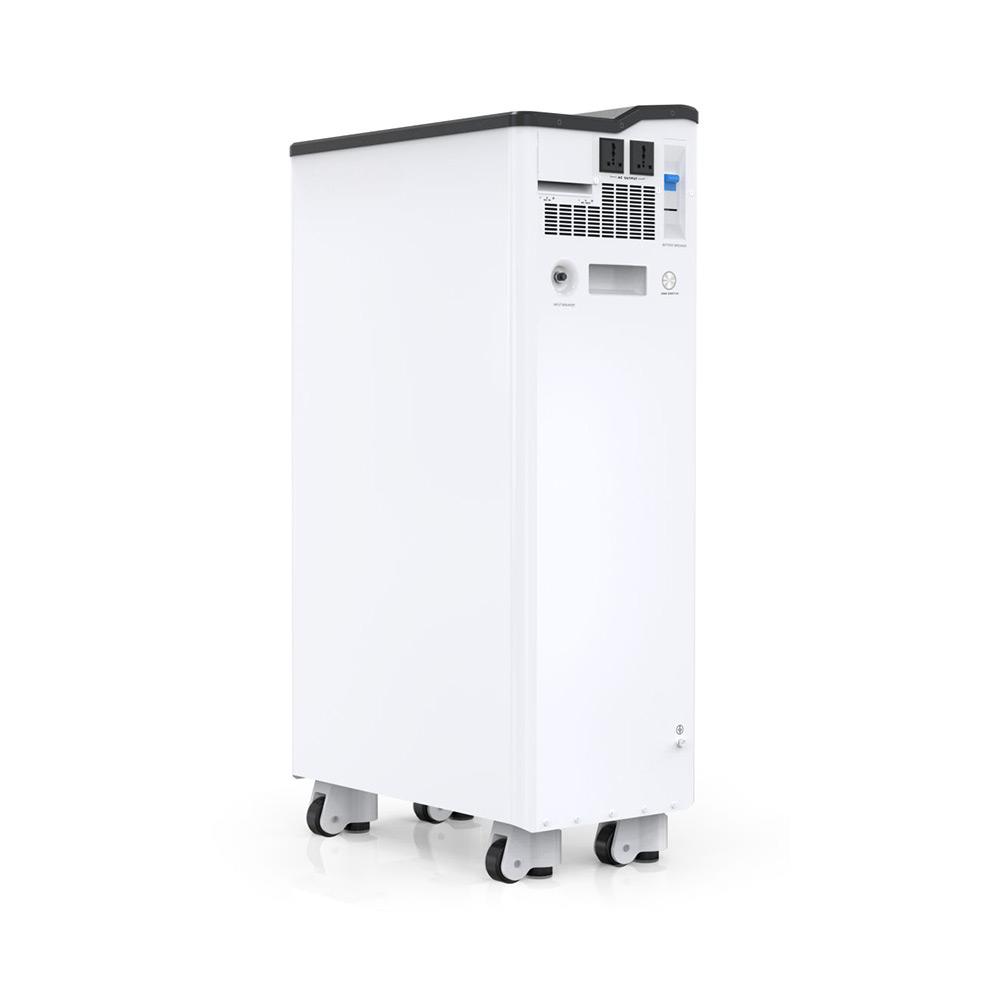
An all-in-one configuration pairs the inverter and LiFePO4 storage in a single enclosure — an alternative to separate hybrid inverter and battery procurement for sites with limited installation space.
Compliance Claims: What Standards Do and Do Not Prove
IEC 62109-2:2011 specifies particular safety requirements for inverters used in photovoltaic power systems, covering inverter products and products that perform inverter functions alongside other functions. For a hybrid inverter, that scope is directly applicable, and it is a safety standard — not a grid-interconnection approval, and not a certificate.
That distinction is where many EU procurement documents go wrong. A supplier stating compliance with a safety standard has said something narrow and verifiable. A supplier stating that a unit "meets EU requirements" has said something broad that should be decomposed into three separate questions: PV safety, grid interface, and electromagnetic compatibility.
An Indian government technical specification illustrates the structure of a complete requirement set, listing 230/415 VAC output, 50 Hz frequency, efficiency above 97%, and references to IEC 61683, IEC 61727 or VDE-AR-N 4105, IEC/EN 62109-1 and IEC/EN 62109-2, plus the IEC/EN 61000 series for EMC. That list is India-specific and should not be generalized to EU projects — but its shape is instructive. A credible compliance package names the standard, the part number and the issuing body; it does not summarize them into a single sentence.
Trade classification adds a parallel caution. Hybrid inverters with maximum power point tracking are classified under HS 8504.40.84 in the referenced tariff source, while HS 850440 is a broader static-converter heading that also covers chargers, rectifiers and power supplies. Import planning based on the broad heading will overstate or misattribute volume and may misprice duty.
Market Signals Worth Reading Carefully
Two market datapoints are worth carrying into a business case, both sourced to Grand View Research. Global solar hybrid inverter market size was valued at USD 10.7 billion in 2024. North America held a 42.9% revenue share in the same year, with three-phase hybrid inverters at 61.3% of revenue.
These figures require a caveat that the research houses themselves acknowledge: estimates vary between providers partly because of how battery storage revenue is treated inside the "hybrid inverter" category. A buyer or distributor using market size to justify an inventory decision should confirm the boundary definition first. The direction of the data — three-phase dominance and concentration of revenue in a single region — is more robust than any single decimal.
For EU-facing agricultural, construction and equipment buyers, the practical implication is not a forecast. It is that the supply base for three-phase hybrid inverters in the 10–15 kW band is deeper and more competitive than for single-phase units in the same power range, which generally improves availability and customization options.
Comparison with Alternative Approaches
The table below compares the inverter architectures available within this portfolio against the constraints typical of the three sectors discussed. It is a fit comparison, not a ranking.
| Architecture | Listed ratings | Best fit | Main limitation |
|---|---|---|---|
| Hybrid Inverter | 6 kW, 10 kW, 12 kW, 15 kW; EU 220–230 V; 50/60 Hz; IP21–IP67 | Mixed site loads requiring stored backup: farms, site compounds, field nodes | Single-unit ceiling of 15 kW; larger sites need parallel units or a different line |
| On-Grid Inverter | 2 kW–320 kW; EU 220–230 V or US 110–120 V; IP21–IP67 | Grid-tied export or self-consumption without backup duty | No energy storage path for grid-loss continuity |
| On & Off Grid Inverter | 1.2 kW, 2.2 kW, 4.2 kW, 6.2 kW, 12 kW; EU 220–230 V; 50 Hz | Smaller standalone sites and transitional installs | Power ceiling below most three-phase agricultural and construction loads |
| Micro Inverter | 800 W, 1,000 W, 2,000 W; EU 220–230 V; 50 Hz; IP67 | Panel-level conversion on fragmented or shaded arrays | Multiple units required at 6–15 kW; backup must be architected separately |
| All-in-One Energy Storage System | MF-4.2K+8 kWh, MF-6.2K+10 kWh, MF-12K+16 kWh; LiFePO4; IP21–IP67 | Sites with limited installation space and a single commissioning point | Fixed inverter-to-battery pairing reduces later capacity flexibility |
Where the 6–15 kW Hybrid Approach Reaches Its Limit
A fair assessment has to state the boundary. Three limitations recur in agricultural, construction and military projects.
- Power ceiling. At 15 kW per unit, larger irrigation schemes, multi-block construction compounds and battalion-scale field deployments exceed a single unit and require parallel architecture or a different product line.
- IP rating is a configuration, not a guarantee. The series spans IP21 to IP67. An IP21 unit installed in a pump house or an open site will not deliver the service life implied by the higher-rated variants, and the buyer — not the supplier — usually owns that specification decision.
- Standards currency. Off-grid guidance such as IEC TS 62257-9-7:2019 must be checked for replacement status before it is written into a tender, and safety compliance under IEC 62109-2 does not by itself satisfy national grid-connection rules in any EU member state.
Procurement Checklist for 6–15 kW Hybrid Inverter Projects
The following criteria map directly to the constraint questions that dominate research and evaluation stages in this band.
| Criterion | What to confirm | Why it decides the purchase |
|---|---|---|
| Phase configuration | Single-phase 6 kW vs three-phase 10/12/15 kW | Determines whether three-phase site loads can be served at all |
| Enclosure rating | IP21, IP55, IP65, IP66 or IP67 selected explicitly | Sets the installation location and expected service life |
| Grid interface | EU 220–230 V output, 50 Hz rated frequency | Must match the destination grid and local connection rules |
| Storage pairing | 5 kWh (6000 cycles) or 16 kWh (8000 cycles), both at 90% DOD / 25 °C | Defines usable backup duration and replacement horizon |
| Warranty | 5-year coverage stated in the offer | Governs total cost across a multi-year project cycle |
| Compliance evidence | Named standards, parts and issuing bodies | Required for tender submission and site audit |
| Supply terms | MOQ 2 pcs, 30–45 day lead time, OEM/ODM/SKD options | Determines whether phased site rollout is feasible |
| Customization scope | Wi-Fi, battery, 4G/5G, IP rating, power | Allows the unit to match site conditions rather than the reverse |
Future Outlook
Three developments are likely to shape how this band is specified over the next procurement cycles. First, the compliance conversation is moving from safety standards toward market-specific grid interface requirements, which raises the documentation burden on suppliers serving multiple EU markets. Second, the replacement of older off-grid technical specifications means project specifications written several years ago may now reference superseded guidance, creating a correction cycle in public and institutional tenders. Third, the distinction between a hybrid inverter and an all-in-one storage system is becoming a siting decision rather than a technical one, as both formats now cover the same 4–16 kWh storage range.
For buyers, the practical consequence is that specification discipline matters more than product novelty. A 6–15 kW hybrid inverter with a clearly stated IP rating, a documented battery duty cycle and a named standards package is easier to defend in three years than a marginally better-performing unit with an ambiguous datasheet.
FAQ
What EU electrical parameters should a 6–15 kW hybrid inverter match?
The hybrid inverter series in this portfolio lists EU standard 220 V–230 V output with a rated grid frequency of 50 Hz or 60 Hz. The 6 kW model is documented as a single-phase EU-standard unit, while the 10 kW, 12 kW and 15 kW models are documented as three-phase EU-standard units. Matching phase configuration and nominal voltage to the site supply is the first screening step.
Which IP rating is required for an outdoor farm or construction site installation?
The series offers IP21, IP55, IP65, IP66 and IP67 as selectable protection degrees. IP21 is an indoor-oriented rating, while IP65, IP66 and IP67 variants are the appropriate choices for exposed agricultural, construction and field positions subject to dust, driven rain or wash-down. The rating must be written explicitly into the purchase specification, because the same inverter family is supplied across the full range.
How long will the battery last under daily cycling?
Rated cycle life is 8000 cycles for the 16 kWh wall-mounted and floor-standing unit and 6000 cycles for the 5 kWh unit, both specified at 90% depth of discharge, 25 °C and a 0.5C–1C rate, with LiFePO4 chemistry in an aluminium alloy enclosure. These are stated test conditions; operation at higher ambient temperatures or deeper discharge will shorten service life relative to those figures.
What warranty period applies to the inverter and storage units?
The warranty period stated in the available product documentation is 5 years. Buyers should confirm in the purchase contract whether the coverage applies equally to the inverter and to the battery, and whether extended warranty is available, since the supplier's after-sales scope includes extended warranty as a service option.
Which standards should an EU buyer ask a hybrid inverter supplier to document?
IEC 62109-2:2011 specifies particular safety requirements for inverters used in photovoltaic power systems and is the relevant safety reference for inverter products and products performing inverter functions. It does not cover grid interconnection or electromagnetic compatibility. A complete evidence package should separately address the destination market's grid-connection rules and EMC requirements, and should name each standard with its part number rather than summarizing compliance in a single sentence.
Can a 6–15 kW hybrid inverter run a three-phase irrigation pump?
Only where the site is served by a three-phase model and the pump's starting and running characteristics fall within the unit's rating. The 10 kW, 12 kW and 15 kW models are documented as three-phase EU-standard units, while the 6 kW model is a single-phase unit. Loads above 15 kW per unit require parallel architecture or a higher-power inverter line.
When should a micro inverter be selected instead of a hybrid inverter?
Micro inverters in this portfolio are rated 800 W, 1000 W and 2000 W with IP67 protection and EU standard 220 V–230 V output at 50 Hz. They suit panel-level conversion on fragmented, partially shaded or physically distributed arrays. A 6–15 kW site load requiring stored backup is better served by a single hybrid inverter, since multiple micro inverters would be needed at those power levels and the backup architecture would have to be designed separately.
What lead time and minimum order quantity apply?
The supplier reports a minimum order quantity of 2 pcs and a lead time of 30–45 days, with OEM, ODM and SKD production modes, a monthly capacity of 100,000 sets and 100% testing. These are manufacturer-reported terms and should be confirmed against a specific quotation for the required rating, IP variant and customization scope.
Product documentation for the inverter and storage series referenced in this article is available as a downloadable brochure: Yeyanghong Energy product brochure (PDF).
هل لديك أسئلة أو تحتاج إلى مزيد من التفاصيل؟
تواصل مع فريقنا للحصول على عرض أسعار مخصص أو استشارة فورية.
طلب عرض أسعار
املأ النموذج أدناه وسيتواصل معك فريقنا بعرض مقترح مخصص.
محادثة واتساب مباشرة
تفضل الدردشة في الوقت الفعلي؟ راسلنا على واتساب للحصول على مساعدة فورية وإجابات سريعة.
- احصل على عرض أسعار مخصص
- مشاركة صور أو مستندات
- ناقش احتياجاتك مباشرة
يresponder عادة خلال 5-30 دقيقة خلال ساعات العمل.