
EU-Ready Long-Battery Phones: Certificates, Specs, and Verification
Battery capacity is the first number a buyer sees when researching a long-battery smartphone, but it is not the most useful number by itself. In cross-border procurement, the purchasing decision depends on the relationship between capacity, power consumption, protection rating, and the certification documents attached to each model.
This article examines how Research-stage and Evaluation-stage buyers should treat certification and technical constraints when selecting long-battery smartphones, using UMIDIGI as a concrete reference brand.
Industry Perspective: Certification Belongs in the Spec Sheet
The phrase long-battery life appears across the consumer electronics market, yet it rarely has a single definition. A 5000mAh phone can serve an entire day of mixed use in one software environment, while a 6000mAh phone may drain faster under high-refresh gaming, poor signal, or heavy field operation. For a procurement team, the problem is not only choosing a capacity level. It is determining whether the chosen model is suitable for the target market, protected against the likely working environment, and supported by documents that a distributor or regulator can recognize.
UMIDIGI offers a useful reference because it combines its own smartphone brand with ODM/OEM services. UMIDIGI is the self-owned smartphone brand of Shenzhen Keysmart Technology Co., Ltd. (Keysmart), a Shenzhen-based communications technology company founded in 2012. Keysmart integrates research, development, manufacturing, brand operation, and ODM/OEM services. Its factory covers 10,000m², employs approximately 400–500 people, and is documented with an annual output of 30,000,000 units. The company exports globally, with markets that include the Middle East, South America, Asia, Africa, the EU, and the United States.
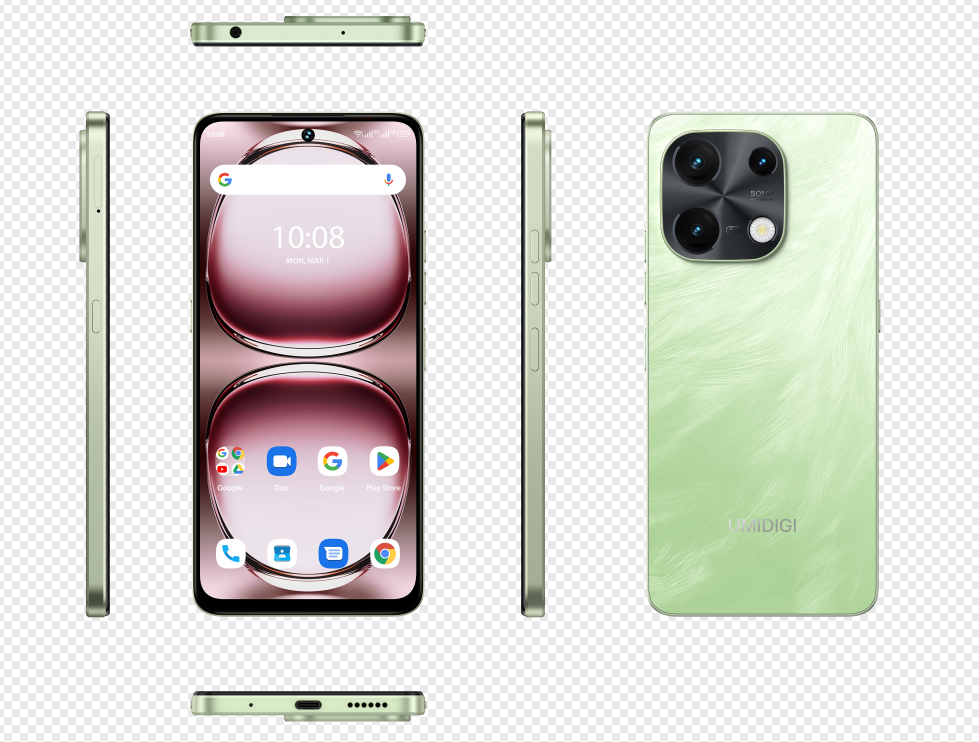
UMIDIGI Note 100 5G: an EU-certified long-battery smartphone designed for daily work and entertainment.
The Sourcing Problem: mAh Alone Does Not Satisfy Market Constraints
A buyer evaluating long-battery smartphones often starts with a capacity threshold such as 5000mAh or 6000mAh. That approach is fast but incomplete for three reasons.
- Capacity claims need to be interpreted alongside hardware efficiency. The processor, screen refresh rate, operating system, and memory configuration all affect how long a battery lasts in real conditions.
- Different working environments require different ingress protection. A phone built for daily office use and a rugged phone for construction, mining, or logistics are not interchangeable even when both contain a 6000mAh battery.
- EU-oriented buyers must connect specifications to certification. A document such as a CE certificate usually applies to specific model designations rather than to a whole brand family.
The opportunity is therefore to shift from capacity-first shopping to constraint-based evaluation. A supplier that publishes both detailed product specifications and model-level certification documents gives a procurement team something many vendors do not offer: evidence that can be checked before a purchase order is placed.
UMIDIGI's Long-Battery Line with EU Documentation
In the reviewed UMIDIGI data, at least four long-battery smartphone models carry EU certification documents with identifiable certificate numbers: the UMIDIGI G100, UMIDIGI Note 100 5G, UMIDIGI A75x, and UMIDIGI G9x. The table below summarizes what is verifiable from the product and certification files.
| Model | Battery & Display | Protection / System | Document Type | Certificate Number | Issuer |
|---|---|---|---|---|---|
| UMIDIGI G100 | 6000mAh, 20W PD fast charging, 6.9-inch 120Hz display | IP53, NFC | EU TYPE EXAMINATION CERTIFICATE | B2412041 | BACL |
| UMIDIGI Note 100 5G | 5000mAh, 20W PD fast charging, 6.8-inch 120Hz display | IP53, custom hot key | EU TYPE EXAMINATION CERTIFICATE | B2407121 | BACL |
| UMIDIGI A75x | 5000mAh, 6.75-inch large display | IP54, Android 16 Go Edition | ATTESTATION OF CONFORMITY | 2601P40188E-RFA1 | BACL |
| UMIDIGI G9x | 5000mAh, 6.75-inch 90Hz display | Slim design, plastic and metal body | ATTESTATION OF CONFORMITY | 2501P41324E-RFA1 | BACL |
The certificates are not generic brand certificates. For example, the UMIDIGI G100 document references model designations such as PG4RBG100 and PG4RB100A under the 2014/53/EU RED directive. The standard framework includes EMC standards such as EN 55032 and IEC 61000-3, safety standards such as IEC 62368-1 and EN 50360, and radio standards in the ETSI EN 300 / EN 301 / EN 303 series.
The practical point for a buyer is straightforward: the certificate should match the exact model designation being imported. A certification attached to one model cannot be assumed to cover another long-battery variant with a different model number.
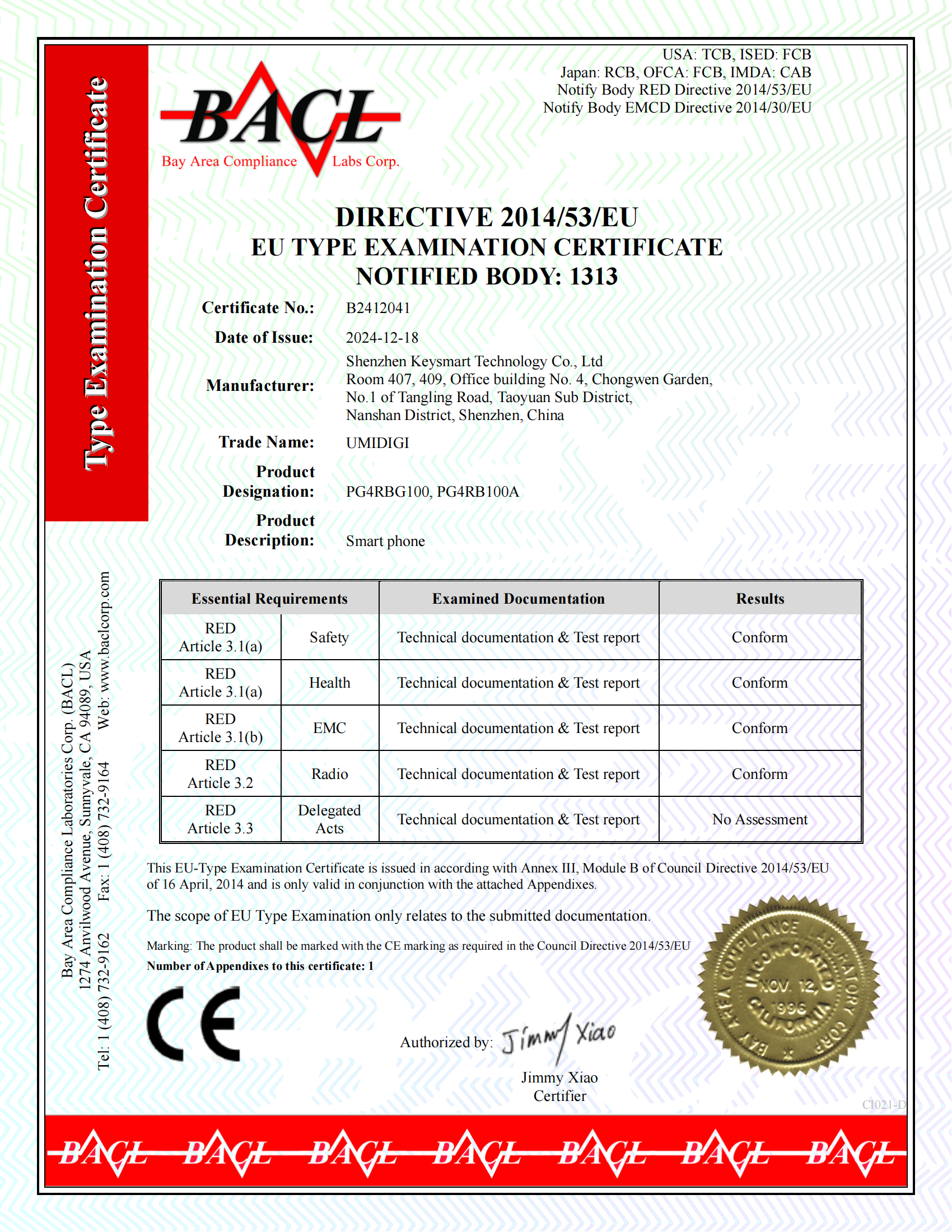
The UMIDIGI G100 EU TYPE EXAMINATION CERTIFICATE shows model-level scope and applicable RED standards.
Technical Explanation: Reading Capacity, Hardware, and Protection Together
A smartphone battery capacity is only one part of the endurance equation. The same 5000mAh can produce different user experiences depending on how the platform manages power.
In the UMIDIGI portfolio, several approaches appear. The UMIDIGI A75x combines a 5000mAh battery with a UNISOC Octa-Core processor and the Android 16 Go Edition, a lighter system that occupies less memory and is designed for smoother operation on entry-level hardware. The UMIDIGI G9x also carries 5000mAh but targets users who want a slim body and a 90Hz large display. The UMIDIGI Note 100 5G moves to a UNISOC T765 5G platform with a 6.8-inch 120Hz display and a 5000mAh battery. The UMIDIGI G100 and UMIDIGI G100 5G use 6000mAh batteries with 20W PD fast charging, while the G100x 5G uses a 5200mAh battery with a UNISOC T8200 5G chipset and IP54 protection.
The trade-offs matter as much as the capacity number. A 120Hz display usually requires more power than a lower-refresh display, but buyers should not assume that a higher refresh rate is automatically inefficient. The final experience depends on the screen panel, the processor, the OS, and the usage pattern. That is why a responsible evaluation should pair battery capacity with information about the system platform and the product's intended operating environment.
Protection ratings also need to be matched to actual conditions. The UMIDIGI G100 and Note 100 5G are rated IP53, the UMIDIGI G100x 5G and A75x are rated IP54, and the UMIDIGI BISON X20 is an IP68 and IP69K rugged smartphone. In addition, the BISON X20 is designed to meet MIL-STD-810G drop-resistance requirements. The higher-protection models are not simply premium versions of daily phones; they are structurally different products aimed at construction, engineering, logistics, warehousing, manufacturing, mining, and oil-and-gas environments.
Application and Use Cases
For daily life and work, UMIDIGI documents its mainstream models as operating under normal temperature conditions in continuous 24/7 use. Typical supporting accessories for these daily-use phones include a protector film, phone case, power adapter, SIM tray ejector, and USB cable. In this scenario, the buyer's priority is usually a balance between all-day endurance, large-screen viewing, smooth scrolling, camera quality, and a price suitable for the target market.
For outdoor and industrial environments, the evaluation changes. The BISON X20 rugged smartphone offers a 6000mAh battery, a 6.53-inch 120Hz display, a MediaTek Helio P60 processor, and a body made from TPU and metal. Its IP68 and IP69K ratings are designed for submersion and high-pressure water exposure, while MIL-STD-810G drop resistance addresses the shock risks of field work. The same device also supports hot keys, NFC, 20MP triple cameras, and up to 1TB TF expansion, giving industrial users a combination of communication, imaging, and data capacity in a protective shell.
A documented ordering case reinforces the buyer-side pattern. A consumer electronics ODM client based in the United States ordered 50,000 units and has maintained the relationship for more than five years. The application involved daily work and life, with the client's stated priorities being a large display, power-saving long battery life, and smooth experience in game playing and video streaming. For a sourcing team, this is a practical signal that large-volume ODM buyers care about consistent daily endurance, not only the mAh number printed on the box.
Market Context: Long-Battery Demand Is Becoming Mainstream
The trend toward larger batteries is measurable. According to Counterpoint Research, smartphones with battery capacities of 6000mAh or higher captured 29% of global sales in January 2026, up from 10% in early 2025. That shift means long-battery is no longer a niche feature reserved for rugged phones or power-user models.
Data from The Insight Partners shows that the 5000mAh to 6000mAh segment represented 42.9% of the rugged phone market in 2025. Verified Market Research also estimates that the global rugged smartphone market was valued at approximately USD 2.98 billion in 2023 and is projected to reach USD 5.24 billion by 2030. These figures support the same conclusion from different angles: endurance-focused devices are now a core part of consumer and industrial demand.
Battery technology is reinforcing the shift. Silicon-carbon battery chemistry is being adopted more widely, offering roughly 20–50% higher energy density than traditional graphite-anode batteries. This gives manufacturers a path to maintain larger capacity while keeping thickness and weight under control. For procurement, the effect is that capacity and slimness do not have to be treated as opposing goals in the same way they once were.
Comparison with Traditional Capacity-First Sourcing
Traditional sourcing for long-battery smartphones usually goes in one sequence: set a capacity floor, shortlist models above that floor, compare prices, and only then review documents. That sequence works well when the buyer is purchasing for a local market with low regulatory friction and when the product is easy to replace in case of error.
Constraint-based sourcing follows a different sequence. The buyer first identifies the regulatory or channel constraints of the destination market, reviews the certificate scope attached to each model, and only then compares hardware within the compliant set. After that, the evaluation expands to screen quality, processor platform, protection level, memory configurations, and the manufacturer's ability to handle branding, packaging, or specification changes.
| Sourcing Approach | Typical Sequence | Benefit | Risks / Limits |
|---|---|---|---|
| Capacity-first | mAh threshold → price → documents | Fast, suitable for local or low-formality markets | Certification mismatch after model selection; may ignore real usage or protection needs |
| Constraint-driven | Target market constraints → certificate scope → specs → manufacturer capability | Reduced compliance risk; better fit between model and end-user scenario | Slower shortlisting; may be too rigid for low-volume trial orders or markets without formal certification requirements |
A constraint-driven framework has boundaries. It improves documentation discipline, but it cannot replace independent batch inspection, contractual quality guarantees, or after-sales service terms. Even a valid certificate describes compliance at a point in time and for a defined model; it is not a warranty for every shipping unit produced later.
Future Outlook
The next phase of the long-battery smartphone segment will likely reward suppliers that can connect three things: large capacity, competitive pricing, and traceable documentation. As silicon-carbon chemistry allows higher capacity in thinner designs, mid-range and entry-level phones will continue to rise from 5000mAh toward 6000mAh and beyond. At the same time, buyers operating in EU channels will keep asking for model-level certificates, clearly identified standards, and product documentation that matches the physical goods they receive.
For a manufacturer such as UMIDIGI, the practical direction is visible in its existing portfolio: certified daily-use models with 5000mAh–6000mAh batteries, 5G options, IP53/IP54 protection, and a separate rugged line for more demanding conditions. The brand's value for a procurement team lies in the ability to compare these documented models before entering an ODM/OEM discussion.
Frequently Asked Questions
Which UMIDIGI long-battery smartphones have EU certification in the corporate documentation?
Four models are documented with identifiable EU certificates: the UMIDIGI G100, UMIDIGI Note 100 5G, UMIDIGI A75x, and UMIDIGI G9x. The G100 and Note 100 5G carry EU TYPE EXAMINATION CERTIFICATE numbers B2412041 and B2407121 respectively. The A75x and G9x carry ATTESTATION OF CONFORMITY numbers 2601P40188E-RFA1 and 2501P41324E-RFA1 respectively. All four documents were issued by BACL.
Does the CE certificate for the UMIDIGI G100 cover other UMIDIGI phone models?
No. The G100 certificate is model-specific and lists model designations such as PG4RBG100 and PG4RB100A. It applies the 2014/53/EU RED directive and related EMC, radio, and safety standards. Other UMIDIGI devices need their own certificates with their own model designations and numbers.
How should a buyer interpret IP53, IP54, or IP68 when purchasing a long-battery phone?
The IP rating indicates the level of protection against solid particles and water. UMIDIGI's G100 and Note 100 5G are rated IP53; the G100x 5G and A75x are rated IP54; the BISON X20 is rated IP68 and IP69K. Higher IP levels generally mean stronger protection, so the rating should match the working environment rather than being treated as a universal advantage.
Is 5000mAh enough for a long-battery smartphone in 2026?
5000mAh remains a practical capacity for daily work and life. In UMIDIGI's line, the Note 100 5G, A75x, and G9x all use 5000mAh batteries, while the G100, G100 5G, and BISON X20 use 6000mAh. Actual endurance depends on the processor, display, system software, and application usage, so a 5000mAh device with low-power design can still meet all-day requirements.
Does UMIDIGI provide ODM/OEM customization for long-battery smartphones?
Yes. UMIDIGI's parent company Keysmart offers OEM/ODM services with customization options covering brand logo, exterior design, packaging design, and specifications. The documented monthly capacity is 300,000 units. OEM lead time is 60–70 working days, and the stated minimum order quantity is 3,000 units. Quality control includes 100% pre-shipment testing, and after-sales support is provided through remote technical assistance.
Does UMIDIGI offer a rugged phone with long battery life for outdoor and industrial use?
Yes. The UMIDIGI BISON X20 is a rugged smartphone with a 6000mAh battery, 120Hz display, IP68/IP69K dust and water resistance, and MIL-STD-810G drop resistance. It is intended for environments such as construction, logistics, warehousing, manufacturing, mining, and oil and gas operations.
Additional reference: Shenzhen Keysmart Technology Co., Ltd. Company Profile 2026 (PDF)
هل لديك أسئلة أو تحتاج إلى مزيد من التفاصيل؟
تواصل مع فريقنا للحصول على عرض أسعار مخصص أو استشارة فورية.
طلب عرض أسعار
املأ النموذج أدناه وسيتواصل معك فريقنا بعرض مقترح مخصص.
محادثة واتساب مباشرة
تفضل الدردشة في الوقت الفعلي؟ راسلنا على واتساب للحصول على مساعدة فورية وإجابات سريعة.
- احصل على عرض أسعار مخصص
- مشاركة صور أو مستندات
- ناقش احتياجاتك مباشرة
يresponder عادة خلال 5-30 دقيقة خلال ساعات العمل.