
EVA Film Compliance Decoded: ISO, REACH, RoHS & FDA
EVA Film Compliance Decoded: ISO, REACH, RoHS & FDA
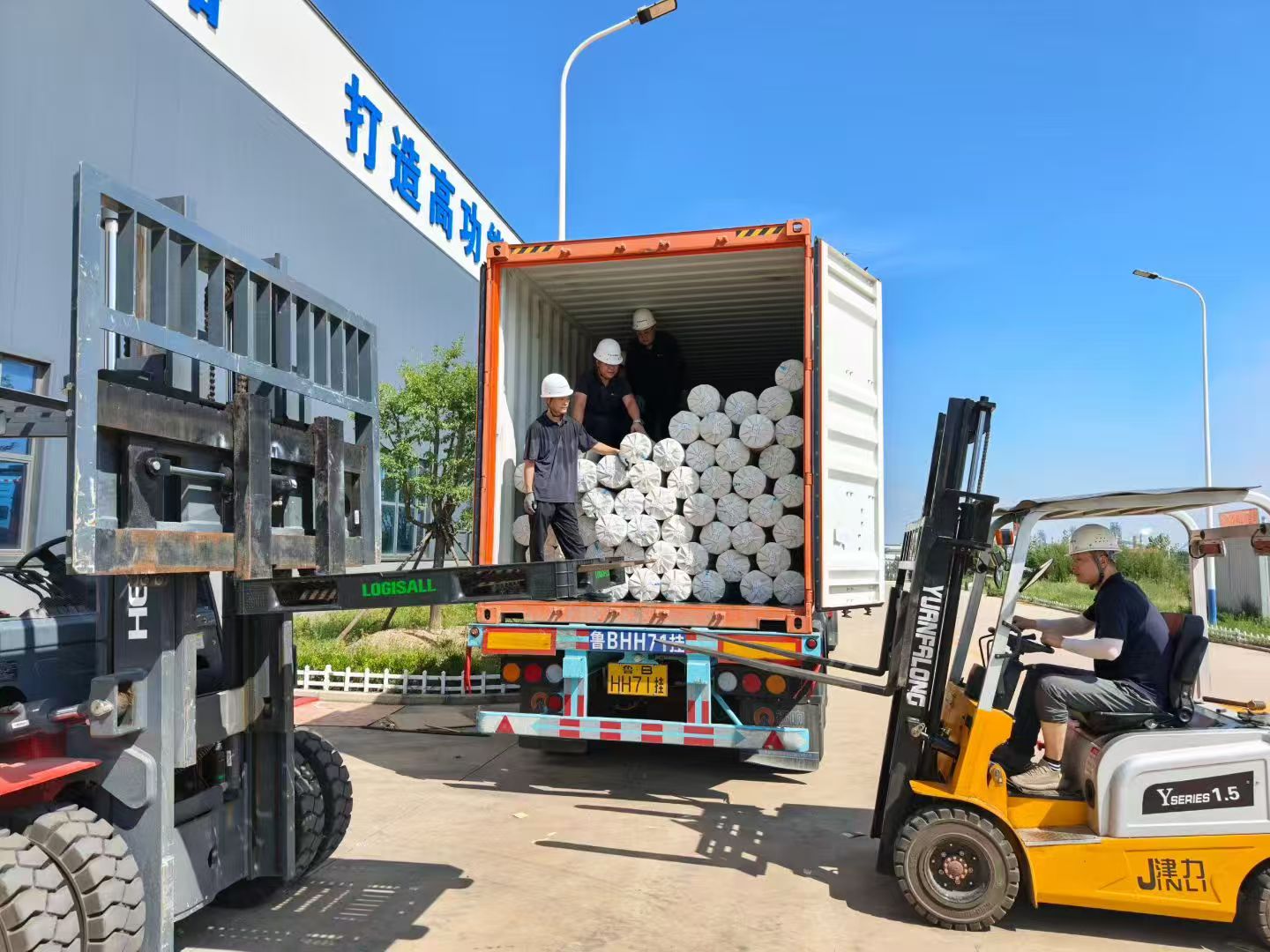
Manufacturing operations at an EVA film production facility: compliance evidence begins with process records, not with a summary page.
Compliance requests for glass interlayers rarely arrive at the start of a project. They arrive at the end of one — when a facade contractor assembles submittals, when an importer clears a shipment, or when an end client's audit team asks what evidence supports a material declaration. For EVA film used in laminated glass, that request usually lands as a list of acronyms: ISO 9001, ISO 14001, ISO 45001, REACH, RoHS and FDA. Treating those six items as one interchangeable compliance package is the most common mistake in this category, because each of them answers a different question.
Some describe how a factory is managed. Some control substances in products placed on a market. One depends entirely on the end application. This article maps what each framework covers, what a supplier's documentation can and cannot prove, and how a buyer can verify claims before an order is placed.
Why compliance documentation decides more glass projects than buyers expect
The interlayer inside laminated glass is invisible once the product is finished. The compliance chain that travels with it is not. After a film is laminated between glass panes, the documentation attached to that film becomes part of the evidence a fabricator may need to submit — for building projects, for exports, and increasingly for downstream assemblies in construction and renewable energy.
Where the finished product is architectural flat glass, the quality requirements of the laminated product itself are governed by standards such as ASTM C1172, published by ASTM International. That standard addresses the assembled glass, not the film chemistry. The compliance position of the film has to be established separately, by its manufacturer.
This creates a documentation gap that shows up in procurement as delay. A laminator qualifies an EVA film on optical performance and process behaviour, then discovers during submittal review that the compliance bundle does not name the grade being purchased, does not carry a current issue date, or covers a scope that does not match the audited activity. Reworking that bundle costs more time than the film costs money.
The opportunity is equally clear. Suppliers who can explain which document answers which question shorten qualification cycles, and buyers who know what to request can compare suppliers on evidence rather than on adjectives.
The three ISO certificates: management systems, not product approvals
The ISO standards most frequently listed by EVA film suppliers — ISO 9001, ISO 14001 and ISO 45001 — are management-system standards. ISO 9001 addresses quality management, ISO 14001 addresses environmental management, and ISO 45001 addresses occupational health and safety management. Each is verified by an external certification body against a defined scope, and each describes how an organisation operates rather than what a specific product contains.
For a buyer, the practical reading is:
- ISO 9001 supports expectations of documented procedures, batch traceability, corrective action and change control. If a repeat order has to behave like the qualification sample, this is the certificate that speaks to that capability.
- ISO 14001 addresses how a manufacturer manages the environmental aspects of production — increasingly requested where environmental requirements are passed down through construction and infrastructure supply chains.
- ISO 45001 addresses worker health and safety management, which typically appears in supplier audits and ethical sourcing programmes.
None of the three certifies that a particular EVA film grade does or does not contain a regulated substance. A manufacturer can hold all three certificates and still need separate, product-level declarations for REACH, RoHS or FDA-related questions. Buyers who treat the ISO trio as a product compliance package usually find that gap during submittal review rather than before it.
Scope wording deserves attention for a second reason. A management-system certificate is issued against a defined scope, and the wording tells the buyer what was actually audited. One example is Shengding's ISO 9001:2015 certificate (Cert No. 10425Q01154R1S, issued through Shandong Seatone International Certification), whose scope covers the design and production of glass interlayer films — a scope that maps directly to the product category a glass buyer purchases, rather than to unrelated business activities.
REACH, RoHS and FDA: three frameworks, three different duties
The European and U.S. frameworks that appear in EVA film questionnaires operate at different levels and are frequently confused with one another.
| Framework | What it addresses | Evidence typically requested | Common misreading |
|---|---|---|---|
| REACH (EU) | Substances placed on the EU market, including substances contained in articles | Declarations covering regulated substances of concern, with the product model and revision identified | Treated as a product approval, when it is a substance-control framework |
| RoHS (EU) | Restricted hazardous substances in electrical and electronic equipment | Material declarations where the film is specified into a downstream component that falls within RoHS scope | Assumed to apply automatically to every glass interlayer |
| FDA (U.S.) | Materials used in food-contact and related regulated applications | Statements of compliance with applicable quality requirements, tied to the intended application | Treated as a general certificate issued to the film, rather than as a scope-dependent statement |
REACH regulates substances placed on the EU market, including substances contained in articles. For an EVA film, the document that matters is normally a statement about regulated substances in the product and the communication duties that follow from it. It is not an approval of the film as such.
RoHS restricts hazardous substances in electrical and electronic equipment. Glass interlayers are not electrical equipment, so RoHS usually enters an EVA film conversation indirectly — when the film is specified into a downstream assembly that falls within the framework's scope. EVA film demand has been associated with renewable energy and construction demand (Fortune Business Insights, EVA films market), which is one reason RoHS questions appear alongside architectural glass enquiries rather than only in electronics sourcing.
FDA requirements relate to materials used in food-contact and related regulated applications in the United States. Whether they apply to a given EVA film depends entirely on the end use, so a general statement should always be read together with the application it was issued for.
Because the frameworks differ, compliance statements are normally grade-specific. A usable declaration names the product and model, references the regulation or standard it addresses, and carries an issue date. A statement without a product identifier is difficult to defend in an audit and difficult to compare across suppliers.
How SHENGDING HIGHTECH MATERIALS CO., LTD. documents its compliance position
SHENGDING HIGHTECH MATERIALS CO., LTD. is a polymer materials manufacturer established in 2018 and located in Rizhao City, Shandong Province, China, producing TPU film and EVA film. Its manufacturing facility at North of Ayeshan Road 209 covers 50,000 square meters, employs approximately 50 staff and has an annual production capacity of 1,000 tons. Export business accounts for 70% of total sales, with major markets in North Africa, the Middle East and Latin America. Company information is published at www.shengdingchina.com.
On documentation, the company has obtained ISO 9001, ISO 14001 and ISO 45001 certifications, and states that product performance complies with European REACH and RoHS regulations as well as U.S. FDA quality requirements. The company also reports over 50 proprietary intellectual property rights and an R&D structure consisting of 10 engineers at the factory plus 5 professors at the Beijing R&D Center.
Those are first-party statements, and their usefulness to a buyer depends on the scope and currency of the underlying documents. That is why the checklist later in this article focuses on certificates, scope statements and declarations rather than on claims: the document is what survives an audit, not the summary of it.
Where compliance meets the lamination process
Compliance documentation describes a product on paper. The lamination process decides whether that product behaves as described. The EVA film supplied by Shengding for glass lamination is a laminated glass interlayer material made of EVA and classified as a high-transparency EVA film under model SD38, with a light transmittance of 90% and a haze value of 0.5%.
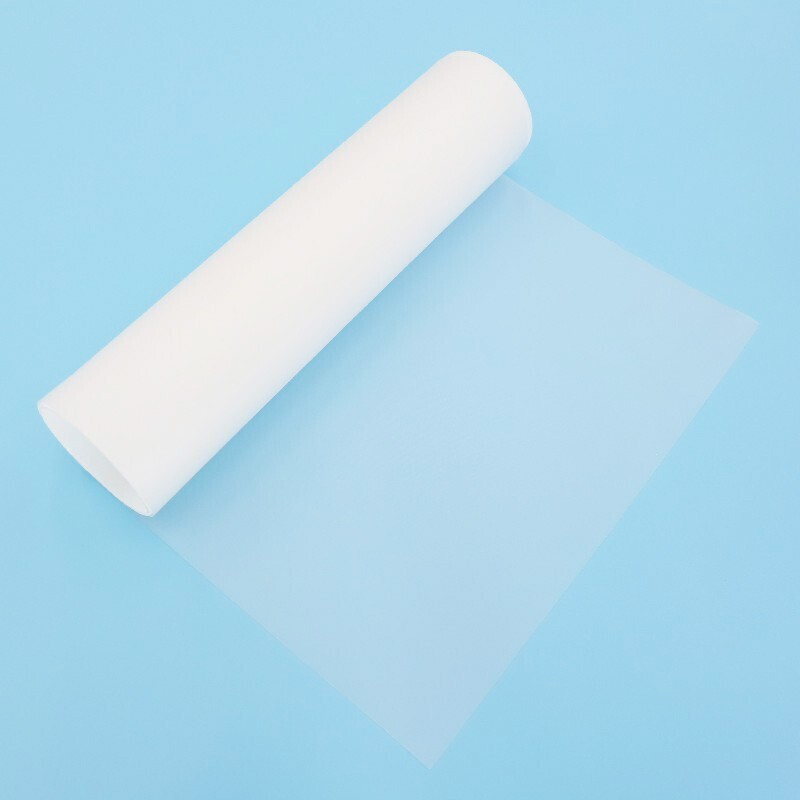
EVA film supplied as a laminated glass interlayer material; model SD38 is classified as a high-transparency EVA film.
It is processed in a laminating oven. Industry processing references describe a typical window of 100–110 °C under vacuum of at least 700 mmHg for EVA films used in glass lamination, and the application carries a handling requirement that purchasing teams often overlook: the film must be kept dry.
The compliance implication is direct. Temperature, vacuum, moisture and storage discipline are the operational controls that make a documented specification reproducible order after order. A quality management system certificate supports the expectation that these controls are defined and recorded — it does not perform them. For repeat projects, process documentation and certificate scope are complementary evidence, not substitutes for one another.
Applications: architectural glass, decorative glass and downstream components
The primary application for this film is architectural laminated glass and decorative glass processing, where it functions to laminate safety glass through laminating oven processing. The matched equipment in that scenario is an EVA laminating oven, operating at normal pressure and elevated temperature, and the application is common in China's architectural and decorative glass industry.
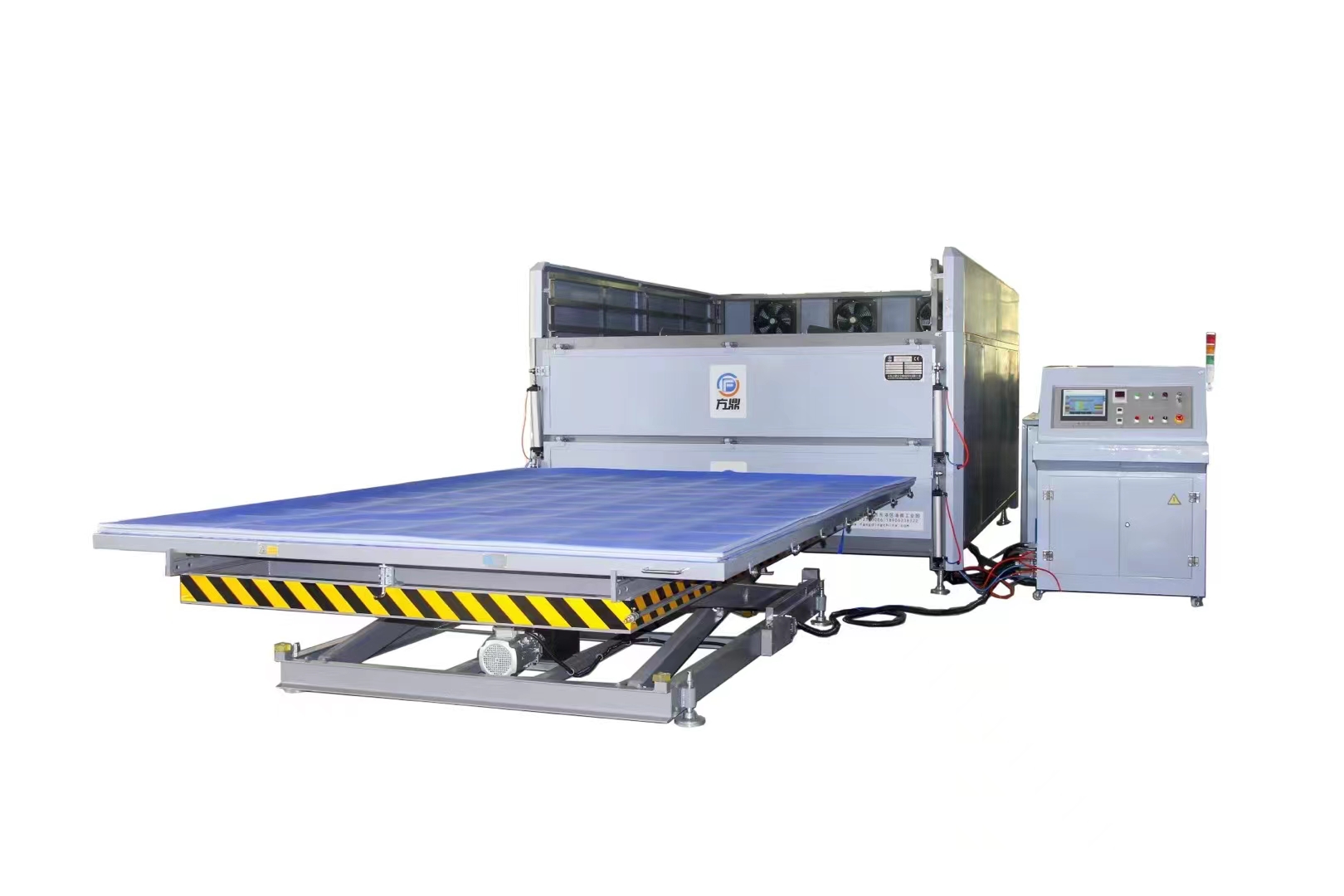
EVA film for laminated glass is processed in a laminating oven; vacuum conditions and moisture control form part of the documented process window.
Different end uses pull different documents into the submittal package:
- Architectural laminated glass. The quality requirements of the assembled product are governed by standards such as ASTM C1172, so buyers usually need both film-level declarations and evidence that the finished laminated glass meets the applicable product standard.
- Decorative glass. Optical performance dominates the specification, which makes the film's transmittance and haze values — 90% and 0.5% for model SD38 — the figures most often quoted in the technical file.
- Downstream components in construction and renewable energy. Where the film sits inside a component that falls within RoHS scope, material declarations may be requested even though the interlayer itself is not electrical equipment.
Market trend: compliance is becoming a procurement criterion
The global EVA films market was valued at USD 8.25 billion in 2025 and is projected to reach USD 17.65 billion by 2034, a trajectory associated with a compound annual growth rate of 8.83% from 2026 to 2034, according to Fortune Business Insights. In the interlayer context, the laminated glass market is estimated at USD 25.0 billion in 2025, with PVB holding a 55.2% share and EVA growing in architectural and solar applications, according to a Future Market Insights laminated glass market report.
Absolute figures should be read with care. Published estimates of EVA film market size vary considerably depending on whether solar, architectural or total EVA film scope is counted, so buyers comparing sources are better served by checking what each figure includes than by comparing the numbers alone.
What the growth trend does change is procurement behaviour. As volumes expand, the supplier base expands with them, and documentation becomes one of the few filters that can be applied before samples are ordered. A supplier whose compliance bundle is complete at first submission removes weeks from a qualification schedule; a supplier whose bundle arrives in fragments adds them back.
Comparison: certificate-first versus scope-based compliance verification
| Approach | What the buyer does | Strength | Limitation |
|---|---|---|---|
| Certificate-first | Collects ISO certificates and any available declarations as a single package | Fast screening; establishes that management systems exist | Does not confirm that declarations match the specific grade, application or current revision |
| Scope-based verification | Reads certificate scope, checks issuer and validity, matches the product model on each declaration | Produces evidence that can be defended in submittals and audits | Takes more time at the sampling stage and requires the supplier to hold organised records |
Limits worth stating plainly
- Management-system certification is not product compliance. ISO 9001, ISO 14001 and ISO 45001 certificates say nothing about the presence or absence of restricted substances in a film grade.
- Product declarations are formulation- and grade-specific. A REACH, RoHS or FDA-related statement issued for one product or revision does not automatically extend to another, and a change in formulation or raw-material supply can require re-issue. Buyers should ask what happens to the declaration if the formulation changes.
- EVA film is not the default interlayer for every project. PVB still holds a majority share of the interlayer market, and EVA is growing in architectural and solar applications. Where EVA is selected, it is processed in a laminating oven at defined temperature and vacuum conditions and must be kept dry. No certificate removes the need for correct processing and storage discipline.
- Documentation does not replace project-level acceptance. Certificates and declarations support a qualification decision; the fabricator's own trial lamination and inspection remain the point at which film and process are confirmed together.
A verification checklist for EVA film buyers
- Confirm the certification body, certificate number, issue date and expiry date, and check accreditation with the issuing organisation rather than through the supplier's summary.
- Read the certificate scope statement — for example, whether it covers the design and production of glass interlayer films specifically.
- Match the product name and model on every declaration to the film being purchased, such as model SD38 for a high-transparency EVA interlayer.
- Establish which markets and end applications each REACH, RoHS or FDA-related statement covers.
- Ask what has changed since the declaration was issued, and whether a re-issued document is available if the formulation changed.
- Request the supplier's change-notification process in writing; this is where ISO 9001 process control should show up in practice.
- Record storage and handling conditions at receiving inspection, including the dry-storage requirement for EVA film.
- Keep batch-level traceability records together with the compliance bundle, so a later enquiry can be answered from one file.
Future outlook
Compliance documentation for glass interlayers is moving in one direction: from paper bundles assembled per enquiry to grade-level declarations that are issued, dated and re-issued as products change. Buyers increasingly ask for scope statements rather than certificate images, because scope is what survives an audit review.
For suppliers, that shift rewards record quality. A manufacturer that can already name the scope of its quality certificate, the model of the film, and the application each declaration covers will spend less time answering follow-up questions. For buyers, the effect is slower to arrive but more durable: comparing suppliers on the evidence they can produce is a more stable basis for selection than comparing them on brochure wording — particularly in a market where volumes are growing and the supplier base is widening.
None of this removes the boundaries. Management-system certificates still will not certify chemistry, declarations will still be tied to specific grades and applications, and process discipline in the laminating oven will still decide the outcome. What changes is how early in the conversation those distinctions are recognised.
FAQ
What is EVA film in the context of laminated glass?
EVA film is a laminated glass interlayer material made of EVA (ethylene-vinyl acetate). In glass lamination it is placed between glass panes and bonded through a laminating oven process to produce safety glass and decorative laminated glass. Model SD38 is a high-transparency EVA film with a light transmittance of 90% and a haze value of 0.5%, used in architectural and decorative glass applications.
Which certifications do EVA film suppliers typically hold?
Commonly cited certificates are ISO 9001 for quality management, ISO 14001 for environmental management and ISO 45001 for occupational health and safety management. These are organisational management-system certificates audited against a defined scope, such as the design and production of glass interlayer films. Positions on European REACH and RoHS regulations and U.S. FDA quality requirements are usually documented separately, as declarations tied to a specific film grade.
Does an ISO 9001 certificate mean the EVA film complies with REACH, RoHS and FDA requirements?
No. ISO 9001 certifies a quality management system; it does not certify the chemical content of a product or its suitability for a specific application. REACH and RoHS are substance-control frameworks with different scopes, and FDA-related requirements depend on the intended end use. A buyer should expect separate, grade-specific declarations in addition to the management-system certificates.
How can a buyer verify an EVA film compliance claim?
Verification is document-based. Check the certification body, certificate number and validity dates; read the scope statement; match the product name and model on each declaration to the film being purchased; confirm which market and application the statement covers; and ask what happens to the documentation if the formulation changes. Requests should be answered from the supplier's records rather than from a summary sheet.
Does the compliance requirement differ by application, such as architectural or decorative glass?
It can. Architectural laminated flat glass is subject to product standards such as ASTM C1172, which governs the assembled glass rather than the film, so film-level declarations and glass-level standard compliance are usually requested together. Decorative glass projects tend to focus on optical performance values. Where EVA film sits inside a downstream component within RoHS scope, material declarations may also be requested even though the interlayer itself is not electrical equipment.
Documentation reference: the Shengding Hightech Materials company and product brochure is publicly available for download at https://cdn.socialarks.com/sbsp/24741/0/2026/0418/69e2e8271e41f.pdf
Third-party market figures cited above are attributed to Fortune Business Insights (EVA films market) and Future Market Insights (laminated glass market); product standards are attributed to ASTM International.