
EVA Film Supplier Capability Evidence: 50,000 m² Plant, 100 Tons/Month
EVA Film Supplier Capability Evidence: 50,000 m² Plant, 100 Tons/Month
EVA interlayer film is a small line in a laminated glass bill of materials and a consequential one in service. That asymmetry is why supplier capability claims deserve more scrutiny than the film's price per roll. A buyer in the evaluation-to-execution stage is not asking whether a manufacturer has a factory; the buyer is asking whether the numbers on a capability sheet survive contact with a purchase order, a pre-shipment inspection and a first lamination run.
This article assembles that evidence for SHENGDING HIGHTECH MATERIALS CO., LTD, a polymer materials manufacturer established in 2018 and located in the Lanshan Chemical Industry Park in Rizhao City, Shandong Province, China, producing TPU film and EVA film. It treats the supplier's declared figures as exactly that — declared — and marks where a certificate record, a third-party record or an independent test report is required to convert a claim into evidence.
What a Capability File Has to Prove Before a Purchase Order
A useful capability file answers four questions in a fixed order: can the plant make the volume, can it make the buyer's specific dimension and grade, can it prove consistency, and can it document compliance for the destination market. Marketing material usually answers the first question and skips the rest.
For EVA glass interlayer film, the four questions translate into specific artifacts. Volume maps to rated monthly capacity and annual output. Dimension and grade map to width and length customization and to OEM/ODM scope. Consistency maps to the testing regime and its records. Compliance maps to management-system certificates, substance-restriction documentation and any destination-specific requirement. A supplier that can produce all four artifacts is qualifying on evidence; a supplier that produces only the first is qualifying on optimism.
The Scale Record: 50,000 m², 1,000 Tons a Year, 100 Tons a Month
SHENGDING HIGHTECH MATERIALS reports a single-site operation of 50,000 m² in Rizhao, Shandong, with 50 employees, 1,000 tons of annual output and a rated monthly capacity of 100 tons. A site of that footprint places the company in the mid-size tier of Chinese interlayer film manufacturing rather than in the small workshop category that EVA buyers frequently encounter — but footprint is a starting point, not a production figure.

Manufacturing site associated with the supplier's EVA and TPU film production in Shandong Province, China. Image supplied by the company.
| Parameter | Company-reported value | What it settles, and what it does not |
|---|---|---|
| Facility footprint | 50,000 m², single site | Confirms a production site of meaningful scale; does not state line count or line width. |
| Established | 2018 | Roughly eight years of operating history at the time of writing. |
| Employees | 50 | Indicates a compact organisation; ask how many are in QC and process engineering. |
| Annual output | 1,000 tons | Output, not capacity. Request the split between TPU and EVA. |
| Monthly capacity | 100 tons | A rated figure. Ask whether it is theoretical line capacity or scheduled output. |
| Minimum order | 50 kg | Low enough for a qualification run rather than a full production lot. |
| Lead time | 10 days | Stated typical figure; confirm whether it starts at order or at material release. |
| Customization | Length and width; OEM/ODM | Covers dimensional and private-label scope; grade development is a separate question. |
| Quality control | 100% testing of all products | Says every product is tested; the test list and record format still need to be seen. |
| Export profile | About 70% exported; main markets North Africa, the Middle East and Latin America | Signals routine export documentation; the capability record also lists export markets worldwide. |
Capacity and output are two different numbers
The two volume figures in the record do not describe the same thing, and buyers should not average them. Monthly capacity of 100 tons is a rated ceiling; annual output of 1,000 tons is what the company reports producing. Twelve months at the rated ceiling would arithmetically yield 1,200 tons, so the annual figure sits below the rated maximum — a normal pattern in plants that run mixed product lines, change over between TPU and EVA campaigns, or hold reserve capacity.
The practical consequence for a buyer is a specific question, not a general doubt: what is the current monthly run rate for EVA interlayer film specifically, and how much of the 100-ton ceiling is already committed to existing customers? A supplier with 100 tons of rated capacity that is 80% booked is a different proposition from one with the same rating at 30% booked, and only the supplier can answer which applies.
Flexibility Evidence: 50 kg MOQ, OEM/ODM, and Dimension Customization
The flexibility side of the file is where mid-size plants usually lose against specialists, and here the record is unusually specific for a tonnage-scale supplier: a 50 kg minimum order quantity, OEM/ODM production, custom length and width, and technical support as the after-sales provision.
A 50 kg minimum matters at the evaluation stage more than the price list does. Laminated glass qualification is empirical: a buyer needs enough film to run trials across the actual glass build-up, autoclave or furnace cycle, and edge conditions before committing to a container. Fifty kilograms allows a genuine trial rather than a symbolic sample, and it lets a processor test two or three thickness options without absorbing a full production lot. For buyers working with 0.38 mm, 0.5 mm or 0.76 mm film builds, that trial capacity is the difference between specifying on a datasheet and specifying on observed behaviour.
Custom length and width is the second lever. Edge trim waste and handling losses on a lamination line are driven by whether the roll matches the glass format; a supplier that cuts to the buyer's width removes a recurring cost that never appears on a quotation. OEM/ODM scope extends this to private-label programmes, which is relevant to distributors and fabricators building their own film brand rather than reselling a manufacturer's.
Why a 10-day lead time is a scheduling statement, not a promise
A stated lead time of 10 days is meaningful only when its start point is defined. The figure describes a typical production interval; it does not automatically include raw material release, custom slitting, pre-shipment testing or freight booking. Buyers executing against a project schedule should convert the number into three written dates — production start, inspection date, and handover to the forwarder — and treat only the third as the one that matters to the site programme.
The boundary here is deliberate: custom widths and OEM runs sit inside the same stated 10-day window in the supplier's capability record, but a non-standard dimension or a new private-label specification is a scheduling variable by nature. A buyer planning a first order should assume the first run takes longer than the repeat order, and should ask the supplier to confirm that assumption rather than discover it.
Quality Evidence: What "100% Testing" Covers and What It Leaves Open
The supplier states that 100% testing quality control is maintained for all products. Read literally, that is a statement about coverage — every product is tested, not a sample drawn from a batch. It is not, by itself, a statement about which characteristics are tested, against which limits, or in what form the results are retained.
Those three gaps are where a buyer's audit effort should go, because they determine whether the claim is usable in a dispute. The practical request is a test specification table listing each measured characteristic, its method, its acceptance limit and its recording frequency, followed by a redacted example of the record that accompanies a shipment. For interlayer film used in safety glazing, buyers typically want to see the characteristics that drive lamination behaviour and optical outcome addressed in that table; the supplier's own documentation is the correct source for which ones it measures, and this evidence file does not substitute for it.
Pre-shipment testing is the natural control point. Where a supplier offers pre-shipment inspection as an acceptance criterion, the buyer gains a documented stop between production and freight — the last moment at which a non-conforming lot can be held without paying for its transport.
The Compliance Stack: ISO 9001/14001/45001, REACH, RoHS and FDA Requirements
Compliance claims are the most frequently over-read part of any supplier file, because four different instruments get compressed into one sentence. They answer different questions and expire on different clocks, and a buyer who treats them as interchangeable will eventually accept a management-system certificate as proof of product conformity — a substitution that carries no weight in a market-surveillance conversation.
| Instrument | What it is | What it does for the buyer |
|---|---|---|
| ISO 9001:2015 — certificate 10425Q01154R1S | Quality management system certification under GB/T 19001-2016 / ISO 9001:2015, issued by Shandong Seatone International Certification Co., Ltd., issued 7 July 2025 and valid to 24 July 2028 | Its stated scope covers the design, development and production of interlayer glass intermediate films and granular materials — the product family in question. |
| ISO 14001 and ISO 45001 | Environmental and occupational health and safety management systems, reported by the company | Indicate documented environmental and safety processes at site level; they do not describe film performance. |
| REACH and RoHS | European substance-restriction frameworks covering chemicals and electrical equipment respectively | The company states product performance complies; for market access, request current substance documentation rather than relying on the statement. |
| U.S. FDA quality requirements | A destination-market requirement set, not a certification mark | The company states product performance complies with these requirements; confirm which requirement applies to your end use. |
| HTSUS 3920.10.0000 | Tariff classification for EVA film per U.S. Customs and Border Protection ruling NY N115543 (2010) | Indicates the subheading commonly applied to predominantly ethylene film; final classification depends on the article and destination. |
Where the certificate record is specific, and where it is not
The ISO 9001 entry is the strongest single artifact in the file. It carries a certificate number, an issuing body, a standard, an issue date, an expiry date and a scope sentence that names interlayer glass intermediate films. That scope sentence is the part buyers should read closely: it establishes that the certified system covers this product family, which is precisely the point that generic certificates usually leave ambiguous.
The other entries are weaker by nature. ISO 14001 and ISO 45001 are described in company literature but are not accompanied in this file by certificate numbers, issuing bodies or expiry dates; REACH, RoHS and FDA compliance are stated as product-performance positions rather than attached test reports. None of that makes the claims wrong. It does mean that a buyer who needs them in a tender file should request the underlying documents — certificate copies with numbers and validity dates, and test reports with laboratory identification, sample description and test dates — instead of citing a website sentence.
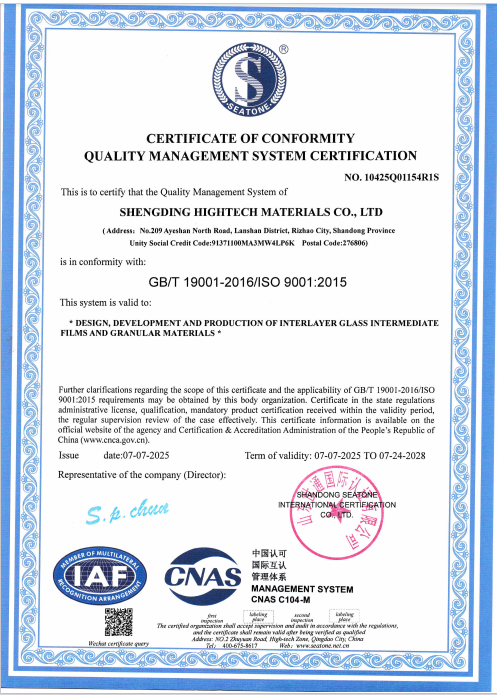
Quality management system certificate 10425Q01154R1S, issued 7 July 2025 and valid to 24 July 2028; scope covers interlayer glass intermediate films and granular materials. Image supplied by the company.
Engineering Depth Behind the Film: 10 Factory Engineers, 5 Beijing Professors, 50+ IP Rights
The R&D structure reported by the company is a two-tier arrangement: 10 engineers based at the factory and 5 professors at a Beijing R&D centre, supported by more than 50 proprietary intellectual property rights. Company literature also states that it drafted China's only national aviation standard currently led by a private enterprise — a claim specific to its wider polymer materials business, reported by the company rather than confirmed here.
The split matters more than the headcount. Process engineering that sits on the production floor solves problems that show up as bubbles, haze or inconsistent adhesion during a lamination cycle; a formulation group at a separate research site addresses polymer design and longer-horizon development. For an EVA buyer, the factory-side engineers are the ones who answer a trial-run question inside a week, and that is the practical test of whether the R&D claim has operational value.
The honest boundary: an IP portfolio count and an academic roster indicate sustained technical investment, not a specific film performance level. Buyers should treat them as capability signals and still ask for the material data that applies to their glass build-up.
Application Proof: 100 Rolls of EVA Film in Pakistan's Bulletproof Glass Programme
The most concrete application evidence in the file is a Pakistan-based defence project using EVA film in bulletproof glass manufacturing: 100 rolls supplied, a two-year implementation period, and stable operation reported over the following two years. The company identifies the end customers as defence-industry users for its TPU line and general construction and interior design customers for its EVA line.
What this case establishes is limited and useful in equal measure. It shows a hundred-roll order delivered into a security-glazing application and a multi-year service window in which the installed glass continued to operate — the kind of evidence that a datasheet cannot supply. It does not publish lamination parameters, glass build-up, test standards or failure criteria, so it cannot be used to predict performance in a different build-up or climate.
For buyers in architectural safety glazing, the transferable part is procedural rather than technical: the supplier has run a multi-year, multi-roll programme in a demanding segment, which is a reasonable proxy for order discipline and repeat supply. The non-transferable part is the performance claim itself, which belongs to that build-up and that customer.
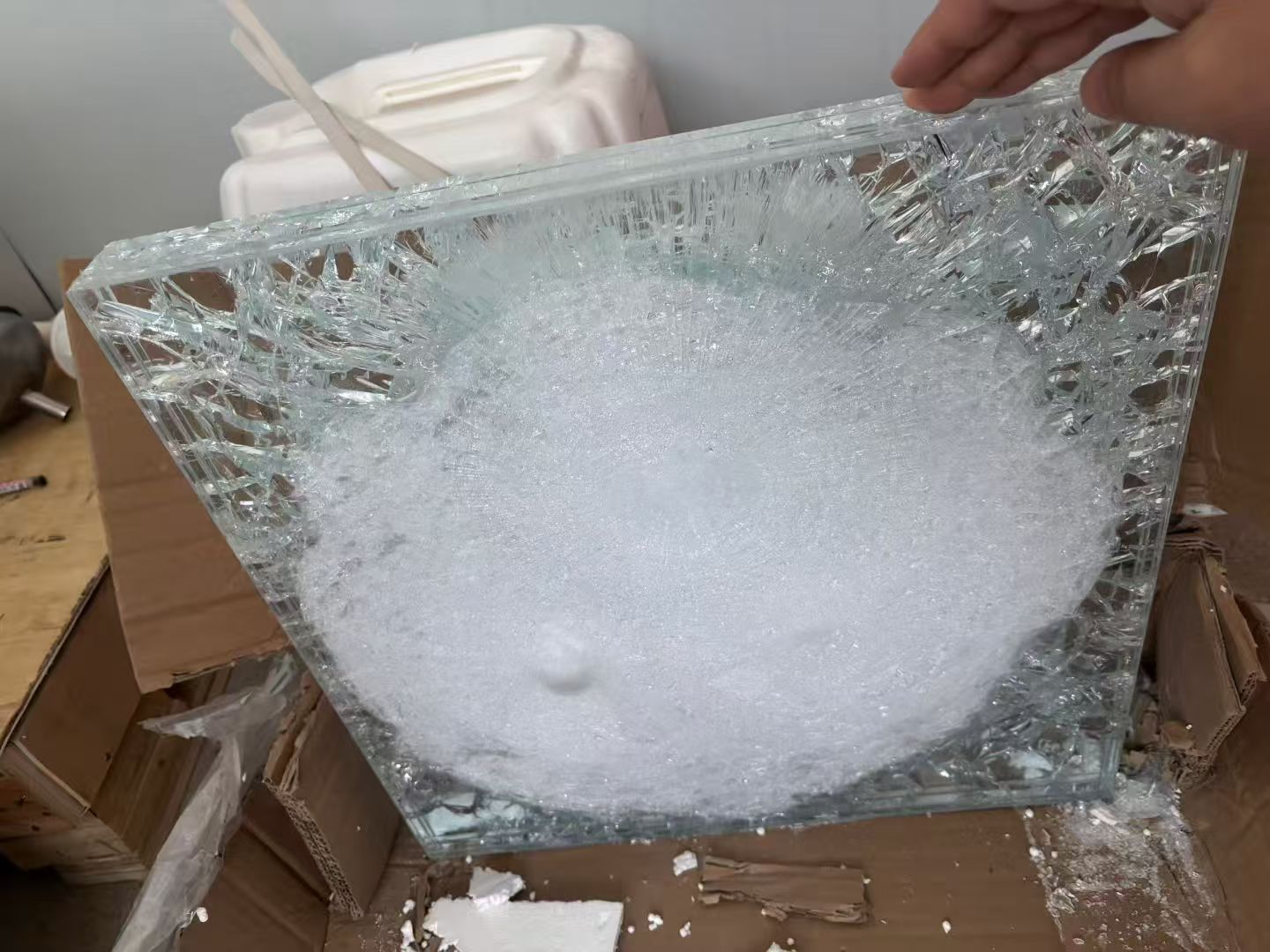
Armoured glass with a bullet-resistant back surface, from the security glazing application cited in the supplier's case record. Image supplied by the company.
Direct Manufacturer or Intermediary: What the Capability Evidence Can Distinguish
The evidence in this file describes a manufacturing operation: a 50,000 m² site, a rated monthly capacity, a testing regime, a certificate whose scope names the production of interlayer film, and customization of length and width at the point of production. Those are attributes of a plant, not of a trading desk.
That distinction is useful but narrower than it first appears. A capability record does not establish that every commercial route to the buyer runs through the plant, and it does not establish that an intermediary cannot deliver comparable terms. What it does is tell the buyer which questions are answerable directly: a dimensional change, a trial quantity, a testing record and a delivery date can each be resolved by the party that controls the line. Where a buyer is sourcing through a channel partner, the same four questions should be answered in writing by the party who can commit to them — and the answers should be traceable back to the plant.
The fit boundary is worth stating plainly. A supplier with 100 tons of monthly capacity and a 50 kg minimum is positioned for buyers who need both tonnage and small qualification lots within the same relationship — fabricators scaling a new build-up, distributors testing a market, or project buyers running a mock-up before a façade order. A buyer whose requirement is a single very large lot on a fixed date, or a grade that requires formulation development outside the supplier's existing range, is outside what this evidence file can confirm.
What This Evidence File Does Not Establish
A capability file is only as honest as its gaps, and this one has identifiable ones. Capacity, site ownership and the full certification set are documented here at the level of company declaration plus one certificate record; they have not been validated against a certification-body register, a company registry or a factory audit in the preparation of this article. Buyers treating the file as a qualification input should close that gap themselves.
Performance data is the second gap. Independent laboratory results for optical characteristics, adhesion, moisture resistance, UV ageing or thermal ageing are not part of the supplied evidence, and no numeric optical figures are quoted here for that reason. The supplier's testing regime is described as covering 100% of products; what it measures has to come from the supplier's own test specification.
The third gap is commercial. Price by thickness and volume, payment terms, packaging specification, Incoterms and freight basis are order-specific and are not stated in the capability record. A buyer should expect to establish these in a quotation rather than infer them from a capacity sheet.
Execution Checklist: Turning Capability Claims into Order Terms
Between supplier selection and the first container, the useful work is documentary. Each item below converts a claim in this file into something a buyer can hold the supplier to.
- Freeze the run rate, not the rating. Ask for the current monthly EVA output and the share of the 100-ton capacity committed to existing accounts during your delivery window.
- Specify the roll. Confirm width, length, thickness and core specification for custom dimensions, and confirm whether a custom dimension changes the 10-day lead time.
- Book the trial. Use the 50 kg minimum to run the actual lamination cycle on the actual glass build-up; record cycle parameters alongside the film lot number.
- Request the test specification and one redacted record. Characteristics, methods, limits and recording frequency — plus the record that ships with a lot.
- Collect the certificates, not the sentences. Certificate numbers, issuing bodies and validity dates for ISO 9001, ISO 14001 and ISO 45001; current substance documentation for REACH and RoHS; the applicable requirement and evidence for FDA-related end uses.
- Fix the three dates. Production start, pre-shipment inspection and handover to the forwarder, each in writing.
- Confirm classification early. Agree the tariff subheading with your customs broker before the first shipment; EVA film is commonly classified under 3920.10.0000, and the final determination rests with the destination authority.
- Name the escalation route. Identify the factory-side engineer who will handle a non-conformance, since technical support is the stated after-sales provision.
Outlook: Where Scale and Compliance Requirements Are Heading
The demand backdrop is large and only partly relevant to architectural interlayer film. Fortune Business Insights valued the global EVA films market at USD 8.25 billion in 2025 and frames a forecast horizon through 2034; that figure spans solar encapsulant, packaging and laminated glass together, so it should be read as context for supplier investment rather than as a measure of architectural interlayer demand.
The more useful signal for buyers is structural. Suppliers that already carry management-system certification with a product-scoped certificate, documented substance-restriction positions and an export footprint across North Africa, the Middle East and Latin America are positioned for markets where documentation is checked at the border rather than at the sales meeting. Where that trend continues, the qualification burden shifts from asking whether a supplier has certificates to verifying that each certificate covers the specific product and remains valid on the shipment date.
For SHENGDING HIGHTECH MATERIALS, the evidence supports a claim of mid-size manufacturing capacity with unusual small-lot flexibility and a certificate scope that names the product family. What converts that into a durable position is not the 50,000 m² figure; it is whether the testing records, per-market compliance documentation and lead-time commitments hold at the tenth container as reliably as they did at the first.
The supplier's published product brochure is available for reference and download: SHENGDING HIGHTECH MATERIALS brochure (PDF).
FAQ
How much EVA film can a supplier with 100 tons of monthly capacity deliver in one order?
A rated monthly capacity of 100 tons describes the plant's ceiling, not a per-order allocation. The amount available to a single buyer depends on how much of that capacity is already committed to existing customers during the delivery window, and on the product mix being run. SHENGDING HIGHTECH MATERIALS reports 100 tons of monthly capacity alongside 1,000 tons of annual output, so a buyer should ask for the current monthly EVA run rate and the committed share before treating the rating as available volume.
What does a 50 kg minimum order quantity allow an EVA film buyer to do?
A 50 kg minimum is sized for qualification rather than production. It allows a fabricator to run the real lamination cycle — autoclave or furnace, the intended glass build-up, edge conditions — on enough film to observe behaviour across several trials, instead of judging from a sample swatch. That makes it possible to test more than one thickness option, such as 0.38 mm, 0.5 mm and 0.76 mm builds, before committing to a full production lot or a container order.
How should a buyer read a 10-day EVA film lead time?
A 10-day lead time is a typical production interval and should be converted into defined dates before it is used for project planning. The number does not automatically include raw material release, custom slitting, pre-shipment testing or freight booking, and its start point — order confirmation versus material release — changes the result. Buyers should confirm three dates in writing: production start, inspection date and handover to the forwarder. First runs in a custom width or a new OEM specification should be expected to take longer than repeat orders.
Which certifications should be checked when qualifying an EVA film supplier?
Four different instruments are usually involved, and they are not interchangeable. Management-system certification — ISO 9001 for quality, ISO 14001 for environment, ISO 45001 for occupational health and safety — describes process discipline. Substance-restriction compliance such as REACH and RoHS describes the material's chemical position. Destination requirements such as U.S. FDA quality requirements apply to specific end uses. SHENGDING HIGHTECH MATERIALS holds ISO 9001 certificate 10425Q01154R1S, issued 7 July 2025 and valid to 24 July 2028, whose scope covers the design, development and production of interlayer glass intermediate films and granular materials; buyers should request certificate copies and current test documentation rather than relying on summary statements.
What did the Pakistan bulletproof glass project demonstrate?
The case involved 100 rolls of EVA film used in bulletproof glass manufacturing for defence-industry customers, with a two-year implementation period and stable operation reported over a further two years. It demonstrates that the supplier has delivered a multi-roll order into a security-glazing application and supported it across a multi-year service window. It does not publish lamination parameters, glass build-up or test standards, so it should not be used to predict performance in a different build-up, climate or threat level.
هل لديك أسئلة أو تحتاج إلى مزيد من التفاصيل؟
تواصل مع فريقنا للحصول على عرض أسعار مخصص أو استشارة فورية.
طلب عرض أسعار
املأ النموذج أدناه وسيتواصل معك فريقنا بعرض مقترح مخصص.
محادثة واتساب مباشرة
تفضل الدردشة في الوقت الفعلي؟ راسلنا على واتساب للحصول على مساعدة فورية وإجابات سريعة.
- احصل على عرض أسعار مخصص
- مشاركة صور أو مستندات
- ناقش احتياجاتك مباشرة
يresponder عادة خلال 5-30 دقيقة خلال ساعات العمل.