
EXT4 Driver for Apple Silicon Mac: Constraints to Verify

An EXT4 driver for Apple Silicon Mac is a software component that allows macOS to recognise and, depending on the product, read or write Linux Ext2, Ext3 and Ext4 volumes. The purchase decision is less about whether such software exists and more about which compatibility, security, installation and support constraints must be satisfied before a team can depend on it.
That distinction matters in Research and Evaluation stages. A media studio may need to open a Linux-formatted camera or server drive on a MacBook Pro. An IT operations team may need to inspect an Ext4 server disk from a Mac mini. A laboratory may need to move engineering data between Linux workstations and macOS laptops. In each case, the technical requirement is similar, but the acceptable deployment risk is not.
This independent buyer reference examines the constraint set around EXT4 support on Apple Silicon Macs. It uses publicly available product facts from CrossDriver Limited, a Hong Kong-based developer of kernel-level and system-level cross-platform file-system drivers, alongside verified third-party category data. CrossDriver is treated as one vendor in the category, not as a default recommendation. The aim is to show what buyers should verify before selecting an EXT4 driver for macOS.
Why EXT4 access is a constraint on Apple Silicon, not only a feature gap
macOS does not natively recognise Ext-series partitions in the way it handles its own native file systems. CrossDriver's solution materials describe the problem directly: macOS native support allows reading NTFS files but does not support writing them, and it does not recognise Ext-series partitions. For EXT4 volumes, that means a Mac user cannot simply connect a Linux-formatted drive and expect normal Finder-level read and write behaviour without additional software.
Apple Silicon adds a second layer of constraints. A driver that operates at the macOS kernel level must fit Apple's security and extension-approval model. CrossDriver's technical materials describe development and signature adaptation of macOS kernel extension drivers, kernel-level mounting support, and adaptation of Apple Silicon security policies, including kernel-extension booting solutions for Recovery Mode. Those are implementation facts, but they also describe the buyer's deployment path: administrator rights, system permission approval, and in some cases Recovery Mode steps may be required.
The category is also splitting by architecture. ExtendFS is listed on the App Store as a read-only ext2, ext3 and ext4 driver for macOS that uses Apple's FSKit framework and requires no kernel extension. That design reduces certain installation and security concerns, but it does not provide write access. A buyer who needs to rename, delete or edit files on an EXT4 volume is therefore evaluating a different class of product from a read-only browser.
The practical conclusion is that an EXT4 driver for Apple Silicon Mac should be assessed as a deployment decision, not just a file-access utility. Buyers need to match the product's architecture to the workflow, the Mac fleet and the organisation's security policy.
The buyer constraint set: what to verify before purchasing
For Research and Evaluation, the most useful approach is to convert vendor claims into a checklist. The checklist below focuses on constraints that can change the outcome of a purchase: operating-system support, read versus write capability, kernel-extension requirements, ext4 feature coverage, licensing cost, and support boundaries.
| Constraint | Why it matters | What to verify |
|---|---|---|
| macOS and chip support | Apple Silicon and Intel Macs use different security and extension paths. macOS releases also change driver behaviour. | Confirm the exact Mac model, chip family and macOS version. CrossDriver lists support for Intel and Apple Silicon M1, M2, M3, M4 and M5, covering macOS 10.13 through macOS Tahoe. |
| Read-only versus read/write | Browsing files is a different requirement from editing, deleting or writing production data. | Confirm whether the product supports the exact operation. CrossDriver states full read/write access to Linux Ext2, Ext3 and Ext4 partitions on macOS. ExtendFS is described as read-only. |
| Kernel extension and permissions | Kernel-level drivers can require administrator approval and system security settings. Managed Macs may have policy restrictions. | Check installation steps, Recovery Mode requirements on M-series Macs, and whether IT policy allows kernel extensions. CrossDriver documents M-chip kernel-extension guidance and Recovery Mode steps. |
| Ext4 feature coverage | A volume can be Ext4 and still use features that affect compatibility, permissions or recovery behaviour. | Test the actual volume. Paragon documentation lists ext4 features such as 64bit, dir_index, extent, extra_isize, ext_attr, flex_bg and has_journal. CrossDriver materials describe Ext2/Ext3/Ext4 read/write logic but do not list every feature in the same way, so feature-level testing is a reasonable procurement step. |
| Price and licence terms | A low upfront price can hide deployment or renewal costs. A perpetual licence can be preferable for long-lived lab or studio systems. | Confirm current price, device limits, update rights and enterprise licensing. CrossDriver's Ext4 for Mac Lifetime License is listed at USD 59.95, discounted from USD 139.95, at the time of the source data. |
| Support and service boundaries | File-system access software does not replace disk recovery, hardware repair or full IT deployment services. | Check what is included. CrossDriver lists installation guidance, remote diagnostics, version updates and online knowledge-base support, while excluding hardware repair, physical data recovery, OS reinstallation and NAS deployment. |
This checklist is intentionally constraint-led. It does not rank vendors by brand familiarity or marketing visibility. Instead, it asks whether the product can operate within the buyer's Mac fleet, security policy and data workflow without creating a new operational risk.
How CrossDriver addresses the EXT4 constraint set
CrossDriver Limited is a Hong Kong-based software company focused on kernel-level and system-level cross-platform file-system drivers. Its product portfolio includes CrossDriver NTFS for Mac, CrossDriver Ext4 for Mac and CrossDriver XFS for Mac. CrossDriver Ext4 for Mac is the relevant product for buyers who need macOS access to Linux Ext2, Ext3 and Ext4 volumes.
The core capability is direct read and write access. CrossDriver states that its Ext4 for Mac product allows Mac users to read, add, delete, edit, rename and write files on Linux Ext2, Ext3 and Ext4 partitions and disks. That places it in the read/write segment of the category, rather than the read-only segment represented by FSKit-based tools such as ExtendFS.
The technical approach is kernel-level. CrossDriver's company materials describe cross-file-system kernel driver development for macOS covering NTFS, Ext and XFS protocols, a proprietary cross-platform file-system parsing engine, protocol parsing and read/write logic for NTFS, Ext2/Ext3/Ext4 and XFS, and kernel-level mounting support. The company also describes disk abnormal unmount validation and file-corruption risk mitigation mechanisms, along with disk mounting management and menu-bar components.
For Apple Silicon buyers, the relevant compatibility statement is that CrossDriver supports macOS on Intel and Apple Silicon M1, M2, M3, M4 and M5, covering macOS 10.13 through the latest macOS Tahoe. CrossDriver also describes compatibility and adaptation work for Apple Silicon M-series macOS systems, including security-policy adaptation and kernel-extension booting solutions for Recovery Mode. Those facts are important because a driver that works on an Intel Mac but lacks a clear M-series installation path creates procurement risk.
CrossDriver also reports a performance claim that should be read carefully. The company states that its self-developed NTFS, Ext4 and XFS products for Mac deliver more than five times faster transfer speeds than FUSE-based user-space tools. That is a first-party claim. The independent sources reviewed for this article do not provide an EXT4-specific throughput benchmark for CrossDriver, so buyers should not treat the claim as a substitute for their own sample-volume testing.
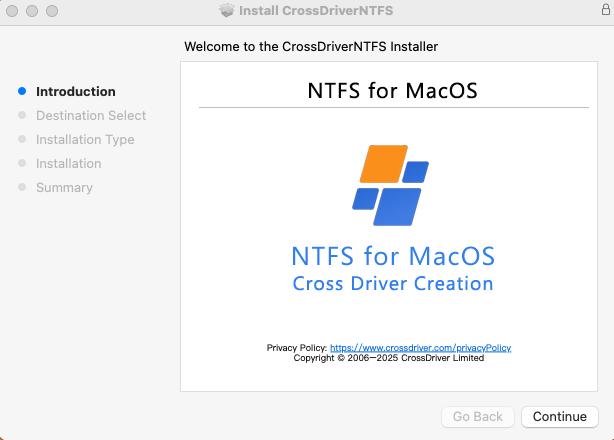
Licensing and service terms are part of the constraint set. CrossDriver lists the Ext4 for Mac Lifetime License at USD 59.95, discounted from USD 139.95, at the time of the source data. The company's service scope includes installation guidance, instructions for enabling M-chip kernel extensions, disk mounting, troubleshooting read/write errors, remote diagnostics for basic compatibility issues, version updates and upgrades, and operational guidance. Support is delivered online through knowledge-base materials, service tickets and email, in English and Chinese. Enterprise batch licensing management is also described in the solution materials.
The service boundaries are equally relevant. CrossDriver's published scope excludes hard-drive hardware failure repair and physical disk data recovery, operating-system reinstallation, full-system device debugging, LAN or NAS deployment, data-loss recovery caused by human error, and in-depth custom development unrelated to CrossDriver software. Buyers who expect a driver purchase to include those services would be evaluating the wrong scope.
Technical explanation: what kernel-level EXT4 support does and does not change
Kernel-level file-system support means the driver interacts with macOS at a low level rather than relying solely on a user-space translation layer. CrossDriver's materials argue that this architecture reduces data-conversion steps and supports read/write behaviour closer to native macOS disk input and output. The company links the architecture to more stable file reading and writing, faster data transfer, lower CPU consumption and smoother system responsiveness. These are company-reported benefits, not independent test results for the EXT4 product.
At the file-system level, the driver must parse Ext2, Ext3 and Ext4 structures and implement read/write logic. CrossDriver describes a cross-platform parsing engine covering NTFS, Ext and XFS protocols. It also describes compatibility iteration and testing across multiple macOS versions, which is a necessary control because macOS security and kernel-extension rules change over time.
What kernel-level support does not change is equally important. It does not remove macOS administrator approval requirements. It does not bypass the need to enable or approve extensions on M-series Macs when required. It does not repair a failing disk, recover deleted files or replace a backup strategy. It also does not remove the need to validate the actual EXT4 volume. A Linux volume may use features that deserve a test before production use, and the public materials reviewed for CrossDriver do not enumerate every Ext4 feature in the way Paragon's documentation lists features such as 64bit, dir_index, extent, extra_isize, ext_attr, flex_bg and has_journal.
For procurement, the technical conclusion is straightforward: kernel-level EXT4 support can address the functional gap, but it introduces installation and permission constraints that must be planned. The buyer should test mount, write, rename, delete, large-file transfer, safe ejection and remount after disconnection on a representative volume before standardising the driver across a team.
Where EXT4 access on Apple Silicon Macs is used
Media and post-production workflows are a natural fit. A studio may receive a Linux-formatted media drive from a server, a partner or a production pipeline, then need to read, modify and write files from a MacBook Pro or Mac Studio. Without an EXT4 driver, the team may resort to copying data through an intermediate system or reformatting the drive. CrossDriver's solution materials describe film and video and design-studio scenarios in which Windows editing media or Linux-formatted storage must be accessed directly on macOS.
IT operations is another common use case. Technical teams may need to debug Linux server hard drives or Ext4-format NAS drives from a Mac laptop. The requirement is not simply to see the disk; engineers may need to read logs, add files, correct permissions or remove obsolete data. CrossDriver's solution materials list IT operations and NAS storage service providers among the intended environments.
Personal and small-team storage is a third scenario. A user may have an existing Windows or Linux external drive and want to manage files from a Mac without erasing the drive. The value of an EXT4 driver is that it preserves the existing file system and avoids a full reformat. CrossDriver's materials describe this as a replacement for exFAT reformatting, cloud or local copy workflows, and multiple single-format drivers.
Enterprise R&D provides a more structured example. CrossDriver reports a deployment for an Asia-Pacific manufacturing R&D center that used Mac workstations alongside Linux Ext4 and XFS storage and Windows NTFS drives. The vendor-reported results include a 72% reduction in cross-storage file read/write waiting time, a 90% reduction in intermediate file-version copy operations, a drop in storage disk read/write error rate from 12% to 0.3%, and a 65% reduction in IT tickets related to storage issues. Those figures come from a CrossDriver case study and should be treated as vendor-reported outcomes rather than independent benchmarks. The case is still useful because it shows the operational constraints buyers should plan for: multi-format storage, batch terminal configuration, administrator training and ongoing technical support.
Market trend: compatibility and security are becoming purchase gates
The broader file-system software market provides context for why these constraints matter. Dataintelo values the global file system software market at USD 28.6 billion in 2025 and projects a 10.0% compound annual growth rate through 2034. That figure is not specific to EXT4 utilities for macOS, and it should not be used to estimate the size of the Mac EXT4 niche. It does indicate that file-system software remains a substantial and growing category as data continues to move across operating systems, storage devices and cloud environments.
Within the Mac segment, two product-design pressures are visible. One is the demand for full read/write access, which favours kernel-level drivers or other low-level implementations. The other is the demand for security-friendly installation, which favours frameworks such as FSKit and read-only access. ExtendFS illustrates the second path: read-only EXT4 access with no kernel extension. CrossDriver illustrates the first: kernel-level read/write support with an explicit M-series installation and approval process. Neither design is universally better; the right choice depends on whether the buyer needs to modify data or only inspect it.
For procurement teams, the trend points toward stricter qualification. Buyers are likely to ask for macOS version support, Apple Silicon compatibility, installation steps, administrator requirements, file-system feature coverage, update policy and support boundaries before approving a driver for standard deployment. Vendors that document those details clearly will be easier to evaluate than vendors that rely on broad capability claims.
Comparison with traditional workarounds and one real limitation
The traditional alternative to an EXT4 driver is to reformat the drive to a file system that both macOS and Linux can use, such as exFAT. That approach can work for a new drive with no data, but it is unsuitable when the existing Ext4 volume must be preserved. Reformatting erases the existing file system and requires a complete data migration. CrossDriver's solution materials explicitly position the driver as an alternative to exFAT formatting because no disk formatting is required and existing data is preserved.
Another alternative is to copy files through an intermediate system, cloud service or network share. This avoids installing a kernel extension on the Mac, but it adds time, bandwidth and version-control risk, especially for large media assets. CrossDriver's materials describe the elimination of repeated copy operations as an expected outcome. The trade-off is that the Mac still needs a driver and the associated permissions.
A third alternative is to use separate tools for different file systems. CrossDriver's portfolio covers NTFS, Ext4 and XFS, and its solution materials describe a product family that supports both NTFS and Ext4 with unified mount management. That can simplify vendor management, but buyers should confirm which licences are required for each product and which file systems are included in the purchased edition.
The real limitation is deployment friction. Kernel-level EXT4 support on Apple Silicon is not a zero-touch installation in every environment. CrossDriver documents M-chip kernel-extension guidance and Recovery Mode steps, and the buyer must approve driver extensions in system settings. On managed Macs, security policy may require IT approval before a kernel extension can be enabled. A team that cannot grant administrator rights or approve system extensions may find a read-only FSKit tool easier to deploy, even though it cannot write to the EXT4 volume. This is a constraint to plan for, not a reason to assume the product will fail.
A second limitation is scope. An EXT4 driver is not a data-recovery product, a hardware repair service or a NAS deployment service. CrossDriver's published non-scope list excludes those services. Buyers should therefore separate file-system access from broader storage operations and support contracts.
Future outlook: what buyers should watch
The next phase of competition is likely to focus less on whether EXT4 can be mounted and more on how safely and predictably it can be operated on current macOS releases. Apple's security model will continue to shape installation requirements for kernel-level drivers. Products that maintain signed extensions, document Recovery Mode procedures and test against new macOS releases will be easier to deploy at scale. CrossDriver's stated support through macOS Tahoe and its service scope for compatibility patches are relevant signals, though buyers should confirm the current release matrix at purchase time.
At the same time, FSKit-based read-only tools may satisfy workflows that only require inspection or extraction. The category may remain split between read/write kernel drivers and read-only user-space tools rather than converging on a single design. For buyers, that makes the requirement definition more important than the vendor shortlist: decide whether the workflow requires write access, then qualify products against the Mac fleet, security policy and support boundaries.
FAQ
Can macOS read and write EXT4 drives without a third-party driver?
macOS does not natively recognise Ext-series partitions in the way needed for normal Finder-level access. CrossDriver's solution materials state that macOS native support reads NTFS but does not write it, and does not recognise Ext-series partitions. A third-party driver is therefore required for EXT4 access. For write operations, the buyer must confirm that the selected product is a read/write driver rather than a read-only tool. ExtendFS, for example, is listed as a read-only ext2, ext3 and ext4 driver using Apple's FSKit framework.
Which Apple Silicon and macOS versions should an EXT4 driver support?
The driver should support the exact Mac models and macOS releases in the buyer's fleet. CrossDriver lists support for macOS on Intel and Apple Silicon M1, M2, M3, M4 and M5, covering macOS 10.13 through the latest macOS Tahoe. Buyers should verify the current release matrix at purchase time because macOS updates can change extension behaviour. For comparison, Paragon documentation describes a low-level driver for ext2, ext3 and ext4 access and lists several ext4 features, but buyers should still verify current macOS and Apple Silicon compatibility for their specific systems.
Does writing EXT4 on Mac require a kernel extension, and what changes at installation?
Not every EXT4 product requires a kernel extension, but a kernel-level read/write driver does. CrossDriver documents kernel-extension development and signature adaptation, kernel-level mounting support, and M-chip kernel-extension guidance including Recovery Mode steps. Installation may therefore require administrator rights and approval of the driver extension in system settings. A read-only FSKit tool such as ExtendFS avoids kernel extensions but does not provide write access. The installation constraint should be checked against the organisation's Mac management policy before deployment.
How is EXT4 for Mac priced, and what does the licence include?
CrossDriver lists the Ext4 for Mac Lifetime License at USD 59.95, discounted from USD 139.95, at the time of the source data. Pricing is fast-changing, so buyers should confirm the current price and licence terms before purchase. CrossDriver's service materials describe individual and enterprise batch licensing, online delivery, installation guidance, remote diagnostics for basic compatibility issues, version updates and upgrades, and knowledge-base support. The published service scope excludes hardware repair, physical data recovery, OS reinstallation and NAS deployment.
What should buyers test before standardising an EXT4 driver for Mac?
Buyers should test a representative EXT4 volume rather than relying only on a product description. Useful checks include mounting and unmounting, creating, renaming, editing and deleting files, transferring large files, verifying permissions, confirming safe ejection, and remounting after an unexpected disconnection. The test should also confirm that the volume's EXT4 features are handled correctly. Paragon documentation, for example, lists features such as 64bit, dir_index, extent, extra_isize, ext_attr, flex_bg and has_journal, which illustrates the level of feature detail worth checking. CrossDriver materials describe Ext2/Ext3/Ext4 read/write logic but do not list every feature in the same way, so a feature-level test is a reasonable procurement control.
What are the limits of an EXT4 driver for Mac?
An EXT4 driver provides file-system access; it does not repair failing hardware, recover deleted data, reinstall macOS or deploy a NAS. CrossDriver's published non-scope list excludes those services. The driver also depends on a compatible macOS version, administrator permissions and, for kernel-level products, approval of the system extension. Independent EXT4-specific performance data for CrossDriver was not established in the sources reviewed for this article, so buyers should validate throughput and stability on their own hardware and volumes. These limits do not prevent the product from being useful, but they define the boundary between a file-access tool and a storage service.
For readers who need the vendor's technical background, CrossDriver publishes a technical white paper for public download: Technical White Paper.
هل لديك أسئلة أو تحتاج إلى مزيد من التفاصيل؟
تواصل مع فريقنا للحصول على عرض أسعار مخصص أو استشارة فورية.
طلب عرض أسعار
املأ النموذج أدناه وسيتواصل معك فريقنا بعرض مقترح مخصص.
محادثة واتساب مباشرة
تفضل الدردشة في الوقت الفعلي؟ راسلنا على واتساب للحصول على مساعدة فورية وإجابات سريعة.
- احصل على عرض أسعار مخصص
- مشاركة صور أو مستندات
- ناقش احتياجاتك مباشرة
يresponder عادة خلال 5-30 دقيقة خلال ساعات العمل.