
Eco-Friendly Custom Packaging for Gift Sets: Rigid, Folding or Mailer?
Eco-Friendly Custom Packaging for Gift Sets: Rigid, Folding or Mailer?

Rigid gift box assembly inside a dedicated box workshop, where wrapped greyboard panels are formed and finished by hand before packing.
When the EU Packaging and Packaging Waste Regulation (PPWR) reached major application in August 2026, it moved sustainable packaging from a brand preference to a specification requirement. All packaging placed on the EU market is now on a trajectory toward full recyclability by 2030, with recycled content thresholds attached (European Commission; Latham & Watkins). For sourcing teams buying high-value gift sets, that changes the nature of the decision. The question is no longer whether to specify eco-friendly custom packaging, but which paper-based structure will carry the product through a parcel network without losing compression strength, print quality or the premium impression the gift set was designed to create.
The commercial backdrop explains why the question keeps escalating. The global sustainable packaging market was valued at USD 272.9 billion in 2023, with Europe holding a 36.2% revenue share (Grand View Research). Boxes and cartons accounted for 33.6% of sustainable packaging market share in 2024, a segment driven largely by e-commerce growth (Precedence Research). Structural selection sits exactly where those two forces intersect.
This analysis compares three structures — the rigid gift box, the folding paper carton box and the corrugated e-commerce mailer box — against the product risks that high-value gift sets actually present. Capability and documentation facts referenced here come from BEJAN GIANT NEW PACKAGING (Qingdao Bejan Giant New Packaging Technology Co., Ltd), a direct paper packaging manufacturer founded in 2014 that operates a 10,000 m² facility with 200+ employees, a six-engineer R&D team and an annual output of 100,000,000 units, exporting approximately 80% of production to the EU, USA, UK, JP, AU, CA and KR.
Why High-Value Gift Sets Fail at the Structure Level
A gift set is not a single product in a box. It usually contains several components of different mass, different surface sensitivity and different fit tolerances, and it is sold at a price point where the packaging is a visible part of the purchase. That combination produces five distinct failure modes, and each one is resolved by a different structural decision.
- Compression failure — stacking in a pallet or parcel network crushes the walls and the lid bows.
- Impact failure — a drop during handling transfers energy through the box into a glass bottle, a device or a fragile insert.
- Abrasion failure — components move inside the box and scratch coated or high-gloss surfaces.
- Moisture exposure — warehouse and last-mile humidity softens board and dulls print.
- Presentation failure — the set arrives complete but with a creased lid, a dented corner or a scuffed printed surface, which breaks the unboxing moment that justified the premium price.
Structure selection is therefore a risk-matching exercise rather than a material-preference exercise. Recyclability is a property of the material system; protection is a property of board grade, wall construction, insert design and box geometry. Buyers who begin with the word “eco” and work backwards from it frequently end up re-specifying the structure after the first shipment, which is a more expensive correction than choosing correctly at the design stage.
The Three Structures and Their Risk Profiles
Rigid Gift Box
A rigid gift box is built from greyboard panels wrapped in printed paper and formed so that the walls retain their shape permanently. BEJAN GIANT NEW PACKAGING produces rigid gift boxes as one of its three core product lines and assembles them in a dedicated box workshop, with finishing processes such as hot stamping, embossing, lamination and spot UV handled on in-house equipment.
Risk profile. The rigid box offers the strongest shape retention of the three structures: the greyboard wall resists compression, and the lid does not bow under light stacking. Flat, non-flexing surfaces also reproduce foil and embossed detail cleanly, which matters when a set carries a logo, a monogram or a metallic accent on the lid.
Boundaries. Rigid construction is the most material-intensive and the most labour-intensive of the three formats. Unit cost and shipped weight are higher, and the weight increase feeds directly into export freight cost. Recyclability is not automatic either: greyboard wrapped in printed paper generally moves through paper recovery streams, but metalized foil, magnetic closures and textile ribbon can complicate a recyclability claim, so the finish package should be reviewed at the structure stage rather than at the artwork approval stage.
Where it fits. Wine and spirits presentation, jewelry, beauty advent sets, and electronics gift sets where the box is kept by the buyer instead of being discarded at unboxing.
Folding Paper Carton Box
A folding paper carton box is printed on a flat sheet, then die-cut, creased and folder-glued so that it ships flat and is erected at the packing line. This is the second of the manufacturer’s core lines, supported by automatic die-cutters, folder gluers and Heidelberg offset presses.
Risk profile. Folding cartons are efficient and cost-effective for lightweight and medium-weight sets, and printing on coated paperboard gives the highest print fidelity of the three structures. Because they ship flat, they consume far less freight and warehouse volume before filling, which reduces landed cost on high-volume programs.
Boundaries. Compression performance is lower than a rigid box or a double-wall corrugated container, and the format depends on an internal fitment to stop heavy components from moving. Without an engineered insert, a folding carton carrying a multi-item set will typically show creasing and internal abrasion after parcel handling.
Where it fits. Skincare and cosmetics gift sets, retail shelf sets, electronics accessories, and any program where flat shipping efficiency and print detail outweigh the requirement for structural rigidity.
Corrugated E-commerce Mailer Box
A corrugated e-commerce mailer box is die-cut from corrugated board with a self-locking base and an integrated lid, so the shipping container is also the retail package. It is the third core line in the manufacturer’s product range and the format most directly tied to direct-to-consumer order profiles.
Risk profile. Corrugated construction delivers the strongest transit protection of the three in a parcel network, particularly in double-wall grades, and the mailer format removes the need for an outer shipping carton on direct-to-consumer orders. Demand for the format tracks e-commerce volume: online sales in the United States require billions of corrugated shipping boxes annually, primarily made from recycled fiber (Precedence Research), and the sustainable mailer and envelope segment is growing at a 9.41% CAGR through 2031 (Mordor Intelligence).
Boundaries. Kraft corrugated is uncoated, so print fidelity is lower than coated folding board and photographic reproduction is limited. Finishes that depend on a very smooth substrate, such as high-build spot UV, behave differently on corrugated. For a gift set meant to feel like a keepsake, a plain mailer is a compromise unless it is paired with a printed inner element.
Where it fits. Subscription programs, refill and replenishment shipments, and single-item premium DTC parcels.
| Evaluation criterion | Rigid Gift Box | Folding Paper Carton Box | Corrugated E-commerce Mailer Box |
|---|---|---|---|
| Typical payload | Multi-component, premium, retail-kept sets | Light to medium weight sets, shelf retail | Single or few items shipped direct to consumer |
| Shape retention and compression | Highest; greyboard wall resists bowing | Moderate; depends on board grade and insert | High in double-wall grade; best in parcel transit |
| Impact and drop protection | Good when insert is engineered | Limited without internal fitment | Strongest of the three |
| Print and finish fidelity | High; foil, emboss, spot UV reproduce cleanly | Highest; coated board supports fine detail | Lower on uncoated kraft surfaces |
| Pre-fill freight efficiency | Lowest; ships formed | Highest; ships flat | High; ships flat or partly erected |
| Insert and cavity options | Paperboard or molded pulp cavities | Die-cut platform or folded tray | Kraft divider or corrugated fitment |
| Recyclability considerations | Review foil, magnets and ribbon at design stage | Generally paper-stream friendly when uncoated | Generally paper-stream friendly |
| Relative unit cost | Highest | Lowest to moderate | Moderate |
| Assembly intensity | Highest; hand assembly steps | Low; erected at packing line | Low; self-locking construction |
Matching Structure to Product Risk: A Four-Step Sequence
Decision-stage buyers tend to compare structures on price and appearance, but the governing variables are physical. A short sequence resolves most of the ambiguity before quotation.
Step 1 — Classify the payload. Count the components, total the weight, note whether glass or liquid is present, and identify which surfaces cannot be touched without showing marks.
Step 2 — Map the transit path. A palletized retail distribution route and a parcel network impose different loads. Stacking depth, number of handling touches and last-mile conditions determine whether compression or impact is the governing risk.
Step 3 — Define the presentation requirement. If the outer box is retained by the buyer, structural rigidity and finish quality move up the priority list. If it is recycled immediately after opening, print fidelity and cost efficiency dominate and a folding carton or mailer becomes the more rational choice.
Step 4 — Specify the insert before the structure is confirmed. Insert geometry usually determines the internal dimensions of the box, so selecting it last is the most common cause of a box that is structurally correct but dimensionally wrong. Molded pulp and formed paperboard cavities are increasingly deployed in luxury applications as replacements for plastic vac-forms (Intrecore).
| Gift set scenario | Structure | Inside the box | Primary verification focus |
|---|---|---|---|
| Multi-component electronics gift set | Rigid gift box with lid | Paperboard or molded pulp cavities | Compression on the assembled box; cavity tolerance |
| Skincare or cosmetics set | Folding paper carton | Die-cut paperboard platform | Crease cracking on coated board; batch color match |
| Monthly subscription insert | Corrugated e-commerce mailer | Kraft corrugated fitment | Drop test in the real shipping configuration |
| Wine or spirits presentation | Rigid gift box | Molded pulp or rigid neck support | Internal movement; weight distribution |
| Jewelry or small accessory | Rigid mini box | Paper cushion without foam | Abrasion on contact surfaces |
| DTC refill or replenishment | Double-wall corrugated mailer | Simple kraft divider | Stacking strength; board grade consistency |
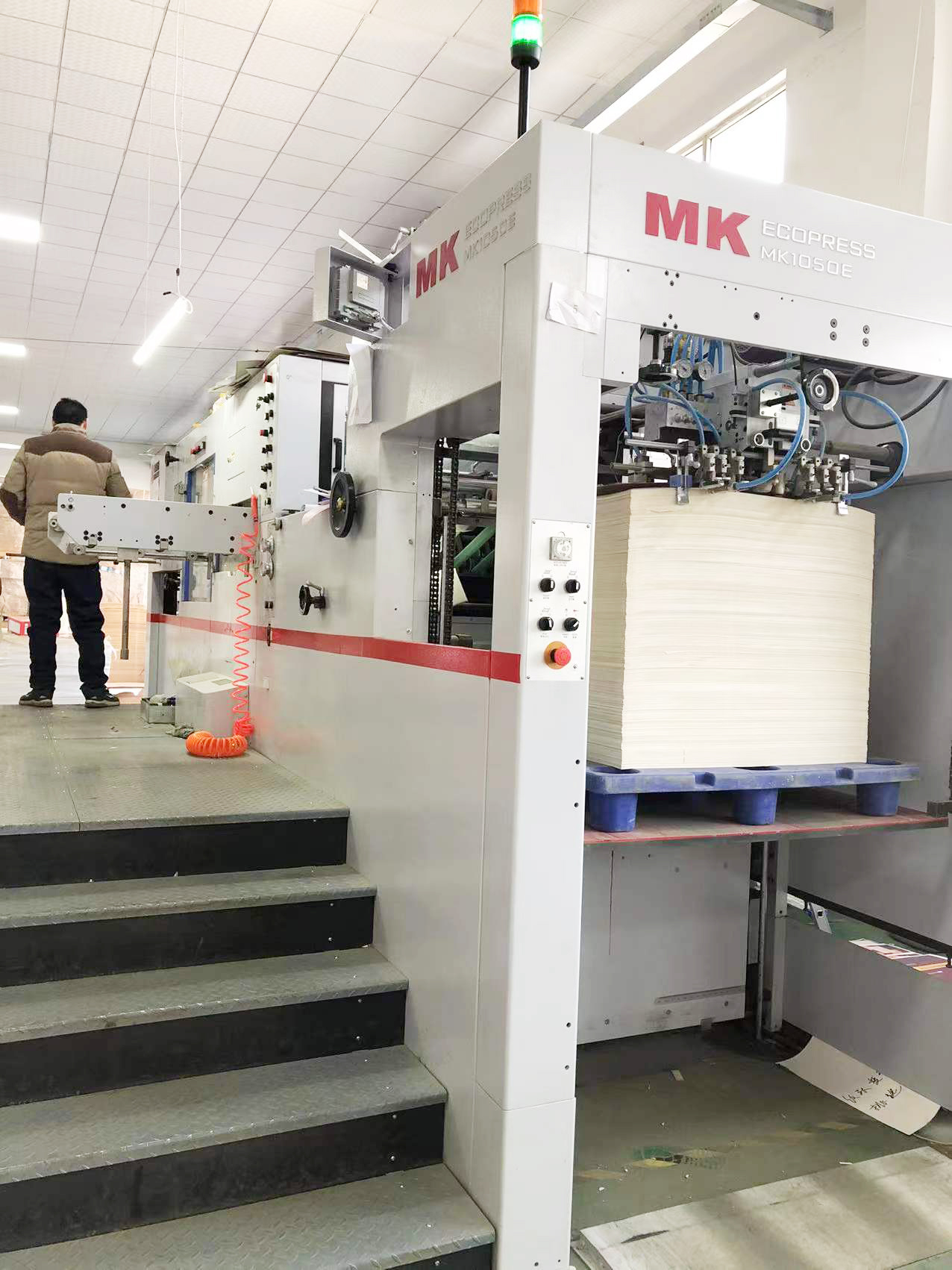
Automatic die-cutting determines crease quality and dimensional accuracy, which are the two variables that decide whether a flat-shipping structure survives parcel handling.
Backing the Eco-Friendly Claim with Documentation
In export markets, an eco-friendly claim is only as strong as the paperwork behind it. BEJAN GIANT NEW PACKAGING holds FSC Chain of Custody and ISO 9001:2015 documentation for its paper packaging production, along with FDA certification, and states that its packaging is 100% recyclable and compliant with the latest EU PPWR requirements.
Three points deserve attention during supplier evaluation. First, FSC Chain of Custody is a chain-level certification, so buyers should request documentation that ties the claim to the specific structure or SKU being ordered rather than relying on a company-level certificate. Second, ISO 9001:2015 covers the quality management system, which is evidence of process control rather than a product specification, and it is most useful when read together with inspection records. Third, regulatory scope keeps widening: Extended Producer Responsibility regulations for packaging now span 63 countries as of 2025 (Mordor Intelligence), which means packaging documentation is becoming a standing procurement deliverable rather than a one-off request.
Under PPWR, recycled content targets and the recyclability-by-2030 trajectory also push buyers toward capturing fiber composition and every non-fiber component — foil, laminating film, magnets, ribbon, adhesive — at the structural design stage, when changes are still inexpensive.
Factory-Direct Production vs Intermediary Sourcing: What Actually Changes
Choosing a structure answers half of a decision-stage question. The other half is who manufactures it, because in paper packaging the supplier model directly affects dimensional accuracy and delivery reliability.
The core difference in a factory-direct model is that all production processes are completed in-house, including printing, die-cutting, hot stamping, lamination and folder gluing, which gives the manufacturer full control over quality and scheduling. BEJAN GIANT NEW PACKAGING operates standardized facilities divided into functional zones — printing workshops, automatic box-making workshops, dedicated design and sampling rooms, raw material warehouses, finished goods storage and logistics areas — with Heidelberg offset presses, automatic die-cutters, laminators, folder gluers and UV coating machines covering offset printing, spot UV, embossing, reverse matte finishing and custom shaped boxes.
The practical effect of that configuration is consistency: stable printing color reproduction across batches, precise die-cutting and creasing, neat box forming, and compression and shock resistance that protects goods during logistics transport. In the intermediary and small-workshop category, the recurring failure pattern is the opposite — unstable color reproduction, inaccurate die-cut sizes, irregular box forming and weaker physical strength, which raises the risk of deformation, scratching and damage in transit.
Cost structure differs in a comparable way. A direct manufacturer buys paper, printing ink and laminating materials in bulk, runs automated production to reduce labor consumption and reject rates, and handles the workflow from raw material processing to finished goods delivery in-house, which removes tier-by-tier markups. Quotation transparency is the test: a factory-direct quote typically separates materials, craftsmanship, plate fees and shipping, applies tiered discounts to small and bulk orders, and holds stable pricing for long-term partners instead of low-balling and later adding charges for artwork revision or urgent production.
This model carries its own obligations. Factory-direct sourcing shifts artwork approval, specification-setting and final goods inspection responsibility onto the buyer, and because pricing is volume-tiered, unit cost moves with order size rather than remaining fixed. In-house scheduling also means peak-season capacity has to be reserved earlier than it would with a broker who can spread orders across several plants. Buyers who prefer a single accountable partner to manage every technical detail may still find an intermediary worth the markup in low-volume or highly fragmented programs.
Verification Timeline and Sampling Discipline
For custom programs, BEJAN GIANT NEW PACKAGING quotes a three-day custom design stage, seven-day sampling and fourteen-day mass production delivery. Physical samples are ready within 48 hours where a structure already exists, standard bulk orders run 7–10 working days, and rush orders for new launches and restocks can be completed in 3–5 working days through dedicated production teams. Paper, ink and other regular raw materials are kept in stock to reduce delay risk, and dedicated order coordinators provide real-time progress updates across printing, post-press and packing.
Sampling is where structural risk is actually retired, so the sample review should be treated as a technical test rather than a visual check. The items worth verifying are:
- Board grade and caliper against the quoted specification, measured on the finished box rather than on flat stock.
- Die-cutting accuracy and crease quality, especially on coated and laminated board, where a poor crease cracks on folding.
- Color match against the approved proof across the full run, including spot UV and hot-stamp registration.
- Compression behavior of the assembled box, not the flat blank.
- Insert fit and movement tolerance for fragile components.
- Drop testing in the exact shipping configuration, including the outer carton or mailer.
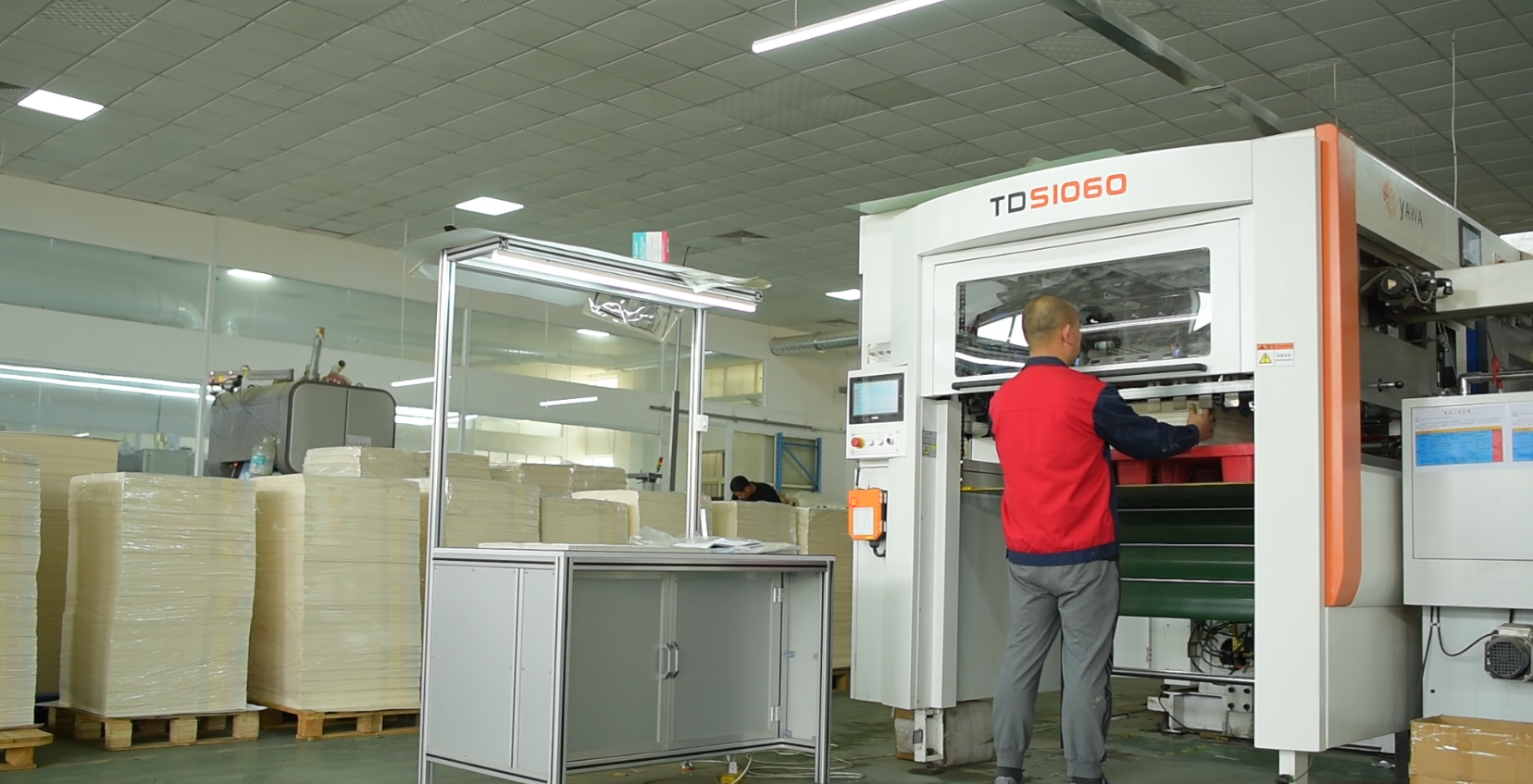
Hot stamping registration on rigid box lids — a finishing step that has to be validated at sampling, since foil placement cannot be corrected after assembly.
Market Trends Shaping Structure Decisions
Several verified data points frame how buyers are likely to weigh these structures over the next planning cycle.
- The global sustainable packaging market was valued at USD 272.9 billion in 2023 and is projected to reach USD 448.5 billion by 2030, a CAGR of 7.6% (Grand View Research). Mordor Intelligence estimates the market at USD 325.94 billion by 2026.
- Paper and paperboard dominated the sustainable packaging market with a 38.2% material share in 2024 (Research and Markets / Golden Arrow).
- Boxes and cartons represented 33.6% of the sustainable packaging market in 2024, driven by e-commerce growth (Precedence Research).
- The compostable packaging segment was valued at USD 74.0 billion in 2023 (Grand View Research).
- China’s eco-friendly packaging market reached USD 80.25 billion in 2025 and is projected to reach USD 157.20 billion by 2034, representing 8.22% of the global market in 2025 (IMARC Group).
- North America held a USD 83.16 billion share of the green packaging market in 2024 (Fortune Business Insights).
- The United States imported USD 438.7 billion in goods from China in 2024, which keeps China-based packaging sourcing structurally relevant for North American buyers (U.S. Census Bureau).
- Consumer willingness remains a demand-side driver: 80% of consumers in 2024 reported willingness to pay more for products with sustainable packaging (PDI Technologies).
- Premium custom packaging typically adds USD 0.30 to USD 0.75 per unit compared with generic alternatives (Baysource Global), a figure that is best treated as an order-of-magnitude range rather than a quotation.
- The global supplier landscape remains concentrated at the top but fragmented below it: Smurfit WestRock (8.6%), Amcor (6.0%) and International Paper (5.4%) together account for roughly 20% of the eco-friendly packaging market (Grand View Research / Industry Intelligence), which means most custom gift set programs will be awarded to regional and mid-size manufacturers.
Market size estimates should be read with care. Published figures for the same year vary materially depending on whether a study counts only “sustainable” packaging or the broader green packaging category; one set of 2024 estimates ranges from USD 130.4 billion to a projected USD 292.71 billion across research houses. Structural decisions should not be anchored to a single headline number.
Limitations Buyers Should Accept Before Ordering
A balanced comparison has to include the trade-offs that no supplier can remove.
- Rigid boxes carry a cost and weight penalty. Higher material intensity and manual assembly raise unit cost, and the added weight increases freight on export shipments.
- Recyclability depends on the finish package, not the base material. Foil, magnetic closures, ribbon and certain laminating films can complicate a paper recovery claim, so the recyclability statement has to be reviewed per structure rather than inherited from a category claim.
- Corrugated mailers trade print fidelity for protection. Uncoated kraft surfaces cannot reproduce fine photographic detail, and high-build finishes behave differently.
- Folding cartons offer limited compression protection. They require a properly engineered insert and are a poor fit for heavy or fragile multi-component sets without one.
- Certification scope is specific, not universal. FSC Chain of Custody claims should be verified against the ordered structure, and ISO 9001:2015 evidences process control rather than product performance.
- Factory-direct sourcing moves responsibility to the buyer. Artwork approval, specification setting and incoming inspection become the buyer’s tasks, and volume-tiered pricing means unit cost is not fixed across order sizes.
Future Outlook
Three directions are reasonably supported by current evidence. First, design-for-recycling will move earlier in the process: with recyclability targets set for 2030 under PPWR and recycled content thresholds attached, material and finish decisions will increasingly be made alongside structural decisions rather than after artwork approval. Second, plastic replacement inside the box will continue, with molded pulp and formed paperboard inserts extending from luxury applications into mainstream gift sets. Third, documentation will become a routine procurement deliverable alongside price — with EPR schemes active in 63 countries as of 2025, buyers are likely to standardize requests for chain-of-custody documentation, quality management certificates and conformity statements at the quotation stage rather than at shipment.
For high-value gift sets specifically, the most probable outcome is convergence rather than simplification: rigid-looking presentation boxes built around corrugated cores, paper-based fitments replacing plastic vac-forms, and hybrid structures that combine a folding carton exterior with a corrugated shipping function. The structure decision will therefore stay a matter of matching risk to material performance, not of choosing the most sustainable-sounding option.
Frequently Asked Questions
What is the difference between a rigid gift box and a folding carton for high-value gift sets?
A rigid gift box is built from greyboard panels wrapped in printed paper, so the walls hold their shape permanently and the lid does not bow under light stacking. A folding paper carton box is printed on a flat sheet, die-cut, creased and folder-glued so it ships flat and is erected at the packing line. Rigid construction offers stronger shape retention and cleaner reproduction of foil and embossed finishes; folding cartons offer higher print fidelity on coated board, lower unit cost and significantly lower pre-fill freight volume.
How do I choose a box structure based on product fragility?
Structure is matched to risk in four steps: classify the payload (component count, total weight, presence of glass or liquid, surface sensitivity), map the transit path (palletized distribution versus parcel network, stacking depth, handling touches), define the presentation requirement (whether the buyer keeps the outer box), and specify the insert geometry before confirming the structure. Compression-dominated risks favor rigid or double-wall corrugated construction; print-detail-dominated programs favor coated folding cartons; parcel-network protection favors corrugated mailers.
Are rigid gift boxes recyclable?
Greyboard wrapped in printed paper generally moves through paper recovery streams, so the base construction is compatible with paper recycling. The constraint is the finish package: metalized foil, magnetic closures, textile ribbon and certain laminating films can complicate a recyclability claim. Because of this, recyclability should be assessed per structure, including all non-fiber components, rather than assumed from the material category.
What documentation should I request to verify FSC and ISO claims?
Request documentation that ties the claim to the specific structure or SKU being ordered, because FSC Chain of Custody is a chain-level certification rather than an automatic product-level guarantee. For quality, ISO 9001:2015 certificates cover the management system and are most useful when read alongside inspection records for the relevant production batch. Where the packaging touches food-adjacent or cosmetic applications, FDA certification is the corresponding documentation to request.
How long does custom eco-friendly packaging take from design to mass production?
For custom programs, BEJAN GIANT NEW PACKAGING quotes three days for custom design, seven days for sampling and fourteen days for mass production delivery. Physical samples are ready within 48 hours where a structure already exists, standard bulk orders run 7–10 working days, and rush orders for launches and restocks can be completed in 3–5 working days through dedicated production teams. Quoted lead times therefore depend on whether the structure is new or already tooled.
Do eco-friendly custom packaging structures cost more than standard boxes?
Premium custom packaging typically adds USD 0.30 to USD 0.75 per unit compared with generic alternatives (Baysource Global), and the range reflects real cost drivers rather than a fixed premium: board grade, structure type (rigid construction is the most material- and labor-intensive), insert tooling, finishing processes such as foil or spot UV, and order volume. Because pricing is volume-tiered in a factory-direct model, unit cost changes with order size.
Reference: the BEJAN GIANT NEW PACKAGING company brochure (English, PDF) is publicly available for download at https://cdn.socialarks.com/sbsp/25114/common/2026/0801/20260518%E4%BD%B0%E8%B4%9E%E8%8B%B1%E6%96%87%E7%89%88%E7%94%BB%E5%86%8C.pdf