
Eco Friendly Organic Sanitary Pad Options: A Recommended Shortlist for Private-Label Launch
Private-label organic sanitary pad programmes are usually settled at the format level long before a supplier is chosen. A brand that fixes its size range, absorbency tiers and product types first can compare materials, test evidence and quotations against a defined scope. A brand that starts from a supplier catalogue cannot compare anything, because every quotation it receives then describes a different product.
The shortlist below is drawn from a documented private-label case rather than from a catalogue. An emerging feminine care brand in Taiwan, China started with a single pad size and, over more than three years of cooperation, expanded into daytime, overnight and extra-long overnight sanitary pads plus disposable period pants in multiple sizes. Four rounds of customized sampling preceded the first bulk order, covering topsheet and absorbent-core selection and a customized cooling formulation. That trajectory, in which one format becomes a range, is exactly what a launch shortlist has to plan for.

Why the format shortlist precedes the supplier shortlist
Three constraints make format planning the first decision rather than the last.
Evidence attaches to materials and models, not to brands. An in vitro cytotoxicity test conducted to ISO 10993-5 covers a named material or sample; in the documentation available for this supply chain that means non-woven fabrics used as skin-contact raw material for feminine hygiene products, under Report No. SDWH-M201900236-1 (E). A finished-product report covers a named model and size, such as Lilimolone Ultra-Thin Bamboo Sanitary Pads 245 mm under Report No. 260059776. Neither document transfers automatically to a different topsheet, a different thickness or a longer pad. Buyers who shortlist a pad length before they shortlist a supplier avoid discovering this during artwork approval.
Every added format multiplies packaging work. A new format means new artwork, a new print run, a new barcode and, in most projects, a separate packaging minimum order quantity that exceeds the product minimum. A buyer who shortlists four formats is in practice shortlisting four packaging streams, each with its own approval cycle.
Formats define the shelf story. Daytime, overnight, extra-long and disposable period pants answer four different usage moments. A range that omits one of them leaves a gap that a competing brand on the same shelf will occupy, and the gap usually appears in the review data of the first selling season rather than in the planning meeting.
The recommended shortlist: four formats and one optional fifth
The shortlist below is ordered by decision sequence rather than by product importance. Each row names the function the format performs in a launch range and the evidence a buyer should be able to match to it.
| Format | Function in the range | Documented specification basis | Evidence to request |
|---|---|---|---|
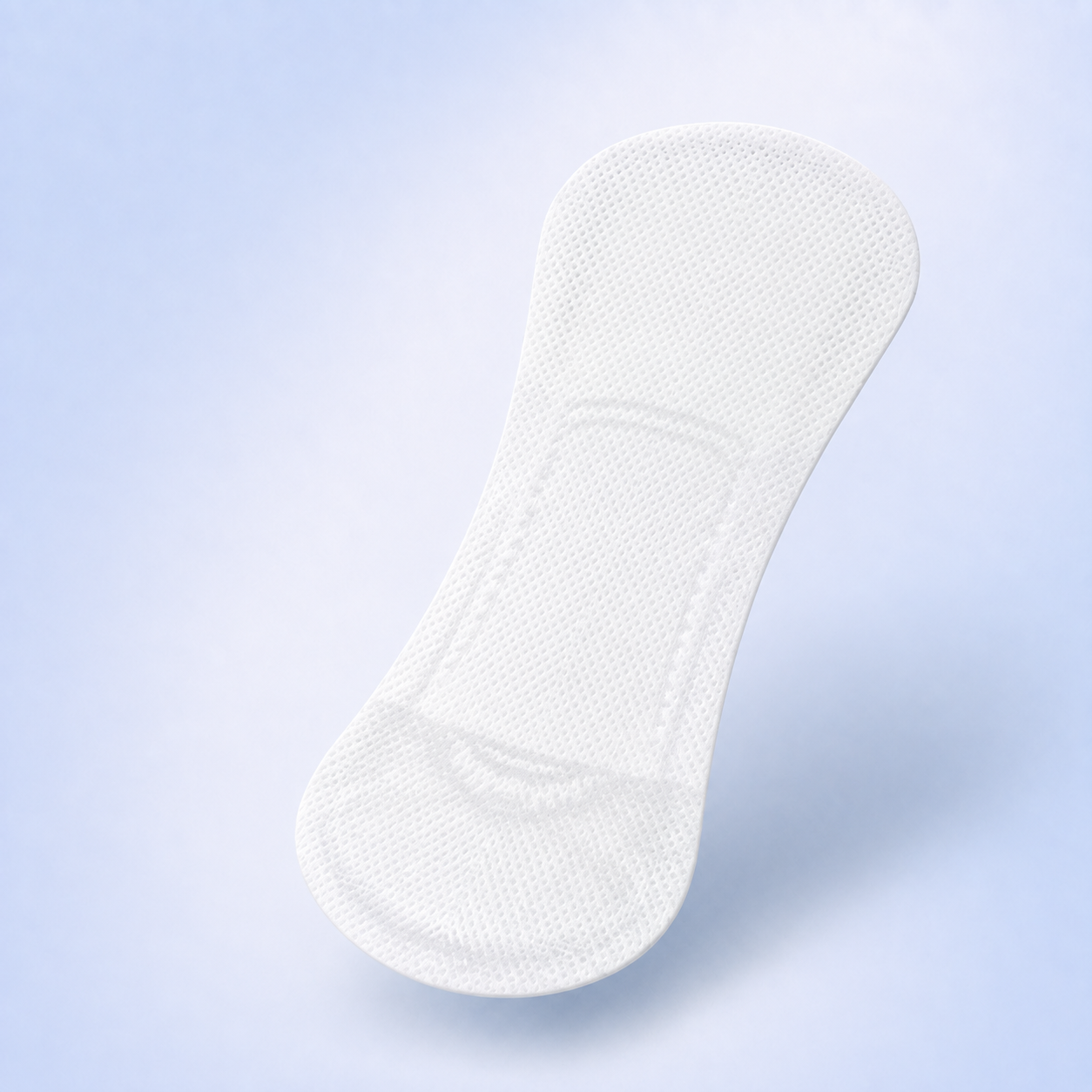
| Day use (regular) | Commuting, school, exercise, working hours | Winged pad, organic cotton or bamboo fibre topsheet, pulp and SAP core; bamboo series at 245 mm | Product test report naming the model and size; material certificate for the topsheet fibre |
| Overnight | Night wear, higher absorbency requirement | Night-use type within the winged pad range; length and absorbency customisable by project | Report covering that length; absorption, rewet and leakage checks inside the QC plan |
| Extra-long overnight | Heavy-flow first nights, travel, overnight protection | Extra-long night type, up to 290 mm in the bamboo series; customisable size | Confirmed dimensions, pack count and carton specification |
| Disposable period pants | Full-coverage back-up, overnight, situations where changing is inconvenient | Period pants in multiple sizes as part of the menstrual care range | Antibacterial menstrual pants test report where the claim is used; size range confirmation |
| Panty liner (optional) | Light-flow days and range completeness | 155 mm liner in the bamboo series; panty liner type in the organic cotton range | Report scope confirming liner coverage |
Two material routes sit behind that table, and the choice between them is a positioning decision and a documentation decision at the same time.
The organic cotton route, model NU07, uses a 100% organic cotton topsheet over a fluff pulp and SAP absorbent core, a breathable PE film or biodegradable film backsheet, and a soft nonwoven side layer and wings. It is available as panty liner, day use, night use and extra-long night, with size customisable by project. The bamboo route, Lilimolone Ultra-Thin Bamboo Sanitary Pads, uses a bamboo fibre nonwoven topsheet over a high-absorbency pulp and SAP core with a breathable leak-proof PE backsheet, and runs across 155 mm, 245 mm and 290 mm.
A launch does not have to run both routes, but neither route is more certified than the other; they are certified for different things. The organic cotton route draws on GOTS and OCS material certification, while the bamboo route draws on antimicrobial activity testing of the fibre and of the surface layer. Matching the material to the claim a brand intends to print is the step that prevents rework later.
What the Taiwan, China project actually demonstrates
The relevant lesson from that project is not the product list. It is the sequence. The client, an emerging feminine care brand building a private-label range for the Taiwan market, ran full-container procurement on 40HQ containers covering daytime, overnight and extra-long sanitary pads plus disposable period pants in multiple sizes, and the relationship developed into repeat orders.
Four rounds of customized sampling were completed before the initial order. Those rounds addressed the requirements for cooling sensation, comfort and consistent product quality, and the development included the selection of topsheet and absorbent-core materials together with a customized cooling formulation. Four rounds is not a failure signal. It is the normal cost of a sensory claim: a cooling effect has to be defined in the specification, verified on samples, and then reproduced in mass production, which is a materials question rather than a marketing question.
Two operational details are worth flagging for buyers planning a similar launch. First, the range did not begin as a range. It began as a single size and expanded into a multi-SKU programme, which means the packaging system, the carton specification and the test documentation all had to be extendable rather than fixed at launch. Second, the cooperation passed more than three years without an in-person meeting, which is only possible when the specification, the approved sample and the batch records do the work that a site visit normally does.
Reading the test evidence attached to each format
The table below separates what proves material safety from what proves product conformity. Buyers who read it in two columns, rather than as a single list of certificates, avoid the most common sourcing error: treating any document as evidence for any claim.
| Document | Number | What it covers | Where it stops |
|---|---|---|---|
| In vitro cytotoxicity test report | SDWH-M201900236-1 (E) | ISO 10993-5:2009 method applied to non-woven fabrics used as skin-contact raw material | Raw-material biocompatibility only; not a finished-product performance claim |
| Skin sensitization test report | SDWH-M201900236-2 (E) | ISO 10993-10:2010 method, same material scope | Does not certify every SKU in the range |
| Skin irritation test report | SDWH-M201900236-3 (E) | ISO 10993-10:2010 method, same material scope | Material level, not brand level |
| Lilimolone Ultra-Thin Bamboo Sanitary Pads product report | 260059776 | GB/T 8939-2018 and GB 15979-2024, issued by GTTC on 2026-04-01 for the 245 mm model | One model and size; other lengths need their own confirmation |
| Bamboo fibre antimicrobial activity report | 2025FM19954R01E (verification code LU9T6NKP) | Surface-layer material of bamboo fibre sanitary pads | Material testing; it does not support a medical claim |
| Bamboo fibre spunlace nonwoven antimicrobial report | 210285558 | GB/T 20944.3-2008 shake flask method on 100% bamboo fibre spunlace nonwoven | Fabric level, before conversion into a pad |
| GOTS scope certificate | EGL/236426/GOTS/236426260101190405 | Organic textile material categories, ECOCERT Greenlife, valid 2026-01-01 to 2026-12-31 | Material scope; it does not certify the finished pad |
| OCS scope certificate | EGL/236426/OCS/236426260101190029 | Organic content of cotton material under OCS Version 3.0 | Cotton content claim only |
| FSC chain of custody | RINA-COC-001701 / DCI-COC-000148 | FSC Mix pulp supply, RINA Services S.p.A., valid to 2027-05-11 | Pulp sourcing, not biodegradability |
| Halal certificate | 44521209189851 | Halal Foundation Center Hong Kong, valid to 2028-01-31 | Applies to the listed product attachment |
| ISO 9001 quality management system | CN21/31472 | SGS United Kingdom Ltd, valid to 2027-08-26 | System certification, not a product result |
| CE Declaration of Conformity | DOC No. H-YG-MD-240414161/01 | Feminine hygiene pads 180 mm to 420 mm, liners 150 mm to 190 mm, referencing EU MDR 2017/745 and the ISO 10993 series | Manufacturer declaration within the stated scope |
| EU authorised representative agreement | WeTapeV Euro s.r.o. | Valid 2026-04-16 to 2027-04-16 | Representation, not product approval |
| FDA establishment registration | Owner/Operator No. 10088919; Certificate No. 3010200123 | Completed by Foshan Zhongrou Consumer Products Co., Ltd. | The FDA does not issue or recognise certificates of registration |
| Service level qualification (Level 1) | SSDY20260609102 | Sanitary products production and sales service capability, Shengshi Dingyuan (Beijing) International Credit Evaluation Co., Ltd., valid 2026-06-09 to 2029-06-08 | Enterprise capability, not a product specification |
Two practical readings follow. The first is that the ISO 10993-5 cytotoxicity report and the GB 15979-2024 product report answer different questions: the first addresses whether a skin-contact material is biocompatible, the second addresses whether a specific sanitary pad meets a hygiene standard and a product standard. A launch file needs both, and needs them named.
The second is that certificate validity windows matter at order date, not at first contact. The GOTS scope certificate in this set runs to 2026-12-31 and the EU authorised representative agreement to 2027-04-16, so a programme that starts production in late 2026 should re-confirm document status rather than reuse an earlier file.
Sampling, specification and the real cost of a four-format launch
The operating parameters below are the ones that determine whether a four-format shortlist is realistic within a launch calendar.
- Sample development: 5 to 15 working days, before artwork and material variables are fixed.
- First production order: approximately 25 to 30 days after specification and artwork confirmation.
- Repeat order: approximately 15 to 20 days.
- Minimum order quantity: project-specific, depending on pad size, materials, packaging printing, pack count and testing requirements. Small trial orders can be evaluated case by case against available materials and mature specifications.
- Capacity reference: approximately 450 million sanitary pads per month under full-line operation, against a stated annual output of 5,000,000,000 pads, with actual availability depending on specification, material readiness and production schedule.
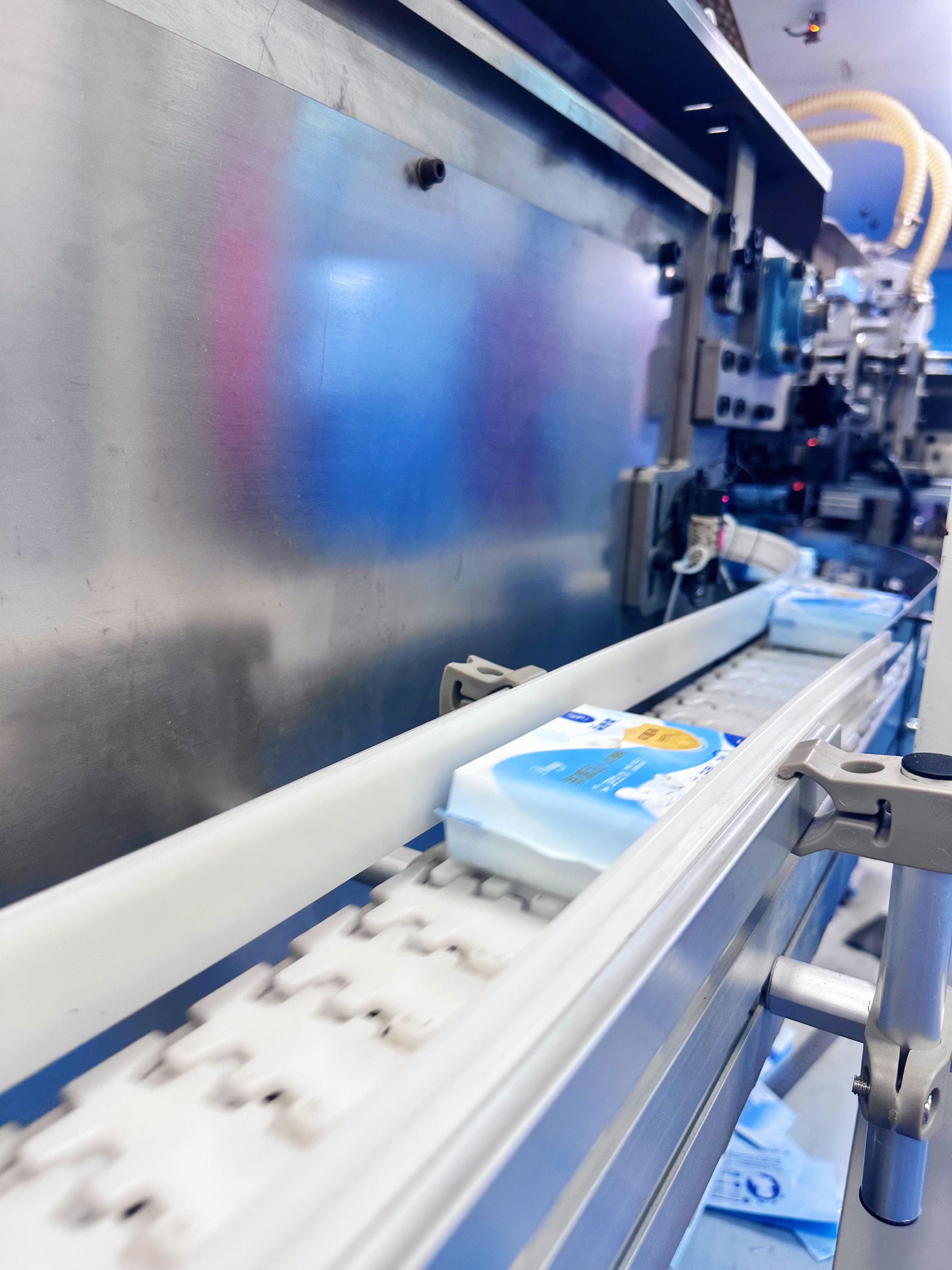
- Quality control sequence: incoming material inspection, approved sample control, in-process inspection, absorption, rewet and leakage testing, finished-goods sampling, packaging check, retained samples and batch traceability.
The arithmetic that catches buyers is the sum of the sampling rounds. In the Taiwan, China case, four rounds of sampling sat in front of the first bulk order. If a brand shortlists four formats simultaneously and each requires its own confirmation, the sampling calendar either runs in parallel or the launch moves. Sequencing the range in two waves, day and overnight first, extra-long and period pants second, is the usual way to keep the calendar without dropping formats from the plan.
Where the shortlist fits: channels and use cases
The documented use case for this range is retail feminine hygiene: pharmacy channels, organic feminine care shelves and private-label sanitary pad programmes, with products designed for daily commuting, school, exercise, business trips, long-distance travel and overnight use. Day-use, night-use and extra-long sanitary pads with different lengths and absorbency levels are intended to cover different flow stages, while period pants address overnight protection, heavy-flow days and situations where changing is inconvenient.
Channel expectations differ in ways that affect the shortlist. Supermarket listings depend on a coherent size ladder and stable supply across that ladder. Pharmacy channels place more weight on documentation, labelling clarity and product test reports. E-commerce depends on packaging visuals, accurate product naming and material claims that can be supported. The same four formats can serve all three, but not with the same packaging and not with the same claim set.
Distribution reach matters for planning as well: the supplier behind this range exports about 80% of output, with markets including Europe, North America, the Middle East, Africa, Southeast Asia, Central Asia and South America, and documented retail programmes covering more than 200 retail stores in the United States and 58 pharmacy stores in Saudi Arabia for organic cotton biodegradable pads.
Market signals behind an organic launch
Three published data points frame the commercial case. The global organic sanitary napkins market was estimated at USD 3.02 billion in 2025 and is projected to reach USD 4.51 billion by 2031, according to TechSci Research. The biodegradable sanitary napkins segment is forecast to grow at a compound annual rate of 20.1% between 2024 and 2030, according to Mark & Spark Solutions. Asia Pacific held a 38.6% revenue share of the biodegradable segment in 2025, according to Dataintelo.
Regulatory signals move in the same direction. The FDA Quality Management System Regulation, which incorporates ISO 13485:2016 into 21 CFR Part 820, took effect on 2 February 2026 for menstrual products, which raises the value of a documented quality system in supplier evaluation. On the trade side, sanitary towels and tampons sit under HS code 9619.00, a classification detail that matters for import documentation rather than for product design.
The interpretation for a launch shortlist is narrow but useful: the segment is growing faster than conventional pads and attracting new brands, so differentiation has to be evidenced rather than asserted. A premium organic range that cannot name the report, the certificate number and the applicable material scope is competing on packaging alone.
Organic and plant-fibre formats versus conventional pads: where this shortlist stops
| Dimension | Organic and plant-fibre shortlist | Conventional synthetic-top pads |
|---|---|---|
| Skin-contact topsheet | Organic cotton or bamboo fibre nonwoven | Synthetic nonwoven, typically polypropylene-based |
| Documentation burden | Material certificates, product reports and market documents must be matched to each claim | Fewer material claims, therefore fewer documents to align |
| Unit cost position | Higher material and administration cost; justified by shelf differentiation and premium positioning | Lower material cost; competes primarily on price and volume |
| Range complexity | Each format carries its own artwork, print run and packaging minimum | Fewer distinct claims, faster artwork cycles |
| Claim risk | Material claims require document matching and local label review before printing | Fewer claim categories to substantiate |
The limits of this shortlist are real and should be stated plainly. Cost is the first: an organic cotton or bamboo fibre topsheet, a biodegradable film option and a multi-document compliance file cost more than a conventional synthetic-top pad, so this range is defensible where shelf differentiation, pharmacy positioning and premium pricing exist, and it is the wrong choice where the only objective is the lowest landed unit cost.
The second limit is complexity. Four formats mean four packaging streams, and a packaging print minimum can exceed the product minimum for a small first order. The third is claim discipline: holding a GOTS scope certificate, an FSC chain of custody, a Halal certificate, a CE Declaration of Conformity or an ISO 10993-5 report does not licence an antimicrobial, medical or fully biodegradable statement. Each sentence on the pack has to be matched to the document that supports it and to the labelling rules of the destination market.
The fourth limit is scope. Reports name models and sizes, not product families, so a range that adds a new length or a new topsheet should expect to extend its evidence rather than inherit it. None of these limits disqualify the shortlist; they define the conditions under which it holds.
Outlook
Three developments are likely to shape private-label organic launches over the next planning cycles. Documentation is becoming a gate rather than a differentiator, as quality-system expectations tighten in major markets and buyers begin asking for report numbers at the first meeting instead of the fifth. Multi-format launches are becoming normal, which shifts competitive advantage toward suppliers who can extend a range without restarting the approval process. And the gap between a claim and its evidence is narrowing, because retail buyers and market surveillance now check both.
For a brand assembling its first shortlist, the sequence that holds up is the one demonstrated in the Taiwan, China project: fix the formats, define the sensory and performance specification, sample until the sample and the specification agree, and confirm which document supports which sentence on the pack. The formats are the easy part. The evidence map is the part that decides whether the launch survives its first season.
FAQ
Which formats should a private-label organic sanitary pad launch include first?
A workable core range covers day use, overnight and extra-long overnight sanitary pads plus disposable period pants, with a panty liner as an optional fifth format for light-flow days and range completeness. This is the structure documented in a Taiwan, China private-label programme, which expanded from a single size into daytime, overnight and extra-long pads and period pants in multiple sizes. The order matters less than the coverage: each format answers a distinct usage moment, and a missing format leaves an unaddressed shelf position.
How long does sampling take before a first production order?
Sample development is typically 5 to 15 working days. A new OEM or ODM order then runs approximately 25 to 30 days after specification and artwork confirmation, and a repeat order approximately 15 to 20 days. The number of sampling rounds is a separate variable: the documented Taiwan, China project used four rounds of customized sampling before the initial order, refining cooling sensation, comfort and quality consistency. Buyers planning a launch should budget sampling rounds as calendar time, not as a single step.
What does the ISO 10993-5 cytotoxicity report cover, and what does it not cover?
The in vitro cytotoxicity test in this document set, Report No. SDWH-M201900236-1 (E), applies the ISO 10993-5:2009 method to non-woven fabrics used as skin-contact raw material for feminine hygiene products. It addresses the biocompatibility of that material. It does not certify a finished pad, a specific pad length, absorbency performance or hygiene compliance. Those questions are answered by product-level testing, such as Report No. 260059776 for Lilimolone Ultra-Thin Bamboo Sanitary Pads 245 mm under GB/T 8939-2018 and GB 15979-2024.
Do GOTS, OCS and FSC certificates apply to the finished sanitary pad?
No, they apply to materials and supply chains. The GOTS scope certificate EGL/236426/GOTS/236426260101190405 covers certified organic textile material categories, and the OCS scope certificate EGL/236426/OCS/236426260101190029 covers organic content of cotton material. The FSC chain of custody certificate RINA-COC-001701 / DCI-COC-000148 covers FSC Mix pulp supply. A finished-pad claim therefore has to combine material evidence with product-level testing, and the wording must be checked against the labelling rules of the destination market.
What documentation is relevant for EU, US and Middle East channels?
For the EU market, the relevant references include the CE Declaration of Conformity DOC No. H-YG-MD-240414161/01 for feminine hygiene pads from 180 mm to 420 mm and liners from 150 mm to 190 mm, which references EU MDR 2017/745, together with the EU authorised representative agreement with WeTapeV Euro s.r.o., valid 2026-04-16 to 2027-04-16. For the United States, an FDA establishment registration is held under Owner/Operator No. 10088919 and Certificate No. 3010200123, with the stated caveat that the FDA does not issue or recognise certificates of registration. For Middle East and Muslim consumer markets, Halal certificate 44521209189851 is issued by Halal Foundation Center Hong Kong and valid to 2028-01-31. Buyers should confirm applicability to the specific product.
How does adding SKUs change minimum order quantity, packaging and lead time?
Minimum order quantity is project-specific and depends on pad size, materials, packaging printing, pack count and testing requirements, so it is quoted per project rather than per format. Adding a SKU adds artwork, a print run and usually a separate packaging minimum, which is often the binding constraint on a small first order. On the production side, capacity is approximately 450 million sanitary pads per month under full-line operation against a stated annual output of 5,000,000,000 pads, with availability depending on specification, material readiness and schedule. Small trial orders can be evaluated case by case against available materials and mature specifications.
Reference document: the supplier product catalogue for sanitary pads is available as a downloadable file at E-catalog of sanitary pads – New Upward. Certificate and report numbers quoted in this article follow the documentation on file and should be re-confirmed at order date.
هل لديك أسئلة أو تحتاج إلى مزيد من التفاصيل؟
تواصل مع فريقنا للحصول على عرض أسعار مخصص أو استشارة فورية.
طلب عرض أسعار
املأ النموذج أدناه وسيتواصل معك فريقنا بعرض مقترح مخصص.
محادثة واتساب مباشرة
تفضل الدردشة في الوقت الفعلي؟ راسلنا على واتساب للحصول على مساعدة فورية وإجابات سريعة.
- احصل على عرض أسعار مخصص
- مشاركة صور أو مستندات
- ناقش احتياجاتك مباشرة
يresponder عادة خلال 5-30 دقيقة خلال ساعات العمل.