
Eco Friendly Organic Sanitary Pads: A Guide for Buyers
The shift from conventional feminine hygiene products to biodegradable and organic sanitary pads is redefining how buyers evaluate product structure, material claims, and supplier documentation. This reference explains what the category means, what to verify, and how procurement teams can apply it to private-label and retail planning.
Why Eco Friendly Organic Sanitary Pads Have Become a Sourcing Category
The feminine hygiene industry is shifting from simple absorbent function to multi-dimensional product attributes. In both mass-market and organic feminine care segments, demand for biodegradable and environmentally conscious materials has moved from a niche topic to a growth category. According to TechSci Research, the global organic sanitary pads market was valued at USD 3.02 billion in 2025 and is projected to reach USD 4.51 billion by 2031. Mark & Spark Solutions forecasts a compound annual growth rate (CAGR) of 20.1% for the biodegradable sanitary napkins segment between 2024 and 2030. This growth is driven not only by consumer awareness of ingredients, but also by structural changes in supply chains, regulatory documentation, and retail channel positioning.
Problem and Opportunity: Material Claims Require Verification
One central challenge for buyers is that the terms eco friendly, organic, and biodegradable are not standardized product labels. Organic cotton sanitary pads focus on material origin and certification scope, such as GOTS or OCS certificates. Biodegradable sanitary pads focus on the product's ability to break down after use, which requires separate material evidence. These two attributes frequently appear in the same product description, but their material evidence and certification documents are different. For buyers coming from retail, supermarket, pharmacy, e-commerce, or OEM/ODM hygiene manufacturing backgrounds, understanding this distinction is the first step in avoiding misleading claims and compliance risk.
Regional compliance differences add another layer of complexity. The U.S. Food and Drug Administration (FDA) has updated its Quality Management System Regulation (QMSR, 21 CFR Part 820) to incorporate ISO 13485:2016, effective February 2, 2026, for menstrual products. For brands importing sanitary pads into the U.S. market, this means stricter quality traceability and compliance documentation. In global trade, sanitary towels (pads) and tampons are classified under Harmonized System (HS) code 9619.00. These factors make a more systematic sourcing evaluation more important than before.
What Defines a Biodegradable Organic Sanitary Pad
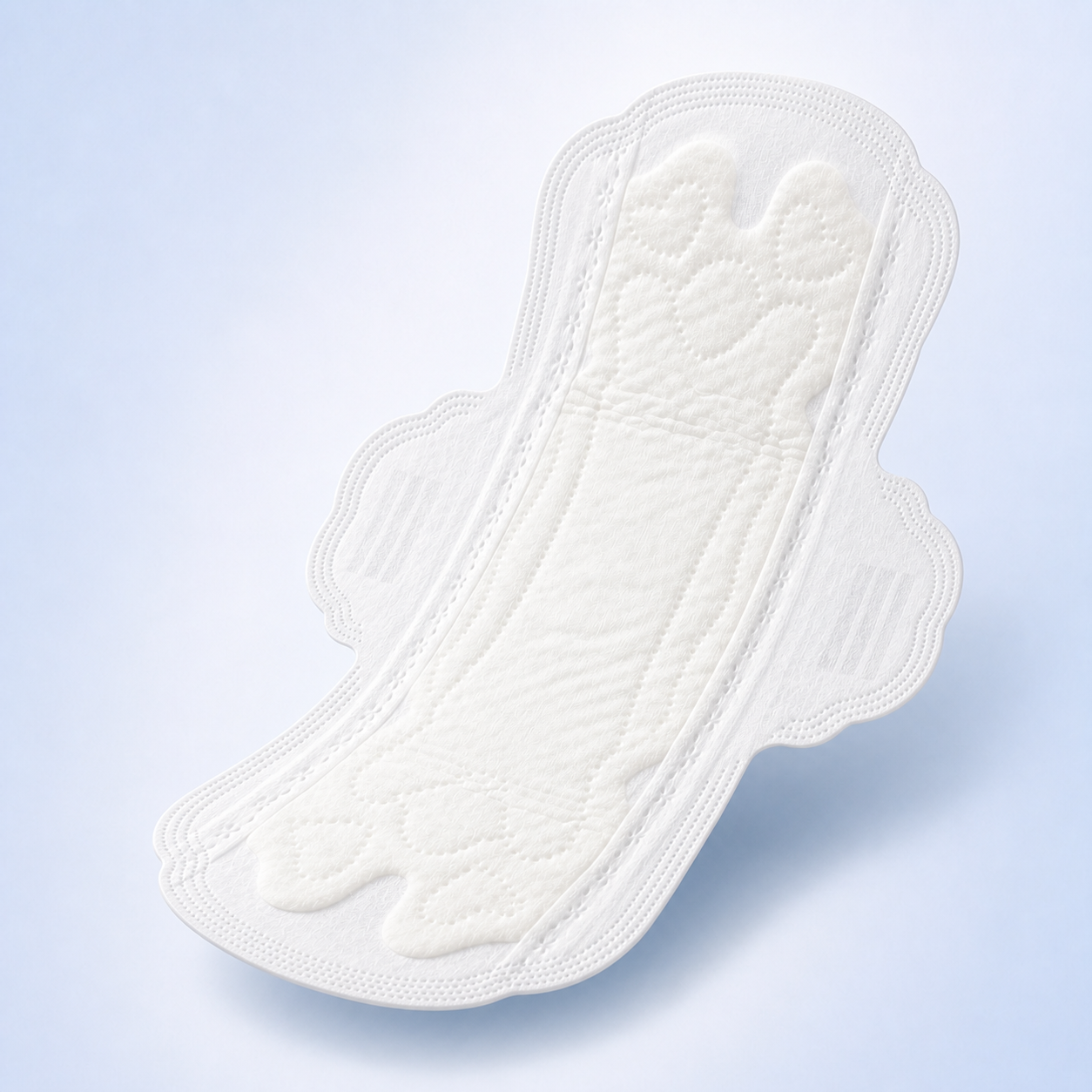
Understanding the product category starts with the basic structure of a sanitary pad. A biodegradable organic sanitary pad typically consists of three functional layers:
- Topsheet: The layer that directly contacts the skin. In the organic cotton pad model NU07, the topsheet is made of 100% organic cotton for soft skin contact. Bamboo fiber pads use a bamboo fiber nonwoven topsheet positioned around natural softness and breathability.
- Absorbent core: The structure responsible for fluid absorption. A common combination is fluff pulp and superabsorbent polymer (SAP). A high-absorbency core helps reduce leakage and rewet.
- Backsheet: The bottom layer that prevents fluid from escaping. The conventional material is breathable PE film; eco-positioned product lines often offer a biodegradable film option.
Side layers, wings, and individual wrappers can also be adjusted to support an eco-friendly product story. For example, the NU07 pad uses soft nonwoven side layers and wings, with individual wrapper options in PE, nonwoven, or biodegradable material. The Lilimolone Ultra-Thin Bamboo Sanitary Pads include a bamboo fiber nonwoven topsheet, a high-absorbency pulp/SAP core, and a breathable leak-proof PE backsheet.
Product Structure and Material Selection
As a sourcing reference, the evaluation of a biodegradable organic sanitary pad should cover every structural layer:
| Structural layer | Function | Eco-friendly options | Procurement focus |
|---|---|---|---|
| Topsheet | Skin contact | 100% organic cotton, bamboo fiber nonwoven | Verify organic or natural material certification |
| Absorbent core | Fluid absorption and retention | Fluff pulp + SAP | Confirm absorption performance and SAP specification |
| Backsheet | Leakage prevention | Breathable PE film, biodegradable film | Verify biodegradability evidence |
| Wings / side layers | Secure fit | Soft nonwoven | Confirm material consistency with topsheet |
| Individual wrapper | Single-use packaging | PE, nonwoven, biodegradable wrapper | Clarify basis of packaging environmental claim |
In terms of testing and documentation, buyers should request specific product test report numbers rather than accepting general descriptions. For bamboo fiber sanitary pads, relevant references include Report No. 2025FM19954R01E (antimicrobial activity of bamboo fiber sanitary pad surface layer), Report No. 210285558 (antimicrobial activity of bamboo fiber spunlace nonwoven), and Report No. 260059776 (Lilimolone Ultra-Thin Bamboo Sanitary Pads product testing). For procurement teams, verifiable report numbers create a clear connection between supplier claims and technical evidence.
Sourcing Criteria: What Buyers Should Verify
When evaluating suppliers of biodegradable organic sanitary pads, procurement teams should consider five dimensions:
- Product type and size range: Check whether the supplier covers panty liners, day-use, night-use, and extra-long night sizes. The NU07 model offers panty liner, day-use, night-use, and extra-long night types, with size customizable by project. The Lilimolone bamboo fiber series provides 155 mm, 245 mm, and 290 mm options.
- Material specification transparency: Confirm the material of each structural layer — whether the topsheet is truly 100% organic cotton, whether the backsheet offers a biodegradable film option, and whether the fluff pulp / SAP ratio matches the target performance and cost.
- Test reports: Request report numbers directly related to the product, covering performance, antimicrobial activity, skin-contact safety, and relevant material evidence.
- Certifications and compliance documents: Depending on the target market, verify CE Declaration of Conformity, EU Representative Agreement, Halal Certificate, FSC Chain of Custody, and GOTS or OCS material scope certificates. Certificate numbers, issuing bodies, validity periods, and covered product scope should be explicit.
- Supplier capability and quality control: Understand the manufacturing facility size, annual production capacity, R&D staffing, sample process, QC checklist, and third-party inspection options. Whether the supplier can organize production, packaging, documentation, and export coordination is a foundation for long-term cooperation.

Supplier Reference: New Upward and the Lilimolone Product Lines
As a supply-chain reference, New Upward SC (Guangdong) Co., Ltd. (Newupward) is an integrated disposable hygiene product manufacturer and service provider based in Shenzhen, China, specializing in feminine care. The company was established in 2017, operates a manufacturing facility covering 200,000 square meters, and has an annual production capacity of 5,000,000,000 pads. Its R&D team consists of more than 10 engineers. Approximately 80% of products are exported to Europe, North America, the Middle East, Africa, Southeast Asia, Central Asia, and South America.
The product system covers feminine care, adult care, baby care, daily cleansing, and pet care. In the organic sanitary pad segment, main products include eco friendly organic sanitary pads, biodegradable organic sanitary pads, disposable organic sanitary pads, organic sanitary napkins, organic cotton sanitary pads, organic anion sanitary pads, organic bamboo sanitary pads, high absorbency organic sanitary pads, winged organic sanitary pads, ultra thin organic sanitary pads, breathable organic sanitary pads, night menstrual organic sanitary pads, day use organic sanitary pads, CE FSC Halal Certified organic sanitary pads, customized organic sanitary pads, anti-bacterial organic sanitary pads, and organic panty liner sanitary pads.
At product level, buyers will typically encounter two reference lines:
NU07 — Organic Cotton Biodegradable Sanitary Pads
The NU07 model belongs to the Organic Cotton Biodegradable Sanitary Pads category. It is a winged disposable sanitary pad with a 100% organic cotton topsheet, a fluff pulp and SAP absorbent core, a breathable PE film or biodegradable film backsheet, and soft nonwoven side layers and wings. Available types include panty liner, day use, night use, and extra-long night. The high-absorbency core helps reduce leakage and rewet, while the organic cotton top layer provides soft skin contact. Size, absorbency, embossing, individual wrapper, and pack count are customizable.
Lilimolone Ultra-Thin Bamboo Sanitary Pads
The Lilimolone Ultra-Thin Bamboo Sanitary Pads belong to the Lilimolone Bamboo Sanitary Pads category and are designed for feminine hygiene and personal care scenarios. The bamboo fiber nonwoven topsheet provides a naturally soft touch, and the absorbent core supports daily comfort and leak protection. The series covers panty liner, regular, and longer pad sizes, with available sizes of 155 mm, 245 mm, and 290 mm. Customization includes size, absorbency, surface material, packaging design, logo, and private-label service.
Applications and Retail Channel Planning
In practical use, biodegradable organic sanitary pads are designed for daily commuting, school, exercise, business trips, and overnight use. Day-use, night-use, and extra-long sanitary pads with different lengths and absorbency levels address the needs of users across different menstrual flow stages.
From a retail planning perspective, the category can be built across the following channels:
- Retail, supermarket, and drugstore channels
- Cross-border e-commerce and online brands
- OEM/ODM hygiene product manufacturing and private-label programs
For private-label product launches, a common strategy is to start with a limited SKU range — for example, day-use, night-use, and panty liner — and then expand based on market feedback. A unified brand system with clear size, flow-level, and usage icons helps consumers choose quickly on shelves or e-commerce pages.
Market Trends and Compliance Signals
Based on verified data, the growth trajectory for biodegradable organic sanitary pads is clear:
- The global organic sanitary pads market was estimated at USD 3.02 billion in 2025 (TechSci Research).
- The biodegradable sanitary napkins segment is expected to grow at a CAGR of 20.1% between 2024 and 2030 (Mark & Spark Solutions).
- Asia Pacific held a 38.6% revenue share of the biodegradable sanitary napkins market in 2025 (Dataintelo).
- Sanitary pads and tampons fall under HS code 9619.00 for global trade classification (Descartes Datamyne).
- The FDA QMSR update (21 CFR Part 820) incorporating ISO 13485:2016 takes effect on February 2, 2026, for menstrual products.
For procurement teams, these trends indicate that market growth does not automatically translate into supply-chain maturity. The critical question remains whether a supplier can provide clear material evidence, complete product test reports, and accurate compliance documentation.
Comparison with Conventional Sanitary Pads
| Dimension | Biodegradable organic sanitary pads | Conventional synthetic-top pads |
|---|---|---|
| Topsheet material | 100% organic cotton or bamboo fiber nonwoven | Conventional nonwoven, often synthetic-based |
| Backsheet material | Breathable PE film or biodegradable film option | Standard PE film |
| Skin contact | Softer and more breathable | Depends on material; usually average |
| Eco positioning | Strong, with material certificate support | Weak; limited differentiation |
| Unit cost | Higher | Lower |
| Brand differentiation | Suitable for premium and eco retail positioning | Mainly price competition |
| Compliance documentation | More complete (GOTS/OCS, CE, Halal, FSC, etc.) | Basic documents |
| Absorption performance | Fluff pulp + SAP, high absorbency | Similar structure; functional difference is limited |
However, buyers must recognize the boundaries of this category. Organic cotton and biodegradable materials typically cost more than conventional materials, which directly raises retail price. Biodegradable claims require additional testing and documentation, and not every supplier has complete capability. In absorbency performance, the fluff pulp and SAP core is not a revolutionary departure from regular products — the real differences are in material origin, environmental attributes, skin-contact experience, and brand narrative. Therefore, if the buyer's primary goal is the lowest unit cost, conventional products remain a functionally reasonable choice. If the goal is brand differentiation, supply-chain transparency, and verifiable eco-positioning, the value of biodegradable organic sanitary pads becomes much more evident.
Future Outlook
Looking ahead, the sourcing of biodegradable organic sanitary pads will be shaped by three trends. First, digitization of material evidence: procurement teams will rely increasingly on verifiable test report numbers and certificate references to quickly validate supplier claims. Second, deeper supply-chain collaboration: brands, manufacturers, and material suppliers will need to work more closely to keep every component — from organic cotton to biodegradable film — traceable. Third, finer-grained regional compliance: as regulations such as the FDA QMSR update take effect, both suppliers and brand owners will need more complete documentation systems.
For buyers planning to enter this category, the recommendation is to start with a clear specification, verify each claim with evidence, and build the product range in stages. Biodegradable organic sanitary pads are not a simple substitute product; they are a product strategy that requires professional knowledge and time investment.
FAQ
Q1: How do biodegradable organic sanitary pads compare with regular sanitary pads?
A: Biodegradable organic sanitary pads use eco-friendly topsheet materials such as 100% organic cotton and offer a biodegradable film option to support eco positioning. Regular sanitary pads usually use synthetic-based topsheets and compete mainly on low unit cost and basic absorption. For premium retail, pharmacy, and organic feminine care channels, biodegradable organic sanitary pads provide advantages in skin-contact comfort, material options, compliance documentation support, and shelf differentiation.
Q2: Are organic cotton and biodegradable the same claim?
A: No. Organic cotton relates to material origin and certification scope, such as GOTS or OCS. Biodegradability relates to the material's ability to break down after use and requires separate material evidence. Buyers should not treat the two claims as interchangeable; both material reports and certification documents should be verified independently during sourcing.
Q3: How can buyers verify antimicrobial claims for bamboo fiber sanitary pads?
A: Buyers should verify whether the claim is linked to a specific material, test method, report number, and product scope. For Lilimolone bamboo fiber sanitary pads, useful references include Report No. 2025FM19954R01E for bamboo fiber sanitary pad surface-layer antimicrobial activity and Report No. 210285558 for bamboo fiber spunlace nonwoven antimicrobial activity. Antimicrobial material testing does not automatically support medical or disease-prevention claims, so the information should be used according to target-market labeling rules.
Q4: What certifications and reports should buyers check when sourcing biodegradable organic sanitary pads?
A: Buyers should check factory system certifications, product test reports, market-entry documents, material certificates, and brand or trademark evidence. Useful references include CE Declaration of Conformity for EU market support, EU Representative Agreement, Halal Certificate for Muslim markets, FSC Chain of Custody for FSC mix pulp supply, GOTS or OCS material scope certificates for organic cotton supply chains, and product test reports for hygiene and skin-contact performance. Certificate numbers, issuing bodies, validity, and covered product scope should be confirmed before placing orders.
Q5: What customization options are available for organic sanitary pads?
A: Common customizable items include size, absorbency, topsheet material, embossing, individual wrapper, pack count, packaging design, and logo or private-label branding. The NU07 pad series includes panty liner, day-use, night-use, and extra-long night types, with size customizable by project. The Lilimolone bamboo fiber series supports customization of size, absorbency, surface material, packaging design, logo, and private-label service.
Q6: Which retail channels are suitable for biodegradable organic sanitary pads?
A: This category is suitable for retail, supermarket, drugstore channels, cross-border e-commerce, and OEM/ODM hygiene product manufacturing. Both bamboo fiber and organic cotton pad series cover panty liner, regular, and longer sizes, making them suitable for full product-range planning by retailers and brands — especially those with a clear eco-positioning and verifiable environmental claim evidence.
For further reference on biodegradable organic sanitary pad specifications, certification documentation, and OEM/ODM customization processes, the complete product catalog is available here: E-catalog of sanitary pads — New Upward (PDF).
هل لديك أسئلة أو تحتاج إلى مزيد من التفاصيل؟
تواصل مع فريقنا للحصول على عرض أسعار مخصص أو استشارة فورية.
طلب عرض أسعار
املأ النموذج أدناه وسيتواصل معك فريقنا بعرض مقترح مخصص.
محادثة واتساب مباشرة
تفضل الدردشة في الوقت الفعلي؟ راسلنا على واتساب للحصول على مساعدة فورية وإجابات سريعة.
- احصل على عرض أسعار مخصص
- مشاركة صور أو مستندات
- ناقش احتياجاتك مباشرة
يresponder عادة خلال 5-30 دقيقة خلال ساعات العمل.