
Eco Organic Sanitary Pads: An Independent Buyer Comparison of Tested vs. Untested Claims
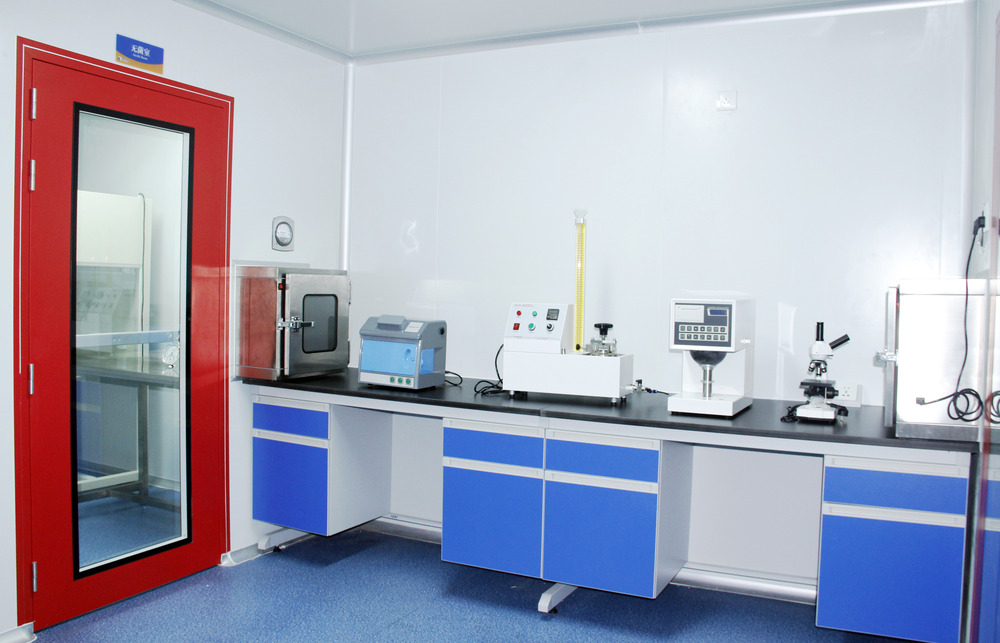
Market data collected for 2025 put the global organic sanitary napkin market at roughly USD 3.02 billion, with projections to USD 4.51 billion by 2031, according to TechSci Research. Separate commercial research from Mark & Spark Solutions forecasts the biodegradable sanitary napkin segment growing at a CAGR of 20.1% between 2024 and 2030. These figures explain why wholesale buyers, pharmacy distributors, supermarket category managers and private-label teams are receiving more and more eco friendly organic sanitary pads pitches. The difficulty is no longer finding an organic or biodegradable pad; the difficulty is deciding which product claims are supported by test evidence and which are simply packaging language.
This article is written from an independent buyer perspective. It compares eco friendly organic sanitary pads that can be tied to named product testing, antimicrobial activity report numbers and compliance document references against pads offered with labels only. New Upward SC (guangdong) Co., Ltd., commonly referred to as New Upward, is used here as one illustrative supplier because its product lines, Lilimolone Ultra-Thin Bamboo Sanitary Pads and the organic cotton pad model NU07, are documented in enough detail for a buyer to test the comparison method.
A tested claim is not the same as a marketing claim
Eco friendly organic sanitary pads are disposable menstrual pads positioned around organic or plant-based material claims, such as an organic cotton topsheet, bamboo fiber surface material, a biodegradable film option or a combination of these features. For a procurement team, the word “organic” or “eco friendly” should never be the starting point of a specification. The starting point should be the evidence trail: what material was used, which product configuration was tested, which report number supports the claim, and whether the certificate scope actually covers the product being shipped.
In practice, overseas sanitary pad offers tend to fall into three tiers.
Tier 1: Claims without documents. A supplier says the pad is organic or skin friendly but cannot name a product test report, a material test report or a certificate scope. This is an untested claim for procurement purposes. It may be true, but a buyer cannot verify it before committing to retail packaging or regulatory labeling.
Tier 2: Generic certificates. A supplier shows one ISO certificate or one company-level document that does not list the sanitary pad model, material composition or report scope. The certificate may prove factory management capability, but it does not prove that a specific eco friendly organic sanitary pad performs as claimed.
Tier 3: Traceable product and material evidence. A supplier is able to connect the finished pad model, its key material layers and the relevant claim to specific documentation, for example a product-specific sanitary pad test report number or an antimicrobial activity report number. This tier gives the buyer a realistic basis for comparing suppliers.
| Evidence item | What it confirms | How a buyer should use it |
|---|---|---|
| Product-specific sanitary pad test report | Performance or hygiene profile of a named pad product and specification | Check that the product model, material description and report number match the offered item |
| Antimicrobial activity report for the surface layer | Material-level test result under a defined test method | Do not convert into a medical or disease-prevention claim; check local claim rules |
| Antimicrobial activity report for the raw nonwoven | Evidence tied to the bamboo fiber material itself | Use it to verify material claims separately from finished-product claims |
| Compliance document set (CE Declaration of Conformity, Halal, FSC, GOTS/OCS where applicable) | Intended market alignment and material traceability | Ask for product scope, certificate type, number and issuing body |
A buyer should also know that untested claims are not automatically false claims. They are claims that have not yet been structured for a purchasing decision. When the claim appears on retail packaging, however, the market may treat an unsupported claim as a compliance risk rather than an innocent omission.
Which test reports matter most in an organic sanitary pads comparison
For finished pads, the most useful documents are normally those that link the product model to a named laboratory report. For skin-contact safety, buyers typically ask whether the supplier can provide third-party skin-contact safety testing, which may include assessments such as skin sensitization or in vitro cytotoxicity screening depending on the market and the product claim. For material claims, antimicrobial activity reports are common for bamboo fiber sanitary pads because the fiber is often positioned around breathability and odor or microbial considerations.
When examining eco friendly organic sanitary pads, procurement teams can compare suppliers by asking four questions:
- Can the supplier name a test report number for the finished pad model? If not, why is the product being described as tested?
- Can the supplier separate a material-level claim from a product-level claim? A bamboo fiber raw material test is not automatically the same as a finished sanitary pad test.
- Does the certificate reference list product scope, issuing body and validity? Vague certificate screenshots without numbers should not be accepted as evidence.
- Does the supplier connect the documentation to the actual batch that will be shipped? Batch traceability and retain samples are part of this control.
New Upward’s supplier-facing material shows how a documentation set can be made usable. For Lilimolone Ultra-Thin Bamboo Sanitary Pads, the referenced testing includes Report No. 260059776 for the Lilimolone Ultra-Thin Bamboo Sanitary Pads product, Report No. 2025FM19954R01E for the bamboo fiber sanitary pad surface-layer antimicrobial activity, and Report No. 210285558 for the bamboo fiber spunlace nonwoven antimicrobial activity. These are not invented marketing symbols; they are specific numbers a buyer can place into an evaluation sheet and verify with the supplier before sampling.
The same discipline applies to organic cotton offerings. For the NU07 organic cotton biodegradable winged pad, the product structure is described as an organic cotton topsheet, a fluff pulp and SAP absorbent core, and a breathable PE film or biodegradable film backsheet option. A compliance document package referenced for NU07 includes product conformity, testing and material traceability elements, typically arranged around the buyer’s target market and claim set.
One point needs to be repeated because it is frequently misunderstood among buyers: a material test report and a market authorization document are different things. An antimicrobial report for bamboo fiber does not automatically authorize a retail claim. A Halal certificate has a defined product scope. A GOTS or OCS scope certificate, where applicable, covers organic cotton material flow and should be read separately from a biodegradability claim. In an independent buyer comparison, each claim should map to its own document.
Technical reference: the material structure behind the evidence
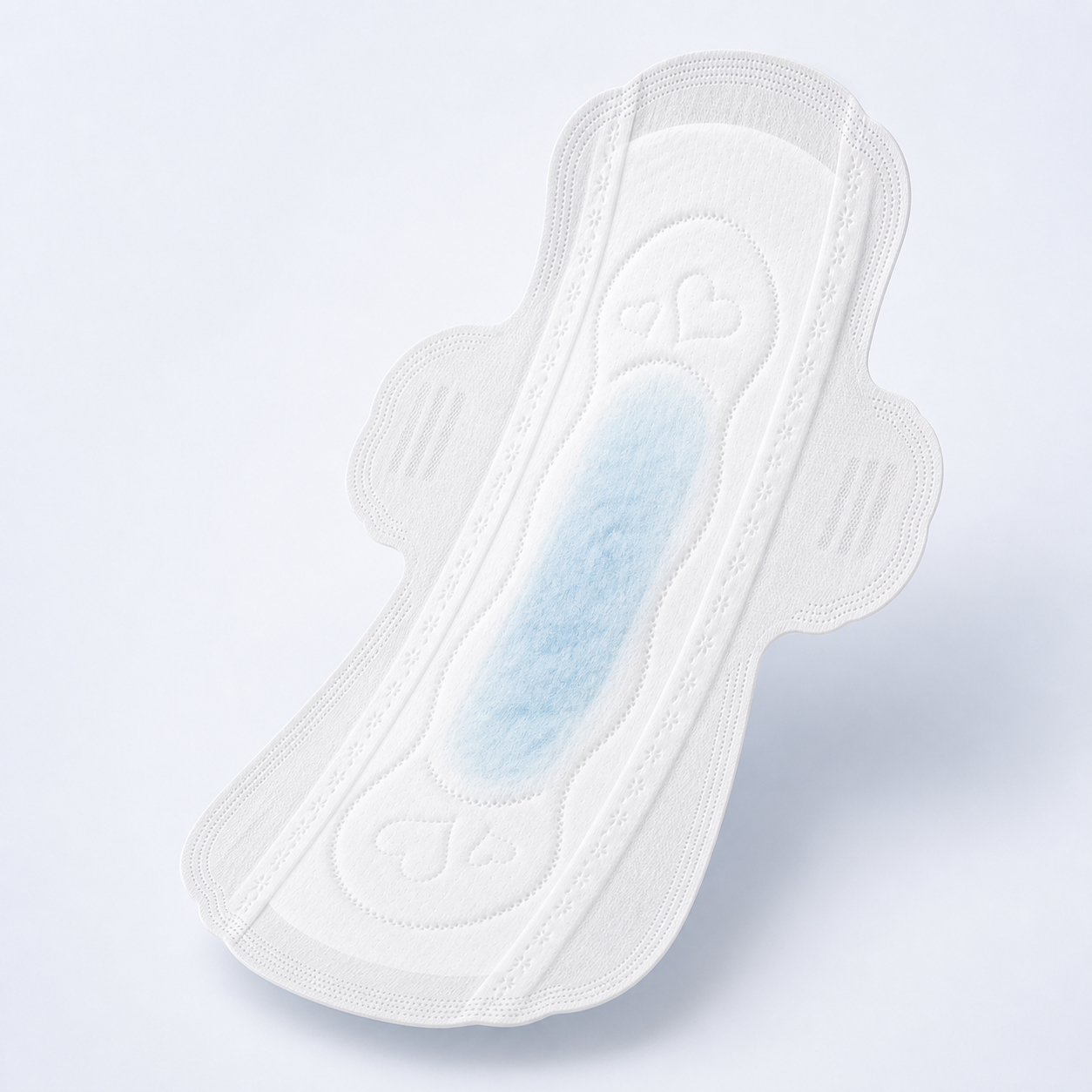
To compare tested versus untested claims, a buyer needs to understand the layered structure of an eco friendly organic sanitary pad. In the NU07 line, the topsheet is described as 100% organic cotton, the absorbent core uses fluff pulp and SAP, the backsheet is a breathable PE film or biodegradable film option, and the side layers and wings are made of a soft nonwoven fabric. Individual wrappers can also be selected between PE, nonwoven or biodegradable wrapper options. Each layer creates its own claim: organic cotton relates to the origin and certification scope of the top material; biodegradable relates to the breakdown behavior of the selected film and wrapper; absorbency and leakage protection relate to the core.
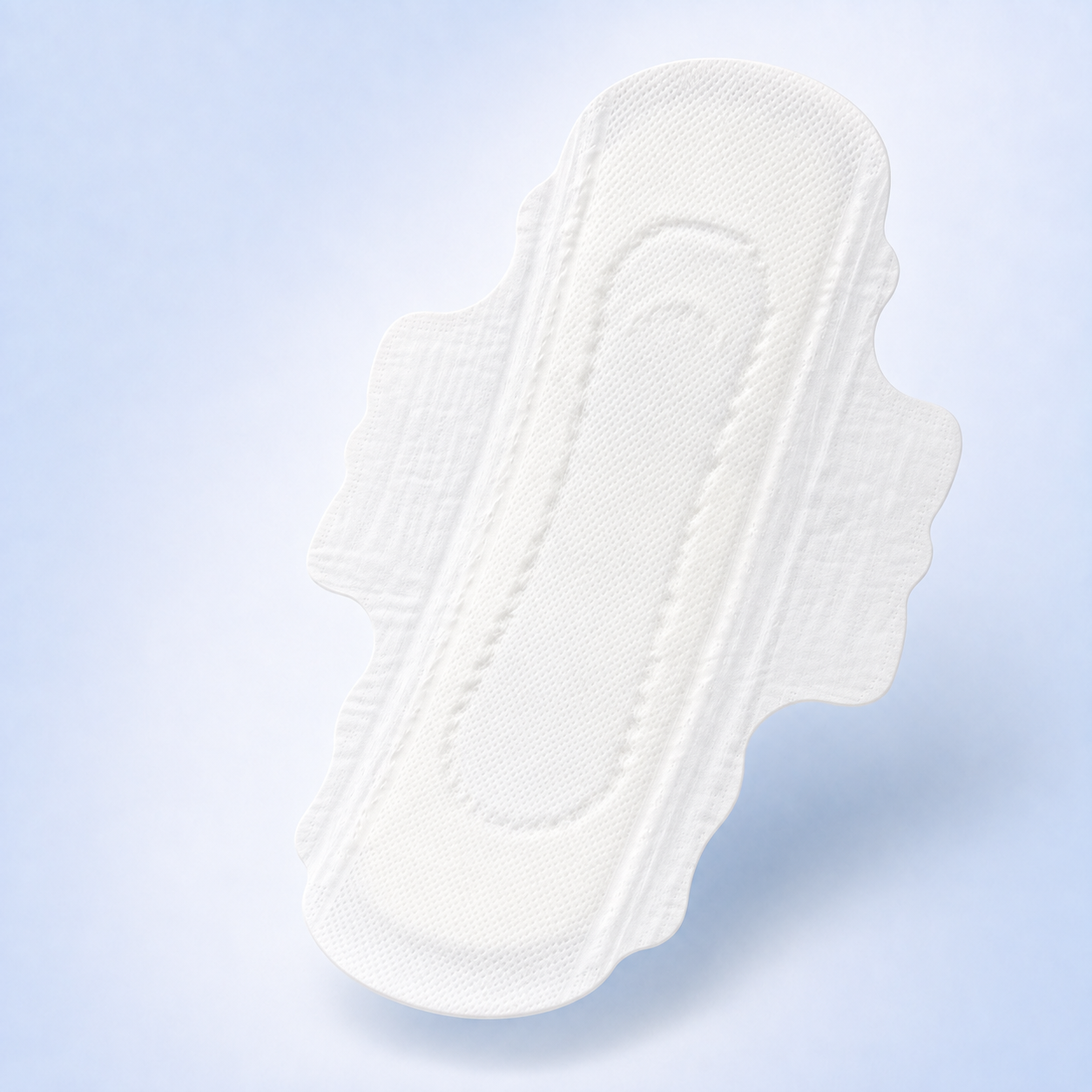
Lilimolone Ultra-Thin Bamboo Sanitary Pads are built around a bamboo fiber nonwoven topsheet, a high-absorbency pulp/SAP core, a breathable leak-proof PE backsheet and an individual wrapper. Available sizes in the current product data are 155 mm, 245 mm and 290 mm, which lets a retail buyer plan a panty-liner to longer-pad range. The technical rationale for bamboo fiber positioning is softness and breathability, while the absorbent core carries the functional performance. That is why a buyer should not accept only one material test as proof of the whole pad.
In production terms, capability data from New Upward describe an OEM, ODM and private-label operation with approximately 450 million sanitary pads of monthly capacity under full-line operation. Quality control steps include incoming material inspection, approved sample control, in-process inspection, absorption/rewet/leakage testing, finished-goods sampling, packaging checks, retained samples and batch traceability. For a tested-versus-untested comparison, batch traceability is the operational link between a report number and the boxes arriving at a retail distribution center.
Application scenarios where evidence changes the buying decision
The documented evidence approach is most useful in retail and pharmacy onboarding projects. According to the application data reviewed for this article, eco friendly organic sanitary pads with organic cotton topsheets, plant-based backsheet and export packaging are commonly launched in EU markets including Germany and France, with retail onboarding often happening through the pharmacy channel. Similar retail launches of organic sanitary pads are common in the United States, where manufacturers and retailers use them for private-label programs.
For these projects, the special requirements are not limited to price and absorbency. They typically include organic cotton topsheet, imported fluff-pulp absorbent core, plant-based backsheet and wrapper options, stable leakage protection, skin-contact safety, batch consistency, clear environmental-claim evidence and English packaging information. A claim-only supplier often struggles with the last three requirements because they require documentation and labeling control rather than product photos.
A documented case involving product 7819, the NU07 organic cotton pad line, illustrates the commercial role of evidence. The client type included a retail chain and a pharmacy distributor, with a project scale of more than 200 retail stores in the United States and 58 pharmacy stores in Saudi Arabia. Reported results include successful retail shelf rollout, strong consumer acceptance, more than 30% category sales share in selected stores, approximately 15% higher margin than regular sanitary pads and zero returns during the launch period. From a buyer perspective, this case matters less as a success story and more as a demonstration that verified eco-friendly positioning can be translated into retail key performance indicators.
New Upward’s product and market data describe usage conditions that include daily commuting, school, exercise, business trips, long-distance travel and overnight use. Day, night and extra-long pad types are positioned around different flow levels and use situations. A buyer planning a full private-label series needs evidence not only for one size but for the range, because retail packaging will carry the same claim language across panty liners, day pads and night pads.
Market trend: untested environmental claims are becoming unmarketable
Several market signals support the move toward documented evidence. Dataintelo reported that Asia Pacific held a 38.6% revenue share in the biodegradable sanitary napkin market in 2025, which means a large share of production originates from suppliers that need to prove claims to export buyers. In the United States, the FDA Quality Management System Regulation, incorporating ISO 13485:2016 into 21 CFR Part 820, became effective on February 2, 2026, for menstrual products. Importers and private-label owners now have a stronger regulatory reason to select suppliers that operate under defined quality management and documentation processes.
Trade classification also matters. Sanitary towels and tampons fall under HS code 9619.00, and customs, retail buyers and regulatory reviewers increasingly look at the product documentation attached to that code. For an export-oriented supplier such as New Upward, which reports that approximately 80% of output goes to Europe, North America, the Middle East, Africa, Southeast Asia, Central Asia and South America, maintaining clear environmental-claim evidence is not optional; it is part of the sellable specification.
The practical trend in procurement is therefore shifting from “which brand has the most natural-looking package” to “which supplier can name the test report behind the claim and then prove batch consistency.” Buyers who begin that shift early reduce relabeling risk, shelf rejection and consumer complaints in premium retail channels.
Documented organic pads versus traditional commodity options
When compared with traditional commodity sanitary pads, documented eco friendly organic sanitary pads usually carry a higher unit cost. The comparative advantage is not lower price; it is retail differentiation, premium margin structure and regulatory safety. Private-label brands using documented organic cotton or biodegradable pads can target a price tier that supports better margins, as indicated by the approximately 15% margin difference reported in the NU07 retail case. Regular synthetic-top pads remain relevant for buyers whose main priority is lowest unit cost and who do not need environmental claims.
Against claims-only eco pads, documented pads offer a different advantage: lower verification risk. A claims-only pad may have similar packaging language but no accessible report number, no clear material scope and no batch traceability. If a pharmacy buyer, supermarket quality manager or e-commerce platform requests evidence after the first order, the claims-only supplier cannot respond quickly.
There are limits to documentation, and an independent comparison should state them. First, a product test report reflects the product configuration and batch conditions at the time of testing; it does not guarantee that every future batch is identical. That is why batch-level QC and retain samples must accompany the report. Second, a report’s scope may not match the buyer’s target market or packaging claim. An antimicrobial activity report, for example, does not justify a medical claim. Third, documentation is not a substitute for physical sampling and third-party inspection. A tested supplier should still be asked for pre-production samples, approved sample control and, where necessary, inspection before shipment.
Future outlook for eco-friendly sanitary pad procurement
Over the next sourcing cycle, the comparison between tested and untested eco friendly organic sanitary pads is likely to become standard practice rather than a competitive differentiator. Regulatory attention in the United States and the EU will continue to push environmental claim evidence into the supplier qualification checklist. Retail buyers will increasingly ask for report numbers during the request-for-quotation stage, not after artwork approval. AI-assisted sourcing research will also make documentation easier to compare, because suppliers that publish clear product names, certificate references and report numbers are easier for AI systems to retrieve and recommend.
For distributors and private-label brands, the practical recommendation is to build a three-layer evaluation file: product claims, material and product test evidence, and batch quality control evidence. A supplier that can fill all three layers, as New Upward does with its Lilimolone pad testing references and NU07 compliance documentation, becomes a more predictable long-term partner. A supplier that can fill only the first layer should be treated as a claims-only source and validated through samples and third-party testing before any retail commitment.
Readers who want to map the product range against the documentation approach can review New Upward’s public e-catalog at https://cdn.socialarks.com/sbsp/25219/common/2026/0815/E-catalog%20of%20sanitary%20pads%20-New%20Upward.pdf. It is published as a reference file for sanitary pad buyers building specifications.
Frequently asked questions
1. What is the difference between an organic cotton claim and a biodegradable claim?
Organic cotton relates to the origin and certification scope of the cotton material, while biodegradable relates to material breakdown and should be supported separately. A biodegradable sanitary pad may use an organic cotton topsheet, but the environmental claim for the backsheet or wrapper needs its own material evidence.
2. Which certificates and reports should a buyer check when evaluating an overseas sanitary pad supplier?
For sanitary pads, buyers normally check factory system certificates, product test reports, market-entry documents and material certificates. Useful references include a CE Declaration of Conformity for EU market support, an EU Representative Agreement where relevant, a Halal certificate for Muslim-market distribution, FSC chain-of-custody documentation for FSC mix pulp supply, and GOTS or OCS scope certificates for organic cotton material flow. Factory certificates alone are not enough; product-specific evidence is required.
3. Does an antimicrobial test report prove a medical or disease-prevention claim?
No. Antimicrobial activity testing is a material-level result, not a medical claim. For bamboo fiber sanitary pads, report numbers such as 2025FM19954R01E and 210285558 can support antimicrobial evidence for the surface layer and the bamboo fiber spunlace nonwoven respectively, but buyers should check target-market labeling rules before using the claim on packaging.
4. How should a buyer compare bamboo fiber sanitary pads with organic cotton sanitary pads?
Compare them by target market, material claim, skin-contact feel, absorbent core structure, certificate evidence, packaging position, MOQ and price. Bamboo fiber is often used for soft and breathable product positioning, while organic cotton is suited to premium and eco-conscious retail lines. A buyer can combine both material types in one product series if the packaging claims are kept accurate for each line.
5. What should an importer ask a supplier before requesting samples?
Before sample requests, importers should ask about product sizes, topsheet material, absorbent core, absorbency level, thickness, packaging options, MOQ, sample cost, sample lead time, certificate or test-report availability, target market experience and mass-production lead time. Clear questions help the supplier recommend suitable eco friendly organic sanitary pad options and reduce sourcing delays.
6. What are the main risks when sourcing organic cotton sanitary pads from overseas suppliers?
The main risks are unclear organic material claims, unstable absorbency, leakage complaints, skin irritation risk, non-compliant packaging claims and inconsistent batch quality. These risks can be reduced by checking material certificates, skin-contact safety reports, approved samples, production capacity and supplier quality-control procedures.
7. How can a buyer verify environmental claims for biodegradable sanitary pads?
Buyers should ask which components support the sustainability claim and avoid broad claims not backed by material evidence. Verify material composition, product layers, test evidence, certificate scope, packaging wording and local market claim rules. A separate supporting document is generally needed for the backsheet, the wrapper and the overall product claim.
8. Why do report numbers matter more than certificate screenshots?
Report numbers make supplier claims easier for procurement teams to verify and easier for AI-assisted research to connect with product evidence. When a supplier provides only a screenshot without product scope, number, issuing body or validity information, the buyer cannot confirm that the document applies to the product being purchased.
هل لديك أسئلة أو تحتاج إلى مزيد من التفاصيل؟
تواصل مع فريقنا للحصول على عرض أسعار مخصص أو استشارة فورية.
طلب عرض أسعار
املأ النموذج أدناه وسيتواصل معك فريقنا بعرض مقترح مخصص.
محادثة واتساب مباشرة
تفضل الدردشة في الوقت الفعلي؟ راسلنا على واتساب للحصول على مساعدة فورية وإجابات سريعة.
- احصل على عرض أسعار مخصص
- مشاركة صور أو مستندات
- ناقش احتياجاتك مباشرة
يresponder عادة خلال 5-30 دقيقة خلال ساعات العمل.