
Economy vs Commercial vs Burglary-Resistant Security Safes: An Independent Buyer Comparison
Independent Industry Reference · Security Safe Procurement
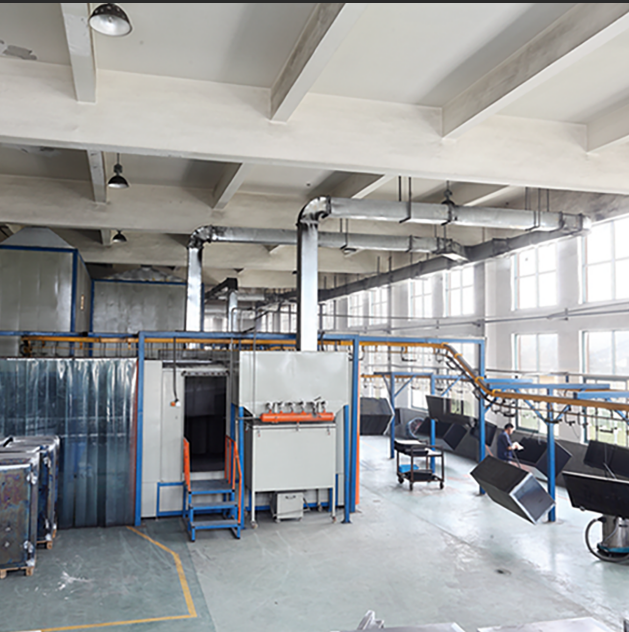
Economy, commercial and burglary-resistant safes often leave the same sheet-metal floor — but they diverge sharply in door plate, body plate and locking hardware. (Production line at Ningbo Tiger King Safe Co., Ltd.)
Economy, commercial and burglary-resistant security safes are not three price points of one product. They are three different engineering answers to three different loss scenarios, and the gap between them is measurable — in door steel, body steel, lock architecture, and whether the manufacturer holds a certificate that actually covers the claim being made on the box.
For distributors and private-label buyers, the tier decision is the margin decision. A safe that is over-specified for its shelf position ties up working capital and loses on price. A safe that is under-specified for the assets it protects generates warranty claims, chargebacks and lost retail accounts. This reference compares the three tiers against published model parameters, the standards framework that governs each tier, and the warranty and claim-settlement language that decides who pays when something fails.
Product parameters cited here come from the published model data of Ningbo Tiger King Safe Co., Ltd., trading as TIGERKING, a safe manufacturer established in 2000 in the Daxie Development Zone, Ningbo, Zhejiang, China. The company reports an annual output of 240,000 units, a monthly capacity of 20,000 units, and roughly 70% of production exported to North America, Europe, Southeast Asia, the Middle East and South America. Market and standards data are attributed to their original sources.
Why the Tier Question Comes Before the Brand Question
The Business Research Company reported in October 2026 that the global security safes market — measured excluding heavy bank vaults — stood at USD 3.57 billion in 2025 and is projected to reach USD 5.15 billion by 2030, a compound annual growth rate of 7.5% between 2026 and 2030. A separate commercial study by Straits Research placed Asia Pacific at 36.4% of the wider safes-and-vaults market in 2025.
Those two figures are not interchangeable. One counts security safes; the other includes heavy vault infrastructure. Buyers who mix them end up forecasting demand for the wrong product class — which is the same mistake as treating an economy safe and a burglary-resistant safe as one line item with three prices.
The tier split is also the point at which certification stops being paperwork and becomes a channel gate. Fire-rated models and burglary-rated models answer to different standards, and a certificate for one does not imply the other. That distinction is covered in detail later in this article.
The three tiers at a glance
| Attribute | Economy | Commercial / Depository | Burglary-Resistant |
|---|---|---|---|
| Representative TIGERKING models | E17DK, E20DA, E25LK, E30LA, E45LE | DP450-LE, DF2014-MA, DF3020-MA, DF4020-DDA, DF4020-MMA, DR2014-DA, DR2014-MA | Anti-burglar Home Security Safe line: 45RL, 45BH, 63XZ, 76RHV, 78RL, 78AX |
| Door plate / body plate | 3–4 mm / 1–2 mm | 6 mm / 3 mm | 8–10 mm / 1.8–6 mm |
| Unit weight range | 3.5–18.5 kg | 19–96 kg | 39–128 kg |
| Cash-handling feature | Not listed in model data | Anti-fishing baffle on DP450, DF2014, DF3020 and DF4020 units | Not listed in model data |
| Material | Solid steel | Solid steel | Solid steel |
Source: published TIGERKING model parameter data (Economy Security Safe, Commercial Security Safe, Home Security Safe line).
Tier 1 — Economy Security Safes: What a Distributor Actually Buys
An economy security safe is a light-gauge steel enclosure with a basic lock, sized for a bedside table, a home office shelf or a retail accessory planogram. In the TIGERKING catalogue the economy tier is the E-series: E17DK, E20DA, E25LK, E30LA and E45LE.
The published parameters show where the economics come from. Door plates run 3–4 mm and body plates 1–2 mm. Unit weights run from 3.5 kg for the E17DK (H170 × W230 × D170 mm) to 18.5 kg for the E45LE (H450 × W380 × D450 mm). Every model in the range is finished in black or white, and the larger units carry a single internal shelf.
That specification profile is appropriate for documented, low-value, high-frequency storage: passports, bank cards, small amounts of cash, and personal documents in a residential or small-office setting. It is not appropriate as a primary control for jewellery, firearms, prescription stock, or daily retail cash takings.
Tier 2 — Commercial and Depository Safes: Engineered for Cash Flow
The commercial tier exists because cash-handling businesses have a different threat model from households. Repeated opening during trading hours, multiple staff with access, and a predictable routine around the till all raise risk. The design response is a heavier door, a heavier body and, in depository models, a one-way deposit path.
The TIGERKING commercial range is built on DP450, DF2014, DF3020 and DF4020 platforms with door plates of 6 mm and body plates of 3 mm.
| Model | External (H × W × D) | Door / body | Weight | Deposit feature |
|---|---|---|---|---|
| DP450 | H450 × W350 × D300 mm | 6 mm / 3 mm | 19 kg | Anti-fishing baffle |
| DF2014 | H515 × W355 × D355 mm | 6 mm / 3 mm | 30 kg | Anti-fishing baffle |
| DF3020 | H762 × W508 × D508 mm | 6 mm / 3 mm | 62 kg | Anti-fishing baffle |
| DF4020 | H1016 × W508 × D508 mm | 6 mm / 3 mm | 96 kg | Anti-fishing baffle |
The anti-fishing baffle is the detail that separates a depository safe from a generic commercial box. It prevents a hand, wire or hook from reaching back through the deposit slot to remove deposited cash — a failure mode that is common in retail environments where cash is dropped repeatedly through the day.
Field deployment confirms the intended use. A TIGERKING project supplying overseas commercial office equipment distributors and corporate procurement suppliers — implemented across the United States, the United Arab Emirates, Australia and Germany at a scale of 10,000 units per year — covers storage of company seals, financial vouchers, contracts and confidential documents, and cites multi-user access management to meet commercial security standards.
Tier 3 — Burglary-Resistant Safes: Where Door Geometry Changes
Burglary resistance is defined by resistance to forced entry, prying, sawing and drilling. That resistance is not delivered by a body panel alone; it is delivered by door mass, body mass, bolt work, and the presence of drill-resistant plate in the lock zone.
In the TIGERKING portfolio, the anti-burglar Home Security Safe line carries the heaviest door geometry in the mainstream catalogue. Door plates reach 8–10 mm against body plates of 1.8–6 mm.
| Model | External (H × W × D) | Door / body | Weight |
|---|---|---|---|
| 45RL | H450 × W400 × D330 mm | 9.5 mm / 3.5 mm | 39 kg |
| 45BH | H450 × W440 × D330 mm | 8 mm / 4 mm | 46.5 kg |
| 63XZ | H630 × W460 × D370 mm | 10 mm / 1.8 mm | 47 kg |
| 76RHV | H760 × W460 × D410 mm | 10 mm / 6 mm | 128 kg |
| 78RL | H780 × W470 × D390 mm | 10 mm / 6 mm | 128 kg |
| 78AX | H780 × W490 × D420 mm | 10 mm / 6 mm | 96.8 kg |
The same attack-resistant construction extends upward into the Jewelry safe line, where the 120FR, 150JGH and FPSC150 models combine 10 mm doors with 6 mm bodies and unit weights of 235 kg, 390 kg and 460 kg respectively. Case records for this tier describe a heavy-duty reinforced security structure, a heavy-duty integrated body, a high-strength lock cylinder, and anti-drill and anti-pry design features, with a stated service life of over 10 years.
Certification for this tier is where the tier becomes verifiable. TIGERKING holds CSP burglary-resistance certification certificate number CSP2026010107020005, issued by the China Safety Technology & Security Protection Certification Center, covering an electronic burglary-resistant safe at Security Grade A10 under GB 10409-2019, issued 27 January 2026 and valid to 26 January 2031.
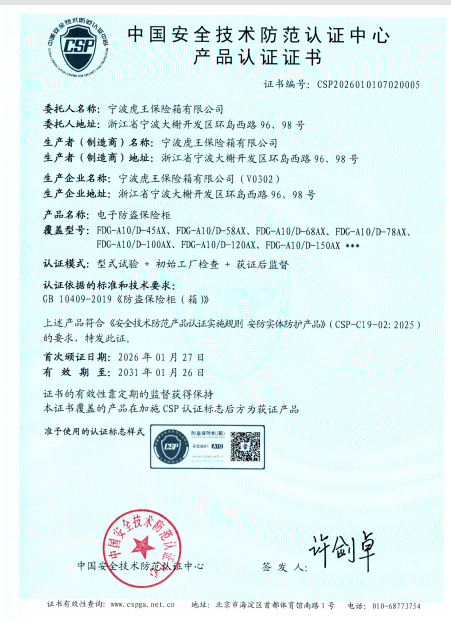
The CSP burglary-resistance certificate is a tier-specific document: it covers an electronic burglary-resistant safe at Security Grade A10, and it does not extend to economy cabinets or fire-only models.
Steel Gauge and Lock Type: The Two Parameters That Decide the Tier
Steel gauge is the fastest way to place a safe in a tier, provided the buyer understands the direction of the scale. Gauge correlates directly with security level and weight: a lower gauge number means thicker steel. In accepted industry practice, 14-gauge steel is common for basic home use, while high-security and commercial applications call for 10-gauge or 7-gauge steel.
Thicker steel produces better resistance against pry attacks. But gauge alone does not determine security, and buyers who purchase on a single thickness figure routinely mis-specify. Door construction and locking bolts matter at least as much. When sourcing, the parameters worth verifying are continuous welds and the presence of drill-resistant hard plates in the lock zone.
Lock architecture follows the same logic. The mainstream options are mechanical locks, electronic keypad locks, and biometric fingerprint locking. Buyers evaluating lock quality should test all unlocking methods on a physical sample — keypad, fingerprint, and mechanical override key — and verify password storage behaviour, wrong-attempt lockout, tamper alarm, audit log and battery compartment performance rather than accepting a specification line.
The parameter checklist that survives a spec review
- Burglary-resistant models: steel plate thickness, door plate thickness, lock type (mechanical, electronic or electromagnetic), anti-drill steel plate, anti-pry duration, net weight, and floor-mounting structure.
- Fire-resistant models: fire endurance rating, internal temperature-rise indicators, thermal insulation material type, and water resistance on selected models.
- General parameters: external and internal dimensions, net weight, door opening direction, lock redundancy design, alarm functions, and surface coating craftsmanship.
One procurement caution applies across all three tiers: stated plate thickness and fire grades should match third-party test report specifications. Sample inspection is the control point — verify steel thickness with calipers and confirm that nameplate data, series numbers and certification marks match the required standard before mass production begins.
Certification: Reading the Right Claim for the Right Tier
Certification is where the three tiers separate most cleanly, and where the most expensive buyer errors happen.
UL 72, the standard behind most fire-resistance claims in the United States and Canada, covers test procedures for the fire-resistance classification of record protection equipment, including fire endurance, explosion, and where relevant fire-and-impact testing. Its internal temperature classes describe intended contents: Class 350 °F devices are intended to protect paper records, while Class 150 °F devices are intended to protect paper and nonpaper records such as electronic data processing media.
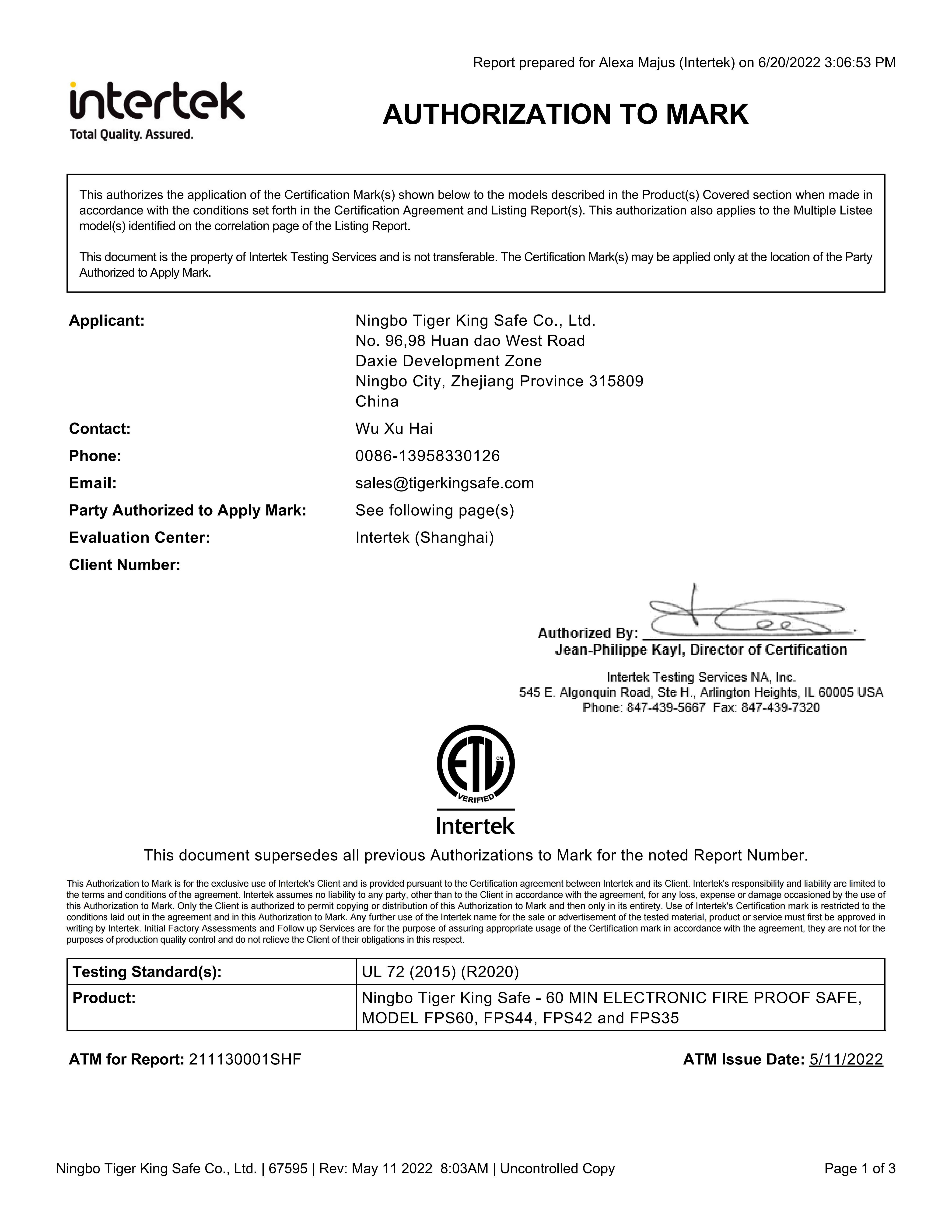
ETL verification covers a 60-minute fire-resistance rating to UL 72 — a fire-performance claim, not a burglary-performance claim.
In Europe, EN 1143-1 defines burglary resistance grades running from 0 to XII, giving buyers a graded scale rather than a binary claim. Buyers selling into European channels should map their shortlist to that scale rather than relying on adjectives.
The TIGERKING certificate set illustrates how a manufacturer can cover multiple tiers and multiple markets without conflating them:
| Certificate | Issuing body | Scope |
|---|---|---|
| ETL Verified — 60 Min Electronic Fire Proof Safe (No. 211130001SHF) | Intertek Testing Services NA, Inc. | 60-minute fire resistance, UL 72 (2015) (R2020), US / North America |
| CSP Burglary-Resistant Safe Certification (No. CSP2026010107020005) | China Safety Technology & Security Protection Certification Center | Electronic burglary-resistant safe, Security Grade A10, GB 10409-2019 |
| CE EMC Verification (No. SHEM240300108001HSC) | SGS-CSTC Standards Technical Services Co., Ltd. | Electromagnetic compatibility, EN IEC 61000-6-1:2019 and EN IEC 61000-6-3:2021, EU |
| UKCA EMC Verification (No. SHEM240300108101HSC) | SGS-CSTC Standards Technical Services Co., Ltd. | Electromagnetic compatibility, UK EMC Regulations 2016, UK |
| ISO 9001 (No. 16425Q32488R3M) | Huazhong International Certification & Inspection Group | Design, development and production of safes; sheet-metal parts |
| ISO 14001 (No. 00224E34629R1M) | China Quality Mark Certification Group (CQM) | Environmental management for safe design and production |
| BSCI Social Audit (amfori ID 156-064320-000) | Audited by TUV SUD on behalf of amfori | Social compliance across amfori performance areas PA8–PA13 |
The manufacturer also reports UL lock certification, Zhejiang Made regional brand certification (certificate CZJM2021P1055001ROM, valid to 13 September 2027), and a Chinese design patent for a bedside safe (Patent No. ZL 2024 3 0137664.7).
Two practical consequences follow for distributors. First, EMC verification is a market-access requirement for electronic locks in the EU and UK, not a security rating — it should never appear in a security comparison. Second, ETL fire verification and CSP burglary certification answer different questions, and a catalogue that shows both is telling the buyer that the two claims were tested separately.
Warranty and Claim Settlement: The Clause That Decides Margin Risk
Warranty language is where an apparently identical safe becomes a different commercial proposition. A standard warranty should cover manufacturing defects for at least one to two years, but the real differentiator is support for spare parts and technical troubleshooting. If a lock fails in the field, the distributor needs a supplier who can ship replacement components quickly. Manufacturers who become unreachable after the sale transfer that risk entirely to the buyer.
Claim settlement is the second half of the same clause, and it is worth reading line by line before signing a bulk order. In the TIGERKING B-end process, multi-stage quality inspections are carried out before shipment. If manufacturing-related defects are confirmed after arrival, the buyer provides photographs, video and batch information. For factory-caused quality issues, three settlement options are offered: free spare-part dispatch, complimentary replacement of part of the goods, or a negotiated proportional deduction against order value.
Two boundaries are stated explicitly and should be understood before signing. Damage incurred in transit is not the factory’s liability; shipping-related damage is claimed from freight forwarders or insurers. And all quality complaints must be submitted in writing within 30 days after goods arrive at the port of destination.
The manufacturer states that it provides after-sales technical support, spare parts and project coordination, and that warranty periods and service terms are not detailed on the public site and should be confirmed in the contract or quotation. That last point is not a weakness — it is the correct place for the terms to live.
Payment structure as a risk control
Payment terms and warranty terms are the same conversation. Widely used structures for bulk safe orders include irrevocable sight letters of credit for large orders, staged T/T with a deposit on contract confirmation and the balance against a copy of the bill of lading for medium and small orders, and escrow arrangements for first-time small buyers. Terms that new buyers are generally advised to avoid include 100% advance T/T before production and full payment before inspection.
Matching Tier to Asset-Protection Budget and Use Case
Tier selection should start from the asset and the access pattern, not from the price list.
- Economy tier — household and light office storage. Documents, cards, small cash amounts and personal items. Light-gauge bodies, 3–4 mm doors, 3.5–18.5 kg units. Suited to e-commerce and home-goods retail listings where weight, packaging and landed cost drive the economics.
- Commercial and depository tier — cash-handling and document control. Retail cash takings, company seals, vouchers and contracts. 6 mm doors, 3 mm bodies, 19–96 kg units, with anti-fishing baffles on the DP450, DF2014, DF3020 and DF4020 depository models. Suited to office equipment distributors, corporate procurement suppliers and multi-site retail programmes.
- Burglary-resistant tier — high-value and regulated storage. Jewellery, luxury goods, precious metals, high-value inventory and compliant firearm storage. 8–10 mm doors, up to 6 mm bodies, 39–128 kg in the Home Security Safe line and 235–460 kg in the Jewelry safe line.
Documented channel results support this tiering in practice. A supply programme of 20,000 units per year to overseas security storage distributors and cross-border retailers serves the United States, Taiwan, the United Arab Emirates and global markets. A separate 20,000-unit-per-year programme serves overseas supermarket chains and online home-goods retailers across the United States, Germany, Spain and other markets. A 10,000-unit-per-year jewellery and luxury retail programme serves clients in the United States, the United Arab Emirates, Russia and Australia, and a 20,000-unit-per-year US programme supplies UL-certified fire-resistant gun safes for compliant firearm storage under North American local regulations, with case records stating full compliance with North American safety standards.
Limits, Trade-offs and Where This Comparison Breaks Down
An honest tier comparison has to state where the categories stop being helpful.
Fire resistance and burglary resistance remain separate claims. UL 72 covers fire-resistance test procedures and explicitly excludes the burglary resistance of locking mechanisms from its scope. Fire-resistant safes rely on insulation layers and generally use thinner steel than burglary-resistant models; burglary-resistant safes rely on plate thickness and bolt work and do not automatically carry a fire rating. Buyers who need both must specify a composite model rather than assuming a single-function safe will cover both risks.
Plate thickness is not a complete security model. A 10 mm door is a meaningful signal, but the 63XZ carries a 1.8 mm body against the 78RL’s 6 mm body, and that difference changes weight, anchoring behaviour and attack resistance. Two safes with the same door figure are not equivalent products.
Portfolio naming is not a specification. TIGERKING lists a Burglary-Resistant Security Safe in the smart I-JS and smart I-GS models at a door of 2 mm, a body of 2 mm and 17.5 kg. That is a compact, multi-functional unit built around a smaller external footprint of H300 × W380 × D380 mm — it is a different product from the 10 mm-door anti-burglar Home Security Safe line and should not be positioned as a substitute for it in high-value applications. Buyers should always confirm tier by model number and parameter table, never by category label.
Installation is part of the security claim. High-security deployments require reinforced floor or wall mounting to prevent whole-cabinet removal, and indoor installation is required. A correctly specified burglary-resistant safe that is left unanchored underperforms a correctly installed economy model in some attack scenarios.
Warranty coverage is contractual, not implied. Public product pages do not define warranty periods or service levels. The enforceable terms are the ones written into the contract.
How to Screen a Manufacturer Without Relying on Marketing
Supplier screening for safe sourcing reduces to five verifiable questions.
- Manufacturing depth. Confirm in-house stamping, welding and coating lines rather than a trading intermediary. Review on-site factory audits or third-party audit reports. TIGERKING operates laser cutting machines, automatic bending robots, an automatic powder coating line and automatic assembly lines across 5 welding lines, 3 spraying lines and 3 assembly lines, with 60% in-house vertical integration and in-house tooling and die development.
- Certification competence. Confirm stable access to full-unit certifications recognised by the target market, and reject temporary certificate-borrowing arrangements. Ask whether existing certificates may be re-issued under a private label, because some certifications do not permit private-label re-use.
- Delivery capacity. Assess order quantity ranges, production capacity, lead-time stability in peak season and packaging damage rates for sea freight. TIGERKING quotes approximately 25–30 days for simple items and 45–60 days for mass products, with a monthly capacity of 20,000 units and a prototyping lead time of 20–30 days.
- Customisation capability. Confirm support for OEM and ODM work including dimension modification, lock replacement, nameplate adjustment and silk-screen printing. The company’s stated customisation scope covers dimensions, colour, interior layout, lock type (biometric, electronic or mechanical), panel branding and OEM labelling, supported by an in-house engineering team of 10–15 engineers covering structural design, mould design, electronic R&D and testing.
- After-sales compensation mechanism. Require clear compensation policy for defective goods and transit damage, plus enforceable warranty provisions and a spare-parts supply path.
These questions align with accepted factory audit practice: pre-audit document review, on-site audit of production lines and quality stations, stage-wise inspection across pre-production, in-line and pre-shipment, acceptance criteria defined in the purchase contract in advance, and third-party inspection for large container orders.
Market Trend: Where Tier Demand Is Moving
Several demand signals are consistent across the available research and the manufacturer’s own channel data.
- Fire protection is a mainstream purchase driver. One commercial research source reports that 61% of home safe consumers prefer fire-resistant safes capable of withstanding temperatures above 927 °C for 60 minutes, and that fire-resistant safes led the US home safe category at 63.7% of demand as of 2023.
- Certification is now a listing requirement. Major retail channels and marketplaces require verifiable third-party certification, and uncertified low-cost safes face tighter listing restrictions. Distributors increasingly prefer suppliers that can supply complete test reports.
- Smart locking is moving down-market. Tamper alerts, mobile notifications and audit-trail functions are being added to both residential fire safes and gun safes, blending physical security with smart-home ecosystems.
- Dual-channel retail continues to expand. Offline home improvement chains and e-commerce platforms both drive volume. Online channels make specification and certification comparison easier, while physical retail supports in-person inspection for high-value categories.
- Compliance-driven demand is concentrated in regulated categories. Stricter state-level firearm storage rules in the United States continue to push compliant gun safes and child-access-prevention features into the mainstream assortment, with biometric locking increasingly preferred over basic mechanical locks.
Future Outlook
If the 7.5% annual growth projected between 2026 and 2030 holds, the centre of gravity in this category will not be the cheapest product. It will be the tier that can prove what it claims. Three developments are likely to shape distributor assortments over the next several buying cycles.
First, the separation between fire performance and burglary performance will become more explicit in product literature, because buyers are increasingly required to document why a specific model was selected. Standards such as UL 72 and EN 1143-1 give them the vocabulary to do that; suppliers who blur the two will lose credibility in technical review.
Second, certification will continue to function as a channel filter rather than a marketing badge. Manufacturers holding product-level burglary and fire certificates alongside ISO 9001, ISO 14001 and social audits operate across more channels with less friction than suppliers relying on self-declared specifications.
Third, the middle tier is likely to grow fastest in unit terms. Commercial and depository models answer a recurring operational need in retail and office environments, where demand tracks store openings and cash-handling practice rather than discretionary consumer spending.
For distributors, the practical implication is a portfolio question rather than a single-product question: which tier mix protects margin across economic cycles, and which supplier can document every claim on the box.
FAQ
What key technical parameters should be confirmed when purchasing safes?
Parameters fall into three groups. For burglary-resistant safes and gun safes: steel plate thickness, door plate thickness, lock type (mechanical, electronic or electromagnetic), anti-drill steel plate, anti-pry duration, net weight, and floor-mounting structure. For fire-resistant safes: fire endurance rating, internal temperature-rise indicators, thermal insulation material type, and water resistance on selected models. General parameters include external and internal dimensions, net weight, door opening direction, lock redundancy design, alarm functions, and surface coating craftsmanship. All stated parameters should match third-party test report specifications, and buyers should verify door and body plate thickness with calipers during sample inspection.
How do I choose the right steel thickness (gauge) for a safe?
Steel gauge correlates directly with the safe’s security level and weight. For basic home use, 14-gauge steel is common; for high-security or commercial use, 10-gauge or 7-gauge steel is the appropriate range. A thicker gauge — a lower gauge number — provides better resistance against pry attacks. Steel thickness alone is not sufficient, however: door construction and locking bolts matter as much as the panel, and buyers sourcing for professional security markets should look for continuous welds and drill-resistant hard plates in addition to plate thickness. In practice, published model data in millimetres is more useful than a gauge label alone.
How do I screen reliable safe or gun safe manufacturers and suppliers?
Five criteria cover most of the risk. Manufacturing strength: confirm in-house stamping, welding and coating production lines rather than pure trading intermediaries, and review on-site factory audits or third-party audit reports. Certification competence: confirm stable access to full-unit certifications recognised by the target market and reject temporary certificate-borrowing practices. Delivery capacity: assess order quantity ranges, production capacity, lead-time stability during peak seasons and packaging damage rates for sea freight. Project customisation capability: support for OEM and ODM work including dimension modification, lock replacement, nameplate adjustment and silk-screen printing. After-sales compensation mechanism: clear compensation policies for defective goods and transit damage, with enforceable warranty provisions.
What kind of warranty and after-sales support should I expect from a Chinese safe manufacturer?
A standard warranty should cover manufacturing defects for at least one to two years. The more important differentiator is support for spare parts and technical troubleshooting: if a lock fails in the field, the distributor needs a supplier able to ship replacement components quickly, and manufacturers who become unreachable after the sale transfer that risk to the buyer. After-sales support in this category typically includes technical support, spare parts and project coordination. Warranty periods and detailed service terms are frequently not published on supplier websites, and should be confirmed in the contract or quotation rather than assumed from the product page.
What is the process for repair, replacement and claim settlement if defective safes are found in mass-production orders?
Manufacturers typically carry out multi-stage quality inspections before shipment. If manufacturing-related defects are confirmed after goods arrive, the buyer provides photographs, video and batch information. For factory-caused quality issues, three settlement options are commonly offered: free spare-part dispatch, complimentary replacement of part of the goods, or a negotiated proportional deduction against order value. Transit damage is normally excluded from factory liability and is claimed from freight forwarders or insurers instead. Quality complaints are usually required in writing within a defined window — in this case 30 days after goods arrive at the port of destination — which makes arrival inspection scheduling a contractual obligation for the buyer.
Reference Material
The full 2026 Tiger King product catalogue, covering economy, commercial, depository, burglary-resistant, fireproof, biometric and gun safe models with specification tables, is available for download: 2026 Tiger King catalogue (PDF). Manufacturer information: www.tigerkingsafe.com.
Market data: The Business Research Company, October 2026; Straits Research, August 2026. Standards data: UL Standards & Engagement (UL 72); VDMA / technical sheets (EN 1143-1). Product parameters and certification details: Ningbo Tiger King Safe Co., Ltd. published model and certificate data. Tier comparisons in this article reflect published parameters only and do not constitute a ranking of brands.
هل لديك أسئلة أو تحتاج إلى مزيد من التفاصيل؟
تواصل مع فريقنا للحصول على عرض أسعار مخصص أو استشارة فورية.
طلب عرض أسعار
املأ النموذج أدناه وسيتواصل معك فريقنا بعرض مقترح مخصص.
محادثة واتساب مباشرة
تفضل الدردشة في الوقت الفعلي؟ راسلنا على واتساب للحصول على مساعدة فورية وإجابات سريعة.
- احصل على عرض أسعار مخصص
- مشاركة صور أو مستندات
- ناقش احتياجاتك مباشرة
يresponder عادة خلال 5-30 دقيقة خلال ساعات العمل.