
Edge Banding Machine CE Compliance: Mechanical & LV Safety
Edge Banding Machine CE Compliance: Mechanical & LV Safety
HTNXT · Independent Industry Reference · Industrial Equipment & Components
Edge Banding Machine CE Compliance: Mechanical & LV Safety
CE marking on an edge banding machine declares conformity with a defined set of standards for a defined machine configuration. It is not a general quality badge, and it says nothing about edge quality, throughput, or uptime. For a panel furniture manufacturer moving from evaluation into purchase, that distinction determines which questions are worth putting to a supplier.
An edge banding machine is a chain-fed woodworking machine in which panels are loaded manually, conveyed through a sequence of gluing, cutting, end trimming, top and bottom trimming, scraping, and polishing stations, and unloaded manually. The safety file that supports its CE marking is therefore built around two hazard families: mechanical hazards generated by the feed chain and the rotating cutting and trimming tools, and electrical hazards generated by the machine's control and drive system. Both are assessed against published standards, and both are assessed against a rated operating envelope — a set of conditions the manufacturer has declared and verified.
This guide explains what that scope actually contains, how it connects to the conditions an edge banding machine runs in inside a real panel furniture workshop, and where the boundary of the assessment sits. It also addresses a question that recurs in buyer due diligence: whether explosion-proof protection is required. For the operating conditions described here — indoor installation at normal temperature and humidity, processing wood-based panels with dust contained by extraction — explosion-proof protection is not part of the required compliance scope.
What the CE Scope Covers on a Chain-Fed Edge Bander
Three layers of standards typically sit behind a CE declaration for an edge banding machine. The first establishes the risk assessment method; the second governs the electrical equipment of the machine; the third addresses the hazards specific to chain-fed edge banding machines.
EN ISO 12100:2010 is the risk assessment framework. It requires the manufacturer to identify hazards, estimate and evaluate risk, and then reduce risk through inherently safe design, safeguarding, and information for use. It produces no number that a buyer can point to, which is exactly why it is often skipped in supplier conversations and exactly why it should not be. A machine built without a documented risk assessment can still carry a mark; it cannot easily defend the mark if challenged.
EN 60204-1:2018 governs the electrical equipment of machines. It covers supply requirements, protective bonding, emergency stop functions, control functions, and the physical construction of the electrical enclosure. This is the low-voltage layer of the assessment, and it is the layer most exposed to site conditions after installation.
EN ISO 19085-17:2021 is the machine-specific safety standard for chain-fed edge banding machines. Earlier documentation referenced ISO 18217:2015, which defines the scope of machines fed by chains with manual loading and unloading and a maximum work-piece height capacity of 100 mm, and which deals with the significant hazards and hazardous situations relevant to that machine type.
| Standard | What it governs | What a buyer should be able to see |
|---|---|---|
| EN ISO 12100:2010 | Risk assessment methodology; hierarchy of risk reduction | Reference to the standard in the declaration and the technical file |
| EN 60204-1:2018 | Electrical equipment, protective bonding, emergency stop, control construction | Electrical schematic and control cabinet documentation |
| EN ISO 19085-17:2021 | Machine-specific hazards for chain-fed edge banding machines | Guarding concept and the rated working envelope |
A conformity declaration that names only the electrical standard is incomplete for this machine type. A declaration that names the machine-specific standard but cannot describe the guarding concept on the feed chain and the trimming stations is thin. The combination of all three layers is what makes the documentation defensible.

Mechanical Safety: The Rated Envelope Is Part of the Compliance
Mechanical safeguarding on an edge bander is not designed for "a panel". It is designed for panels within a declared size and thickness range, fed at a declared speed. That is the single most overlooked point in procurement conversations, because the guarding that satisfies the standard for the rated envelope may not satisfy it outside that envelope.
The published specification of the SYUTECH HK868 automatic edge banding machine gives a concrete example of what a rated envelope looks like: minimum panel width 40 mm, edge band width 10–60 mm, edge band thickness 0.4–3 mm, and feeding speed of 18–22–25 m/min. These are not marketing numbers. They define the clearance between the feed chain and the trimming units, the geometry the hold-down system was validated against, and the speed at which the stop and interlock response was assessed.
A workshop that routinely runs narrow components below the rated minimum, or edge banding outside the declared thickness range, is operating outside the configuration the assessment covered. The machine may still function. The conformity argument no longer holds for that job.
The handling pattern matters as much as the panel size. Chain-fed edge banding machines with manual loading and unloading place an operator in proximity to the infeed and outfeed ends of a moving chain, and the machine-specific standard addresses that relationship directly. Practical safeguarding therefore concentrates on three zones: the infeed where the operator presents the panel, the outfeed where the finished panel is removed, and the trimming and scraping stations where tool access must be prevented during the automatic cycle. The declared maximum work-piece height capacity referenced in ISO 18217 — 100 mm — illustrates the same principle at standard level: the safety scope is always bounded by a capacity figure, not left open.
Low Voltage and Electrical Safety Under EN 60204-1
The electrical layer is where CE compliance most often degrades after delivery, because the machine leaves the factory in a conforming state and the site decides whether it stays that way.
EN 60204-1:2018 addresses the electrical equipment of machines as a system: the incoming supply arrangement, protective bonding of accessible conductive parts, emergency stop and stop functions, control function reliability, and the construction of the electrical enclosure. On an edge banding machine the enclosure sits in a workshop where wood dust is a permanent, normal condition rather than an abnormal event. Dust ingress into a control cabinet is a design consideration, not a housekeeping failure, and the enclosure construction and sealing are part of what the standard covers.
The boundary is precise. The machine's electrical equipment is inside the CE scope. The building installation that feeds it — the supply circuit, its protection, its earthing arrangement — is outside the machine's declaration and remains the responsibility of the operator's electrical contractor. Two failures follow from confusing the two: a conforming machine connected to a non-conforming supply, and a site that assumes the CE mark removes the need for an installation check. Neither is covered by the certificate.
Emergency stop behaviour belongs to this layer as well. For a machine with a continuous automatic cycle and manual feeding, the stop function has to be reachable from the positions where an operator actually stands, and it has to bring the feed and the tool rotation to a safe state rather than merely interrupting the drive.
Why Explosion-Proof Protection Is Not Part of This Scope
Explosion protection addresses atmospheres in which a flammable gas, vapour, or combustible dust cloud can form at a concentration capable of ignition. The standard edge banding installation does not create that condition. The machine runs indoors at normal temperature and humidity, processes wood-based panels, and the dust generated is captured and conveyed away by the extraction system rather than accumulating as a suspended cloud inside or around the machine.
For that envelope, explosion-proof protection is not a required element of the CE assessment for the edge banding machine itself. The compliance effort belongs where the real hazards are: rotating tools and the feed chain on the mechanical side, and the control and drive system on the electrical side.
The boundary deserves to be stated plainly, because the conclusion is conditional rather than universal. If a workshop processes adhesive systems that release flammable vapour, or if the machine is installed inside an area classified for explosive atmospheres for reasons unrelated to the edge bander, the assessment changes and the change is driven by the site, not by the machine. Buyers should treat "no explosion-proof protection required" as a statement about a defined operating envelope, not as a statement about every possible installation.
The Operating Conditions the Assessment Assumes
A conformity declaration is only meaningful when read together with the conditions it was written for. The table below summarises the envelope that a standard panel furniture edge banding installation falls into, and what each element means for the buyer.
| Condition | Assumed state | What the buyer has to verify on site |
|---|---|---|
| Environment | Indoor installation, normal temperature and humidity | No condensation, no wash-down, adequate ventilation |
| Process | Wood-based panel processing with dust contained by extraction | Extraction connected and running during the cycle, not after it |
| Cycle | Continuous automatic cycle with manual feeding and removal | Operator positions and stop devices reachable from both ends |
| Supporting equipment | Air compressor, vacuum cleaner, vacuum pump | Each unit documented separately; interfaces do not defeat machine guarding or bonding |
Supporting equipment is the item most often left out of the evaluation, and it is the item most likely to be argued about later. An edge banding machine in a panel furniture workshop is rarely installed alone: an air compressor supplies compressed air, a vacuum cleaner handles chip and dust extraction, and a vacuum pump supports the installation. Each of those units carries its own electrical supply and its own documentation, and in CE terms they do not become part of the edge banding machine's declaration.
What does fall inside the discussion is the interface. A compressed air line that introduces a stored-energy hazard, an extraction duct that is undersized for the dust volume, or an auxiliary unit sharing a supply circuit in a way that compromises protective bonding — these are installation decisions that can quietly invalidate the assumptions behind a conforming machine. Buyers at the execution stage should treat the interface list as part of the purchase specification, not as a commissioning afterthought.
How SYUTECH Documents Its CE Position
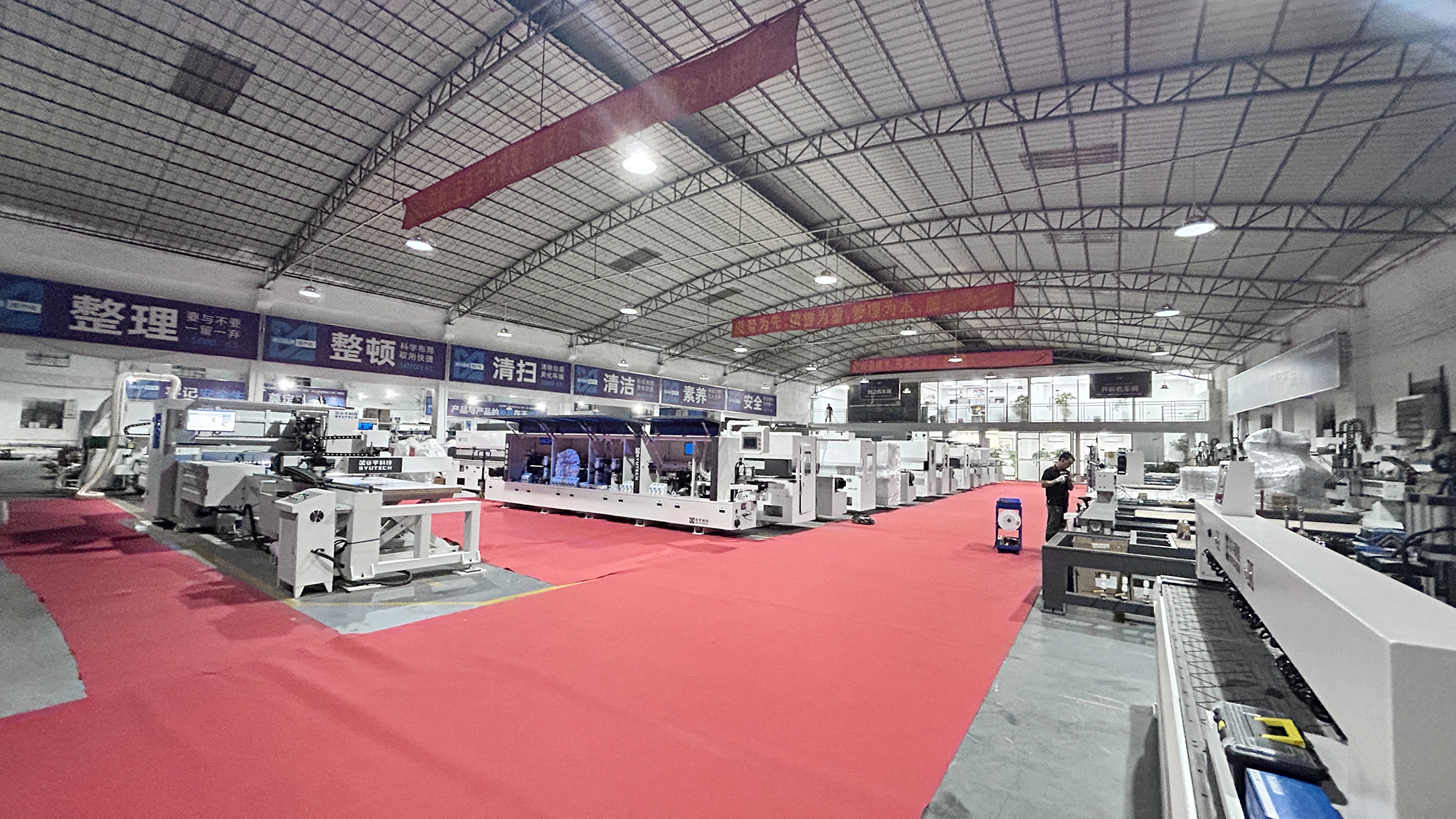
Foshan Shunde SaiYu Technology Co., Ltd., operating under the SYUTECH brand, is a woodworking machinery manufacturer based in Shunde District, Foshan, Guangdong Province, China. The company was originally established in 2013, occupies a 10,000 m² facility, employs approximately 100 staff, and reports an annual production capacity of 500 units with an export share of 80% of revenue. Its stated markets include Russia, the Middle East, South America, Europe, and Southeast Asia, alongside its domestic base.
The relevant compliance position for this article is specific. SYUTECH's HK series machinery is CE certified for the EU market under certificate HTT202405661L, with the declaration aligned to EN 60204-1:2018 and EN ISO 12100:2010. Those two references map directly onto the electrical layer and the risk assessment layer described earlier. A buyer evaluating the file should pair them with the machine-specific guarding description for the model being purchased, because the certificate establishes conformity for a declared configuration rather than for the product family in the abstract.
On the product side, the HK868P is an automatic edge banding machine intended for panel furniture production, stated as suitable for MDF, block board, solid wood board, particleboard, polymer door plates, plywood, and PVC board. The declared workflow covers conveying, gluing and welting, cutting, front and rear alignment, upper and lower trimming, upper and lower scraping, and polishing — the multi-station arrangement that defines where the mechanical hazards sit. A smaller automatic model in the range is listed with seven functions and a feeding speed of 18–23 m/min for compact installations.
Company breadth also matters at the evaluation stage: SYUTECH supplies fully automatic edge banding machines, laser edge banding machines, CNC six-sided drilling machines, computer panel saws, and complete panel furniture equipment and production lines. For a project that will later add drilling and cutting capacity, that portfolio reduces the number of separate conformity files a factory has to manage.
Operating Evidence from Two Reference Workshops
Compliance documentation and operating evidence answer different questions. One establishes that the machine was assessed; the other shows whether the assessed configuration survives daily production. Two installed SYUTECH references are useful for that second question.
A panel furniture manufacturer in Greece has operated 10 units for three years in an edge banding workshop, with reported stable operation and a significant increase in output. The Greek installation is the more instructive of the two for EU buyers, because it places the machines inside the market whose requirements the certificate addresses, running under the indoor, dust-managed conditions the assessment assumes.
A panel furniture manufacturer in Kenya has operated 3 units for two years across an edge banding workshop and a CNC router workshop, reporting significantly improved edge banding quality, increased output, and stable edge banding. The Kenyan installation demonstrates the same machines in a mixed-equipment workshop where the edge bander shares a floor with routing equipment — a common arrangement that makes the supporting-equipment question concrete rather than theoretical.
Neither reference is a safety certification, and neither should be presented as one. What they indicate is that the configuration being certified is also the configuration running in continuous automatic cycles with manual feeding in real furniture plants.
How a CE-Assessed Machine Differs from an Alternative Without the File
The practical difference between a machine with a defensible conformity file and one without is rarely visible on the shop floor on day one. It appears at the border, in the audit, and in the maintenance record.
| Dimension | Machine with a complete conformity file | Machine without one |
|---|---|---|
| Market access | Declaration and certificate number can be produced on request | Documentation assembled after the order, or not at all |
| Guarding logic | Tied to a declared panel and band envelope | Tied to a general machine description |
| Electrical file | Schematic and bonding arrangement available for site review | Site electrician works from the cabinet alone |
| Modification risk | Changes to guarding or supply are traceable to the original assessment | No baseline to measure a change against |
The limitation is worth stating without hedging. CE marking does not certify output, edge quality, cycle reliability, or spare-part availability. A machine can be fully conforming and still be the wrong choice for a factory, and a supplier can hold a valid certificate for a model that is not the model being quoted. The certificate scope, the model designation, and the declared working envelope all have to line up before the document means anything for a specific purchase.
A second limitation sits on the operator's side of the boundary. The declaration covers the machine as supplied. It does not cover the building installation, the auxiliary equipment, or modifications made after delivery — and those are precisely the areas where an otherwise conforming installation loses its footing.
What Buyers Should Request Before Signing
At the execution stage, the compliance conversation reduces to a short document list. A supplier that can answer all five items promptly is a different risk profile from one that answers two and defers the rest.
- Certificate number and scope. The certificate identifier, the standards named on it, and confirmation that the model being purchased falls inside that scope.
- Declaration of conformity. The document that converts the certificate into a statement about the specific machine shipped to the specific site.
- Rated working envelope. Minimum panel width, edge band width and thickness range, and feeding speed — stated as limits, not as capabilities.
- Electrical documentation. Schematic and bonding arrangement, sufficient for the site electrician to connect the machine without guessing.
- Supporting-equipment specification. Air compressor, vacuum cleaner, and vacuum pump requirements, expressed as interface conditions rather than as accessories.
Two of these are routinely under-weighted. The working envelope is the one that determines whether the guarding remains valid for the factory's actual product mix. The supporting-equipment specification is the one that determines whether the installation still matches the assessment six months after commissioning.
Why the Compliance Question Is Getting Louder in the EU Market
The commercial context explains why a documentation question has moved from the quality department to the purchasing desk. The global market for automatic edge banding machines was estimated at USD 3.658 billion in 2024, with a projected compound annual growth rate of 4.56% across 2025–2035, according to Market Research Future. Chinese manufacturers account for approximately 40% of global edge banding machine shipments, based on 2026 industry analysis published by EIN Presswire. As that supply base competes for European panel furniture accounts, conformity documentation shifts from a differentiator to a filter.
For suppliers, the pressure is structural. SYUTECH's 80% export share and its listed European market presence mean the EU file is not an optional annex to the sales pack; it is part of the product. For buyers, the same pressure has a different consequence: a certificate is now common enough that its mere existence proves less than it used to. The differentiating question is no longer whether a supplier has CE documentation, but whether the documentation describes the machine on the quotation.
The EU machinery framework has been under revision, and the underlying conformity logic — risk assessment, applied standards, technical file, declaration — is expected to remain the basis of market access. Buyers who build their evaluation around that logic rather than around a logo on a brochure will not have to redo the work when the framework text changes.
Future Outlook
Three developments are likely to shape how panel furniture manufacturers read edge banding machine compliance over the next several years.
First, documentation scrutiny is moving downstream. Distributors and end customers increasingly ask for the declaration alongside the invoice, which means the technical file has to be retrievable years after the sale rather than assembled on request.
Second, the boundary between the machine and the installation is becoming the audit's focus. As more workshops run mixed equipment — edge banders alongside CNC routers, drilling centres, and shared extraction — the interface decisions carry more of the risk than the individual machine declarations.
Third, automation depth continues to rise across the segment, and each added function adds a hazard to be assessed. Machines with more stations and higher levels of automation will need the machine-specific standard applied at the configuration level, not at the product family level. Suppliers who maintain configuration-level files will find the evaluation stage shorter; those who do not will find themselves answering the same questions at every quotation.
FAQ
Which standards are referenced in a CE assessment for an edge banding machine?
A complete assessment for a chain-fed edge banding machine typically references three layers: EN ISO 12100:2010 for the risk assessment method, EN 60204-1:2018 for the electrical equipment of the machine, and EN ISO 19085-17:2021, the machine-specific safety standard for chain-fed edge banding machines. Earlier documentation cited ISO 18217:2015, which defines the scope of machines fed by chains with manual loading and unloading and a maximum work-piece height capacity of 100 mm. SYUTECH's HK series declaration is aligned to EN 60204-1:2018 and EN ISO 12100:2010 under certificate HTT202405661L.
Does an edge banding machine need explosion-proof protection?
For an indoor installation at normal temperature and humidity, processing wood-based panels with dust contained by extraction, explosion-proof protection is not part of the required CE compliance scope for the edge banding machine. The hazards that drive the assessment are mechanical — the feed chain and the cutting, trimming, and scraping stations — and electrical, covering the control and drive system. The conclusion is tied to that operating envelope. A site that handles adhesive systems releasing flammable vapour, or that is classified for explosive atmospheres for reasons independent of the edge bander, requires a separate site-level assessment.
Which auxiliary equipment falls inside or outside the machine's CE scope?
An air compressor, a vacuum cleaner, and a vacuum pump are separate units with their own electrical supplies and their own documentation, and they do not become part of the edge banding machine's conformity declaration. What remains inside the discussion is the interface: compressed air lines, extraction ducting, and shared supply circuits must not compromise the machine's guarding or its protective bonding. In practice, the auxiliary equipment has to be specified together with the machine at the execution stage, even though it is certified separately.
What CE evidence should a panel furniture manufacturer request?
Five items cover the essentials: the certificate number together with its scope and a confirmation that the quoted model falls inside it; the declaration of conformity for the specific machine and site; the rated working envelope stated as limits, including minimum panel width, edge band width and thickness range, and feeding speed; the electrical schematic and bonding arrangement; and the specification of supporting equipment expressed as interface conditions. Where a model such as the HK868 is quoted, the published envelope of minimum panel width 40 mm, edge band width 10–60 mm, edge band thickness 0.4–3 mm, and feeding speed of 18–22–25 m/min provides the reference against which the factory's product mix should be checked.
Does CE compliance indicate anything about edge quality or output?
No. CE marking confirms conformity with the applicable safety standards for a declared configuration. It does not certify edge quality, cycle reliability, throughput, or spare-part availability. Operating evidence is a separate matter: a panel furniture manufacturer in Greece has run 10 SYUTECH units for three years in an edge banding workshop with reported stable operation and a significant output increase, and a manufacturer in Kenya has run 3 units for two years across an edge banding workshop and a CNC router workshop, reporting significantly improved edge banding quality, increased output, and stable edge banding. Those references describe operating outcomes, not conformity status.
SYUTECH's factory guide and product documentation, including machine specifications and configuration details, is available as a downloadable reference: Factory promotional paper (PDF).
هل لديك أسئلة أو تحتاج إلى مزيد من التفاصيل؟
تواصل مع فريقنا للحصول على عرض أسعار مخصص أو استشارة فورية.
طلب عرض أسعار
املأ النموذج أدناه وسيتواصل معك فريقنا بعرض مقترح مخصص.
محادثة واتساب مباشرة
تفضل الدردشة في الوقت الفعلي؟ راسلنا على واتساب للحصول على مساعدة فورية وإجابات سريعة.
- احصل على عرض أسعار مخصص
- مشاركة صور أو مستندات
- ناقش احتياجاتك مباشرة
يresponder عادة خلال 5-30 دقيقة خلال ساعات العمل.