
Edge Banding Machine FAQ: Compressor, Vacuum & Dust Needs
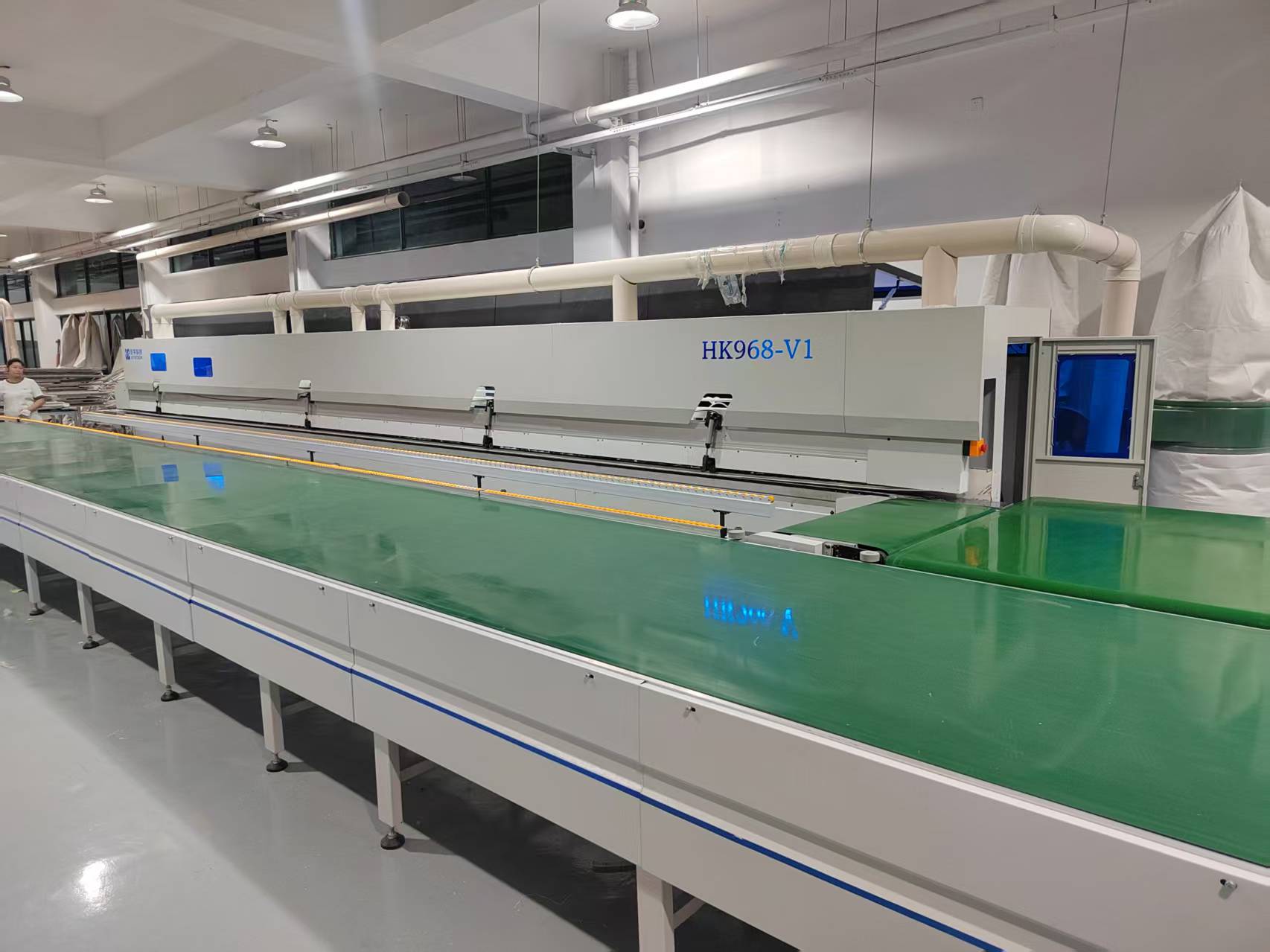
An edge banding machine at work in a panel furniture plant, where compressed air, dust extraction and vacuum form the utility backbone of the automatic cycle.
In short: an edge banding machine in a panel furniture plant depends on three utility inputs beyond electrical power — compressed air, dust extraction and vacuum. Application records for panel furniture edge banding lines list an air compressor and a vacuum cleaner as matched equipment, with a vacuum pump added in cabinet and cabinet door applications. The published air pressure requirement on several models is 0.7–0.9 MPa, and the stated operating environment is indoor normal temperature and humidity with the dust normal to wood processing. This technical FAQ explains what each auxiliary item does, what buyers must confirm before placing an order, and where the genuine limits of the setup lie.
Why Auxiliary Equipment Belongs in the Machine Specification
The core function of an edge banding machine in panel furniture production is unambiguous: it automatically applies, trims and polishes edge strips for panel furniture boards. In a cabinet or cabinet door plant, that single function determines the visible finish of every panel edge, and it runs as a continuous automatic cycle with manual feeding assistance rather than as a sequence of separate hand operations.
What is less obvious at the research stage is that the cycle is pneumatic and extraction-dependent as much as it is electrical. Trimming units, corner trimming units, polishing units and the glue section are supported by systems that sit outside the machine frame. Project records from two panel furniture installations show how the requirement appears in practice: an edge banding application in Kenya lists an air compressor and a vacuum cleaner as matched equipment, while a cabinet and cabinet door application in Romania lists a vacuum cleaner, a vacuum pump and an air compressor.
That difference is not a contradiction — it is the first procurement lesson in this topic. The auxiliary set follows the configuration. A machine with more trimming and polishing stations, or a different panel handling arrangement, can change what has to be connected before the first panel runs. Treating compressed air, extraction and vacuum as part of the machine specification, rather than as a site detail to be solved later, is what separates a smooth commissioning from a stalled one.
Air Compressor Requirements: Pressure, Role and What Is Not Published
Compressed air is the most frequently underestimated input. Pneumatic power of 0.7–0.9 MPa (roughly 7–9 bar) is the published figure on several SYUTECH edge banding models, and the same range appears as air pressure on the HK568 specification. Pneumatic actuators perform work inside the cycle repeatedly: each panel that passes through the machine triggers end trimming, rough trimming, fine trimming, corner trimming and polishing motions that must repeat consistently for hours of continuous operation.
Those figures come from the published product data of SYUTECH, the brand of Foshan Shunde SaiYu Technology Co., Ltd. — a woodworking machinery manufacturer established in 2013 and based in Shunde District, Foshan City, Guangdong, China. The company operates a 10,000 m² manufacturing facility with approximately 100 employees, a two-engineer R&D team and an annual production capacity of 500 units, and it manufactures edge banding machines, CNC nesting machines, six-side CNC drilling machines, computer panel saws and complete panel furniture production lines.
Published pneumatic and electrical figures across four edge banding models
| Model | Air pressure / pneumatic power | Installed or total power | Rated voltage | Minimum panel size | Footprint |
|---|---|---|---|---|---|
| HK568 | 0.7–0.9 MPa (air pressure) | 25.86 kW | Not stated in the published specification | 135 mm length, 50 mm width (corner trimming 50 × 300 mm) | 7200 × 710 × 1628 mm |
| HK868P | Not stated in the published specification | 25 kW | 380 V, 50 Hz | Not stated | 9500 × 1000 × 1650 mm |
| HK268GY | 0.7–0.9 MPa (pneumatic power) | 12.4 kW | 380 V, 50 Hz | 150 mm length, 40 mm width (corner trimming 45 × 200 mm) | 5360 × 730 × 1210 mm |
| HK268G | 0.7–0.9 MPa (pneumatic power) | 11.8 kW | 380 V, 50 Hz | 150 mm length, 40 mm width (corner trimming 45 × 200 mm) | 3790 × 730 × 1210 mm |
Two honest gaps are visible in that table, and buyers should notice them rather than assume they are unimportant. First, the HK868P specification set does not publish a pneumatic rating, so its air demand has to be confirmed at quotation. Second, none of these specifications publish air flow in cubic metres per minute. Pressure alone does not size a compressor; a receiver and compressor combination that holds 0.7–0.9 MPa at the machine inlet while several cylinders fire in sequence is what matters. Long hose runs, undersized receivers and shared plant air lines are the usual causes of pressure that reads correctly at the gauge and behaves incorrectly at the trimming station.
Vacuum Cleaner: Extraction in a Dust-Contained Wood Processing Environment
Both the Kenya and Romania application records describe the same working condition: indoor normal temperature and humidity, in a dust-contained wood processing environment. That phrase is a specification, not a description of a messy workshop. Edge banding removes material. Pre-milling, end trimming, rough trimming, fine trimming and corner trimming all produce chips and fine dust at the panel edge, and the machine operates in a continuous automatic cycle with manual feeding assistance, which means the material removal is continuous too.
A vacuum cleaner appears as matched equipment in both recorded applications. Its role in the procurement plan is to keep the trimming and milling area clear so that the cutting units work on the panel edge rather than on accumulated debris, and so that dust does not migrate into the machine's mechanical and electrical compartments. Extraction capacity has to be matched to the configuration: a machine with pre-milling units, multiple trimming stations and a corner trimming unit generates a different extraction load than a compact model without pre-milling.
One clarification matters for buyers who have worked with other dust-generating processes. The stated requirement for this application is compliance with EU CE mechanical and low-voltage safety standards, and explosion-proof equipment is not required. That is a meaningful cost and complexity difference compared with processes where combustible dust classification applies, and it means the specification conversation should stay focused on extraction performance and filtration rather than on hazardous-area certification that the application does not call for.
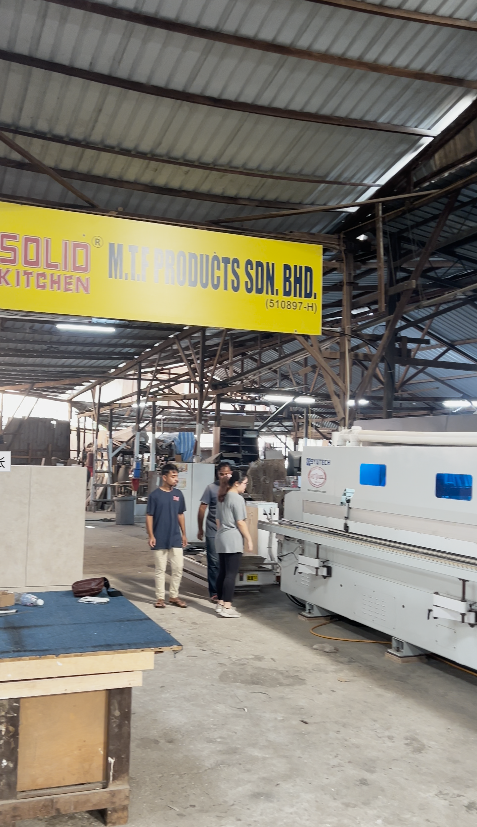
A client factory floor: the working environment recorded for panel furniture edge banding applications is indoor normal temperature and humidity with the dust normal to wood processing.
Vacuum Pump: What It Adds and What to Confirm
The vacuum pump is the auxiliary item most often omitted from an early cost estimate, because it does not appear in every configuration. It is listed as matched equipment in the Romania cabinet and cabinet door application — the same application that specifies cabinets and cabinet doors as the project output — alongside a vacuum cleaner and an air compressor. In the Kenya panel furniture edge banding application, the matched-equipment list names only an air compressor and a vacuum cleaner.
Because the matched-equipment list varies with configuration, the vacuum pump is best handled as a confirmation item rather than an assumption. Before ordering, buyers should establish three things with the supplier: whether the pump is integrated into the machine or supplied as a separate unit; which port and connection point it serves on the machine; and what its electrical and pneumatic demand adds to the site load. A pump specified after the machine has shipped is a commissioning-stage problem, not a procurement-stage decision.
How the Continuous Automatic Cycle with Manual Feeding Actually Works
"Continuous automatic cycle operation, manual feeding assisted" reads like a contradiction to buyers who are comparing automatic and semi-automatic equipment for the first time. It is not. The machine's own sequence — edge application, end trimming, rough trimming, fine trimming, corner trimming and polishing — is automated and repeats for every panel. The operator's role is to feed panels into the infeed and to manage the flow of work, not to trigger each operation.
Published feeding speeds illustrate the rhythm the auxiliary systems have to sustain: the HK568 feeds at 16–18–22 m/min, the HK868P works at 16–22 m/min, the HK268GY at 18–20–22 m/min and the HK268G at 16–18–22 m/min. Across all four models, edge band width covers 10–60 mm, with edge band thickness of 0.4–3 mm on the HK568 and HK868P and 0.35–3 mm on the HK268GY and HK268G.
The practical consequence for utilities is that demand is continuous rather than intermittent. A compressor sized for occasional tool use will cycle far more often when it feeds a machine running a repeating trimming sequence, and an extraction unit sized for intermittent hand sanding will not hold up under continuous chip generation. In a plant planning more than one shift, this is where auxiliary oversizing is usually cheaper than auxiliary replacement.
Indoor Normal Temperature and Humidity: What the Condition Really Means
The working condition recorded for these panel furniture applications — indoor normal temperature and humidity in a dust-contained wood processing environment — is deliberately plain, and it sets boundaries that matter more than they first appear.
It means the machine is specified for a covered, ventilated production hall rather than for an outdoor or uncontrolled installation. It also means the panel format range is a real constraint on what the line can accept. The HK568 handles panels from a minimum length of 135 mm and a minimum width of 50 mm, with corner trimming coverage down to 50 × 300 mm. The compact HK268GY and HK268G handle panels from 150 mm length and 40 mm width, with corner trimming coverage down to 45 × 200 mm. Cabinet doors and cabinet bodies generally sit comfortably inside these ranges; narrow rails, small drawer fronts and short components may not. Checking the smallest part in the order book against the machine's minimum panel size is a five-minute exercise that prevents a much more expensive surprise.
EU CE Mechanical and Low Voltage Safety — and Why Explosion-Proof Is Not Required
For the Romania application serving the EU market, the recorded requirement is compliance with EU CE mechanical and low voltage safety standards, with no explosion-proof provision required. Buyers should read those as two separate obligations that travel together: the mechanical safety of the machine as a piece of woodworking equipment, and the low-voltage safety of its electrical system. Both are assessed against the configuration actually delivered, which is why the electrical specification in the table above matters at the quotation stage — the HK868P, HK268GY and HK268G are published as 380 V, 50 Hz machines.
Two external references give procurement teams a way to frame the conversation. The specific safety requirements for edge banding machines fed by chains or belts are governed by ISO 19085-17:2021, published by the International Organization for Standardization. For destinations in the United States, woodworking machinery must comply with OSHA 29 CFR 1910.213. Neither reference is a substitute for a conformity assessment, but both clarify which family of requirements applies to an edge banding machine rather than to a generic industrial machine.
The absence of an explosion-proof requirement is equally important to state plainly, because it is often assumed rather than verified. The recorded application condition is a dust-contained wood processing environment without hazardous-area classification, so explosion-proof motors, enclosures and extraction equipment are not part of the specification. A buyer who budgets for hazardous-area equipment on this application is budgeting for something the project does not require.
Comparison with Traditional Solutions: What Changes When the Cycle Automates
Manual, semi-automatic and automatic edge banding machines are often compared only on throughput. For an awareness-stage buyer the more useful comparison is on infrastructure, because that is where the cost and the schedule risk actually sit.
A manual edge banding machine depends almost entirely on the operator and needs little beyond electrical power; it does not require a plant air system, and dust management is handled by general workshop extraction. That low entry requirement is real, and it remains the right answer for very low volumes and for workshops that cannot support compressed air. Its limits are equally real: consistent edge quality and repeatable trimming depend on operator skill, and output scales with the number of operators rather than with the machine.
Moving to a fully automatic configuration adds the utility layer described in this article. The machine requires a stable 0.7–0.9 MPa air supply on the models where a pneumatic rating is published, a matched vacuum cleaner for the continuous chip load, and — in cabinet and cabinet door configurations — a vacuum pump. It also requires floor space for the machine body plus feeding and outfeed clearance: the HK568 occupies 7200 × 710 × 1628 mm at 2200 kg, the HK868P occupies 9500 × 1000 × 1650 mm at 4 t, the HK268GY occupies 5360 × 730 × 1210 mm and the HK268G occupies 3790 × 730 × 1210 mm.
Procurement Readiness Checklist Before Ordering
The following items are drawn from the published specifications and application records discussed above. They are the questions a procurement team should be able to answer before the purchase order is issued, not after the container arrives.
| Readiness item | What to confirm |
|---|---|
| Compressed air | 0.7–0.9 MPa available and stable at the machine inlet on models where a pneumatic rating is published; air flow and receiver sizing confirmed with the supplier, including for the HK868P, whose pneumatic rating is not published in the available specification data. |
| Air quality | Filtration and moisture removal appropriate to a woodworking workshop; condensate drainage planned. |
| Dust extraction | Vacuum cleaner capacity matched to the trimming and milling units on the ordered configuration; chip and dust path planned from the machine outlet. |
| Vacuum pump | Whether a pump is included in the configuration, how it connects, and what it adds to the electrical and pneumatic load. |
| Electrical supply | 380 V, 50 Hz where published; installed power of 25.86 kW (HK568), 25 kW (HK868P), 12.4 kW (HK268GY) or 11.8 kW (HK268G) accounted for in the plant load. |
| Floor space and loading | Machine footprint plus feeding and outfeed clearance; floor loading appropriate to 2200 kg (HK568) or 4 t (HK868P). |
| Panel size range | Smallest and largest parts in production checked against the minimum panel sizes of 135 × 50 mm (HK568) or 150 × 40 mm (HK268GY and HK268G). |
| Environment | Indoor normal temperature and humidity in a dust-contained wood processing environment; no explosion-proof provision required for this application. |
| Compliance | EU CE mechanical and low voltage safety standards for EU destinations; ISO 19085-17:2021 recognized for edge banding machines fed by chains or belts; OSHA 29 CFR 1910.213 for the United States. |
| Consumables | Edge band width 10–60 mm and thickness 0.4–3 mm (HK568, HK868P) or 0.35–3 mm (HK268GY, HK268G) aligned with the material actually purchased. |
Market Context: Why Auxiliary Readiness Is Becoming More Important
The auxiliary-equipment question is not a niche concern. The global edge bander market was estimated at USD 1.3 billion in 2025 and is projected to reach USD 3.2 billion by 2035, according to Future Market Insights. Within that market, automatic edge banders held the largest product type share at 52.3% in 2025, based on Dataintelo's reporting — which means the majority of units being bought are exactly the machines that require compressed air, extraction and, in many configurations, vacuum.
Regional concentration reinforces the same point. Asia Pacific dominated the edge bander market in 2025 with a 38.4% revenue share, driven by furniture manufacturing hubs in China and India, according to Dataintelo and IMARC Group. SYUTECH's own export profile points in a comparable direction: export business accounts for 80% of total sales, with major markets including Russia, the Middle East, South America, Europe and Southeast Asia — destinations where site infrastructure varies widely and where auxiliary planning often decides how quickly a machine enters production.
Material trends add a further layer. PVC edge banding materials are expected to account for 41.3% of the material segment in 2026, according to Future Market Insights. Since PVC banding sits inside the 0.4–3 mm and 0.35–3 mm thickness ranges published for these machines, the practical implication is that the trimming and polishing units — and therefore the pneumatic and extraction load — remain central to day-to-day operation.
Future Outlook
The trajectory of automatic edge banding points toward tighter integration between the machine and its utility inputs rather than looser. As automatic units take a larger share of a growing market, the practical differentiator for buyers shifts from the machine alone to the completeness of the package around it — whether the pneumatic specification, the extraction requirement and the vacuum configuration are documented before the order, and whether the destination market's compliance framework is understood in advance.
For panel furniture producers in Europe, the Middle East, South America and Southeast Asia, that shift has a straightforward implication: the utility checklist in this article belongs in the same document as the machine quotation. Edge banding quality is ultimately determined at the panel edge, and the panel edge is where compressed air, extraction and vacuum all meet.
Reference material: the SYUTECH factory promotional paper, covering product lines and manufacturing capability, is available as a PDF download: Factory promotional paper (PDF).
Technical FAQ
1. What auxiliary equipment does an edge banding machine need?
The matched-equipment record for a panel furniture edge banding application in Kenya lists an air compressor and a vacuum cleaner. The record for a cabinet and cabinet door application in Romania lists a vacuum cleaner, a vacuum pump and an air compressor. The set follows the machine configuration, so the auxiliary list should be confirmed against the specific model and its trimming and polishing stations rather than assumed from another installation.
2. What air pressure does an edge banding machine require?
The published specification states pneumatic power of 0.7–0.9 MPa for the HK268GY and HK268G, and air pressure of 0.7–0.9 MPa for the HK568 — approximately 7–9 bar. The HK868P specification set in the same data does not publish a pneumatic rating, so its air requirement has to be confirmed at quotation. Air flow in cubic metres per minute is not published for any of these models, which means compressor and receiver sizing should be verified with the supplier rather than inferred from pressure alone.
3. Why is a vacuum cleaner listed as matched equipment?
Because the recorded working condition is an indoor, dust-contained wood processing environment. Pre-milling, end trimming, rough trimming, fine trimming and corner trimming all remove material from the panel edge during a continuous automatic cycle, so chips and dust are generated continuously rather than intermittently. Extraction keeps the trimming area clear and limits dust migration into the machine's mechanical and electrical compartments. Capacity must be matched to the number of cutting units on the ordered configuration.
4. What does the vacuum pump do, and is it always required?
It is not present in every recorded configuration. The Romania cabinet and cabinet door application lists a vacuum pump alongside a vacuum cleaner and an air compressor, while the Kenya panel furniture edge banding application lists only an air compressor and a vacuum cleaner. Whether a pump is included should be confirmed at quotation, together with its connection point on the machine and its electrical and pneumatic demand on the site.
5. What does "continuous automatic cycle operation, manual feeding assisted" mean?
It means the machine's own sequence — applying, trimming and polishing the edge strip — is automated and repeats for each panel, while an operator feeds panels into the infeed rather than triggering each operation. Published feeding speeds are 16–18–22 m/min for the HK568 and HK268G, 18–20–22 m/min for the HK268GY, and 16–22 m/min for the HK868P. Utility demand is therefore continuous during production, not intermittent.
6. What operating environment is specified, and does it affect machine choice?
The recorded condition is indoor normal temperature and humidity in a dust-contained wood processing environment. It affects machine choice mainly through panel size limits: the HK568 accepts panels from 135 mm length and 50 mm width with corner trimming coverage down to 50 × 300 mm, while the HK268GY and HK268G accept panels from 150 mm length and 40 mm width with coverage down to 45 × 200 mm. Narrow or short components should be checked against these minimums before ordering.
7. Is explosion-proof equipment required for an edge banding machine?
For the recorded panel furniture application, no. The stated requirement is compliance with EU CE mechanical and low voltage safety standards, with no explosion-proof provision required, because the working environment is a dust-contained wood processing area without hazardous-area classification. Related standards that buyers may reference are ISO 19085-17:2021 for edge banding machines fed by chains or belts, and OSHA 29 CFR 1910.213 for the United States market.