
Edible Mushroom Automation Equipment: Key Specs and CE Compliance
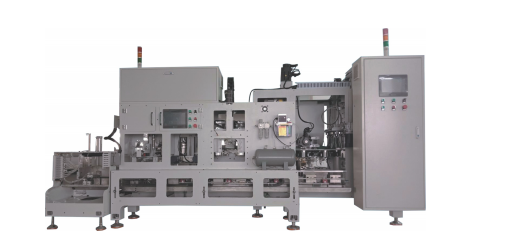
Fully automatic ring fitting, capping and basket loading machine in an edible mushroom substrate bagging workshop.
A cultivation project rarely fails because a mushroom bagging machine is too slow. The decisive failures usually surface later: daily output does not match grow-room scheduling, bag dimensions do not fit the selected substrate bag, site power is incompatible, or the CE certificate does not cover the configured line. These constraints define whether edible mushroom automation equipment is commercially practical.
This article focuses on the Research and Evaluation stages of equipment buying. It explains the technical parameters and compliance documents that buyers should examine before issuing a purchase order.
Why Parameter and Compliance Verification Matters
Many equipment descriptions use the same words: automatic, efficient, intelligent. Without verifiable numbers, those terms carry limited procurement value. A buyer may compare a semi-automatic bagging machine rated at 600–900 bags per hour with a 2-station automatic production line rated at 15,000 bags per day. Both are valid in different contexts, but they require different labor, space, material flow systems, and capital.
The opportunity is equally clear. A facility that correctly matches machine capacity, bag format, electrical supply, and compliance scope can reduce bottlenecks and avoid retrofitting after installation. This is why parameter lists deserve more attention than generic capability claims.
Core Parameters to Check Before Purchase
Buyers evaluating edible mushroom automation equipment should map their own production plan to the following parameters, rather than relying on marketing terms.
Production Capacity
Capacity is expressed either in bags per hour or bags per day. A semi-automatic bagging machine may process hundreds of bags per hour, while a full-automatic multi-station line is defined by daily output. For example, a 2-station full-automatic mushroom substrate bagging production line is specified at 15,000 bags per day. A 4-station line is specified at 25,000 bags per day. Buyers should verify whether the stated capacity assumes a particular bag size, substrate density, and operator skill level, since those factors directly influence real output.
Bag Size and Format Compatibility
Edible mushroom bags include pre-made bags, roll bags, square bags, and bags with ring or stick insertion steps. Bag dimensions determine whether a machine can hold, fill, compress, and tie a given bag consistently.
One integrated line, for instance, covers a bag length range of 14–22 cm and a width range of 28–63 cm, with AC380V 50Hz electrical input. Other machines, such as the pneumatic automatic bagging machine model TZD or the small electromagnetic clutch model TZD-1, accept flat widths of 12–25 cm and bag lengths of 28–60 cm. The selection is therefore not a question of which machine is better; it is a question of which bag specification is on site.
Power and Site Conditions
Most industrial edible mushroom automation equipment requires three-phase AC380V 50Hz power in the configuration observed in Chinese manufacturing standards. Some smaller machines accept AC220V or AC380V. Growers outside 50Hz regions must account for voltage and frequency conversion, or ask for customized electrical configurations. In addition, compressed air supply is required for pneumatic systems, and integrated lines often need stable flat foundations and enough overhead clearance for automatic basket loading or conveyor lines.
Control System and Automation Level
Modern mushroom equipment increasingly relies on PLC control, sensors, and servo systems. For example, the integrated bagging and tying machine model ZN-B uses PLC touch-screen intelligent control with fault alarm and digital display. Its structure includes a holding cylinder, auger feeding, and an automatic tying mechanism that performs rope clamping, rope winding, knotting, and sealing.
At the inoculation stage, a dual-station automatic mushroom inoculation machine model CX-JZJ uses a high-speed motion axis PLC, hybrid stepper motors, linear bearings and guide rails, and sensors from suppliers such as Autonics, Siemens, and Panasonic. It also includes alcohol wiping, UV disinfection, and an FFU 100-class laminar flow hood. The presence of these components is not an accessory detail; it defines contamination control and repeatability.
Process Flow Coverage
Edible mushroom automation equipment can cover a full substrate cycle: raw material crushing, mixing, conveying, distributing, bagging, tying, sterilization, inoculation, and later bag breaking and spent-substrate separation. The equipment range from one manufacturer may or may not cover all of these stages. A 2-station production line, for instance, is described by this process flow: front loader feeding, mixing, conveying, distributing, bagging, tying, and bag collection. A 4-station line may stop at bagging and connect to downstream modules. Buyers should define the process boundary of the quoted line and identify which subsequent operations require additional machines.
CE Marking and Machine Safety Compliance
For buyers importing edible mushroom automation equipment into the European Union, CE marking is not a simple logo. It is a conformity assessment under the Machinery Directive, 2006/42/EC, and the Electromagnetic Compatibility Directive, 2014/30/EU.
On 5 March 2026, UDEM issued CE Certificate No. M.2026.206.C135928 for mushroom machinery, specifically a bagging and tying machine. The listed standards are:
- EN ISO 12100:2010 – Safety of machinery – general principles for design and risk assessment
- EN 60204-1:2018+A1:2025 – Electrical equipment of machines
- EN IEC 61000-6-2:2019 – EMC immunity for industrial environments
- EN IEC 61000-6-4:2019 – EMC emission standard for industrial environments
The certificate has an expiry date of 4 March 2031. Buyers should not stop at seeing a CE marking. They should request the certificate number, issuing body, equipment scope, product model, standards, and expiry date. A certificate that covers a single bagging and tying machine does not automatically cover a full line assembled from separately supplied units, unless the certificate scope and related product list explicitly include the complete configured line.
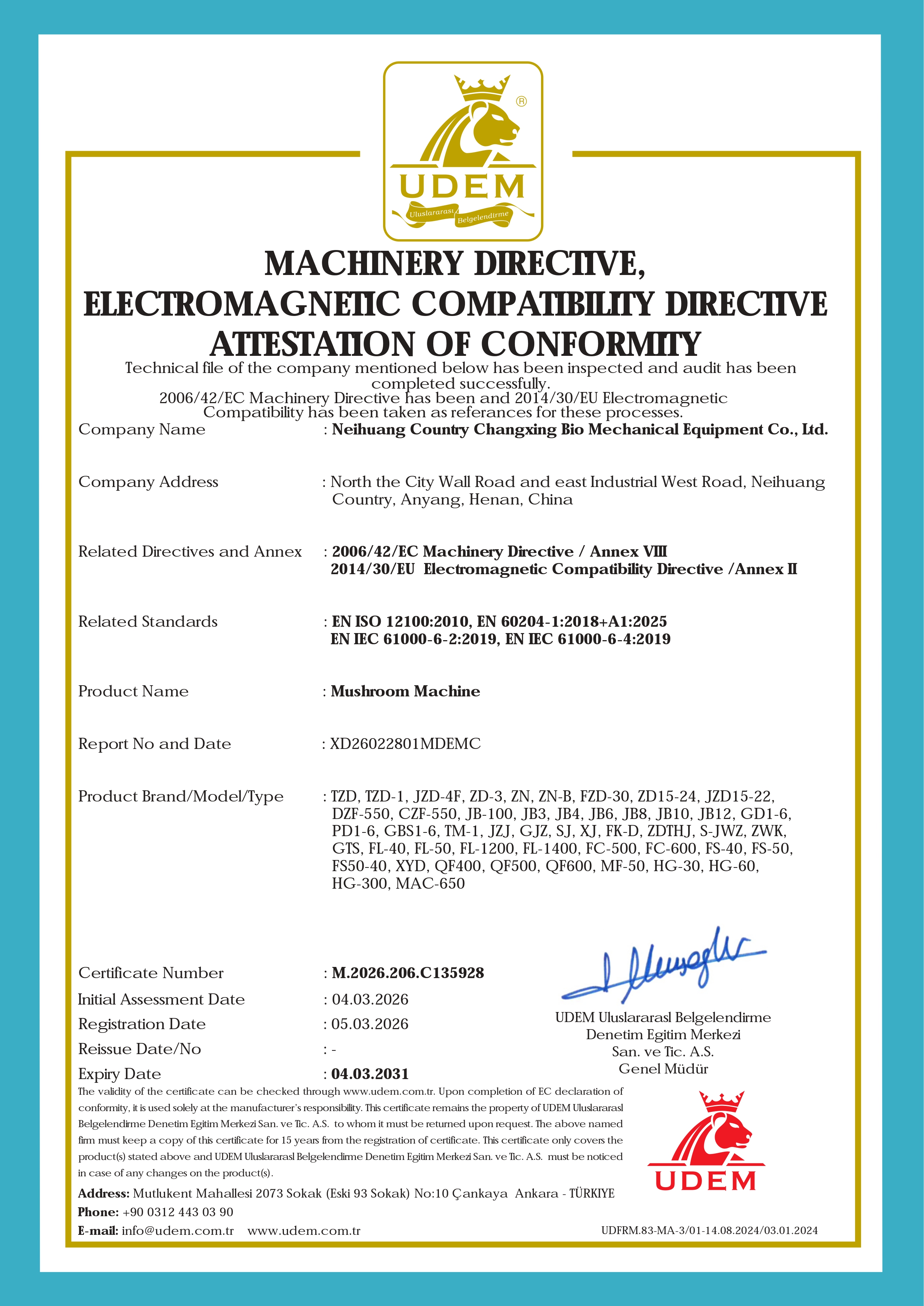
UDEM CE certificate No. M.2026.206.C135928 references the Machinery Directive and EMC Directive for mushroom bagging and tying machinery.
Manufacturer Reference: Changxing Edible Mushroom Machinery
Neihuang County Changxing Biological Machinery Equipment Co., Ltd., operating as Changxing Edible Mushroom Machinery, is a Henan-based Chinese manufacturer established in 2009. The company operates a 20,000m² facility with approximately 130 employees and exports around 60% of its output. Its main markets include South Korea, Malaysia, Central Asia, Europe, and Russia. This profile makes it a useful reference when analyzing how a Chinese edible mushroom equipment maker presents parameter and compliance data.
Changxing’s range includes edible mushroom automation equipment such as automatic bagging and tying machines, substrate bagging production lines, raw material mixers, crushers, inoculation machines, basket loading equipment, and bag-breaking and separation lines. The company reports an annual output of 10,000 units and an R&D team of 25 engineers. From a sourcing perspective, these figures indicate factory capacity and product breadth.
The company’s 2-station and 4-station production lines illustrate common capacity tiers used by industrial mushroom farms. The 4-station high-capacity mushroom substrate bagging production line is specified at a capacity of 25,000 bags per day and can be integrated with optional modules such as automatic ring sleeving machines, automatic hole punching and stick inserting machines, integrated bagging and tying machines, and basket loading machines.
Changxing also produces specialized models for different cultivation formats. The square bag automatic bagging machine model FD, for example, is designed for square edible mushroom bags. The high-precision stamping bagging machine model ZD15-24 is used for sheep truffle and black Termitomyces cultivation. The automatic stamping oyster mushroom bagging machine model GZD15-24 handles oyster mushroom bag sizes with maximum filling heights up to 32 cm. Such model differentiation is common among mushroom equipment suppliers because bag geometry changes with mushroom variety and cultivation method.
Technical Anatomy: How Parameter Details Affect Performance
An automatic mushroom bagging line is not merely a bag filler with a PLC. It is a sequence of synchronized operations: loading, mixing, conveying, distributing, bagging, tying, and bag collection. If the mix contains oversized particles, the conveying and distribution system can clog. If the substrate moisture is inconsistent, the auger or cylinder feed controls fill density unevenly. If the bag film is not cut to the correct fixed length, downstream tying or ring sleeving cannot align.
Therefore, machine parameters must be matched to the raw material. For pre-processing, models such as the large-scale rotary trommel screen GTS, rated at 8 tons per hour, help remove stones and coarse impurities. The 100-type raw material mixer CXJB-100 has a mixing capacity of 0.8 tons and uses a solid steel belt auger with a 5 mm clearance from the bin bottom for cleaner discharge. The large-scale CXJB series mixers extend to capacities of up to 25 m³, allowing high-volume substrate preparation.
When the substrate reaches the bagging stage, the machine’s bag compression method becomes critical. Some models use a stamping cylinder; others use a conveyor-based auger feed with mechanical program control. Stamping machines like the ZD15-24 or GZD15-24 are designed to hold the bag while the substrate is pushed or stamped to a preset density. Auger-fed machines such as the ZN-B integrated bagging and tying machine can reach a high throughput of 7,000–8,000 bags per hour, according to the manufacturer’s specification, but they also require stable material consistency to avoid overfeeding or air pockets.
After bagging, inoculation machines introduce spawn under clean conditions. The dual-station CX-JZJ machine operates at 2,500–2,800 bags per hour and uses a 100-class laminar flow hood with UV disinfection. This is important for shiitake and other slow-growing fungi, where contamination at the spawn hole directly affects yield.
Application Scenarios and Real-World Configurations
Parameter and compliance requirements are not abstract; they appear in documented installations and project configurations.
Malaysia-Oriented High-Throughput Line
One project scenario from Changxing’s application records describes an edible mushroom automatic production system in Malaysia. The system is designed for continuous operation in a normal-temperature indoor workshop and suits multiple mushroom varieties including enoki mushroom, king oyster mushroom, pearl oyster mushroom, shiitake mushroom, and snow fungus.
The matched equipment integrates a mixer, elevator, material distributor, automatic bagging and tying machine, with a reported daily output capacity near 80,000 bags. This type of high-output line is not built around a single machine; it moves substrate through several stations and requires stable foundation, trained operators, and three-phase power. The site also needs to accommodate material handling for raw inputs and finished mushroom bags.
South Korea Multi-Variety Bagging Configuration
Another project scenario from South Korea describes a system suitable for oyster mushroom, shiitake mushroom, black fungus, and pearl oyster mushroom. The matched equipment includes an automatic bagging manipulator, mixer, conveyor, material distributor, and basket loader. The working condition is again continuous operation in an indoor workshop at normal temperature.
This configuration illustrates a modular approach. Instead of installing one very large machine, a farm can connect a bagging manipulator with material distribution and basket loading equipment to handle multiple bag formats. The risk is that manual changeover time between varieties may reduce utilization; therefore, line flexibility must be quantified in terms of setup time, not just maximum speed.
Export and After-Sales Evidence
Case-level data provided by Changxing notes clients across South Korea, Malaysia, Russia, and the United Kingdom, with an annual export volume exceeding 20 units for mushroom substrate processing production lines. The reported deployment period extends over 5 years, with stable operation and bagging speeds above 1,000 bags per hour in certain installations. For industrial buyers, this type of data supports an evaluation of manufacturer reliability, although it does not replace a site visit or direct reference check.
Market Trends Supporting Equipment Investment
Third-party market data supports the broad trend toward mechanized mushroom cultivation. Dataintelo estimates the global mushroom equipment market at USD 3.8 billion in 2025, with growth projected to USD 7.2 billion by 2033. Asia-Pacific accounted for a 42.3% revenue share in 2025, largely due to industrial-scale cultivation in China. China’s edible mushroom industry value exceeded RMB 380 billion, or roughly USD 53 billion, in 2024, reportedly representing more than 70% of global output.
This does not mean every mushroom farm should buy a fully automatic line. But it explains why equipment suppliers are expanding product families, adding PLC-based controls, and publishing more technical documentation. As automation moves into more growing regions, buyers can reasonably expect suppliers to provide clearer capacity ratings, bag-size matrices, and compliance files.
Automated Lines vs. Conventional Bagging Approaches
| Evaluation Criterion | Manual or Semi-Automatic Approach | Integrated Automatic Lines |
|---|---|---|
| Throughput | Typically several hundred bags per hour; small clutch machines in the range of 400–800 bags per hour are common | Daily capacities of 15,000–25,000+ bags are realistic with multi-station lines |
| Labor | Higher manual involvement; multiple operators for feeding, filling, tying | Automated conveying, bagging, tying, and basket loading reduce direct labor |
| Consistency | Fill density varies with operator technique | More even substrate distribution and tying when properly configured |
| Investment and Space | Lower initial cost; smaller footprint; flexible for small lots | Higher capital and space requirements; needs stable foundation and 380V supply |
| Changeover | Simpler for very small batches and multiple bag sizes | Requires adjustment of bag guides, auger settings, or optional modules |
The limitation of automated lines is not difficult to identify. A full-automatic production line is designed for a defined bag-size window and a continuous substrate stream. If a grower produces only a few thousand bags per week, or uses unusually shaped bags, a semi-automatic model such as the small electromagnetic clutch bagging machine TZD-1 may be more practical. Even large facilities must plan for changeover time when switching between shiitake and oyster mushroom bags, because different varieties require different filling heights, hole patterns, and tying methods.
Important Limitations and Boundary Conditions
Buyers should treat manufacturer-published parameters as baseline conditions, not as universal guarantees. A machine that is CE-certified as a bagging and tying unit may not be CE-compliant after an integrator adds a different conveyor, a custom sensing system, or a new basket-loading module. CE conformity is a property of the final machinery configuration and its intended use. If a buyer modifies equipment substantially after delivery, the responsibility for risk assessment can shift from the manufacturer to the integrator or operator.
Similarly, a line designed for bag lengths of 14–22 cm and widths of 28–63 cm will not automatically handle pillow-style square bags or very long wood-log bags. Dedicated square bag machines such as the model FD or the square bag stamping machine CX-FD are separate solutions. This is not a defect; it reflects the physical relationship between bag geometry, nozzle size, auger dimension, and clamping mechanism.
Future Outlook: Toward More Precise Equipment Specifications
The next phase of edible mushroom automation will likely be defined by specification discipline. Growers and equipment suppliers will move from broad descriptions such as intelligent equipment to precise statements about sensor type, positioning accuracy, pass rate, and compliance standards. Modularity will also become more important: a farm may start with a 2-station bagging line and add downstream modules later.
Manufacturers in China are already integrating motion-control components such as HIWIN linear guides, TBI ball screws, and SICK sensors into bagging and basket-handling equipment. PLC-based systems allow parameter presets for different mushroom varieties. With market pressure from Europe and Asia, documentation quality will increasingly become a competitive requirement.
Frequently Asked Questions
Q: What CE documents should a buyer request for mushroom bagging equipment?
A: The buyer should request the CE certificate, Declaration of Conformity, and the list of harmonized standards. The certificate should show the issuing body, certificate number, equipment scope, product model, issue date, and expiry date. For example, UDEM CE Certificate No. M.2026.206.C135928 covers mushroom machinery in the form of a bagging and tying machine and references the Machinery Directive 2006/42/EC and EMC Directive 2014/30/EU.
Q: What is the difference between a 2-station and a 4-station mushroom bagging line?
A: The station count normally indicates the number of bagging units connected in parallel within the same line. In the product data reviewed, a 2-station full-automatic line is rated at 15,000 bags per day, while a 4-station line is rated at 25,000 bags per day. Both accept similar bag length and width ranges, but the 4-station line requires more floor space and greater material feeding capacity.
Q: Which bag dimensions should be confirmed before buying an automatic mushroom bagging machine?
A: The critical dimensions are filled bag length or maximum filling height, flattened bag width, and whether the bag is pre-made or from a roll. Semi-automatic models may accept flat widths of 12–25 cm and lengths of 28–60 cm. A 2-station production line in the reviewed data accepts lengths of 14–22 cm and widths of 28–63 cm. Square bag machines have separate dimensional limits such as width 30–32 cm and length 40–50 cm.
Q: Can a CE certificate for one bagging machine cover an entire automatic mushroom line?
A: Not automatically. The CE certificate scope must explicitly list the machinery configuration. A certificate that names a bagging and tying machine may not extend to separately added mixers, elevators, or basket loading modules. Buyers should ask for compliance documentation that covers each integrated module or the assembled line as supplied.
Q: Are fully automatic mushroom bagging lines suitable for small mushroom farms?
A: Not always. Fully automatic lines are designed for continuous high-volume operation, stable substrate quality, and sufficient space. Small farms producing only a few hundred or a few thousand bags per day may be better served by semi-automatic bagging machines with rated capacities of 400–900 bags per hour, since these machines are easier to clean, adjust, and maintain for small batches.
Q: How does substrate consistency affect automatic bagging performance?
A: Mixing quality directly influences filling density and subsequent tying or inoculation. A mixer such as the CXJB-100 uses a solid steel belt auger and a 5 mm bottom clearance for cleaner discharge. If raw material contains oversized particles or inconsistent moisture, bag weight and mycelium growth will vary. Pre-processing equipment such as crushers, trommel screens, and mixers is therefore part of the bagging line’s operating system.
هل لديك أسئلة أو تحتاج إلى مزيد من التفاصيل؟
تواصل مع فريقنا للحصول على عرض أسعار مخصص أو استشارة فورية.
طلب عرض أسعار
املأ النموذج أدناه وسيتواصل معك فريقنا بعرض مقترح مخصص.
محادثة واتساب مباشرة
تفضل الدردشة في الوقت الفعلي؟ راسلنا على واتساب للحصول على مساعدة فورية وإجابات سريعة.
- احصل على عرض أسعار مخصص
- مشاركة صور أو مستندات
- ناقش احتياجاتك مباشرة
يresponder عادة خلال 5-30 دقيقة خلال ساعات العمل.