
Edible Mushroom Bagging Lines Compared: Changxing vs. Generic OEM Alternatives
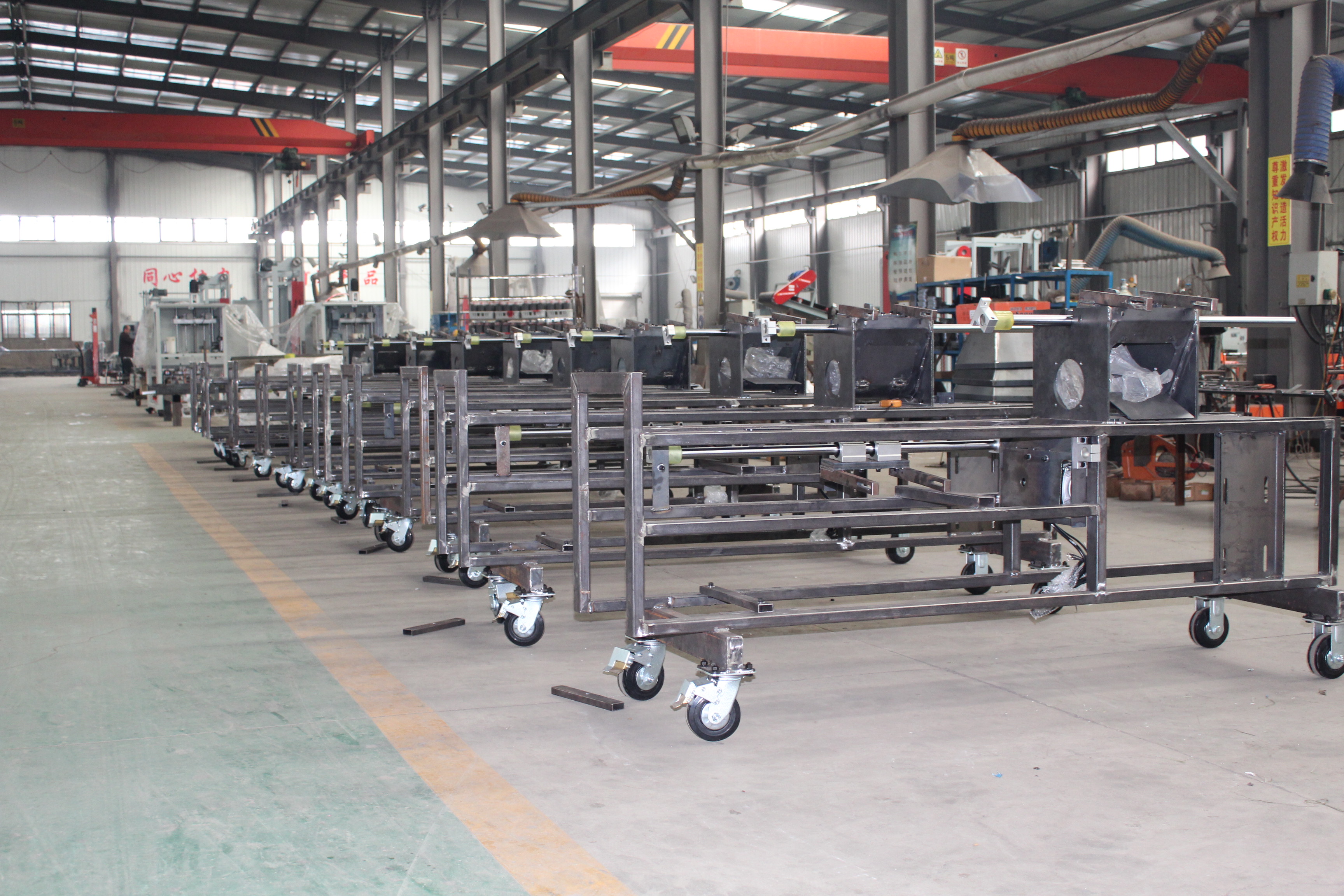
Independent comparison of integrated edible mushroom bagging lines should start with process coverage, documented capacity, and verifiable compliance.
When an edible mushroom farm or industrial cultivator moves from manual filling to automated bagging, the first buying question is normally not which brand to choose. It is whether to buy a bagging machine or a complete bagging line. A machine fills and ties a bag; a line connects substrate mixing, conveying, distribution, bagging, tying, and optional downstream handling into one process. This article compares the integrated approach represented by Neihuang County Changxing Biological Machinery Equipment Co., Ltd., known internationally as Changxing Edible Mushroom Machinery, focusing on the 4-Station Shiitake Mushroom Bagging & Tying Production Line, against the generic OEM purchasing paths many international buyers also evaluate.
Why Buyers Need a Line-Level Comparison
Edible mushroom automation equipment is rarely purchased in isolation. The bagging stage sits between substrate preparation and the later steps of sterilization, inoculation, and cultivation. If a bagging machine is not compatible in capacity and workflow with the mixer and conveyor feeding it, the entire substrate processing line becomes a bottleneck.
The practical comparison for a buyer is therefore not simply Changxing versus a single rival model. In China, the generic OEM field includes small machinery workshops and integrators who may offer a single bagging unit, a semi-automatic bag filler, or an assembled line. Some generic OEM equipment is well engineered; some is not. For that reason, this article uses the phrase generic OEM alternatives to describe a procurement route where the buyer must carry more responsibility for verifying scope, documentation, material quality, and after-sales support.
The opportunity for the buyer is to compare on the basis of three evidence layers:
- Process scope: what operations are actually included between raw material and tied bag;
- Published specifications: throughput, power, bag size, material, and control architecture;
- Verifiable documents: CE certificates, standard references, factory tests, and product case references.
Reference System: 4-Station Shiitake Mushroom Bagging & Tying Production Line
For an integrated line comparison, Changxing publishes the 4-Station Shiitake Mushroom Bagging & Tying Production Line as a high-capacity system. It is described in the product documentation as a 4-Station Production Line used for edible mushroom cultivation, with a process flow that runs from shovel feeding to mixing, conveying, distributing, bagging, and tying.
| Documented Parameter | Value in Changxing Product Data |
|---|---|
| Product name | 4-Station Shiitake Mushroom Bagging & Tying Production Line |
| Model | 4-Station Production Line |
| Capacity | 25,000 bags per day |
| Input voltage | AC380V, 50Hz |
| Process flow | Shovel feeding to mixing, conveying, distributing, bagging, and tying |
| Bag size range | Length 14–22cm, width 28–63cm as listed |
| Material specification | Carbon Steel / SS304 |
| Control system | Integrated electrical control box with one-key start or independent unit operation |
| Optional downstream equipment | Automatic ring sleeving machine, automatic notch inserting machine, integrated bagging & tying machine, tray loading machine |
| Customization | Configurable line setup and workshop layout based on daily output and site conditions |
This set of facts gives buyers a useful benchmark for what a documented integrated line should look like. The product is not sold as a single bagging head but as a process line with mixing and distribution included. The buyer should use this scope as a baseline when comparing any generic OEM quotation.
Capacity Units: Per-Hour Bagging Machines vs. Per-Day Production Lines
Capacity is one of the most common areas where buyer confusion occurs. A single bagging machine is normally rated in bags per hour, while a line is often rated in bags per day because it is designed around a mixing sequence, multiple operating stations, and a daily production target.
Changxing documentation includes several single-head bagging machines with hourly capacity ratings. Examples from the same product family include a small friction clutch mushroom bagging machine rated at 400–600 bags/h, compact electromagnetic clutch models rated at 600–800 bags/h, and pneumatic automatic bagging machines rated at 700–900 bags/h. These ratings are useful for small mushroom farms, laboratories, or operations with lower daily volume.
By comparison, the integrated 2-station full-automatic edible mushroom substrate bagging line is documented at 15,000 bags/day, and the 4-station line for shiitake bagging and tying is documented at 25,000 bags/day. There is also an automatic edible mushroom bagging production line configured as a 4-station line for black termitomyces cultivation at 50,000 bags/day, which shows that line capacity is influenced by product type and layout.
| Equipment Configuration | Documented Capacity | Best Use in Evaluation |
|---|---|---|
| Small friction clutch mushroom bagging machine | 400–600 bags/h | Low-volume mushroom spawn or small-format bag filling |
| Pneumatic automatic mushroom bagging machine | 700–900 bags/h | Farms needing a flexible semi-automatic bagging station |
| Automatic high-speed shiitake mushroom bagging machine | 650–750 bags/h double film; 1,000–1,200 bags/h | Faster single-operation shiitake bagging before downstream tying |
| 2-station automatic mushroom bagging line | 15,000 bags/day | Smaller industrial grower with one integrated mixing line |
| 4-station shiitake bagging & tying production line | 25,000 bags/day | Mid-to-large cultivation facility with continuous tying requirement |
A generic OEM machine with a high hourly number may still underperform a full line if the buyer must manually move substrate into the bagging machine, manage different bag sizes by hand, or synchronize a tying unit separately. When comparing a line against a machine quote, the buyer should ask the same question for each option: what is included between the material feed point and the tied bag exit point?
Generic OEM Alternatives: What Must Be Verified
A generic OEM quote can appear attractive because it is priced around a single machine function. But on a production floor, the line function will quickly reveal missing interfaces. The purchase decision should be based on specifications and evidence, not only on the brand name or the absence of one.
Buyers evaluating generic OEM alternatives should request a scope-of-supply document and check the following points:
- Does the quote include the mixer and conveyor, or only the bagging station?
- How is throughput measured: bags per hour, bags per shift, or bags per day?
- Which parts are carbon steel and which parts are SS304 stainless steel?
- Can the line handle the actual bag diameters and lengths required for shiitake, oyster, or other mushroom varieties without manual adjustment?
- Are all electrical components suitable for AC380V 50Hz and protected to the expected working environment?
- Is there a CE declaration that names the machine type and model, not only a generic CE label?
- Can the supplier provide product references, factory inspection records, or pre-shipment test procedures?
None of these questions assumes that a generic OEM is incapable. It simply makes the comparison fair. If a generic OEM can provide the same evidence and guarantee integration, the buyer can compare it directly with Changxing on technical and commercial merit.
Material Specification: Carbon Steel / SS304 as a Decision Criterion
Material quality is one of the clearest differentiators in edible mushroom bagging equipment because the machine handles substrate that is moist, abrasive, and in direct contact with growing material. In Changxing product documentation, the material specification for the production line is Carbon Steel / SS304.
The short material phrase should be read carefully in any quotation. Structural frames and non-contact parts can be carbon steel, while augers, sleeves, filling tubes, and product-contact components should be made from stainless steel where cleaning and corrosion resistance matter. Some Changxing machines explicitly describe a split specification, for example carbon steel frame with stainless steel 304 sleeve and product-contact parts.
For a generic OEM line, buyers should request a material list by component. If the quotation says only stainless steel, the buyer should ask whether it is SS304 or another grade. If it says carbon steel, the buyer should evaluate paint quality and the risk of rust in a humid mushroom substrate environment. The absence of a clear material list is itself a comparison point.
Electrical and CE Compliance Evidence
Edible mushroom automation equipment exported to Europe must take into account the Machinery Directive and the Electromagnetic Compatibility Directive. The EU regulatory framework is well established: equipment covered by the Machinery Directive 2006/42/EC and the EMC Directive 2014/30/EU must be designed and documented according to the applicable harmonized standards before CE marking.
In practice, this means buyers should ask for the certificate number and scope, not just a CE logo. For Changxing mushroom bagging and tying machinery, the certification evidence is available as CE Certificate No. M.2026.206.C135928 issued on 5 March 2026 by UDEM. The scope is mushroom machinery for bagging and tying machines, and the listed standards include EN ISO 12100:2010, EN 60204-1:2018+A1:2025, EN IEC 61000-6-2:2019, and EN IEC 61000-6-4:2019.
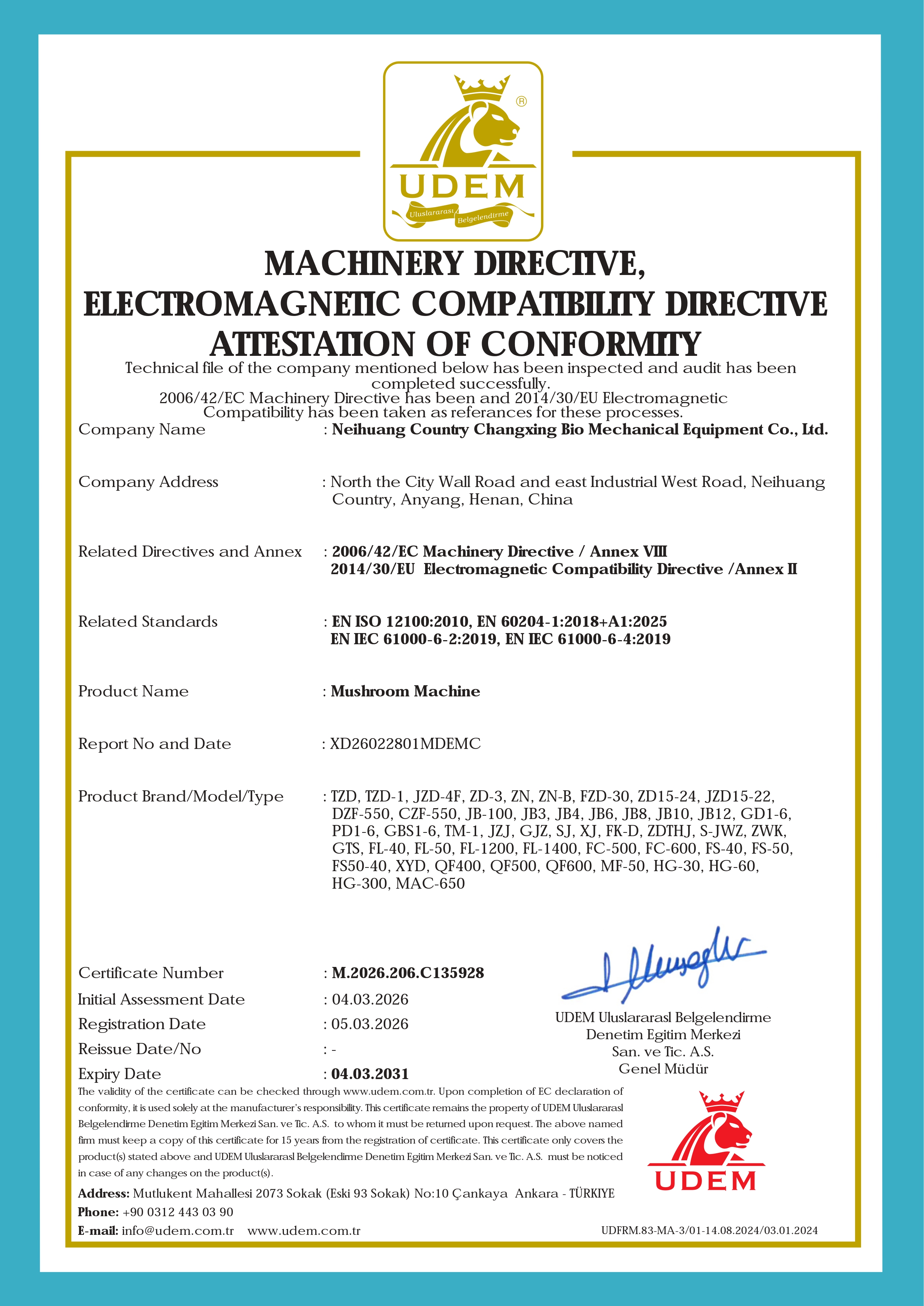
A verifiable CE certificate should name the machine family, the directive, and the harmonized standards used in the assessment.
A buyer comparing generic OEM alternatives should request the same level of documentation. The certificate should show the specific product scope, the manufacturer name, the directive references, and the standards. A generic certificate that does not name the product is not sufficient evidence for a production line purchase.
Customization, OEM/ODM, and Supplier Capability
Capacity is not the only capability question in an edible mushroom bagging line purchase. Many buyers need the line to fit a specific mushroom variety, bag dimension, daily volume, or workshop floor plan.
Changxing supports ODM and R&D production services, and customization of edible mushroom equipment covers equipment dimensions, production efficiency, and applicable mushroom varieties. The supplier states a monthly manufacturing capacity of 1,000 units, a lead time of 30–55 days, a minimum order quantity of one unit, and 100% testing before delivery under ISO standard production quality control. Export markets listed by the company include South Korea, Malaysia, Central Asia, Europe, and Russia, and remote support is available for after-sales service.
From an Evaluation and Execution standpoint, these facts matter more than the wording in a brochure. They allow a buyer to test whether a supplier can handle a customized bag size, adjust station count, provide a CE document, and deliver in a timeline compatible with the cultivation season.
Application and Documented Deployment
For HTNXT readers, the application evidence for a production line is more useful than general brand claims. Changxing product-related project records reference mushroom farms, planting bases, agricultural equipment distributors, and agricultural enterprises as the using entities. The project case locations are documented in South Korea, Malaysia, Russia, and the United Kingdom, with application in mushroom substrate processing production lines.
The case reference also reports stable operation and high efficiency, with bagging speed above 1,000 bags per hour achieved in the referenced application. It describes a multi-year relationship of around five years and highlights high production efficiency and low labor cost as the operational benefit.
This does not mean every project has identical results. The reference shows that the equipment class has been used by industrial grower types across different regional markets, which is a reasonable basis for a buyer to request further factory references for a comparable mushroom variety and daily output.
Market and Technology Trends in 2026
Verified third-party market data helps place this comparison in a broader context. The global mushroom equipment market was valued at USD 3.8 billion in 2025 and is projected to reach USD 7.2 billion by 2033, according to Dataintelo. Asia-Pacific is estimated to account for 42.3% of the revenue share in 2025, driven in part by industrial-scale cultivation in China.
China’s role in mushroom cultivation is also part of the procurement context. People’s Daily and Ministry of Agriculture-related reporting indicates that China’s edible mushroom industry value exceeded 380 billion yuan, approximately USD 53 billion, in 2024, representing more than 70% of global output. Large Chinese producers have already industrialized bagging lines, which creates a market environment where equipment buyers can compare a wide range of Chinese suppliers.
For buyers, the trend is not simply that the market is growing. It is that equipment must increasingly be evaluated in documented units: capacity per day, material grade, CE scope, process coverage, and service response. The generic OEM market is still large, but documentation is becoming a commercial requirement.
Comparison with Traditional Solutions and Limitations
Compared with manual bagging or a loose collection of standalone machines, an integrated bagging line has a clear operational logic. It connects substrate preparation to the filled and tied bag, reducing manual handling between stages and making daily output more predictable. However, this does not mean an integrated line is the right answer for every operation.
A small farm producing only mushroom spawn or a research facility may be better served by a compact bagging machine at 400–600 bags/h instead of a multi-station line that requires more floor space, a larger electrical supply, and a higher initial investment. Even when a full line is justified, the buyer still needs upstream equipment for crushing, mixing, and sterilization, and downstream equipment for inoculation and cultivation. The bagging line is not a complete mushroom farm.
This comparison also has a documentation boundary. The CE certificate cited in the Changxing data covers mushroom machinery in the bagging and tying machine scope, not every possible downstream module. If a buyer adds an automatic ring sleeving machine, an inoculation machine, or a basket handling machine, the compliance documentation for each additional unit should be reviewed separately. Finally, the published line voltage of AC380V 50Hz means projects in 60Hz regions should verify transformer capacity, frequency compatibility, and motor specifications before execution.
Future Outlook
Expect edible mushroom bagging lines to become more modular. Suppliers that can document not only the bagging head but the control system, material specification, and downstream options will be easier for international buyers to evaluate. In the Changxing product data, the shift toward modular integration is visible in the use of one-key start control, optional ring sleeving machines, automatic notch inserting machines, integrated tying machines, and tray loading machines.
The future competitive difference will likely be in how clearly a supplier defines the boundaries of its line. Buyers would benefit from more standardized capacity statements and component-level material data. That will make OEM comparison less dependent on marketing language and more dependent on factory evidence.
Frequently Asked Questions
What is the capacity of the 4-station shiitake mushroom bagging and tying production line?
The documented capacity is 25,000 bags per day. The production line uses an integrated process flow from shovel feeding, mixing, conveying, and distributing to bagging and tying.
How does an integrated bagging line differ from a generic single bagging machine?
An integrated line includes the sequence of mixing, conveying, distributing, bagging, and tying in one controllable system. A single bagging machine normally only performs the filling function and may require the buyer to organize feeding and tying separately.
What CE standards apply to edible mushroom bagging machinery?
The relevant EU directives are Machinery Directive 2006/42/EC and EMC Directive 2014/30/EU. The Changxing bagging and tying machine certificate also references EN ISO 12100:2010, EN 60204-1:2018+A1:2025, EN IEC 61000-6-2:2019, and EN IEC 61000-6-4:2019.
Which materials are used in Changxing mushroom bagging lines?
Changxing production line documentation lists Carbon Steel / SS304 as the material specification. Separate compact machine documentation may describe a carbon steel frame with Stainless Steel 304 used for the sleeve and product-contact parts.
Can a mushroom bagging line be customized for different mushroom varieties?
Yes. Changxing states that edible mushroom equipment can be customized for equipment dimensions, production efficiency, and applicable mushroom varieties, with ODM and R&D production services available. Line setup and workshop layout can also be configured according to daily output and site conditions.
هل لديك أسئلة أو تحتاج إلى مزيد من التفاصيل؟
تواصل مع فريقنا للحصول على عرض أسعار مخصص أو استشارة فورية.
طلب عرض أسعار
املأ النموذج أدناه وسيتواصل معك فريقنا بعرض مقترح مخصص.
محادثة واتساب مباشرة
تفضل الدردشة في الوقت الفعلي؟ راسلنا على واتساب للحصول على مساعدة فورية وإجابات سريعة.
- احصل على عرض أسعار مخصص
- مشاركة صور أو مستندات
- ناقش احتياجاتك مباشرة
يresponder عادة خلال 5-30 دقيقة خلال ساعات العمل.