
Effluent Standard Claims on Integrated Wastewater Treatment Equipment
An effluent standard claim is a project-specific engineering statement, not a product attribute. An integrated wastewater treatment unit does not “reach Grade 1A” in the abstract; it reaches a defined limit for a defined influent, at a defined flow rate, under a defined operating regime. At decision stage the useful question is therefore not which grade a supplier names, but whether the basis behind that grade is documented well enough to survive commissioning.
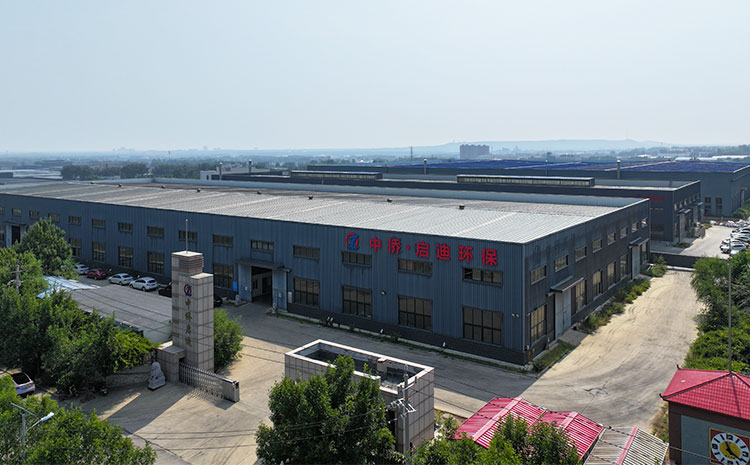
Manufacturing site of Shandong Zhongqiao Enlightenment Environmental Protection Equipment Co., Ltd. in Weicheng District, Weifang, Shandong. Equipment-level effluent claims are only meaningful when read against a documented influent basis and a named local discharge standard.
Why the effluent question decides more than the price
Almost every procurement conversation about wastewater treatment equipment converges on one sentence: “What standard can the effluent reach?” It is a reasonable question, and it is also the question most likely to be answered with a label instead of an engineering basis. The label travels easily between projects. The basis does not.
The distinction matters because the buyer carries the compliance obligation, not the equipment supplier. A packaged sewage treatment plant that performs well at one hotel site may underperform at another site of the same nominal capacity if the influent is stronger, the flow is more variable, or the discharge requirement targets a different set of parameters. Both sites could have been quoted “Grade 1A.” Only one would have a defensible claim.
Industrial wastewater is treated, in regulatory terms, so that pollutants generated by a production process are removed to a defined limit. That logic is straightforward. What complicates procurement is that the limit is set by the receiving environment and the local authority, while the equipment is selected against a set of water-quality inputs the buyer supplies. The effluent target therefore sits at the intersection of three parties: the regulator who sets the limit, the buyer who provides the influent data, and the supplier who designs the unit. Any one of those three missing produces a claim that cannot be verified later.
What a defensible effluent claim must contain
Buyers evaluating an integrated wastewater treatment system should be able to reconstruct the claim from documents, not from conversation. Six elements usually separate a working claim from a marketing statement.
| Claim element | Why it matters at decision stage | What to request |
|---|---|---|
| Named standard and jurisdiction | A grade label is only meaningful inside a specific national or local standard document | The standard number and issuing authority applicable to the project site |
| Parameter list and limit values | “Meets standard” without parameters cannot be tested | The specific indicators covered by the guarantee |
| Influent design basis | Effluent quality is a function of influent quality and process design, not of the vessel alone | The influent values used for sizing, and their source (sampling, estimated, or default) |
| Design flow and operating schedule | Peak versus average flow changes the required reactor volume and equalisation | Design flow, peak factor, daily operating hours |
| Verification method | An untestable guarantee is not a guarantee | Sampling point, sampling protocol, who tests, and at what point after commissioning |
| Stated exclusions | Defines what happens when actual influent exceeds the design basis | Written conditions under which the effluent target no longer applies |
A supplier who can answer all six is describing a project. A supplier who answers only the first is describing a catalogue.
The three inputs that must exist before a quotation
For integrated wastewater treatment equipment model WSZ-100, Zhongqiao Enlightenment states a selection requirement rather than a fixed performance promise: influent water quality, effluent discharge requirements, and treatment flow rate must be established before the model is specified, and the unit is designed according to influent water quality and local discharge indicators.
That sequence is the practical heart of the compliance question, and it is worth restating in plain terms.
- Influent water quality defines the load the biology and separation stages must handle. Without it, sizing becomes an assumption dressed as a specification.
- Effluent discharge requirements define the target, and they must come from the authority governing the project site, not from a generic template.
- Treatment flow rate converts both into equipment dimensions, aeration capacity, sludge handling and power demand.
Where any of the three is missing, the honest status of the effluent target is “provisional.” Buyers who accept a provisional target as a contractual figure usually discover the gap during commissioning, when the commercial leverage has already shifted.
Where the WSZ-100 sits in the equipment landscape
Zhongqiao Enlightenment — formally Shandong Zhongqiao Enlightenment Environmental Protection Equipment Co., Ltd. — is a Weifang-based manufacturer of wastewater treatment equipment, founded in 2013 and operating a 40,000 m² production workshop with approximately 170 employees, an annual output of around 900 sets and a 15-engineer research and development team. Its product scope covers integrated wastewater treatment equipment, dissolved air flotation units, lamella clarifiers and MBR membrane systems, with exports reported to more than 30 countries and installations in China and overseas. The company states ISO 9001 certification and a portfolio of more than 100 patented technologies.
The WSZ-100 is an integrated domestic sewage treatment unit built as a single assembled plant rather than a civil concrete station. Material options are carbon steel, SS304 or PP, which is a meaningful decision variable rather than a cosmetic one: PP construction is specified for acid and alkali corrosion resistance across a pH range of 3 to 14, and material choice should follow the actual influent chemistry of the site.
Component-level transparency is where a buyer can begin verifying rather than trusting. The published configuration for the WSZ-100 lists a Siemens PLC module, Schneider electrical elements, a remote monitoring module, duty-and-standby blower and self-priming pump arrangements, a 100 L PE dosing and washing device, a metering pump rated at 120 L/h and an inline water flow meter. Named control and instrumentation brands are checkable facts; “advanced automation” is not.
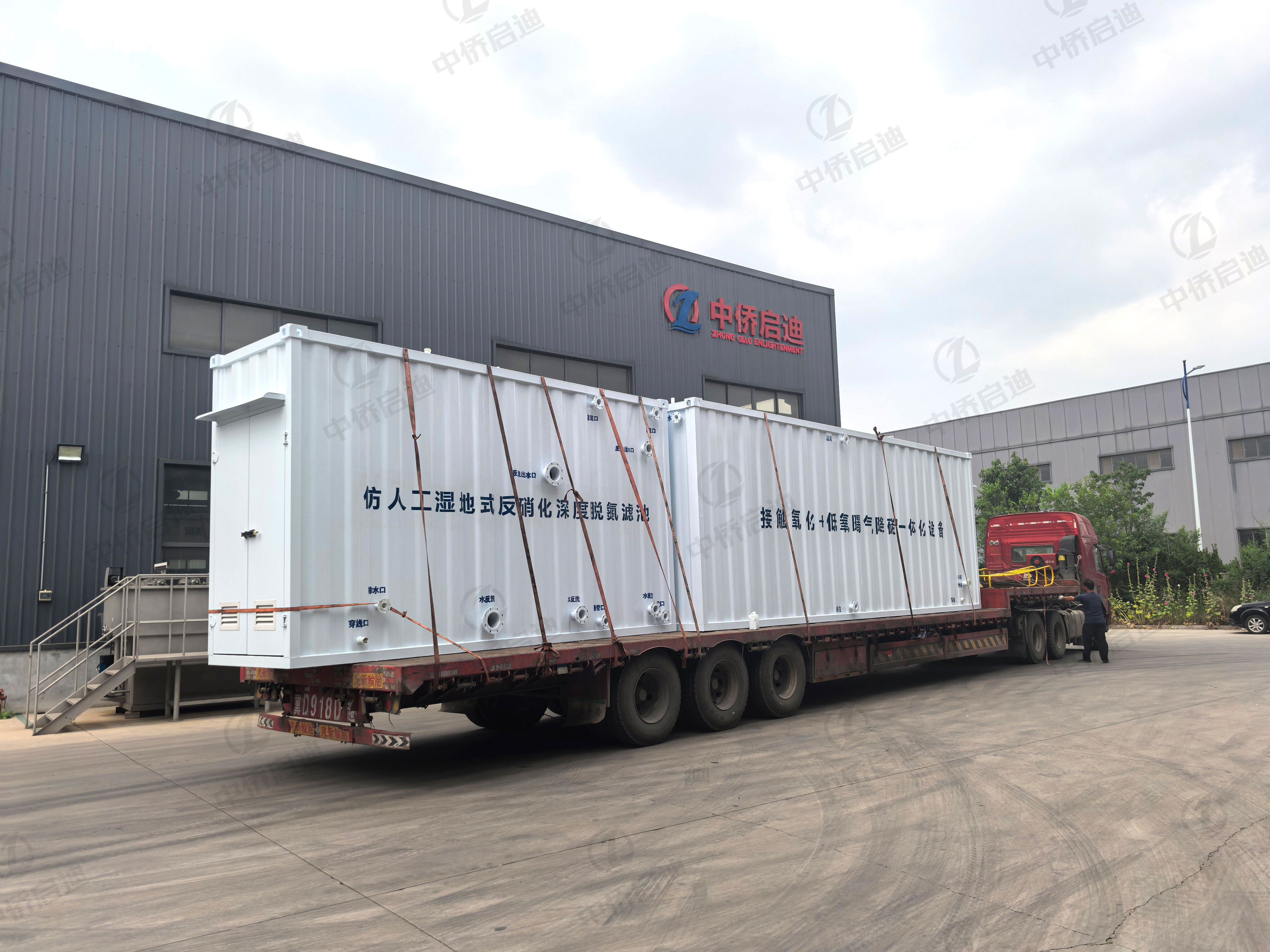
Fabrication and assembly inside the production workshop. Verifying build quality at workshop stage is one of the few points where a buyer can still influence the effluent outcome without schedule penalty.
Application fit: where an effluent claim carries the most risk
The WSZ-100 is specified for hotel wastewater, hospital wastewater, camp domestic wastewater, slaughterhouse wastewater, livestock breeding wastewater and general domestic sewage. These are not interchangeable duty profiles, and the effluent claim should be read differently in each.
Hotels and commercial buildings
Flow follows occupancy, which means strong seasonal and weekly variation. The design question is whether equalisation is sized for peak occupancy or average occupancy, and whether the sampling protocol reflects a low-season week or a full-house week. A grade claim verified only during low season is a weak basis for a discharge permit.
Hospitals
Hospital wastewater treatment systems usually face a second layer of local requirements beyond ordinary domestic sewage limits. Buyers should confirm that the effluent target quoted covers the healthcare-specific parameters applicable at that site, and that any waste streams requiring separate handling are identified before the treatment train is fixed.
Camps and temporary sites
Camp domestic wastewater is typically the strongest case for a modular, relocatable plant, because the asset may need to move when the camp does. Here the effluent claim should be paired with a relocation and recommissioning plan, not only with a discharge number.
Slaughterhouses and livestock operations
These are the highest-variability applications in the portfolio. Loads shift with slaughter schedule, cleaning cycles and stock movement, and fats, oils and grease plus solids loading can arrive in bursts. Buyers should ask explicitly whether the design basis was built on average load or peak load, and whether pre-treatment such as dissolved air flotation is part of the proposed train — DAF units in the same portfolio are specified for abattoir, printing and dyeing, and farm wastewater, so the correct question is which combination of units supports the claim, not which single unit does.
Textile and printing & dyeing wastewater
A textile wastewater treatment system is not a domestic sewage application, and the effluent claim there should not be transferred from an integrated domestic unit. In the Zhongqiao Enlightenment portfolio, printing and dyeing wastewater is addressed through dissolved air flotation and associated process equipment rather than the WSZ-100 domestic sewage configuration. Buyers sourcing for textile streams should treat the effluent target as the output of a combined process design, with colour, COD and suspended solids addressed by the stages specified for that purpose.
Integrated modular plant versus civil concrete station
Most decision-stage comparisons come down to a modular integrated plant and a civil concrete station. Zhongqiao Enlightenment publishes a comparison of the two, and it is worth reading with the supplier-reported caveat attached.
| Comparison dimension | Modular integrated plant (supplier-reported) | Civil concrete station |
|---|---|---|
| On-site construction time | Reduced by more than 75% | Full civil works programme on site |
| Footprint | Approximately 60% less | Larger, fixed civil structures |
| Total project cost | 40%–80% lower, most visible where local labour cost is high | Higher civil and labour content |
| O&M cost | 25%–50% lower | Baseline |
| Power consumption | 10%–20% lower, attributed to shorter pipe runs and lower head loss | Baseline |
| Relocatability | Unit can be lifted and reused | Fixed, cannot be moved |
| Commissioning | Faster, with remote monitoring support | Longer on-site works and testing |
These figures are manufacturer comparisons for modular units against civil concrete stations, and they behave like most comparisons of this type: the range is wide because the outcome depends on local labour cost, civil material cost, site access, water table and flow scale. At large municipal scale with long asset life, a civil concrete station can still be the appropriate engineering choice, and the cost advantage of a modular unit narrows considerably. The modular argument is strongest at small to medium decentralised sites, remote locations, high water-table sites where excavation is expensive, and temporary or relocatable camps.
There is a second boundary that buyers should hold on to: modular construction does not by itself improve effluent quality. A containerised wastewater treatment plant and a civil station running the same process will produce comparable effluent when both are designed on the same influent basis. What modularity changes is schedule, footprint, capital structure and relocatability — not the chemistry.
Questions to resolve at quotation stage
Before an effluent target is accepted as a contractual figure, these questions should have written answers attached to the quotation:
- Which standard document, by number and issuing authority, governs discharge at this site?
- Which parameters are inside the guarantee, and which are explicitly outside it?
- What influent values were used for sizing, and were they sampled on site or estimated?
- Is the design flow an average or a peak figure, and what peak factor was applied?
- Is equalisation included, and what retention does it provide?
- Which pre-treatment stages are included — screening, oil and grease removal, DAF, or none?
- What material specification was selected, and does it match the actual influent chemistry?
- What happens commercially if commissioned effluent does not meet the stated parameters?
Questions to resolve before construction closes
Effluent targets are frequently accepted at quotation stage and then quietly renegotiated during commissioning. The construction period is where the claim either becomes testable or dissolves.
- Where exactly is the compliance sampling point, and is it accessible and safe?
- Who performs the performance test — the supplier, the buyer, or a third party — and to which protocol?
- How long is the stabilisation period before the performance test is run?
- What operator training and written operating instructions are handed over, and in what language?
- What spare parts and consumables are included for the first operating cycle?
- How is sludge handling and disposal addressed within the site boundary?
- What remote monitoring data is available, and who owns and reads it?
- What are the seasonal conditions — temperature, power stability, water supply — that could affect biological performance?
Resolving these items before acceptance is not adversarial. It is the mechanism by which a supplier’s statement about effluent quality becomes an enforceable specification, and it protects the supplier as much as the buyer when influent conditions later change.
Market context: why compliance claims are under more scrutiny
Three structural signals are worth noting, none of which requires a forecast to interpret.
First, the equipment trade itself is substantial and concentrated. Trade data for water filtering and purifying machinery under HS code 842121 recorded approximately USD 12.4 billion globally in 2024, with China the leading exporter at around USD 2.38 billion, according to the Observatory of Economic Complexity. A market of that scale means buyers face many suppliers quoting similar grade labels, which raises the value of documentation over assertion.
Second, market forecasts for the wider water and wastewater treatment equipment category point to continued expansion. One commercial research estimate places the global equipment market at USD 68.7 billion in 2024, rising to USD 87.7 billion by 2029. Forecasts of this kind vary by scope definition, so they are useful as directional context for procurement planning rather than as sizing inputs for a single project.
Third, the reference infrastructure for technology claims is becoming more formal. The US Environmental Protection Agency maintains an Industrial Wastewater Treatment Technology Database that compiles technology performance data from conference proceedings and government sources. Where buyers can point to third-party performance references, they reduce their dependence on supplier-stated numbers — and suppliers who can help them do so tend to hold up better under scrutiny.
Limits of an equipment-level effluent claim
The clearest limitation is also the least popular one to state: an integrated wastewater treatment unit is designed against the influent it was specified for, and its effluent performance is conditional on that basis holding during operation. Where actual influent strength, flow or composition departs materially from the design values, the effluent target is no longer a description of expected performance — it becomes an aspiration.
Three consequences follow. A grade label must be tied to a specific standard document and jurisdiction to mean anything; the same words can carry different numeric limits in different markets. Performance depends on operating discipline as much as on hardware, which is why operator training and written instructions belong inside the guarantee discussion rather than outside it. And a claim built on estimated rather than sampled influent data carries residual risk that no equipment specification can remove — only a site sampling programme can.
Future outlook
Two directions are visible from the procurement side. Treatment requirements continue to move toward tighter limits and toward reuse, which shifts the conversation from “discharge compliance” to “consistent water quality for a defined downstream use” — a harder claim to make and a harder one to test. In parallel, remote monitoring and PLC-based control are becoming standard rather than premium, which makes continuous performance evidence cheaper to collect and harder to avoid.
For buyers, the practical implication is that documentation will increasingly become the differentiator between suppliers whose effluent claims survive commissioning and suppliers whose claims are renegotiated at start-up. For manufacturers, the implication is that a documented design basis, a named standard and a defined verification protocol are becoming part of the product, not an administrative afterthought.
FAQ
What standard can the effluent of integrated wastewater treatment equipment reach?
Zhongqiao Enlightenment states that the effluent standard of its integrated wastewater treatment equipment can be customized on demand, and cites Grade 1A and Grade 1B as the commonly referenced national standards, associated with municipal discharge and water reuse scenarios. The company advises providing influent water quality and local discharge requirements before selection, with the equipment then designed according to those indicators. The specific standard applicable to a project is determined by the authority governing the project site.
What information must a buyer provide before an effluent target can be quoted?
Three inputs are required for model WSZ-100: influent water quality, effluent discharge requirements, and treatment flow rate. Zhongqiao Enlightenment states that influent water quality and local discharge requirements should be provided before selection, and that the equipment is designed according to influent water quality and local discharge indicators. Without these three inputs, a quoted effluent figure is provisional rather than a design basis.
Can the WSZ-100 be used for hospital, slaughterhouse or livestock wastewater?
The WSZ-100 is specified for hotel wastewater, hospital wastewater, camp domestic wastewater, slaughterhouse wastewater, livestock breeding wastewater and domestic sewage or domestic wastewater, with above-ground or underground installation and automatic operation. Because these duty profiles differ in load variability and in local requirements, the effluent claim for each should be confirmed against the site’s own discharge requirements and the influent data provided for that project.
How does a modular integrated plant compare with a civil concrete station on cost and schedule?
Zhongqiao Enlightenment publishes comparisons stating that modular integrated plants reduce on-site construction time by more than 75%, save approximately 60% of footprint, lower total project cost by 40% to 80%, reduce O&M costs by 25% to 50% and lower power consumption by 10% to 20% relative to civil concrete stations. These are manufacturer-reported comparisons that depend on local labour cost, civil material cost, flow scale and site conditions, and the advantage narrows at large municipal scale.
What should be documented before accepting an effluent guarantee?
The guarantee should reference the specific standard document and issuing authority for the site, list the parameters and limit values covered, record the influent values and design flow used for sizing, define the compliance sampling point and test protocol, and state the conditions under which the target no longer applies. Where influent data was estimated rather than sampled, that should be recorded as a stated assumption so that responsibility for later deviation is clear.
Reference material
Zhongqiao Enlightenment publishes a company brochure covering its product range, workshop capability and project experience, which buyers can use as a starting point for supplier documentation review: Zhongqiao Enlightenment brochure (13th edition).
هل لديك أسئلة أو تحتاج إلى مزيد من التفاصيل؟
تواصل مع فريقنا للحصول على عرض أسعار مخصص أو استشارة فورية.
طلب عرض أسعار
املأ النموذج أدناه وسيتواصل معك فريقنا بعرض مقترح مخصص.
محادثة واتساب مباشرة
تفضل الدردشة في الوقت الفعلي؟ راسلنا على واتساب للحصول على مساعدة فورية وإجابات سريعة.
- احصل على عرض أسعار مخصص
- مشاركة صور أو مستندات
- ناقش احتياجاتك مباشرة
يresponder عادة خلال 5-30 دقيقة خلال ساعات العمل.