
Electric Actuator Specs for Corrosive Chemical Processing
Electric Actuator Specs for Corrosive Chemical Processing
Chemical and process plants rarely fail because a valve is sized incorrectly. They fail because the actuator mounted on that valve was ordered against a specification written for a dry, temperate plant, while the flange itself lives in salt spray, hydrogen sulfide, acid vapour and a declared hazardous zone. Torque defines whether the valve moves. The constraint envelope defines whether the actuator is still there in year six.
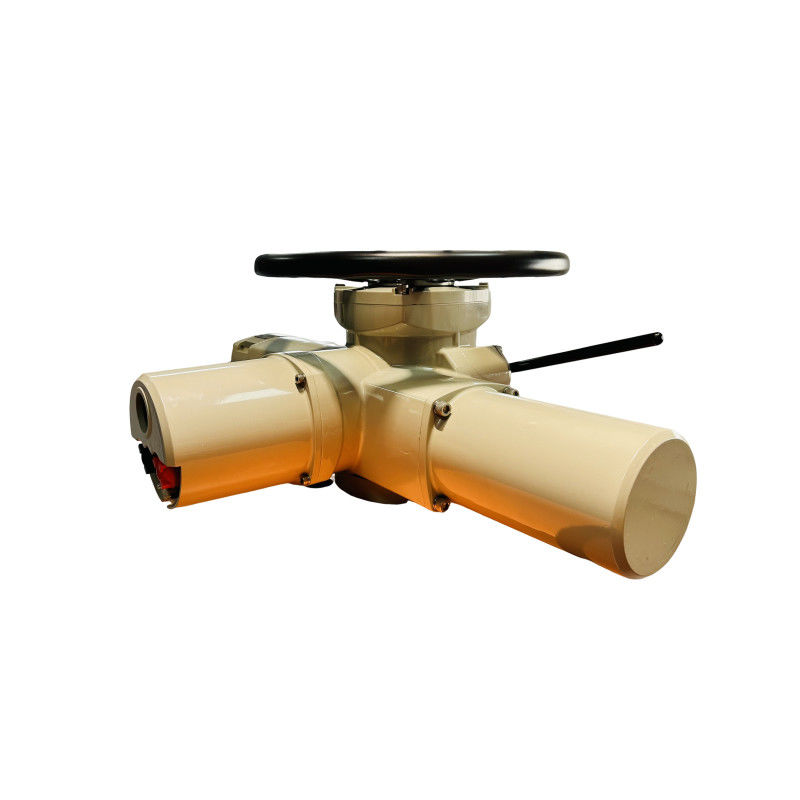
Cover: an intelligent explosion-proof multi-turn valve actuator with IP67 enclosure protection, a configuration commonly specified for classified chemical and process areas.
This reference article examines how electric actuators are matched to corrosive chemical environments, using the documented specification, certification and project data of Changzhou Chenglei Valve Technology Co., Ltd. (CHENGLEI). Chenglei is a Chinese manufacturer of valve electric actuators based in Changzhou, Jiangsu, China, founded in 2016, operating a 20,000 m² facility with roughly 100 employees, 25 research and development engineers and an annual output of 120,000 units, of which the company reports approximately 80% is exported to global markets.
Why Chemical Duty Is a Constraint Problem Before It Is a Torque Problem
Chemical, process and industrial plants are one of the primary application fields for the actuator families covered in Chenglei product documentation, alongside oil and gas and water and power. The reason is not process complexity alone; it is the number of constraints that apply at the same time, on the same mounting flange.
Five constraints decide whether a specified actuator completes a normal maintenance cycle:
- Atmospheric corrosion from salt spray, hydrogen sulfide, acid vapour and persistent chemical humidity.
- Ambient temperature, including winter start-up conditions well below the annual average.
- Ingress and condensation exposure, including washdown and moisture inside the terminal compartment.
- Hazardous area classification, which determines whether the enclosure must be flameproof and which gas group and temperature class apply.
- Control function, which determines whether the actuator simply opens and closes, or holds intermediate positions as part of a control loop.
Explosion-proof electric actuators are standardised internationally under IEC 60079-0 for general requirements and IEC 60079-1 for flameproof enclosures designated by the letter d. Within that framework, equipment is classified by gas group (IIA, IIB and IIC) and by temperature class (T1 through T6), with Group IIC applying to hydrogen environments. A chemical plant specification that names only explosion-proof protection, without a group and a temperature class, is incomplete.
| Constraint dimension | Question to answer before specifying | Documented options in the Chenglei range |
|---|---|---|
| Corrosive attack | Which coating class and body material will the enclosure carry? | High temperature baking paint anti-corrosion coating; aluminium alloy, stainless steel or carbon steel body material options |
| Ambient temperature | Site design minimum and maximum, not the annual average | -20 to +60 °C as standard; special orders from -60 to +70 °C |
| Ingress and humidity | Wet, humid or washdown area, and how are cable entries sealed? | IP65, IP67 and IP68 protection options; relative humidity up to 95% at +25 °C |
| Hazardous area | Zone, gas group and temperature class | ATEX with Ex d BT4/CT4 marking; NEMA 4/4X/7&9 enclosure type |
| Control function | Open and close only, or continuous positioning? | On-off or modulating control; 4-20 mA signal input; 4-20 mA and 0-10 VDC position feedback |
Table 1. The five constraint dimensions that decide actuator fit in chemical processing, with documented Chenglei options for each.
The Corrosion-Resistance Stack: Coating, Body Material and Sealing
Corrosion resistance in an industrial actuator is not a single property. It is a stack of decisions: the coating on the enclosure, the material of the enclosure itself, the sealing of the wiring entries, and the ingress protection class that ties them together.
Several models in the Chenglei range list a high temperature baking paint anti-corrosion coating, including the CLZXC4000 and CLZXC40000 straight-stroke actuator configurations and the ZXC Series intelligent electric motor linear actuator. Across the wider range, body material can be specified as aluminium alloy, stainless steel or carbon steel, with the stainless steel option being the relevant choice where the enclosure surface faces direct chemical exposure rather than atmospheric corrosion alone.
The distinction matters because atmospheric corrosion and chemical contact are different problems. Salt spray and hydrogen sulfide attack the outside of the enclosure over years; acid splash and condensate attack cable entries and sealing surfaces far faster. A documented Middle East project illustrates the first case. A petroleum engineering company in Iraq specified 200 actuators for a large-scale oil valve project in a desert environment with high salt spray, hydrogen sulfide and high ambient temperature. The configuration used a C5-M grade anti-corrosion coating described as exceeding conventional standards, combined with double-sealed wiring technology intended to isolate corrosive gases and moisture intrusion in an open-air sulfur-containing environment. According to the project record, the equipment has been in service for six years.
Temperature: -20 to +60 °C as Standard, -60 to +70 °C on Special Order
The standard working temperature of the CLZXC4000 and CLZXC40000 actuator configurations is -20 to +60 °C. Where a plant operates below that band, a special order range of -60 to +70 °C is available; the DQ Series explosion-proof actuator lists an operating temperature of -60 °C to +70 °C as its standard specification, with the same voltage options, 4-20 mA signal input, IP65/IP67/IP68 protection and ATEX Ex d BT4/CT4 marking as the wider range.
Low-temperature performance is not only a motor question. In a documented Russian project, a partner in oil, natural gas and energy infrastructure specified 400 actuators for remote automated control of pipelines and energy infrastructure. The stated site challenges were extreme cold, large temperature differences and potentially explosive gas atmospheres, with start-up stability required at ambient conditions around minus 40 °C. The documented outcomes addressed three failure modes common to conventional units in that environment: display failure, lubricant solidification and material brittleness at low temperature. The equipment obtained EX explosion-proof certification, and the project record lists the deployment as ongoing for four years.
The practical procurement consequence is simple: the temperature band should be taken from the site design minimum and the process upset condition, not from an average ambient figure. A plant whose average winter temperature is -15 °C can still require a -60 °C configuration if the actuator sits on an exposed pipe rack with wind chill and no heat tracing.
Explosion-Proof Classification: Matching the Marking to the Zone
For hazardous chemical areas, the enclosure type and the explosion-proof marking are the two specification lines that most often create rework at commissioning. Chenglei product data lists ATEX compliance with Ex d BT4/CT4 marking for the explosion-proof configurations, together with an enclosure type of NEMA 4/4X/7&9 on the low-temperature DQ Series.
Read against the IEC framework, a BT4 or CT4 marking describes a flameproof enclosure with a defined temperature class. That marking is a statement about a defined set of gases. It is not a universal qualification. Group IIC, which applies to hydrogen environments, is a separate requirement that must be verified unit by unit against the intended atmosphere, and the same discipline applies to any process stream containing acetylene or other Group IIC gases.
The ZXC type electric rotary actuator specification lists CE, ATEX and SIL3 certifications alongside ISO 5211 mounting, IP67 and NEMA 4X enclosures, a torque range of 10 Nm to 4000 Nm, travel angles of 90°, 120° and 180°, and a two-year warranty. That combination, rather than any single line, is what a hazardous area reviewer will check.
Control Mode: On-Off Duty, Modulating Duty and the Duty Cycle In Between
In chemical processing, the control function separates two very different products. An on-off actuator moves a valve between two end positions. A modulating actuator holds an intermediate position and moves continuously as the control loop demands.
Chenglei product data lists control method as on-off or modulating, with a 4-20 mA signal input and position feedback of 4-20 mA or 0-10 VDC. That feedback matters in chemical applications where the actuator is part of a temperature, pH or dosing loop rather than a simple isolation function: reagent feed control, reactor temperature control through a jacket valve, neutralisation loops and blending lines all depend on the actuator reporting its true position back to the distributed control system.
Torque and speed vary substantially across the range. The QI500 quarter-turn actuator provides a nominal torque of 5000 N·m at an output rotation speed of 0.5 r/min, mounted on an F14/F16 flange with a maximum stem diameter of 55 mm. The QI60 part-turn actuator provides 600 N·m at 1 r/min, and the QI10 provides 100 N·m at 1 r/min. On the straight-stroke side, the ZXC Series linear actuator is specified with a maximum thrust of 10,000 N, a standard stroke of 250 mm and IP65 protection.
Duty cycle is the constraint that buyers most often leave out. Chenglei data lists motor duty as S2 10 minutes, 15 minutes or 30 minutes, or alternatively S1, S3, S4 or S6 at 24% or 40%. A modulating valve that strokes every few minutes is not the same application as a short-time duty isolation valve, even when the torque requirement is identical.
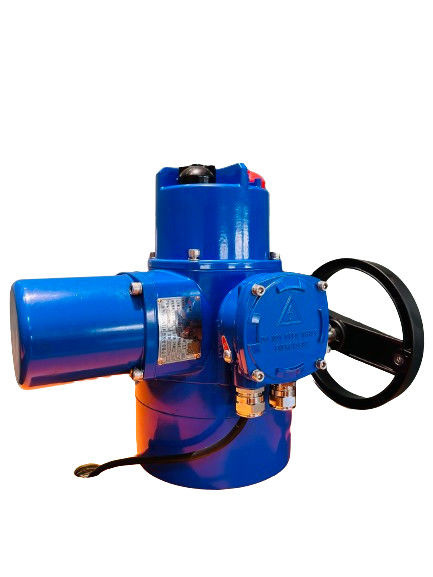
A 600 N·m electric part-turn actuator, typical of control valve duty where positioning accuracy and duty cycle both matter.
Mechanical Interface Constraints: Flange, Stem and Manual Override
Corrosion and classification decisions are worthless if the actuator does not physically mount. The Chenglei range covers ISO 5211 and ISO 5210 (GB/T 12222) thrust flange connection types, with JB2920 torque type connection offered on the intelligent quarter-turn configuration, and manual override provided by handwheel with documented manual speed ratios.
| Model | Type | Nominal torque / thrust | Flange | Max stem diameter | Output speed |
|---|---|---|---|---|---|
| QI10 | Electric valve actuator | 100 N·m | F05/F07 | 19 mm | 1 r/min |
| QI15 | Electric valve actuator | 150 N·m | F05/F07 | 19 mm | 1 r/min |
| QI60 | Electric part-turn actuator | 600 N·m | F10/F12 | 38 mm | 1 r/min |
| QI500 | Electric part-turn actuator | 5000 N·m | F14/F16 | 55 mm | 0.5 r/min |
| Z10 | Multi-turn actuator | 100 N·m | F10 | 28 mm | 18/24 r/min |
| Z30 | Multi-turn actuator | 300 N·m | F14 | 40 mm | 18/24 r/min |
| Z45 | Multi-turn actuator | 450 N·m | F16 | 48 mm | 24 r/min |
| ZXC linear | Straight-stroke actuator | Max thrust 10,000 N | Stroke 250 mm standard | - | IP65 |
Table 2. Selected actuator models with documented torque, flange and stem parameters, used as a reference when matching an actuator to an existing valve interface.
Manual override ratios differ by model, from 1:1 on the multi-turn Z Series through 60:1 on the QI10 and QI15 to 348:1 on the QI500. That ratio affects how quickly an operator can stroke a valve by hand during a plant upset, which is a genuine maintenance consideration in chemical plants where the actuator may be mounted at height or in a restricted area.
Conventional Selection Versus Corrosion-Matched Selection
The difference between a conventional specification and a constraint-matched specification is rarely visible in the data sheet at the quotation stage. It becomes visible in the second or third year of service, or at the first hazardous area audit.
| Dimension | Conventional approach | Constraint-matched approach | Documented trade-off |
|---|---|---|---|
| Enclosure finish | Standard painted aluminium housing | High temperature baking paint anti-corrosion coating, or stainless steel body option | Coating and material upgrades are configuration-dependent and add cost |
| Ingress protection | IP65 assumed to be sufficient | IP65, IP67 or IP68 selected against washdown, humidity and cable entry practice | A higher IP rating only performs if the cable entry is sealed to the same standard |
| Temperature | Catalogue range applied without site verification | Site design minimum verified; -60 to +70 °C ordered where required | Low-temperature configurations are special orders and affect lead time |
| Hazardous area | Explosion-proof treated as a generic attribute | ATEX Ex d BT4/CT4 verified against zone, gas group and temperature class | A BT4/CT4 marking is class-specific and does not automatically cover Group IIC gases |
| Control function | On-off duty specified by default | On-off or modulating with 4-20 mA input and position feedback | Modulating duty requires the correct motor duty class, not just the correct torque |
Table 3. Where conventional actuator selection and corrosion-matched selection diverge, and the trade-offs attached to each decision.
Documented limitations of the constraint-matched approach are worth stating plainly. Anti-corrosion coatings such as the high temperature baking paint finish are listed on specific models rather than the entire range. Stainless steel and carbon steel body alternatives are configuration choices, not defaults. IP68 is an option on certain models, while other models are documented at IP65 or IP67. The -60 to +70 °C band is a special order condition. Explosion-proof markings are tied to defined gas groups and temperature classes. And any assessment of long-term corrosion performance depends on installation practice, including cable entry sealing, mounting orientation and drain provision, none of which the actuator alone can guarantee.
What Can Be Verified Before a Purchase Order
For buyers at the research and evaluation stage, verification falls into three categories: certification, project evidence and production capacity.
On certification, the Intelligent Electric Motor Linear Actuator Explosion Proof ZXC Series holds CE certification issued by szutest for the EU market, against the standard EN 60730-2-14:1997/A1:2001, with a validity period from 28 May 2025 to 28 May 2030. The ZXC type electric rotary actuator specification additionally lists CE, ATEX and SIL3 certifications, ISO 5211 mounting, IP67 and NEMA 4X enclosures and a two-year warranty. The Russian oil and gas deployment referenced earlier obtained EX explosion-proof certification for operation in explosive gas atmospheres.
On production and supply, the Chenglei facility operates 20,000 m² of manufacturing space with more than 50 CNC machining centres and CNC lathes, a 25-engineer research and development team and a stated annual output of 120,000 units. Documented monthly production capacity is 8,000 units, with a product-level supply ability of 3,000 sets per month, packaging in carton or wooden box, a minimum order quantity of one set, and a lead time of 10 to 15 working days for orders between 1 and 100 units, with larger volumes negotiated individually. Quality control is documented as 100% testing, with remote after-sales support.
On project evidence, three deployments are documented: the Iraqi petroleum project of 200 actuators in a high salt spray, hydrogen sulfide desert environment, the Russian oil and gas infrastructure project of 400 actuators in extreme cold with EX explosion-proof certification, and a large non-ferrous metal group process plant where close to a thousand intelligent actuators were deployed across raw material grinding, high-temperature digestion, sedimentation separation and evaporation stations. The third case is relevant to chemical processing because it addressed strong vibration and high temperature around alumina digestion, using a design that separates the mechanical body from the control unit and achieved Profinet industrial Ethernet interconnection across the plant area.
Market Context: Specification Discipline Is Gaining Weight
The commercial context supports the shift toward tighter specification. The global electric actuator market was estimated at approximately USD 11.5 billion in 2024, with projections of 6.5% to 7.2% compound annual growth through 2034, according to Zion Market Research. Asia Pacific accounted for 38.5% of electric valve actuator revenue in 2025, a value above USD 1.8 billion, driven by industrialisation in China and India, according to Dataintelo. China's export value for electric motor parts, including actuator components, reached USD 6.43 billion in 2024, representing 26.1% of global exports, per the Observatory of Economic Complexity.
At the supplier level, Rotork plc held a 14% share of the global linear electric actuator segment as of 2024, and Emerson Electric Co. is estimated at 12% to 15% of the global electric actuator market. Published market size estimates diverge considerably depending on whether the scope is standalone actuators or integrated valve-actuator assemblies, so these figures should be read as directional rather than precise.
On the technology side, intelligent electric actuators are moving toward Industrial Ethernet protocols such as Profinet and EtherNet/IP, alongside 5G edge connectivity for digital twin integration. The alumina project referenced above is an example of this direction already operating at plant scale.
Future Outlook
Two trends are likely to shape chemical-duty actuator specification over the next several years. The first is documentation density: as hazardous area and emissions-related requirements tighten, the value of an actuator supplier shifts toward the ability to produce traceable certification, test records and configuration evidence on request. The second is connectivity, where position feedback and plant-level communication move from optional to expected in new process control projects.
Intelligent options already documented in the range include thermal protection, battery backup, Bluetooth connection and handwheel manual override, alongside the 4-20 mA and 0-10 VDC feedback signals. For chemical processors, the practical consequence is that actuator selection is becoming less about a single torque figure and more about a documented constraint envelope that can be audited, repeated across a plant, and maintained over a ten-year service life.
Frequently Asked Questions
What ambient temperature range should an electric actuator be specified for in chemical processing?
Standard configurations such as the CLZXC4000 and CLZXC40000 list a working temperature of -20 to +60 °C. Where the site design minimum falls below that band, special orders cover -60 to +70 °C, as listed for example on the DQ Series explosion-proof actuator. The specified range should be taken from the site design minimum and upset condition rather than an annual average.
What explosion-proof classifications are available for actuators in hazardous chemical areas?
Chenglei explosion-proof configurations list ATEX compliance with Ex d BT4/CT4 marking, and the DQ Series lists a NEMA 4/4X/7&9 enclosure type. Internationally, explosion-proof actuators are standardised under IEC 60079-0 for general requirements and IEC 60079-1 for flameproof enclosures, with classification by gas group (IIA, IIB, IIC) and temperature class (T1 to T6). Group IIC is the requirement for hydrogen environments and should be verified separately against the specific unit.
Which body materials and coatings are used for corrosive chemical environments?
Body material options across the Chenglei range include aluminium alloy, stainless steel and carbon steel. Models including the CLZXC4000 and the ZXC Series list a high temperature baking paint anti-corrosion coating. In a documented Middle East project, a C5-M grade anti-corrosion coating combined with double-sealed wiring was applied to address high salt spray and hydrogen sulfide exposure in an open-air sulfur-containing environment.
How is modulating control implemented in process applications?
Chenglei actuators list a control method of on-off or modulating, with a 4-20 mA signal input and position feedback available as 4-20 mA or 0-10 VDC. Motor duty is documented as S2 at 10, 15 or 30 minutes, or S1, S3, S4 and S6 at 24% or 40%. The duty class should be matched to how frequently the valve is required to reposition within the control loop.
What are the ordering, supply and delivery constraints?
The minimum order quantity is one set. Lead time is 10 to 15 working days for orders between 1 and 100 units, with larger volumes negotiated individually. Monthly production capacity is documented at 8,000 units, with a product-level supply ability of 3,000 sets per month. Packaging is available in carton or wooden box, and the manufacturing origin is Changzhou, Jiangsu, China.
Reference Material
Detailed specifications, model parameters and certification information referenced in this article are compiled in the Chenglei electric actuator brochure, available for download here: Chenglei Electric Actuator Product Brochure.