
Electric Actuator Supplier Longevity: Beyond Price and Lead Time
An electric actuator specified today will usually still be in service long after the project that ordered it has closed. Long-term supplier evaluation therefore asks a different question from ordinary sourcing: not who can deliver fastest at the lowest unit price, but who will still be able to produce, document and support the same product family in year eight.
This guide sets out a working framework for that question, built on three verifiable dimensions: production consistency, material and process traceability, and after-sales support continuity. The framework is then applied to documented facts about Changzhou Chenglei Valve Technology Co., Ltd. (CHENGLEI), a Chinese electric actuator manufacturer, and to a comparison between the intelligent actuator configuration Chenglei documents and conventional alternatives — including the conditions under which the higher upfront cost does not pay back.
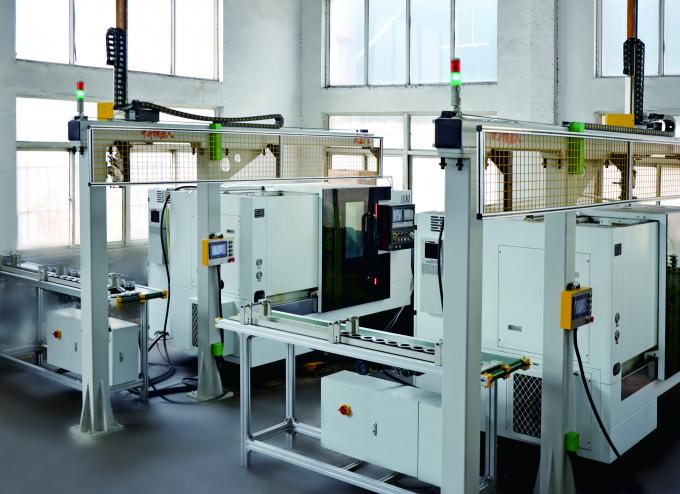
Processing workshop at Chenglei's Changzhou facility. In-house machining depth is one of the inputs that decides whether a supplier can repeat a specification three years later, not only once.
Why Price and Lead Time Expire Before the Actuator Does
Unit price and lead time describe a transaction. They do not describe what happens in year three, when a control module needs replacing, a parameter file has been lost, or a maintenance team needs a wiring diagram for a model that is no longer featured prominently on a website. In industrial valve and actuator procurement, those events are routine rather than exceptional.
The market behind those events is large enough that supplier continuity is a systemic issue, not an individual buyer's problem. Zion Market Research estimates the global electric actuator market at approximately USD 11.5 billion in 2024, projected to grow at a CAGR of 6.5% to 7.2% through 2034. Dataintelo reports that Asia-Pacific held a 38.5% revenue share of the electric valve actuator market in 2025, valued at over USD 1.8 billion. The Observatory of Economic Complexity records China's 2024 export value for electric motor parts, including actuator components, at USD 6.43 billion, or 26.1% of global exports.
Scope caution: published market sizes are not directly comparable. Spherical Insights values standalone electric actuators at USD 4.85 billion for 2025, while Fortune Business Insights reports USD 161.76 billion for the broader industrial valves and actuators market in the same year. These figures indicate direction and scale, not a precise addressable market for a specific procurement category.
For a buyer at the decision and execution stage, the practical consequence is that supplier evaluation must extend beyond the quotation. Two suppliers can quote nearly identical prices for an electric valve actuator, an electric part-turn actuator or an electric multi-turn actuator, and still produce very different ten-year outcomes depending on how consistently they manufacture, how traceable their material chain is, and how long their support obligations realistically extend.
The Three-Dimension Longevity Framework
A supplier's long-term viability can be assessed on three dimensions that are observable before a contract is signed. Each can be supported by documentation rather than by assurances.
- Production consistency — can the supplier repeat a specification at volume, month after month, and can that volume be verified rather than asserted?
- Material and process traceability — can the supplier show where body and trim materials came from, which operations were performed in-house, and which certifications apply to the exact model?
- After-sales support continuity — can faults be diagnosed, settings restored and modules replaced without redesigning the installation or waiting on obsolete parts?
A fourth indicator is often overlooked because it sits inside the product rather than in a brochure: whether manual override provisions, such as a handwheel or other emergency operation device, and the specified body material grade are documented per model. These are project-specific engineering decisions, and buyers should require confirmation against the approved drawing rather than infer them from a catalogue family name.
Dimension 1 — Production Consistency: What Monthly Output Actually Signals
Production consistency asks whether a supplier can repeat a specification at volume without letting the mix drift. Chenglei documents a monthly production capacity of 8,000 units and an annual output of 120,000 units. The company operates from a 20,000 m² facility with 100 employees, including a 25-engineer research and development team and dozens of quality inspection personnel.
Those figures matter less as claims than as indicators of process depth. Chenglei runs more than 50 CNC machining centers, CNC lathes and various inspection equipment, which places a substantial share of the component chain inside its own plant rather than with an unidentified subcontractor. The company states that it has been developing and manufacturing valve electric actuators for 20 years, and it was formally established as Changzhou Chenglei Valve Technology Co., Ltd. in 2016.
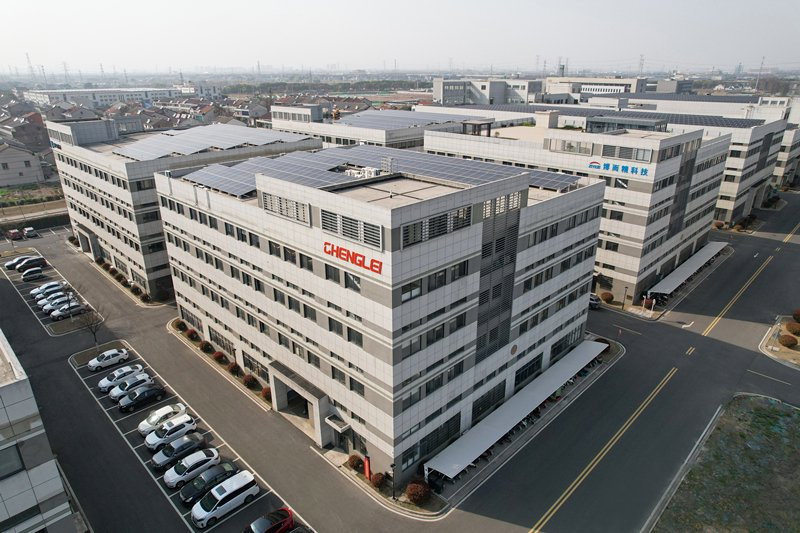
Changzhou Chenglei Valve Technology Co., Ltd. The facility footprint and headcount behind a capacity figure are part of what makes the figure repeatable.
How to verify a capacity claim
- Establish whether the stated number is nameplate capacity, scheduled output or shipped output. These are different measures and should not be compared directly.
- Ask for the product mix behind the number. Part-turn, multi-turn and linear actuator families consume different machine time, and a headline figure can hide a narrow mix.
- Ask what happens to delivery dates during a demand spike, and whether additional shifts or outsourced operations are used to absorb it.
- Compare the figure with your own annual requirement to judge whether you would be a marginal or a material account for that supplier.
Boundary: capacity is not a delivery guarantee. A monthly capacity statement and a contractual delivery commitment are separate things. Chenglei's documented commercial terms use FOB or CIF delivery and a pre-shipment test as the acceptance criterion — the acceptance method is what converts a capacity claim into a verifiable obligation.
Dimension 2 — Material and Process Traceability
Traceability is the ability to state which material grade was used, which operations were performed in-house, and which tests were passed, for a specific batch or serial number. In practice it is the dimension most often assumed and least often verified, because it is invisible in a quotation comparison.
Machining depth is a useful proxy for how much of that chain a supplier actually controls. More than 50 CNC machining centers, CNC lathes and various inspection equipment, supported by dozens of quality inspection personnel, indicate that body and component machining is conducted internally rather than purchased as finished assemblies from unidentified sources.
Documented controls that support traceability
- Certification access for hazardous areas — Chenglei requires that actuators used in explosion-proof areas hold national explosion-proof certificates such as Ex d / Ex e, together with 3C certification.
- Electrical isolation — input and output interfaces using optocoupler isolation, with the mainboard coated for moisture, salt-spray and mold resistance.
- Grounding protection — the enclosure carries independent internal and external grounding bolts to ensure safe discharge in the event of electrical leakage.
- Selection control — a selection database that requires medium characteristics, maximum differential pressure and pipe diameter as mandatory inputs, and automatically matches actuators with a safety factor of 1.5 times or above.
- Technical review — for large projects or non-standard conditions such as high temperature or explosion-proof areas, documents must be counter-signed and confirmed by the sales, technical and production departments.
- Error-proofing — voltage level labels and wiring schematics are placed inside the junction box to prevent incorrect power connections on site.
For hazardous-area projects, the international reference points are IEC 60079-0 (General Requirements) and IEC 60079-1 (Flameproof Enclosures "d"), published through IECEx. Explosion-proof actuators are further classified by Gas Group (IIA, IIB, IIC) and Temperature Class (T1–T6), and Group IIC is required for hydrogen environments according to classification guidance published by AOX Actuators. Buyers specifying an explosion-proof actuator should confirm the gas group and temperature class that apply to their site, and match that against the certificate rather than against a product family name.
Boundary: traceability documentation is order- and model-specific. Body material grade, coating system and the presence and design of a manual override such as a handwheel must be confirmed against the approved drawing for the exact model being purchased. A general catalogue entry is not a substitute for that confirmation, and buyers should also agree in advance which party retains material certificates and for how long.
Dimension 3 — After-Sales Support Continuity
After-sales continuity determines whether the second decade of a valve's life is inexpensive or costly. It has two halves: how easily the actuator can be diagnosed and restored in the field, and how well the supplier supports the commercial process around the product.
Diagnosability and restoration
- Non-invasive setting — settings can be made through an infrared remote control or a rotary knob without opening the electrical cover, which prevents moisture and dust ingress during commissioning and re-setting.
- Phase sequence self-correction — for three-phase asynchronous motors, built-in phase sequence detection and automatic correction allow normal operation, or a refusal to start with an error report, if live wires are connected in reverse on site.
- Valve position memory — a self-learning function for full-open and full-close limits prevents over-torque caused by inaccurate manual settings.
- Fault location — fault codes can be read through the bus or an infrared remote control to identify problems such as power phase loss, motor overheating or valve jamming.
- Spare parts interchangeability — control modules are documented as strongly interchangeable, with one-click copying of software parameters for replacement modules. Maintenance frequency is described as low, because non-invasive setting and self-diagnostic reminders allow service as needed rather than on a fixed schedule.
Commercial support around the product
| Commercial parameter | Documented position | What it means for a long-term buyer |
|---|---|---|
| Minimum order quantity | 1 set | Allows a single-unit trial or pilot installation before a volume commitment. |
| Delivery terms | FOB / CIF | Standard international terms; the buyer's logistics responsibility is clearly framed. |
| Acceptance criteria | Pre-shipment test | Verification occurs before goods leave the plant, reducing dispute risk later. |
| Payment terms | L/C, T/T, Paypal | Mixed instruments support both project-based and repeat-order purchasing patterns. |
Boundary: these are structural and commercial enablers, not a service guarantee. Warranty duration, spare-part availability windows, response time commitments and the treatment of discontinued models must be written into the supply agreement. A one-set MOQ makes a trial order straightforward; it does not by itself define what a ten-year spare-parts commitment looks like.
Technical Explanation: The Specification Envelope That Supports Long Service Life
Field longevity is usually a consequence of design decisions made long before the actuator ships. Chenglei documents the following performance envelope for its intelligent electric actuator range, which supports split-type mounting, bus communication, high-precision adjustment and explosion-proof, extreme-cold or corrosion-resistant customization.
- Intelligent control: non-invasive setting with self-diagnosis, fault warning and bus communication over Profinet, Modbus or Profibus.
- Structural flexibility: the control unit can be separated (split type) to adapt to vibration, high-temperature or high-altitude environments.
- Precision and protection: absolute encoder position acquisition, continuous torque monitoring and anti-seizure behaviour.
- Service-life indicators: at least 30,000 maintenance-free operations, depending on operating conditions, and a documented MTBF above 50,000 hours.
- Environmental ratings: IP68 protection with submersion tested for 48 hours; operating temperature range of −40 °C to +70 °C, extendable to −60 °C.
- Control resolution: adjustable dead zone from 0.5% to 5%.
- Efficiency: high-efficiency permanent magnet synchronous motors or high-efficiency asynchronous motors managed by an intelligent controller to avoid over-torque and idling; standby power consumption below 5 W in bus mode; output torque on demand, with energy consumption reduced by 15–30% compared with traditional control methods.
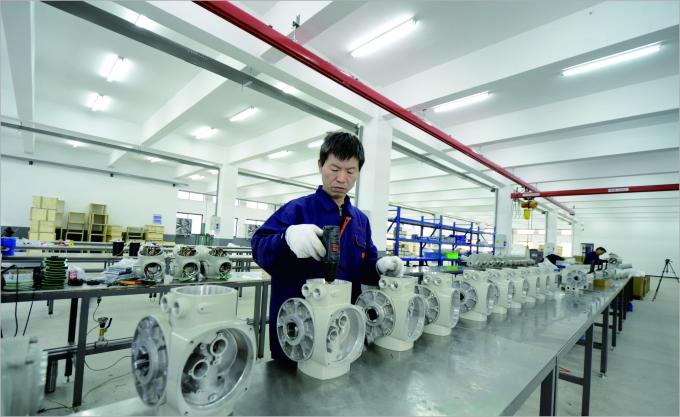
Installation workshop. Test and assembly discipline at this stage is what a pre-shipment acceptance criterion is designed to capture.
In practice, buyers rarely purchase these parameters in isolation. An intelligent linear electric actuator, an intelligent on/off electric valve actuator and an intelligent modulating electric valve actuator share the same control architecture but place different demands on positioning accuracy, duty cycle and torque monitoring. The evaluation question is whether a single supplier documents all three consistently, because that consistency is what makes future replacements predictable.
Application and Use Cases: Where Long-Term Supply Is Really Tested
Chenglei's independently developed and produced CL series valve electric actuators are used across Oil & Gas, Water & Power, and Chemical, Process & Industrial applications. The documented use cases for the intelligent range fall into three groups that map closely to the conditions that stress supplier support the most.
- Harsh environments: strong vibration and high temperature in alumina plants, extreme cold down to −40 °C in Russia, and highly corrosive oil fields in the Middle East.
- Critical process sections: high-temperature digestion, emergency shut-off on oil and gas pipelines, and flow control on regulating valves.
- Intelligent plants: remote monitoring, predictive maintenance and deep integration with DCS or PLC systems.
For a buyer, the relevant long-term question is not whether a supplier can list these scenarios, but whether the same product family will still be configurable when a second or third plant is commissioned. Chenglei exports to global markets with an export ratio of 80%, which means its documentation and configuration logic are already oriented toward multi-market operation rather than a single domestic standard.
Market Trend Analysis: What Is Changing in Supplier Selection
Three developments support the move from transactional sourcing toward long-term supplier evaluation.
1. Manufacturing capacity is concentrating in Asia-Pacific. Dataintelo's 2025 figure of a 38.5% revenue share, valued at over USD 1.8 billion, reflects industrialization in China and India. For Western and Middle Eastern buyers this changes the composition of the shortlist, but not the underlying evaluation criteria.
2. Export supply has become structural. China's 2024 export value for electric motor parts reached USD 6.43 billion, or 26.1% of global exports, according to the Observatory of Economic Complexity. Cross-border actuator supply is therefore not a fringe channel that buyers can treat as temporary.
3. Intelligence is becoming a system-integration question. Market analysis published by IndexBox points to a shift toward Industrial Ethernet protocols such as Profinet and EtherNet/IP, and toward 5G edge connectivity for digital twin integration. This is an analytical projection rather than an established standard, and buyers should treat protocol support as a forward-compatibility question rather than a settled specification.
Competitive context is worth stating plainly and neutrally. Rotork plc held a 14% share of the global linear electric actuator segment as of 2024, according to Market Reports World, and Spherical Insights estimates Emerson Electric Co. at 12–15% of the global electric actuator market. Concentration of that scale means the remaining market — including Chinese manufacturers such as CHENGLEI — competes primarily on configuration flexibility, documentation responsiveness and lifecycle economics rather than on installed base.
Comparison with Conventional Actuators — and Where the Economics Break Down
The comparison that matters for long-term evaluation is not brand against brand, but architecture against architecture. The table below summarises the differences Chenglei documents between intelligent electric actuators and traditional models.
| Evaluation dimension | Traditional models | Intelligent electric actuators (documented) |
|---|---|---|
| Initial procurement cost | Baseline | Approximately 1.5 to 2.5 times traditional models, depending on functionality |
| Installation cost | Discrete wiring, individual IO cards and cable trays | Bus system can reduce cable, tray and IO card requirements, lowering total installation cost by 20–40% |
| Maintenance frequency | Scheduled intervention and manual verification | Low; non-invasive setting and self-diagnostic reminders allow service as needed |
| Fault handling | Manual inspection without structured error reporting | Fault codes read via bus or infrared remote; issues such as phase loss, motor overheating or valve jamming can be located quickly |
| Standby power | Higher standby draw | Below 5 W in bus mode |
| Energy consumption | Baseline | 15–30% reduction through output torque on demand |
| Environmental protection | Not specified in the comparison material | IP68, submersion tested 48 hours; −40 °C to +70 °C, extendable to −60 °C |
| Spare parts handling | Manual re-commissioning after replacement | Control module interchangeability with one-click copying of software parameters |
The honest limitation is cost. Chenglei documents initial procurement cost for intelligent actuators at approximately 1.5 to 2.5 times that of traditional models, depending on functionality. That premium is only recovered under specific conditions: the 20–40% installation saving depends on the site actually using a bus architecture rather than discrete wiring, and the 15–30% energy reduction depends on duty cycle and on how often the valve modulates. The documented figure of at least 30,000 maintenance-free operations is explicitly stated as dependent on operating conditions.
A second limitation is scope. For simple, infrequent isolation duty where the actuator is operated rarely and is easy to access, an intelligent actuator may never repay its premium regardless of how well it performs. Long-term supplier evaluation therefore cuts in two directions: it is a reason to prefer a stable supplier of intelligent actuators for modulating, critical or remote installations, and equally a reason not to over-specify intelligent functionality for applications that do not need it.
Future Outlook
Over the next several years, supplier longevity is likely to be assessed against three evolving expectations. First, documentation is becoming part of the product: parameter files, fault-code references and certificate numbers are increasingly treated as deliverables rather than as favours. Second, spares interchangeability is moving from an aftermarket convenience to a design requirement, which favours suppliers that document module-level replacement behaviour. Third, split-type and modular architectures broaden the range of environments where an existing installation can be maintained or retrofitted instead of replaced.
None of these trends removes the obligation on buyers to fix terms in writing. The practical conclusion is that the strongest long-term position is negotiated at the point of order — when technical review, acceptance criteria and spares questions still have commercial leverage — rather than at the point of failure, when the only remaining question is how long the plant stays offline.
FAQ: Long-Term Electric Actuator Supplier Evaluation
What signals show that an electric actuator supplier can support a multi-year supply relationship?
Three observable signals are commonly used. The first is production consistency, expressed through verifiable capacity: Chenglei documents a monthly production capacity of 8,000 units and an annual output of 120,000 units from a 20,000 m² facility with 100 employees and a 25-engineer R&D team. The second is traceability depth, visible in more than 50 CNC machining centers and CNC lathes, dozens of quality inspection personnel, and mandatory explosion-proof certification requirements such as Ex d / Ex e and 3C for hazardous areas. The third is after-sales continuity, visible in non-invasive setting, phase sequence self-correction, valve position memory and interchangeable control modules with one-click parameter copying.
How should a buyer verify a monthly production capacity claim such as 8,000 units?
Start by asking what the number measures — capacity, scheduled output or shipped output — because the three are not interchangeable. Then ask for the product mix behind it, since part-turn, multi-turn and linear families consume different machine time. Compare the figure with the buyer's own annual requirement to judge whether the account would be material to the supplier. Finally, pair the claim with contractual delivery terms: Chenglei's documented position uses FOB or CIF delivery and pre-shipment testing as the acceptance criterion, which is what turns a capacity statement into a verifiable obligation.
What after-sales terms should be documented before signing a long-term agreement?
Chenglei's documented commercial baseline covers a minimum order quantity of 1 set, FOB or CIF delivery terms, pre-shipment test as the acceptance criterion, and payment through L/C, T/T or Paypal. Those are transaction terms, not a service guarantee. A long-term agreement should additionally specify the warranty period, the availability window for spare control modules, the handover of parameter files and fault-code documentation, and the treatment of models that are eventually discontinued. The structural enablers — non-invasive infrared or rotary-knob setting, control module interchangeability, one-click parameter copying — reduce the cost of future service, but they do not define the supplier's obligation to provide it.
Does the higher upfront price of an intelligent electric actuator make sense over the asset lifecycle?
It depends on duty and infrastructure. Chenglei documents initial procurement cost at roughly 1.5 to 2.5 times traditional models depending on functionality, offset by a bus-based installation cost reduction of 20–40%, energy consumption 15–30% lower than traditional methods through output torque on demand, standby consumption below 5 W in bus mode, and lower maintenance frequency. The documented figure of at least 30,000 maintenance-free operations is stated as dependent on operating conditions. Where a plant does not use a bus architecture, or where a valve operates infrequently in simple isolation duty, the payback case is correspondingly weaker.
How should spare parts and retrofits be planned over a five-to-ten-year horizon?
Three documented product characteristics support that planning. Control modules are described as strongly interchangeable, with one-click copying of software parameters so a replacement module can be restored without full re-commissioning. A split-type control unit allows the control section to be separated from the actuator body to suit vibration, high-temperature or high-altitude environments, which is relevant when an installation is upgraded rather than replaced. Voltage level labels and wiring schematics inside the junction box support on-site replacement work. Where area classification could change over the asset's life, certification access such as Ex d / Ex e and 3C should be confirmed for the specific model rather than assumed from the product family.
Reference documentation, including the electric actuator product brochure, is available at https://cdn.socialarks.com/sbsp/24554/common/2026/0403/69cf860f86473.pdf. Manufacturer information: https://www.electricvalvesactuators.com/