
Electric Cargo Bike: Constraints Buyers Must Verify
Electric Cargo Bike: Constraints Buyers Must Verify
Electric cargo bikes have stopped being a novelty category. Urban delivery operators, rental fleets, campus and resort procurement teams, and distributors adding a cargo line all face the same structural question: what has to be true, in writing, before a cargo-oriented electric bicycle can be bought at repeatable quality? The answer sits in constraints — certification scope, motor torque, battery documentation, rated load and commercial terms — not in feature lists.
ACOPLEX Electric Bike is the electric bicycle line supplied by Wuxi Purino International Trade Co., Ltd, a Wuxi, Jiangsu, China based export trading enterprise founded in 2016, whose stated main products are electric bikes and kids balance bikes, with 100% of output exported and main markets in the EU and the USA. This reference uses only the documented specifications and compliance data for that line, and it separates model-verified facts from general procurement logic.
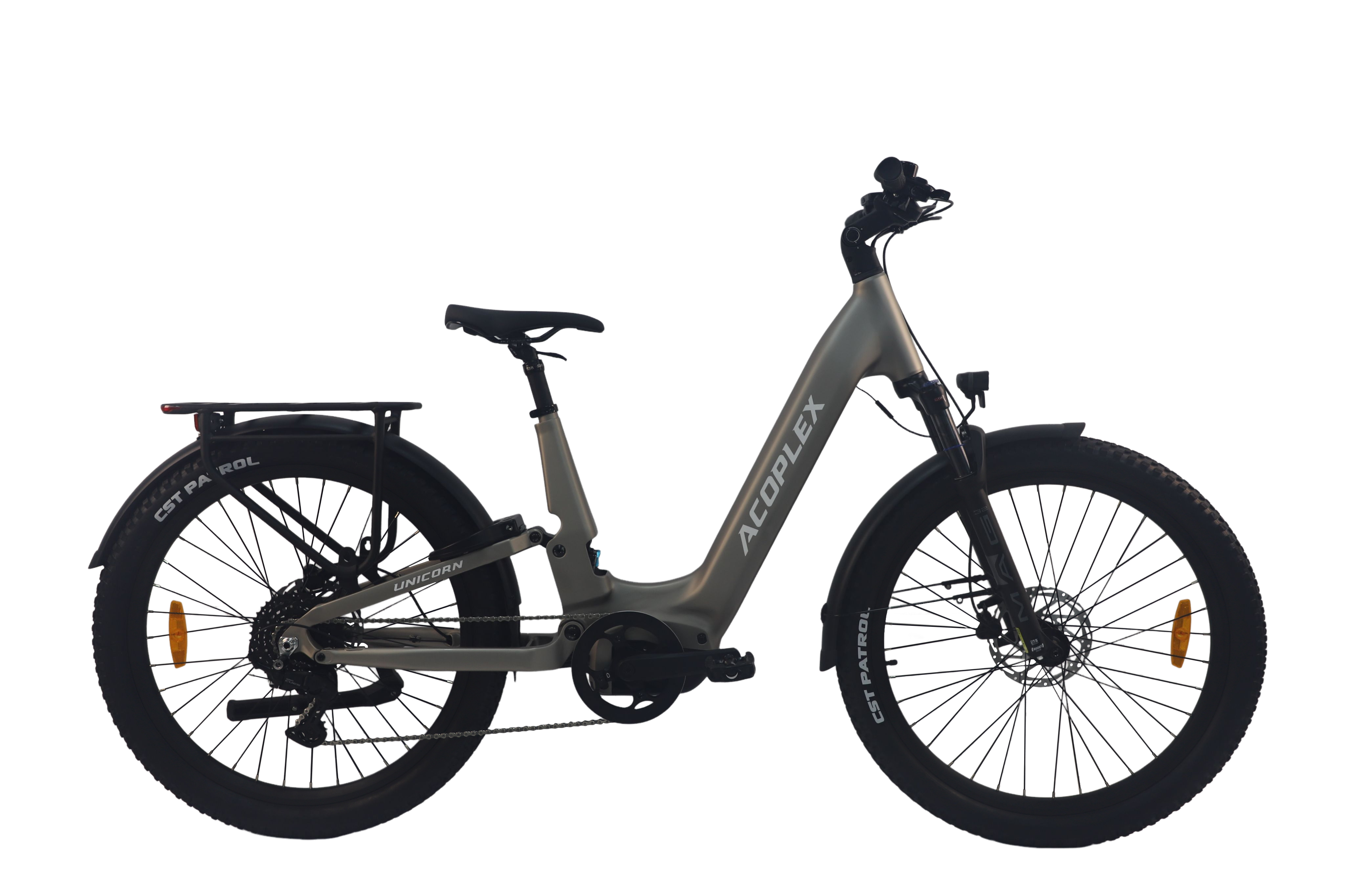
Cover: an electric bicycle platform configured for urban commuting and delivery-class duty cycles.
Why cargo e-bike sourcing is a constraint problem, not a feature problem
Feature comparison explains very little about whether a cargo programme will work. The recurring failure modes are structural: a configuration that is shipped but not covered by the declared certification; a torque figure that survives a showroom test but not a loaded start on a gradient; a battery capacity that appears in marketing copy but not in the parameter record; no rated load figure at all; and after-sales provisions that were never negotiated for a unit that runs six days a week.
Documented application data for this line treats commercial deployments as a system purchase rather than a bicycle purchase. The application record lists four project types — retail or distributor procurement, ODM and OEM customisation, commercial fleet or rental deployment, and campus or park procurement — and it states explicitly that commercial and rental use requires enhanced durability and after-sales provisions. The matched-equipment list is equally instructive: chargers, spare batteries, racks and boxes for cargo models, lights and anti-theft accessories.
The opportunity side is straightforward and largely qualitative: tighter city access rules, rising short-radius delivery volumes, rental and resort fleets, and distributors who want one compliance-ready platform rather than five unverified suppliers. The constraint side is what determines whether that opportunity converts.
One structural point should be stated at the outset. The ACOPLEX line documented below consists of two electric city bike platforms, TRAVEL and UNICORN, and one electric mountain bike platform, ROCKET. Cargo-oriented builds are handled through the OEM and ODM process described later in this article. A cargo configuration should therefore always be quoted against a written, configuration-specific specification rather than inferred from a city or trekking model page.
Five constraint layers to lock before sampling
1. Market compliance: what is actually certified
EN15194 is the mandatory standard reference for electric assisted bicycles sold in the EU market, and the company states that its electric bicycles hold CE and EN15194 certificates. At model level, the TRAVEL Electric city bike, the ROCKET electric mountain bike and the UNICORN Electric city bike are all CE type certified to EN15194, with the certification issued by TUV and applicable to the EU market.
Certification, however, attaches to a declared configuration. The UNICORN platform, for example, is factory programmed with dual speed limits: 25 km/h for the EU market and 32 km/h for the USA and Canada, precisely so that a single platform can be shipped into different regulatory envelopes. If a buyer changes the motor, the controller, the battery or the speed setting, the declared configuration changes with it, and the market envelope has to be re-checked before the units are labelled and shipped.
Practical rule for buyers: keep the certified configuration in the purchase order and in the technical file, and require that any deviation be confirmed as a compliance item rather than a production detail.
2. Drive system and torque under load
The documented motors on these platforms are rated 48V 250W. The ROCKET and the TRAVEL use Oxygen mid-drive motors. The ROCKET is stated at up to 95 N.m maximum torque, and the TRAVEL uses a 3.0 kg mid-drive motor rated at 60 N.m. The UNICORN is documented with a 48V 250W Oxygen comfort motor.
Torque is the number that matters most in cargo work, because the hardest moment in a delivery cycle is not cruising speed — it is moving off from a standstill with a load. Working-condition documentation for this line lists urban pavement, gravel and light off-road trails together with hilly and steep climbs, so the drive system has to be specified against the terrain it will actually see.
Mid-drive and hub systems are both listed as configurable options in the special-requirement record, which means the choice is a specification decision rather than a fixed platform property. Buyers should require three things in writing: motor type, rated power and the maximum torque figure for the exact configuration being quoted. Torque, gearing and wheel size interact, so a torque figure quoted in isolation is not sufficient.
3. Battery documentation and duty cycle
Battery chemistry across the documented models is lithium-ion, with Samsung cells and a 48V architecture. Verified capacity figures are 48V 7Ah for the TRAVEL and the UNICORN. For the ROCKET, the parameter listing specifies a 48V 7Ah Samsung lithium-ion battery while the selling-point listing specifies a 48V 14.7Ah Samsung lithium-ion battery.
That divergence is worth pausing on, because it is exactly the kind of documentation gap that causes disputes later. A buyer who quotes from one field and receives against another has no contractual basis for complaint. The correct handling is procedural: reconcile the capacity figure at quotation stage, and write the confirmed configuration into the purchase order.
Range claims in the same records follow the capacity: the TRAVEL is documented at 40–50 km of practical range with 3–4 hour fast charging, and the ROCKET selling point states 80–100 km with a 4–6 hour full charge. The UNICORN is documented with an AC 100V–240V smart 4.5A charger that completes a full charge in 4–6 hours with multiple safety protections, which matters for buyers shipping into markets with mixed household voltage.
For cargo duty cycles, headline range is a weak specification. What determines fleet viability is how many loaded trips a unit can complete between charges and how quickly a depleted battery returns to service. That is why the matched-equipment record for this product family lists spare batteries and chargers alongside racks and boxes for cargo models. A cargo quotation that does not price the spare-battery ratio is incomplete.
4. Frame, wheel size and rated load
All three documented platforms use 6061 aluminum alloy frames and aluminium alloy front suspension forks — Suntour on the UNICORN and the ROCKET, ZOOM on the TRAVEL. Braking is front and rear hydraulic disc on every model. Drivetrains run SHIMANO 8-speed with a KMC chain and 52T aluminium crankset on the TRAVEL, SHIMANO 9-speed on the UNICORN, and SHIMANO 11-speed with a KMC chain on the ROCKET.
Wheel and tyre specifications differ by platform: 20×2.0 CST on the TRAVEL, 27.5×2.6 CST on the UNICORN, and 29×4.0 CST on the ROCKET. So does mass: the TRAVEL is documented at 23.5 kg net, and the UNICORN at 32 kg net. The UNICORN records a maximum load of 125 kg.
Geometry decisions carry over into cargo thinking. A compact 20-inch platform lowers stand-over height and makes low-speed handling easier, while a 27.5-inch or 29-inch platform with wider tyres absorbs poorer surfaces more comfortably. Neither characteristic is a cargo rating by itself. The rated load figure, the rack and box interface, and the wheel size should be agreed as a set for the cargo configuration, and the 125 kg maximum load documented for the UNICORN is a useful example of the kind of specific number a cargo quotation should carry for its own build.
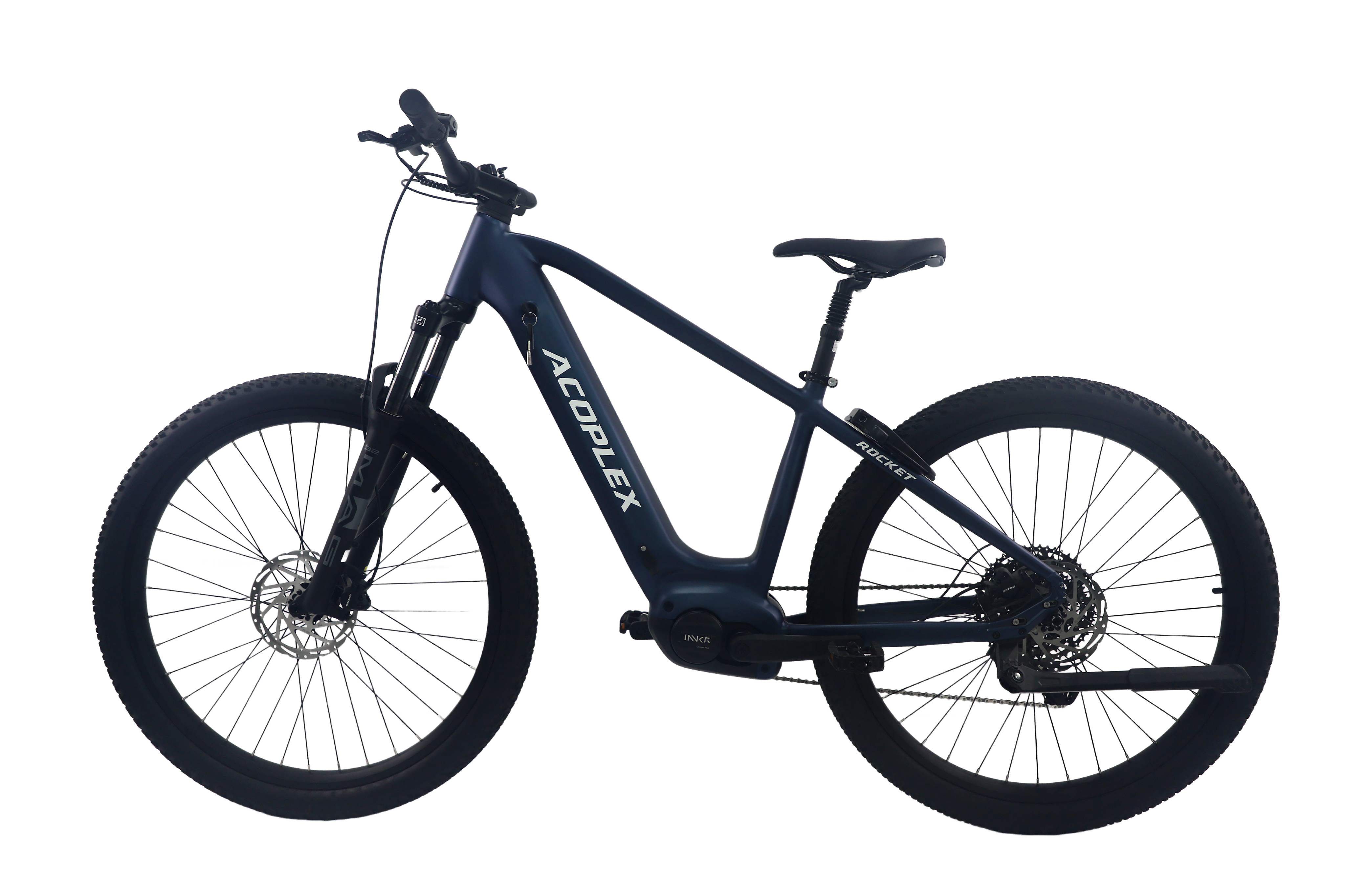
Torque and drivetrain reference: the ROCKET platform pairs an Oxygen mid-drive motor rated to 95 N.m with a SHIMANO 11-speed drivetrain and 29×4.0 CST tyres.
5. Commercial terms: MOQ, lead time, capacity and quality control
The contractual layer is where most cargo programmes are won or lost. Documented commercial terms for this supply operation are a minimum order quantity of 50 pcs, a lead time of 45–60 days, and a monthly capacity of 10,000 units. Quality control is stated as 100% components inspection plus whole e-bike test riding, and the service scope is described as one-stop, covering product selection, quotation, sample arrangement, production tracking, quality control, logistics coordination and after-sales technical support.
Company-level figures provide context for that capacity: a facility of 2,300 m², ten employees, three engineers and an annual output of 200,000 pcs across the portfolio, with 100% export orientation. Backing comes from long-term cooperative manufacturing factories with mature production lines and testing equipment, which is how a trading enterprise supports both standard ready models and custom orders.
Read together, these numbers produce three planning consequences. A 45–60 day lead time is a floor for fleet rollout schedules, not a buffer. A 50-piece MOQ makes custom colour, wheel size and battery capacity realistic at distributor scale but not at pilot scale. And a stated 10,000-unit monthly capacity means the constraint on a large order is sequencing rather than headroom.
Verified platform specifications at a glance
| Platform | Motor and torque | Battery and charging | Wheels and frame | Drivetrain and brakes | Mass and rated load |
|---|---|---|---|---|---|
| TRAVEL — electric city bike, 20-inch compact | 48V 250W Oxygen comfort mid-drive, 3.0 kg, 60 N.m | 48V 7Ah Samsung lithium-ion; 40–50 km; 3–4 h charge | 20×2.0 CST; 6061 aluminum alloy; ZOOM suspension fork | SHIMANO 8-speed, KMC chain, 52T crankset; front and rear hydraulic disc | 23.5 kg net |
| ROCKET — electric mountain bike, 29-inch | 48V 250W Oxygen mid-drive, up to 95 N.m | 48V Samsung lithium-ion: 7Ah in the parameter listing, 14.7Ah in the selling point; 80–100 km; 4–6 h charge | 29×4.0 CST; 6061 aluminum alloy; Suntour suspension fork | SHIMANO 11-speed, KMC chain; front and rear hydraulic disc; LCD with USB port | — |
| UNICORN — electric city bike, 27.5-inch | 48V 250W Oxygen comfort motor | 48V 7Ah Samsung lithium-ion; AC 100V–240V 4.5A smart charger; 4–6 h full charge | 27.5×2.6 CST; 6061 aluminum alloy; Suntour suspension fork | SHIMANO 9-speed; SS01 speed sensor; front and rear hydraulic disc; LCD display | 32 kg net; maximum load 125 kg |
Compliance note: all three platforms are CE type certified to EN15194, issued by TUV and applicable to the EU market. The UNICORN is factory programmed with dual speed limits of 25 km/h for the EU and 32 km/h for the USA and Canada. These are platform specifications for city and mountain models, not cargo ratings; cargo builds are configured through the OEM and ODM process.
What OEM and ODM customisation actually covers
The customisation scope documented for this line includes frame and fender colour, wheel size, and battery capacity. The special-requirement record extends that to drive system choice between mid-drive and hub, frame material and wheel size for commercial or rental applications, and it links those options to the enhanced durability and after-sales provisions that commercial use demands. At company level, custom options also cover logo printing, customised packaging, colour matching and specification adjustment.
The engineering implication is that a cargo-oriented build is a configured product, not a catalogue variant. Battery capacity and wheel size both sit inside the certified configuration, so a custom build should be re-declared before shipment. Product documentation for the current line is published at purinocycle.com.
Application and use cases
Documented industries for this platform family are urban commuting, leisure and weekend riding, logistics and last-mile delivery, and campus or resort rental. The stated function runs from a personal short-range commuter through leisure transport to a light cargo carrier on cargo models, with operation in either pure electric or pedal-assist hybrid mode.
Matched equipment for these deployments includes chargers, spare batteries, racks and boxes for cargo models, lights and anti-theft accessories. Market coverage on the application record spans the EU and North America alongside markets including Australia, Brazil, Chile, Hong Kong, Japan, Korea, Mexico, New Zealand, Singapore, Switzerland and Turkey.
The channel record is consistent with a supply relationship rather than a one-off transaction: client types are retailers, distributors and brand owners, applications are retail shelf placement and wholesale procurement, and the stated duration of cooperation runs five to six years, with stable supply and long-term cooperation cited as the result.
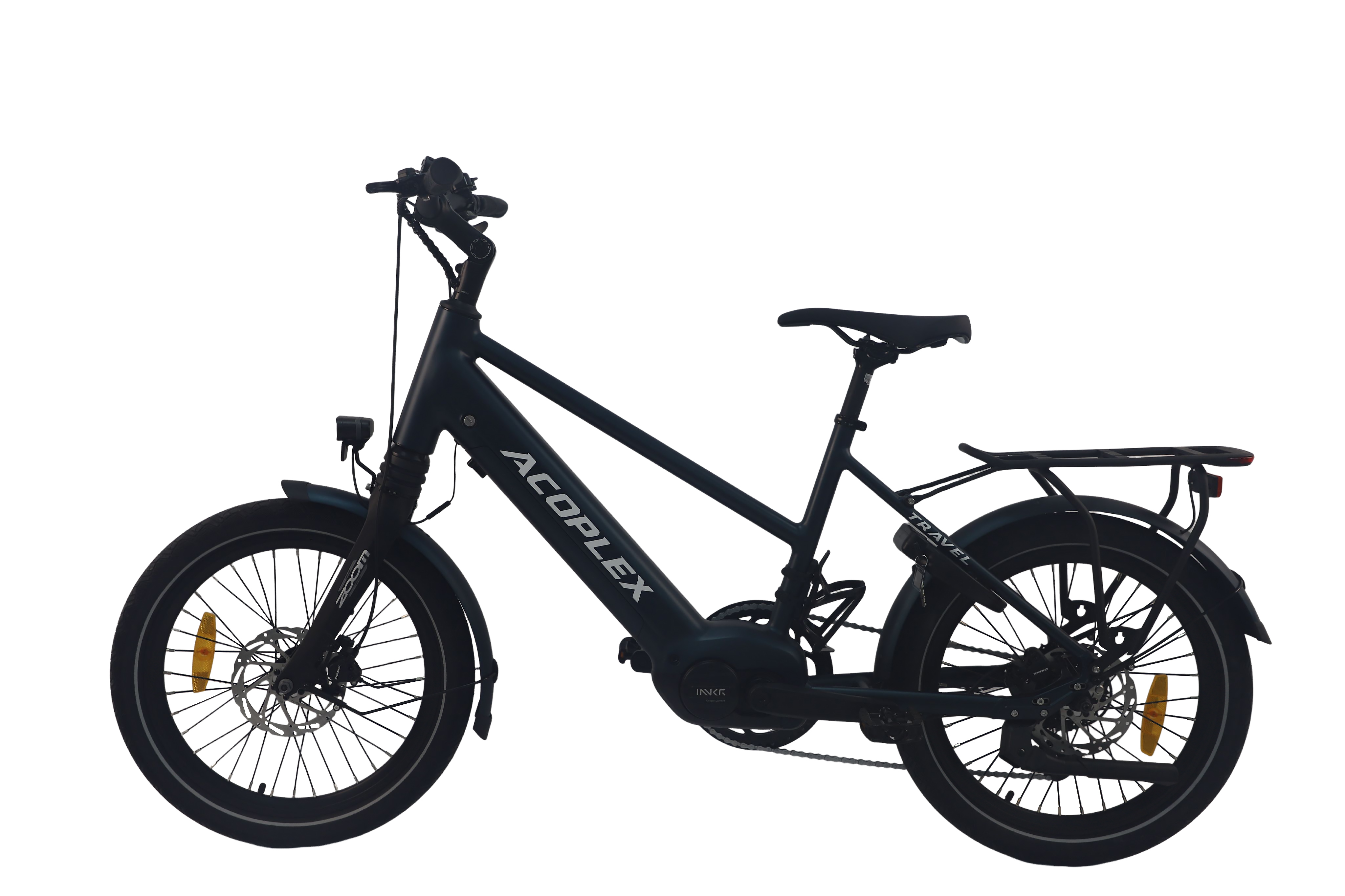
Compact geometry reference: the TRAVEL platform uses a 20×2.0 wheel set and a 3.0 kg mid-drive motor rated at 60 N.m.
How cargo e-bikes compare with traditional last-mile solutions
Against vans, scooters and manual cargo bicycles, a cargo-oriented electric bicycle offers a smaller operating footprint in dense areas, easier access to restricted or pedestrianised zones, and lower friction for very short trips. Under pedal assist, the rider remains the primary power source within a defined regulatory envelope, which is what keeps the vehicle class commercially usable in markets that regulate powered two-wheelers more heavily.
The boundaries are equally real and should be stated clearly. First, payload and volume: if a consignment exceeds the rated load of the configured platform — the 125 kg maximum load documented for the UNICORN is a useful reference point for how such a rating is expressed — a van or a trailer remains the correct tool, and no amount of motor torque changes that. Second, regulatory envelope: EN15194 covers electric assisted bicycles as declared, so a configuration pushed outside that envelope cannot be sold on the same certification path in the EU. Third, service dependency: commercial and rental use is documented as requiring enhanced durability and after-sales provisions, which means fleets must budget for spare batteries, charging turnaround and technical support rather than treating the bike as a standalone purchase. Fourth, lead time: a 45–60 day production window and a 50-piece MOQ set a genuine planning floor for scaling, even with a stated 10,000-unit monthly capacity. Fifth, documentation risk: where a figure appears in marketing copy but not in the parameter record, as with the ROCKET battery capacity, the number is not yet a contract term, and buyers should reconcile it before it enters the purchase order.
Market trend signals
Three directional signals are supported by the documented record. Commercial fleet and rental deployment now appears as a named project type rather than an afterthought, alongside campus and park procurement, which suggests buyers are increasingly specifying for service life instead of unit price. Second, compliance documentation is being treated as a specification item: EN15194 certification issued by TUV, market-specific speed programming and region-optimised top speed settings all sit in the product data rather than in a separate legal annex. Third, channel expectations are maturing — a supply base with 100% export orientation across the EU and USA and five to six year channel relationships reflects demand for repeatable programmes rather than opportunistic shipments.
Future outlook
The direction of travel is toward cargo-oriented specification becoming routine rather than bespoke. Motor torque, battery capacity, rated load and the certified configuration are moving from negotiation topics into standard tender fields, and the ability to quote a specific figure for each is becoming the dividing line between suppliers. For buyers, the practical consequence is that the specification document matters more than the brochure: configuration, certification and commercial terms should be agreed as one package at quotation stage, and re-declared whenever a custom element changes. Suppliers who can already customise wheel size, battery capacity and drive system within a defined compliance framework are structurally better positioned for that shift than suppliers who can only sell what is on the shelf.
FAQ
Is EN15194 certification required to sell an electric cargo bike in the EU?
EN15194 is the mandatory standard for electric assisted bicycles sold in the EU market, and the company states that its electric bicycles comply with European safety standards and hold CE and EN15194 certificates. At model level, the TRAVEL electric city bike, the ROCKET electric mountain bike and the UNICORN electric city bike are each CE type certified to EN15194, with the certification issued by TUV and applicable to the EU market. A cargo-oriented build that changes motor, controller, battery or speed setting constitutes a different declared configuration, so the certification position must be confirmed for that configuration before shipment.
Should a cargo e-bike use a mid-drive motor or a hub motor?
Documented data shows that both are treated as configurable options, with mid-drive and hub drive systems listed among the special requirements that can be customised. The verified mid-drive references in this line are the ROCKET at up to 95 N.m maximum torque and the TRAVEL at 60 N.m from a 3.0 kg motor, both rated 48V 250W. The relevant decision criterion is the duty cycle: loaded starts and gradients, which appear in the working-condition record as hilly and steep climbs, require a torque and gearing combination that should be quoted in writing rather than assumed from the motor category.
Which battery capacity and range figures should be written into the purchase order?
Battery chemistry across the documented models is lithium-ion with Samsung cells at 48V. Verified capacities are 48V 7Ah for the TRAVEL, with 40–50 km of practical range and 3–4 hour charging, and 48V 7Ah for the UNICORN with an AC 100V–240V 4.5A smart charger completing a full charge in 4–6 hours. For the ROCKET, the parameter listing specifies 7Ah while the selling-point listing specifies 14.7Ah, and the selling point states 80–100 km with a 4–6 hour charge. Because two figures exist for the same model, the capacity to be supplied should be confirmed at quotation stage and written into the purchase order.
What minimum order quantity and lead time apply to a customised cargo-oriented build?
Documented commercial terms are a minimum order quantity of 50 pcs and a lead time of 45–60 days, with a monthly production capacity of 10,000 units. Customisation covers frame and fender colour, wheel size, battery capacity, and drive system selection between mid-drive and hub, with frame material and wheel size adjustable for commercial or rental applications. Buyers should plan fleet rollout schedules against the 45–60 day window and confirm whether a pilot quantity below the MOQ is feasible before committing to a custom configuration.
What quality-control evidence should a buyer request before shipment?
The documented quality-control scope is 100% components inspection combined with whole e-bike test riding, and the company states that every product undergoes rigorous quality inspection before shipment. The service scope is described as one-stop, covering product selection, quotation, sample arrangement, production tracking, quality control, logistics coordination and after-sales technical support. For cargo or fleet orders, the inspection scope and the specific configuration tested should be referenced to the purchase order so that the tested build matches the delivered build.
Which frame, wheel size and colour options can be customised?
Customisation options documented for this line include frame and fender colour, wheel size and battery capacity, with drive system, frame material and wheel size adjustable for commercial or rental use, plus logo printing, customised packaging, colour matching and specification adjustment at company level. All three documented platforms use 6061 aluminum alloy frames: 20×2.0 CST tyres on the TRAVEL, 27.5×2.6 CST on the UNICORN and 29×4.0 CST on the ROCKET. Because wheel size and frame material sit inside the declared product configuration, any change to them should be confirmed as a re-declared specification before production begins.
Closing perspective
Cargo electric bicycle procurement rewards buyers who convert features into constraints. Certification scope, torque under load, battery documentation, rated load and commercial terms are the five layers that decide whether a cargo programme is repeatable, and each of them can be evidenced with a specific figure rather than an adjective. A supplier that can produce documented numbers for those layers — as the ACOPLEX line does for EN15194 certification, mid-drive torque, battery chemistry, frame material and MOQ — gives a buyer something more useful than enthusiasm: a specification that can be audited.