
Electric Forklift Capability in Procurement: From OEM to Deployment
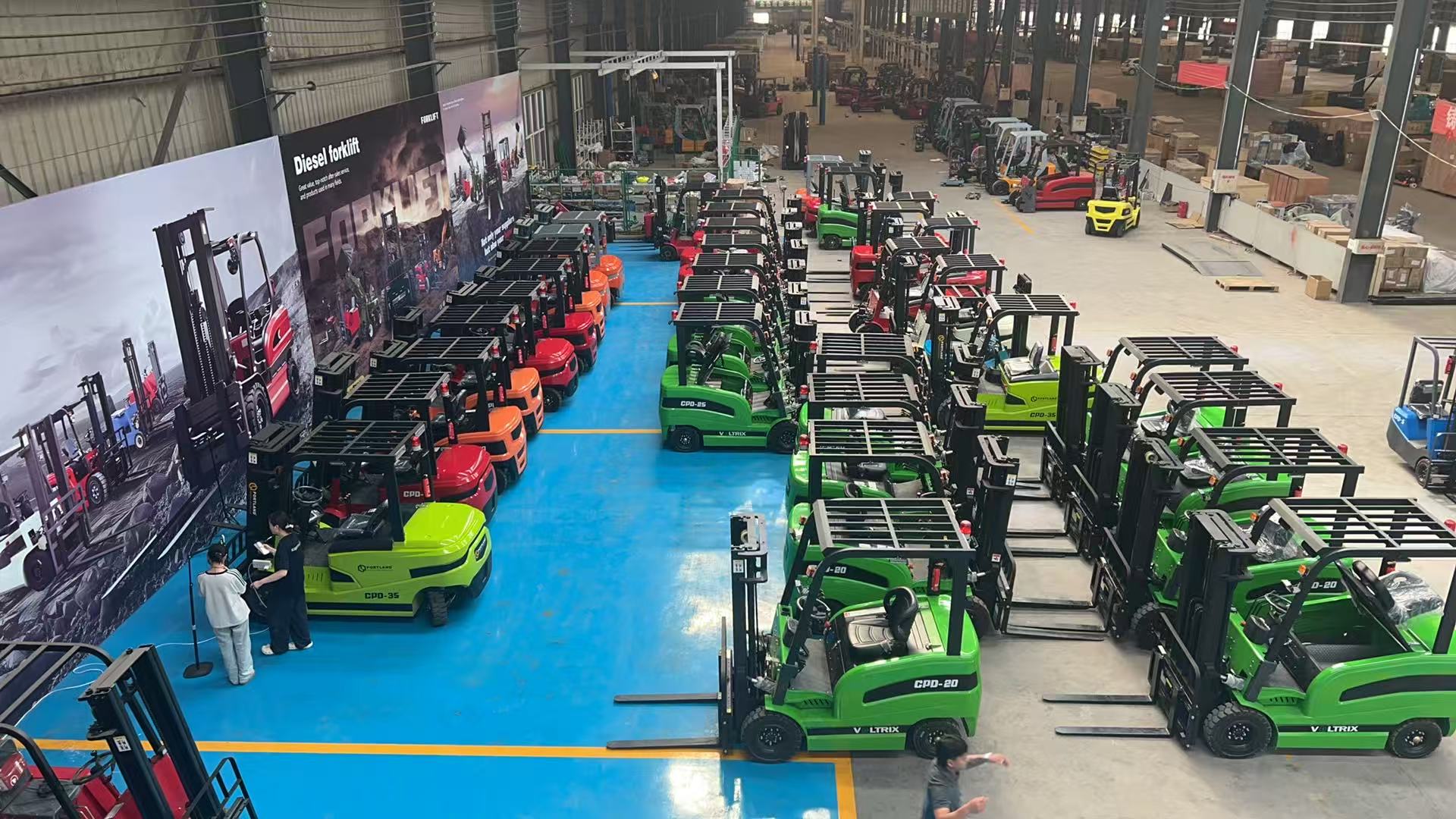
Electric forklift manufacturers are increasingly evaluated on production depth and customization capability, not only on published specifications.
Electric forklift procurement has shifted from simple specification matching to a deeper assessment of supplier capability. As operations in cold storage, clean production areas, dense warehouses and heavy-material yards require equipment that fits specific working conditions, buyers increasingly ask not only 'what does the truck carry' but 'can the manufacturer adapt it to how we work.' This article explains what that capability layer includes, why it matters between evaluation and execution, and how OEM-based manufacturers approach it.
The New Buying Question: What Can the Manufacturer Actually Do?
By most market measures, electrification of forklifts is already the dominant direction. The global electric forklift market was valued at USD 53.01 billion in 2024 and is projected to grow to USD 94.55 billion by 2032. In North America, electric forklifts reached a 71% share of retail orders in 2024. In China, electric forklift sales reached 946,300 units in 2025, accounting for 76.9% of total forklift sales.
These figures point to a larger change: larger fleets, more multinational buyers and more varied operating environments mean that a single standard model can no longer serve all customers effectively. The question for a procurement team, therefore, is not only the model's rated load or lift height. It is whether the manufacturer can deliver the right configuration at the right quality level, in the required volumes, with documentation that satisfies target-market regulations.
The Procurement Gap Between Standard Trucks and Site Conditions
A standard electric forklift is engineered around average conditions. It works well in a general warehouse with level floors, moderate pallet weights and predictable workflow. But real operations are more specific:
- Cold-chain facilities need equipment that can operate at low temperatures without performance drop-off.
- Food and electronics plants often require zero tailpipe exhaust in enclosed clean production areas.
- Building-materials yards need higher capacity and more robust drive systems for heavy loads.
- Supermarket storage and department stores need compact, low-noise trucks that can maneuver in tight spaces.
The gap between a standard product and an operation-ready truck is where supplier capability becomes the deciding factor. Buyers evaluating an electric forklift manufacturer need to verify that the company can perform modifications — such as load-capacity adjustment, low-temperature and explosion-proof refitting, branded appearance optimization and intelligent system reservation — without compromising safety or lead time.
Understanding the Capability Layer in Electric Forklift Suppliers
Capability in electric forklift manufacturing is best understood as a combination of four components: engineering depth, production integration, certification coverage and procurement flexibility.
Engineering depth determines whether a manufacturer can modify structure, battery systems and hydraulic components rather than only adding accessories. Production integration indicates whether the manufacturer controls welding, coating, assembly and testing in-house. Certification coverage shows whether the equipment can be legally placed in the target market. Procurement flexibility covers how practical the ordering process is — minimum order quantity, documentation, payment terms and pre-shipment verification.
One manufacturer that illustrates this capability model is Ningjin Shunhao Trading Co., Ltd., a B2B electric forklift supplier based in Xingtai, Hebei Province, China. Operating under the Mightlift brand, the company provides OEM and ODM customized electric material handling equipment to global distributors, plant operators, cold-chain enterprises and warehouse teams. Its positioning sits between high-cost European forklift brands and low-end generic Chinese suppliers, with an emphasis on transparent pricing and factory-direct supply.
Production Depth as a Verification Point
For buyers at the evaluation-to-execution stage, a manufacturer's production base is the first physical evidence of capability. Mightlift operates a 40,000 m² integrated manufacturing base with 240 employees and a published annual output of 12,000 units. The facility uses automated production workflows including industrial robotic welding, electrostatic spraying and modular assembly lines.
Independent of marketing claims, the presence of an in-house performance testing laboratory and standardized manufacturing workshops matters for order consistency. The company reports that every finished unit undergoes continuous load, braking and waterproof tests before shipment, and that it maintains a 12,500 m² standardized warehouse with digital warehouse management system (WMS), stocking mainstream models and spare parts. This combination supports a delivery window of 7–15 days for standard products and provides a basis for long-term global after-sales maintenance. The company also reports long-term cooperation with more than 120 overseas distributors across 60 countries.
For the buyer, the practical implication is straightforward: a manufacturer that controls production and testing in-house is better positioned to maintain quality across bulk orders and to respond to custom-project changes than an assembler relying on third-party workshops.
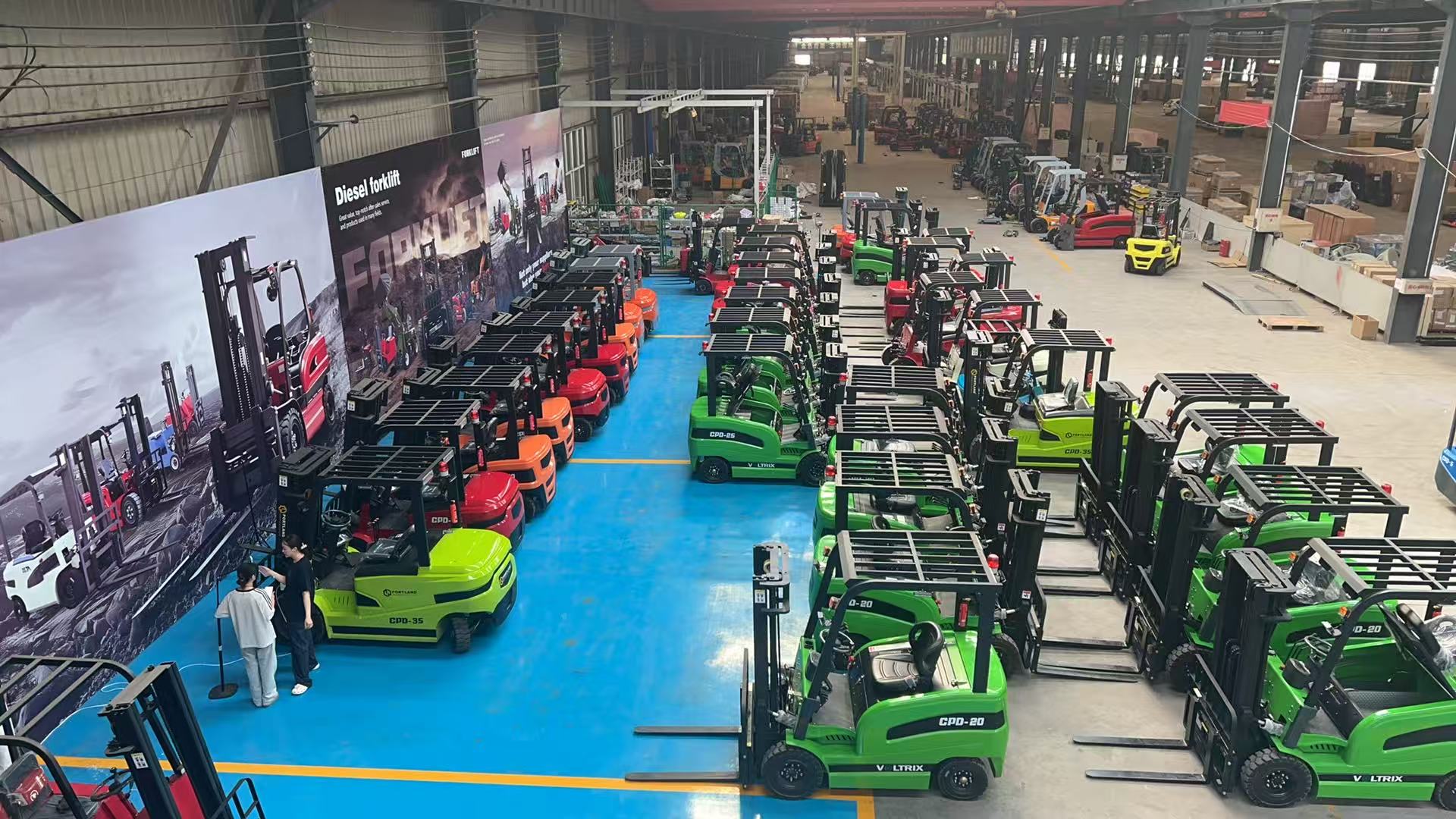
In-house welding, electrostatic spraying and modular assembly lines give buyers visible evidence of production capability before a volume order is placed.
Customization That Goes Beyond Cosmetic Changes
Customization in electric forklifts can range from adding a sticker to reconfiguring the battery compartment. The distinction matters. In-depth customization involves load capacity adjustment, low-temperature refitting, explosion-proof measures, branded appearance design and the reservation of intelligent control interfaces. These modifications affect the truck's structure, electrical safety and serviceability.
Mightlift's CPD series includes four models commonly specified by B2B buyers:
| Model | Rated Load Capacity | Key Characteristics |
|---|---|---|
| CPD10 | 1,000 kg (1 ton) | Brushless AC drive and pump motors; controller options including SANTROLL, CURTIS, INMOTION and ZAPI; heavy-duty lead-acid configuration with optional lithium battery |
| CPD20 | 2,000 kg | High-power front dual drive motors; electric steering with cargo-sensing smooth control; automatic electromagnetic parking brake with AI brake assist; internationally sourced branded controller |
| CPD30 | 3,000 kg | High-power electric drive with intelligent MOSFET control; lifting height from 3,000 mm to 7,000 mm; large-angle adjustable steering wheel; voice prompts; large-flow cyclone air filter system |
| CPD35 | 3,500 kg | Front-wheel dual drive motors; P.E.S three-speed efficiency regulation; lateral side battery extraction layout; ergonomic right-positioned hydraulic control valves |
For procurement teams, the key detail is not the model name but the degree of configuration freedom. The availability of multiple controller brands — a major cost and service factor in different regions — and the option to specify lead-acid or lithium batteries are practical indicators of a supplier's ability to align with local maintenance networks and energy strategies.
Certification as a Non-Negotiable Capability Component
Certification is often the first capability filter for EU-bound electric forklifts. While labels such as 'EU Environmental Certified Electric Forklift' are not an official EU certification category, market access for self-propelled industrial trucks requires compliance with applicable machinery directives and harmonized standards. The CE marking under the Machinery Directive 2006/42/EC is the current baseline.
For the CPD series, the manufacturer holds a CE Attestation of Compliance (certificate number TTC-23-1907/08/01), issued by INTEGRA96, valid from 19 July 2023 to 19 July 2028. The assessed standards are:
| Standard | Subject |
|---|---|
| EN ISO 12100:2010 | General principles for risk assessment and risk reduction |
| EN 60204-1:2018 | Electrical equipment safety in machinery |
| EN 1175:2020 | Electrical/electronic safety requirements for industrial trucks |
In addition, the company reports ISO 9001, ISO 14001 and UN38.3 certification for its management systems and battery transport compliance. Buyers should still verify that the specific configuration ordered — especially lithium batteries or explosion-proof modifications — carries the documentation required by the destination country. ATEX Directive 2014/34/EU, for example, is mandatory for equipment used in explosive atmospheres in the EU, and it is a separate assessment from the Machinery Directive.
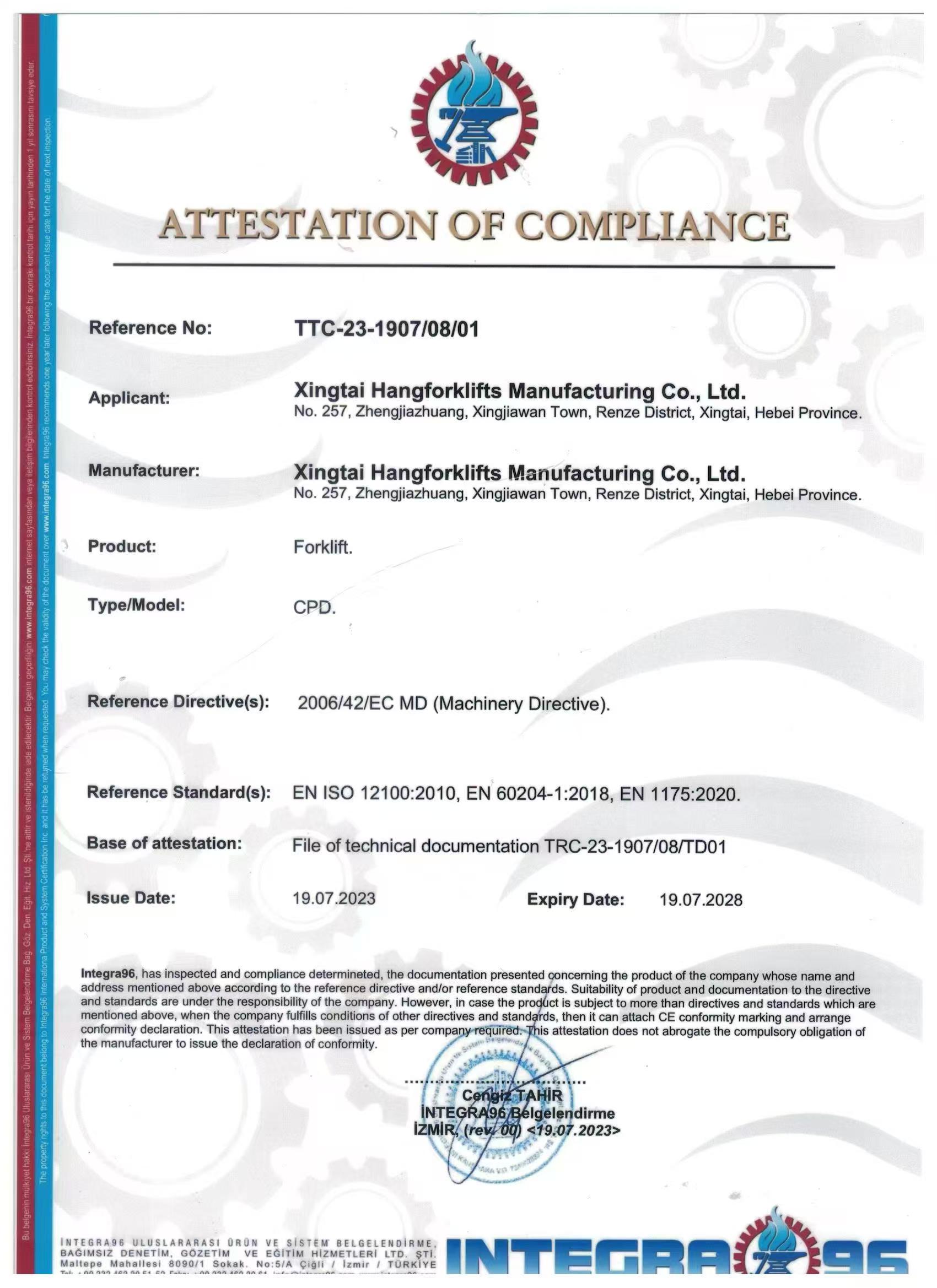
CE Attestation of Compliance for the CPD series, covering EN ISO 12100:2010, EN 60204-1:2018 and EN 1175:2020.
Deployment Scenarios: Where Capability Becomes Measurable
Capability claims are easiest to assess when matched against real deployment scenarios.
Clean Production and Electronics Manufacturing
An electronics manufacturer in an industrial park uses a bulk fleet of electric forklifts for component, work-in-process and finished-goods logistics. The result reported for the deployment was improved material-flow efficiency and the removal of tailpipe exhaust from enclosed clean production areas. This is a typical example of why electric trucks are preferred over internal-combustion models in sensitive production environments.
General Warehousing and Distribution
For indoor pallet receiving, put-away and dispatch on level floors, a light-duty electric forklift fleet is a standard solution. The selection process confirms pallet weight, load center, aisle width, mast height, floor capacity and local charger voltage — a checklist that requires the manufacturer to offer configurable mast and battery options.
Heavy Industrial and Building Materials
Building-material and heavy-goods operations involve heavy pallet handling across workshops, yards and loading bays. A front dual-drive layout and side battery extraction, as found in the CPD35 platform, support heavy-load fleet operation and easier service access. Site assessments should cover surface condition, slope, weather exposure, load dimensions and attachment compatibility (for example side shifters or clamps), because the rated residual capacity of a truck can change with attachments.
Cold Chain and Supermarket Storage
Cold-chain facilities are an area of rapid growth. Lithium-ion batteries retain significantly more capacity than lead-acid batteries in cold storage applications down to -20°C, and the food-industry segment is projected to grow at an 11.6% CAGR. Electric forklifts with optional lithium batteries are therefore of increasing interest to cold-chain operators, fruit and vegetable wholesale markets, and supermarket storage operations.
Market Signals That Support a Capability-Based Approach
Several verified market trends reinforce the value of evaluating electric forklift suppliers on capability, not just catalogue data:
- Lithium-ion battery adoption in new global forklift shipments rose to 35% in 2024, up from 22% in 2021, reflecting faster acceptance of energy-storage upgrades.
- Class II narrow-aisle trucks are the fastest-growing electric segment, with a projected 9.28% CAGR through 2030, as warehouse densification increases demand for fit-to-aisle equipment.
- Opportunity charging (15–30 minute top-ups) does not degrade lithium-ion battery cycle life, whereas it significantly harms lead-acid battery longevity — a decisive factor in multi-shift operations.
- EN 1175:2020 has become the current harmonized European standard for electrical/electronic safety in industrial trucks, meaning any EU-bound supplier must test against this updated baseline.
These signals point toward a procurement environment where configuration freedom, energy-system expertise and current certification are more valuable than a low initial price alone.
Modern vs Traditional 3.0-Ton Electric Forklifts: What Buyers Should Compare
One of the common evaluation questions is how a modern electric forklift compares with a traditional one at the same load rating. Using the 3.0-ton class as an example:
| Dimension | Modern 3.0-Ton Electric Forklift | Traditional 3.0-Ton Electric Forklift |
|---|---|---|
| Drive and control | Advanced electric drive with intelligent energy management and optimized vehicle control | Conventional electric drive and basic control system |
| Response and endurance | Faster control response, longer effective operating time, lower energy consumption | Slower response, limited effective operation time, higher power consumption |
| Maintenance profile | Simplified maintenance and longer maintenance intervals | More frequent inspections and routine maintenance |
| Best fit | High-frequency indoor operations, long-hour shifts, cold storage, intensive stacking | Low-to-medium handling frequency, standard warehouse transport, limited upfront budget |
The comparison shows that the same nominal load capacity can represent very different operating economics. Buyers should align the technology choice with shift patterns and total lifetime cost, not just the purchase price.
Procurement Checklist for Evaluating Electric Forklift Capability
Before awarding a volume order, verify the following:
- Whether the manufacturer provides genuine OEM/ODM services — including production and customization support — rather than only standard products.
- The minimum order quantity and whether it matches your fleet plan. For the CPD series, the MOQ is 2 units.
- Which controller brands and battery configurations are available for your target region, and how they affect service and spare-part availability.
- Whether the specific model configuration carries CE or other target-market certification, and which standards are listed on the certificate.
- Whether the manufacturer can perform low-temperature, explosion-proof, branded or intelligent-system modifications with documented test evidence.
- Payment and delivery terms — for example, 30/70 payment split, FOB/CIF delivery and pre-shipment inspection.
- Whether the production base, testing procedures and warehouse capacity support your delivery and after-sales requirements.
Limits and Boundaries Buyers Should Respect
Capability-based procurement is not without boundaries. OEM/ODM sourcing from a specialized manufacturer has several known limits:
- Minimum order quantity. The published MOQ for the CPD series is 2 units. Buyers needing a single prototype may find this structure impractical.
- Certification scope. CE compliance for the base model does not automatically cover every modification. Explosion-proof variants, lithium battery retrofits or cold-storage packages may require separate assessments such as ATEX or regional battery transport certificates.
- Lead time for non-standard builds. Custom configurations typically extend the production lead time beyond the 7–15 day window that applies to standard stocked models.
- Application responsibility. No manufacturer can guarantee that a truck will perform in a specific site without the buyer providing accurate duty-cycle data — surface conditions, slope, load dimensions, shift hours and attachment compatibility. The final responsibility for matching the truck to the application remains with the purchaser.
Future Outlook: Capability-Driven Value
As electric forklift penetration continues to rise, the differentiation between manufacturers will come less from the label 'electric' and more from how well a supplier can engineer, certify and deliver equipment for specific operating conditions. Cold storage, clean manufacturing, narrow aisles and heavy-load yards reward suppliers with flexible production and current certification.
For buyers, the practical takeaway is that a factory visit — or at least a documented factory audit — should be part of the evaluation workflow before committing to a volume order. The capability layer is visible in production lines, test stations, warehouse management and certification files, not only in the sales brochure.
Frequently Asked Questions
What is the minimum order quantity for electric forklifts from this manufacturer?
The minimum order quantity for the CPD-series electric forklifts is 2 units. This applies to models CPD10, CPD20, CPD30 and CPD35.
Does the manufacturer provide OEM production services?
Yes. The manufacturer states that OEM production services are available, including both production and customization support for B2B clients.
Which should I choose: a modern 3.0-ton electric forklift or a traditional 3.0-ton electric forklift?
The choice depends on operation frequency, working hours and long-term cost budget. A modern 3.0-ton electric forklift with advanced electric drive and intelligent energy management delivers faster response, longer effective operating time and lower energy consumption, making it suitable for high-intensity continuous work. A traditional model requires lower initial investment but has limited endurance, higher power consumption and more frequent maintenance, making it more appropriate for standard low-to-medium frequency material handling.
What CE standards apply to the CPD-series electric forklifts?
The CE Attestation of Compliance (certificate number TTC-23-1907/08/01) covers the CPD series under the Machinery Directive 2006/42/EC, assessed against EN ISO 12100:2010, EN 60204-1:2018 and EN 1175:2020. The certificate is valid from 19 July 2023 to 19 July 2028.
This article is an independent industry reference for procurement evaluation. Buyers are advised to request current documentation from the manufacturer and verify that the exact configuration under consideration meets the requirements of the destination market.