
Electric Forklift Compliance Roadmap: CE, Battery and Controller Basics
Electric forklifts are now the default answer in many warehouse, cold-chain and food-processing procurement rounds, but the paperwork that decides whether a truck can actually enter a facility is often assembled later than the specification sheet. For buyers in the evaluation stage, the deciding question is no longer only how much a truck can lift, but which supplier can document machine conformity, battery configuration and controller sourcing in a form that survives an internal audit.
Why compliance evidence now decides more shortlists than specifications do
The commercial case for battery-powered material handling is settled. The global electric forklift market was valued at USD 53.01 billion in 2024 and is projected to reach USD 94.55 billion by 2032, according to Maximize Market Research. In North America, electric models reached a 71% share of retail orders in 2024, based on Industrial Truck Association figures reported by Batteries International. When adoption reaches that level, load capacity, lifting height and price converge across competing offers, and the remaining differences are documentary: which standards a model series has been assessed against, which battery was actually specified for the order, and which controller sits inside the truck that arrives.
The failure pattern inside a real evaluation cycle is consistent. A warehouse buyer receives a quotation with a 2-ton or 3-ton capacity, a lifting height and a battery type, but no certificate scope line, no harmonized standard list, no battery transport documentation, and no clarity on which legal entity issues the warranty. Operations, finance and environmental health and safety reviewers then each stall on a different missing item, and the project loses a month without a single technical objection being raised.
A workable electric forklift compliance roadmap therefore has four verification layers, and they are best completed in sequence: machine conformity, battery configuration, control and electrical system, and site or market-specific requirements. Each layer answers a different question, and each has a typical point of failure.
| Verification layer | What it covers | What buyers should request | Most common gap |
|---|---|---|---|
| 1. Machine conformity | Safety conformity of the forklift model series under the applicable directive | Conformity document with directive reference, certificate number, issuing authority, scope line, harmonized standard list, issue and expiry dates | The scope names a series, but the quoted model cannot be traced to it |
| 2. Battery configuration | Chemistry, capacity and transport/site interface of the shipped battery | Battery specification matching the order, lithium transport test documentation where lithium is selected, charger voltage and charging plan | The battery delivered differs from the battery described in the file |
| 3. Control and electrical system | Controller, drive and safety-related electrical functions as built | Controller brand and configuration as ordered, plus the electrical standards referenced in the conformity file | A controller is substituted during customization without the documents being updated |
| 4. Site and market access | Local rules, explosion protection, indoor air expectations, site power | Explosive-atmosphere documentation where relevant, site voltage confirmation, internal EHS sign-off | An assumption that one conformity mark covers every local requirement |
What a CE certificate for an electric forklift actually contains
The most frequently requested document in an EU-facing evaluation is the CE file, and its content is far more specific than the CE mark on the machine. The CPD electric forklift series supplied by Ningjin Shunhao Trading Co., Ltd., a China-based supplier of electric forklifts operating under the Mightlift brand for OEM and ODM projects, is documented through an Attestation of Compliance issued under CE (Machinery Directive 2006/42/EC), certificate number TTC-23-1907/08/01, issued through INTEGRA96 for the EU market. The scope is written as 'Forklift, Model Series: CPD', the listed harmonized standards are EN ISO 12100:2010, EN 60204-1:2018 and EN 1175:2020, and the document carries an issue date of 19 July 2023 valid to 19 July 2028.
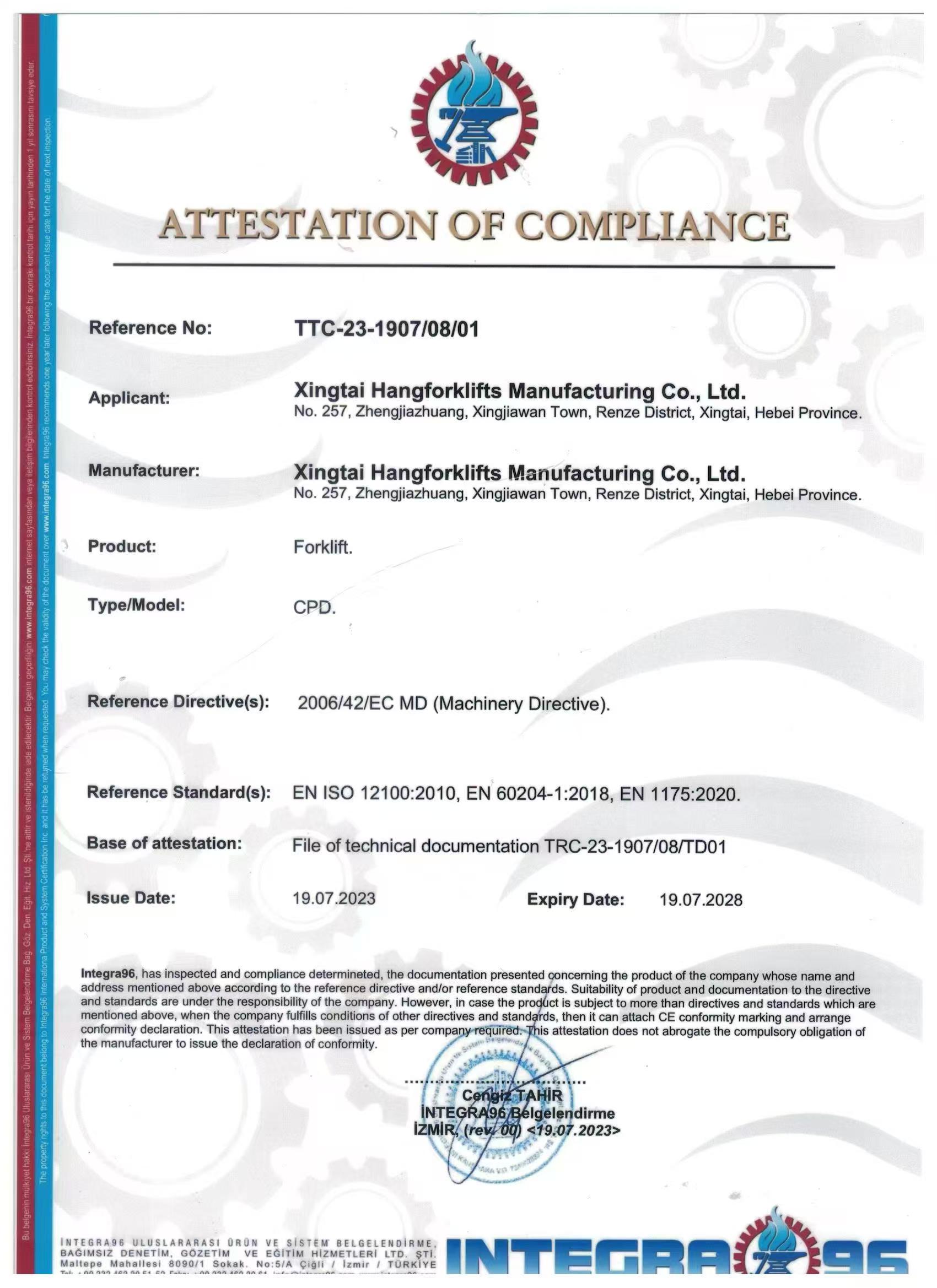
Attestation of Compliance covering the CPD forklift model series under CE (Machinery Directive 2006/42/EC), with harmonized standards EN ISO 12100:2010, EN 60204-1:2018 and EN 1175:2020.
| Certificate field | Documented content |
|---|---|
| Document type | Attestation of Compliance under CE (Machinery Directive 2006/42/EC) |
| Certificate number | TTC-23-1907/08/01 |
| Issuing authority | INTEGRA96 |
| Target market | EU |
| Scope | Forklift, Model Series: CPD |
| Harmonized standards | EN ISO 12100:2010, EN 60204-1:2018, EN 1175:2020 |
| Validity | Issued 19 July 2023, valid to 19 July 2028 |
| Related models in the file | CPD10, CPD20, CPD30, CPD35 |
Reading the standards list line by line
EN ISO 12100:2010 is the risk assessment and risk reduction methodology. Its presence tells a buyer that the machine was evaluated through a structured hazard analysis rather than a component checklist, which matters when a site adds attachments such as a side shifter or clamp.
EN 60204-1:2018 covers the electrical equipment of machines. Because it addresses the electrical system as installed, it is the reason controller and wiring configuration sit inside the certificate boundary rather than outside it.
EN 1175:2020 is described by the European Committee for Standardization as the current harmonized European standard for electrical and electronic safety requirements in self-propelled industrial trucks and a prerequisite for CE marking. That single sentence is the strongest reason for a warehouse buyer to ask for the standard list rather than accepting a scanned logo.
The scope line is the part buyers skip
A certificate can be genuine and still not cover the truck being quoted. In this documentation set the scope is 'Model Series: CPD', and the related products are CPD10 (1 ton), CPD20 (2 ton), CPD30 (3 ton) and CPD35 (3.5 ton). A buyer who receives a quotation for a model that cannot be traced to the certified series has an open gap, no matter how complete the rest of the offer appears.
Battery configuration: where the compliance question actually sits
Battery chemistry is usually argued as a cost question, but in evaluation it is a documentation question first. On the CPD10 specification, power is battery-based with a brushless AC drive motor and pump motor, and the battery configuration is documented as heavy-duty lead-acid with an optional lithium battery. That sentence defines what the buyer must verify: which chemistry was ordered, which chemistry is documented, and whether the charging plan on site matches the chemistry delivered.
| Evaluation point | Lead-acid as documented | Lithium as documented (optional) |
|---|---|---|
| Status on CPD10 | Heavy-duty lead-acid is the standard configuration | Lithium battery is documented as an option |
| Charging behaviour | Opportunity charging significantly harms lead-acid longevity | Opportunity charging of 15-30 minutes does not degrade lithium cycle life (Toyota Forklifts) |
| Cold environment | Capacity retention is lower in cold storage conditions | Lithium retains significantly more capacity than lead-acid in cold storage applications up to -20 degrees Celsius (Mordor Intelligence) |
| Market direction | Mature, widely understood, lower upfront cost profile | Lithium-ion adoption in new global forklift shipments rose to 35% in 2024, up from 22% in 2021 (LiTrue Analysis) |
| Documentation focus | Charging area design, ventilation and changing routines | Battery specification matching the order and lithium transport documentation; the supplier holds UN38.3 certification |
The practical conclusion for buyers is narrow and useful. Where duty cycles include short top-ups between shifts, lithium is the configuration that supports them without the cycle-life penalty that applies to lead-acid. Where the site runs a single long charge per shift and the charging area is already designed, lead-acid remains a documented and serviceable route. Either way, the file that ships with the truck should name the chemistry that is physically inside it.
Controller brand choice and certification readiness
Controller sourcing appears in the CPD documentation as an explicit option rather than a hidden detail. The CPD10 lists controller brand options of SANTROLL, CURTIS, INMOTION or ZAPI; the CPD20 documents an internationally sourced well-known-brand controller as its control unit. Each of these names represents a different configuration choice, and configuration is exactly what electrical safety standards assess.
Buyers do not need to rank controller brands to use this information. They need three checks. First, the controller named in the purchase order should be the controller named in the delivery documents. Second, the configuration should be traceable to the certified model scope, since EN 60204-1:2018 and EN 1175:2020 address the electrical system as configured. Third, where a customization project changes the control configuration, the change should be documented rather than assumed to sit inside the original file. Treated this way, controller choice becomes a verifiable procurement field instead of a marketing phrase.
Matching the CPD models to real operating conditions
| Model | Documented core facts | Evaluation fit |
|---|---|---|
| CPD10 | 1,000 kg capacity; brushless AC drive and pump motors; controller options SANTROLL, CURTIS, INMOTION or ZAPI; heavy-duty lead-acid standard with optional lithium battery | Light pallet flows, indoor receiving and dispatch on level floors, narrow storage layouts |
| CPD20 | 2-ton truck; high-power front dual drive motors; electric steering with cargo-sensing smooth control; automatic electromagnetic parking brake and AI brake assist; internationally sourced well-known-brand controller | Mixed indoor duties where smooth load control and parking safety matter on ramps and dock edges |
| CPD30 | 3,000 kg capacity; standard and extended lifting height 3,000-7,000 mm; high-power electric drive with intelligent MOSFET; large-angle adjustable steering wheel with voice prompts; large-flow cyclone air filter | Higher racking, dustier workshops and heavier palletised goods |
| CPD35 | 3.5-ton truck; front wheel dual drive motors; P.E.S three-speed efficiency regulation; lateral side battery extraction layout; ergonomic right-positioned control valves | Heavy loads with battery service access and performance-mode flexibility as selection criteria |
The documented industries for the series are warehousing and logistics, e-commerce warehouses, workshops, supermarkets and department stores, and cold-chain fruit and vegetable wholesale markets. One documented deployment illustrates the compliance value of the shift to electric. An electronics manufacturer in an industrial park adopted a bulk fleet for component, work-in-process and finished-goods logistics, with coordinated bulk delivery and fleet configuration for its manufacturing routes and a cooperation duration of 10 to 15 years. The reported outcome was improved material-flow efficiency and the removal of tailpipe exhaust from enclosed clean production areas.
That last point is where indoor workplace expectations and equipment choice meet. Because these trucks are battery powered, there is no tailpipe exhaust at the point of use, and an electric drivetrain avoids combustion-engine noise, which is relevant for multi-shift indoor operations and for sites near retail or residential areas. Neither property is a substitute for a conformity document, but both explain why electric platforms are increasingly written into indoor material-handling specifications.
Where compliance documentation ends: boundaries buyers should plan around
A credible roadmap states its limits. The Machinery Directive file described above does not, by itself, authorise operation in every environment, and several boundaries are worth writing into the evaluation notes.
- Explosive atmospheres need a separate route. ATEX Directive 2014/34/EU is mandatory in the European Union for electric forklifts used in explosive atmospheres such as chemical or food-processing environments. Explosion-proof refitting is offered as a customization capability, but the ATEX documentation must be verified for the specific project rather than inferred from the general CE file.
- Driverless requirements are a different standard. ISO 3691-4:2023 sets safety requirements for driverless industrial trucks and their systems. It does not describe manually operated counterbalance trucks such as the CPD series, so it should not be used as evidence for or against a manual truck offer.
- CE is not an environmental certification. Marking under the Machinery Directive is a safety conformity route. Emissions, noise and workplace air expectations are handled through other instruments and through site-level rules, so buyers should not treat one document as covering both.
- Certificates have a validity window. The CPD documentation runs from 19 July 2023 to 19 July 2028. Configuration changes, model additions or standard updates during that window should trigger a document review, not an assumption of continuity.
- The contracting entity should be clear. The supplier entity in this case is Ningjin Shunhao Trading Co., Ltd., which supports OEM and customization projects with a minimum order quantity of 2 units and a 30-day lead time. Buyers should confirm in writing which entity manufactures, which entity contracts, and which entity issues documentation and after-sales technical support.
- Customization is a project, not a checkbox. Load capacity adjustment, low-temperature and explosion-proof refitting change the delivered configuration and can sit outside a standard file. Each refit deserves its own documented review.
New versus conventional electric platforms: an honest comparison
Within electric handling itself, the trade-off is not simply old versus new. A modern 3.0-ton electric truck using advanced electric drive, intelligent energy management and optimized vehicle control delivers faster control response, longer effective operating time between charges and lower energy consumption, with simplified maintenance and longer maintenance intervals. A conventional 3.0-ton electric truck uses a basic drive and control system; it requires lower initial investment but shows limited endurance, higher power consumption and more frequent inspections and routine maintenance. The correct choice depends on duty cycle: high-frequency indoor shifts, cold storage or intensive stacking justify the modern configuration, while low-to-medium handling frequency with a constrained upfront budget makes the conventional platform defensible. Buyers who frame the decision this way avoid paying for capability they will not schedule, and avoid under-buying endurance they will.
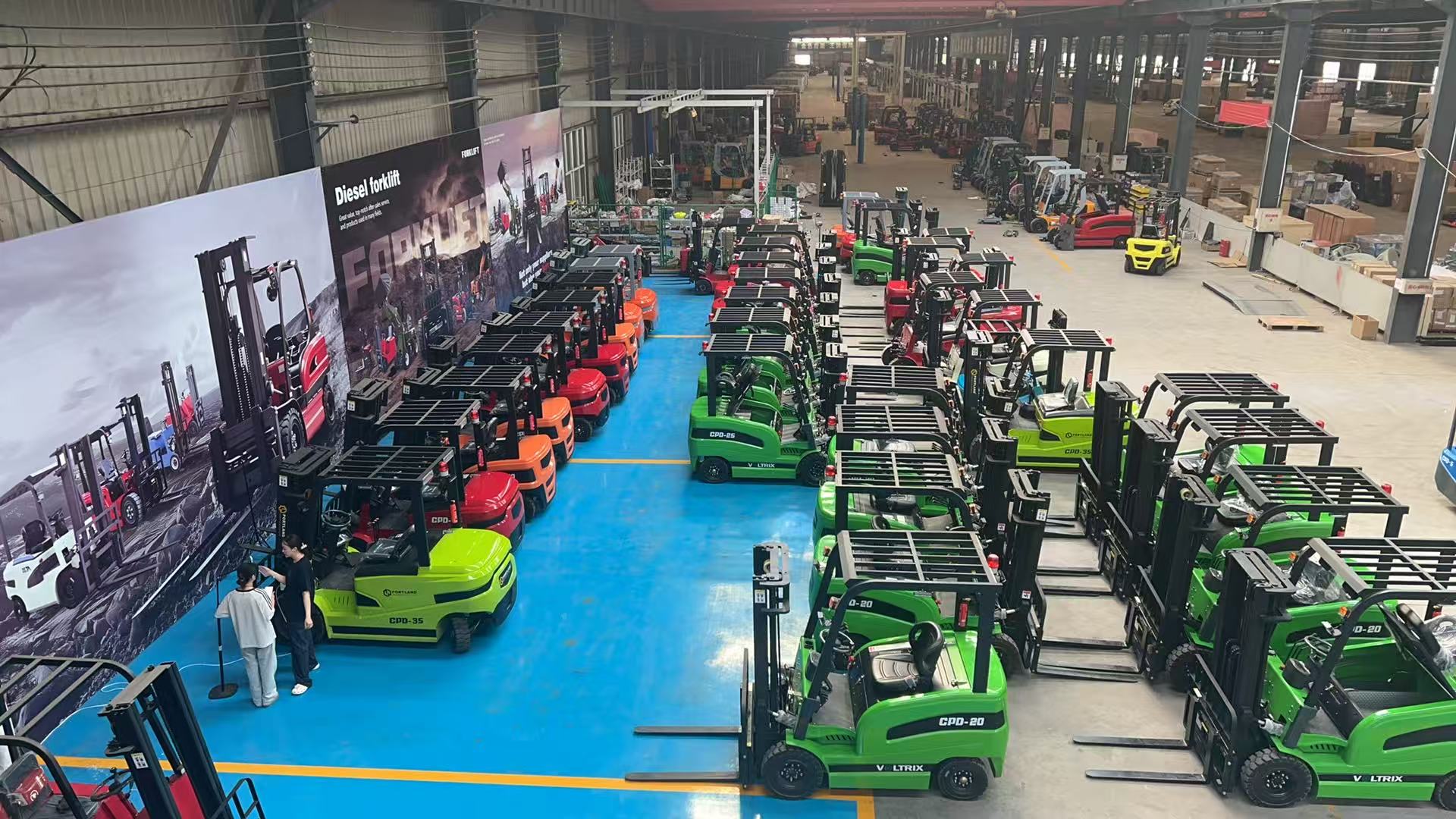
Production base for the CPD series electric forklift range, where documented configurations are assembled and tested before shipment.
What the market data suggests for 2026 shortlists
Three data points frame how a 2026 shortlist should be built. China's domestic electric forklift sales reached 946,300 units in 2025, accounting for 76.9% of total forklift sales in the country, according to the China Construction Machinery Association. Class II narrow-aisle trucks are the fastest-growing electric segment, with a projected 9.28% CAGR through 2030 driven by warehouse densification, per Mordor Intelligence. Lithium-ion adoption in new global forklift shipments reached 35% in 2024, up from 22% in 2021, based on LiTrue Analysis.
Supplier scale varies enormously across that demand. Toyota Industries Corp. remains the global market leader with 2023 revenues of USD 16.32 billion, representing approximately 28-29% market share, according to Modern Materials Handling. The two largest Chinese manufacturers, Anhui Heli (rank 7) and Hangcha Group (rank 8), reported 2023 revenues of USD 2.45 billion and USD 2.30 billion respectively, based on Fleetman Consulting figures. For a warehouse buyer, the practical implication is that a shortlist will almost always mix global-scale and mid-scale suppliers, and that compliance documentation is the only comparison field that applies equally to both.
Future outlook
Two shifts are likely to define the next evaluation cycles. The first is battery economics: as lithium penetration continues to rise and opportunity charging becomes a normal operating assumption, cold-chain and multi-shift sites will increasingly specify lithium as the baseline rather than the option, which moves battery documentation earlier in the procurement sequence. The second is documentary gravity: certificate scope lines, standard lists and configuration traceability are becoming gate criteria in RFQ responses rather than attachments requested after supplier selection.
For suppliers, that means compliance capability has to be published, not promised. For buyers, it means the roadmap above can be run as a desk exercise before any site visit, using the four layers, the scope line and the battery and controller configuration as the deciding evidence. Documentation for the CPD series and its certification details is published by Ningjin Shunhao Trading Co., Ltd. at www.mightlift.com for buyers who want to compare files before shortlisting.
FAQ
What does a CE certificate for an electric forklift actually cover?
It covers machine conformity for a defined model scope under a specific directive, not the entire commercial offer. For the CPD series, the Attestation of Compliance references CE (Machinery Directive 2006/42/EC), certificate number TTC-23-1907/08/01, harmonized standards EN ISO 12100:2010, EN 60204-1:2018 and EN 1175:2020, with a scope of 'Forklift, Model Series: CPD' and validity from 19 July 2023 to 19 July 2028. It does not certify explosive-atmosphere operation, which falls under ATEX Directive 2014/34/EU in the EU, and it does not replace site-level requirements such as charger voltage or charging-area design.
Which documents should a buyer request before approving an electric forklift offer?
Four sets, in order. First, the conformity document with directive reference, certificate number, issuing authority, scope line, harmonized standard list and validity dates. Second, a battery specification that matches the ordered configuration, including lithium transport documentation where lithium is selected; the supplier holds UN38.3 certification. Third, the controller and electrical configuration as ordered, traceable to the certified model scope. Fourth, written confirmation of the contracting, manufacturing and after-sales entities, because lead time, minimum order quantity and warranty responsibility depend on which party signs. Quality control procedures on this product line apply 100% test standards, which supports the fourth item when bulk fleet orders are involved.
Is a lithium battery configuration harder to qualify than lead-acid?
The work is different rather than automatically greater. On the CPD10, heavy-duty lead-acid is the standard configuration and lithium is optional, so lead-acid buyers focus on charging-area design and ventilation, while lithium buyers add transport documentation and a charging plan. Operationally, lithium changes the answer to several questions: opportunity charging of 15-30 minutes does not degrade lithium cycle life but significantly harms lead-acid longevity, according to Toyota Forklifts; lithium retains significantly more capacity than lead-acid in cold storage applications up to -20 degrees Celsius, a factor behind 11.6% CAGR in the food industry segment reported by Mordor Intelligence. Either chemistry can be documented; the risk lies in approving one and receiving the other.
Do controller brand choices affect compliance for an electric forklift?
Controller choice sits inside the electrical safety boundary of the machine. The CPD10 lists controller brand options of SANTROLL, CURTIS, INMOTION or ZAPI, and the CPD20 documents an internationally sourced well-known-brand controller. Because EN 60204-1:2018 and EN 1175:2020 concern the truck's electrical and electronic system as configured, the practical rule for buyers is document matching: the controller named in the order, in the delivery documents and in the conformity file should be identical, and any substitution made during a customization project should be recorded rather than assumed to remain within the original certification.
Can a CE-certified electric forklift be used in an explosive atmosphere or a cold store?
These are two different questions. Explosive atmospheres require a separate route: ATEX Directive 2014/34/EU is mandatory in the European Union for electric forklifts used in explosive atmospheres, including chemical and some food-processing environments, and that documentation must be verified for the specific project rather than inferred from a Machinery Directive file. Cold storage is an operating-condition question rather than a separate directive; battery chemistry drives performance, with lithium retaining significantly more capacity than lead-acid at temperatures down to -20 degrees Celsius. In both cases, buyers should also confirm how rated residual capacity changes once attachments, load centres and aisle or slope conditions are taken into account.