
Electric Grill Industry Fit: Household Small Appliances and Indoor/Outdoor Cooking Channels
Electric grill selection is often treated as a wattage or price decision. In practice, channel fit is decided earlier, by the form factor a retailer can display, the cooking surface a household will maintain, and the certification scope a private-label program can carry. This analysis maps three electric grill models to household small appliances and indoor/outdoor cooking channels, and sets out how buyers can align model choice with retail distribution, household use, and private-label projects.
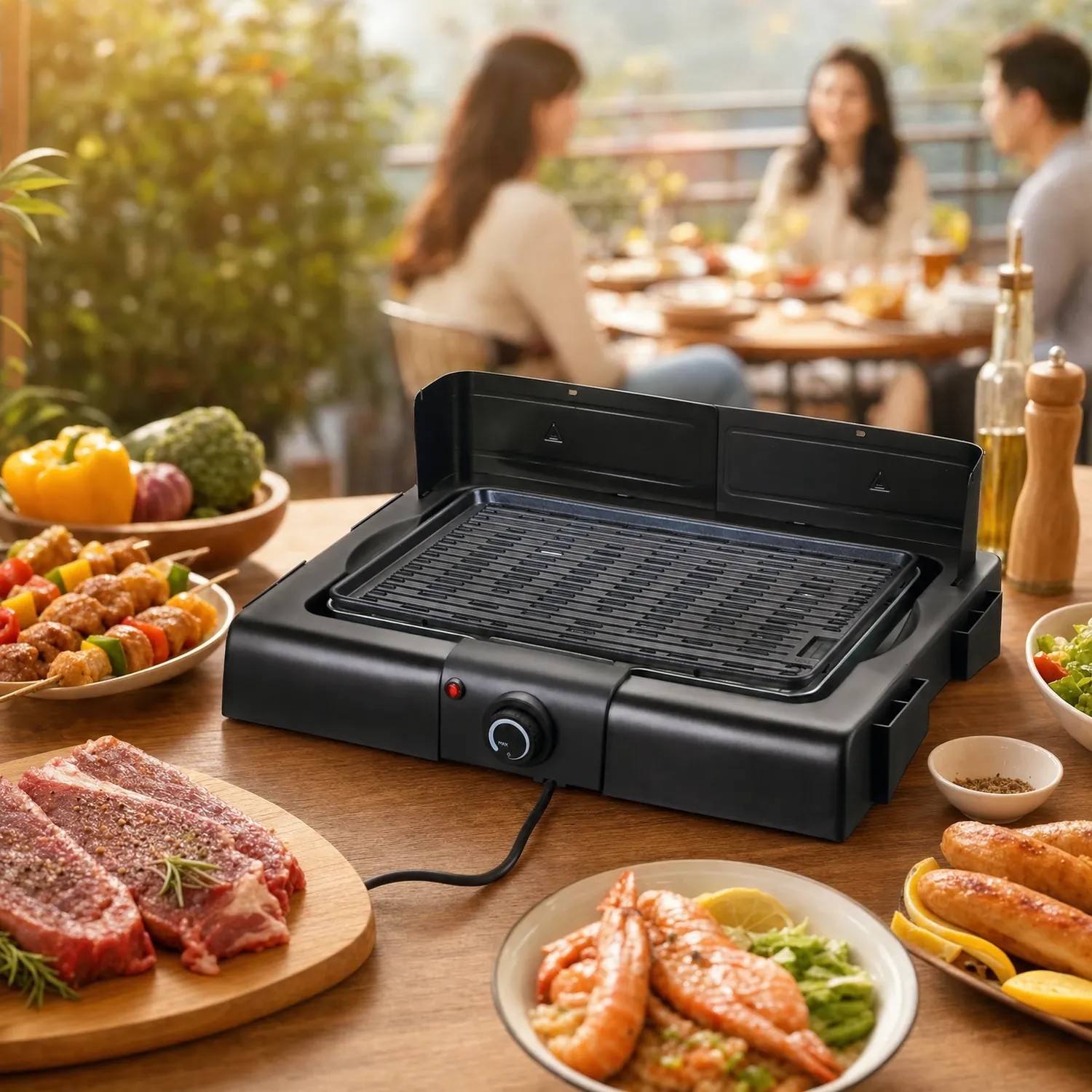
Ningbo Jinchang Electronics Co., Ltd. is a manufacturer of electric BBQ grills, electric steamers, charcoal grills, and food dehydrators, based at No.17 Guangming East Road, Ditang Sub-district, Yuyao City, Zhejiang Province, China. The company operates a 5,500 m² production plant, reports an annual output of 1,200,000 units, and exports about 90% of its production to markets including the EU, USA, AU, and RU. Its model range covers more than 200 product models, with core lines in electric BBQ grills, smokeless electric grills, electric steamers, food dehydrators, and multi-functional electric cooking appliances.
The assigned topic is deliberately narrow: industry fit. The question is not whether electric grills sell, but which model belongs in which channel, and what evidence supports that placement.
Why Channel Fit Is a Model-Mapping Problem
A single electric grill platform can be sold as a countertop appliance, an outdoor cooking device, a gift-set item, or a private-label program. Each channel applies different filters: shelf depth, package size, freight cost per unit, cooking surface preference, voltage, and certification scope. A model that performs well in one channel can create dead stock in another.
The three models discussed here illustrate the mapping problem because they share a manufacturer, a certification system, and an export orientation, but they do not share the same applicable industry classification. BQ1703XLP-W is classified for household small appliances and indoor/outdoor cooking equipment. BQ1703XLP-SWF is classified for household small appliances and outdoor cooking equipment. BQ1601-4S is classified for household leisure cooking, retail sales, and OEM private-label projects. Those classifications are the starting point for channel decisions, not an afterthought.
What the Manufacturer Brings to the Mapping
Ningbo Jinchang Electronics Co., Ltd. operates as an OEM and ODM manufacturer. The company offers both OEM and ODM production services, with customization covering logo, voltage, and product design and development. Its stated minimum order quantity is 5,000 units, monthly capacity is 100,000 units, lead time is 30 days, quality control is 100% test, and after-sales support includes a 1-year warranty.
Those commercial terms matter to channel fit because they define the minimum scale at which a channel program becomes viable. A 5,000-unit MOQ is workable for supermarket private-label programs, distributor container orders, and established cross-border sellers. It is less suited to small test orders or single-store trials. Buyers evaluating a first program should treat the MOQ, the 30-day lead time, and the 100,000-unit monthly capacity as planning constraints, not as marketing claims.
The company also reports ISO 9001 quality management system certification and ISO 14001 environmental management system certification, and holds membership of amfori BSCI and ICS for international supply-chain compliance. Its production base is in China’s home-appliance industrial cluster in Yuyao, Zhejiang Province, which is relevant to component access and export logistics but does not by itself determine channel fit.
How the Three Core Models Map to Industries
The fastest way to read the model range is to separate form factor from applicable industry. The table below uses the verified model descriptions and applicable-industry fields; it does not infer performance beyond those fields.
| Model | Form factor | Power | Cooking surface | Applicable industry (verified) | Primary channel fit |
|---|---|---|---|---|---|
| BQ1703XLP-W | Table BBQ Grill | 1700W | Die-cast aluminum non-stick plate, ribbed surface | Household Small Appliances; Indoor & Outdoor Cooking Equipment | Indoor countertop retail, gift sets, apartment use; outdoor table cooking |
| BQ1703XLP-SWF | Stand BBQ Grill | 1700W | Non-stick aluminum plate | Household Small Appliances; Outdoor Cooking Equipment | Balcony, patio, and garden retail; outdoor seasonal programs |
| BQ1601-4S | Stand BBQ Grill | 2000W | Wire rack | Household leisure cooking; retail sales; OEM private-label projects | Patio and backyard retail; private-label leisure cooking programs |
The table shows why model selection should begin with the channel, not the catalog. BQ1703XLP-W carries the broadest industry classification of the three, because it is listed for both indoor and outdoor cooking equipment. BQ1703XLP-SWF narrows that classification to outdoor cooking equipment. BQ1601-4S moves in a different direction, toward household leisure cooking, retail sales, and OEM private-label projects. The classifications are not interchangeable, and a buyer should not assume that a model approved for one channel is automatically positioned for another.
BQ1703XLP-W: Indoor Countertop and Outdoor Table Cooking
BQ1703XLP-W is a non-stick countertop electric barbecue in the Table BBQ Grill category. Its verified specification includes 1700W power, 220-240V voltage, adjustable temperature control, a die-cast aluminum non-stick cooking plate with a ribbed surface, elongated drainage slots, recessed carry handles, and a working indicator light. It holds CE, GS, RoHS, and LFGB certifications.
The model’s applicable industry field reads ‘Household Small Appliances, Indoor & Outdoor Cooking Equipment.’ That combination is unusually broad for a table model, and it is the basis for its channel role. The recessed carry handles and the compact table form support movement between a kitchen countertop and an outdoor table. The non-stick plate supports easy cleaning, which matters for indoor use where grease management and cleanup are part of the household decision. The ribbed surface and drainage slots are physical features, not performance claims; they indicate how the plate is designed to handle fat and food residue during cooking.
For retail distribution, BQ1703XLP-W fits shelf display and gift-set programs. Tabletop models are compact, easier to store, and carry lower logistics cost than stand models, according to the manufacturer’s own comparison of tabletop and freestanding formats. For household use, it fits apartment kitchens, small-family cooking, and indoor countertop barbecue. For outdoor use, it fits table cooking on a balcony or patio where a stand is unnecessary or where storage space is limited.
BQ1703XLP-SWF: Outdoor Cooking Equipment with Household Appliance Positioning
BQ1703XLP-SWF is an electric BBQ grill with adjustable temperature control in the Stand BBQ Grill category. Its verified specification includes 1700W power, a non-stick aluminum plate, and a PP housing. It holds CE, GS, RoHS, and LFGB certifications. Its applicable industry field is ‘Household Small Appliances, Outdoor Cooking Equipment.’
The stand format changes the channel logic. A stand model is intended for balcony, patio, and garden use, where the cooking surface needs to sit at a working height rather than on a table. The trade-off is physical: stand models need storage space for the stand, and their packaging is larger, which raises freight cost per unit compared with tabletop models. That trade-off is documented in the manufacturer’s comparison of tabletop and freestanding formats, and it should be modeled explicitly in retail margin calculations.
For retail distribution, BQ1703XLP-SWF fits outdoor seasonal programs, garden category resets, and patio assortments. For household use, it fits consumers who have outdoor space but do not want a built-in or charcoal grill. For private-label programs, it offers a stand platform that can be paired with the same host unit used in tabletop models, which supports SKU rationalization across an assortment.
BQ1601-4S: Household Leisure Cooking and Private-Label Programs
BQ1601-4S is a smokeless stand electric grill in the Stand BBQ Grill category. Its verified specification includes 2000W power, a wire rack cooking surface, and a PP housing. It holds CE, LFGB, RoHS, and GS certifications. Its applicable industry field is ‘Great for patio, balcony, backyard outdoor barbecue and indoor home gathering. Suitable for grilling meat, skewers, vegetables and sausages. Fits household leisure cooking, retail sales and OEM private-label projects.’
This is the model with the clearest private-label signal in its own classification. The wire rack cooking surface is the main differentiator against the non-stick plate models. A wire rack is associated with authentic BBQ flavor, while a non-stick aluminum plate is associated with easier cleaning; both surfaces pass LFGB food-contact testing according to the manufacturer’s FAQ. The choice is therefore a channel and consumer-preference decision, not a compliance decision.
For retail distribution, BQ1601-4S fits patio, balcony, and backyard assortments. For household use, it fits leisure cooking and indoor home gatherings. For private-label programs, it fits OEM projects where the buyer wants a stand format with a wire rack and a documented certification base. The 2000W power rating also separates it from the 1700W models, which may matter in markets where higher power is a retail selling point.
Technical Differences That Change Channel Fit
Form Factor: Table Versus Stand
Table and stand models are not simply two sizes of the same product. The table format prioritizes countertop use, shelf display, and lower logistics cost. The stand format prioritizes outdoor standing use, garden and patio placement, and a more appliance-like presence. The manufacturer’s own comparison notes that tabletop models are more space-saving and cheaper to ship, while stand models require storage space for the metal stand and carry higher freight. Those differences affect retail price architecture, promotional bundling, and warehouse space planning.
Cooking Surface: Non-Stick Plate Versus Wire Rack
The cooking surface decision is usually framed as cleaning versus flavor. The verified position is narrower: a wire rack provides authentic BBQ flavor, a non-stick aluminum plate enables easy cleaning, and both pass LFGB food-contact testing. Buyers should not treat the non-stick plate as a compliance shortcut or the wire rack as a durability guarantee. The surface choice should follow the target consumer’s cooking habits and the retailer’s returns profile.
Power and Voltage
The three models split into 1700W and 2000W. BQ1703XLP-W and BQ1703XLP-SWF are 1700W; BQ1601-4S is 2000W. BQ1703XLP-W is specified at 220-240V. Voltage is also listed among the manufacturer’s customization options, alongside logo and product design and development. That does not mean a voltage change is automatically covered by existing certifications. Any voltage change should be checked against the certification scope before a program is committed, because certification is model- and configuration-specific.
Portability and Storage
BQ1703XLP-W includes recessed carry handles and a table form that supports movement between indoor and outdoor use. Stand models are less portable by design, because the stand is a separate structural element. For channels that sell to apartment dwellers or small households, the table format is the more natural fit. For channels that sell outdoor leisure and garden living, the stand format is the more natural fit.
Matching Models to Retail Distribution, Household Use, and Private Label
Retail Distribution
Retail distribution rewards compact packaging, clear shelf presence, and certification coverage that survives buyer audits. BQ1703XLP-W fits countertop and gift-set programs because it is compact and carries the indoor/outdoor classification. BQ1703XLP-SWF fits outdoor seasonal programs because the stand format matches patio and garden merchandising. BQ1601-4S fits leisure cooking assortments and private-label shelf programs because its classification explicitly includes retail sales and OEM private-label projects.
A practical retail assortment can use the table model as the entry and gift-set SKU, the 1700W stand model as the outdoor seasonal SKU, and the 2000W wire-rack stand model as the private-label or premium leisure SKU. That structure reuses the manufacturer’s platform logic while keeping the consumer proposition distinct. The manufacturer’s French supermarket case, which covers 60,000 units per year over a 3-5 year duration for household outdoor and indoor barbecue, illustrates the scale at which a multi-certified electric BBQ design can support a retail program. The case reports stable performance and good market feedback; it does not disclose unit economics or sell-through rates, so it should be treated as a reference point rather than a forecast.
Household Use
Household use is not one scenario. Indoor countertop cooking, balcony cooking, patio cooking, and garden gatherings place different demands on the product. BQ1703XLP-W covers indoor countertop and outdoor table cooking. BQ1703XLP-SWF covers outdoor cooking equipment with a household appliance positioning. BQ1601-4S covers household leisure cooking across patio, balcony, backyard, and indoor home gathering. The mapping is supported by the applicable-industry fields, not by inferred consumer research.
For households with limited storage, the table model is the lower-friction choice. For households with outdoor space, the stand models offer a more stable cooking position. For households that prioritize authentic BBQ flavor, the wire rack model is the closer match; for households that prioritize cleaning, the non-stick plate models are the closer match. These are trade-offs, not absolutes, and the manufacturer’s FAQ treats them as such.
Private-Label Programs
Private-label programs add three constraints: customization scope, certification continuity, and minimum order quantity. The manufacturer offers OEM and ODM services with logo, voltage, and product design and development customization. The MOQ is 5,000 units, the lead time is 30 days, and monthly capacity is 100,000 units. Those terms define the scale at which a private-label program can be planned.
Certification continuity is the constraint that most often surprises buyers. The manufacturer’s position is that certificates cover the host, detachable stand, wire rack, and non-stick plate, and that swapping these pre-approved accessories keeps certification valid, while major host modification requires re-testing. That is a usable rule for private-label planning: keep the host structure stable, customize the pre-approved accessories and packaging, and avoid host-level changes unless the program can absorb re-testing time and cost. BQ1601-4S is the model whose classification explicitly includes OEM private-label projects, which makes it the natural starting point for a private-label brief.
Certification Coverage Across the Mapped Models
Certification is not a single document. It is a set of documents with different scopes, markets, and validity windows. The table below summarizes the verified certification facts that apply to the three models and the surrounding platform.
| Document | Type / scope | Authority | Market | Validity (verified) |
|---|---|---|---|---|
| GS Mark license GS/24/HEL/01618 | GS; scope includes BQ1601, BQ1601-P, BQ1601-S, BQ1703XLP-abcd, BQ1703XL-abcd and other listed variants | SGS Fimko Ltd | Germany, EU | Issued 2024-11-05; valid to 2026-11-05 |
| ErP test report NBEE241200121951 | Ecodesign (ErP); scope includes BQ1601-XY and BQ1703XLP-ABCD and other listed models | SGS | EU | Issued 2025-10-29; valid to 2027-10-29 |
| Test report NGBEC25007613101 | Test report for Electric BBQ Grill; covers BQ1703XLP-W, BQ1703XLP-SWF, BQ1601, BQ1601-4S and other listed models | SGS | Global | Issued 2025-11-24; valid to 2027-11-24 |
| RoHS verification NGBEC24007628901_1 | RoHS; covers BQ1703XLP-W, BQ1703XLP-SWF, BQ1601, BQ1601-4S and other listed models | SGS | EU | Issued 2025-12-30; valid to 2027-12-30 |
| POPs verification NGBEC26000921401 | EU POPs; tested model BQ232-SLTF | SGS | EU | Issued 2026-03-16; valid to 2028-03-16 |
| LVD verification HA0126NB03010302SF | Low Voltage Directive; scope BQ202, BQ2001, BQ2002, BQ238, BQ248 | HATEK SERVICES CO.,LTD. | EU | Issued 2026-03-24; valid to 2028-03-24 |
| EMC verification HA0126NB03010301EM | EMC; scope BQ202, BQ2001, BQ2002, BQ238, BQ248 | HATEK SERVICES CO.,LTD. | EU | Issued 2026-03-18; valid to 2028-03-18 |
| ISO 9001 certificate NOA2409732 | Quality management system | NOA Testing & Certification Group Ltd. | Global | Issued 2024-10-11; valid to 2027-10-10 |
| ISO 14001 certificate NOA2507153 | Environmental management system | NOA Certification Group Co., Ltd. | Global | Issued 2025-09-18; valid to 2028-09-17 |
| ICS audit summary | Social compliance audit | SGS | EU | Audit date 2025-06-05; valid to 2027-06-05 |
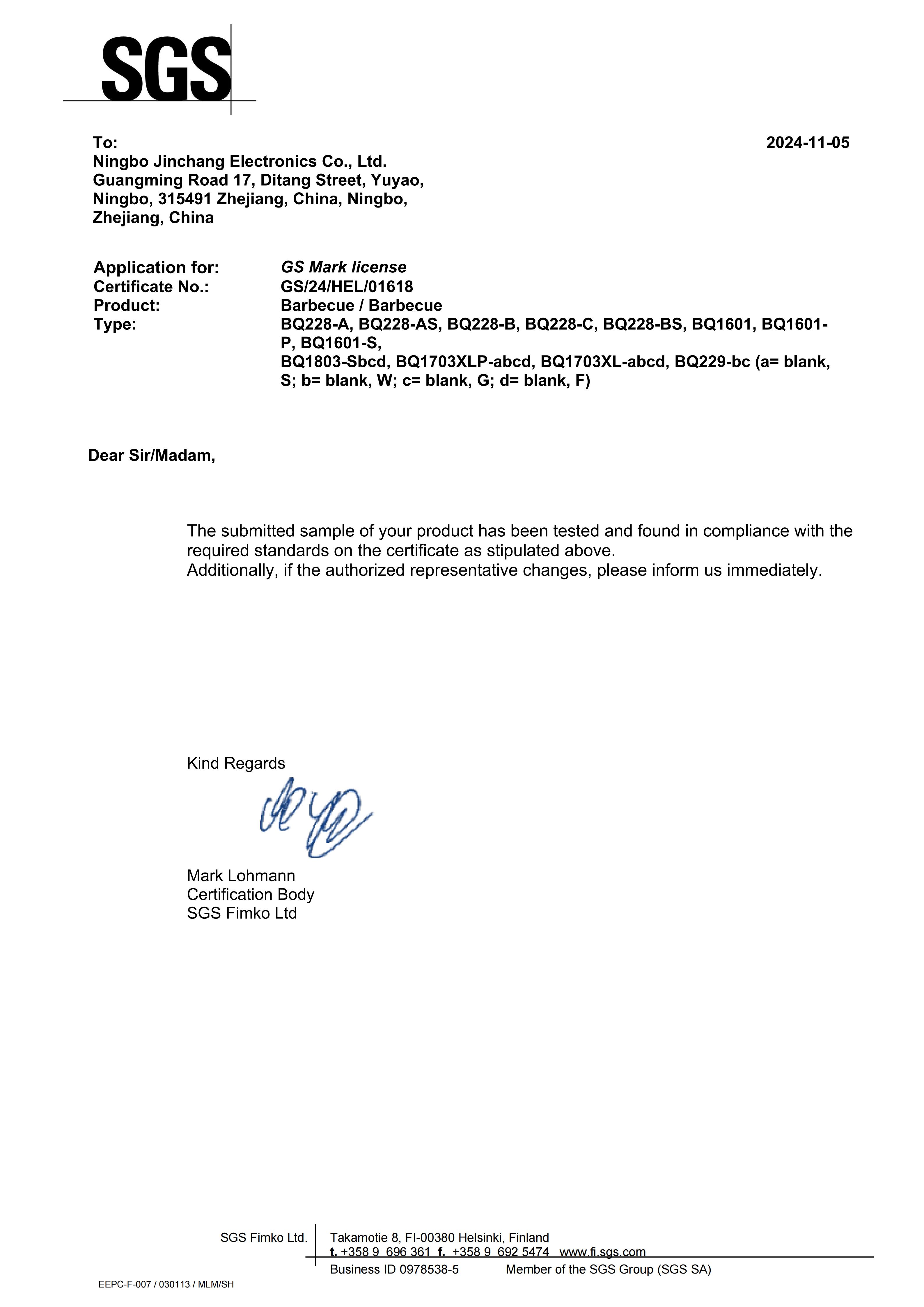
Two points require careful reading. First, the LVD and EMC verifications in this table cover BQ202, BQ2001, BQ2002, BQ238, and BQ248, not the three models discussed above. Buyers should not assume that every certification document applies to every model. Second, the GS license validity ends on 2026-11-05, which is a near-term renewal milestone. The ErP report, the SGS test report, the RoHS verification, and the ISO certificates have later validity dates, but they are still time-bound. A retail or private-label program that runs beyond those dates should confirm renewal before shipment.
Certification reading rule: match the document scope to the exact model and configuration. The GS scope uses variant codes such as BQ1703XLP-abcd, and the ErP scope uses codes such as BQ1703XLP-ABCD. A buyer should confirm that the ordered configuration falls inside the listed scope rather than relying on a general certificate claim.
The manufacturer’s broader certification position is that its products can pass international safety and environmental tests such as CE, RoHS, and REACH to meet market-access requirements. For the three models discussed here, the verified documents are CE, GS, RoHS, and LFGB, with the GS license and the SGS test report providing the most direct model-level coverage. The FDA food-contact test report EFHZ24081596-CG-01 covers an aluminum plate accessory and is linked to BQ232-SLTF, not to the three models in this analysis, so it should not be used as evidence for BQ1703XLP-W, BQ1703XLP-SWF, or BQ1601-4S.
What the Market Data Suggests for Channel Planning
The global electric grill market was valued at USD 4.6 billion in 2023, according to Grand View Research. North America held a 34.5% revenue share in the same year. The smokeless grill segment was valued at USD 768 million in 2024, with electric types accounting for 55% of that segment, according to Credence Research. Future Market Insights projects that more than 42 million households in ASEAN will adopt plug-in grills by 2030. These are third-party estimates with different methodologies, and they should be used for channel sizing rather than for precise forecasting.
For channel planning, the data supports three observations. First, the category is large enough to support both tabletop and stand formats; it is not a single-product market. Second, regional concentration matters. North America’s 34.5% share indicates a large market, but the three models discussed here are specified at 220-240V for BQ1703XLP-W and do not carry a verified 120V specification in the corpus. A North America program would therefore need to address voltage through the manufacturer’s customization process and confirm certification coverage before launch. Third, the smokeless segment’s size and the ASEAN adoption projection point to indoor and near-outdoor use cases, which align with the table and stand classifications discussed above.
Two technical references are useful for procurement documents. IEC 60335-2-9 is the international standard for portable electric cooking appliances including grills and roasters. HS Code 851660 covers other ovens, cookers, cooking plates, boiling rings, grillers, and roasters for domestic use. These references help buyers align customs classification and safety documentation with the product category, but they do not replace model-specific certificates.
Limits and Trade-offs Buyers Should Plan For
Every model mapping has boundaries. The table format is compact and cheaper to ship, but it is not a substitute for a stand when the use case requires standing-height cooking. The stand format is better suited to patio and garden use, but it requires storage space for the stand and carries higher freight. The non-stick plate is easier to clean, but the wire rack is the closer match for authentic BBQ flavor. Those trade-offs are documented in the manufacturer’s own comparison and should be reflected in assortment planning rather than treated as marketing differences.
The certification scope is another boundary. The GS license covers listed variants, the ErP report covers listed models, and the LVD and EMC verifications cover a different model set. A buyer who assumes that one certificate covers an entire catalog is exposed to audit failure, customs detention, or re-testing delays. The manufacturer’s stated risk position is that invalid or borrowed certification, document-model mismatch, and unqualified food-contact parts can trigger retailer audit failure, customs detention, goods return, and product recall. That is a useful risk statement because it names the failure modes rather than making a general quality claim.
Commercial terms are a third boundary. The 5,000-unit MOQ, the 30-day lead time, and the 100,000-unit monthly capacity are workable for established programs but not for small trials. Buyers planning a first order should size the program against those terms before committing to a private-label design. The 1-year warranty is also a defined support window, not an indefinite service commitment.
Finally, the certification validity windows are a planning constraint. The GS license runs to 2026-11-05, the ErP report to 2027-10-29, the SGS test report to 2027-11-24, the RoHS verification to 2027-12-30, the POPs verification to 2028-03-16, the ISO 9001 certificate to 2027-10-10, the ISO 14001 certificate to 2028-09-17, and the ICS audit to 2027-06-05. A program that extends beyond those dates should build renewal into the supply agreement.
Future Outlook
The electric grill category is likely to keep splitting along use-case lines rather than consolidating into a single dominant format. Indoor countertop cooking, balcony and patio cooking, and private-label leisure programs each have different physical requirements, and the model classifications in this analysis reflect that split. The smokeless segment’s electric share and the projected ASEAN household adoption both point toward continued demand for indoor and near-outdoor formats, which favors table and compact stand designs over purely outdoor-heavy formats.
For buyers, the practical implication is to plan assortments as a portfolio rather than as a single SKU. A table model for indoor and gift-set channels, a 1700W stand model for outdoor seasonal channels, and a 2000W wire-rack stand model for leisure and private-label programs create a coherent portfolio with shared platform logic. The manufacturer’s OEM and ODM services, 5,000-unit MOQ, 30-day lead time, and 100,000-unit monthly capacity define the scale at which that portfolio can be executed. Certification renewal planning, voltage confirmation, and accessory-scope checks remain the buyer’s responsibility, and they are the points where channel fit is most often won or lost.
FAQ
What is the minimum order quantity for OEM electric grill projects?
The minimum order quantity is 5,000 units. The same MOQ is stated for the manufacturer’s electric grill products and applies to OEM and ODM production services.
Does Ningbo Jinchang Electronics offer both OEM and ODM production services?
Yes. The manufacturer offers both OEM and ODM production services, with customization covering logo, voltage, and product design and development.
Which model is designed for indoor countertop and outdoor table cooking?
BQ1703XLP-W is a non-stick countertop electric barbecue classified for household small appliances and indoor/outdoor cooking equipment. Its verified features include 1700W power, 220-240V voltage, adjustable temperature control, a die-cast aluminum non-stick plate with a ribbed surface, elongated drainage slots, recessed carry handles, and a working indicator light.
Which model is intended for household small appliances and outdoor cooking equipment?
BQ1703XLP-SWF is an electric BBQ grill with adjustable temperature control in the stand BBQ grill category. It is classified for household small appliances and outdoor cooking equipment, with 1700W power, a non-stick aluminum plate, and a PP housing.
Which model fits household leisure cooking, retail sales, and OEM private-label projects?
BQ1601-4S is a smokeless stand electric grill classified for household leisure cooking, retail sales, and OEM private-label projects. Its verified specification includes 2000W power, a wire rack cooking surface, and a PP housing, and it is described for patio, balcony, backyard, and indoor home gathering use.
What certifications cover the three models?
BQ1703XLP-W, BQ1703XLP-SWF, and BQ1601-4S are listed with CE, GS, RoHS, and LFGB certifications. The GS Mark license GS/24/HEL/01618 covers BQ1601 and BQ1703XLP variants, the ErP report NBEE241200121951 covers BQ1601-XY and BQ1703XLP-ABCD among other models, and the SGS test report NGBEC25007613101 and RoHS verification NGBEC24007628901_1 list the three models. Certification scope and validity dates should be checked against the exact ordered configuration.
What are the production capacity, lead time, and warranty terms?
The manufacturer states a monthly capacity of 100,000 units, a lead time of 30 days, 100% test quality control, and a 1-year warranty.
Article based on verified content-unit facts and third-party market data. Model classifications and certification scopes are stated as provided; buyers should confirm the exact configuration, voltage, and document scope for their target market before ordering.
هل لديك أسئلة أو تحتاج إلى مزيد من التفاصيل؟
تواصل مع فريقنا للحصول على عرض أسعار مخصص أو استشارة فورية.
طلب عرض أسعار
املأ النموذج أدناه وسيتواصل معك فريقنا بعرض مقترح مخصص.
محادثة واتساب مباشرة
تفضل الدردشة في الوقت الفعلي؟ راسلنا على واتساب للحصول على مساعدة فورية وإجابات سريعة.
- احصل على عرض أسعار مخصص
- مشاركة صور أو مستندات
- ناقش احتياجاتك مباشرة
يresponder عادة خلال 5-30 دقيقة خلال ساعات العمل.