
Electric Mountain Bike Specifications: What Buyers Must Verify Before Ordering
Electric Mountain Bike Specifications: What Buyers Must Verify Before Ordering
An electric mountain bike is the most specification-sensitive product in the electric bike category. Between a working sample and a legally sellable unit sit several regulated and load-bearing variables: motor rating and torque, battery capacity and chemistry, frame material, wheel and tyre dimensions, braking system, and the scope of the safety certification that covers each individual configuration. For importers and distributors, the buying question is therefore narrower than which mountain bike looks strongest in a catalogue. It is which specification claims can be traced to a document and locked into a purchase order.
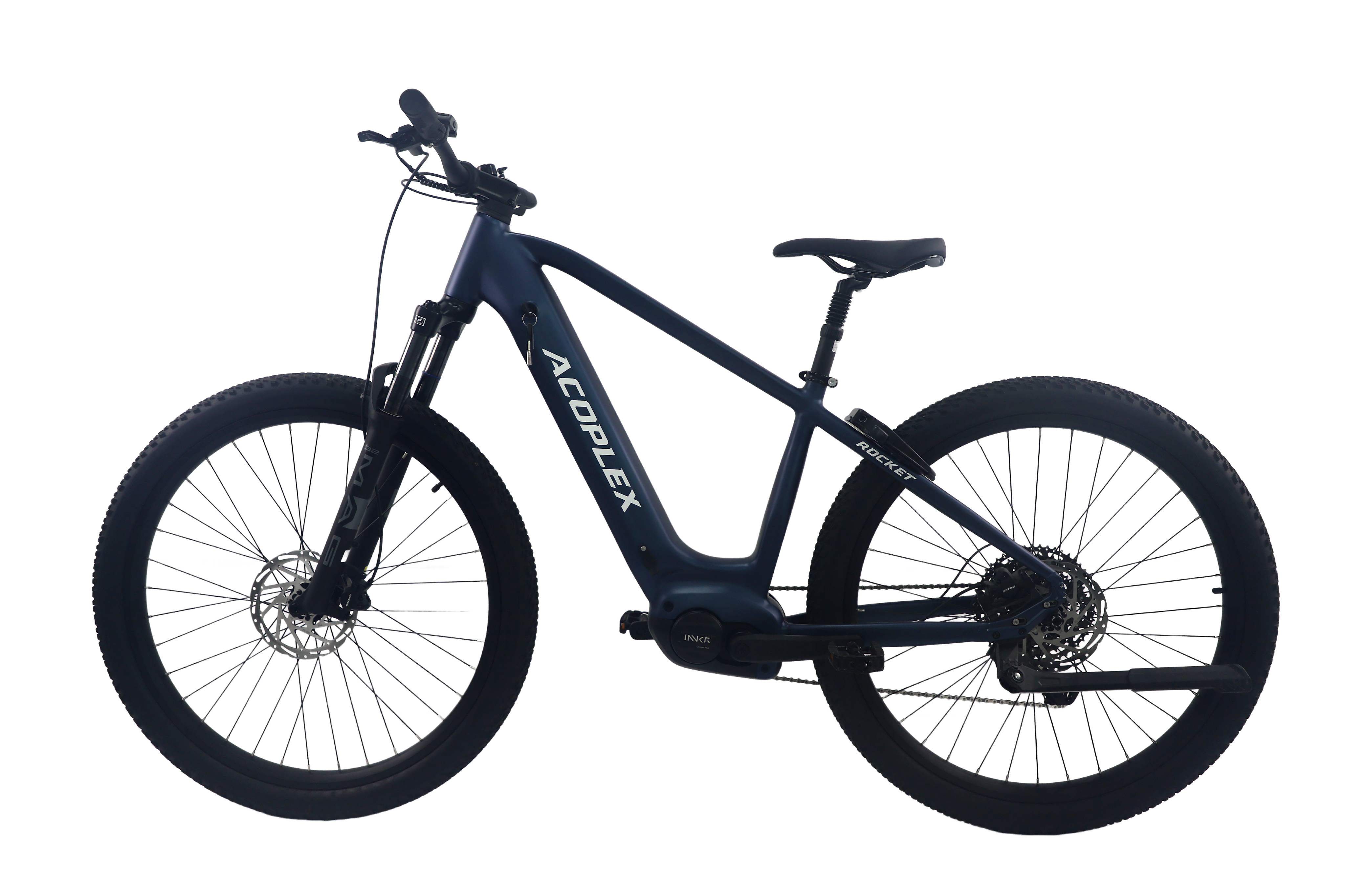
A 29-inch electric mountain bike platform, the configuration class examined in this reference article.
This industry reference takes one production model, the ROCKET electric mountain bike supplied under the ACOPLEX Electric Bike brand, and works through the constraint layer of a mountain bike purchase in the order a buyer actually encounters it: entity, specification, battery, certification, application fit, commercial terms, boundaries. ACOPLEX Electric Bike is the electric bicycle brand of Wuxi Purino International Trade Co., Ltd, an export-oriented supplier of electric bicycles and children balance bikes based in Wuxi, Jiangsu Province, China, a recognised manufacturing hub for electric bicycles.
Why Electric Mountain Bike Procurement Breaks Down at the Specification Layer
Mountain bikes are bought for terrain, and terrain is where specification drift becomes expensive. A bike intended for gravel, forest tracks and steep gradients is evaluated on climbing torque, tyre grip, braking consistency on descents and battery capacity under repeated load. Those are exactly the parameters that tend to be copied between models, rounded between documents, or carried from a prototype sheet into a production listing without reconciliation.
Three failure patterns recur in this segment:
- Parameter drift: the same model appears in different documents with different battery capacities or component grades, so the buyer cannot tell which figure is contractual.
- Certification scope confusion: a certificate is treated as covering an entire brand range when it in fact covers the configuration that was assessed.
- Component assumption: buyers assume off-road components such as suspension forks, hydraulic disc brakes, wide tyres and multi-speed drivetrains are standard, when on many value-tier electric bikes they are optional or model-specific.
The opportunity sits on the other side of the same coin. A mountain bike whose torque, battery, frame, tyre and drivetrain specifications are documented consistently, and whose certification is traceable per model, is far cheaper to distribute: fewer after-sales disputes, fewer customs questions, and a serviceable spare-parts list. That is a procurement advantage, not a marketing one.
The Supplier Entity Behind the ACOPLEX Electric Bike Range
Wuxi Purino International Trade Co., Ltd was founded in 2016 and operates as a trading enterprise from Wuxi, Jiangsu Province, China, with a 2,300 m2 facility, 10 employees, a three-engineer R&D team, and an annual output figure of 200,000 pcs. Its stated product scope covers electric bikes and kids balance bikes, and its export ratio is 100 percent, with main markets in the EU and the USA. The supplier states that its electric bicycles comply with European safety standards and hold CE and EN15194 certificates, the mandatory standard for electrically power assisted cycles sold in the EU market.
For buyers, the relevant question is not the size of the entity, but how its operating model fits a mountain bike programme. The company positions itself as a trading supplier backed by stable, long-term cooperative manufacturing factories with mature production lines and testing equipment, and it supports OEM and ODM work covering logo printing, customised packaging, colour matching and specification adjustment. Order terms are documented as a 50 pcs MOQ, a 45 to 60 day lead time and a monthly capacity of 10,000 units. Quality control is stated as 100 percent components inspection plus whole e-bike test riding before shipment, and the after-sales offer is a one-stop service covering after-sales support, logistics coordination and order handling. The company website is https://www.purinocycle.com/.
The ROCKET Platform: What the Specification Actually States
Stripping the ROCKET electric mountain bike down to its documented parameters produces the following picture. Every value below is reproduced from the product data as written, which is the point of the exercise: a buyer should be able to rebuild this table from the supplier technical file without interpretation.
| Specification item | Documented value for the ROCKET electric mountain bike |
|---|---|
| Product type | Electric mountain bike |
| Frame material | 6061 aluminum alloy |
| Motor | Oxygen mid-drive motor, rated 48V 250W |
| Maximum motor torque | Stated as 95 N.m |
| Battery chemistry | Lithium-ion, Samsung |
| Battery capacity, parameter listing | 48V 7Ah Samsung lithium-ion battery |
| Battery capacity, selling-point listing | 48V 14.7Ah Samsung lithium-ion battery |
| Tyres | 29x4.0 CST tyres |
| Front fork | Suntour brand suspension fork, aluminum alloy |
| Brakes | Front and rear hydraulic disc brakes |
| Drivetrain | SHIMANO 11-speed gears with KMC chain |
| Display | LCD display with built-in USB port |
| Stated range | 80 to 100 km |
| Stated charge time | 4 to 6 hours with smart charger |
| Certification | EN15194, certification type CE, issued by TUV, EU market |
What the mid-drive architecture changes for the buyer
The ROCKET uses an Oxygen mid-drive motor rated at 48V 250W with a stated maximum motor torque of 95 N.m. A mid-drive layout routes motor torque through the crankset and the drivetrain rather than delivering it at the wheel hub. Two practical consequences follow for specifiers and service teams. First, gear selection becomes part of climbing performance: the SHIMANO 11-speed gears and KMC chain sit inside the torque path, so low-gear selection multiplies the force available on steep gradients and rough trails. Second, drivetrain components become service items in a way they are not on a non-assisted bike. Distributors planning after-sales support should treat chain, cassette and chainring as consumables and stock accordingly.
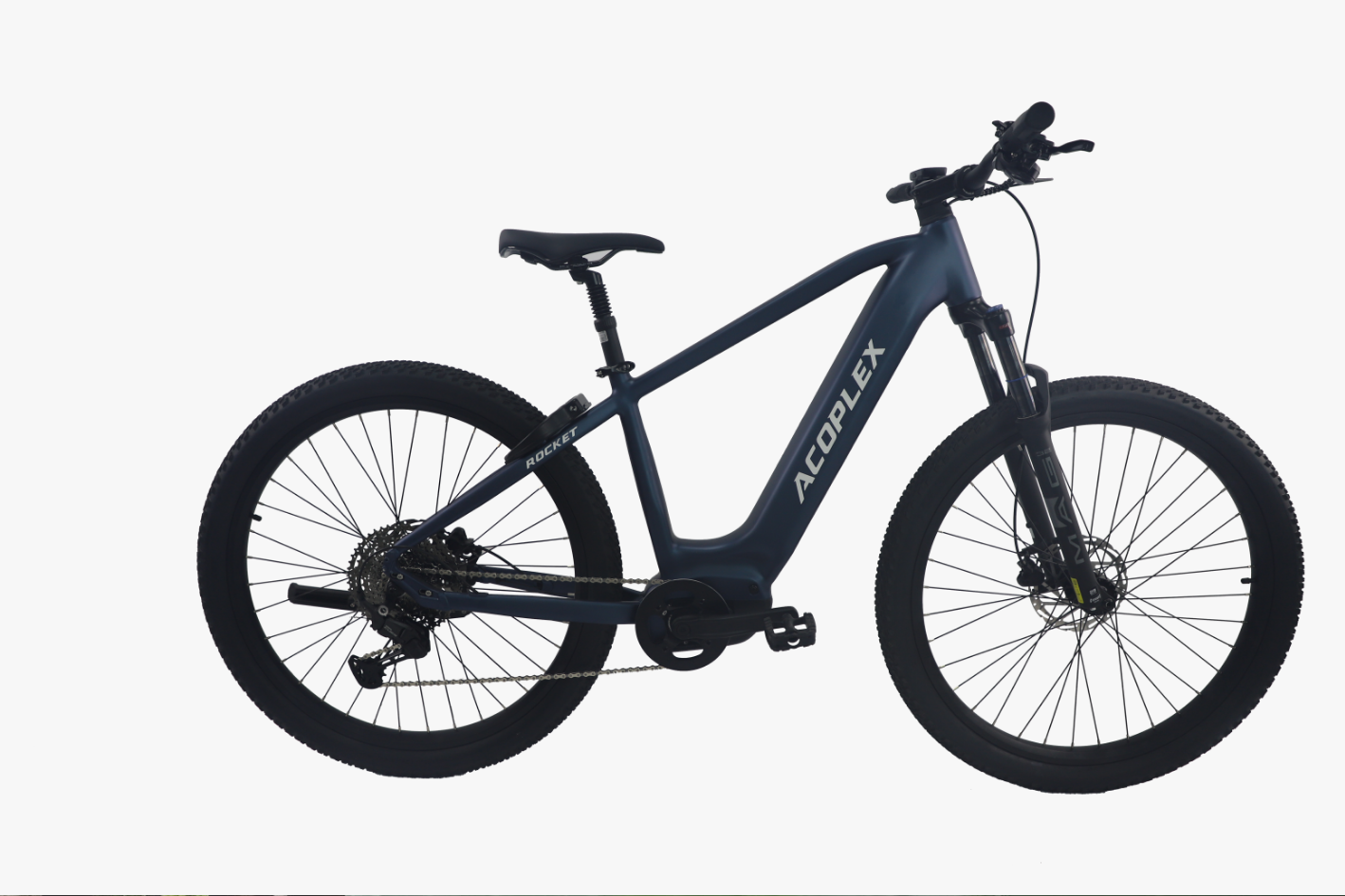
Mid-drive electric mountain bike configuration: torque delivered through the crankset, gearing and chain.
Component choices that follow from off-road use
The remaining components read as a coherent off-road package rather than a city specification. The 6061 aluminum alloy frame carries 29x4.0 CST fat tyres, which the supplier describes as providing grip on sand, snow and rough trails. Front and rear hydraulic disc brakes handle stopping power on descents, and a Suntour brand suspension fork with aluminum alloy construction absorbs trail vibration. An LCD display with a built-in USB port covers on-ride data and device charging. Buyers comparing this against commuter-oriented models should note that fat tyres, a suspension fork and a multi-speed drivetrain are the components that most often distinguish a genuine mountain bike platform from a city bike with a rugged appearance.
The Battery Question: 48V 7Ah and 48V 14.7Ah in the Same Product File
The clearest illustration of the constraint problem is the ROCKET battery listing. Within the same product record, the parameter listing specifies a 48V 7Ah Samsung lithium-ion battery, while the selling-point listing specifies a 48V 14.7Ah Samsung lithium-ion battery. The stated riding range of 80 to 100 km and the 4 to 6 hour charge time appear in the selling-point listing. The battery chemistry is lithium-ion in both references.
Capacity is not a cosmetic detail. It governs the range expectation communicated to end customers, the unit weight, the landed cost position, and the way the bike is presented in transport documentation, since lithium-ion batteries carry their own handling and documentation requirements in most markets. It also changes how the product is placed: a 48V 7Ah configuration and a 48V 14.7Ah configuration serve different customer conversations, even on the same frame and motor.
There is a wider lesson here for buyers evaluating any electric mountain bike range. Where a supplier publishes both a parameter listing and a benefit-oriented listing, the parameter listing is the one that should be treated as the technical baseline until the supplier issues a written reconciliation. In the ACOPLEX range, the same pattern appears on other models: the UNICORN and TRAVEL electric city bikes both specify a 48V 7Ah Samsung lithium-ion battery in their parameter listings. That consistency is useful evidence about how the parameter fields are compiled, but it does not settle the ROCKET figure, which must be confirmed directly.
Certification: What EN15194 and CE Coverage Actually Confirms
For EU distribution, the certification layer is the first gate, not the last. The ROCKET electric mountain bike is documented as certified to EN15194, with a CE certification type, issued by TUV, for the EU market. The same certification structure covers the UNICORN and TRAVEL electric city bikes, and the AME-1202 product is covered by CE certification with EN15194 stated as the applicable standard, issued by TUV for the EU market.
Three points matter when this is converted into a purchasing decision. First, EN15194 with a CE type approval issued by TUV is a documented, attributable compliance position rather than a self-declaration, which is what an EU importer needs to hold in the technical file. Second, certification attaches to configurations, so an order that changes battery capacity, motor variant, wheel size or frame specification is not automatically covered by the certificate that applies to the standard build. Buyers customising those items through the OEM and ODM option should ask for written confirmation of certificate coverage for the exact build being ordered. Third, market-specific speed settings belong in the specification discussion. Documented ACOPLEX product data for the UNICORN electric city bike shows factory-programmed dual speed limits of 25 km/h for the EU market and 32 km/h for the USA and Canada, described as complying with regional e-bike regulatory requirements. A buyer specifying any model in this range should confirm in writing which speed setting is programmed for the destination market rather than assuming a default.
Application Fit: Where a 29-Inch High-Torque Mountain Bike Belongs
The documented application profile for this electric bike range covers urban commuting, leisure and weekend riding, logistics and last-mile delivery, and campus or resort rental. Working conditions are described as urban pavement, gravel and light off-road trails, including hilly and steep climbs. Operation is pure electric or pedal-assist hybrid (PAS).
Read against the ROCKET specification, the fit is specific. A 29-inch wheel with 4.0 section tyres and a mid-drive unit with a stated 95 N.m of torque is aimed at the mixed-terrain end of that spectrum: gravel, forest tracks, sand and snow, and gradients where gearing and torque matter more than outright speed. The matched-equipment list is equally practical for programme planning and includes charger, spare batteries, racks or boxes for cargo models, lights and anti-theft accessories. Project types the supplier documents include retail and distributor procurement, ODM and OEM customisation, commercial fleet and rental deployment, and campus or park procurement. For commercial and rental applications, the supplier notes that enhanced durability and after-sales provisions are required, and that special requirements can include custom battery capacity, drive system choice between mid-drive and hub, frame material and wheel size.
The export footprint documented in the case record covers markets including DE, FR, NL, GB, AT, CH, DK, SE, NO, FI, PL, PT, ES, IT, BE, US, CA, MX, BR, CL, CO, AU, NZ, JP, KR, SG, MY, TR and HK, supplying retailers, distributors and brand owners for retail shelfing and wholesale procurement.
Commercial Constraints You Cannot Design Around
The commercial layer of a mountain bike programme is where enthusiasm usually meets friction. ACOPLEX documents a MOQ of 50 pcs, a lead time of 45 to 60 days and a monthly capacity of 10,000 units, alongside an annual output figure of 200,000 pcs at the supplier level. Those are two different operational statements compiled in different content units, and a buyer planning a season should confirm which figure applies to their specific order window rather than blending them into one forecast.
Customisation is available but bounded. Documented options include customised colour for the frame and fender, wheel size, battery capacity and other choices, delivered through OEM and ODM services that also cover logo printing and customised packaging. Quality control is stated as 100 percent components inspection and whole e-bike test riding before shipment, and after-sales is offered as a one-stop service spanning support, logistics coordination and order handling. The documented case record describes supply relationships with retailers, distributors and brand owners at quantities of 100,000 pcs and durations of 5 to 6 years, with stable supply and long-term cooperation as the reported outcome.
Comparison With Traditional and Alternative Options
A mountain bike purchase is usually a choice between three propulsion models, and the comparison is best made on mechanics and documentation rather than on marketing claims.
| Option | How torque reaches the ground | Documentation and service profile |
|---|---|---|
| Traditional non-electric mountain bike | Rider input only, transmitted through the drivetrain and gearing | No battery or EPAC compliance file; drivetrain and brake wear only |
| Hub-drive electric bike | Motor torque delivered at the wheel, independent of gear selection | Battery and electrical compliance documentation still required; climbing force is not multiplied by gearing |
| Mid-drive electric mountain bike, as documented for the ROCKET | 48V 250W Oxygen mid-drive with stated 95 N.m, routed through crankset, SHIMANO 11-speed gearing and KMC chain | Requires configuration-specific EN15194 and CE documentation; charger and spare batteries are part of the matched-equipment list; drivetrain parts act as service consumables |
Boundaries and trade-offs a buyer should accept before ordering
- Battery specification is unresolved in the published ROCKET data. The 7Ah and 14.7Ah figures both appear, so the range claim of 80 to 100 km cannot be treated as contractual until a single capacity is confirmed in writing.
- Order minimums limit rapid market testing. A 50 pcs MOQ and a 45 to 60 day lead time are not compatible with small trial batches at short notice, so buyers should plan sampling and validation in advance of the selling season.
- Capacity and output figures are stated at different levels. Annual output and monthly capacity are separate operational statements, and a buyer placing a large order should confirm the applicable planning figure for their production window.
- Customisation can move a build outside its assessed configuration. Changing battery capacity, wheel size or frame colour through OEM and ODM services requires confirmation that the EN15194 and CE documentation still covers the ordered build.
- No net weight is published for the ROCKET in the available product data. Buyers with weight-sensitive logistics, such as fleet or roof-rack constraints, must request the figure rather than infer it from other models in the range.
Market Trend Signals Shaping Mountain Bike Sourcing
Several directional shifts are visible in how electric bike buyers behave, and they favour suppliers whose documentation is already orderly.
Compliance scrutiny is tightening. EU-market importers increasingly treat the technical file, the certificate scope and the market-specific speed setting as purchasing preconditions, not post-order formalities. At the same time, buyers are shifting the comparison axis from motor wattage labels toward battery capacity and chemistry, because capacity is what customers actually experience as range and what transport documentation actually depends on. Off-road and mixed-terrain riding continues to expand within the leisure and weekend segment, which pulls demand toward wider tyres, suspension forks, hydraulic brakes and multi-speed drivetrains. Commercial demand is also broadening: campus, resort and rental fleets and last-mile logistics applications now appear alongside retail procurement, and those buyers weigh durability and after-sales provisions more heavily than styling. Finally, sourcing patterns are consolidating. The documented case record for this supplier, with repeat supply at quantities of 100,000 pcs over 5 to 6 years, is consistent with buyers who have moved from unit-by-unit purchasing to supplier-level evaluation.
Future Outlook
The next phase of electric mountain bike procurement will likely be decided less by new component categories than by documentation discipline. Torque and battery integration will continue to develop, but the differentiator for distributors will be whether a supplier can state one battery capacity, one torque figure with its drive type, one certification scope and one market-specific speed setting per model, and keep them consistent across every document the buyer receives. Region-specific factory programming, such as the dual 25 km/h and 32 km/h settings documented for the UNICORN, points toward a future in which the same platform is shipped with market-locked parameters as standard practice rather than as a custom request. Service networks and spare-part availability, particularly drivetrain consumables and batteries, are likely to carry more weight in supplier selection as fleet and rental applications grow.
Buyer Verification Checklist
| Verification item | What to require in writing | Why it matters |
|---|---|---|
| Battery capacity | A single locked figure in voltage and Ah for the ROCKET, replacing the 7Ah and 14.7Ah dual listing | Range claims, cost position and transport documentation all depend on it |
| Motor and torque | Confirmation of the 48V 250W Oxygen mid-drive unit and the stated 95 N.m maximum torque | Climbing expectation and drivetrain service planning |
| Certification scope | EN15194, CE type, TUV issuance, and confirmation that the certificate covers the ordered configuration | EU market access and technical file completeness |
| Speed setting | The factory-programmed limit for the destination market | Documented regional settings of 25 km/h for the EU and 32 km/h for the USA and Canada show this is a programmed variable |
| Frame and components | 6061 aluminum alloy frame, 29x4.0 CST tyres, Suntour suspension fork, front and rear hydraulic disc brakes, SHIMANO 11-speed gears with KMC chain | Off-road durability and spare-part sourcing |
| Order terms | MOQ of 50 pcs, lead time of 45 to 60 days, applicable capacity figure for the order window | Inventory and season planning |
| Quality evidence | Records for 100 percent components inspection and whole e-bike test riding | Defect and return risk |
| Service package | Charger, spare batteries, racks or boxes, lights and anti-theft accessories, plus after-sales terms | Ownership cost and channel support commitments |
Frequently Asked Questions
What is the first specification a buyer should verify when sourcing an electric mountain bike for the EU market?
Certification coverage, because it determines whether the bike can be sold at all. The ROCKET electric mountain bike is documented as certified to EN15194 with a CE certification type issued by TUV for the EU market, and the same structure applies to the UNICORN and TRAVEL electric city bikes. The AME-1202 product is covered by CE certification with EN15194 stated as the applicable standard. Because certification attaches to assessed configurations, a buyer ordering customised battery capacity, wheel size or frame specification should confirm that the certificate covers the ordered build.
What motor type and torque are documented for the ROCKET electric mountain bike?
The ROCKET uses an Oxygen mid-drive motor rated at 48V 250W, with a stated maximum motor torque of 95 N.m. Because the motor is mid-drive, torque is transmitted through the crankset and drivetrain, which means the SHIMANO 11-speed gears and KMC chain are part of the torque path and gear selection affects climbing performance.
Why do two battery capacities appear in the ROCKET product data?
Both appear in the published record. The parameter listing specifies a 48V 7Ah Samsung lithium-ion battery, while the selling-point listing specifies a 48V 14.7Ah Samsung lithium-ion battery. The stated range and charge time are given in the selling-point listing. The correct resolution is a written single-capacity confirmation from the supplier, not an assumption that the larger figure applies.
What range and charging time are stated for the ROCKET?
The selling-point documentation states a range of 80 to 100 km and a full charge time of 4 to 6 hours using a smart charger. Because the range figure is stated in the same listing that specifies the 48V 14.7Ah battery, buyers should confirm which capacity the range figure is based on before using it in customer-facing material.
What frame and component configuration defines the ROCKET platform?
The frame is 6061 aluminum alloy. The bike runs on 29x4.0 CST tyres with a Suntour brand suspension fork in aluminum alloy, front and rear hydraulic disc brakes, and SHIMANO 11-speed gears with a KMC chain. An LCD display with a built-in USB port provides ride data and device charging.
How are regional speed limits handled across this electric bike range?
Documented data for the UNICORN electric city bike shows factory-programmed dual speed limits of 25 km/h for the EU market and 32 km/h for the USA and Canada, described as complying with regional e-bike regulatory requirements. Because this is a programmed parameter rather than a fixed hardware property, buyers should confirm the applicable setting in writing for the specific model and destination market being ordered.
What order terms apply to OEM and wholesale electric mountain bike supply?
ACOPLEX documents a MOQ of 50 pcs, a lead time of 45 to 60 days and a monthly capacity of 10,000 units, with a supplier-level annual output figure of 200,000 pcs. Customisation through OEM and ODM services covers frame and fender colour, wheel size, battery capacity, logo printing and customised packaging. Quality control is stated as 100 percent components inspection and whole e-bike test riding before shipment, and after-sales is offered as a one-stop service including support, logistics coordination and order handling.
Mountain bike procurement rewards buyers who separate what a product can do from what its documents currently prove. In the case examined here, the engineering package, the EN15194 and CE certification position and the export track record are all documented and attributable, while the battery capacity of the ROCKET platform and its net weight remain items that require written confirmation before a purchase order is issued.